Einstein Defiant: Genius Versus Genius in the Quantum Revolution (2004)
Chapter: 29 A Very Pleasant Talk
29
A Very Pleasant Talk
Another Solvay Conference was scheduled for late in October 1927. Einstein had told Lorentz he never wanted to be invited again, and the French and Belgians still despised Germans, but the conference could never live up to its ambitions without a German presence. Modern physics was German physics. Planck’s declaration immediately after his country’s defeat—“no foreign or domestic enemy has taken … the position German science occupies”—had proven correct. The world wanted to spurn them but could not. Already in the spring of 1926, Lorentz had brought the matter to the attention of Albert, King of the Belgians. Albert had amazed Europe by standing up to the Germans and acting more like a monarch from the days of Henry V than today’s constitutional symbols. He had ample reason to begrudge Germans their recovery. Ever the diplomat, Lorentz spoke his piece tactfully enough to report that he and the king saw eye to eye: “His majesty expressed the opinion that seven years after the war, the feelings which they aroused should be gradually damped down, that a better understanding between peoples was absolutely necessary for the future, and that science could help to bring this about. He also felt it necessary to stress that in view of all that the Germans had done for physics, it would be very difficult to pass them over.”
Germany was clawing its way back onto the world stage. By 1927,
the economic hardships of the first half of the 1920s were merely a bad memory, and Berlin had become a center of artistic achievement. Prominent visitors paid call on the city. The American composer George Antheil had seen Berlin in its ruin but returned during this “golden” period and reported, “The electric lights were back in their sockets. The red carpets, new ones, were down on the floors of the expensive hotels. People had their brass doorknobs out again. “ He did not mention that among the posters for films and cabarets was a blood-red one that proclaimed, “The bourgeois state is coming to an end. A new Germany must be forged.” Goebbels was getting down to work.
Freud, the only thinker able to rival Einstein’s fame, came to Berlin and met Einstein. “He understands as much about psychology as I do about physics,” Freud reported, “so we had a very pleasant talk.” The weather and music were two neutral topics in which both men were expert. And of course each thought he understood more of the other fellow’s field than he did.
Einstein’s favorite psychological doctrine came from Schopenhauer: We can do whatever we want, but we cannot choose our wants. Freud’s ideas owed much to Schopenhauer and were quite in keeping with that sentiment, although as a medical man, he attracted patients by offering the hope that they could overcome their neurotic actions. Meanwhile Freud thought of himself as every bit the scientist that Einstein was and he based his imagery of how the mind worked on the mechanist’s faith that there is a natural reason for everything that happens. Einstein might have found Freud’s steam-engine mechanics naive. Possibly he laughed at Freud’s notorious insistence that a patient’s refusal to accept his diagnosis was merely one of the patient’s symptoms, but Einstein agreed entirely with Freud that every event has its reason.
That was the notion he took with him to Brussels and the 1927 Solvay Conference, the greatest gathering of physicists since the first Solvay in 1911. The official conference photograph shows the century’s grandest collection of physics heroes. Einstein radiates the presence of a movie star. Arthur Compton sits right behind him. Lorentz has the chair beside Einstein. Marie Curie is there. Bohr is there. Rounding out the German delegation are Heisenberg, Planck, and Max Born.
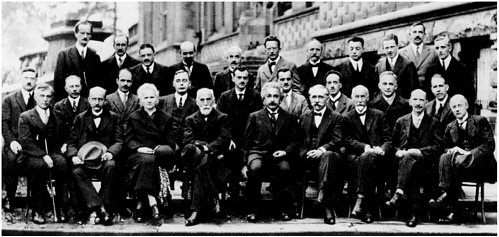
Solvay Conference, 1927.Front Row: Irving Langmuir, Max Planck, Marie Curie, Hendrik Lorentz, Albert Einstein, Paul Langevin, Charles Guye, CharlesWilson, Owen Richardson. Middle Row: Peter Debye, Martin Knudsen, William Bragg, Hendrik Kramers, Paul Dirac, Arthur Holly Compton, Louis de Broglie, Max Born, Niels Bohr. Back Row: Auguste Piccard, Emile Henriot, Paul Ehrenfest, Edouard Herzen, Theophile de Donder, Erwin Schrödinger, EmileVerschaffelt, Wolfgang Pauli, Werner Heisenberg, Ralph Fowler, Louis Brillouin.
Credit: Photographie Benjamin Couprie, Institut International de Physique Solvay, courtesy AIP Emilio Segré Visual Archives.
The conference’s official theme was “Electrons and Photons.” At the previous conference, in 1924, the existence of light quanta had been, at best, controversial. Now, rebaptized as photons, they were accepted by everybody in the room. A new controversy bedeviled physics. Were quantum events caused? Lorentz, as always, chaired the sessions, and in his opening remarks he asked, “Could not one maintain determinism by making it an article of faith? Must one necessarily elevate indeterminism to a principle?”
Scientists have their doctrines, but they rarely assemble them into some sort of Nicene Creed whose tenets are duly recited and accepted. Lorentz’s proposal went nowhere, and yet his attitude was held by many of the Solvay participants. The two heroes of X-ray studies, William Bragg and Arthur Compton, gave papers and both of them leaned toward the explanatory school; that is, they discussed experiments and looked for physical causes to explain why what happened happened. De Broglie and Schrödinger also sat in this camp. Unfortunately, de Broglie tried to go beyond just believing in explanations and actually proposed one. A few months earlier he had suggested some subtle ideas. His original notion of wave-particle harmony singing a duet had also been evocative, but in Brussels he suddenly reverted to the abandoned concept of a “pilot-wave” guiding the photons. Nobody championed his proposal, and in the confusion everyone, apparently including de Broglie, forgot that there was another de Broglie explanation out there. It was only generations later, well after Einstein’s and Bohr’s death, that some philosophers of science looked at de Broglie’s work and found it provocative.
The opposed camp did not try to explain phenomena so much as describe them. Born and Heisenberg gave a joint paper in which they insisted that although quantum events could be described, finding reasons for the events was impossible. They ended their lecture with the tossing of a gauntlet, “We maintain that quantum mechanics is a complete theory; its basic physical and mathematical hypotheses are not further susceptible of modifications.” If the explainers were hesitant to adopt Lorentz’s credo, the describers were eager to join the prophets who claimed their teachings to be the final revelation on the matter. This was Max Born’s reply to Einstein’s assertion that quantum me-
chanics was “not yet the real thing.” He said it was not only the real thing; it was the final thing.
Until that moment Einstein might have viewed the continuing struggle over quantum physics as part of science’s normal work. You sweat. You learn. You get transitory ideas. You follow false leads. You finally take a stride or two that ties the subject to the rest of physics and makes the whole thing comprehensible. In that context, quantum mechanics could be an impressive achievement even if it was not yet the real thing. But Born and Heisenberg were now saying that the work was done, the revolution over. It was never going to be more intelligible or more fully connected to the rest of physics.
Starting with that Solvay Conference of 1927, Einstein ceased to be merely skeptical or dissatisfied with the state of quantum physics. He became defiant, refusing to bow before the claim of completeness, finality, and unmodifiability. Quantum completeness became for him the new ether, a doctrine to be resisted, precisely because it put the undiscoverability of proof as the ultimate proof. And the notion that something must be forever undiscoverable was offensive to him. The reason that all objects fall at the same speed no matter what they weigh had, for centuries, been unknown and beyond all discovery, yet one afternoon the reason had, in a flash, been understood.
At the close of the formal sessions, Einstein had his first opportunity to show his new mood. Bohr gave his summary of what physics was to be, now that mathematical probability had replaced physical causes. This was the long-awaited new thinking promised at the end of Heisenberg’s paper. Bohr had presented these same ideas a month earlier at a conference in Italy, but many physicists, including Einstein, had not attended that affair and did not know what Bohr had said.
Bohr was never an articulate man, and any attempt to summarize his remarks inevitably makes them seem clearer and more focused that they appeared to his audience. As he spoke that autumn afternoon in Brussels, the physicists peering through the smoky air could collect only parts of what he was saying. Einstein tended to see wider and deeper than his colleagues and appears to have grasped the nub of Bohr’s point. However, for many it was undoubtedly like trying to follow the voice in the babbling brook. One thing was plain; the kind
of solution Einstein had anticipated in his Nobel lecture was not Bohr’s. Einstein had imagined a solution in which relativity was a limiting case; Bohr presented something quite different.
The very nature of the quantum theory, Bohr told his audience, forces us to take the distinct concepts of classical physics and use them as complementary, exclusive features in a description of quantum phenomena. Physicists have been trying to understand light’s wave and particle nature as a whole. It cannot be done. In some experiments, light appears to be a particle; in others, it appears to be a wave. The concepts are complementary, meaning we can understand light’s nature only if we abandon the search for a coherent unit and think of it as sometimes being like a particle and sometimes like a wave. We can think this way without becoming contradictory because these complementary concepts are also exclusive. That is, we can never perform an experiment in which light’s wave and particle natures are both measurable. This complementarity is the profound physical meaning of Heisenberg’s principle. Whatever p symbolizes in Heisenberg’s algebra is the complement of whatever q symbolizes. Thus, position and momentum, or time and energy are complementary and exclusive notions in quantum physics, even though they are coherent concepts in traditional physics. Therefore, it is impossible to design an experiment that will simultaneously determine a photon’s position and momentum, or its time and energy.
Bohr was not given to mathematical reasoning of the sort that Max Born had used in arguing that a quantum wave was a mathematical fiction describing probabilities without underlying causes. Nevertheless, Niels Bohr’s theory of complementarity stood firmly in Max Born’s camp, because it insisted that experimental outcomes could only be described, not explained in terms of real causes. Bohr was replacing Einstein’s theoretical arch in which facts and concepts supported one another with a new style in which rival facts and rival concepts tolerate each other. Any observation of atomic phenomena involves an interaction between the phenomenon and whatever tools the scientist uses to observe the event. Thus, Bohr told his audience, “an independent reality in the ordinary physical sense can neither be ascribed to the phenomenon nor to the agencies of observation.”
The logic of Bohr’s argument rested on one novel dogma: the language of classical physics could not be abandoned. Quantum mechanics had to be understood in classical terms and, in order to avoid seeing classical terms like wave and particle as contradictory, they had to be viewed as complementary. Only when taken together did quantum mechanics “offer a natural generalization of the classical mode of description.” Bohr gave as a reason for this axiom of complementarity that “every word in the language refers to our ordinary perception.” Classical physics does an excellent job of describing the events we can study with our eyes, ears, and other sense organs. Our language, thus, describes experiences that are well suited to a classical understanding. Quantum phenomena, however, cannot be tracked directly with our senses. We see hints of events—changes in atomic spectra, for example—but when we try to talk about them we find that we must think in classical terms, and in the quantum world such thinking makes sense only if we understand them as complementary notions rather than contradictory ones.
But surely, some readers are bound to object, we can make up a new language that is more suited to this new world.
Physics had already done that by using the language of mathematics. It had coined a whole string of symbols that applied to quantum events: h, hυ, p, q, and Ψ. They work perfectly well in equations, the sentences of mathematical language. It is just that when we try to understand these symbols—that is, when we try to imagine what is happening—we fail. Our perceptions have trapped our imaginations in a classical world where quantum events do not apply.
This argument aimed at a secret assumption behind Einstein’s talk of “accessibility.” He often said that the world was lawful and the laws were accessible to us. By that last point he meant that logic and fact were sufficient for us to discover and understand natural laws. But Bohr was saying that accessibility rests on a third thing. In addition to facts and logic there was language, and language can never dive down from the classical to the quantum level. Rather cheekily, Bohr claimed an alliance with Einstein in his attitude toward language, “We find ourselves here on the very path taken by Einstein of adapting our modes of perception borrowed from the sensations to the gradually deepening knowledge of the laws of Nature.”
Einstein did not see Bohr as a true and faithful disciple, and he never had any patience with Bohr’s complementarity. It seemed to him that it was simply giving up on the effort to understand the physics of quantum events. A similar “solution” could have followed the Lorentz equations if Einstein had tumbled over the edge of the Alps and never completed his work. Lorentz’s equation was demonstrably correct. How then could anyone explain the electricity-magnetism paradox that Einstein so worried over? Surely, no one would have settled for the “explanation” that the very nature of electrodynamics forced scientists into understanding electricity and magnetism as complementary concepts.
As soon as the general discussion began, Einstein rose to show how well he understood the arguments that he rejected. He pointed out a contradiction between Max Born’s probabilistic understanding of quantum mechanics and Niels Bohr’s complementary interpretation. Einstein’s arguments were always grounded in experiments, usually imaginary ones. In this case he pictured a photon passing through a slit to a photographic plate. This thought experiment happens in reality every time a photographer snaps a shutter, or, going back further in history, is inherent in pinhole image studies that had determined that light is out in the world and not part of the eye. Light bends when it passes through the slit. Schrödinger’s equation shows that this bent light might land anywhere on the film. Max Born’s probabilistic interpretation says the chances of the photon’s striking a point are spread over practically every point on the film. When the photon strikes the film, however, the probability of its landing anywhere else drops to zero. This result was in keeping with Max Born’s indeterministic viewpoint. We cannot know what will happen until it has happened.
Bohr took a stronger view and insisted that during the undetermined period the photon maintained a virtual reality as though it were smeared like butter across every point where it might strike. This idea, however, contradicts relativity because the collapse of the smeared photon into a single point would be instantaneous (faster than the speed of light) and, like Newton’s discredited account of how gravity worked, would constitute action at a distance.
Einstein proposed an alternate explanation. The photon passes
through the slit and follows a distinct trajectory to the point on the film where it strikes. Quantum mechanics cannot describe this trajectory and is, therefore, not the whole story. It was another William Tell bulls-eye. Einstein had gotten, at first hearing, to the central mystery of the quantum revolution: the quantum collapse. What happens when a quantum particle that might appear in many possible places appears in one particular place? Einstein did not know, but he had heard enough to see that the revolutionaries did not know either.
Bohr appears to have had no immediate answer. Heisenberg, Pauli, and Dirac, however, were more concerned with saving quantum mechanics than with complementarity, and they insisted that Schrödinger’s wave equation does not represent actual events in space-time. It expresses what we observers can know of events. We know the photon entered the slit and that it hit the film at some point. The wave equation tells us what the chances were of its hitting any point. True, quantum mechanics cannot describe what happens between any two observations, but the incompleteness cannot be held against the theory. It is built into our own experimental limitations. We can only perform experiments that give us part of the data. We can never get the full, objective data; therefore, we cannot develop a full, objective theory. Quantum mechanics is as complete as our experimental limitations will ever let a theory be.
This answer was not to be the last word. The dispute over the meaning of the quantum collapse, or whether there is even any such thing, continues to this day. It was typical of Einstein to have seen at once the loosest thread on the sweater and to have given it a good tug. It was typical, too, of people caught in the midst of revolution to have missed the importance of what had happened before their eyes. Einstein had transformed Bohr’s complementarity from being an unambiguous account of what happens in quantum events into being one way of talking about events. Only over time would physicists feel the hurt from this sting. Complementarity would become know as an “interpretation”—the “Copenhagen interpretation”—rather than as a theory, and the worldwide shorthand for the paradoxes of quantum theory would not be Bohr’s complementarity but Heisenberg’s principle.
Not that Einstein wanted to prop up Heisenberg. His thought experiment with photon and film had not challenged Heisenberg’s principle, but now Einstein did turn his attention there. He began looking for an experiment that would allow a more complete collection of data than the Heisenberg team thought possible. If he could find a technique that allowed the simultaneous discovery of position and momentum or time and energy, he would prove that quantum mechanics had indeed not yet brought us to the secret of the Old One.
This effort led to the most famous set-pieces of the Einstein “debate” with Bohr over quantum mechanics. Einstein, Bohr, and Ehrenfest would meet in the hotel dining room for breakfast. Einstein would propose a thought experiment. Bohr would think about it. Ehrenfest played the role of silent spectator, like an onlooker at a chess game between two grandmasters, but along with a sports fan’s fascination, he felt the horror a child knows when parents enter into a quarrelsome divorce. One side might seem to be right, but even so, how can someone who loves them both choose?
Many of Einstein’s thought experiments concerned photons passing through slits. A typical one used a shutter to guard the slit. The shutter opens. Light passes through and strikes a film plate. As it passes through the slit, the light strikes the moving shutter and then strikes the plate. If we study both the plate’s and the shutter’s reaction to the photon collision, we can calculate the time, position, and momentum of the photon to a greater accuracy than the uncertainty principle allows.
Einstein’s mistake in this reasoning was to overlook the inherent uncertainty in the experiment. Suppose the mass of the plate is infinite. Then the photon’s momentum will not knock the film plate ever so slightly. Instead, according to the physics of momentum, the plate’s mass will increase slightly, except that changes in infinite things cannot be measured. The experiment would give no data. So we will assume the more realistic condition that the film plate’s mass is not infinite. Now the photon’s momentum will jar the film plate ever so slightly, allowing (in principle) a technician to measure the photon’s momentum; however, jarring the photographic plate will slightly blur the
point where the photon landed. Working through the math in detail shows that the Heisenberg principle survives intact. The more certain the momentum, the less certain the point of landing. Similar considerations show that measuring the shutter action also includes enough uncertainty to make it impossible to calculate the exact time and energy of the photon’s interaction with the shutter.
A certain kind of philosopher would have objected that this reply “begs the question.” It assumes the point that it set out to test—that uncertainties in the photon’s interaction prove the validity of Heisenberg’s principle. Einstein raised no such objection, however, because scientific arguments are settled by experiment, not by logic. Einstein used logic simply to look for contradictions. In this case, Heisenberg’s principle was consistent even if Einstein did not think it was coherent. So he moved on, looking for other experiments.
During the day’s program at Solvay, Heisenberg and Pauli would analyze the experiment that Einstein had proposed. They would find some point where the uncertainty principle fought back, and over dinner, Bohr would refute the experimental effort while Ehrenfest looked on.
At the end of this ordeal both Heisenberg and Pauli felt elated. They left Solvay convinced, as Heisenberg reported in a letter to his parents, that they had won. “I am satisfied in every respect with the scientific results. Bohr’s and my views have been generally accepted; at least serious objections are no longer being made, not even by Einstein and Schrödinger.”
Heisenberg was getting carried away. Others knew that doubts persisted, especially among Einstein and Schrödinger. Ehrenfest sent a more reliable letter back to his students giving a chatty account. “BOHR was towering over everybody. At first not understood at all … then step by step defeating everybody. Naturally, once again the awful Bohr incantation terminology. Impossible for anybody else to summarize.”
Ehrenfest’s tone, simultaneously awestruck and irreverent, suggests why he was so popular and effective a teacher. His letter also included a striking bit of news, “Every night at 1 a.m. Bohr came into my room
just to say ONE SINGLE WORD, until 3 a.m.” You can bet Einstein was not out lobbying all night.
Ehrenfest also reported on the Einstein-Bohr debates. “It was delightful for me to be present during the conversation between Bohr and Einstein. Like a game of chess, Einstein all the time with new examples. In a certain sense, a sort of Perpetuum mobile of the second kind to break the UNCERTAINTY RELATION. Bohr from out of philosophical smoke clouds constantly searching for the tools to crush one example after another.” Evidently Ehrenfest did not realize that Bohr was like a chess grandmaster with powerful coaches who had studied the position and proposed counter moves.
“Einstein, like a jack-in-the-box,” Ehrenfest continued, “jumping out fresh every morning. Oh that was priceless. But I am almost without reservation pro Bohr and contra Einstein. His attitude to Bohr is now exactly like the attitude of the defenders of absolute simultaneity towards him.” Perhaps he should have pointed out, however, that the defenders of absolute simultaneity did not understand Einstein and did not argue by producing a series of thought experiments designed to test Einstein’s concept.
Einstein, for his part, was exhausted. After the conference, with Louis de Broglie aboard the train from Brussels to Paris, Einstein said he was getting old and that a younger man might do better. “Carry on,” Einstein told de Broglie, “You are on the right road.”
But youthful de Broglie immediately abandoned the effort while Einstein slogged on.