Finding Hazardous Asteroids Using Infrared and Visible Wavelength Telescopes (2019)
Chapter: Appendix B: Studies of the Accuracy of the Near Earth Asteroid Thermal Model
B
Studies of the Accuracy of the Near Earth Asteroid Thermal Model
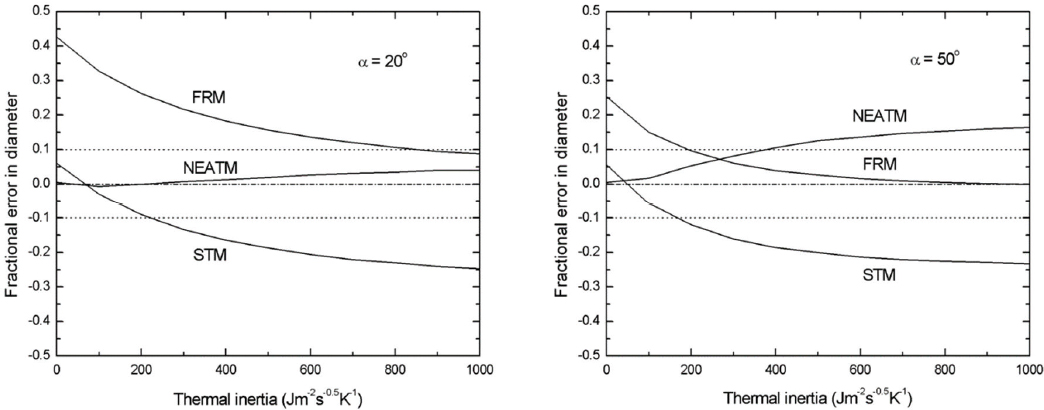
A disadvantage of the Near Earth Asteroid Thermal Model (NEATM) is the assumption of zero thermal emission on the night side of the asteroid. Without knowledge of the spin vector and thermal inertia, it is not possible to estimate the amount of thermal energy emitted on the night side. At low solar phase angles, the telescope receives thermal radiation predominantly from the day side, so the neglect of emission from the night side is significant only for very large values of thermal inertia (see Figure B.1). At large phase angles, however, thermal emission enters the telescope from the night side too, leading to overestimation of sizes by the NEATM; in this case, the Fast Rotating Model (FRM) is the model of preference if thermal inertia is likely to be large.
Mommert et al. (2018) investigated the performances of the NEATM and the FRM in a study of 1 million synthetic, thermophysically generated NEOs with physical properties, spin vectors, and observational circumstances randomly selected from within realistic bounds.1 They concluded that the NEATM provides statistically more robust diameter estimates for solar phase angles less than ~65 degrees. The Mommert et al. (2018) results are consistent with the results shown in Figure B.1, given that the performance advantage of the FRM over the NEATM at high solar phase angles is reduced for realistic nonzero subsolar latitudes (note that the results in Figure B.1 are for subsolar latitude equal to 0 degrees, which favors the FRM). Mommert et al. also provided statistical functions to correct NEATM- and FRM-derived diameters and albedos for the dependence on solar phase angle.
Harris et al. (2011) investigated the accuracy of the NEATM when used in the fixed-η mode and found that, in the case of Spitzer observations of near Earth objects (NEOs) in the 3.6 μm and 4.5 μm bands, root-mean-square errors are ±20 percent in diameter and ±50 percent in albedo (note that the 3.6 μm band is normally contaminated with reflected solar radiation; see Figure 5.3).2
Using the single thermal-emission dominated band of the Warm Spitzer mission, Trilling et al. (2016)3 acknowledge the large uncertainty in the η parameter in their thermal modeling and derive diameter and albedo uncertainties by applying the full distribution of previously measured η values. This approach leads to estimated
___________________
1 M. Mommert, R. Jedicke, and D.E. Trilling, 2018, An investigation of the ranges of validity of asteroid thermal models for near-Earth asteroid observations, Astronomical Journal 155:74.
2 A.W. Harris, M. Mommert, J.L. Hora, M. Mueller, D.E. Trilling, B. Bhattacharya, W.F. Bottke, et al., 2011, ExploreNEOs. II: The accuracy of the Warm Spitzer Near-Earth Object Survey, Astronomical Journal 141:75.
3 D.E. Trilling, M. Mommert, J. Hora, S. Chesley, J. Emery, G. Fazio, A. Harris, M. Mueller, and H. Smith, 2016, NEOSurvey I: Initial results from the Warm Spitzer Exploration Science Survey of Near-Earth Object Properties, Astronomical Journal 152(6):172.
typical diameter uncertainties of 40 percent and albedo uncertainties of 70 percent. These numbers highlight the benefit of acquiring thermal-infrared observations at a minimum of two different wavelengths.
Ryan and Woodward (2010) compared the performances of the NEATM and the Standard Thermal Model (STM) on thermal-infrared fluxes of 1,517 main-belt asteroids taken from the IRAS and MSX catalogues, finding that the STM underestimates asteroid diameters by ~10 percent and the NEATM underestimates diameters by ~4 percent when compared to radar- and occultation-derived diameters. They concluded that the NEATM approach produces more robust estimates of albedos and diameters.4
Hanus et al. (2018)5 compared the diameters of main-belt asteroids derived from thermophysical modeling of Wide-Field Infrared Survey Explorer (WISE) thermal-infrared data with those published by NEOWISE based on the NEATM, concluding that on average their results are consistent with the radiometric sizes and 10 percent uncertainties reported by Mainzer et al. (2016)6 (see Figure B.2.). Similar results are reported by Wright et al. (2018) in a comparison of WISE data from the fully cryogenic mission phase with occultation diameters.7
___________________
4 E.L. Ryan and C.E. Woodward, 2010, Rectified asteroid albedos and diameters from IRAS and MSX photometry catalogs, Astronomical Journal 140:933.
5 J. Hanus, M. Delbo, J. Durech, and V. Ali-Lagoa, 2018, Thermophysical modeling of main-belt asteroids from WISE thermal data, Icarus 309:297-337.
6 A.K. Mainzer, J.M. Bauer, R.M. Cutri, T. Grav, E.A. Kramer, J.R. Masiero, C.R. Nugent, S.M. Sonnett, R.A. Stevenson, and E.L. Wright, 2016, NEOWISE diameters and albedos V1.0, NASA Planetary Data System 247.
7 E. Wright, A. Mainzer, J. Masiero, T. Grav, and J. Bauer, 2018, Response to “An empirical examination of WISE/NEOWISE asteroid analysis and results,” arXiv:1811.01454v1.


