Climate Security in South Asia: Proceedings of a Workshop (2023)
Chapter: 3 Historical Case Studies
3
Historical Case Studies
A panel of invited experts shared their perspectives and engaged workshop participants on past events where climate drivers contributed to the evolution of security challenges. Dr. Sunil Amrith, of Yale University, shared an environmental historical perspective on the “History of Climate Crises and Security Challenges in South Asia.” Dr. Saleemul Huq, of the International Centre for Climate Change and Development, offered a climate adaption perspective on the “Impact of Cyclones on Security in South Asia.” Ms. Jumaina Siddiqui, of the U.S. Institute of Peace, offered a democracy and development perspective on “A Natural Security Crisis—Impacts of Climate Change on Pakistan’s Stability and Security.” A member of the workshop planning committee, Dr. Hariharasubramanian Annamalai, of the University of Hawaii, moderated the panel and also offered his own insights into climate dynamics in the region (see Box 1-1 in Chapter 1). Later, workshop participants broke into smaller, structured discussions, with a goal of advancing a “systems” understanding of the historical case studies.
CLIMATE CRISES AND SECURITY CHALLENGES IN SOUTH ASIA
In his remarks, Amrith applied lessons from South Asian environmental history to the accelerating climate impacts the region presently experiences. He noted that climate variability has been a fundamental concern to every government and ruler in the Indian subcontinent for centuries, from the Mogul Empire; through the British Empire; to the postcolonial governments of India, Pakistan, and Bangladesh. He noted that variability in rainfall and, in particular, the seasonal monsoon has
___________________
1 This list is the rapporteurs’ summary of the points made by individual speakers, and the statements have not been endorsed or verified by the National Academies of Sciences, Engineering, and Medicine.
shaped military tactics, the design of supply and transportation networks, the development of industrial and agricultural technologies, and the establishment of modern hydrometeorological services.
Amrith argued that in order to comprehend the climate-related security risks in contemporary South Asia, it is important to acknowledge the relationship of postcolonial political borders with existing natural and man-made hydrologic structures. In the west of the region, at the India–Pakistan border, he noted that the partition in 1947 bisected the great river basins of the Indus and Ganges, as well as a carefully planned network of irrigation canals created half a century earlier. In the east of the region, he described an opposite problem, where political borders were based on the natural hydrologic landscape but attempted to fix in place an inherently unstable boundary. In his view, this made climate and hydrologic variability a matter of existential importance—with the major security threats in the first decades after independence arising over the control of the infrastructure that had been put in place to mitigate climatic uncertainty and to redistribute water. Amrith then presented three recent historical examples (see Figure 3-1) of climate-related security threats that have manifested themselves in different parts of South Asia.
The first example focused on water disputes directly following the 1947 India–Pakistan partition, when makeshift arrangements to share transboundary waters of the Indus River basin fell apart. The water distribution networks that serviced the region had been designed and built as a unified system but were now divided by the political border. After years of negotiation, mediated by the World Bank, an agreement on an Indus Water Treaty was reached in 1960. The treaty is still in effect today but has been strained repeatedly by disputes over water management and border conflicts, as well as climate-related hydrologic variability.
The second example focused on the severe drought experienced by the Indian state of Bihar in the 1960s, which created a food shortage that threatened the political stability of the entire country. Amrith observed that a catastrophe was averted through actions by the U.S. government, which sent significant amounts of food aid, and by the Indian government, which successfully used the public distribution system to address food shortfalls on a local basis. Amrith noted that the U.S. government’s planning for each shipment of food aid carefully integrated scientific assessment and projections of rainfall throughout the region. Amrith also shared that during the crisis, both governments secretly consulted on the possibility of using cloud-seeding techniques to break the drought and reduce Indian agriculture’s vulnerability to the vagaries of weather.
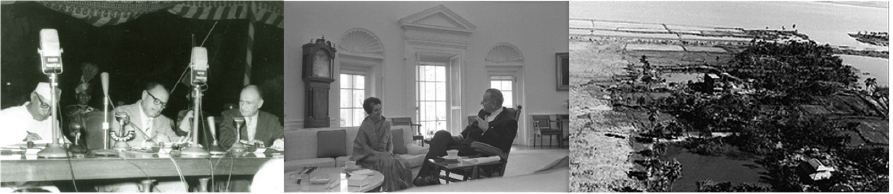
Amrith’s third example focused on the devastating tropical cyclone Bhola, which struck East Pakistan in 1970 and claimed the lives of almost half a million people. He noted that this event serves as perhaps the most prominent example in South Asia of a climatic event that had direct consequences for regional security. Amrith explained that the disaster played a triggering role, although not demonstrably causal, in the Bangladeshi war of liberation and its expansion into a war between India and Pakistan. Following the cyclone, criticism of the East Pakistan government’s response undermined public confidence and strengthened pro-independence factions. At the same time, an influx of refugees displaced by the disaster into India gave the government a strategic stake in the conflict and a pretext for providing military backing to the Bangladeshi independence movement. The conflict ultimately widened into the Indo-Pakistani War of 1971 and concluded with the founding of Bangladesh.
Amrith offered two concluding thoughts. His first was that a critical factor linking climate change to security in South Asia has been the inherited infrastructure for water control that was created to even out existing natural spatial and temporal variability in rainfall. He noted that this shared infrastructure—for example, the system of interlinked canals and irrigation channels in the Indus basin—is more likely to be a flashpoint of interstate conflict than climate stresses themselves. Amrith observed that intensively engineered environments are often vulnerable to climate impacts; in his view, the essential steps to improving security in the region would involve improvements in the safety and reliability of this infrastructure as well as improvements to the water sharing agreements themselves to be more equitable, transparent, and less vulnerable to knee-jerk reactions when conflict arises in other domains. Amrith’s second concluding thought, from a historical perspective, was that climate security in South Asia is bound with every other dimension of security, and that it should not be addressed in isolation from them. In South Asia, he argued, climate security maps directly onto economic security, political stability, border security, and regional peace and conflict.
CYCLONES IN SOUTH ASIA
Huq prefaced his remarks by noting that he was speaking to workshop participants remotely from Bangladesh, a day after tropical cyclone Sitrang made landfall on its southwestern coast. Reflecting on the storm’s impacts,2 he noted the successes achieved by Bangladesh in developing approaches to manage risks from tropical cyclones. He explained that in comparison to years past, when major cyclones would produce death tolls in the hundreds of thousands, the country now has the capacity to effectively evacuate and shelter a million people and has dramatically lowered mortality during even the most severe storms (Figure 3-2). He noted that early warning capabilities have been improved through investments in advanced satellite tracking of storms in the Bay of Bengal, as well as communications technologies that can deliver information and alerts across the country. He also noted that Bangladesh has developed a network of thousands of cyclone shelters in coastal zones, all within in a few hours walking distance for every resident. Shelter designs have been improved to make them more friendly to women as well as livestock, and also to serve as multipurpose buildings that can be used as schools or community centers in the non-cyclone season. Huq also described other adaptive actions to improve national preparedness, including conducting postmortems of the entire national response structure after every storm, organizing regular emergency drills in every primary and secondary school, and maintaining strong coordination with authorities in neighboring India.
___________________
2 Sitrang caused the evacuation of about a million people, resulting in at least 35 deaths (see https://timesofindia.indiatimes.com/world/south-asia/cyclone-sitrang-kills-35-in-bangladesh-officials/articleshow/95085350.cms).

Huq reflected further on the status of the Bangladeshi people displaced by Sitrang at that moment, noting that tens of thousands of people who survived the initial disaster would not be easily able to return to their homes or resume their lives. He acknowledged that while the country has been very successful at minimizing loss of human lives, it has not yet achieved comparable success in coping with the loss of property and livelihoods that accompany climate shocks. Huq pointed out that many Bangladeshis displaced by cyclones and other disasters end up migrating to the capital Dhaka and other major cities, gravitating to communities where they have social and familial connections that can be leveraged to find work, schooling, and other resources. He noted, however, that sea-level rise and other climate stressors are expected to displace up to 13 million people from low-lying coastal areas and into cities by 2050 (Rigaud et al., 2018), and that it will be difficult to absorb so many migrants. Huq described the increasing flows of people into host communities that are increasingly unable to support them as they attempt to rebuild their lives as a “slow-moving humanitarian disaster.”
Huq cited his ongoing work with colleagues at the International Centre for Climate Change and Development (ICCCAD) to develop climate-resilient, migrant-friendly towns as a potential solution to disperse the massive flows of climate migrants into Dhaka and provide opportunities for them to recover their communities and livelihoods (Alam et al., 2018; Khan et al., 2021). The ICCCAD effort has identified approximately 20 secondary towns distributed around the country,
each with the capacity to potentially integrate half a million refugees. ICCCAD is currently working with national and local authorities, as well as civil society partners, to plan and implement activities to build climate resilience—for example, through investments in the towns’ infrastructure and sustainable technologies—and to foster peaceful co-existence of host communities and migrants—for example, through the design of informal dispute-resolution mechanisms. Other important elements of this effort would include incentivizing migrants to commit to staying in and contributing to their host communities, including through scholarships, skill development programs, and other ways to help them adapt to their new homes. Huq acknowledged that there is a long history of a failure of this type of controlled relocation, and that it is important to enable people to make these choices themselves. He noted that settlement of displaced people in towns that are nearer to their ancestral homes would allow them to maintain their existing psychological and cultural connections. He expressed hope that this type of approach would generate interest beyond the Bangladeshi context.
IMPACTS OF CLIMATE CHANGE ON PAKISTAN
In her remarks, Siddiqui reflected on the dynamic interactions between climate-related disasters and existing security challenges in Pakistan, focusing her attention on the intense rainfall and devastating floods experienced by the country in the summer of 2022 (Figure 3-3). She observed that the flooding, as well as the intense rainfall preceding it, was not a novel or unforeseen occurrence for the country and that Pakistan has experienced many previous climate-related disasters, including record flooding in 2020. She noted that the national hydrometeorological service is capable of issuing advance warnings, although the complex geography makes forecasting difficult, and that disaster management authorities at the national and provincial levels do have disaster plans in place. The magnitude of the 2022 flooding, however, exceeded the resources allocated in those plans, particularly for temporary shelters, and the emergency response was not able to match the scale of the disaster. Siddiqui described the magnitude of the humanitarian crisis that followed, noting the large number of displaced people; the large spatial extent of flooding; the damage to agriculture and livestock; and socioeconomic impacts such as inflation, unemployment, and disruption of education (Salikuddin and Siddiqui, 2022). She observed that the direct impacts of the flooding were compounded by existing vulnerabilities in poor and underdeveloped communities, poor governance of rural and urban construction and development, and lack of public faith in institutions and the government.
Siddiqui argued that climate disasters will compound the domestic and international challenges facing Pakistan and ultimately undermine the security of the country and the wider South Asia region. Within Pakistan, Siddiqui observed that the massive fatalities and financial losses associated with recurring climate disasters have strained the nation’s emergency management capacity to its limits; created disputes over scarce national resources; and placed the nation’s food, water, and energy systems at risk.
At the same time, the country has experienced significant political disruption, in the form of protests and unrest; a constitutional crisis that removed an elected prime minister; and a power transition to a fractured coalition government that has had difficulty managing the humanitarian crisis produced by the most recent floods. Outside of its borders, Pakistan faces challenges related to the recent U.S. withdrawal from Afghanistan and international concerns over Pakistan’s ability to maintain control over its own nuclear arsenal. Siddiqui noted that cooperation and coordination on these issues is hampered by the difficult past 20 years of history between the United States and Pakistan.

Siddiqui examined the downstream effects and security implications of the initial humanitarian disaster. She noted that the floods destroyed critical health infrastructure and increased the incidence of infectious and water-borne diseases, as well as halted the education and disrupted the livelihoods of millions of people.
Where the government failed to address these dislocations, Siddiqui noted that other groups have stepped in to provide services, potentially including religious extremist or terrorist organizations. In a political environment characterized by infighting and inattention to the needs of new climate refugees, people could turn to extremist groups. The education crisis, in particular, potentially leads to children ceasing to receive a holistic education and only receiving religious instruction, which would create a learning deficit and also make them more susceptible to recruitment into the extremist organizations. She pointed out that the messaging from religious organizations and on social media has already spread extremist rhetoric through misinformation and disinformation about the crisis, including messages saying the floods were a divine punishment on society for not being appropriately religious, or that India had caused rivers to flood by opening up dams upstream.
Siddiqui touched on a range of challenges, and their associated opportunities, related to the climate disaster and broader security issues. She argued that the extended political transition in Pakistan has disconnected science from policy and planning, noting that Pakistan’s national security policy—which does discuss climate change and its separate impacts on food, water, and health security—needs to be more holistic. Pakistan may benefit from a national Command and Operation Center on climate, and she pointed to the lessons learned from the COVID-19 pandemic, for which Pakistan developed smart lockdowns along with targeted assistance and food aid. Another opportunity is that the U.S. withdrawal from Afghanistan has removed capacity for HADR operations in the region, so that Pakistan is more reliant on its own domestic equipment and personnel. A security stressor will be the movement of displaced people into the already-stressed urban centers.
Siddiqui noted some of the outstanding security questions moving forward. One is the safety of Pakistan’s nuclear sites. There has not been any deep analysis or research on whether they were damaged by the floods or what would happen to those sites in a postdisaster environment. There has not been strategic thinking around it against the backdrop of the ongoing leadership transitions in the political and military power structure. It is also an open question as to how the rise of populism and ethnic nationalism, especially in middle-class communities, will affect how political parties deal with the interplay between climate disasters and political security issues. It remains to be seen how political actors in Pakistan and across South Asia are thinking about and planning for the emerging climate-related security challenges in the region. There will be consequential elections over the next few years in different countries.
PARTICIPANT DISCUSSIONS
Workshop participants broke out into three smaller, structured discussions intended to advance a “systems” understanding of the historical examples provided by the expert panel. Each group selected one or more of the case studies, or agreed to explore a new one, and received some organizing prompts for their discussion:
- Understanding the climate security risks: What were the key security risks that emerged in this setting? Were they expected or unexpected? What were the relevant external influences/underlying conditions/systems interactions that shaped the evolution of this risk?
- Considering human responses: How did human responses and choices modulate (amplify or reduce) risk in the setting? What were the response options for decisionmakers in this setting?
- Considering tipping points and near misses: Did the setting approach/cross any tipping points?
- Anticipating and avoiding risks: Were there key intervention points for mitigating security risk?
After participants reconvened in plenary, representatives from each of the three groups (A, B, and C) summarized their discussions and shared key points.
Group A chose to compare and contrast the historical experiences of flooding in Bangladesh and Pakistan as a way of understanding security risk in the region. In considering the factors influencing the evolution of this risk, the group’s representative shared three main factors that accounted for the different outcomes observed in each country. The first was lack of adequate preparation and assessment of needs beforehand, particularly related to maintaining human and social infrastructure, which would hamper an effective response. The second factor was a lack of public trust
in institutions and government, which would undermine their ability to deliver services before, during, and after the disaster. The third factor was a lack of effective coordination and collaboration between authorities within a country and also between countries.
In considering human responses, the Group A representative suggested forced migration and displacement as key areas where human responses modulated security risk. The representative noted that in comparison to Pakistan, Bangladesh took an anticipatory approach by investing in resilient migrant-receiving communities. A substantial and unresolved challenge for both countries, however, was returning displaced people to their homes and recovering their lost property and livelihoods. In considering opportunities to anticipate and avoid future climate disaster risks, the Group A representative suggested a few key intervention points. These included conducting needs assessments and prestaging relief efforts in the periods between disasters, as well as working at the local and provincial levels to determine the best agents of action for a disaster response. The representative also noted that the Bangladesh and Pakistan flooding cases illustrate that climate security risk in a given setting reflects the cumulative burden of persistent inequity and existing environmental health threats, such as poor air and water quality, as well as the climate hazard itself.
Group B used its discussion to describe overall takeaways that emerged from the panel discussion, and the group’s representative presented three key perspectives. The first was that in both Bangladesh and Pakistan, the strong institutions and social cohesion that were important contributors to the successes achieved in managing climate risk were absent where there were failures. The second key message was that a substantial, broad-based level of development is not necessarily required to improve resilience to climate impacts. The Group B representative noted, for example, that Bangladesh is a relatively poorer country but has made great strides in building resilience to cyclones. The final key message was that the metrics used to assess climate impacts strongly influence our understanding of security implications. As an example, the representative noted that cyclone mortality may provide a good measure of success in saving lives, but that levels of displacement and loss of livelihoods are just as consequential to security outcomes.
Group C used its discussion to compare and contrast the historical experiences for Bangladesh and Pakistan but considered a broader range of security challenges over recent decades. The group’s representative shared some observations on how the two nations have diverged in their approaches to those challenges. The first observation was that domestic societal factors have strongly influenced the approach to security risk in both countries. These factors include the strength of social cohesion, the degree of military influence within government, the degree of religious influence within government and local communities, and the strength of governance and social support systems. The group’s representative noted, for example, that social cohesion is stronger in Bangladesh. The second observation was that the two nations have distinct approaches to security risk management due to their very different political histories and roles within the South Asia region. Group C’s representative noted that Pakistan was an important regional player during the Cold War, receiving significant foreign military and economic assistance, and is currently a nuclear state. These conditions may have contributed to a national government that has historically been less interested in addressing internal societal issues. By contrast, Bangladesh has historically played a more passive role in the region, often acting as a “shock absorber.” The country’s successes in building national resilience may reflect its stronger history of democratic conditions, the government’s more inclusive view of its citizens, and a smaller overall wealth imbalance. Group C’s representative noted, however, that while Bangladesh has had success in reducing its climate mortality, the country still faces significant challenges in protecting livelihoods and this may ultimately be a stronger driver of security risk.


