Integrating the Human Sciences to Scale Societal Responses to Environmental Change: Proceedings of a Workshop (2023)
Chapter: 9 Moving Forward: Improving Community Resilience
9
Moving Forward: Improving Community Resilience
The workshop’s next panel brought together experts and thought leaders to explore pathways toward building more robust and resilient communities in the face of climate change. Moderated by Raj Pandya, a Planning Committee Member and Vice President of Community Science at the American Geophysical Union, this session delved into the topic of improving community resilience. In addition to moderating, Pandya opened the session by highlighting the themes that had been discussed in the previous two panels.
The second speaker, Lisa Arkin, Executive Director of Beyond Toxics, focused on sector-based goals for climate justice and the societal response to climate change. Arkin’s experience shed light on the intersectionality of climate issues and the urgent considerations of justice and equity in pursuing community resilience. Shahzeen Attari, an Associate Professor in the O’Neill School of Public and Environmental Affairs at Indiana University Bloomington, delivered the final presentation on key tools and options that best support efforts to advance transformative change in communities. With her sustainability and behavioral science expertise, she provided practical guidance on implementing effective strategies that could be used to drive positive and lasting transformations.
Throughout the session, participants engaged in discussions centered on exploring the core of community resilience. Topics included encouraging forward thinking and considering appropriate time frames, integrating diverse disciplines and sectors to generate innovative solutions, and evaluating the effectiveness and feasibility of holistic approaches. The panelists also addressed challenges posed by the broader political environment and the importance of depolarization in the context of fostering resilience. Additionally, discussions on driving community resilience focused on mobilizing the public and reviewing existing mechanisms for promoting health equity. Finally, the panel discussion sparked innovative ideas, insights, and actionable strategies that offer hope for communities striving to enhance their resilience in the face of climate change.
HIGHLIGHTS OF PREVIOUS PANEL’S DISCUSSION ON HUMAN SCIENCES
Pandya began by highlighting the importance of fostering thinking and cultures that exhibit an abundance mindset, emphasizing the benefits of adopting equity-focused approaches that prioritize front-line communities’ needs, desires, and perspectives. He recognized the value of feedback amongst individuals, communities, and systems within an integrated landscape, and he embraced the possibility of the transformation of human sciences away from a siloed paradigm. Pandya rejected the notion of simply “coping” with climate challenges and instead advocated for transformative action, which means challenging the prevailing status quo and extending support to individuals, communities, and the systems underpinning them.
Pandya noted the interconnectedness of people and nature, while acknowledging that exploitation and colonialism are deeply ingrained in history. Stressing the need to admit to past harms as a first step toward repairing them and preventing subsequent instances, he emphasized that future research be conducted based on solid ethical considerations. He encouraged the parallel advancement of environmental justice and climate action, stressing connections between the two and underscoring the interrelationships between environment and public health.
Pandya also discussed the critical work necessary to improve understanding of resilience. He emphasized the need to move beyond solely physical descriptions of resilience to include normative aspects, particularly those addressing systemic inequalities and those involving emotional, cultural, and political dimensions. He highlighted the complementary nature of scientific disciplines, emphasizing the importance of incorporating knowledge cycles, building partnerships with experts, synthesizing multiple disciplines, facilitating education, and engaging in practical resilience applications.
Pandya identified trust, benefit sharing, and power dynamics as central themes of the workshop’s second day. He emphasized the need to earn and give trust to communities and research participants to facilitate scientific knowledge, capacity, and agency. He stressed the importance of considering community history, and of ensuring that research outcomes benefit minority and underrepresented groups. He encouraged co-design approaches, which involve meeting communities where they are physically, technically, linguistically, culturally, and economically. Relatedly, he addressed the need to consider the role of power dynamics, including challenges regarding resource allocation, decision making, public and community access, scientific credibility, and power sharing. He emphasized embracing the joy and excitement inherent in these collaborative efforts.
Pandya’s discussion also touched on the evolution of scientific institutions, underscoring the importance of accompaniment in the evolutionary process. He also advocated supporting community partnerships through advancing infrastructure, training, team building, tenure considerations, ethical standards, shared governance, and flexibility. He went on to emphasize multigenerational and youth-oriented approaches to adaptation and mitigation. Concerning funding, Pandya highlighted the importance of designing science grants and incentives that are equitable in their distribution, involve community collaborations and investment in long-term infrastructure, and result in open sharing of accessible research outputs. In conclusion, Pandya outlined several goals for effective co-created strategies, emphasizing the importance of diverse scientific disciplines and partnerships. The questions he shared included the following:
- What are effective strategies for co-creation, and how do people know they are effective?
- What human and behavioral sciences are most ready for practice?
- What practice-informed questions should guide new research?
- What are the priorities and learnings of front-line communities?
- How can people make new and existing data and tools more usable?
- What are the most effective ways to nurture boundary spanners?
- What does scale mean, contextually?
- How can people study the concept and practice of resilience?
- How do people best engage with multiple sources of knowledge—what tools and practices work?
- How does the evolution of decision and governance systems shape the state of climate change?
DURABLE SOLUTIONS FOR ADVANCING ENVIRONMENTAL JUSTICE AND IMPROVING COMMUNITY RESILIENCE
Arkin opened by highlighting areas in which she believes policymakers and polluters should make necessary, sustainable changes to enhance public safety. Second, she emphasized the importance of institutionalizing community-generated data, since data developed by polluters are often biased and unusable, leading to inaction. Next, she introduced Beyond Toxics,1 a statewide environmental justice organization focusing on the needs of communities in Oregon to achieve innovative policy.
___________________
1 “Beyond Toxics provides leadership to build a community-driven environmental justice movement for a thriving and just Oregon.” More information about Beyond Toxics is available at https://www.beyondtoxics.org/
SOURCE: Arkin, L. (2023). Durable Solutions to Advancing Environmental Justice and Improving Community Resilience (slide #6), presentation for the Workshop on Integrating the Human Sciences to Scale Societal Responses to Environmental Change. Reprinted with permission.
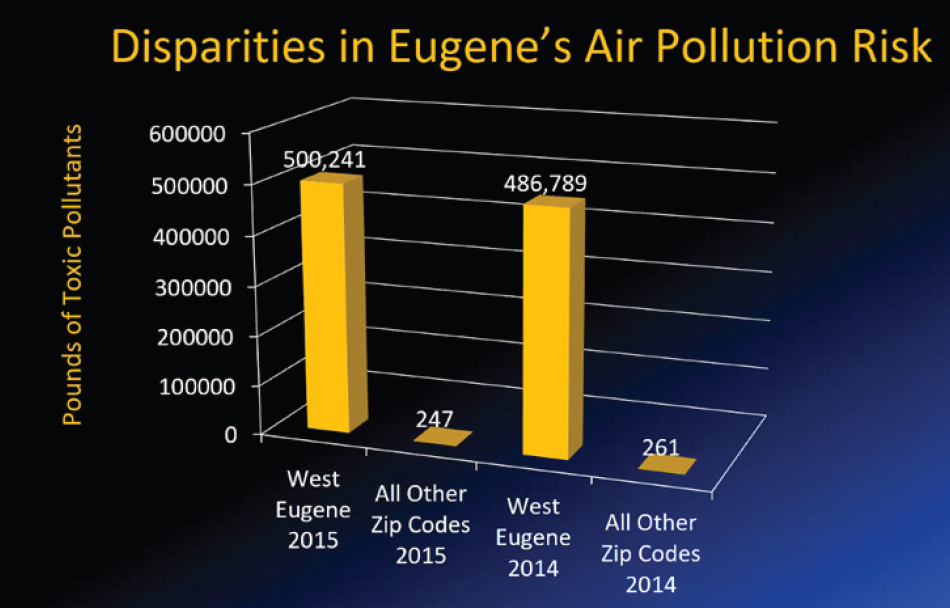
Arkin then provided an example of efforts in Oregon, where problems associated with industrial pollution led to the establishment of the Eugene Toxics Right-to-Know Program.2 This program relies on an ordinance that serves as a primary, publicly available data source by annually recording federally listed hazardous materials emitted into the local environment by manufacturers. Beyond Toxics uses the data to highlight communities’ inequalities in south and east Eugene. The Bethel community is a low-income area within the city with substantial representation of diverse communities, disabled individuals, and young families. Eugene is heavily burdened by toxic emissions (Figure 9-1), resulting in higher-than-average rates of cancer and asthma, as well as low life expectancy. Arkin said that polluters should be reporting these emissions, and she stressed the need for accountability.
As a success story, Arkin discussed how members of the Bethel community took it upon themselves to educate the public and advocate for environmental justice. They organized events designed to inform city regulators of the burden of pollution and to uplift the experiences of the community. Beyond Toxics helped to install air monitors designed to identify chemical exposures, so that exposure data could be shared with the public. Arkin noted that air monitors, strategically placed in concentric circles at varied distances from the polluters, were focused on measuring industrial polycyclic aromatic hydrocarbons. The resulting data, combined with community narratives and story maps, led to the proposal of a policy solution known as the Public Health Overlay Zone,3 which established a one-quarter-mile outdoor emissions buffer or land-use zoning code to protect communities.
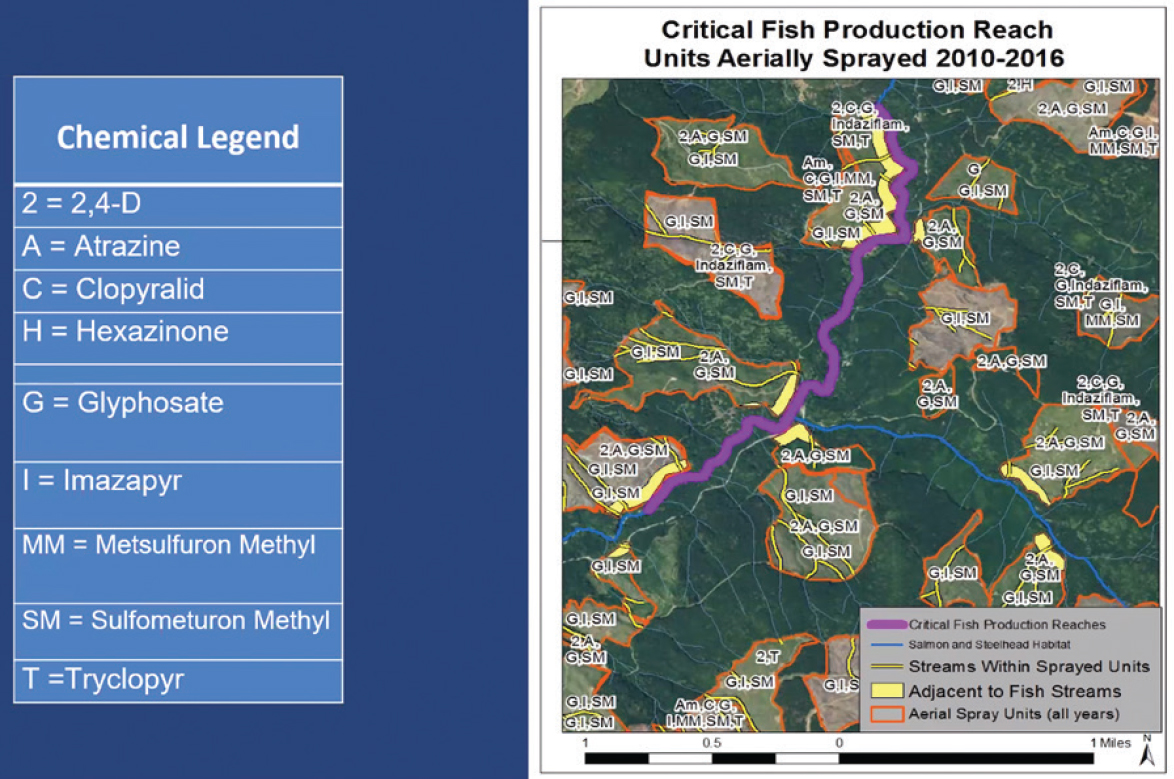
Arkin described Gold Beach, Oregon, as another example of Beyond Toxics’ efforts. The community was experiencing adverse effects of herbicide use near its drinking water sources. During clear-cutting logging activities allowed by the Oregon Forest Practices Act (FPA),4 helicopters sprayed mixes of pesticides. Nearby rural communities often collect surface water for livestock, irrigation, and domestic purposes including drinking, and were thus concerned about contaminated surface water as well as runoff into local waterways. Through years of data collection and relationship building, Beyond Toxics demonstrated the impact of chemical drift and runoff on streams within the watershed. This analysis showed that areas adjacent to streams were heavily sprayed during clear-cutting activities.
___________________
2 More information about the Eugene Toxics Right-to-Know Program is available at https://www.eugene-or.gov/1833/Program-Overview#:~:text=The%20Eugene%20Toxics%20Right%2Dto,of%20federally%20listed%20hazardous%20substances
3 More information about the Public Health Overlay Zone is available at https://www.beyondtoxics.org/work/environmental-justice/the-public-health-overlay-zone/
4 More information about the FPA is available at https://www.oregon.gov/odf/working/pages/fpa.aspx
SOURCE: Arkin, L. (2023). Durable Solutions to Advancing Environmental Justice and Improving Community Resilience (slide #18), presentation for the Workshop on Integrating the Human Sciences to Scale Societal Responses to Environmental Change. Reprinted with permission.
Community right-to-know initiatives were also discussed, such as the Forest Activity Electronic Reporting and Notification System (FERNS).5 FERNS is a reporting system managed by the Oregon Department of Forestry that relies on community input regarding forestry activities. The system provides free and accessible information, including detailed references to location, number of acres, chemicals used, proximity to streams and endangered species, and township information. Figure 9-2 provides an example of proximity of fish habitats to aerial spray locations. Arkin advocated for policy reforms, such as the Memorandum of Understanding in the Oregon Private Forest Accord,6 which became a state law in the 2021–2022 legislative session. This accord aimed to increase no-spray and no-cut buffers. Additionally, a new bill promoting natural carbon solutions was proposed in the state legislature, with the following goals: incorporating community voices, ensuring accurate and accessible data, addressing challenges related to subjective data, advancing data proficiency and access, and encouraging community decision making.
TRANSFORMATIVE CHANGE AND THE CHALLENGES ASSOCIATED WITH DECARBONIZATION PATHWAYS
Attari began by stating that, to navigate toward a world with temperatures above preindustrial averages,7 current policies need to be more robust and better informed by research. She noted that a significant portion of
___________________
5 More information about FERNS is available at https://ferns.odf.oregon.gov/E-Notification/
6 More information about the Memorandum of Understanding is available in Appendix A at https://www.oregon.gov/odf/aboutodf/documents/2022-odf-private-forest-accord-report.pdf
7 “In recognition of this, the overwhelming majority of countries around the world adopted the Paris Agreement in December 2015, the central aim of which includes pursuing efforts to limit global temperature rise to 1.5°C.” More information about 1.5°C efforts is available at https://www.ipcc.ch/sr15/faq/faq-chapter-1/. Attari also shared the Climate Action Tracker (CAT), which monitors government climate action compared to the Paris Agreement. More information about the CAT is available at https://climateactiontracker.org/
SOURCE: Attari, S. (2023). Thoughts on Transformative Change (slide #11), presentation for the Workshop on Integrating the Human Sciences to Scale Societal Responses to Environmental Change. Originally from Barnett, M. J., Hancock, P. I., Klotz, L. E., & Attari, S. Z. (2023). Recycling bias and reduction neglect. Nature Sustainability. https://doi.org/10.1038/s41893-023-01185-7. Reprinted with permission from Nature Sustainability.
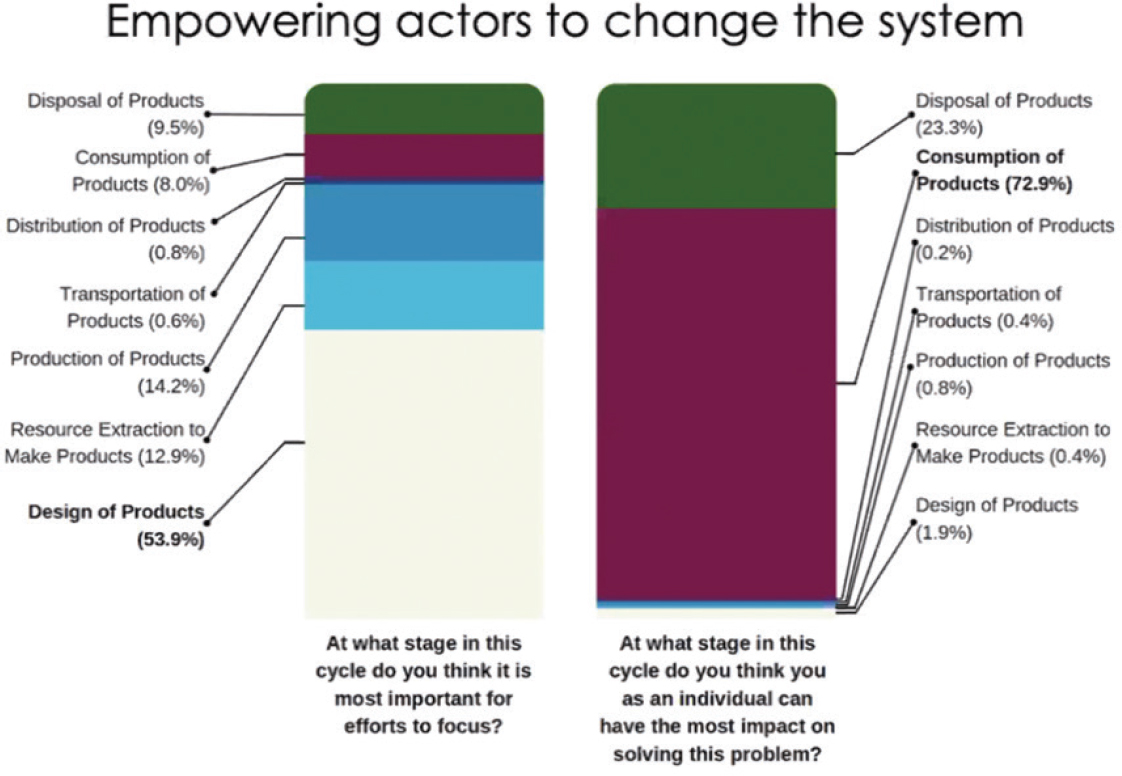
greenhouse gas emissions stems from energy use, particularly fossil fuels. Attari presented the findings of a recent study8 revealing that, of 2,429 members of the public surveyed, participants tended to underestimate the amount of fossil fuels used, while overestimating the contribution of renewable energy sources. Emphasizing that many members of both the Republican and Democratic parties share a common vision for a decarbonized future, she pointed out the ongoing lack of clear, shared pathways for mitigation and adaptation. She also shared results of a study that included survey responses regarding the role of fossil fuels and renewables in empowering actors to change energy systems and considering how and when individuals might participate. They found that most participants think the design of products is the most important effort to focus on; however, consumption of products is the stage they think an individual can have the most impact (Figure 9-3).
Attari discussed the difficulties inherent in decarbonization policies and pathways, citing psychological barriers, timing constraints, and geographical considerations. The absence of shared pathways toward future adaptation further complicates the transition. She emphasized the need to design strategies beyond reducing consumption that empower individuals to shape systems; this requires collaborations across disciplines and the integration of storytelling to help illustrate and communicate what a sustainable future could “look and feel like.” Attari highlighted areas for future work, including community empowerment and individual responses to climate grief, applying Elinor Ostrom’s principles in larger populations,9 bridging methods using narratives as data, and establishing innovation centers for social and decision sciences. Attari pointed out that storytelling can be an effective means of changing people’s viewpoints. Attari also addressed the challenges faced by academia. For example, academic institutions have encountered threats to tenure and increasing corporatization pressures,
___________________
8 Miniard, D., Kantenbacher, J., & Attari, S. Z. (2020). Shared vision for a decarbonized future energy system in the United States. PNAS, 117(13), 7108–7114. https://doi.org/10.1073/pnas.1920558117
9 Ostrom, E. (2015). Governing the commons: The evolution of institutions for collective action. Cambridge University Press.
due to an emphasis on strict metrics such as citation counts, paper publications, and grant funding. This system often hinders collaboration among researchers. To overcome academic tenure-related challenges, Attari proposed solutions such as organizing community engagement, promoting self-governance among faculty members, and fostering resilience in various fields.
She further discussed the preferences of funders, noting a tendency to emphasize scalability and generalizability in their support metrics. Attari also highlighted the importance of context-specific considerations, questioning when and where scalability is appropriate. She mentioned the preference for funding physical sciences over humanities and the arts, despite the need for increasingly diverse ways of understanding complex problems. She suggested that reducing silos and integrating varied disciplines is crucial for addressing funding biases.
Attari raised the concept of justice and equity transitions, particularly regarding challenges associated with adopting innovative technologies (e.g., electric vehicles and solar panels), which may inadvertently exclude low-income communities. She emphasized climate change as a threat multiplier, necessitating efforts to future-proof policies and administrations. Attari called for several advances, including decision aids to facilitate demand management and technology switching, solutions for policymakers and decision makers focusing on systemic change and poverty alleviation, and context-designed community engagement and empowerment. Additionally, she urged consideration of the ingredients necessary for human flourishing, particularly in the face of the uncertainties presented by artificial intelligence. Finally, she advocated for the importance of “deep care and love for yourself” in the context of climate grief and institutional and professional burnout.
PANEL DISCUSSION
During the question-and-answer session, panelists addressed diverse topics related to navigating political polarization, scalability, and combating the corporatization of research. One audience member asked about the challenges associated with navigating the partisan divide. Arkin highlighted the difficulty in Oregon, where the state is bisected by the Cascade Range, resulting in a rural-to-urban transition that often influences political affiliation. She emphasized the importance of working closely with communities facing pollution problems and highlighted the importance of prolonged engagement including the presence of interns, which can help build relationships and trust. She also stressed the significance of allowing communities to tell their own stories despite the challenging political overtones inherent in environmental work. Arkin mentioned resistance by corporate-dominated interests, particularly in rural communities that tend to be more conservative, but emphasized that such resistance can be changed over time.
The topic of scalability was also discussed. Attari highlighted the need for enhanced communication within various work areas, through more meetings and conversations. Language barriers and the challenges of scaling specific projects were also mentioned. Finally, Attari emphasized the value of local and contextual work that may need greater reproducibility on large scales.
Arkin provided an example drawn from her work with a community-based organization in the Bethel community, which is facing a massive cleanup due to dioxin contamination of parks and residences. She stated that the contamination is so severe that three feet of soil must be removed. Arkin emphasized that this situation has decreased residents’ mobility options and led to a loss of faith, pride, and residential investment in the community. She mentioned that her organization is working with local utilities and state incentive programs to increase the community’s resilience, and she suggested using this community as a model for others. In this context, scalability is achieved by honoring and working within the specific dimensions of each community rather than implementing the same approach across separate communities. She also discussed the passage of legislative policies designed to establish community climate assessments. Under these policies, she noted, polluters would be required to contribute funds that would be distributed to community-based organizations to support clean energy projects across communities, thus achieving scalability.
Regarding the fight against the corporatization of research, Attari pointed out that this is an ongoing issue. While some philanthropic organizations and individuals fund research, there are still challenges to securing funding. She highlighted the difficulties within academia, where independent funders often determine “winners and losers.” Arkin emphasized the importance of prioritizing both data and community needs, as well as pressuring decision makers and regulators to ensure that research is conducted with community interests at the forefront.


