Integrating the Human Sciences to Scale Societal Responses to Environmental Change: Proceedings of a Workshop (2023)
Chapter: 8 Achieving More Durable Solutions Through New Collaborations
8
Achieving More Durable Solutions Through New Collaborations
In this session, panelists discussed the qualities and examples of successful partnerships and collaborations to build community resilience in the face of environmental change. Moderated by Linda Silka, a Planning Committee Member and Senior Fellow at the Senator George J. Mitchell Center for Sustainability Solutions, University of Maine, the panel featured two speakers. Shina Robinson, the Resilience Hubs Manager at the Asian Pacific Environmental Network (APEN), discussed the importance of equitable knowledge sharing and power distribution in collaborations involving communities and anchor institutions. Mark Lubell, a Professor in the Department of Environmental Science and Policy and the Director of the Center for Environmental Policy and Behavior at the University of California, Davis, explored the dynamics of mutually beneficial partnerships and tactics for collaborating with communities in the pursuit of racial, economic, environmental, and climate justice. These two presentations highlighted the transformative potential of collaborative efforts in achieving sustainable solutions for climate change impacts.
BUILDING RESILIENCE IN YOUNG PEOPLE AND COMMUNITIES
Robinson emphasized the importance of equitable partnerships in developing community resilience. As the Resilience Hubs Manager at APEN,1 an organization with 30 years of grassroots experience within the California Bay Area, Robinson highlighted APEN’s efforts in empowerment and policy advocacy at the local and state levels, including efforts to build broader-scale resilience through engaging voters. Providing examples of APEN’s organizing work, Robinson shared information about one of the largest stationary refinery polluters in the state, and described the Laotian Organizing Project2 from the 1990s, which aimed to assist the substantial Southeast Asian refugee populations in Richmond, California. She acknowledged that these populations needed essential information in multiple languages and modalities to respond to environmental hazards and protect their health and well-being. Additionally, Robinson emphasized the need to share power and knowledge about energy and resources by giving an example of APEN’s work in communities in Oakland, where it organized working-class Chinese citizens facing evictions, vulnerable housing stock, and pollution. She stressed the importance of such intersectional solutions and mentioned APEN’s plans to expand its initiatives to Los Angeles.
___________________
1 APEN “brings together a collective voice to develop an alternative agenda for environmental, social and economic justice.” Additional information on APEN is available at https://apen4ej.org/
2 More information about the history of the Laotian Organizing Project is available at https://www.foundsf.org/index.php?title=APEN
Robinson addressed climate change as a threat multiplier, exacerbating air- and water-quality issues that disproportionately affect certain families and communities. She observed that traditional models of environmental response could be improved by, for example, increasing trust in community services such as those provided by government facilities or police stations. Additionally, evacuation efforts may be challenging for some residents due to distance from safe locations, limited mobility, and language barriers, potentially hindering access to refuge during climate crises. Finally, Robinson underscored the importance of community resilience which, according to the California Environmental Justice Alliance,3 should address underlying systemic inequalities and support communities in taking immediate action while providing long-term assistance.
Robinson discussed the concept of Community Resilience Hubs, highlighting the Refugee Youth Success and Empowerment (RYSE) Youth Center4 in Richmond, CA, as an example. Established in 2017, the RYSE Youth Center fosters community governance, collaboration, skill building, and leadership development. Offering healing spaces, computer labs, garden spaces, and community partner spaces, the center emerged from a collective response to lack of safety at school and in the larger community and the need for sanctuary from violence, economic hardship, and environmental injustices. This climate resilience and liberation hub builds community youth empowerment by providing free programming for young adults, and explicitly offers benefits to the youth of disadvantaged and vulnerable communities. She emphasized that community resilience, facilitated by programs such as those in the RYSE Youth Center, extends beyond physical safety to political and emotional security.
Robinson mentioned APEN’s collaboration with Physicians, Scientists, and Engineers (PSE) for Healthy Energy5 in a multiyear funded partnership to model resilience capacity in community centers, public schools, and places of worship. This modeling involves providing fundraising guidance and planning for infrastructure and organizational development. She went on to acknowledge the extended multiyear timeline for such projects and how challenges associated with funding, including complications caused by COVID-19, change over time. Robinson noted that communities face the following:
- Environmental injustices and hazards because of historic discrimination in land use and planning;
- Climate change as a threat multiplier;
- Cascading impacts from heatwaves, wildfires, smoke, the COVID-19 pandemic, and resultant air- and water-quality issues; and
- Inadequate housing for seniors and populations on fixed incomes.
Robinson suggested that climate resilience solutions need to be dynamic based on a community’s needs, and that the problems communities face will likely increase in frequency. She provided further insights into the RYSE Youth Center’s initiatives to foster enhanced community resilience, explaining their build-out and transition from one building to a campus model. Programs at the RYSE Youth Center have trained youth to develop surveys, engage in friendly competition, and gain public speaking skills—while promoting community outreach, networking, and leadership development skills. RYSE also seeks direct input from youth about the training and programs they desire, including emergency response and first responder skills, de-escalation and mediation for emergencies, safety precautions, and civic engagement.
Robinson highlighted APEN’s focus on solar power and battery storage, and its push for creating green career-development pipelines. She discussed APEN’s research partnerships with the state; APEN aims to explicitly access and analyze the solar and storage potential of California school buildings and community centers. In addition, through partnership with PSE, APEN not only evaluated structural-design parameters to ensure electrical loads are sustained during earthquakes but also analyzed population demographic and climate vulnerability metrics for affected areas. Robinson closed her remarks by mentioning APEN’s ongoing work on a resilience hub in the Lincoln Square Park and Recreation Center in Oakland’s Chinatown.
___________________
3 The California Environmental Justice Alliance “is a statewide, community-led alliance that works to achieve environmental justice by advancing policy solutions.” More information is available at https://caleja.org/
4 The RYSE Youth Center “is a place where integral parts of a hurting and glorious city come to shed conflict so that they may seek and create solutions.” More information about the RYSE Youth Center is available at https://rysecenter.org/
5 More information about PSE for Healthy Energy is available at https://www.psehealthyenergy.org/
SOURCE: Lubell, M. (2023). The Quest for Cooperation in Regional Sea Level Rise Adaptation (slide #4), presentation for the Workshop on Integrating the Human Sciences to Scale Societal Responses to Environmental Change. Reprinted with permission.
THE QUEST FOR COOPERATION IN REGIONAL ADAPTATION TO RISING SEA LEVELS
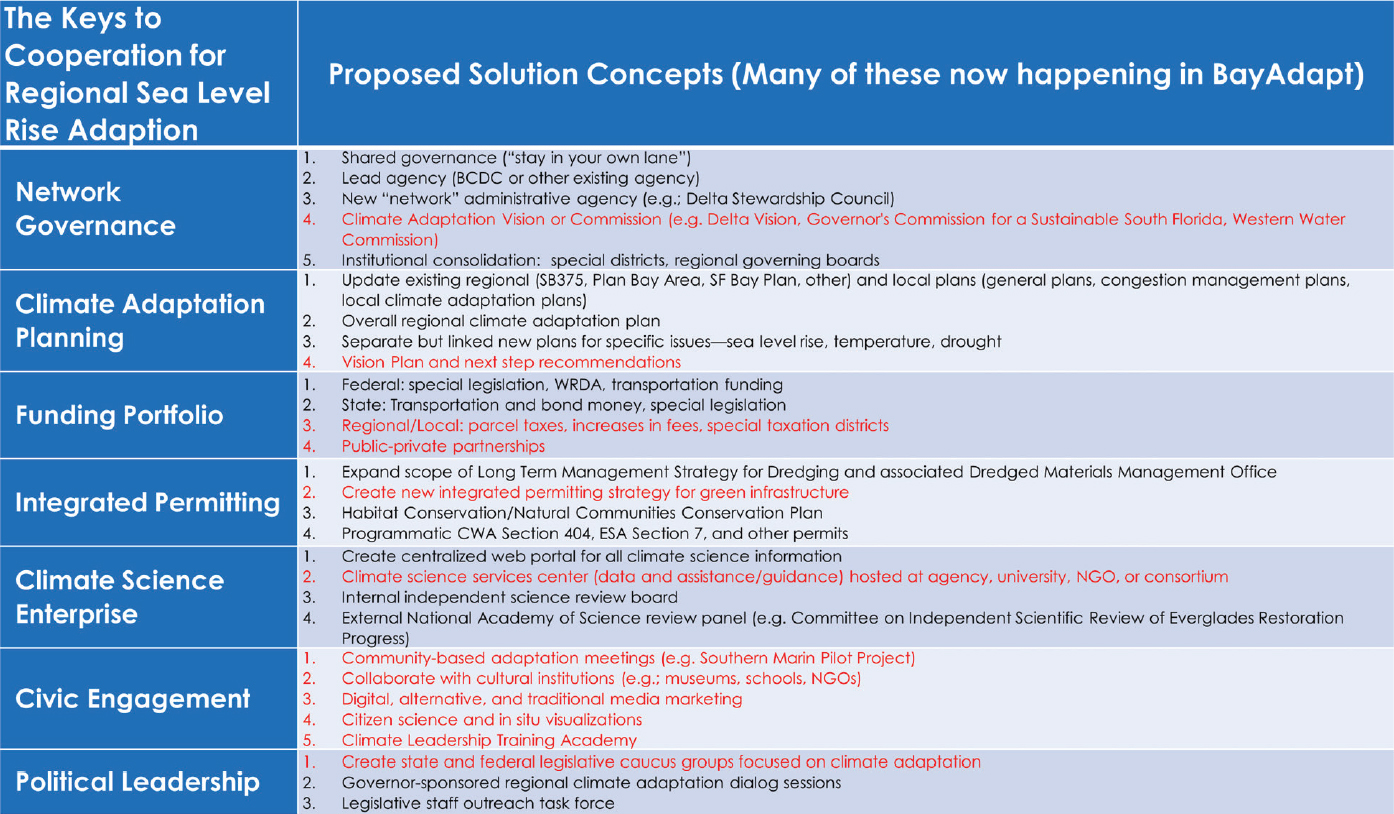
Lubell discussed cooperative efforts in the context of regional sea-level rise adaptation, emphasizing that climate change-related resilience necessitates collaboration among communities. Focusing specifically on the Bay Area’s infrastructure, he highlighted the interdependence of climate adaptation, noting that communities with similar vulnerabilities to sea-level rise can work together and learn from shared experiences, affecting regional responses and dictating physical interactions and adaptation. Lubell’s research on governance involved a mixed-methods approach, including surveys, interviews, focus groups, and comparative participant observations.6 He identified seven key elements crucial to cooperation for regional sea-level rise adaptation: network governance, climate adaptation planning, funding portfolio, integrated permitting, climate science enterprise, civic engagement, and political leadership (Figure 8-1).
The first key element of cooperation that Lubell highlighted was network governance, which involves participating in diverse types of organizations rather than working in isolation. He noted that, since 2008, planning efforts to address sea-level rise adaptation at the local and regional levels have increased in the Bay Area. He reflected on and advocated for a joint agreement on problem identification for climate change challenges. Lubell also observed that reaching a consensus on adaptation strategies proved challenging. While there is a general desire to plan and create partnerships, there is resistance to establishing an overarching regional decision-making authority—a governance challenge that may hinder collaboration. Nevertheless, Lubell said, “everybody believes climate change is real, at least among the policy actors, and that sea-level rise is a big problem.” He noted that agreement is lacking in terms of addressing and fixing the problem.
___________________
6 One example Lubell shared was the following paper: Lubell, M., Stacey, M., & Hummel, M. A. (2021). Collective action and governance barriers to sea-level rise adaptation in San Francisco Bay. Climatic Change, 167, 46.
SOURCE: Lubell, M. (2023). The Quest for Cooperation in Regional Sea Level Rise Adaptation (slide #17), presentation for the Workshop on Integrating the Human Sciences to Scale Societal Responses to Environmental Change. Reprinted with permission.
Lubell provided the example of the Bay Adapt7 project, which serves as the lead state agency for shoreline planning and permitting in the Bay Area, with the broader aim of developing a regional plan for sea-level rise adaptation. The project is integrating affected communities using a multilevel process, through leadership advisory groups, public forums, and working groups. Lubell recognized that environmental justice groups’ leverage and influence are diminished when projects are administered by an agency rather than grassroots groups.
The next element of cooperation Lubell stressed was the importance of community engagement, noting that sea-level rise is often perceived as a slow-moving natural disaster—which is to say psychologically distant compared to other natural disasters that have more immediate effects, such as earthquakes or wildfires. Highlighting the need to address inequities in risk and vulnerability, he acknowledged that sea-level rise exacerbates intersectional issues related to environmental and social factors. Furthermore, he raised the question of how vulnerability analysis can be linked to other susceptibilities, noting the challenges posed by resource competition, personality conflicts, and political pitfalls.
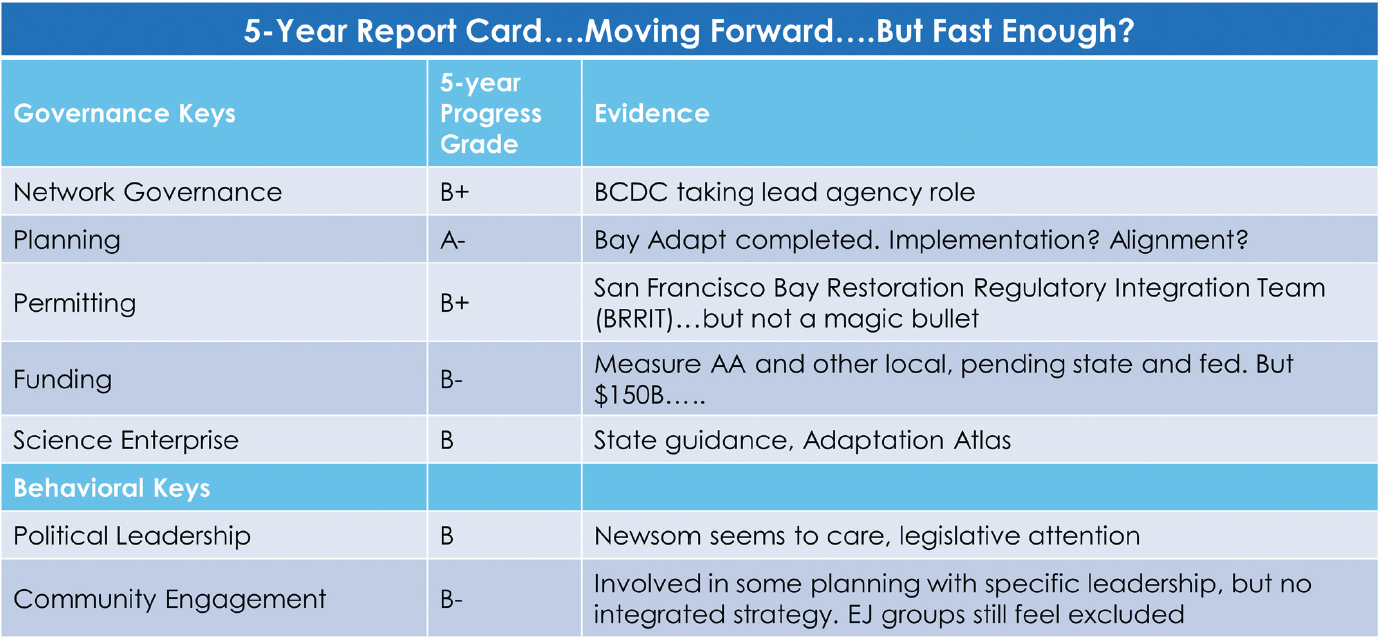
Lubell introduced a “5-year report card” for the Bay Area (Figure 8-2), highlighting several governance keys: network governance, planning, permitting, science enterprise, and funding and behavioral keys. The behavioral keys he mentioned were political leadership, community engagement, and partnership. Lubell explained that the overall five-year progress grade for the Bay Area was in the B range, noting that earning an A grade is difficult in any governance category, given the numerous constraints and the history of structural vulnerability and racism that exists in many urban places. He noted that this report card was not inclusive and was just one of the evaluation metrics urban areas can use to track development and progress for adaptation.
In conclusion, Lubell asserted that not only does climate adaptation require cooperation but, at the same time, collaborative governance presents both advantages and disadvantages. He emphasized the link between planning and justice, noting the intersectional nature of “slow-moving” natural disasters such as sea-level rise and the associated need for specific environmental justice coalitions. He called for an increase in longitudinal research to further explore these dynamics and promote effective collaboration in regional sea-level rise adaptation efforts.
___________________
7 Bay Adapt is an “initiative to establish regional agreement on the actions necessary to protect people and the natural and built environment from rising sea levels.” More information about Bay Adapt is available at https://www.bayadapt.org/
PANEL DISCUSSION
Following the panelists’ remarks, Silka moderated a question-and-answer session for Robinson and Lubell. First, she reflected on Lubell’s Bay Area report card as an approach to discuss effective and ineffective adaptation strategies. Lubell mentioned that the report card is a professional judgment based on observations about the area, and that more effective report card models are available. He emphasized that the core challenges lie in determining the basis for adaptation and resilience decisions, and he suggested the need for further work to evaluate adaptive measures.
The panelists also discussed the importance of establishing community resilience hubs in every region. When asked about convening entities to establish these hubs, Robinson highlighted that, in the case of Richmond, CA, which is home to Southeast Asian refugees with long-sustained environmental justice issues, language barriers are a significant consideration for adaptation. She suggested that capturing the interconnected issues and determining an appropriate response are crucial in bringing people together and providing actionable solutions.
The conversation then shifted to how decision making and information sourcing induce change. Silka acknowledged the nuanced nature of decision making. The panelists then discussed not only where and how to source information and data intended to effectively drive change but also suggestions for facilitating system networks and identifying leaders to champion these efforts. In reference to network governance, Lubell noted that no single entity is in charge. Instead, various agencies may take on specific leadership roles based on funding and expertise. He suggested that there is currently a dilemma because advanced leadership accountability is needed to improve the direction of adaptation. Finally, Lubell emphasized the importance of, and the need to invest in, self-organizing systems, as well as the critical role of researchers and practitioners in driving individualized organization.
Concerning the spread of sustainable approaches to new areas, Robinson shared her experiences in transforming communities. She mentioned the challenges associated with coordinating representatives from large areas of cities or states, and the assistance needed to obtain attention and action from local representatives. She emphasized the importance of community empowerment and highlighted the unexpected ways that shared efforts can pay off.
Regarding research connections and collaborating with youth, Robinson responded to a question about training youth to develop surveys and the possibility of fostering relationships or partnerships with schools, universities, and other institutions. She mentioned her experience creating internships, stipends, and youth-centered bodies or programs for environmental justice and resilience. She also highlighted the importance of teaching public speaking skills, utilizing social media, and creating informational videos to engage and educate youth.
This page intentionally left blank.


