A Research Agenda Toward Atmospheric Methane Removal (2024)
Chapter: 6 Research Agenda
6
Research Agenda
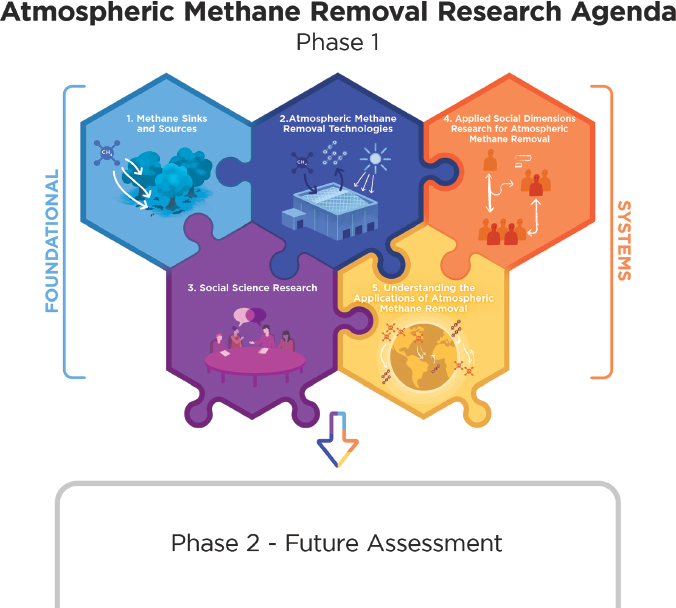
The Committee recognizes that atmospheric methane removal is an emerging area of research and has assessed the currently available information across sociotechnical dimensions in Chapters 4 and 5 of this report. However, for the task of fully assessing the need and potential for atmospheric methane removal, the Committee recommends a two-phase approach. In this first-phase report, the Committee has identified priority research questions that should be addressed within 3–5 years (see Figure 6-1). With the results from this research, a second-phase assessment could more robustly assess the viability of technologies to remove atmospheric methane at 2 parts per million (ppm)—from the perspective of both technical, economic, and broader social viability and the potential for climate-scale impacts. Advances in the recommended research areas and a second-phase assessment would inform any decision to move from knowledge discovery into more targeted investment in additional research, development, and/or deployment as well as help identify possible off-ramps for technologies that did not meet criteria based on performance and/or acceptability. It is beyond this Committee’s purview to specify the mechanism, process, or outcomes of any future phase-two assessment.
The utility of a sequence of reports evaluating the progress of emerging technologies has been demonstrated in the past—for example, carbon dioxide removal (CDR) was assessed in NRC (2015a) and again in NASEM (2019b); solar geoengineering was assessed first in NRC (2015b) and subsequently in NASEM (2021b). Smith et al. (2023, 2024) published the first and second reports establishing a series toward a comprehensive scientific assessment of the state of CDR. Pett-Ridge et al. (2023) outlined options for CDR across the United States, building on the body of literature and developing original analysis. As an example from another area of emerging climate technology, the National Renewable Energy Laboratory (NREL) assessed the potential for terawattscale photovoltaics initially (Haegel et al., 2017) and on a global scale (Haegel et al.,
2019). NREL has also produced a series of technical reports in collaboration with the International Energy Agency on the life-cycle assessment of photovoltaics (Frischknecht et al., 2020; Heath et al., 2015; Stolz et al., 2018). In these examples, earlier reports assessed the knowledge base and recommended research to advance understanding, and subsequent reports used research progress to provide recommendations about technology development, deployment, and guardrails. The Committee recognizes the value of moving research forward in the near term to inform understanding of atmospheric methane removal and assess the potential impact of this important emerging concept to inform decision making.
Recommendation 6.1: A two-phase assessment of the need and potential for atmospheric methane removal is needed.
- This report represents phase one, in which the Committee has developed recommendations for priority foundational and systems research across five areas that should be initiated in parallel within 1 year of publication.
- The research in phase one should be completed or significantly advanced to inform a phase-two assessment within 3–5 years of this report.
- In both phases, the research areas should be transdisciplinary and pursued as convergence research with deep disciplinary integration among research teams in early stages of inquiry to maximize learning across diverse fields.
The research agenda recommended in this chapter is organized into foundational and systems research needs. The foundational research questions seek to fill knowledge gaps in basic understanding of atmospheric and ecosystem methane sinks, atmospheric methane removal technologies (e.g., technical feasibility between 2 ppm and 1,000 ppm), and social dimensions of how publics and society would interact with research on atmospheric methane removal. The recommended foundational research not only would advance understanding of atmospheric methane removal but also would constitute an investment in filling knowledge gaps in other related fields, representing a cost-effective use of limited resources for research. The systems research questions seek to address what developing and/or deploying atmospheric methane removal at scale would entail from technological (e.g., inputs needed to achieve climate-scale removal per year) and social perspectives. The Committee has sought to distinguish between research questions that would be most useful to answer before a second-phase assessment (“high priority”) and those that may take longer but where progress would provide a valuable contribution to the phase-two assessment (“low to medium priority”). This prioritization of research questions does not imply an evaluation of potential impact of the research but reflects the current knowledge gaps that need to be addressed to enable a phase-two assessment.
Within the broad categories of foundational and systems research, the Committee has identified five research areas around which the recommended research questions are organized:
- Research Area 1: Methane Sinks and Sources
- Research Area 2: Atmospheric Methane Removal Technologies
- Research Area 3: Social Science Research
- Research Area 4: Applied Social Dimensions Research for Atmospheric Methane Removal
- Research Area 5: Understanding the Applications of Atmospheric Methane Removal.
The total number of research questions among Research Areas 1, 3, 4, and 5 are comparable, whereas Research Area 2 has the largest number of research questions, given the focus of this report.
To advance knowledge across the full range of sociotechnical dimensions that are relevant to informing a phase-two assessment, these prioritized foundational and systems research questions should be pursued in parallel. Furthermore, many of the foundational and systems research questions have interdependencies (as illustrated in Figure 6-1). For example, developing life-cycle and economic models (Research Area 5) will require inputs on the materials and reaction rates of the specific atmo-
spheric methane removal technologies (Research Area 2). Similarly, social perception and governance questions (Research Areas 3 and 4) would be informed by increasing the state of knowledge of existing atmospheric and ecosystem methane sinks (Research Area 1) and atmospheric methane removal technologies (Research Area 2).
In both phases, the recommended research areas should be integrative and transdisciplinary. By integrative, the Committee means research in which knowledge from different disciplines is integrative, perhaps evolving into a shared set of methods and concepts that comes to be used by collaborators. “Transdisciplinary” can refer to interaction between disciplines in defining the research but often includes other features: research that is socially engaged, reflexive, and focuses on real-world problems (Lawrence et al., 2022). Atmospheric methane removal falls into the broad categories of “wicked problems” or “grand challenges” within sustainability science—complex socioecological problems that demand working beyond disciplinary silos (Sundstrom et al., 2023). While convergent research lacks one standard definition, it is focused on deep integration of knowledge across disciplines to address socially relevant problems and create new fundamental knowledge; themes include addressing social justice, integrating team science, and requiring diverse teams (Thompson et al., 2023). The Committee recommends that research on atmospheric methane removal be funded through a convergent approach to maximize learning between social and biophysical sciences, for example, and ensure that the outputs of the research do not remain siloed but are used and integrated by people from diverse fields. Within the recommended research areas, not all individual research questions would require a transdisciplinary, convergent approach. This recommended approach would cohere with other research efforts funded by the National Science Foundation (NSF), such as the Convergence Accelerator1 or the Growing Convergence Research Program,2 or efforts funded through NSF’s Office of Integrative Activities.3
Each research area includes a description of the context motivating the specific research questions identified by the Committee as well as a description of the priority for informing a second-phase assessment, research program length, total cost (categorized as low [$5 million], medium [$20 million], or high [$50 million]), and potential funders. The research agenda is summarized in Table 6-2 at the end of this chapter. The Committee focused on public sector funding opportunities at U.S. federal agencies and identified opportunities for philanthropic and private research funding, as appropriate. Potential funders described in this chapter are meant to serve only as illustrative examples and should not preclude investments from those not listed (e.g., public sectors outside the United States). The final section of this chapter synthesizes the Committee’s recommendations and looks ahead to a phase-two assessment.
The Committee suggests that a reasonable initial investment in basic science that would help society understand the prospects of atmospheric methane removal is in the range of $50 million–80 million per year over 3–5 years. A research program of
___________________
1 See https://new.nsf.gov/funding/initiatives/convergence-accelerator.
2 See https://new.nsf.gov/od/oia/ia/growing-convergence-research-nsf.
this size would advance the five research areas recommended to inform a phase-two assessment, as outlined in Recommendation 6.1. The Committee emphasizes that any investment in the foundational research areas identified in this research agenda would also represent research investments to fill knowledge gaps in related disciplines (see Table 6-2), independent of progress toward atmospheric methane removal.
FOUNDATIONAL RESEARCH NEEDS
Previous chapters in this report outlined knowledge gaps across a wide range of areas that inhibit current understanding of the technical capabilities and physical and social implications of atmospheric methane removal. These gaps point to the need for foundational research on methane sinks; the technical potential of different atmospheric methane removal technologies; and the social dimensions across which people, social, and political systems may interact with these technologies. Foundational research also has synergies with other research fields such that investments in research motivated by atmospheric methane removal would be valuable investments toward informing unanswered questions in a wide range of other fields of study, from chemical engineering to microbiology to social science. Examples of these synergies are provided below and in Table 6-2. In this section, foundational research questions are identified across three themes: methane sinks and sources (Research Area 1); atmospheric methane removal technologies (Research Area 2); and social science research (Research Area 3).
Research Area 1: Methane Sinks and Sources
Atmospheric methane removal seeks to accelerate conversion of methane in the atmosphere to a less radiatively potent form, including through technologies that would enhance natural methane sinks in the atmosphere and managed ecosystems. Research is needed on these atmospheric and ecosystem methane sinks to reduce uncertainties in natural processes, improve understanding of the potential to enhance these sinks for atmospheric methane removal (see also Research Area 2), and inform estimates of the scale of atmospheric methane removal technology deployment required for climate-scale impacts (see also Research Area 5). Additionally, research to improve understanding of methane sources—particularly natural sources—would inform potential applications of atmospheric methane removal technologies (see also Research Area 5) and the potential consequences of these technologies on the lifetime and concentrations of atmospheric methane. Research to reduce uncertainties in the methane budget would also enable the monitoring, reporting, and verification (MRV) of atmospheric methane removal technologies (see also Research Areas 2 and 5).
Investments in the research questions identified in this area would also be valuable toward knowledge discovery in other fields of research including methane cycling; MRV of greenhouse gas (GHG) emissions and removals; biology; and atmospheric chemistry. In the sections that follow, this research area has been organized into research questions on atmospheric methane sinks, methane sinks in managed ecosystems, natural methane sources, and anthropogenic methane sources. Of the sub-areas outlined below,
advancing foundational research on methane sinks is the highest priority to inform any phase-two assessment.
Atmospheric Methane Sinks
The main atmospheric sink of methane (CH4) is oxidation by the hydroxyl radical (OH) (~90% of the total sink). Understanding of the oxidative capacity of the troposphere by OH is critical for understanding the potential for and consequences of any atmospheric methane removal technology. Current understanding of oxidative capacity has been inferred from measurements of methyl chloroform; however, as methyl chloroform concentrations have approached detection limits over the past decade, uncertainty in the oxidizing capacity of the troposphere has increased (see Chapters 2 and 3). New methods of monitoring the oxidative capacity of the atmosphere are needed to improve understanding of methane sinks, drivers of future methane trends, and the scale of atmospheric methane removal that would be needed for a climate-scale impact. New observational methods would also help to fill observational gaps in the chlorine (Cl) sink for methane (e.g., Röckmann et al., 2024).
Importantly, atmospheric oxidation enhancement (AOE) approaches that require large additions of chlorine or hydrogen peroxide to the atmosphere (see Chapter 4) would significantly affect the oxidative capacity of the atmosphere and atmospheric photochemistry. For example, large additions of chlorine to the atmosphere would compete with OH for reaction with methane, which would have nonlinear and cascading impacts for many organic and inorganic species in the atmosphere. Monitoring changes to the oxidative capacity of the atmosphere would be critical to understand the atmospheric impacts of any atmospheric methane removal technology, AOE in particular. Furthermore, better understanding of the oxidative capacity of the atmosphere would advance understanding of tropospheric chemistry more broadly, including for consequences of changes to the global energy system and other climate response strategies (Research Area 5). For the reasons described above, the research recommended in this sub-area is of high priority to inform a phase-two assessment.
Previous work has identified three promising directions for monitoring changes in the oxidative capacity of the troposphere and the methane sink. First, carbon-14-containing carbon monoxide (14CO) has been long-recognized as a useful tracer for OH (e.g., Brenninkmeijer et al., 1992). Briefly, 14C is formed in the stratosphere by cosmic rays and rapidly oxidized to form 14CO. This 14CO is then transported to the troposphere where it can be oxidized by OH. As such, the amount of 14CO that ultimately reaches the surface will be inversely related to the oxidizing capacity of the troposphere. This measurement is difficult and previously required very large air volumes. Recent advances have made this measurement more feasible (e.g., Petrenko et al., 2021).
Second, isotopic measurements could constrain the chlorine sink of methane (e.g., Röckmann et al., 2024). The oxidation of methane produces CO as an intermediate product. The chlorine sink of methane (CH4 + Cl) imparts a strong signal on 13CH4, whereas the OH sink of methane does not. As such, measurements of the ratio of 13C to 12C in CO (δ13C-CO) are indicative of changes in the chlorine sink of methane. The feasibility
of these measurements was demonstrated many years ago (Brenninkmeijer, 1993), but routine observations of δ13C-CO are not currently collected. Routine δ13C-CO measurements would illuminate the impact of halogens on the methane lifetime (Röckmann et al., 2024), which would be highly relevant to understanding AOE (Research Area 2).
Third, previous work (e.g., Holmes et al., 2013; Murray et al., 2014; Turner et al., 2018) has demonstrated that the oxidizing capacity of the troposphere generally will depend on the ozone photolysis frequency, specific humidity, sources of reactive nitrogen (i.e., nitrogen oxides [NOx]), and sources of reactive carbon (e.g., methane and volatile organic compounds) (see Chapter 2). Many of these species are observed from satellite observations. As such, recent work has developed preliminary satellite proxies of the oxidative capacity of the troposphere using pre-existing satellite observations (e.g., Anderson et al., 2023; Duncan et al., 2024; Souri et al., 2024; Zhu et al., 2022). These satellite proxies would provide spatial coverage that would complement the isotopologue measurements described above. The National Aeronautics and Space Administration (NASA), other international space agencies, and private companies operating and/or developing satellite observations could inform these efforts.
The National Oceanic and Atmospheric Administration (NOAA) currently operates a cooperative air sampling network in collaboration with international partners (NASEM, 2022c). The Institute of Arctic and Alpine Research (INSTAAR) at the University of Colorado Boulder currently analyzes NOAA’s air samples for the stable isotopes of carbon dioxide (CO2) and methane. Research Questions 1.1a and 1.1b should be carried out either by or in collaboration with NOAA and INSTAAR to expand their operational monitoring capacity. Support for this research would involve upfront instrument and personnel costs and would require sustained funding support to build a continuous measurement record, with a total program cost of $5 million–20 million. Additional research on the capabilities of satellite observations to constrain the oxidative capacity of the atmosphere (Research Question 1.1c) could be supported by NASA and/or private funders. The Committee recommends a research program that is carried out over 10 years, with interim progress assessed.
Research Question 1.1: How can changes in the oxidative capacity of the troposphere and lifetime of methane be monitored?
- How can an observational network that measures carbon-14-containing carbon monoxide in ambient air provide estimates of the oxidative capacity of the troposphere?
- How can an observational network that measures the ratio of 13C to 12C in carbon monoxide in ambient air provide estimates of changes in the chlorine sink of methane?
- How can satellite observations provide operational estimates of spatial variability in hydroxyl radicals?
- What is the potential (and limitation) for each of these methods to enable monitoring of the atmospheric oxidation enhancement technologies both locally and globally, described in Research Area 2?
Methane Sinks in Managed Ecosystems
Methanotrophs in soils, aquatic systems, and foliar systems are natural methane sinks that could be enhanced to remove atmospheric methane (see Chapter 4). Methanotroph activity can be enhanced by increasing the quantity or distribution of efficient microbial types, enhancing nutrient conditions to facilitate their activities, or providing more surfaces for naturally emerging populations; these activities will vary by system type and biogeochemical constraints. Basic gaps in the understanding of the factors controlling methanotrophy in different global ecosystems remain. Advances in this foundational research area would improve understanding of the potential and efficacy of ecosystem uptake enhancement (Research Area 2).
In any soil environment, the most influential soil properties that alter methane uptake are related to the rate of gas diffusion into soils (e.g., water-filled pore space, bulk density, temperature) and to the biogeochemical factors that affect the activity of methanotrophs and methanogens (e.g., soil carbon, nutrient status, pH, plant populations, temperature). Soil systems are complex; accurate modeling of methane uptake by methanotrophs depends on understanding the biology of microbes in situ as well as nutrient cycling from different management practices and landscape alterations from climate change impacts. Understanding the conditions under which different soil systems can enhance methane uptake would inform the development of atmospheric methane removal technologies that could enhance these natural processes. Research questions in this area are complementary to questions on ecosystem uptake enhancement in Research Area 2.
Research Question 1.2 could be explored over 10 years for $5 million–20 million. Federal agencies, including the U.S. Department of Agriculture (USDA), U.S. Geological Survey, NSF, U.S. Department of Energy (U.S. DOE), and U.S. Agency for International Development (USAID) would be well suited to fund this research. The fundamental research on methanotrophy (foliar, soils, others) could lead to new management approaches in environments providing key ecosystem services (e.g., grasslands, forests, wetlands, arid or semi-arid regions), including to enhance the methane sink. Research in this area would also represent an investment in knowledge gaps in the carbon cycle, agronomy and soil science, forestry, biology, microbiology, and ecology by improving understanding of methanogens/methanotrophs in ecosystems and how they respond to a variety of environmental/climatic conditions. This research is of high priority for any phase-two assessment because understanding ecosystem sinks would inform both the climate relevance of managing these sinks—for example, water sources (as watersheds are channeled or dams constructed), geochemical inputs by erosion or transport, conservation of areas prone to effective removal or exclusion of activities that lower methanotrophy—as well as the natural processes relevant to the potential of ecosystem uptake enhancement (Research Area 2).
Research Question 1.2: Under what conditions do methanotrophs maximize their uptake of atmospheric methane in different environments?
- Under what in situ conditions do novel and known methanotrophic taxa reach their highest activity in terrestrial (managed and unmanaged soils), aquatic, and foliar environments, and what are their key biogeochemical constraints?
- What are the functional limits (e.g., conditions, nutrients, and metabolic competition) of methanotrophic taxa operating at or near atmospheric methane concentration levels in cultures and in diverse ecosystems (~2 parts per million)?
- What factors determine which plants favor higher rates of methanotrophy (and thus methane removal) while others do not?
- What factors limit foliar methanotrophy (e.g., biomass, solar radiation stress, nutrient limitation)?
Terrestrial soils are an important ecosystem methane sink (~5% of the total global methane sink; see Chapter 2) (Saunois et al., 2024). While soils under frequent water-saturated conditions can represent sources of methane, these environments also contain methanotrophic microbes that can consume methane at near-atmospheric levels (Cai et al., 2016; Conrad & Rothfuss, 1991; Frenzel et al., 1992; Tveit et al., 2019). Atmospheric methane oxidation has been detected in wetland soils during dry seasons or intense droughts, though the magnitude of this sink is uncertain. While well-drained soils may serve as consistent sinks for atmospheric methane (including upland permafrost soils), the rates of natural atmospheric methane removal activity are affected by various processes, including seasonal variation in pristine lands, land use change, and management practices of converted lands (particularly agricultural and grazing lands). Better understanding of methane fluxes from soils is needed to consider both the process and impacts of enhancing natural removal processes via ecosystem uptake enhancement.
Managed systems are potentially attractive ecosystems for enhancing atmospheric methane removal because they are sites where humans already interact with the landscape. Agricultural soils, which represent a large land area globally, represent one managed ecosystem where enhanced methane removal could be considered. More broadly, anthropogenic land use changes can impact the methane fluxes of ecosystems due to land conversion or other anthropogenic interventions. Research needs in both areas are described below. The Committee estimates that Research Question 1.3 could be explored over 10 years for $5 million–20 million. Government agencies (e.g., USDA, NSF, USAID) as well private funders (e.g., philanthropies promoting agricultural, reforestation, or carbon market developments) would be well suited to fund this work. This research is also of high priority for any phase-two assessment for the reasons described above.
Key uncertainties limiting understanding of the methane sink in agricultural soils include the maximum rate of methane consumption across different croplands, the spatiotemporal variation of soil methane consumption for most crops and regions based on localized biogeochemical constraints, and variations in removal effects due to different land management or land use strategies. Research into the development of cropping and grazing systems with enhanced methane uptake would provide valuable information about the mechanisms that affect methane uptake and would provide tools for producers to select systems or practices that would enhance atmospheric methane removal. Cropping systems utilizing reduced/deficit irrigation, crop residues to enhance soil carbon, alternate fertilizer management (including source, rate, and placement), soil amendments that alter pH, crop rotations, and other management strategies could be
investigated to develop optimal systems for atmospheric methane removal and improve overall soil health. Grazing systems utilizing rotational grazing, fertilization, and soil amendments could improve overall soil heath, productivity, and carbon sequestration as well as enhance atmospheric methane removal. Research could be conducted at the plot to landscape scale to assess treatment or management strategies and capture interactions within the environment.
USDA would be well suited to fund relatively low-cost research that would analyze existing data from the GRACEnet (Greenhouse Gas Reduction through Agricultural Carbon Enhancement Network) program on methane fluxes in soils from a wide range of climatic regions, soil types, cropping systems, and management (tillage, irrigation, etc.) to evaluate the potential methane sink of U.S. agricultural soils and identify practices that may enhance this sink. Additionally, the National Strategy to Advance an Integrated U.S. Greenhouse Gas Measurement, Monitoring, and Information System (GHGMMIS) recommends that USDA establish the national Soil Organic Carbon Monitoring and Research Network, which would monitor soil carbon changes over time across agricultural systems (The White House, 2023b). The recommended research would complement this new network by providing data related to carbon cycling in a variety of agricultural systems and improving estimates of methane fluxes.
Additionally, the biological methane cycle is highly sensitive to land use and natural landscape changes that promote warm, wet, carbon-rich environments that stimulate methane production over methane consumption. Across terrestrial ecosystems, undisturbed forests, grasslands, and shrublands have been shown to remove methane at the highest rates (Chen et al., 2011; Singh & Gupta, 2016). Atmospheric methane removal rates are adversely affected by anthropogenic activities (e.g., forest harvesting, roads and transiting, mining, burning, and urbanization) that reduce soil structure and quality. Reforestation and afforestation are common ecosystem restoration approaches that have been proposed and documented to increase soil methane consumption (Hemes et al., 2018; Hiltbrunner et al., 2012; Nazaries et al., 2011; Wu et al., 2018); however, land restoration efforts may not improve methanotrophic activity in soils to the extent of nondegraded sites (J. Wu et al., 2020). Research is needed to improve understanding of how and in what direction landscape-scale changes impact methane fluxes, how interrelated cycles (e.g., N-cycle, atmospheric oxidants) further alter the accumulation and persistence of atmospheric methane, and what the limitations are to recovering or enhancing soil methanotrophy in restored ecosystems.
Research Question 1.3: How are ecosystem methane sinks impacted by amendments and/or management practices?
- Which ecosystems are increasing capacity as methane sinks, and which are losing capacity?
- What are the rate and biogeochemical constraints of atmospheric methane consumption in environments with the potential for methane removal enhancements including wetlands, rice paddies or other wet soils during dry periods, grazing lands, drylands, Yedoma soils, floating vegetation, leaves, and tree stem surfaces?
- How do management factors (e.g., soil tillage, irrigation, fertilization regime, ecosystem amendment) influence the rate of methanotrophy in situ, and can these factors be optimized and directed toward atmospheric uptake?
- What is the capacity of agricultural soils to serve as a sink for atmospheric methane? What soil conditions, biogeochemical factors, climatic conditions, and management practices (e.g., tillage, irrigation, fertilization, grazing strategies) stimulate or decrease methanogen and methanotroph activities?
- What impacts do land use changes in managed (e.g., agricultural, reservoirs, forests) systems have on methane fluxes from ecosystems?
Natural Methane Sources
The Global Carbon Project publishes a living review every 4 years synthesizing decadal estimates of the methane budget based on ensembles of bottom-up and top-down approaches (Kirschke et al., 2013; Saunois et al., 2016, 2020, 2024). These budgets also outline key research needs that would improve future budgets. The Committee seeks to build on, rather than reproduce, these existing efforts, and it highlights in this and the following research sub-area specific questions that would inform potential applications of atmospheric methane removal technologies and understanding of the scales of atmospheric methane removal needed for climate-scale impacts.
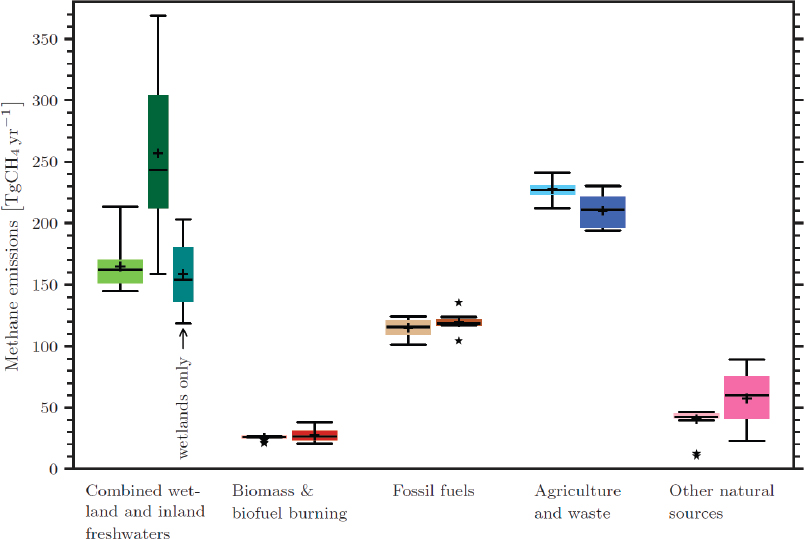
Figure 6-2 shows estimates of global methane emissions for 2010–2019 from Saunois et al. (2024). There are large uncertainties in natural methane sources where historically less attention has been dedicated to source-level monitoring—in part due to their high spatiotemporal variability—and these sources are sensitive to the impacts of climate change (see Chapters 2 and 3). New research in the global methane budget (Saunois et al., 2024) also estimates the role of natural and indirect anthropogenic methane emissions associated with wetlands and inland freshwater systems, including ~30 teragrams (Tg) CH4 yr-1 emitted by reservoirs (Jackson et al., 2024). Changes in natural methane sources could counteract reductions in anthropogenic emissions and contribute to a potential “methane emissions gap” (see Chapter 3), and approaches to mitigate these emissions are not currently available. To understand the potential need for applications of atmospheric methane removal technologies, research is needed to reduce uncertainties in current and projected changes in global methane emissions from wetlands and lakes, natural geologic sources, and permafrost soils and thermokarst.
Wetlands are the largest source of natural methane emissions, accounting for 159 (119–203) Tg CH4 yr-1 or ~50 percent of natural and ~24 percent of total global methane emissions, and lakes are the second largest source of natural methane emissions (53 [19–86] Tg CH4 yr-1) (Saunois et al., 2024). The latest global methane budget summarized recent advances to reduce uncertainties in emissions from wetland and inland freshwater systems (Saunois et al., 2024); however, these sources remain the most uncertain components of the global methane budget (see Figure 6-2). Research is needed to improve observations and models of current emissions from wetlands and projections of the climate feedbacks on emissions from wetlands and lakes, particularly in light of the fact that current climate response policies do not account for the potentially
SOURCE: Saunois et al. (2024).
increasing role of methane emissions from wetlands (Zhang et al., 2017). Synergies may exist between understanding these climate-methane feedbacks and climate-carbon cycle feedbacks more broadly, as well as the emissions mitigation or removals required to offset such anticipated feedbacks.
Some studies attribute increases in atmospheric methane concentration since 2007 to rising microbial emissions (Oh et al., 2022) linked to positive climate feedbacks on tropical, sub-tropical, and northern wetland emissions (L. Feng et al., 2022; Zhang et al., 2023); however, large uncertainties remain in the attribution of methane trends over this time period (e.g., Turner et al., 2017, 2019), indicating a need for more research. There are large regional differences in the methane isotopic source signatures from these aquatic ecosystems (Brosius et al., 2012; Ganesan et al., 2018; Haghnegahdar et al., 2023; Walter Anthony et al., 2016). Improved monitoring of stable methane isotopes and source signatures could help track sources, changes in methane emissions, and
improve model estimates. A suite of measurements—including eddy covariance, tall towers, aircraft, drones, and satellites—could improve understanding of the magnitude and patterns of methane fluxes. Research could be conducted at the field/landscape scale over at least 5 years to understand fluxes in methane emissions from wetlands and lakes.
Natural geologic methane emissions are one of the most uncertain terms in the global methane budget (Etiope & Schwietzke, 2019). Bottom-up approaches attribute 45 (18–63) Tg CH4 yr-1 to natural geologic sources (Saunois et al., 2024), while top-down constraints from measurements of 14C-CH4 in ancient air trapped in polar ice cores suggest that the geological methane source is an order of magnitude smaller (Dyonisius et al., 2020; Hmiel et al., 2020; Petrenko et al., 2017). These sources have been comprehensively mapped outside the Arctic, with diffusive microseepage fluxes dominating emissions (24 Tg CH4 yr-1) (Etiope et al., 2019), albeit with high uncertainties due to a paucity of flux data covering the wide range of hydrocarbon basin characteristics worldwide. Far less is known about natural geologic methane emissions in the Arctic and Antarctic, yet permafrost and ice sheets are thought to cap vast pools of methane that will be more vulnerable to escape as the cryosphere degrades due to climate change (Kleber et al., 2023; Sullivan et al., 2021; Wadham et al., 2019; Walter Anthony et al., 2012). An opportunity exists to use fieldwork and remote sensing tools to better quantify natural geologic methane emissions in polar and non-polar emissions and their responses to a changing climate.
Direct emissions from permafrost soils are currently small contributors to the global methane budget (1 [0–1] Tg CH4 yr-1), though current wetland and freshwater methane emissions already likely include an indirect contribution from thawing permafrost (Saunois et al., 2024). Natural methane emissions estimates can also be uncertain as many models assume homogeneity in tundra landscapes and fail to account for natural fluxes in net ecosystem exchange where CO2 and methane are regularly in flux (Ludwig et al., 2024). While currently a small natural methane source, ice-rich permafrost soils, known as Yedoma and formed during the last Ice Age, harbor a large pool of frozen soil organic carbon (~450 billion tons) (Hugelius et al., 2014, 2020). The formation of thermokarst (thaw) lakes is currently the most widespread form of permafrost thaw leading to mobilization of this ancient permafrost carbon and its transformation by microbes in anaerobic lake bottoms. Yedoma thermokarst lakes have the highest methane emissions among all permafrost-region ecosystems (Delwiche et al., 2021; Treat et al., 2018; Walter Anthony et al., 2018, 2021); however, new evidence suggests talik (thaw bulb [perennially unfrozen soil layers in permafrost regions]) formation in well-drained permafrost uplands leads to unexpectedly high methane emissions (Walter Anthony et al., 2024), with large implications for permafrost-climate feedback modeling.
These lakes and Yedoma uplands also host highly active methanotrophic bacteria that consume methane dissolved in lake water (Martinez-Cruz et al., 2015) and aerobic surface soils (Walter Anthony et al., 2024). Nonetheless, preferential-flow pathways in thawed sediments allow methane to escape to the atmosphere, bypassing oxidation in both systems. Development of novel remote sensing approaches (Engram et al., 2020) provides an opportunity to identify lakes with the highest methane emissions to target research related to methane mitigation and atmospheric methane removal. New
ground-based and airborne methods of methane hotspot imaging on land (Elder et al., 2021; Gålfalk et al., 2016) could be useful for identifying upland-talik methane hotspot locations as targets for methane mitigation and/or atmospheric methane removal.
Research in this sub-area is a medium priority (after atmospheric and ecosystem sinks) for any phase-two assessment because better understanding natural methane sources and climate feedbacks would help quantify the potential “methane emissions gap” and the scale of atmospheric methane removal that may be needed. This research would also advance knowledge in other fields of research on the carbon cycle, GHG observing systems, paleoclimate, and climate modeling. The Committee estimates that Research Question 1.4 could be explored over 5–10 years for at least $20 million–50 million. This research could be funded by a variety of federal agencies (e.g., U.S. DOE, NASA, National Institute of Standards and Technology [NIST], NOAA, NSF) as well private funders and industry.
Research Question 1.4: What is the magnitude and variation of methane emissions from natural sources (wetlands and lakes, natural geologic sources, permafrost soils and thermokarst), and how are these emissions projected to change under future warming scenarios?
- How can observational (fieldwork and remote sensing) tools be used to quantify methane emissions from natural sources more accurately, including better characterization of seasonal and episodic fluxes?
- How are natural emissions changing in response to current warming? How can models used for future emissions projections be improved to include climate feedbacks on natural methane fluxes?
- Are there regions of high-concentration natural emissions that could be addressed with methane mitigation or atmospheric methane removal technologies?
Anthropogenic Methane Sources
Relative to the other components of the methane budget, anthropogenic methane sources are well characterized (see Figure 6-2). Unlike global anthropogenic emissions of CO2, which are dominated by large industrial sources, anthropogenic methane emissions come mostly from smaller distributed point sources, and emissions occur at diffuse concentrations below the limit (~1,000 ppm) of currently available methane oxidation technologies (see Chapters 2 and 3).
Research funding in the public and private sectors has supported advances in observing systems for large methane point sources and data and modeling tools that have improved estimates of methane emissions from the major anthropogenic sources: fossil fuels, agriculture, and waste (see Chapter 2). In addition, regulatory requirements—for example, the U.S. Environmental Protection Agency (EPA) Greenhouse Gas Reporting Program (GHGRP)—have improved data availability (see Chapter 2). Given robust existing efforts in this space, the section below identifies targeted research needs related to current knowledge gaps in anthropogenic methane sources that are hard-to-abate because they are diffuse and/or have limited or no mitigation options available
(see Chapter 2), making them relevant to research on atmospheric methane removal. Additionally, monitoring tools utilized or developed to support this research could inform the development of MRV tools for atmospheric methane removal technologies (Research Question 1.6). For the reasons stated above, this sub-area is the lowest priority from Research Area 1 for a phase-two assessment.
Methane emissions from agriculture represent 40 percent of total anthropogenic emissions (143 [132–155] Tg CH4 yr-1, with 112 [107–118] Tg CH4 yr-1 from enteric fermentation and manure and 32 [25–37] Tg CH4 yr-1 from rice cultivation) (Saunois et al., 2024). Emissions from both enteric fermentation and rice paddies are typically diffuse where production systems tend to be most extensive. Accurate determination of ruminant enteric emissions and development of mitigation strategies in extensive production systems remain a challenge. In addition, in confined livestock production systems, manure management can become a significant source of on-farm methane emissions when manure is stored as a liquid where anaerobic conditions are maintained, generating hot spots of methane emissions. Improving methane emissions estimates from manure storage would enable more accurate reporting and improve quantification of potential reductions from the application of methane mitigation or atmospheric methane removal technologies. Research recommended below on hard-to-abate agricultural sources would complement strategic objectives identified elsewhere (e.g., PCAST, 2024; The White House, 2023b) and resources already allocated (e.g., $70 million to USDA’s Agricultural Research Service from the Inflation Reduction Act).
The Committee estimates that Research Question 1.5a could be explored over 5–10 years for at least $50 million. In addition to USDA, private industry would be well suited to contribute funding for this research. This research could be useful to inform the phase-two assessment because it would improve understanding of baseline emissions and inform whether targeted atmospheric methane removal or improved mitigation technologies could be applicable to these sectors. However, the scale and length of research may limit the data available in 3–5 years.
Emissions from coal mines and landfills account for large sources of methane in the United States and globally, and Chapter 3 introduced the state of recovery and use of concentrated methane from these sources. Coal mine ventilation of relatively dilute (<1,000 ppm) methane presents a potential opportunity to oxidize and/or utilize this methane should technologies that operate at lower methane concentrations be developed (Research Area 2); however, the magnitude and temporal variation of these emissions could be better constrained. Improved understanding of coal mine ventilation emissions could make a more compelling case to mine operators and developers regarding the potential for methane conversion projects. This research would also inform Research Area 5, which considers optimal systems for demonstration or deployment of atmospheric methane removal technologies. The GHGMMIS recommends the formation of a Coal Mine Emissions Working Group to coordinate federal efforts to improve emissions estimates, particularly to reconcile atmospheric- and activity-based estimates of emissions from active underground coal mines (The White House, 2023b), which would be complementary to Research Question 1.5b.
Municipal solid waste landfills account for the largest source of methane emissions in the waste sector in the United States (U.S. EPA, n.d.d). Emissions of landfill
gas vary depending on site-based operational conditions, which may not be well represented in emissions estimates. Recent remote sensing observations of 20 percent of U.S. landfills found significant and persistent methane emissions and found large discrepancies between estimates from the GHGRP and airborne observations (Cusworth et al., 2024). Improved estimates of landfill methane emissions could similarly inform mitigation opportunities as well as lessons learned for the development of atmospheric methane removal technologies that could operate at lower methane concentrations than those at landfills. Complementary to Research Question 1.5c, the GHGMMIS also recommends improving emissions estimates from landfills using activity- and atmospheric-based approaches and developing cost-effective measurement and monitoring approaches. U.S. EPA currently is funding $4.6 million in research grants for developing cost-effective approaches for quantifying landfill emissions using different types of measurements.4
The Committee estimates that Research Questions 1.5b and 1.5c could be explored over 5–10 years for $20 million. Potential funders of this research could include the U.S. Department of the Interior, U.S. EPA, NASA, NOAA, NIST, and private industry.
Research Question 1.5: How much hard-to-abate methane is emitted globally at concentrations above and below those that can be oxidized using available technologies (i.e., ~1,000 parts per million)? What are the opportunities for the application of mitigation or atmospheric methane removal technologies to these sources?
- For hard-to-abate agricultural sources (e.g., extensive livestock systems, manure management, leaks from digesters and advanced treatment systems, paddy rice systems), what are the concentrations, volume, and mass flow rates of methane, and how consistent are they through time? What available methane mitigation or atmospheric methane removal technologies could be applied to these sources?
- For hard-to-abate fossil fuel sources (e.g., operating and abandoned coal mines), what are the concentrations, volume, and mass flow rates of methane, and how consistent are they through time? What available methane mitigation or atmospheric methane removal technologies could be applied to these sources?
- For hard-to-abate waste sources (e.g., municipal solid waste landfills and water treatment facilities), what are the concentrations, volume, and mass flow rates of methane, and how consistent are they through time? What available methane mitigation or atmospheric methane removal technologies could be applied to these sources?
Research Question 1.6: How could monitoring tools developed for diffuse anthropogenic methane sources be utilized or adapted to support the monitoring, reporting, and verification of atmospheric methane removal technologies described in Research Area 2?
___________________
4 See https://www.epa.gov/research-grants/understanding-and-control-municipal-solid-waste-landfill-air-emissions-grants.
Research Area 2: Atmospheric Methane Removal Technologies
Chapter 4 of this report provided a preliminary assessment of atmospheric methane removal technologies based on information available at the time of writing. However, the knowledge base for these technologies—particularly their potential application and efficacy at atmospheric methane concentrations (2 ppm)—is very limited. Research on methane removal at 2 ppm can lower the concentration limit at which currently available mitigation technologies operate (~1,000 ppm; see Chapter 3). To advance knowledge about the technical potential of atmospheric methane removal technologies considered in this report, foundational research is needed to inform any phase-two assessment. This second assessment phase would examine technology feasibility against a set of criteria deemed to be appropriate at that time. The questions presented in this research area are intended to guide these technologies along a development path that would allow for the development of appropriate feasibility criteria. Outcomes from this research area will also inform Research Area 5 on applications of atmospheric methane removal. Questions in this research area are organized by the five atmospheric methane removal technologies considered in this report.
Methane Reactors
Chapter 4 detailed the major challenges for methane reactors to process large volumes of air containing low concentrations of atmospheric methane (necessitating notable energy input) to realize a climate-scale benefit. Energy needs of methane reactors are increased further by methane’s symmetric, small, non-polarizable, non-polar properties. Reactor operations and their reactive components that can efficiently process methane at ambient concentrations are part of an important research area. All reactive technologies described here should be assessed in the context of the overall energy balance of operation not only to ascertain what is technically possible but also to consider the energy use, critical materials supply, and eventually the cost of implementing the studied approach (see Chapter 5).
Research Questions 2.1–2.4 could be completed in the short term (1–5 years). Research Question 2.5 should occur over a longer-term timeframe, specifically 3 years after the start of Research Questions 2.1–2.4, and be completed over a 3–7 year timeline. Given the important role of reactor performance in determining the feasibility of this technology, the priority for these research questions is moderate. Accordingly, the Committee determines that a moderate amount of funding ($20 million) would be appropriate to support these research efforts. Assessments are likely to be calculation-based, process modeling studies informed by laboratory-scale experiments and available data from the literature. Relevant funding sources include the applied offices of U.S. DOE and interested private entities. As an indicator of demand for this type of research support, a philanthropic funding opportunity for atmospheric methane removal (excluding iron salt aerosol) in 2024 received 47 research proposals totaling more than $13 million and involving more than 100 researchers and 91 institutions (Spark Climate Solutions, 2024).
Research Question 2.1: How can technologies based on heterogeneous, inorganic methane combustion catalysts be enhanced to allow for combustion of atmospheric methane?
- How dilute can the methane concentration be while still allowing for efficient operation of a methane combustor?
- How can the temperature of operation of heterogeneous, inorganic methane combustion catalysts operating with feeds of <1,000 parts per million be reduced while limiting use of scarce elemental resources?
- How can designs be optimized for durability?
- Are there competing reactions from other atmospheric compounds that affect reaction rates?
Research Question 2.2: Biocatalysts will typically operate in an aqueous phase, while atmospheric methane is in the gas phase. Given the ultra-dilute nature of methane in the atmosphere, bioreactors operating at atmospheric methane concentrations will often be mass transfer–limited unless they incorporate materials that can overcome this limitation:
- Can changes to the matrix/composition of supported biocatalysts and/or efficient reactor designs enhance mass transfer and reaction rates for methane consumption using biocatalysts?
- If mass transfer is not limiting under conditions relevant to atmospheric methane concentrations, can genetic engineering or synthetic biology create new, more efficient methane-consuming biocatalysts that operate at low methane concentrations?
Research Question 2.3: Do other reactor types, such as those that use highly reactive intermediates like radicals or plasmas, offer the potential for atmospheric methane conversion to products with low global warming potential?
- Do non-catalytic reactors efficiently convert methane at 2 parts per million (ppm), 200 ppm, or 2,000 ppm methane concentrations?
Research Question 2.4: How low can the minimum methane concentration be pushed for different catalysts and reactors to still achieve acceptable catalyst durability, reaction rates, and energy use? The answer to this question sets potential concentration targets for product streams from methane concentrators.
Research Question 2.5: It can be instructive to consider the scalability and overall climate impact of different approaches if deployed at a scale that impacts atmospheric methane concentrations:
- Given the measured and/or calculated reaction rates for all of the previously discussed technology types, what land area would be needed for deployment of each technology to achieve climate-scale impacts? What energy source would be necessary to enable a positive impact on climate?
- What reaction rates would be needed for the different reactor technologies to achieve climate-scale impacts? How do these reaction rates compare to the measured/calculated rates for each reactor type?
- What would be the impacts on atmospheric circulation, atmospheric chemistry, critical materials and other resources, and global energy and land use of climate-scale deployment of each of these technologies?
Methane Concentrators
Methane has been a key feedstock for the oil and gas industries for more than a century. As such, considerable research and development has been focused on fractionation of streams containing methane and other light gases, as well as conversion to more valuable products. Owing to its unique physical properties, methane is an exceptionally difficult molecule to selectively sorb into liquids or onto solids and is rarely converted to more valuable products by routes other than through formation of synthesis gas (hydrogen and CO). Such technologies generally require concentrated methane feeds to create favorable economics. Similarly, the molecular size of methane is so close to that of nitrogen gas that membrane separations by molecular sieving are challenged at the ultra-dilute methane concentrations found in air. If a suitable material were to be identified, the energy requirement for moving huge amounts of air would also limit the scalability of methane concentrators (see Chapter 4).
Efficient methane sorbing materials and methane concentrators, should they be developed, would enable downstream technologies that might efficiently combust methane or convert methane into other useful products.
Research Question 2.6 can be investigated in the short term (1–5 years), with Research Question 2.7 beginning no sooner than 5 years following that effort (in a 5–10 year timeframe). Research Question 2.8 can be undertaken in the short term. All research questions for methane concentrators can be conducted at the laboratory scale. The Committee determines these research needs to be of relatively low to moderate priority for informing a phase-two assessment of atmospheric methane removal due to the early stage of this research, with relatively lower level of financial support required ($5 million–20 million). Potential funders include U.S. DOE Basic Energy Sciences, the relevant directorates of NSF (e.g., Engineering, Biological Sciences), and interested private entities. Given the amount of research progress that would be required for methane concentrators to reach viability, high-risk, high-reward funders like U.S. DOE’s Advanced Research Projects Agency–Energy or a prize-funding system like XPRIZE could be appropriate mechanisms for supporting this research.
Research Question 2.6: In the past few decades, new classes of adsorbents and solvents (collectively referred to as sorbents) have been developed:
- Can sorbents that efficiently concentrate methane from 2 parts per million (ppm) (bulk air concentration), 50 ppm (representative dairy barn concentration), or 200 ppm (representative coal mine concentration) to concentrations >100-fold higher upon desorption be identified? Similarly, can membranes that offer a similarly concentrated permeate be identified?
- When the separation materials are combined with a suitable air/sorbent or air/membrane contacting process, does the process offer suitable energy efficiency and projected cost to merit further research and development at larger scales?
Research Question 2.7: Among the most promising near-term engineered atmospheric methane removal technologies is catalytic combustion, owing to the maturity of the technology when using concentrated methane feeds. However, effective devices that can operate below ~1,000 parts per million methane in the feed are rare or unknown. Thus, methane concentrators that can produce enriched methane streams from more dilute feeds at levels suitable for methane combustors are an important target:
- What separators or arrays of separators can efficiently concentrate methane to the levels needed by methane reactors? After “minimum activation concentrations” are determined for different methane reactor technologies, their integration with suitable methane concentrators may be considered, seeking energy and cost-efficient combinations.
Research Question 2.8: Large industrial installations exist around the world today that separate the major components of air (e.g., oxygen, nitrogen, argon) for societal use. For industries with deep technology experience in this space, what would be the added energy use and cost required to concentrate carbon dioxide and/or methane from these existing processes?
Surface Treatments
Surface treatments containing catalysts rely on passive contact with atmospheric methane to convert it into a less radiatively potent product. Like methane reactors, efficient rates of oxidation of methane at relevant atmospheric concentrations will benefit these technologies. Additionally, due to exposure to the natural or built atmosphere, surface treatments will need to be effective within a relatively narrow temperature range compared to methane reactors. To be able to assess the climate-scale impact of surface treatments, additional fundamental knowledge into the rates of methane destruction under applicable reaction conditions is required for all proposed classes of materials (Research Question 2.9). These studies should be performed using actual or simulated gas compositions, reaction temperatures, and/or solar irradiance to be able to derive relevant reaction rates that would inform the efficacy of these interventions in a phase-two assessment of technologies.
Beyond methane removal reaction rates, information about the durability of surface treatments and potential co-benefits or conflicts is necessary to accurately assess the life-cycle impacts and cost of deploying this approach for comparison against other types of removal and mitigation approaches, should methane destruction rates be found to be potentially impactful at climate-relevant scales (Research Questions 2.10–2.13).
Development of the ability to directly measure the impact of deployed surface treatments on the nearby atmospheric methane concentration—for example, via very sensitive eddy flux covariance measurements or reliable models that describe the methane removal efficiency over the course of a surface treatment’s lifetime—is needed for reliable MRV (Research Question 2.14). Appropriate instrumentation may need to be developed to perform these measurements in a cost-effective and scalable manner.
These types of research activities are similar to those undertaken in materials science, catalysis, and sensing programs funded by federal research agencies. The research
activities span fundamental through applied science and technology development. The Committee estimates that this research could be conducted in the short-term (1–5 year) timeframe. Research Question 2.13 may be a longer-term study (5–10 years) after establishing whether effective surface treatments exist, but preliminary calculations could be done in the short term. A moderate amount of funding ($20 million) would be needed to advance research questions in this area, and potential funders include U.S. DOE’s applied offices, U.S. DOE’s basic science offices, the relevant directorates of NSF (e.g., Engineering; Biological Sciences; Technology, Innovation and Partnerships), and interested private funders.
Research Question 2.9: What are the reaction rates (for all catalysts) and apparent quantum yields (for photocatalysts) for methane destruction at 2 parts per million (ppm), 200 ppm, and 2,000 ppm?
- To what extent can reaction rates be increased by leveraging surfaces that are naturally warmed? What is the rate dependence on temperature?
- Can reaction rates be improved through better catalyst design?
- Can catalysts that do not use critical materials be identified?
- Can climate-relevant rates be achieved for any passive catalytic system?
Research Question 2.10: What are the most effective locations to deploy surface treatments (e.g., rooftop; heating, ventilation, and air-conditioning; exhaust fans on dairy barns or coal mines), considering methane concentration and the potential need to supply energy?
- If surface treatments were deployed in a dense area (e.g., urban environment), what are the rates of methane removal compared to natural atmospheric circulation? Is the removal rate large enough to cause a decrease in the local concentration of methane, and how does that impact performance? Could such surface treatments reduce the abundance of local air pollution (e.g., ozone or volatile organic compounds), thus improving human health?
Research Question 2.11: What is the durability or lifetime of surface treatments in their relevant environment (see Research Question 2.10)?
- What are the mechanisms of performance loss in catalytic surface treatments (e.g., catalyst attrition, fouling, poisoning, deactivation)? Can catalytic performance be restored in a cost-effective and low energy–intensity manner (e.g., washing)?
- What are the rates of deactivation of catalytic surface treatments under relevant atmospheric conditions?
Research Question 2.12: What are the air quality co-benefits or conflicts of using surface treatments?
- What other atmospheric species can be destroyed by surface treatments? If surface treatments can destroy other air pollutants (e.g., nitrogen oxides, volatile organic compounds), what are the relative rates of destruction at relevant atmospheric concentrations?
- If surface treatments do not completely oxidize methane to carbon dioxide, what other products are formed and what are their direct and indirect air quality impacts?
Research Question 2.13: What is the scalability of surface treatments, considering their effectiveness, materials required, and lifetime?
- Given the measured reaction rates of catalysts used in surface treatments (see Research Question 2.9), what surface area is needed to achieve climate-scale impacts? For photocatalytic surface treatments, this should include an estimate of the exposure to solar radiation.
- What reaction rates (or apparent quantum yields) would be needed for surface treatments to achieve climate-scale impacts if all human-made structure surfaces were to be coated? How do these reaction rates compare to the measured rates for each catalyst type?
Research Question 2.14: What tools are needed to measure the impacts of surface treatments at deployed scale, given that they are passive and open systems? Can reliable methods of measuring methane removal rates in a controlled environment be developed, applied, and validated in open systems? What is the necessary instrumentation and equipment needed to enable measurement and diagnostics?
Ecosystem Uptake Enhancement
Ecosystem amendments ultimately aim to accomplish atmospheric methane removal, emissions reduction, and sequestration of soil organic carbon simultaneously. Thus far, research on soil amendments in managed soils has shown which types of amendments can enhance and maintain the soil organic carbon pool by positively affecting physical, chemical, and biological properties of the ecosystem, and which have a net positive effect on GHG efflux (Abbott et al., 2018; Cayuela et al., 2013; Rubin et al., 2023). In degraded soils, restorative practices could be employed to enhance soil methane uptake (e.g., changes in water-filled pore space, bulk density, pH); in active agricultural systems, management practices could be undertaken to enhance soil methane uptake, including modified programs of irrigation or tillage (Research Area 1).
For atmospheric methane removal, metal-rich amendments (like rock dust) have started to be investigated, as trace elements like copper, iron, and lanthanides in such amendments can improve microbial methane consumption rates by switching the expression of central enzymes in the metabolic pathways of methanotrophic microbes (Semrau et al., 2018). In aquatic ecosystems including lakes, thawing permafrost, and expanding wetlands, amendments like phosphorous (Sawakuchi et al., 2021) and copper (Guggenheim et al., 2019) have been shown to enhance methane oxidation capacity and may also inhibit methanogenesis. For atmospheric removal, both soil and aquatic methanotrophs can be limited by similar factors—namely, access to trace metals, methane uptake capacity, oxygen availability or redox status, and rate of enzyme turnover. Research is needed to better understand how microbial populations in the methane
cycle are controlled by the localized biogeochemical constraints of their ecosystems and how redox potential and nutritional factors can switch an ecosystem from net methane production to net methane uptake. Factors limiting atmospheric methane uptake and removal by microbial communities at any one location can be alleviated during the formulation of an ecosystem amendment and the mechanism that will be used to deploy the amendment (e.g., surface spraying, incorporation into soil, injection into groundwater).
Plant surfaces offer an attractive option for atmospheric methane removal due to their large, globally distributed surface area; species diversity; and association with diverse biomes. Global tree planting programs are emerging around the world and could be leveraged for expanding atmospheric methane removal capacity on plant surfaces. While plants in wetlands and rice paddies are generally associated with methane emissions, other plants are active methane sinks, and some can switch between methane production and emission (Bastviken et al., 2023; Jeffrey et al., 2021, 2023). Key research needs in this area include which methane-cycling microbial communities are present and active on the surfaces of diverse plant species; whether atmospheric methane oxidizers can be engineered or adapted to live and thrive on plant surfaces; which plant types are most amenable to atmospheric methane uptake rather than methane emission; and how plant surfaces would be reached over large areas, particularly outside of intensively managed agricultural systems.
Related to these gaps is the need for better measurement and monitoring systems that can quantify the changes in ecosystem uptake as a result of amendments or management practices, as well as other consequences for ecosystem services, biodiversity, and nutrient cycling (see Chapters 4 and 5). Methane uptake varies both seasonally due to changes in climatic conditions and spatially due to differences in the chemical/physical properties of soil, microbial activity, and differences in vegetation (Bezyk et al., 2022; D’Imperio et al., 2023; Guckland et al., 2009). The ability to monitor and verify changes in ecosystem uptake will be essential to assess the effectiveness of potential future demonstrations for methane uptake and determine the economic return on investment.
Recommended short-term research (3–5 years) can be performed at the laboratory and research plot scales, with longer-term research (>10 years) at the landscape scale. The Committee estimates measurable progress on both amendment type and suitable geographical targets occurring within 3–5 years at a cost of $20 million–50 million. Progress on this research in time for any phase-two assessment is critical to determine whether deployable ecosystem amendments could have a measurable impact on atmospheric methane removal over a reasonable (e.g., 20 years) timeframe and over a sufficient geographical space. Advances in Research Area 1 (Research Questions 1.2 and 1.3) would complement the questions below. Funders for this research include U.S. DOE Biological and Environmental Research (BER), NSF, USDA, U.S. EPA, and private funders to allow for testing of a large breadth of amendment types and demonstration over a range of geographical areas and ecosystem types.
Research Question 2.15: What ecosystem amendments can augment the methane sink component to offset or overcome the methane production component, perhaps in synergy with other climate-active gases?
- Can amendments and materials be identified and/or engineered (at laboratory to research plot scales) to overcome mass transfer, methane capture, and nutrient limitations to stimulate the rate of atmospheric methane uptake by extant microbial communities at landscape scales?
- Can engineered microorganisms developed at laboratory and pilot scales be introduced to ecosystems for higher rates of atmospheric methane uptake at landscape scale?
- Do upland soils confer an advantage over flooded or lowland soils in supporting atmospheric methane oxidizing microorganisms over methane production?
- Do ecosystem amendments have unintentional consequences on other vital soil services (e.g., nitrogen cycle and nitrous oxide production, soil carbon sequestration), and how can these consequences be minimized and mitigated (with studies at laboratory scale but consequences at landscape scale)?
- Can large-scale production and transport of ecosystem amendments for broad application purposes be accomplished without contributing to greenhouse gas emissions (e.g., life-cycle analysis)?
Research Question 2.16: What is the strength and diversity of the plant/leaf/bark methane sink, and how can atmospheric methane uptake be enhanced on plant surfaces?
- What factors (e.g., nutrient, physical, microbiological, physiological, seasonal) control whether plants (leaves, bark, roots) are net methane consumers or producers?
- Can microbial populations associated with plants be modified or engineered to adhere to plant surfaces and grow on methane from surrounding air masses? Which plant species and ecosystems are optimal for enhancement or engineering of atmospheric methane removal on plant surfaces?
Research Question 2.17: What spatial and temporal scales are useful for measuring the rate of atmospheric methane uptake from ecosystem-scale amendments?
- How do climatic factors alter the rate of methane uptake, and can these factors be predicted and incorporated into long-term models of whether ecosystem amendments have a net positive effect on atmospheric methane removal?
- Do different measurement tools need to be developed and/or deployed to measure methane uptake rates from land-based, aquatic-based, and plant-based systems effectively? Are different measurement tools needed to robustly monitor, report, and verify ecosystem interventions, taking into account large spatial variability?
Atmospheric Oxidation Enhancement
AOE technologies include chlorine- or hydrogen peroxide–based methods in which natural processes that oxidize methane in the atmosphere would be accelerated. Chapter 4 identified large uncertainties in the scale and duration of material that would need to be added to the atmosphere to realize a climate-scale impact, and Chapter 5 identified large uncertainties in the potential consequences of these technologies on atmospheric
composition. Key research needs are outlined below to advance understanding of the chemical mechanisms of chlorine- and hydrogen peroxide–based AOE technologies, their technical potential, and potential unintended consequences. The research outlined in Research Area 1 on atmospheric methane sinks would also improve understanding of AOE.
Large uncertainties remain in the mechanism of chlorine release from iron salt aerosols—one of the chlorine-based AOE methods. Laboratory studies of this mechanism are needed to inform understanding of whether this AOE approach would be viable in the atmosphere. Sufficient laboratory studies have not been conducted on which iron species efficiently produce chlorine radicals and catalytically cycle under true atmospheric conditions; laboratory conditions have shown atmospheric sulfate suppresses the relevant reactions (Mikkelsen et al., 2024; Wittmer, Bleicher, et al., 2015; Wittmer & Zetzsch, 2017). Gorham et al. (2024) provide examples of laboratory and field studies that would improve understanding of the iron salt aerosol mechanism. Horowitz (2024) also suggests that laboratory studies of natural and engineered iron salt aerosol, including mixtures with ambient species, are needed to improve the understanding of chemical kinetics in addition to experimental measures of bromine species released from natural and engineered iron salt aerosols.
Recent observations have suggested that small amounts of methane (0.6 Tg yr-1) are oxidized by halogens that are activated by large amounts of natural iron in the atmosphere (120 Tg) (van Herpen et al., 2023). However, the relevant halogen chemistry is generally neglected in chemistry-climate models, and the few models that do include halogen chemistry find qualitatively similar but quantitatively different model responses (Horowitz, 2024; Li et al., 2023; Wang et al., 2021). Quantitative differences in model responses could be due to a variety of reasons including different halogen chemical mechanisms, spatiotemporal resolution, and model run times. Uncertainties also persist in model parameterizations of halogen chemistry. The addition of sufficiently large amounts of chlorine to remove atmospheric methane would require models to simulate a different, halogen-dominated photochemical regime than the current chemical regime for which models have been optimized and observationally constrained, posing challenges for model evaluation. Model uncertainties represent a challenge in assessing the efficacy of modeled AOE technologies on the methane lifetime and, more generally, the chemical composition of the atmosphere.
Additionally, AOE technologies would require continuous application of Cl2, iron, hydrogen peroxide, or other species to theoretically realize climate-scale impacts (see Chapter 4). Many unknowns regarding these applications remain; for example, what form of iron should be added, and the particle size and duration at which the iron would stay in a reactive form in the atmosphere. Chapters 4 and 5 also describe an inflection point at which models of AOE technologies change from being climate-detrimental to climate-beneficial—an area that requires further investigation. Additional questions remain about the local and global consequences of AOE technologies on atmospheric composition (see Chapters 4 and 5).
Research Question 2.18 could be investigated through laboratory studies, large chamber experiments, and/or field observations prior to the consideration of AOE
demonstration or deployment. Research Question 2.19 identifies modeling research that should be addressed prior to the consideration of AOE demonstration or deployment. The Committee recommends that Research Question 2.19 be carried out through a model intercomparison project in which halogen chemistry would be implemented into multiple chemistry-climate global models. Research Question 2.20 could be investigated through a combination of modeling studies, field observations, and/or laboratory chamber experiments and should also be addressed prior to the consideration of AOE demonstration or deployment. This research could be carried out over a period of 5–10 years for $5 million–20 million. U.S. DOE-BER, NASA, NOAA, and NSF would be well suited to fund this work.
Research Question 2.18: For the iron salt aerosol chemical mechanism, which iron species are photoactive and efficiently produce chlorine radicals under atmospheric conditions?
- What are the sources and distributions of photoactive iron currently in the atmosphere?
- Under what conditions does natural or engineered iron salt aerosol continuously produce chlorine radicals?
- What bromine species are released from natural and engineered iron salt aerosols? How would these species affect the efficacy of chlorine radical production?
Research Question 2.19: What is the impact of increasing the sources of halogens (e.g., chlorine and bromine) on the oxidizing capacity of the troposphere and the methane lifetime?
- How well do current chemistry-climate models reproduce observations (e.g., carbon isotopes, methane, hydroxyl radicals, halogens, by-products of methane oxidation) (see Research Question 1.1)? What improvements are needed?
- What is the impact of increasing halogen sources on ozone-depleting substances and stratospheric ozone?
- What is the impact of increasing halogen sources on surface air quality (e.g., ozone and particulate matter) and clouds?
- How sensitive are the aforementioned changes to the implementation of coupled tropospheric halogen (i.e., chlorine, bromine, iodine) chemistry in different chemistry-climate models?
Research Question 2.20: For chlorine- and hydrogen peroxide–based atmospheric oxidation enhancement (AOE) technologies, what is the magnitude of molecules (e.g., chlorine gas, hydrogen peroxide, iron salt aerosols) required for a climate-scale impact? What is the inflection point at which AOE technologies change from a net climate benefit to a net climate detriment?
- For each AOE technology, how does this inflection point vary regionally, temporally, and with the local chemical regime?
- How are modeling results dependent on uncertainties in hydroxyl radical and nitrogen oxide concentrations and chemistry in models?
- How can observations of natural analogs (e.g., ship tracks, iron-containing dust) improve understanding of chemical mechanisms and improve model representations?
- What determines the efficacy of AOE by engineered iron salt aerosol? How would rate of dispersal and particulate parameters affect efficacy? How might competing halogen reactions, the addition of bromine, and the photoactive fraction of iron aerosols impact the efficacy?
Conclusions for Research Area 2
Chapter 4 assessed the current knowledge base and capabilities of atmospheric methane removal technologies. Research Area 2 outlines priority research questions to assess each technology’s technical potential at 2 ppm atmospheric methane concentrations and inform any phase-two assessment. Figure 6-3 summarizes technology readiness levels (TRLs) for each atmospheric methane removal technology at high (~1,000 ppm) and atmospheric (~2 ppm) methane concentrations. Atmospheric methane removal technologies are firmly in the research and development stages (see Conclusion 4.7).
Chapter 4 assessed whether each technology had a feasible path to removing methane at higher (~1,000 ppm) and atmospheric (2 ppm) concentrations based on information available during this phase-one assessment (see Table 4-2). Table 6-1 shows how that assessment could change should all the research outlined in Research Area 2 be funded and implemented over the next ~10 years.
Based on the technology assessment in Chapter 4 and research needs identified above, the Committee makes the following conclusions pertaining to atmospheric methane removal technologies:
Conclusion 6.1: Currently available mitigation technologies that oxidize methane have a lower operational limit of ~1,000 parts per million (ppm). Pursuing research on methane removal at 2 ppm atmospheric methane concentrations would help lower this concentration limit as technologies are developed.
Conclusion 6.2: All research questions identified in Research Area 2 can be assessed without requiring deployment of atmospheric methane removal technologies. Technology research may require thoughtful demonstration efforts coupled with robust monitoring, reporting, and verification tools and structured means for public engagement.
Research Area 3: Social Science Research
Chapter 5 outlined crosscutting social and policy dimensions relevant to the considerations of atmospheric methane removal broadly. Foundational knowledge is lacking across these social dimensions, which inhibits understanding of how research on atmospheric methane removal would interact with different publics and society. This section identifies priority research questions on engagement, perspectives, and social implications of policy choices on technology development and/or deployment. Research
![Technology readiness levels (TRLs) for the five atmospheric methane removal technologies assessed in this report at higher methane concentrations (~1,000 parts per million [ppm]) (left) and lower atmospheric methane concentrations (~2 ppm) (right). TRLs 1–3 refer to research (through proof-of-concept), 4–6 refer to development (partial scale, not in operational environment), and 7–9 refer to demonstration and deployment](https://www.nationalacademies.org/read/27157/assets/images/img-204-1.jpg)
SOURCE: Adapted from Iowa Technology Institute (n.d.).
TABLE 6-1 Technical Potential of Atmospheric Methane Removal Technologies Based on Current Knowledge (Chapter 4) and with Implementation of Research Area 2 Recommendations
| Chapter 4 Technology Assessment Based on Current Knowledge | ||||
| Technology | Technically Feasible at ~1,000 ppm Today? | Technically Feasible at 2 ppm Today? | Technically Feasible Path to Working at 2 ppm, without Technological Breakthroughs? | With Implementation of All Research in Research Area 2 |
| Methane Reactors | Yes, technologies in use | No known technology | Technological breakthrough needed (due to energy use and volume of air requirements) |
Possible improvements in efficiency to increase viability |
| Methane Concentrators | Likely, but no known technology | No known technology | Technological breakthrough needed (due to physicochemical properties of methane) |
Possible advances in materials selection and in efficiency to increase viability |
| Surface Treatments | Likely, but no technology in use | No known technology | Technological breakthrough needed (due to low temperature and low reactivity) |
Possible improvements in catalytic performance, reaction rates, and materials to address surface area and durability needs |
| Ecosystem Uptake Enhancement | Existing process, but no enhancement technology in use | Existing process, but no known enhancement technology in use | Likely | Better understanding of ecosystem effects, length of meaningful impact, and geographic space needs |
| Atmospheric Oxidation Enhancement | Existing process, but no enhancement technology in use | Existing process, but no known enhancement technology in use | Likely, but with large uncertainties | Better understanding of magnitude of additions to the atmosphere required for climate-scale impacts and effects on methane lifetime and other consequences for atmospheric composition |
NOTE: ppm, parts per million.
in this area will also inform Research Area 4: Applied Social Dimensions Research on Atmospheric Methane Removal. While foundational social science research on emerging technologies has much broader needs than those covered here, Research Area 3 is focused on the foundational social scientific research that is most central to the methane removal technologies discussed in this report.
Engagement
There are broad calls across multiple literatures for community and/or public engagement efforts to be part of research efforts when research has potentially important social impacts (see Chapter 5). This may include but also extends well beyond research on emerging technologies, such as atmospheric methane removal and other climate intervention approaches. These calls for engagement are often rooted in claims for environmental justice and the imperative to involve those impacted by decisions in the decision-making process as well as for rights-based arguments and those which are more instrumental in nature (see Chapter 4). Recent research further suggests that early deliberative engagement can mitigate social impacts, especially in the context of emerging technology development (Grubert, 2024).
Concerns exist that engagement efforts slow down research, but analysis of recent cases with analog technologies suggests that a lack of engagement can shut down research entirely (see Chapter 5). These experiences provide lessons for atmospheric methane removal, especially given the nascent stage of research in this area.
As described in Chapter 5, engagement can be done in a range of ways, and the scope of engagement efforts can vary for a variety of reasons. Yet, disagreement persists about the scale at which research should trigger an engagement process and the specific types of engagement that might be required or desirable (Jinnah, Talati, et al., 2024; UNEP, 2023), pointing to the need for more research. For example, in the context of solar geoengineering, diverging opinions about the need for engagement surrounding small-scale outdoor experiments and/or engineering trials with negligible (if any) environmental impact contributed to the cancellation of one prominent field trial (see Chapter 5; Grubert, 2024). Although there is broad agreement that engagement is important and should be conducted early (e.g., Lavery, 2018; Ulibarri, 2015), more nuanced research is needed to illuminate when and how engagement should be conducted and what constitutes quality engagement for different technologies and populations. An additional knowledge gap is if and under what conditions engagement efforts for different climate intervention strategies (e.g., CDR) might be coordinated or connected.
Although Chapter 5 presented a general framework to consider these questions, more research is needed to sharpen this framework for empirical implementation. Specifically, what scale of research demands engagement, what types of engagement are appropriate in specific situations, and what factors are important to consider in designing engagement plans?
It is also important for researchers to better understand the conditions required to ensure that engagement efforts are meaningful for communities. Work in this area likely will require developing relationships with local partners and engaging in listening
sessions to understand community preferences prior to committing to specific engagement approaches, which likely will be context-specific. It would be useful, however, to develop research-based guidelines or best practices to guide researchers in the development of these efforts (see discussion in Synthesis and Assessment section). Best practice guidelines could, for example, clarify when researchers should be responsible for engagement work and when such work might be best approached another way. Well-designed engagements are essential to increasing the likelihood that engagement efforts will be both useful for researchers and empowering for communities.
Substantial case study evidence demonstrates how engagement enhances quality outcomes in some fields (e.g., public health) (e.g., Gambelli et al., 2023; Grubert, 2023; Helbig et al., 2015; Karris et al., 2020; Pidgeon et al., 2014). Engagement can also provide “a means of navigating, and responding to, the complex social, economic, cultural, and political settings in which science programs are conducted” (Lavery, 2018). However, in order to overcome resistance to conducting engagement in scientific communities, additional analysis is needed to understand the particular scientific benefits that accrue to scientific projects through engagement efforts (Lavery, 2018). Furthermore, research to guide scientific communities on how to integrate the outcomes of engagement into their projects is needed.
Research on engagement in technology development and/or deployment for GHG removals and climate interventions is insufficient (see Chapter 5). No research specific to engagement in the development of atmospheric methane removal technologies has yet been done. Understanding how researchers could engage communities and interested groups meaningfully in the development of their research approaches would be critical to inform a future phase-two assessment and is thus a high priority. This research might include, but is not limited to, analysis in the fields of ethics, justice, democracy, and/or experimental approaches. The Committee estimates that this research could be completed in 5 years with an investment of $20 million, based on examples of public engagement research in other areas of emerging technologies that have generated insights on best practices. Given the relevance of these questions to both social science theory and U.S. public policy, NSF would be an important source of funding for this work—possibly through its Directorate for Social, Behavioral and Economic Sciences, including its Decision, Risk and Management Sciences program.
Research Question 3.1: Under what conditions and with what approaches should the public be engaged in decisions around technology development, including greenhouse gas removal and climate intervention technologies such as atmospheric methane removal technologies? How can researchers ensure that engagement efforts are meaningful for both science and the public?
Research Question 3.2: Do engagement efforts improve scientific outcomes? If engagement efforts do affect scientific outcomes, what causal mechanisms are responsible?
Research Question 3.3: How can scientists use the outputs of engagement efforts to effectively and equitably inform research, policy design, and decision making?
Social Perspectives and Understanding
Social and behavioral and science research can identify factors that systematically shape human perspectives on the potential development and/or deployment of atmospheric methane removal. Understanding these perspectives is important for designing engagement with and communicating about methane removal, as well as for incorporating social perspectives into research and any potential deployment.
Examining how the literature on perspectives on energy technologies has evolved is a good analogy for how researchers might approach understanding perspectives on atmospheric methane removal. Over the past few decades, this literature generally has moved from concepts like “social license” and “social acceptance” toward a broader focus on “responses,” including place-based perspectives. In the 1990s, when public acceptability issues with new energy infrastructure in support of the energy transition were increasing, research was focused on identifying barriers to this transition—with a lot of emphasis on “not-in-my-backyard” opposition (Batel, 2020). In the 2000s, the literature began to offer alternative explanations for opposition, such as place-protective action, or qualified resistance (resistance or support under certain conditions); it also focused on how processes and institutions affect opposition (Batel, 2020). Then, a “third wave” of research in the 2010s started to criticize the normative stance that research on people’s responses to new energy technologies needs to facilitate social acceptance (and the implicit assumption that opposition is deviant from a norm) (Batel, 2020). This research has moved away from a focus on acceptance toward examining a range of responses, thinking more about factors like history and social-political-ideological contexts, focusing on how power relations shape the deployment of energy technologies, and moving to a broader set of methods beyond surveys (Batel, 2020). Social science research on energy is more or less still in this third wave, and its themes and interests (place, power, broader political and ideological contexts) would influence the approach to research on atmospheric methane removal perspectives. In other words, the questions of interest to contemporary researchers would not be “How can we learn about the social understanding of atmospheric methane removal to facilitate acceptance?” but rather, for example, “What histories, power dynamics, and institutions are shaping how people understand atmospheric methane removal technologies? How does sense of place and particular contextual factors of those places shape atmospheric methane removal perspectives?”
Theories and methods from a range of social and behavioral science disciplines address human perspectives on emerging technologies and environmental decisions. Factors of interest include individual differences (e.g., demographics, personality, values), situational differences (e.g., interpersonal dynamics, judgment context, current goals), cultural differences (e.g., regional differences, cultural norms and values), and temporal differences (e.g., development of beliefs as a function of increasing knowledge, emerging rhetoric, and changing climate scenarios). Different theories have emerged to suggest why people approach new technologies the way they do. These include the theory of planned behavior (which centers on rational decision making), value-belief-norm theory (centering the importance of values), diffusion of innovation theory (which
looks at how information about innovations is communicated), social practice theory (which examines how everyday practices change over time to become normal), social representations theory (which looks at how mental models of technologies are social and not purely individual), and more (Boudet, 2019). Also, a “standard model” of public perceptions of risky technologies is evolving from sociology, psychology, geography, and risk communication, which has explained perceptions through a variety of elements like sociodemographic factors, issue familiarity, risk-benefit perceptions, and attitudes about the actors involved (Boudet, 2019).
While research on social perceptions is a vibrant multidisciplinary space, the Committee makes some general recommendations on the features of research that would help build a base of knowledge that would fill knowledge gaps not just for atmospheric methane removal but also for understanding the social perspectives on new energy and environmental technologies more broadly.
Smaller-scale and one-off social science projects can be designed and reported in a way that deliberately supports cumulative science. For example, many areas of behavioral science have been criticized for a “narrow emphasis on discovering main effects” or for overgeneralizing simple effects based on the association between two variables (Bryan et al., 2021). Yet, meaningful heterogeneity may reside in sources ranging from experimental procedures (e.g., word choice when describing a specific atmospheric methane removal technology), to research populations (e.g., dominant cultural frames), to structural features of the context (e.g., opportunities for developing scientific literacy), to psychological interpretations of the context (e.g., impression that one’s voice matters or not) (Bryan et al., 2021). Even research projects that are primarily interested in testing simplified models—and therefore do not have a focal goal of addressing these different sources of heterogeneity—can make serious efforts to support the understanding of heterogeneity through deliberate theorizing, sample selection, measurement of key variables that would support meta-analysis, and transparent data sharing.
Tracking the beliefs of a large and diverse sample over time will be valuable for many reasons. Longitudinal data can inform an understanding of the evolution of public opinion, allowing trends and patterns to be identified over short and long timescales. These trends can be compared against evolving frames and narratives in popular media and public (e.g., political) discourse to understand their potential reciprocal influence. More broadly, the data can inform basic science on how mental models are formed and change over time, and how attitudes about new concepts (e.g., innovative technologies, new policies) emerge (Stern et al., 1995). They can also help us understand how objects (e.g., technologies, policy proposals) become politically charged and polarizing over time (Gustafson et al., 2019).
Communications research can explore how to improve the quality of deliberation and understanding. For framing research, for example, researchers could investigate frames that may be most effective for different communication goals, not just desired communication goals. If research and development of atmospheric methane removal gain any momentum, then different communicators may seek to shape public perception (Dove et al., 2024; Hofmann et al., 2023). Scientists, policymakers, environmental activists, and industry representatives may all convey information with distinct objectives,
ranging from advocating for or against certain proposed solutions to encouraging fact-based deliberation. Acknowledging these varied motivations is crucial for anticipating communication strategies and key points of influence. Understanding biasing influences will, inversely, support more neutral dialogues that can encourage less biased deliberation among diverse audiences.
Research that helps to establish, for the first time, some understanding of the factors that contribute to individuals’ and groups’ perspectives on atmospheric methane removal technologies would be useful to inform a phase-two assessment but is considered the lowest relative priority in this research area. Should the phase-two assessment identify some plausible scenarios for atmospheric methane removal technology development or deployment, this research would inform understanding of how and why perspectives are developed and strategies for deliberation with multiple audiences. The Committee estimates that this research could be carried out over 5 years for $20 million. NSF’s Directorate for Social, Behavioral and Economic Sciences has supported behavioral science research for other climate interventions in the past and would be well suited to support these research questions.
Research Question 3.4: What contextual and dispositional factors contribute to individuals’ and groups’ developing perspectives of different types and descriptions of atmospheric methane removal technologies and their possible research and/or deployment? How are these perspectives shaped by emerging social and network dynamics?
Social and Environmental Implications of Policy Choices
Assessing the efficacy of markets.
In the United States, GHG emissions generally are not regulated directly. Thus, many decision makers are operating under the assumption that market mechanisms will be the key mechanism to scale GHG removal technologies, at least initially (see Chapters 2 and 5). However, the social and environmental impacts of using market mechanisms to scale GHG removal approaches, especially for technologies such as atmospheric methane removal at early TRLs, are uncertain. While a technology may be effective on the scale of an individual pilot project, or within the bounds of the life-cycle assessment of a particular system, a technology could then be inserted into a policy regime—such as a carbon market—and may not achieve the intended policy goals—such as a reduction in GHG emissions (see Chapter 5). As policy proposals for carbon or carbon removal markets consider incorporating atmospheric methane removal, better understanding of the social implications and efficacy of these policies is needed. At present, many organizations and investors have low confidence in offsets to achieve climate goals, especially in the voluntary markets (Holger, 2023; Payton, 2024). If these markets are indeed effective—or could be effective—an authoritative multidisciplinary assessment could help illustrate why and how. While this is a research need and opportunity that goes beyond atmospheric methane removal, the field can only develop responsibly if such questions receive serious attention. This kind of assessment is a building block not just of responsible atmospheric methane removal development but of wider climate policy.
Emissions trading markets of varying designs have a long history in environmental policy (see Chapters 2 and 5). Given markets’ centrality to many climate policy proposals, one would expect a robust literature that supports their efficacy for both climate and social goals and outlines the conditions in which they succeed. On the one hand, the Intergovernmental Panel on Climate Change (IPCC) states that “there is abundant evidence that carbon pricing policies reduce emissions,” pertaining to both emissions trading schemes and other carbon pricing approaches like carbon taxes (IPCC, 2023b). This statement suggests a consensus that carbon pricing is effective at reducing emissions. On the other hand, recent studies suggest that many carbon offset projects in particular are not reducing GHG emissions as intended, suggesting that the effectiveness of policies focused on carbon offset markets may be limited (Badgley et al., 2022; Haya et al., 2020; Stapp et al., 2023; West et al., 2023).
Making sense of this conflicting evidence requires understanding a few distinctions. The IPCC is tasked with assessing the extant literature. Much of this literature is on carbon pricing generally rather than the specifics of carbon markets, and it does not make the further distinction between regulatory and voluntary markets (though that distinction may or may not matter because many carbon registries serve compliance and voluntary markets). Much of this literature also is based on econometric studies that examine whether jurisdictions with carbon pricing experience emissions reductions compared to jurisdictions that do not (e.g., Cui et al., 2021). It is challenging to control for the many other factors that influence emissions (Best et al., 2020), and as the IPCC points out, “[E]stimating the emission reductions due to a specific policy is difficult due to the effects of overlapping policies and exogenous factors such as fossil fuel price changes and economic conditions” (IPCC, 2023b). Within the reductions observed, some have argued that regulatory instruments are doing the heavy lifting rather than carbon pricing (Cullenward & Victor, 2020).
Within the econometric literature, studies demonstrating the effectiveness of carbon pricing may make claims about the efficacy of emissions reductions by modeling a counterfactual (e.g., Bayer & Aklin, 2020). It can be challenging to know which counterfactual to model (i.e., whether the counterfactual should be no climate policy or an alternate policy approach), with some authors choosing to use recent pre-market-policy data to resolve this (e.g., Hernandez-Cortes & Meng, 2023). Altogether, the studies grounded in econometrics seem to indicate that carbon markets are somewhat effective in reducing GHG emissions. Real-world implementation of carbon pricing, including cap-and-trade systems, may fail to achieve economical modeled outcomes (Jenkins, 2014). A meta-review of ex-post analyses found that few studies assess the actual effects of markets on carbon emissions, the aggregate reductions on emissions are limited, and different policy designs have different outcomes (Green, 2021). Furthermore, much of the literature is focused on emissions trading schemes and regulated markets rather than the voluntary market. Yet for CDR—and presumably for atmospheric methane removal, should it be introduced—the voluntary market is very important, given the absence of regulatory structures for removals (see Chapter 5).
Beyond questions about the effectiveness of markets on emissions reductions, other social and environmental impacts—ranging from impacts on food systems and
land access, to economic development, to changes in social relations—are important to consider when incentivizing new technologies (see Chapter 5). Social science fields such as geography, environmental sociology, and anthropology have made claims about the impacts of carbon market incentives and related projects on local communities, which are often case study–based and focus on projects that support both voluntary and regulatory markets. However, research has not yet synthesized these case studies or conducted large-N assessments, and examined these studies together with atmospheric observations of emissions in a way that would offer evidence-based advice about how to effectively move forward with the idea of GHG removal markets. Thus, the Committee recommends a multidisciplinary assessment of the impacts of market-led approaches for GHG removals. This assessment is of moderate priority to inform a phase-two assessment. The Committee estimates that this research could be carried out over 5 years for $5 million–20 million. NSF’s Directorate for Social, Behavioral and Economic Sciences would be a potential funder of this multidisciplinary assessment.
The U.S. government already funds scientific research that would be critical to making a GHG market operable, such as research on MRV approaches, with an implicit understanding that the ability to issue verifiable credits is a main way to incentivize GHG removal. Performing an assessment of the existing markets would be another natural step toward ensuring their reliability and workability, particularly if a regulatory market becomes part of climate policy, as it has in many jurisdictions (see Chapter 5). States such as California, which has a compliance market, lack studies that examine the efficacy of the cap-and-trade program. This lack of credible assessment allows for continued controversy about the efficacy of the program. U.S. government agencies have done some assessment of the state of GHG markets (USDA, 2023b), but a basic assessment of the social and environmental impacts of GHG markets has not yet been conducted to demonstrate how to build a reliable market for GHG removals that would achieve the intended goal of reducing net emissions. This is a foundational question with applicability beyond atmospheric methane removal, but this research would be useful (and is of moderate priority) for informing the consideration of policy options in a phase-two assessment.
Research Question 3.5: What are the impacts of greenhouse gas markets, in terms of both efficacy in lowering emissions and co-benefits or harms on community, regional, national, and global scales?
Research Question 3.6: What alternative policy regimes can incentivize the development of greenhouse gas removal approaches beyond markets, and what are the strengths, weaknesses, and impacts of these policy regimes?
Valuing methane mitigation and removals for decision making.
While methane is already involved in carbon markets (see Chapter 5), to the Committee’s knowledge, no national or global market exists for methane removal. As introduced in Chapter 5, markets are expected to be relied upon as countries, subnational entities, and private
actors strive to meet their stated climate goals. In this context, research is needed on how to value methane action in these markets.
Two widely used currencies for assessing the value of reducing GHG emissions are the social costs of GHG emissions and their global warming potentials (GWPs). The social cost of a GHG estimates the climate damage associated with an additional metric ton emitted of that gas (Azar et al., 2023) and provides policymakers with a tool to understand the social benefits or costs of reducing or increasing such emissions (U.S. EPA, 2021).
In practice, social costs can be used as tools to compare the benefits of action for a unit marginal investment. One way social costs may be relevant to atmospheric methane removal is to weight the relative damage from methane to that of CO2, for which markets already exist. U.S. EPA estimates the social cost of carbon to be ~$200 per ton CO2 (U.S. EPA, 2023b). Using a 2.0 percent discount rate and an “average” estimate of the damage function (U.S. EPA, 2021), recent estimates of the social cost of methane (SCM) for the year 2020 suggest a cost of ~$2,200 per metric ton CH4. Azar et al. (2023) suggest a 2020 base-case estimate that is nearly twice as high: $4,000 per ton CH4. Research to better understand SCM and its value relative to CO2 is needed to inform how methane removal may be valued in a market.
Another approach for valuing methane in a policy framework is using GWP. Abernethy and Jackson (2022) derived equations to calculate time horizons that align with scenarios for achieving specific temperature goals. For example, the time horizons that align with not overshooting the 1.5°C and 2°C global warming goals of the Paris Agreement are 24 and 58 years, respectively; in turn, the GWPs for methane that align with these corresponding temperature goals are 75 and 42, indicating a gap in the GWP framework in terms of valuing both methane and policy-relevant temperature targets.
Given the different climate impacts of long-lived CO2 and short-lived methane (see Chapter 2), no “single-basket” metric can unambiguously equate the impacts of their emissions (Miller et al., 2024; Pierrehumbert, 2014). From a climate impacts perspective, methane and CO2 are non-fungible except over a discrete time interval. Any approach assuming fungibility requires an implicit values judgment of the relative risks and costs associated with irreversible risks in the near term compared with the long term. Research is needed on the potential applications of a “multi-basket” approach for valuing methane mitigation and removals separately from CO2 and other long-lived GHG. One example of a multi-basket approach is the Montreal Protocol, which set separate control schedules for different classes of substances and did not allow for trading between classes (Daniel et al., 2012). Another example is U.S. EPA’s Acid Rain Program, which set separate requirements for sulfur dioxide (SO2) and NOx; while cap-and-trade was allowed for SO2 emissions, cap-and-trade was not allowed for NOx.5
No universally accepted currency currently exists for comparing the relative merits of carbon and methane action; this is an opportunity to advance research. Policymakers would either need to establish separate targets for GHGs individually—which would be the cleanest approach—or agree on a currency that makes the fungibility of methane,
___________________
CO2, and other GHGs possible, with explicit acknowledgment of the choice of timescale and relative valuation of near-term versus longer-term risks. Whatever the final decision, if atmospheric methane removal is to be undertaken broadly, either a policy mandate or a market paying for removals would first need to be established.
The Committee estimates that research on valuing methane mitigation and removal for decision making could be carried out over 5 years for $5 million–20 million. This research is of moderate priority to inform a phase-two assessment. The NSF Directorate for Engineering would be a potential funder of this multidisciplinary assessment.
Research Question 3.7: How should methane mitigation and removals, and their effects, be priced for potential incorporation into markets and decision-making processes?
- What can be learned from “multi-basket” approaches, such as those used in the Montreal Protocol, and their potential application into markets and decision-making processes?
SYSTEMS RESEARCH NEEDS
In addition to the foundational research questions outlined above, the Committee also recommends systems research that would evaluate the technological, social, governance, and economic conditions needed to consider the implementation of atmospheric methane removal at scale. Research questions in this section are complementary to the foundational research questions but are specific to the application of atmospheric methane removal technologies. Research questions in this section are organized into two research areas: applied social dimensions research for atmospheric methane removal (Research Area 4) and understanding the applications of atmospheric methane removal (Research Area 5).
Research Area 4: Applied Social Dimensions Research for Atmospheric Methane Removal
Should atmospheric methane removal technologies be developed and/or deployed, it will be crucial to have in place a body of systems research that lays out the frameworks and capacities needed for publics and social systems to move forward. Research Area 4 prioritizes social-, justice-, and governance-related questions that would inform potential development and/or deployment of atmospheric methane removal technologies. This research area is a high priority to inform any phase-two assessment, could be carried out for a relatively low cost within the short term, and would be heavily informed by the foundational social science research from Research Area 3.
Social and Justice Considerations
The social impacts of a technology are not necessarily inherent properties of that technology; they are determined by the social system in which the technology is used. For example, nothing about the hardware of a smartphone indicates that the device
would have impacts on the mental health of adolescents (Abi-Jaoude et al., 2020). At the same time, by combining engineering and social science knowledge, it may be possible to anticipate the social impacts of a technology for a business-as-usual trajectory. This would require a dedicated research program capable of combining insights from multiple fields.
The process of mapping out relevant social considerations will be aided by literature reviews of analogous technologies as well as empirical work such as deliberative workshops, surveys, participant-observation, focus groups, and interviews with publics and interested parties to evaluate initial hypotheses about what social considerations are most relevant to people. Results of perspectives research (Research Area 3) should directly inform these efforts, helping to identify the consequences about which members of different publics feel most strongly. Some of this research will involve working in areas where relationships between the researchers and the community will take some time to build due to complex histories and power imbalances. The implication is that short funding durations (e.g., 1–3 years, depending on the community) will be inadequate for this kind of research. At the same time, researchers must be mindful of engagement fatigue among participants, who may be asked to engage on a variety of energy and climate projects or activities. Researchers should also ensure that project funding includes plans for ensuring mutual benefits with communities, compensation for their time, and shared plans for dissemination of results back to communities themselves. In mapping out the social considerations for atmospheric methane removal, it will be important to be aware of and potentially coordinate with other projects related to social considerations of clean energy, environmental interventions, GHG removals, and other climate solutions. For example, research on the perceptions of other energy and infrastructure projects in the context of net-zero goals could inform insights that are likely to apply to atmospheric methane removal. The Committee estimates that this work could be carried out over 2–5 years for $5 million.
While experts may identify justice considerations and risks based on analog technologies and knowledge of social processes, understanding how these considerations and risks are perceived from the point of view of those most impacted by climate change and environmental injustice is critical. These communities may overlap, but they may also be distinct. Methods such as interviews, surveys, focus groups, and deliberative workshops and other engagements can help researchers learn about the justice considerations that these community members identify given their situated knowledge. However, given the unfamiliarity with atmospheric methane removal, time will be required to introduce these technologies as well as contextualize them within other responses to climate change such as mitigation and adaptation. This investment of time creates a burden on the participants, and research programs will need to budget for adequate time and compensation for them.
This research would be critical (high priority) to inform any phase-two assessment because understanding the relevant social and justice considerations for each atmospheric methane removal technology would be necessary to assess whether and how to develop and/or deploy these technologies and inform choices in any future research program design. As with Research Area 3, NSF would be well positioned to fund this
research because of its social science expertise in evaluating and selecting proposals on the ethical, legal, and social dimensions of emerging technologies; U.S. DOE also would be an appropriate funder given its increasing work on elements of environmental justice, community benefits, and other equity implications of energy technologies.
Research Question 4.1: What social considerations are relevant for each atmospheric methane removal technology, both broadly and in specific contexts and interested communities?
Research Question 4.2: What justice considerations do both environmental justice communities and climate-vulnerable communities identify as important when considering atmospheric methane removal as part of a climate response portfolio?
Governance
As with all climate intervention strategies, establishing early governance of atmospheric methane removal research will be an important tool to steer research and broader behavior in ways that enhance benefits, decrease costs, and shape the distribution of costs and benefits across populations (see Chapter 5). Governance includes legally binding mechanisms (e.g., law and public policy) as well as voluntary mechanisms (e.g., private funding requirements, codes of conduct, and international technology assessments). For any given case or issue, governance should be responsive to and ideally anticipatory of potential risks and benefits and their distribution. Much literature is available on governance for analogous climate intervention technologies (Baum et al., 2024; Chhetri et al., 2018; Jinnah & Nicholson, 2019), which may inform governance design for atmospheric methane removal. However, mapping potential atmospheric methane removal–specific risks and benefits, including how those potential risks and benefits might be distributed, should be a research priority and a precursor to the design of atmospheric methane removal governance structures.
Developing governance takes time, resources, and political will. These expenditures are particularly high when new institutions, policies, and/or other mechanisms are needed. Yet not all issues require unique governance systems, and some governance functions can be managed within existing institutions and/or frameworks. Institutional efficiencies should, therefore, be identified when possible. Furthermore, governance for atmospheric methane removal need not take place within a single institution or organization. Rather, governance can be housed across multiple institutions in polycentric systems that distribute governance functions and responsibilities across multiple public and private entities (Dorsch & Flachsland, 2017; Ostrom, 2010). In the context of other climate intervention technologies, scholars have suggested that new international institutions are not required; technological governance needs can be mapped onto and subsequently executed by existing institutions, which have relevant capacity, expertise, and interest, in a polycentric manner (Nicholson et al., 2018).
Similarly, atmospheric methane removal technologies likely have some parallel governance needs to other emerging climate interventions. A plethora of governance
recommendations exists for other climate intervention technologies, such as solar geoengineering, from which to build and adapt (e.g., Bipartisan Policy Center, 2011; Chhetri et al., 2018; Gardiner & Fragnière, 2018; Hubert, 2017; Jinnah, Talati, et al., 2024; NASEM, 2021b; Rayner et al., 2013; Schäfer et al., 2015). Although atmospheric methane removal certainly has unique needs, strong areas of overlap are likely (e.g., public engagement, making funding streams transparent, international technology assessments) and wisdom can be drawn from existing proposals. The wheel need not be reinvented.
Therefore, after governance needs for atmospheric methane removal research are identified, ideally informed by engagement efforts (Research Question 4.3), additional research is needed to map relevant institutional capacities and interests to determine where existing institutions can be utilized, where existing governance models can be applied, and if and where any new systems must be developed (Research Question 4.4). Answering both of these research questions would be critical (high priority) for any phase-two assessment that would consider additional research and development of atmospheric methane removal technologies. The Committee recommends that this research could be completed in 2–5 years for $5 million.
Research in this area should be supported by significant funds, approximately 10 percent of the $5 million, for dissemination of results with policymakers and other communities and/or interested parties to enhance the probability of uptake, which has been low in analogous areas despite substantial research. Publicly funded research could also help with policy uptake. As noted previously, NSF’s Directorate for Social, Behavioral and Economic Sciences would be well suited to support this research based on existing expertise and practice in this area as well as relevance to U.S. public interest and policy.
Research Question 4.3: What are the key research governance needs/demands to ensure responsible atmospheric methane removal research and possible development? What are key lessons learned from other fields that can be applied to atmospheric methane removal research governance?
Research Question 4.4: What new or existing institutional structures are needed to govern atmospheric methane removal research, including field testing, and how is research defined and differentiated from demonstration and any possible future deployment?
Research Question 4.5: How should research and any future deployment be differentially governed across scales? How should differentiation thresholds be determined?
Research Area 5: Understanding the Applications of Atmospheric Methane Removal
Atmospheric methane removal technologies, if developed and/or deployed, would be introduced into a complex and changing climate system as well as a dynamic space of sociopolitical climate responses. Understanding how atmospheric methane removal technologies would complement, compete against, or interact with other cli-
mate responses will be important for informing consideration of their optimal use. Developing an informed understanding of how these technologies could be applied also necessitates building a knowledge base of the systemic interactions and effects these technologies will have with and on existing technological and ecological systems throughout their life cycles. The following sections outline research questions that would identify optimal systems and tools for potential demonstration and deployment, and assess synergies and interactions with climate response strategies.
Optimal Systems and Tools for Potential Demonstration and Deployment
Even as atmospheric methane removal technologies are researched and developed, it is important to consider the system within which these technologies would be deployed to ensure that benefits can be maximized and negative risks minimized. These systems-level considerations will include geospatial variability in climate, access to energy and other resources, justice (social, energy, and environmental), community needs and interests, and implications of local law and policy. To this end, foundational and applied social science research in engagement, perspectives, markets, social and justice considerations, and governance outlined in Research Areas 3 and 4 combined with technical research in methane removal rates, energy requirements, and MRV in Research Area 2 will inform future systems-level decisions. An analysis of considerations to determine the optimal systems for demonstration and/or deployment would also allow early movers to more rapidly identify the locations and communities that may be more receptive to early demonstrations. Alternatively, systems research may reveal that nontechnological barriers (e.g., the availability of renewable energy, supply chain for particular components) may be a more significant limiting factor than the technical efficacy of a particular intervention, highlighting areas where future attention would be needed. The existence and impact of these barriers as well as potential resources to harness (e.g., renewable energy generation in excess of demand) can be characterized and understood in the context of technoeconomic assessment and life-cycle assessment (see Box 4-2). This information could then be paired with the information gathered on hard-to-abate emissions from Research Question 1.5 to inform integrated climate and economic modeling to assess the potential integration of removal technologies into a climate response portfolio (Research Question 5.6; see next section), with sub-questions on suitable locations (Research Question 5.1).
These studies should be performed as modeling and analysis exercises intended to inform technology developers, communities, and policymakers of the specific atmospheric methane removal options available to them. The state of technology development may be too underdeveloped at this stage to assess systems-level impacts, in which case these kinds of studies should be considered in a future assessment after more of the fundamental science questions have been resolved.
Concurrently, existing analytical tools developed to assess the impact of other climate-beneficial interventions, such as technoeconomic analysis, life-cycle analysis, and integrated assessment models (introduced in Chapter 4), should be adapted to inform the consideration of potential atmospheric methane removal demonstration and/
or deployment. As described in Chapter 4, sufficient information about atmospheric methane removal technologies was not available at the time of this report’s writing for these analysis tools to be used; research described in Research Area 2 would provide inputs to these tools. In addition, adaptation of tools designed to assess CDR technologies should consider the increased radiative forcing and shorter atmospheric lifetime of methane compared to CO2 (see Chapter 2, Research Question 3.7). More broadly, these kinds of tools need to be adapted to account for all GHGs and non-GHGs that may have complex trade-offs (e.g., N2O) and interactions in the atmosphere (e.g., hydrogen) and may impact the overall climate response. These tools should account for MRV and the durability of a given technological intervention (Research Area 2) to enable a fair comparison between technologies within their deployment context.
Despite the strong dependency on Research Areas 2–4, investigation of these research questions could begin in a short-term timeframe, with preliminary results available in 1–5 years. The Committee estimates the approximate cost of this research to be $20 million. Advancing these systems research questions would be of moderate priority to inform any phase-two assessment that would consider potential applications of atmospheric methane removal technologies because optimization of intersecting systems requires detailed understanding of the individual systems on their own. At the same time, answering these research questions requires strong data as the basis for optimization analysis, which may not be available in the near term. These types of research activities are broad and crosscutting, not solely under the purview of a single research agency. In the CDR space, philanthropies and nongovernmental organizations have commissioned these kinds of studies, with the results made publicly available through technical reports. A cross-agency coordination effort, like U.S. DOE’s Energy Earthshots initiative, may be appropriate for this kind of crosscutting activity.
Research Question 5.1: What makes a location suitable for deploying different atmospheric methane removal technologies, and where are these locations? How does the character of an optimal location evolve with time and deployment for each technology?
- Where are the regions of highest opportunity for initial deployment of atmospheric methane removal technologies if the goal is to maximize learning on the technologies? How does this change if the goal is to maximize climate or social benefit? How are the various technologies impacted by choice of location (e.g., urban vs. remote, climate and weather variability, different countries or geographic regions)?
- What are the appropriate scales for initial deployments of atmospheric methane removal technologies? How is the scale impacted by the location or the technology?
- Which methane removal methods are best suited to target methane emissions from different sources?
- Are there synergies and cost benefits of using atmospheric methane removal technologies (e.g., surface treatments) to oxidize methane, volatile organic compounds, and other short-lived climate pollutants?
- What are the competing priorities for resources (e.g., energy, materials, lifecycle energy and environmental impacts of inputs, investment, opportunity costs, workforce) necessary to deploy atmospheric methane removal at climate-relevant scales?
- How do the timing and scale of atmospheric methane removal deployment impact deployment of other climate-beneficial technologies, and what are the trade-offs?
- How does research and/or deployment impact local communities? What information can be collected and documented to inform how decision makers may balance community needs and interests with broader social benefits? For example, how should a broad range of perspectives be collected to inform how one might weigh the benefit of deploying a 1 million tonnes per year atmospheric methane removal project that uses renewable electricity versus using that renewable energy to decarbonize a community historically impacted by pollution from fossil electricity generation? Or if scientific research strongly supports large climate benefits at reasonable costs for atmospheric methane removal deployment but community resistance is strong, how should these needs be balanced and resolved?
Research Question 5.2: What tools are needed to support the consideration of potential atmospheric methane removal demonstration and/or deployment?
- What unknowns need to be answered to be able to apply standard systems analysis and technoeconomic analysis techniques to atmospheric methane removal (e.g., global warming potential–based accounting vs. alternative metrics)?
- How can the emerging literature on social life-cycle analysis be tailored specifically for atmospheric methane removal? How can tools developed for social justice analysis and life-cycle analysis be integrated in a way that capture benefits and costs beyond simple economic terms?
- How can the above tools be merged with integrated assessment models to estimate the climate impact of atmospheric methane removal deployment?
- What modeling improvements are needed to capture economic, ecosystem, and atmospheric co-benefits and consequences of atmospheric methane removal deployment more accurately?
- How can circular design and green engineering be incorporated into the deployment of atmospheric methane removal technologies?
- What additional information is needed to enable the development of a roadmap for atmospheric methane removal deployment based on scenarios? How does this change by the current state of the technology, assumed improvement, and other competition for resources?
- How can monitoring, reporting, and verification be implemented at larger deployment scales (i.e., beyond laboratory scale), given finite resources? What is the spatiotemporal scale of sampling required for accurate accounting of atmospheric methane removal?
Assessing Synergies and Interactions with Climate Response Strategies
Atmospheric methane removal technologies will be considered in the context of multiple policy and technological options for GHG emissions mitigation, removal, and management. Future decisions on whether, and to what extent, to draw on atmospheric methane removal will be made by assessing these technologies against or in conjunction with other climate response approaches. These future decisions would also be informed by the research questions on policy choices in Research Area 3.
Atmospheric methane removal is being considered at the same time as large changes to the global energy system are occurring, and many other climate response strategies are being considered. Further research is needed to assess potential synergistic and antagonistic interactions between atmospheric methane removal technologies, alternative mitigation technologies, and emerging energy systems. Synergies may exist in co-designing as well as co-locating atmospheric methane removal facilities with other systems such as carbon capture facilities, or siting atmospheric methane removal technologies in areas of methane emissions hotspots. It is also important to understand how different anthropogenic activities related to the energy transition and decarbonization would affect atmospheric methane in the future. One key unknown is how methane’s atmospheric lifetime depends on the anthropogenic emissions and leaks of other gases that influence methane sinks (e.g., hydrogen). Similarly, it is unclear how atmospheric methane concentrations would be affected by the increasing use of renewable energy generation (particularly in transportation), which may decrease emissions of NOx and other reactive organic compounds and improve local air quality but increase methane’s atmospheric lifetime. Another research gap is how increasing emissions of hydrogen from leaks (see Chapter 5), novel sources of methane emissions such as e-methane (synthetic methane ideally generated from green hydrogen and captured CO2), or CO (from wildfires) would prolong methane’s atmospheric lifetime.
Because understanding the potential interactions between atmospheric methane removal and other systems would inform any decision about future research and potential demonstration and/or deployment, the Committee assesses these research questions to be of high priority for a phase-two assessment. Much of this research could be carried out over approximately 1–5 years. Research that depends on large-scale deployment to confirm results, such as deployment of large-scale hydrogen-based systems and/or an almost complete phaseout of fossil fuels, could take as long as 10 years for published results. Because of the nature of their funding priorities and climate-related budgets, U.S. DOE, NSF, and private funders are well suited to fund this research. The Committee estimates the cost of this research to be approximately $20 million.
Research Question 5.3: How will changes in the global energy system (i.e., investments in hydrogen for energy and industrial decarbonization) interact with atmospheric methane and the need for or utility of atmospheric methane removal technologies?
- How will the increasing reliance on renewable energy and decreasing use of fossil fuels affect atmospheric composition and methane’s atmospheric lifetime? How will the atmospheric sink of methane be affected as anthropogenic emissions of reactive pollutants change?
- How would increasing emissions of hydrogen from leaks affect methane’s atmospheric lifetime? What are the different impacts on atmospheric methane concentrations depending on whether the hydrogen is “green” or “blue”?
- How would management and transport of the methane feedstocks for blue hydrogen affect methane emissions from pipelines and storage tanks?
- Could the methane feedstock for hydrogen production come from atmospheric removal?
Research Question 5.4: Given that partially closed system technologies require substantial amounts of energy, the source of energy and its emissions will matter in determining the net benefit of deploying the technology. Careful life-cycle analysis including all emissions associated with energy use, including direct emissions and supply chain emissions, is required:
- For a methane reactor or concentrator technology to have a beneficial climate impact, what level of direct emissions from energy use for operation is allowable? What is the impact of lower-emissions energy on the cost of net methane removal?
Research Question 5.5: What opportunities exist to coordinate atmospheric methane removal with different climate response strategies to enhance synergies and reduce costs and social harms?
- What opportunities exist for integrating air handling systems for ventilation, methane removal, and/or carbon dioxide removal (CDR)?
- Can closed system atmospheric methane removal technologies and CDR infrastructure be co-located to foster synergistic emissions reduction opportunities?
- How much does strategically locating atmospheric methane removal technologies in areas with elevated methane concentrations help to reduce costs?
- How can atmospheric methane removal technologies be optimally deployed in areas with a high potential for inexpensive and/or low-carbon energy?
- What are the opportunities as well as the opportunity costs for locating atmospheric methane removal technologies where established options for shared land use, water resources, workforce, and workforce skills exist?
- To what extent can atmospheric methane removal technologies be used to produce economically valuable products such as formaldehyde and methanol?
- How could augmenting iron salt applications on existing ships and shipping routes reduce the cost of atmospheric methane removal?
- How can siting decisions be systematically informed by social dimensions research to minimize possible social harms, including to communities and other interested parties?
Research Question 5.6: How should atmospheric methane removal be integrated into climate technology and policy modeling frameworks to enable informed decision making?
TABLE 6-2 Summary of Atmospheric Methane Removal Research Agenda
| Research Category | Research Area | Sub-Area | Synergies with Other Fields (for Foundational Research) | Importance of Advancing Research to Inform any Phase-Two Assessmenta | Total Costb | Potential Funders |
|---|---|---|---|---|---|---|
| Foundational Research | 1: Methane Sinks and Sources | Atmospheric Methane Sinks | Atmospheric chemistry, carbon cycle | *** | $–$$ | DOE, DOI, EPA, NASA, NIST, NOAA, NSF, USAID, USDA, USGS, private fundersc |
| Methane Sinks in Managed Ecosystems | Carbon cycle, agronomy and soil science, forestry, biology, ecology | *** | $$–$$$ | |||
| Natural Methane Sources | Carbon cycle, GHG observing systems, paleoclimate, climate modeling | ** | $$–$$$ | |||
| Anthropogenic Methane Sources | Energy transition, GHG observing systems | * | $$$+ | |||
| 2: Atmospheric Methane Removal Technologies | Methane Reactors | Methane combustion chemistry, waste management, air movement/handling, energy systems | ** | $$ | ARPA-E, DOE, EPA, NASA, NOAA, NSF, USDA, private fundersc | |
| Methane Concentrators | Separations chemistry, air movement/handling, energy systems | */** | $–$$ | |||
| Surface Treatments | Photochemistry, catalysis and chemical synthesis, barriers and coatings, urban air quality | ** | $$ | |||
| Ecosystem Uptake Enhancement | Micro/molecular biology, microbial ecology, agronomy and soil science, botany, forestry, aquatic sciences, social sciences | *** | $$–$$$ | |||
| Atmospheric Oxidation Enhancement | Air quality, tropospheric chemistry, carbon cycle, social sciences | ** | $–$$ | |||
| 3: Social Science Research | Engagement | Decarbonization, emerging technologies | *** | $$ | NSF | |
| Social Perspectives and Understanding | Emerging technologies, GHG removals | * | $$ | |||
| Social and Environmental Implications of Policy Choices | Carbon markets, climate policy decision making | ** | $$ |
| Research Category | Research Area | Sub-Area | Synergies with Other Fields (for Foundational Research) | Importance of Advancing Research to Inform any Phase-Two Assessmenta | Total Costb | Potential Funders |
|---|---|---|---|---|---|---|
| Systems Research | 4: Applied Social Dimensions Research for Atmospheric Methane Removal | Social and Justice Considerations | *** | $ | DOE, NSF | |
| Governance | *** | $ | ||||
| 5: Understanding the Applications of Atmospheric Methane Removal | Optimal Systems and Tools for Potential Demonstration and Deployment | ** | $$ | DOE, NSF, private fundersc | ||
| Assessing Synergies and Interactions with Climate Response Strategies | *** | $$ |
a Importance is evaluated as the relative importance for research in a sub-area to advance substantially to inform any phase-two assessment (see Recommendation 6.1). One asterisk (*) indicates lower relative importance for advancing research prior to a phase-two assessment, and three asterisks (***) indicate higher relative importance.
b Total cost is provided for the full duration of the research program and is categorized by approximate cost: $ is $5 million, $$ is $20 million, and $$$ is $50 million.
c Private funders include philanthropies, nongovernmental organizations, private organizations, and private industry.
NOTES: ARPA-E, Advanced Research Projects Agency–Energy; DOE, U.S. Department of Energy; DOI, U.S. Department of the Interior; EPA, U.S. Environmental Protection Agency; GHG, greenhouse gas; NASA, National Aeronautics and Space Administration; NIST, National Institute of Standards and Technology; NOAA, National Oceanic and Atmospheric Administration; NSF, National Science Foundation; USAID, U.S. Agency for International Development; USDA; U.S. Department of Agriculture; USGS, U.S. Geological Survey.
SYNTHESIS AND ASSESSMENT
Alongside achieving net-zero CO2 emissions, large reductions in methane emissions are needed to limit end-of-century warming with limited mid-century overshoot; however, global methane emissions from anthropogenic and natural sources continue to rise. The urgency of limiting warming in the near and long terms and the potential barriers in the technologies, policies, and investments required to reduce methane emissions at the scale needed to limit warming make this the right time to consider research on atmospheric methane removal. The foundational research (Research Areas 1–3) recommended in this report would both fill critical knowledge gaps relevant to atmospheric methane removal and represent investments in outstanding research gaps in related fields. The systems research (Research Areas 4–5) explores the social and resource implications if atmospheric methane removal technologies were to be developed further and/or deployed.
The nascent stage of atmospheric methane removal research limited this Committee’s ability to fully consider the technical potential for atmospheric methane removal technologies and the full set of physical and social consequences of their development and/or deployment. The research agenda outlined in this chapter represents the Committee’s vision for priority foundational and systems research across five areas that should commence, with urgency, within 1 year of this report’s publication. Within 3–5 years, the Committee recommends a phase-two assessment to revisit the need and potential for atmospheric methane removal based on the knowledge gained in response to the research questions identified in phase one. Additional future re-assessments could be determined as a function of the evolving state of knowledge and social context.
As part of the recommended phase-two assessment, the Committee identified the following questions that would be valuable to be assessed, as informed by advances in the five recommended research areas:
- What is the potential for enhancing natural methane sinks in ecosystems and the atmosphere? What are the consequences of enhancing natural methane sinks in ecosystems and the atmosphere?
- What is the potential for atmospheric methane removal to address a potential methane emissions gap between projections of increases in anthropogenic and natural emissions and implementation of available mitigation measures? What are the consequences of using atmospheric methane removal to address a potential methane emissions gap between projections of increases in anthropogenic and natural emissions and implementation of available mitigation measures?
- What is the technical potential for atmospheric methane removal technologies to remove 2 ppm atmospheric methane? What would it take to scale these technologies for a climate-scale impact? What MRV systems need to be in place prior to the development and/or deployment of each type of atmospheric methane removal technology?
- How should researchers engage different publics in atmospheric methane removal research to support both scientific outcomes and community needs?
- How might compliance or voluntary markets be structured to increase efficacy in the context of GHG removals and methane removal in particular?
- What policy levers could be implemented to effectively reduce atmospheric methane concentrations?
- How should social and justice considerations be integrated into atmospheric methane removal research and be addressed as part of technology development and/or deployment? What role should new and/or existing governance frameworks play in atmospheric methane removal research, development, and/or deployment?
- What are optimal systems for atmospheric methane removal technology development and deployment? Where, if anywhere, would atmospheric methane removal be favored (from climate, economic, and social perspectives) over methane emissions mitigation? How would atmospheric methane removal technologies interact with other climate response decisions and systems?
It is critical that research in this emergent space be conducted responsibly. Within technology innovation broadly—and within decarbonization, climate, and climate intervention technologies in particular (Low & Buck, 2020)—responsible innovation has become a framework and orientation for conducting research. The vision behind responsible research and innovation is that research is a transparent, interactive process through which society and researchers are mutually responsive to each other, making sure that science reflects social values (Owen et al., 2012). One succinct definition in the literature is that “[r]esponsible innovation means taking care of the future through collective stewardship of science and innovation in the present” (Stilgoe et al., 2013). Responsible research and innovation involve democratizing intent (identifying the targets for innovation in a democratic, equitable way) and making the research process anticipatory and inclusive (being able to anticipate and address potential impacts) (Owen et al., 2012). When operationalizing these ideals in terms of research on atmospheric methane removal, many activities and processes could be involved. For example, a code of conduct for researchers could be an instrument that furthers responsible innovation. A database of research activities to promote transparency could be another. Public deliberation on the formation of potential further phases of research would also fit within a responsible innovation approach. Community engagement and partnerships can also be important contributions to developing responsible research and innovation. Distributing power by, for example, compensating communities for time and expertise is central to this effort, as is taking seriously community concerns and being willing to expand or adapt research questions to be inclusive of community and interested publics concerns and interests. Finally, creating transparent funding streams and maximizing publicly funded research can help to build credibility and legitimacy and ensure that publicly interested research remains in the public interest.
It is also critical that research on atmospheric methane removal be conducted in an integrative, transdisciplinary manner. Social scientists and biophysical scientists should work together in teams to co-develop research questions. This requires a different programmatic approach from that of many funding agency and academic incentives;
however, it is in line with the growing interest in convergence research approaches for complex socioecological problems. The Committee recommends that both phases of the research agenda approach be integrative in nature.
In adopting this phased approach, the Committee does not intend to preclude, and in fact it encourages, other assessments, such as by the IPCC or others, from considering developments in atmospheric methane removal research. Importantly, the Committee cautions against recent calls to stifle research in other open system climate intervention technology discussions by, for example, eliminating public funding, prohibiting outdoor experiments, and banning international technology assessments (Biermann et al., 2022). The Committee underscores the need for methane emissions mitigation to be prioritized. The Committee also takes seriously the risks of moral hazard but urges more research on this topic before making potential assumptions about behavior. Indeed, preliminary research in other climate intervention technology areas finds little evidence consistent with the moral hazard conjecture (e.g., Austin & Converse, 2021; Fairbrother, 2016; Merk et al., 2016; Schoenegger & Mintz-Woo, 2024; see also Campbell-Arvai et al., 2017; Raimi et al., 2019) and sometimes finds that research participants express more support for mitigation mechanisms after considering geoengineering as an option (Cherry et al., 2021, 2023). The Committee, nonetheless, recognizes that atmospheric methane removal is a novel area that requires attention to and tracking of new developments to inform parallel or future assessments—allowing for research on key questions, such as those identified above—before drawing premature conclusions.
As the first major assessment of the potential and need for atmospheric methane removal, this report considered many novel concepts as well as a range of possible scenarios and use cases for atmospheric methane removal. A foundational conclusion of this report is that atmospheric methane removal approaches, if successfully developed, could not replace methane emissions mitigation on timescales relevant to limiting peak warming this century. Another key conclusion is that potential exists for a substantial methane emissions gap due in part to large, growing, primarily natural methane emissions sources, for which no mitigation options currently exist. It is in this context that the Committee recommends a two-phase assessment and research agenda to better understand the potential benefits, risks, and trade-offs associated with atmospheric methane removal technologies through responsible research and innovation.


