A Research Agenda Toward Atmospheric Methane Removal (2024)
Chapter: 1 Introduction
1
Introduction
As the warmest year in the modern record, 2023 shattered global climate records, with devastating impacts to people and ecosystems (WMO, 2024). Human-driven emissions of greenhouse gases (GHGs) since the preindustrial era are responsible for rising temperatures and their impacts. The impacts of climate change are already being experienced locally, including through more frequent and intense extreme events, disproportionately affecting the most vulnerable people and systems (IPCC, 2023a). Without rapid reductions in GHG emissions in the near term, the potential for reinforcing feedbacks and cascading tipping points—thresholds beyond which a system reorganizes, often abruptly and/or irreversibly—will increase. While carbon dioxide (CO2) is the main GHG contributing to warming, methane (CH4) emissions are responsible for about 65 percent as much recent warming as CO2 has caused to date and more than five times as much recent warming as from nitrous oxide (N2O) (IPCC, 2021), and atmospheric concentrations of methane continue to rise. Due to the contribution of methane emissions to warming and the urgency to limit the scale of climate impacts over the next several decades, global attention is focusing increasingly on methane alongside continuing efforts to zero out CO2 emissions. Many well-established approaches reduce methane emissions at their source (i.e., emissions mitigation). Researchers are also beginning to explore the nascent concept of atmospheric methane removal (see Box 1-1).
According to the Intergovernmental Panel on Climate Change (IPCC), scenarios that limit warming to 1.5°C with no or limited overshoot require global net-zero CO2 emissions by mid-century as well as deep reductions in other GHG emissions (IPCC, 2023c). While the level of peak warming depends on cumulative CO2 emissions,
[d]eep GHG emissions reductions by 2030 and 2040, particularly reductions of methane emissions, lower peak warming, reduce the likelihood of overshooting warming limits and lead to less reliance on net negative CO2 emissions that reverse warming in the latter half of the century…Due to the short lifetime of CH4 in the atmosphere,
BOX 1-1
Key Definitions
Atmospheric methane: Methane that is in the free atmosphere (currently about 2 parts per million). Methane in the atmosphere naturally converts to carbon dioxide via oxidation and has a lifetime of 9–12 years (IPCC, 2021).
Atmospheric methane removal: Human interventions to accelerate the conversion of methane in the atmosphere to a less radiatively potent form or to physically remove methane from the atmosphere and store it elsewhere. The term “atmospheric methane removal” is also used when human interventions increase the sink and decrease the net flux from ecosystems to the atmosphere, or make this flux negative.
Methane emissions mitigation: Any human intervention to reduce methane emissions at the source, typically anthropogenic in origin.
projected deep reduction of CH4 emissions up until the time of net zero CO2 in modelled mitigation pathways effectively reduces peak global warming. (high confidence) (IPCC, 2023c)
Reducing emissions of methane and other short-lived climate forcers—compounds with relatively short lifetimes in the atmosphere compared to CO2 such as ozone, black carbon, and hydrofluorocarbons (HFCs)—can influence both the timing and magnitude of peak warming compared to deep decarbonization scenarios that only reduce CO2 emissions (see Figure 1-1) (e.g., Dreyfus et al., 2022; Dvorak et al., 2022).
Anthropogenic methane–dominated sources (agriculture, waste, fossil fuel production and distribution) are projected to account for 60 percent of the warming over the next decade, and mitigation actions in these sectors can play an outsized role in slowing warming in the near term relative to baseline methane emission projections (Cohen-Shields et al., 2023; Höglund-Isaksson et al., 2020; Ocko et al., 2021). Importantly, increases in natural methane emissions—for which mitigation technologies are not currently available—are not currently accounted for in emissions targets for decision making.
EMISSIONS MITIGATION
In 2015, the 21st Conference of the Parties to the United Nations Framework Convention on Climate Change (UNFCCC) adopted the Paris Agreement, an international agreement that established the goal to limit “the increase in the global average temperature to well below 2°C above pre-industrial levels” and to pursue efforts to “limit the
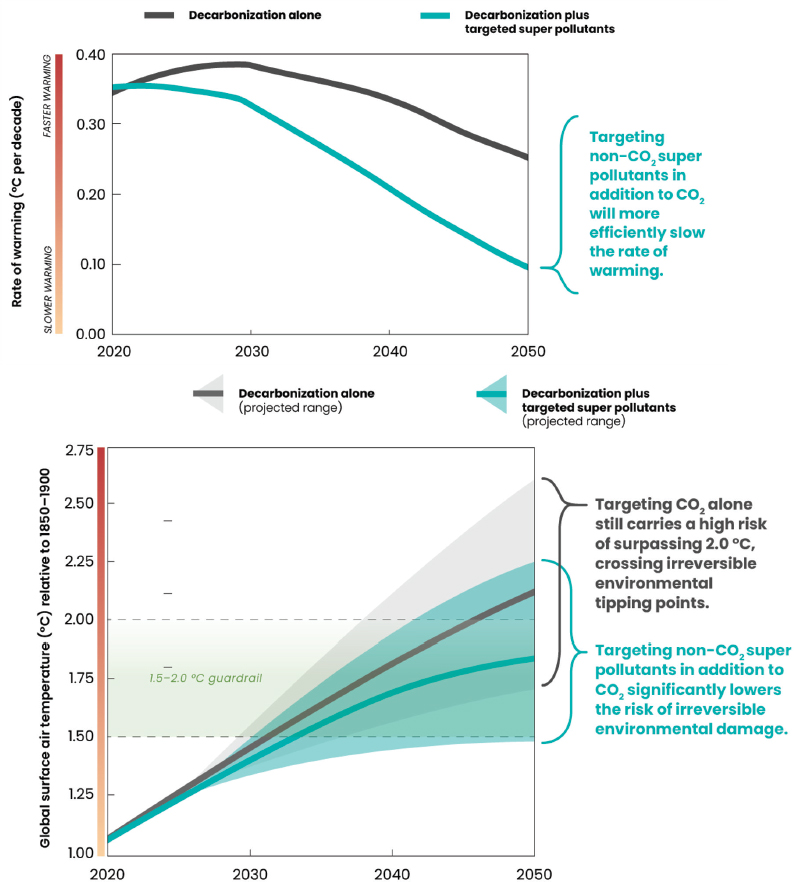
SOURCE: Gillespie (2024), adapted from Dreyfus et al. (2022).
temperature increase to 1.5°C above pre-industrial levels.” To limit warming to 1.5°C by 2100 with limited overshoot mid-century, the IPCC finds that CO2 emissions must be reduced compared to 2019 levels by 48 (38–69) percent by 2030, and methane emissions must be reduced by 34 (21–57) percent by 2030 (assuming no change in natural emissions), with additional reductions in N2O and HFCs (IPCC, 2023c).1
Controlling both CO2 and methane emissions is essential to limiting future warming, with CO2 dominating future temperature in a scenario with limited mitigation and methane emissions determining timing and magnitude of peak in a high-mitigation scenario (see Figure 1-2). As Reisinger (2024) states, “It can be challenging for policymakers to appreciate that both narratives are correct. Action on CH4 is no substitute for inaction on CO2, but if we genuinely wish to limit warming to well below 2°C then action on CH4 becomes as non-negotiable as action on CO2.”
All modeled pathways that limit warming to 1.5–2°C “involve rapid and deep and in most cases immediate GHG emission reductions in all sectors” (IPCC, 2023c). However, according to World Energy Outlook 2023, global energy-related CO2 emissions rose to an all-time high in 2022, and large gaps remain between state policies, announced pledges, and the emission reductions needed to achieve net-zero emissions by 2050 (IEA, 2023a). While growth in CO2 emissions has slowed compared to earlier high-emission projections, methane and N2O emissions continue to track the highest-emission representative concentration pathway (Nisbet, 2023b). Under current policy scenarios, combined anthropogenic methane emissions (from the fossil fuel, waste, and agricultural sectors) are expected to increase 24–30 percent by 2050 (Mar et al., 2022; UNEP & CCAC, 2022). Furthermore, latest estimates of the remaining carbon budget assume 50 percent reduction in methane emissions by 2050 (with no change in natural emissions) (Forster et al., 2023; Rogelj & Lamboll, 2024). Thus, a gap exists between the methane emissions reductions needed to achieve global temperature targets and the current trajectory of methane emissions and policies enabling mitigation.
GREENHOUSE GAS REMOVALS
In addition to reducing GHG emissions at their source (i.e., emissions mitigation), technologies or interventions that enhance the removal of GHGs—sometimes called negative emissions technologies—are increasingly part of portfolios to achieve net-zero emissions reductions (Fujimori et al., 2016; Luderer et al., 2018; Rose et al., 2017; Sanderson et al., 2016; van Soest et al., 2017). This change began with the addition of afforestation and reforestation to the UNFCCC as mitigation options as part of the Kyoto Protocol of 1997 (UNFCCC, 2013). Negative GHG emissions refer to the removal of GHGs from the atmosphere by deliberate human activities in addition to the removal that would occur via natural cycles or atmospheric chemistry processes (IPCC, 2021). In this report, the Committee refers to “GHG removals” collectively to include current and potential future technologies that may apply to CO2, methane, and/or N2O,
___________________
1These percentages are an average of emission reductions assuming rapid implementation of nationally determined contributions announced before the 26th Conference of the Parties to the UNFCCC.
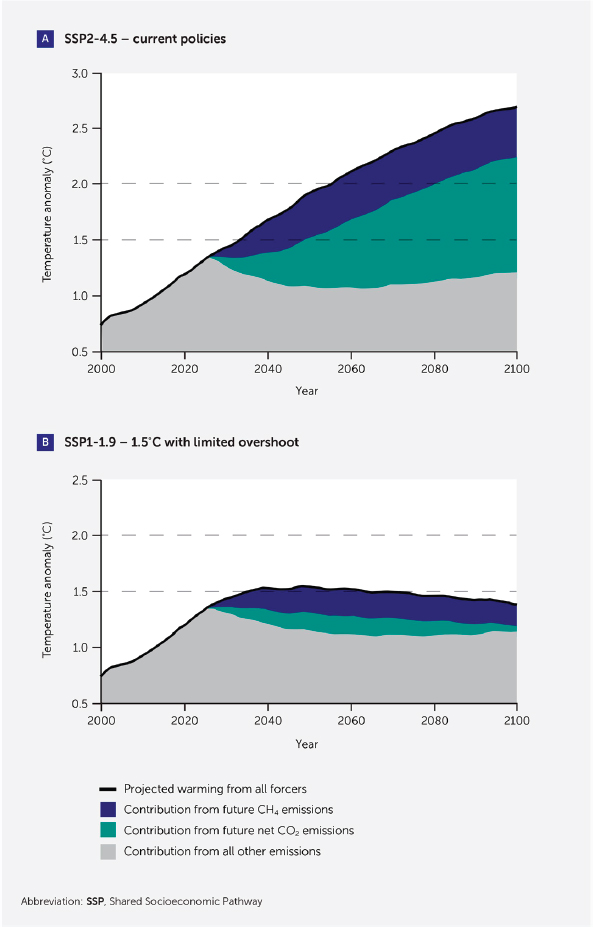
SOURCE: Reisinger (2024).
and for consistency with the UNFCCC definitions of “anthropogenic emissions” and “anthropogenic removals” that encompass GHGs (IPCC, 2021).
Models of emissions scenarios used for policy planning utilize integrated assessment models that link GHG emissions, the economy, and climate. The lowest-cost trajectories in these models often include massive deployment of negative emissions technologies to meet the 2°C temperature goal set out in the Paris Agreement (Reisinger & Geden, 2023). In fact, the basic idea behind net-zero CO2 or GHG emissions is that continued emissions to the atmosphere will be balanced by removals of CO2 or GHGs such that the net effect on climate is that of zero emissions (see Figure 1-3). According to the latest IPCC assessment, the deployment of carbon dioxide removal (CDR) is required to achieve net-zero CO2 or GHG emissions to offset hard-to-abate residual emissions (IPCC, 2023b).
CDR refers to anthropogenic activities that remove CO2 from the atmosphere and durably store CO2 in reservoirs or products (IPCC, 2021). CDR technologies vary widely in their processes, technical maturity, timescale for carbon storage, costs, risks, and co-benefits (e.g., NASEM, 2019, 2022b; Smith et al., 2023, 2024; The Royal Society, 2018). Given an increasingly limited carbon budget and the continued upward trend of GHG emissions, GHG removals—and CDR in particular—are increasingly expected to be relied upon to compensate for exceeding the remaining carbon budget (IPCC, 2023b; Smith et al., 2024). However, while the knowledge base for CDR is relatively large compared with that of other GHG removal technologies, slowdowns have been noted in the innovation process (Smith et al., 2024).
METHANE REMOVAL AND THIS STUDY
While CDR technologies have been studied and developed for decades, analogous removal for other GHGs has not been similarly considered. Boucher and Folberth (2010) first suggested artificial methane removal from the atmosphere for climate mitigation, and Jackson et al. (2019) proposed methane removal as a complement to CDR with the potential to restore atmospheric methane concentrations to preindustrial levels. Given methane’s potency and short atmospheric lifetime, sustained removal efforts could potentially address or offset hard-to-abate anthropogenic or natural methane emissions (Abernethy et al., 2021).
The field of methane removal research is nascent. Few peer-reviewed publications on the topic exist, reflecting limited investments in research funding to date. Compared to methane mitigation—for which decades of research and development have led to technologically and economically feasible solutions for anthropogenic methane sources—and CDR—for which early-stage demonstration projects are underway—atmospheric methane removal is in its earliest stages of knowledge discovery. However, given the urgency to reduce emissions and the potential promise of an approach that could theoretically have a near-term climate impact, there is interest, particularly in the private sector, in investing in the development and/or deployment of atmospheric methane removal technologies.
According to the IPCC (2021), large-scale removal technologies for non-CO2 GHGs were speculative as of 2021. At this critical moment for resource investment and
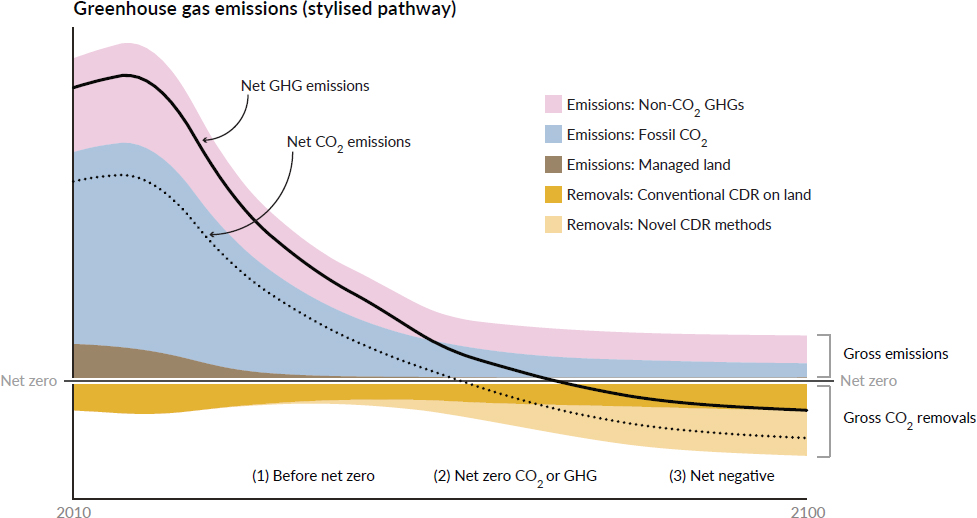
SOURCE: Smith et al. (2023).
decision making around climate action, an authoritative study on the state of knowledge of atmospheric methane removal was needed.
The National Academies of Sciences, Engineering, and Medicine (National Academies) produced two reports on climate intervention in 2015 (NRC 2015a,b) and subsequent research agendas for terrestrial and coastal CDR (NASEM, 2019), ocean CDR (NASEM, 2022a), and solar geoengineering (NASEM, 2021b). This history makes the National Academies well suited to examine atmospheric methane removal. In this study, the Committee was tasked with assessing the need and potential for atmospheric methane removal and recommending research that would improve the sociotechnical understanding of atmospheric methane removal. The Committee’s complete Statement of Task is in Box 1-2. The concept of atmospheric methane removal is novel; while several potential technologies exist, information is limited, and many key questions remain.
Study Scope
The Committee defined atmospheric methane as methane in the free atmosphere (currently about 2 parts per million [ppm]); methane emissions mitigation as any human intervention to reduce methane emissions at the source, typically anthropogenic in origin; and atmospheric methane removal as human interventions to accelerate conversion of methane in the atmosphere to a less radiatively potent form or physically
BOX 1-2
Statement of Task
The National Academies will examine the need for atmospheric methane removal, assess the potential, risks, and co-benefits of viable technological options, and recommend research that could improve understanding. The following topics will be addressed:
- Why might atmospheric methane removal be needed? What specific situations/scenarios might call for deployment of methane removal?
- What are viable options for atmospheric methane removal? To the extent possible, assess how much methane could be removed from the atmosphere for each option, as well as the cost of deployment, technological efficiency, scale potential, potential risks, and key uncertainties and challenges.
- What potential tradeoffs, co-benefits, and unintended consequences should be considered in developing atmospheric methane removal approaches? What are potential social barriers associated with atmospheric methane removal?
- What new research is needed to improve understanding of atmospheric methane removal?
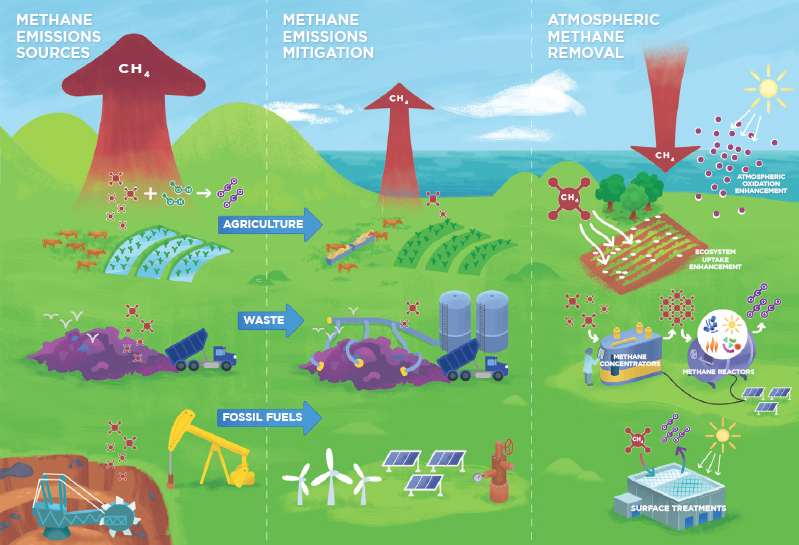
remove methane from the atmosphere and store it elsewhere (see Box 1-1 and Figure 1-4). The term “atmospheric methane removal” is also used when human interventions increase the sink and decrease the net flux from ecosystems to the atmosphere, or make this flux negative.
Part of the Committee’s task was to define the set of atmospheric methane removal technologies considered for assessment. The five technology categories considered in this report are in Box 1-3 and Figure 1-4. The Committee focused its evaluation on removal technologies applied to 2–1,000 ppm atmospheric methane (see Box 1-4). Box 1-5 answers the question of whether atmospheric methane removal would increase CO2.
In interpreting its task, the Committee acknowledged that atmospheric methane removal, like any climate intervention, is fundamentally a sociotechnical problem. Any technological approach under consideration will be shaped by and have consequences for human participants and bystanders. A useful knowledge base must therefore consider technology and humans in concert. At the outset of the study, ClimateWorks Founda-
BOX 1-3
Atmospheric Methane Removal Technologies Considered in This Report
Methane reactors: Purpose-built, physically bounded systems that utilize the active flow of air to capture or convert methane to a different chemical species with lower atmospheric warming potential.
Methane concentrators: Materials or devices that can separate or enrich methane with some degree of selectivity relative to other atmospheric components. A methane concentrator itself may not be a stand-alone form of atmospheric methane removal but may be a core component for enabling atmospheric methane removal technologies.
Surface treatments: Application of a catalyst to a built or other surface that contacts air naturally to convert methane to a different species with lower atmospheric warming potential.
Ecosystem uptake enhancement: An amendment or practice that augments the in situ net uptake of methane by or within primarily managed ecosystems but with potential to apply to natural ecosystems.
Atmospheric oxidation enhancement: Accelerated conversion of methane via the augmented abundance or lifetime of reactive species, such as chloride or hydroxyl radicals, in the free atmosphere. This includes activity in the troposphere and stratosphere of the Earth’s atmosphere.
tion (the project sponsor) emphasized its desire for the report to give social dimensions full, if not equal, consideration compared to the technical dimensions (Mazurek, 2023).
The Committee’s Approach to This Study
In addressing its task, the Committee met in person and virtually from April 2023 to July 2024. The Committee held its first information-gathering meeting in Washington, DC, on April 20, 2023; on October 17–18, 2023, the Committee held the Workshop on Atmospheric Methane Removal: Needs, Challenges, and Opportunities, which included presentations from 40 experts and breakout discussions for all participants. The Committee solicited written technical input from the community from May through October 2023. Contributors of input to the Committee are acknowledged in Appendix C. Also, as
BOX 1-4
Consideration of Methane Concentrations in This Report
The Committee considered atmospheric methane removal to be removal from the free atmosphere, which has a current average methane concentration of ~2 parts per million (ppm). As such, the Committee focused on assessing technologies to extract or convert methane to less radiatively potent species at this extremely high level of dilution. Most known technologies for methane oxidation work effectively at substantially higher methane concentrations (1,000 ppm or higher) (Abernethy et al., 2023). To this end, the Committee sought to identify the concentration range(s) where various technologies might become efficient enough to be economically viable. In some cases, these methane concentrations are commensurate with higher concentrations that may occur in specific locations, such as in coal mines, in dairy barns, or at other emissions sources. The Committee considered the application of such technologies at these sources to be methane emissions mitigation—distinct from methane removal, which would be applied to atmospheric methane concentrations. Nonetheless, research and development of mitigation technologies at high (>1,000 ppm) methane concentrations are relevant to the global goal of reducing methane emissions and may be relevant for the development of technologies that could work at lower (<1,000 ppm) methane concentrations with additional research and development, as explored in this report.
part of Committee’s task and to strengthen the literature base on atmospheric methane removal, the Committee commissioned four original papers: Edwards et al. (2024), Grubert (2024), Horowitz (2024), and Silverman-Roati and Webb (2024). These papers are available on nap.edu. While the Committee identified the paper topics, based on gaps in the literature and information needed to inform its report, and the authors, based on their records of scholarship, the papers were solely authored by the external experts, not the Committee. The authors are solely responsible for the content of their papers, which does not necessarily represent the views of the National Academies of Sciences, Engineering, and Medicine. The Committee’s information gathering was followed by virtual meetings from November 2023 to April 2024 and an in-person meeting in Irvine, California, on January 17–18, 2024, during which the Committee deliberated and wrote the report. Following standard National Academies’ procedures, the draft report then underwent a rigorous process of external peer review before publication.
BOX 1-5
Does Atmospheric Methane Removal Increase Carbon Dioxide?
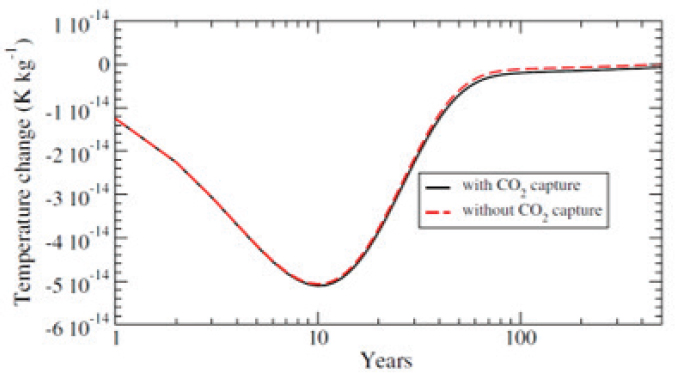
In the atmosphere, methane is naturally converted to carbon dioxide (CO2) through reaction with the hydroxyl radical (see Chapter 2). The emissions-based effective radiative forcing (ERF) of methane is 0.818 percent of the CO2 ERF (IPCC, 2021), meaning that natural methane oxidation is not an important contributor to the total radiative effect of CO2. Atmospheric methane removal would not increase CO2 in the atmosphere. Most approaches accelerate the natural conversion of methane to CO2; no additional CO2 is generated from the direct oxidation of methane. Modeling of the temperature impact from the capture of atmospheric methane shows little impact from the conversion of methane to CO2 (see Figure 1-5-1). Indirect CO2 could be generated depending on the fuel source used to generate heat (in the case of thermocatalysts) or power air movement (see Chapter 5).
SOURCE: Boucher and Folberth (2010).
Report Roadmap
Chapter 2 describes the current opportunities and challenges for addressing methane emissions through mitigation actions and current policies and considers other interventions beyond emissions mitigation.
Chapter 3 addresses the question of why atmospheric methane removal might be needed by laying out potential high-level arguments in support of and in opposition to atmospheric methane removal and outlining specific potential use cases for atmospheric methane removal.
Chapter 4 assesses the five atmospheric methane removal technologies—methane reactors, methane concentrators, surface treatments, ecosystem uptake enhancement, and atmospheric oxidation enhancement—against a common set of criteria to evaluate the potential and challenges of each technology and identify research needs.
Chapter 5 considers issues that cut across all atmospheric methane removal technologies, including governance, engagement, perspectives, and justice; the policy landscape; costs, trade-offs, and resource use; and the potential physical consequences of atmospheric methane removal technologies.
Chapter 6 presents the Committee’s research agenda, in which five priority research areas are recommended with urgency to inform a second-phase assessment that could more robustly assess the technical and social viability of technologies to remove atmospheric methane.


