Barriers, Challenges, and Supports for Family Caregivers in Science, Engineering, and Medicine: Proceedings of Two Symposia (2023)
Chapter: 6 Federal Responses to Address Caregiving
6
Federal Responses to Address Caregiving
The symposium turned to new and long-standing policies and programs within the federal government and at federal agencies. To highlight one of the newest responses, Kylie Patterson (CHIPS for America) explained why and how the Creating Helpful Incentives to Produce Semiconductors (CHIPS) and Science Act of 2022 (CHIPS Act; P.L. 117-167) includes guidelines for applicants to address childcare as part of their proposal to access funding through the act. A roundtable of representatives from four federal agencies, NASA, National Institutes of Health (NIH), National Institute of Standards and Technology (NIST), and National Science Foundation (NSF), with policies and programs that affect the scientific workforce concluded the symposium.
CHILCARE PROVISIONS IN THE CHIPS ACT
The CHIPS Act boosts U.S. semiconductor research and manufacturing to fulfill a three-pronged vision to achieve economic security, national security, and future innovation, according to Ms. Patterson, the senior advisor for opportunity and inclusion of the CHIPS for America team. The pandemic made clear that chokeholds in the supply chain for semiconductor chips must be solved by building domestic capacity, she pointed out.
BACKGROUND ON THE CHIPS ACT
One objective of the CHIPS Incentives Program is to promote the inclusion of economically disadvantaged individuals and small businesses in the semiconductor market.1 As Ms. Patterson explained, the childcare provision under the act is intended to remove a barrier to this inclusion. The act provides $50 billion in federal grants. Of that amount, $39 billion will be invested in manufacturing to attract large-scale investments in advanced technologies and incentivize expansion of manufacturing capacity for mature and other types of semiconductors. An additional $11 billion will be invested in research and development. Several funding opportunities (called Notice of Funding Opportunities, or NOFO) have been or will soon be released. Proposals will be evaluated across six program priorities: (1) economic and national security objectives, (2) commercial viability, (3) financial strength, (4) technical feasibility and readiness, (5) workforce development, and (6) broader impacts. An important aspect of workforce development is to recruit, hire, train, and retain a diverse and skilled construction and manufacturing workforce, Ms. Patterson explained. “To that end, we think childcare is a key component,” she said.
Ms. Patterson reported that the CHIPS for America Workforce Development Planning Guide was released the day of the symposium (CHIPS Program Office, 2023). Applicants applying for more than $150 million in funding are required to provide a plan for access to childcare with access for both facility and construction workers. Those applying for less than $150 million are “strongly encouraged” to do so. The guide includes possible ways that applicants can meet the childcare requirements (see Figure 6-1).2 Applicants are expected to devise solutions that are responsive to the specific needs of their workers. For example, they may work outside the typical 9 a.m. to 5 p.m. workday. Priorities are that the childcare is affordable, accessible, and of high quality. There is no one-size-fits-all solution, but the guide describes options for onsite/near-site and offsite care.
Ms. Patterson said these models provide flexibility and creativity, including for facilities located in exurban and rural environments. The
___________________
1 For more information about the legislation, see CHIPS.gov. For a White House briefing on the childcare provision, see https://www.whitehouse.gov/briefing-room/statements-releases/2023/03/08/icymi-experts-agree-chips-manufacturing-and-national-security-bolstered-by-childcare/.
2 For more information, see the CHIPS for America Workforce Development Planning Guide Webinar at https://www.nist.gov/system/files/documents/2023/04/04/3.30.23-CHIPS-Workforce_Development_Guide_Webinar.pdf.
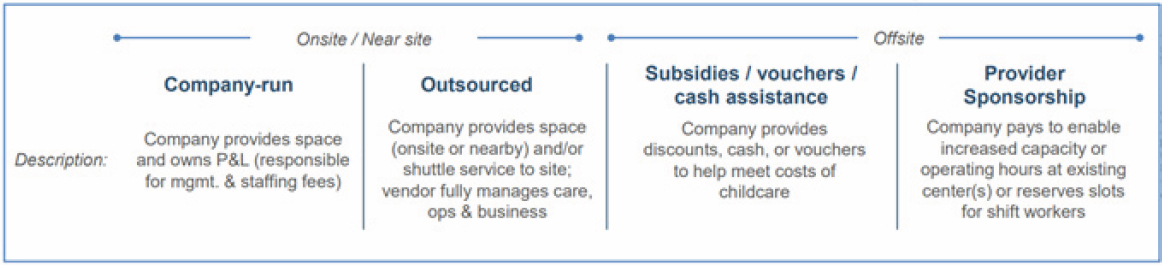
SOURCE: National Institute of Standards and Technology.
hope is that the childcare opportunities can be sustained and expanded for other workers in other industries. She noted that the Workforce Development Guide provides resources that are useful to a wider audience as well, beyond funding applicants.
DISCUSSION
In answer to a question from Kathleen Christensen, Ph.D. (Boston College) about who will be covered, Ms. Patterson said the childcare provisions cover all workers at a facility, including support staff and janitorial staff, although most are expected to be technicians. Ellen Ernst Kossek, Ph.D. (Purdue University) commented that some manufacturers are hesitant about the expense, but Ms. Patterson said the childcare provisions are intended to meet the overall goals of the CHIPS program, which requires a robust workforce. She noted creativity is allowed in the regulations, so solutions are reflective of local environments. Dr. Kossek suggested the potential of community-based childcare through partnerships across employers, rather than providing vouchers to employees to find the childcare on their own.
Ashley Bear, Ph.D. (the National Academies) commented on the significance of the childcare provision in this federal act, and Joan Williams, M.A., J.D. (University of California, San Francisco) echoed the ground-breaking nature of conceptualizing childcare as part of industrial infrastructure. Ms. Patterson underscored the need for 100,000 additional technical employees and 1 million construction employees. Childcare is imperative to meet the ambitions of the program and to provide opportunities for well-paying jobs to women, especially women of color. Dr. Christensen commented on a historic precedent, when childcare was provided during World War II to get women into the workforce. In response to a question from Jeff Gillis-Davis, Ph.D. (Washington University in St. Louis), Ms. Patterson clarified that consideration of caregiving for adults, such as eldercare, is not required in the act, but applicants are requested to identify all potential barriers to meeting their workforce targets, which may include the need for other types of care besides childcare. She also stressed this is a long-term effort and hopes that research can be undertaken to evaluate the effects, while respecting privacy concerns.
FEDERAL AGENCIES’ ROUNDTABLE
To open the federal agency panel, Ms. Williams expressed appreciation for the funding from federal agencies to undertake the committee’s consensus study on caregiving and commented that the agencies have a profound influence on academic institutions to change policies. She moderated a session with Janine Clayton, M.D. (NIH), Jessie DeAro, Ph.D. (NSF), Christopher Szakal, Ph.D. (NIST), and Maggie Yancey (NASA).
OVERVIEW OF PROGRAMS
Ms. Williams first asked the presenters to explain their agency’s interest in family caregivers who are working at the agencies or are funded by their programs.
Dr. Clayton explained that the NIH Office of Research on Women’s Health, of which she is associate director, has three mission areas: expand women’s health research, ensure women are included in NIH-supported clinical research, and advance women in science, technology, engineering, mathematics, and medicine (STEMM).3 Related to this third area, Dr. Clayton commented on the number of women leaving academia and medicine. She noted the pipeline in life sciences and medicine is about 50 percent women, but this percentage is not reflected in leadership positions. The mid-career years are critical. “We invest substantially in the development of scientists,” she said, “If we cannot see the full benefit of those investments that the American people are paying for and we are not promoting an inclusive STEMM workforce, we will not be competitive in the future.”
Dr. DeAro is the program officer for NSF’s ADVANCE program, which promotes equity for STEMM faculty across all identities to achieve a more diverse workforce.4 She explained that NSF became interested in the consensus study to follow up with the unusual opportunity that the pandemic presented. “We learned quite a few things about how to be inclusive and flexible and still be productive and produce new knowledge,” she observed. She expressed hope that some of the lessons learned can be translated into long-term policies by funding agencies and institutions of higher education. “We are interested in updating the understanding of what ‘normal’ is, not just what it was,” she commented.
___________________
3 For more information on the NIH Office of Research on Women’s Health, see https://orwh.od.nih.gov/.
4 For more information on ADVANCE, see https://www.nsf.gov/crssprgm/advance/.
Dr. Szakal said NIST is engaged with diversity, equity, and inclusion across the organization as part of a commitment to provide staff what they need to do their jobs most effectively. To fulfill this commitment, staff express what they need and help drive solutions. The earliest example is an onsite childcare center, which began more than 40 years ago. An eldercare support group and lactation support group have also formed. One change after COVID-19 was more flexibility about telework when dependents are in the home during the workday. He said one reason NIST is interested in the consensus study is to understand the future of hybrid work.
Ms. Yancey supports entrepreneurship in academia at NASA and has been involved in the implementation and evaluation of programs that work to promote equity and well-being of inclusive innovation systems, including those involving family caregivers. Calling attention to President Biden’s Executive Order 13985 on advancing racial equity, she said one way to fulfill that order is through better caregiving policies and supports.5 E.O. 13985 and other administration policies provide a whole-of-government approach for the science and technology community and the framework to address systemic inequalities. “Serious efforts to accommodate how granting agencies may support caregivers who are also researchers are paramount,” she said.
FEDERAL EFFORTS TO SUPPORT CAREGIVERS
Ms. Williams noted that federal agencies can generate support for caregivers by building out requirements and policies as a condition to receive funding, and asked how caregiving in academia is reflected in each agency’s funding programs.
Dr. DeAro said NSF has a Career-Life Balance Initiative in place, which started during the Obama administration. It has synthesized all regulations about how federal dollars can be spent and identified flexibilities that could help in situations of family leave, such as the delayed start of a grant or a no-cost extension. Supplements are available at up to $30,000 each to hire temporary technical support if people on the grant are on leave, without the requirement to share personal information about the reason for the
___________________
5 The text of Advancing Racial Equity and Support for Underserved Communities Through the Federal Government, Executive Order 13985, January 20, 2021, is available at https://www.whitehouse.gov/briefing-room/presidential-actions/2021/01/20/executive-order-advancing-racial-equity-and-support-for-underserved-communities-through-the-federal-government/.
supplement with NSF. Over the past few years, the funds requested under these supplements ranged from $600,000 to $2.2 million per year. Dr. DeAro said the supplements and policy clarifications have been institutionalized as permanent, rather than articulated in “Dear Colleague letters” that might be temporary. An NSF priority goal is to increase the diversity of individuals getting grants, but she acknowledged that policy change in the federal government is slow.
Dr. Clayton discussed several recent and long-standing programs. NIH now provides stipends for National Research Service Award (NRSA) trainees and fellows for up to 8 weeks of paid leave for adoption or birth of a child. Childcare cost support is provided to full-time predoctoral and postdoctoral researchers appointed on NRSA institutional training awards. A long-standing reentry program provides funding for individuals who have left the workforce, often to care for children, and need an on-ramp back to the research arena. The program has been expanded to cover reintegration for people who had been working in an unsafe environment, including those who experienced harassment or discrimination. Two continuity supplements have recently been developed through the NIH Working Group on Women in Biomedical Careers: one for K awardees to continue research if they need to scale or step back, and the other for first-time Research Program Grant recipients. She noted these two points were chosen because they are where women tend to leave the field.
Flexibility outcomes have been built into other aspects of NIH programming, Dr. Clayton continued. Conference grants (R-13) must address the resources available at the location for family care, including eldercare. The biosketch guidelines for grant applications have been expanded to allow applicants to explain breaks due to family circumstances. NIH has ramped up efforts to combat bias and harassment, in particular, gender harassment. NIH now disaggregates data to track these areas for extramural and intramural scientists. NIH is encouraging early-stage investigators (ESI) to inform the agency if they need to extend their ESI status, which may be because of caregiving responsibilities. A Request for Information is now out for public input to simplify peer review criteria, which might point to issues related to caregiving. A series of postdoc listening sessions included one on childcare. Several surveys were conducted to understand the impact of COVID-19 on the research workforce, with data disaggregated by race and gender, and the findings have been published.
Ms. Yancey pointed out that across government, several key regulations that guide grants allow for flexibility. She noted the need to raise awareness
about these flexibilities within academic institutions so that everyone understands what is allowable and destigmatizes using them.
Dr. Szakal said NIST is primarily intramural, but its best practices can be shared beyond the agency, including the childcare provisions in the CHIPS Act (see above), family-friendly leave, and telework. The Lactation Support Group is a grassroots group that launched an effort that resulted in an NIST-wide directive that formalizes lactation policy. Another grassroots initiative resulted in a recently announced childcare subsidy program that provides $5,000 annually, with income restrictions. He also noted attention to writing policies in gender-neutral language, for example, related to caregiving.
BARRIERS TO BETTER SUPPORT UNPAID CAREGIVERS
To accelerate progress, Ms. Yancey said more data are needed to creatively support programs. She also urged using evidence from existing case studies, such as those collected by Mothers in Science as part of the group’s action plan for federal funding agencies (Torres et al., 2023). Examples of solutions range from less burdensome grant requirements to taking a global vantage point to learn from other organizations.
Dr. Clayton commented that policies can be established, but implementation is challenging given the culture of STEMM. For example, pregnant postdocs and faculty report they are sometimes discouraged from taking advantage of existing policies based on the concern they would be seen as less serious scientists. Policy and cultural change must work together, she stressed. Cost is also a barrier, and organizations that receive funding from different sources may find they have to navigate different requirements and allowances across these sources. Postdocs in particular face uncertain status when they are considered neither employees nor students. The main question to answer is, Dr. Clayton said, “Whose problem is it?” She underscored that caregiving touches everyone, which is why NIH is very interested in cross-sector approaches.
Dr. DeAro reiterated the points made by Ms. Yancey and Dr. Clayton, including dealing with the variation in policies and regulations of different funding sources. In terms of Dr. Clayton’s point about who owns the problem and can encourage change, she said the expectations in the CHIPS Act are exciting, and she expressed hope they will become a model. She urged
learning from Federal Demonstration Partnership projects.6 More broadly, she urged a rethinking of tenure and promotion processes so that people can advance while also dealing with child, elder, or other care. The current mechanisms reward the so-called ideal worker with no gaps in their CV.
Dr. Szakal suggested communications can help bridge policy and culture. Even with good policies in place, he expressed concern about what he termed the “inequity of adoption.” It is important to determine who is getting information about a policy or program—whether the information is readily available or whether individuals must seek it out. Supervisors are critical. The language supervisors employ to discuss these policies can make a difference (for example, welcoming usage or discouraging it), as they are the barrier or advocate for promotion. The big lesson learned is to ensure equitable communication so that employees understand they all have access to the available policies.
Dr. Clayton pointed to surveys of federal workers for valuable data on work/life matters. This year, offices had to develop a detailed action plan to respond to the findings. She noted respondents raised concerns about the need for emergency backup care, the cost of childcare, and flexible work schedules. Supervisor awareness is important, she agreed, and training on caregiving policies is now required. Equity elements are now part of all NIH institutes’ and centers’ directors’ plans, and how they are advancing equity is part of their performance evaluations.
Dr. DeAro said implicit bias training alone is not enough to achieve change. Some people become aware of their biases but will still act on them, she said. She agreed that structures must be built into the system to mitigate the effects of bias, such as leadership accountability. Ms. Yancey added another lesson learned is that demand for flexibility is strong (such as for NASA’s augmentation and extension provisions), but the awareness among leadership must be there to tap into them.
UNINTENDED IMPACTS OF WELL-INTENTIONED POLICIES
In considering how policies that are intended to help people, including caregivers, can negatively affect careers, Ms. Yancey brought up the need to fully understand the cumulative effect when participating in conferences
___________________
6 For more information, see the Federal Demonstration Partnership website: https://thefdp.org/default/.
and meetings virtually, rather than in person. Dr. Clayton brought up tenure stop-the-clock policies. Although she said she did not have data, she noted some women feel this process just extends the process without making them more likely to get tenure. She suggested deeper study with data. Dr. DeAro agreed that the policy is well-intentioned, but it could be functionally implemented in a way that causes problems. She also noted ADVANCE has shown the need to spend time on those who are not the primary target—not just women or people of color but the majority faculty. She suggested flipping the focus of an intervention to understand why the current system benefits only some individuals. “Do we need to have a super-competitive system?” she posed. “Is there another model for how we support and identify scientific research and teaching?” Dr. Szakal called attention to expectations management, noting it takes time to implement a new policy or program. Today’s postdocs may be working to enact a policy that they themselves may not benefit from, as the timing is sometimes drawn out.
DISCUSSION
Sandra Masur, Ph.D. (Icahn School of Medicine at Mount Sinai) urged the agencies to make their resources more available to others, noting the information is superb but sometimes hard to find. Dr. Szakal said NIST provides the information internally but has realized that sharing it more publicly would inform employment seekers and others. Dr. Christensen suggested that NIH or NSF support long-term, organizational intervention trials to test out different models of tenure. Dr. Clayton agreed with the value, noting a previous study on causal factors and interventions was extremely effective, and she shared the findings with NIH leadership at the time to make the case for the next version. Although it was not funded, she continues to push for it. She added that it is helpful to know there are people ready to implement such an experiment if funding were available. Not all Institutes and Centers (ICs) see women in careers as a priority issue, but Dr. Clayton makes the case to them that it is a workforce issue. Dr. DeAro suggested ADVANCE, as well as the Sea Change initiative at the American Association for the Advancement of Science, as possible other routes to study the effect of changes to the tenure and promotion structure. Ms. Williams cautioned that opening up tenure may create problems in the current political climate, as reflected in statements by the American Association of University Professors and other organizations.
Referring to Dr. DeAro’s earlier comment about implicit bias training, Dr. Christensen commented that a recent book (Dobbin and Kalev, 2022) cites data showing the countereffects of this training. Ms. Williams clarified that the studies were conducted from 1997 to 2004. She pointed to more recent randomized control trials from University of Wisconsin researchers that showed significant effects with implicit bias training (Devine et al., 2017; Carnes et al., 2015). There are many other experiments going on in the field, including early results from her own trial on the effect of training on service burden for women.
Dr. Kossek commented on the many policies highlighted by the presenters and asked for ideas on how to study improved implementation and prevention of biases. As an analogy, she noted that occupational health interventions are designed to prevent problems, not just react and deal with the exceptions. Dr. Clayton stressed cross-sector communication and programming. For example, a new program in the National Institute of Arthritis and Musculoskeletal and Skin Diseases targets mid-career scientists to provide support as they explore data science. As another example, Leadership Development Scholars is a coordinated, concerted effort across sectors.7 NIH also offered the Enhancing Faculty Gender Diversity in Biomedical and Behavioral Science Prize to institutions in 2021, using the challenge. gov mechanism, and hopes to offer it again.8 As Dr. Clayton noted, it is important to know people are ready to be creative and do things differently.
___________________
7 For more information on NIH leadership programs, see https://hr.nih.gov/training-center/leadership/nih-continuum-leadership.
8 For more information, see https://orwh.od.nih.gov/career-development-education/prize-competition.
This page intentionally left blank.


