Assessing Lifecycle and Human Costs of Bus Operator Workstation Design and Components (2024)
Chapter: 6 Discussion and Bus Packaging Software Tools
CHAPTER 6
Discussion and Bus Packaging Software Tools
This work aimed to provide increased understanding of anthropometric variability of U.S. bus drivers and their postural preferences while driving. To achieve this, a cascade posture prediction approach was used with linear regression models verified for posture prediction. Using this method, a total of 1,000 virtual drivers were successfully postured in a given bus cab. Based on the accommodation conditions shown in the model, proper design recommendations can be made. This chapter discusses the recommendations and presents an overview of the cascade model and its software applications.
6.1 Observation and Reflection
As discussed, a driver’s body landmarks and the vehicle interior components, such as the steering wheel and seat, are all measured from the AHP. Intuitively, smaller drivers tend to posture themselves closer to the AHP for comfort and task-oriented considerations. However, this observation is not always true due to human variability and preference unrelated to anthropometry. As research has shown, an nth-percentile person, who has all nth-percentile body dimensions, does not exist. In fact, people vary tremendously from each other, and anthropometric variability and preference are expected to contribute enormously to the final driving posture of a driver. Even among people with similar body dimensions, a large degree of variation still exists, as shown in the “average” male and 50th-percentile-stature male comparison in Chapter 5. This observation indicates that human variability in preference plays a critical role in how drivers posture themselves in a bus.
Although there has been a lot of literature on the distribution of locations of the H-point and the driver eye point, research on steering wheel location is limited. In some vehicles, steering wheels have only one mode of adjustment (tilting), and drivers are expected to achieve a comfortable driving posture by moving the seat. In the case of buses and most other large vehicles, the steering wheels are designed to move on two axes with rotating and telescoping mechanisms. In the cascade model developed for buses and trucks, steering wheel location prediction is the first step and serves as an input for seat location prediction and eye location prediction. Therefore, it is critical to select a proper pivot location and provide an adequate adjustment range for the steering wheel. These factors not only improve drivers’ hand grip comfort, but also make it easier to accommodate the preferred seat and eye locations.
In this work, a spatially limited bus cab was chosen to demonstrate disaccommodated conditions. The cab layout accommodates the majority of the preferred body configurations, which are the centers of the clusters of points shown in Chapter 5. In other words, for each body landmark (indicated as a cluster of points) the highest frequency of occurrence is at the center. Extending outward, the frequency of occurrence decreases. The farther the distance, the larger the decrease. Researchers have found that body dimensions can be approximated as Gaussian
distributions. Since drivers’ posture is predicted using linear regression models with variance, it is implied that drivers’ posture is also normally distributed in the dimensional space of each predicted measure.
6.2 Cascade Model Overview
This work uses estimated anthropometry of U.S. bus drivers. This data passes through a sequence of posture prediction models and becomes an invaluable part of representing preferred driving posture. Two critical design concerns, spatial fitting and driving safety, are analyzed for accommodation during each step of the prediction process. Spatial fitting is usually limited by the adjustment envelope, and drivers can sometimes compromise on a less desirable posture and achieve comfort by adjusting the rest of their bodies to adapt. Driving safety is assessed by driver’s ability to maintain adequate vision during driving. The outcomes of the analysis indicate the overall quality of a bus package and indicate directions to improve the design.
The posture prediction models are carried out in a cascading manner such that the output of the previous step becomes the input of the next step. Starting with steering wheel location prediction, the cascading process then directs its focus to seat location and eye location, which are the critical reference points in vehicle packaging. Following that, other body landmarks can be configured, such as shoulder joint, elbow joint, knee joint, and ankle joint. A schematic diagram of the cascading approach is shown in Figure 4.2.
6.3 Applications
The objective of this work was to investigate the effect of human variability in vehicle packaging and deliver tools to assist in the design of workstations for U.S. bus drivers. The goals were met by applying the fundamental principles of the cascading posture prediction model throughout this research in the use of linear models that incorporate residual variance to predict landmark locations for each virtual driver and reverse kinematics to configure body posture. The outcomes of this research are delivered in an Excel spreadsheet.
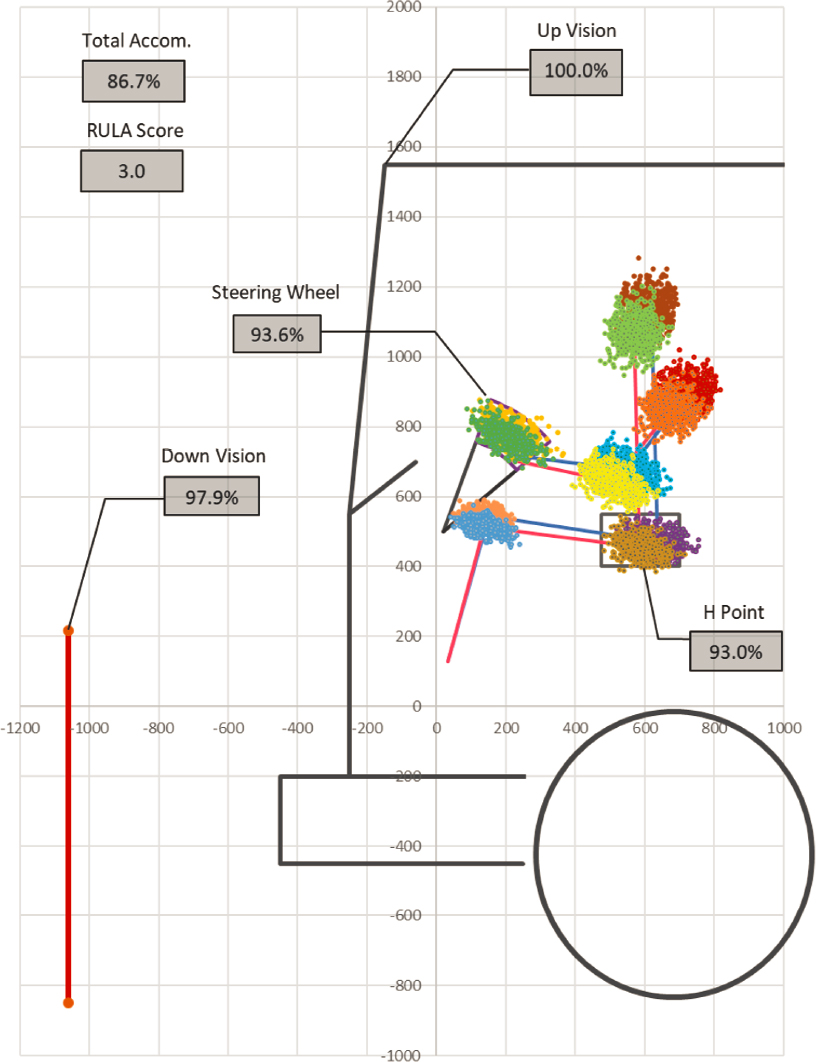
The spreadsheet tool is primarily for industry users who are packaging buses and assessing candidate designs. Due to the complexity of the subject and the learning curve of using a new tool, an intuitive software tool with visuals is highly desirable. In the tool, users can change the bus geometry, adjustment range of the components, and driver demographics. The tool automatically performs posture prediction for each virtual driver and assesses the design. Results are presented in two forms: (1) a table that summarizes the accommodation rates of each of the four design objectives (steering wheel location, seat location, upvision, and downvision) and the overall accommodation rate, and (2) a pictorial representation of the bus layout and the body landmarks. It allows users to see how the drivers are accommodated so they can make proper adjustments to the design.
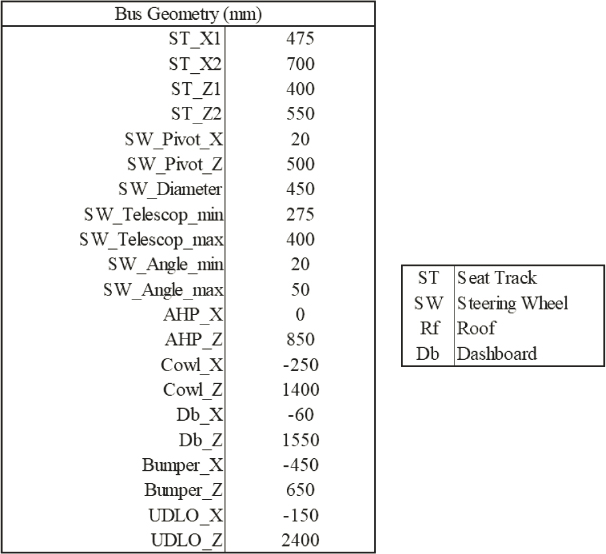
In the Excel spreadsheet the inputs are used to construct a frontal layout of a bus, a seat track adjustment envelope, and a steering wheel adjustment envelope (Figure 6.1). An example of the table outputs that display univariate and multivariate accommodation rates is shown in Figure 6.2, and an example of the pictorial outputs is shown in Figure 6.3.
6.4 Limitations and Future Work
This work primarily studies bus drivers’ posture and uses it to assess bus packages in the X-Z plane because most of the packaging components are designed to be adjustable only in this plane. For example, the steering wheel and the seat are two of the most important design considerations when packaging a bus. They are fixed in the Y direction but are adjustable in the

X-Z plane. By default they are expected to reside in the center plane on the driver’s side so the distance from the driver’s left hand to the components is the same as from their right hand. In addition to spatial fitting, a driver’s central vision is also mainly determined in the X-Z plane due to the windshield setup. By analyzing the two-dimensional accommodation, the majority of design questions can be answered. The software presented can consistently provide predictable results. However, with additional time and resources, a three-dimensional analysis can be performed by augmenting the spatial fitting assessment and the vision safety assessment in the Y direction. For instance, opaque areas of bus structure create blind spots that cannot be effectively monitored by the driver. By knowing a driver’s eye point in three dimensions, designers can identify the effective range of the driver’s peripheral vision and make appropriate design modifications. With a three-dimensional analysis, parameters such as seat width can also be assessed.
An Excel spreadsheet was developed to help industry users package the driver workstation of a bus. The output summary table quantitatively estimates the percentage of people to be accommodated, and the graphic indicates how to modify the bus layout to improve the accommodation rate. This tool is expected to facilitate the iterative design process and help engineers as they explore vehicle packaging options and the consequences of different decisions. For instance, if a user wants to improve the accommodation rate of upward vision, they can raise the ceiling or lower the seat adjustment envelope. It will be the user’s decision to do one or both. To minimize this ambiguity, future research can investigate the cost factors of the components to be packaged so design decisions can be logically made. Once cost factors are quantitatively studied, an overall cost calculation method can be developed and used as an objective function in an optimization study. By setting a target overall accommodation rate and an objective of minimizing cost, the “best” vehicle layout can be found.