Resilience in Transportation Networks, Volume 2: Network Resilience Toolkit and Techniques (2024)

Chapter: 6 Cascading Effects of Disruptions on Multimodal Facilities in a State

Previous Chapter: 5 Cascading Effects of Disruptions on Large Statewide Networks
Page 104
Suggested Citation: "6 Cascading Effects of Disruptions on Multimodal Facilities in a State." National Academies of Sciences, Engineering, and Medicine. 2024. Resilience in Transportation Networks, Volume 2: Network Resilience Toolkit and Techniques. Washington, DC: The National Academies Press. doi: 10.17226/27921.

6 Cascading Effects of Disruptions on Multimodal Facilities in a State

6.1 Cascading Effects for Intermodal Facilities – Illinois

Objective

This document describes cascading effects resulting from the disruption of intermodal facilities in Illinois. It shows how the failure of intermodal facilities can impact access to trade centers and jobs, as well as how disruptions affect access to employment of residents in different income categories.

Data Sources

Transearch 2019 data is used as the primary source for analyzing commodity flows and identifying the top intermodal facilities. Illinois Statewide Travel Demand Model (ILSTDM) data from 2017 was the source used to identify the impacted truck corridors and the trade centers and the hinterlands. The datasets from the travel demand model include the following:

  • Traffic analysis zone (TAZ) boundary
  • 2017 model network
  • Truck trip tables by four periods
  • Socioeconomic data – includes population households, average income by TAZ

Other data sources include:

  • Employment by TAZ – Data from the Longitudinal Employer-Household Dynamics (LEHD) dataset provides the number of employees in various industry sectors working in each TAZ.

Software used for the analysis includes TransCAD, ArcGIS, Microsoft Excel, and R.

Procedure

Step 1: Identify critical intermodal facilities

The Transearch database records commodity flows between defined origin and destination regions by freight mode. Boundaries for regions within Illinois are defined as county boundaries, while boundaries for regions outside of the state are defined as county boundaries or larger. Using Transearch data, the total inbound, outbound, and internal tonnage for each shipment mode, water, rail, and air, was determined for each region. The counties with highest total trade tonnage are Madison County for water and Cook County for rail and air.

Step 2: Tonnage transfer to other modes

For each of the shipments analyzed, some of the inbound/outbound commodities (defined by the 4-digit Standard Transportation Commodity Code) were transferred to/from a primary mode to a secondary mode at intermodal facilities. For instance, commodities shipped by water mode often get transferred to truck or rail, and commodities shipped by rail mode often get transferred to truck or water. These transfers are determined from Transearch. However, when Transearch lacks detailed

Page 105
Suggested Citation: "6 Cascading Effects of Disruptions on Multimodal Facilities in a State." National Academies of Sciences, Engineering, and Medicine. 2024. Resilience in Transportation Networks, Volume 2: Network Resilience Toolkit and Techniques. Washington, DC: The National Academies Press. doi: 10.17226/27921.

data on secondary modes, commodities shipped by air are assumed to be transferred only to truck and are analyzed using data from the Freight Analysis Framework (FAF). Commodities not transferred to secondary modes are assumed to be consumed locally (within the destination county). The steps for assigning shipments to specific modes are described below:

Water Mode
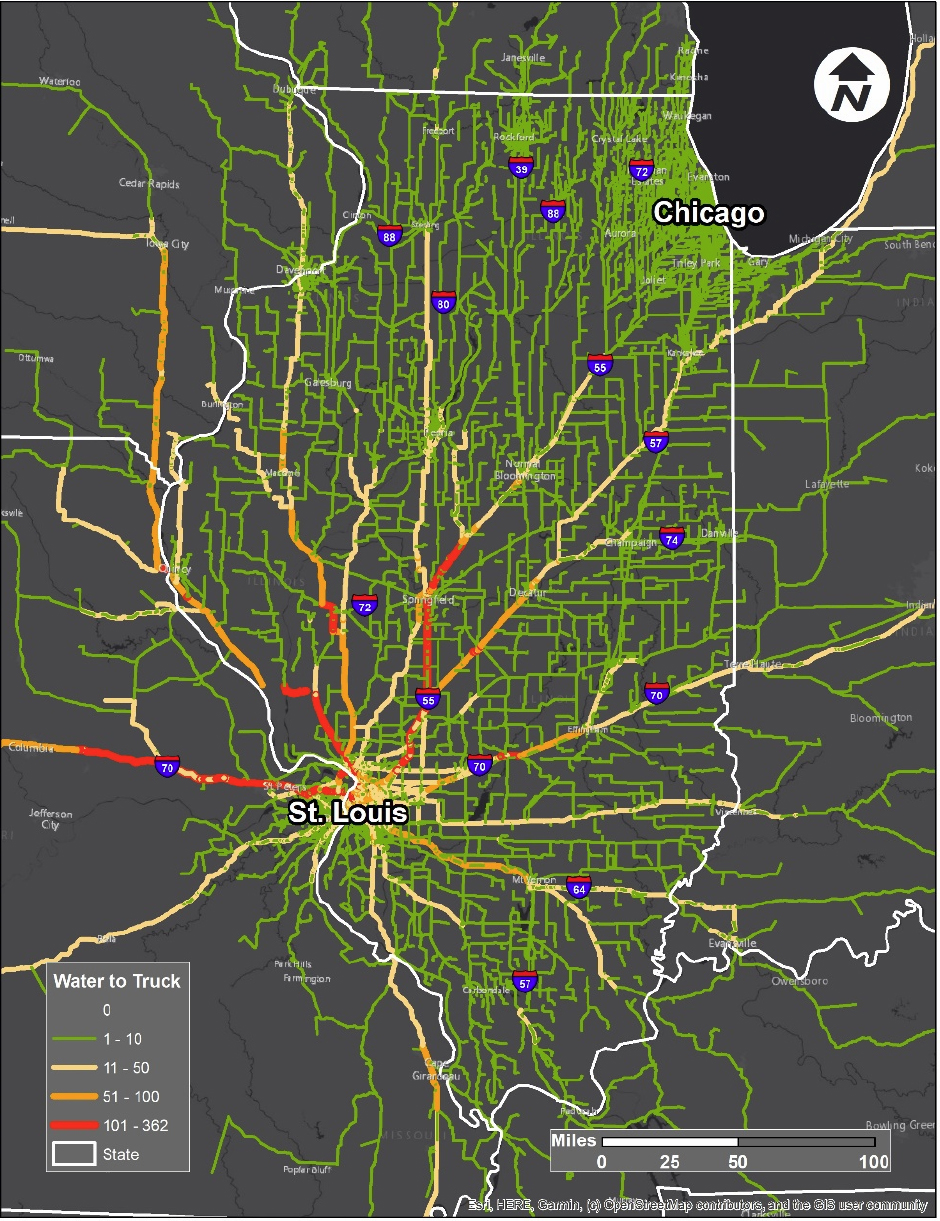
  1. When the primary shipment mode is by water, process Transearch data to develop OD flows with either the origin or the destination region as Madison County (see Figure 60).
  2. Calculate the inbound, outbound, and internal commodity flows by Standard Transportation Commodity Code (STCC) for each of three modes: primary mode water, and the secondary (transfer modes) modes truck and rail.
  3. Join the inbound water to outbound truck and rail by STCC. If the water tonnage for any commodity is less than the total tonnage of rail and truck, then the tonnage is allocated to rail and truck in their proportions. If the water tonnage is more than the total tonnage of rail and truck, then only the tonnage equal to the total of rail and truck tonnage will be allocated to the secondary modes. The remaining tonnage is assumed to be consumed locally. The tonnage that does not get allocated for any STCC is also assumed to be consumed locally.
  4. Tonnages transferred to trucks are filtered out. Results are a table of outbound truck tonnage by STCC code.
  5. The processes outlined in steps c) and d) are repeated for outbound water tonnage with inbound secondary modes. Results are a table of inbound truck tonnage by STCC code.
  6. The processes outlined in steps c) and d) are repeated with internal water tonnage allocated to internal truck and rail tonnages. Results are a table of internal truck tonnage by STCC code.
  7. The outbound truck tonnage (from inbound water) is distributed to various destination regions based on the share of all trucks by STCC from Madison County to those destinations.
  8. The inbound truck tonnage (to outbound water) is distributed to various origins based on the share of all trucks by STCC from those origins to Madison.
  9. The internal truck tonnage is from Madison County to Madison County.
  10. The inbound, outbound, and internal tonnage are combined in a single file. The tonnage is converted to daily truck trips using load factor of 20 (trucks to tons) and an annualization factor of 365.
Page 106
Suggested Citation: "6 Cascading Effects of Disruptions on Multimodal Facilities in a State." National Academies of Sciences, Engineering, and Medicine. 2024. Resilience in Transportation Networks, Volume 2: Network Resilience Toolkit and Techniques. Washington, DC: The National Academies Press. doi: 10.17226/27921.
Truck Trips from/to Madison County (Across the Mississippi River from St. Louis, MO) Carrying Commodities Exchanged with Water-Borne Freight Shipments
Figure 60: Truck Trips from/to Madison County (Across the Mississippi River from St. Louis, MO) Carrying Commodities Exchanged with Water-Borne Freight Shipments
Page 107
Suggested Citation: "6 Cascading Effects of Disruptions on Multimodal Facilities in a State." National Academies of Sciences, Engineering, and Medicine. 2024. Resilience in Transportation Networks, Volume 2: Network Resilience Toolkit and Techniques. Washington, DC: The National Academies Press. doi: 10.17226/27921.
Rail Mode
  1. When the primary shipment mode is rail mode, process Transearch data to develop OD flows with either the origin or the destination region in Cook County (see Figure 61).
  2. The secondary modes (transfer modes) are water and truck.
  3. The process to calculate the commodity transfers by STCC is the same as for water.
  4. Daily trucks are calculated in the same manner as for water from the annual tons.
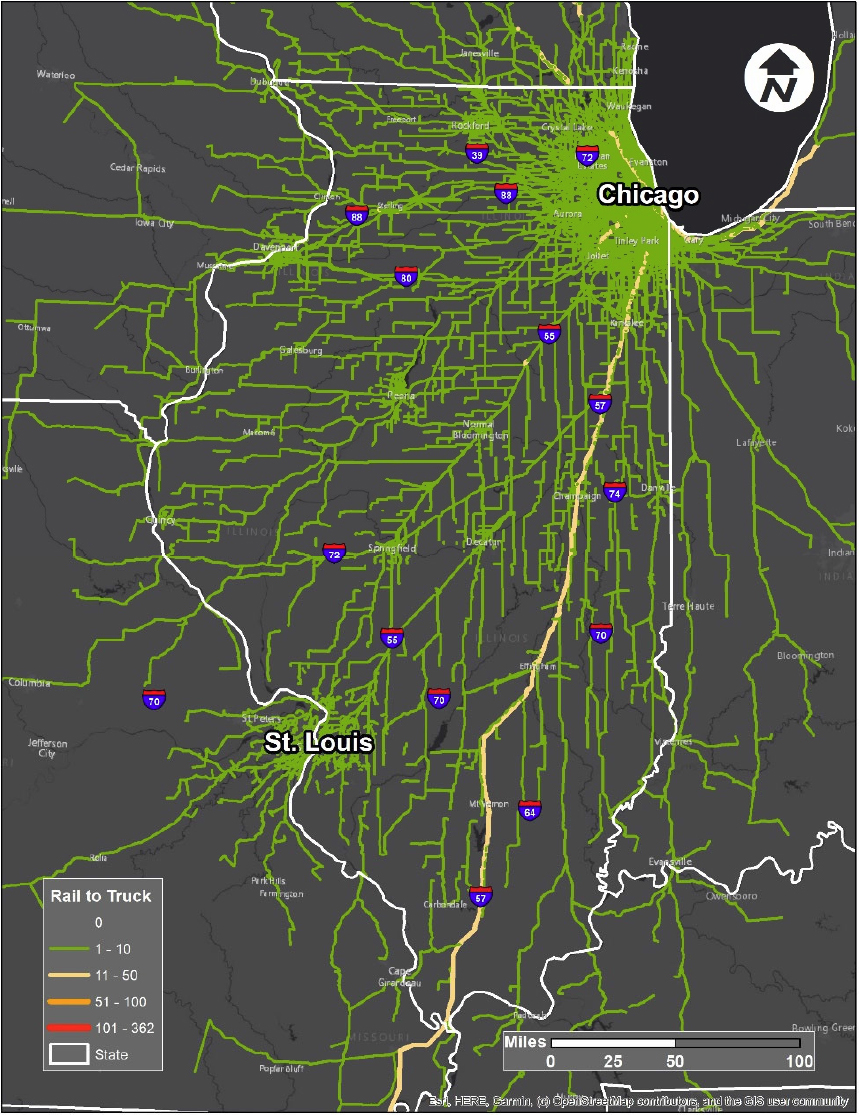
Truck Trips to/from Cook County Carrying Commodities Exchanged with the Rail Freight Shipments
Figure 61: Truck Trips to/from Cook County Carrying Commodities Exchanged with the Rail Freight Shipments
Page 108
Suggested Citation: "6 Cascading Effects of Disruptions on Multimodal Facilities in a State." National Academies of Sciences, Engineering, and Medicine. 2024. Resilience in Transportation Networks, Volume 2: Network Resilience Toolkit and Techniques. Washington, DC: The National Academies Press. doi: 10.17226/27921.
Air Mode
  1. FAF data provide tonnage flows for each of the 42 FAF commodities (defined by Standard Classification of Transported Goods [SCTG] code) by air to/from Cook Country, and then to/from domestic destinations within Illinois via truck (see Figure 62).
  2. Results are tonnage by FAF commodity between the three FAF zones.
Truck Trips to/from Cook County Carrying Commodities Exchanged with the Airborne Freight Shipments
Figure 62: Truck Trips to/from Cook County Carrying Commodities Exchanged with the Airborne Freight Shipments
Page 109
Suggested Citation: "6 Cascading Effects of Disruptions on Multimodal Facilities in a State." National Academies of Sciences, Engineering, and Medicine. 2024. Resilience in Transportation Networks, Volume 2: Network Resilience Toolkit and Techniques. Washington, DC: The National Academies Press. doi: 10.17226/27921.

Step 3: Trips Matrix Development

Daily truck trips from each mode (water, rail, and air) are disaggregated to develop TAZ-to-TAZ trip matrices. This requires a correspondence table (called equivalency) between the ILSTDM TAZ and the Transearch region (for water and rail) or FAF region (for air). The process to develop this equivalency is described below:

Water and Air Modes

Equivalency between Transearch region and TAZ was developed using existing data on daily truck trips from the base year ILSTDM model. The procedure is as follows:

  1. Trips by TAZ were calculated using the average of total origin and total destination trips for that TAZ.
  2. The region boundary and the TAZ boundary were spatially joined using ArcGIS.
  3. Region-to-TAZ shares were calculated.
    1. If the region is same or smaller than the TAZ, then all the trips in the region will be assigned to the TAZ in which it lies, and therefore region-to-TAZ share will be 100%.
    2. If the region is bigger than the TAZ, then the region-to-TAZ share for each TAZ in that region is calculated using its share of daily truck trips in the existing base year ILSTDM model.

The equivalency is used to disaggregate the trips from region to TAZ. The equivalency is joined with origin and destination regions providing origin shares and destination shares of region to TAZ. The TAZ-to-TAZ truck trips are obtained by multiplying the region-to-region truck trips with the origin and destination shares.

Air Mode

The equivalency between FAF zones and TAZ was developed using the LEHD data and a regression-based process. The procedure is as follows:

  1. Using regression, develop relationship between each commodity and LEHD’s North American Industry Classification System (NAICS) employment as a percentage of each employment category.
  2. For each commodity, develop inbound and outbound employment totals for each TAZ by multiplying individual TAZ’s employment in each NAICS category with its respective percentage for that commodity.
  3. The total inbound and outbound employment of TAZs is aggregated to FAF zones and share of FAF zones are calculated for each TAZ. The outbound employment provides origin shares while inbound employment provides destination shares of FAF to TAZ.
  4. The TAZ-to-TAZ tonnages are obtained by multiplying the FAF-to-FAF zone tonnages with the origin and destination shares.
  5. Combine the tonnage for all commodities and convert it to daily truck trips using a load factor of 20 and an annualization factor of 365.
Page 110
Suggested Citation: "6 Cascading Effects of Disruptions on Multimodal Facilities in a State." National Academies of Sciences, Engineering, and Medicine. 2024. Resilience in Transportation Networks, Volume 2: Network Resilience Toolkit and Techniques. Washington, DC: The National Academies Press. doi: 10.17226/27921.

Step 4: Perform traffic assignment

Assign daily traffic to the highway network for each mode by using the trip tables developed above in Step 3. The Traffic assignment is based on the shortest path. The results of the assignment provide truck trips by each link and direction.

Step 5: Process the data, analyze the impacts, and develop reports in the form of maps and summaries

The impacted facilities and zones due to the disruption to intermodal facility are determined. The assignment results show the impacted facilities. The origin or destination zones of the trucks that carry transferred commodities to/from intermodal facilities are the impacted zones and obtained from the trip table.

5a: Traffic-volume and sensitive employment maps: The analysis quantifies the number of truck trips that carry commodities transferred from the primary mode (called selected trips) to the zones served by those trips (called selected zones).

  1. Estimate the proportion of the region’s sensitive and non-sensitive employment in selected zones using LEHD employment data.
  2. Calculate the average of total origin and destination selected truck trips by zone.
  3. Determine the top twenty-five percentile zones based on volume and label them high volume (with remaining as low volume) and determine the top twenty-five percentile zones based on the high sensitivity employment and label them high sensitivity (with remaining as low sensitivity).
  4. Develop map of zones categorized into the four classifications.

5b: Summaries for trucks trips, household by poverty (below or above), and employment by sensitivity for each mode: A spreadsheet can be used to develop input data for graphs, maps, and tables.

  1. For each mode, calculate the following input data at the TAZ level:
    1. Average of origin/destination total truck and impacted trips for each TAZ
    2. Employment by NAICS code and sensitivity level (low or high)
    3. The number of households by poverty level (below poverty and above poverty)
  1. The TAZ variables (trips, employment, number of households, etc.) were aggregated to regions that include seven trade centers and seven hinterlands. Following maps were developed for each mode:
    1. Number of impacted trips by region.
    2. Share of state’s sensitive employment in each region.
    3. Share of state’s households below poverty in each region.

Results

Volume-Employment Sensitivity

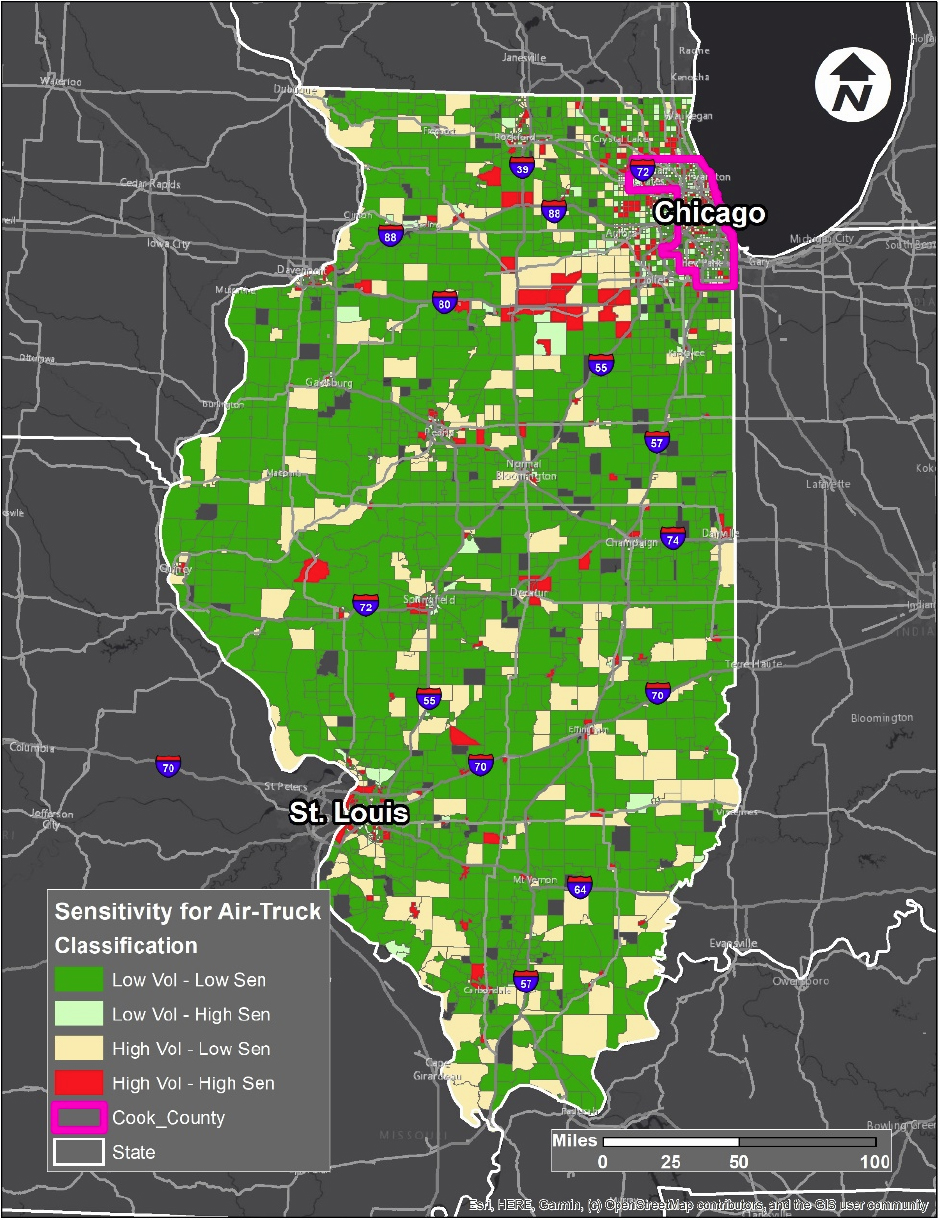
Figure, Figure , and Figure 65 highlight zones that are impacted by disruption of an intermodal facility serving water, rail, and air modes, respectively. During disruptions to water-borne freight modes, more impacts are seen in the TAZs closer to Madison County. For rail and air modes, more impacts are seen in and around Cook County.

Page 111
Suggested Citation: "6 Cascading Effects of Disruptions on Multimodal Facilities in a State." National Academies of Sciences, Engineering, and Medicine. 2024. Resilience in Transportation Networks, Volume 2: Network Resilience Toolkit and Techniques. Washington, DC: The National Academies Press. doi: 10.17226/27921.
Impacted Zones by Volume and Sensitivity for Water-to-Truck Trips
Figure 63: Impacted Zones by Volume and Sensitivity for Water-to-Truck Trips
Page 112
Suggested Citation: "6 Cascading Effects of Disruptions on Multimodal Facilities in a State." National Academies of Sciences, Engineering, and Medicine. 2024. Resilience in Transportation Networks, Volume 2: Network Resilience Toolkit and Techniques. Washington, DC: The National Academies Press. doi: 10.17226/27921.
Impacted Zones by Volume and Sensitivity for Water-to-Truck Trips
Figure 64: Impacted Zones by Volume and Sensitivity for Water-to-Truck Trips
Page 113
Suggested Citation: "6 Cascading Effects of Disruptions on Multimodal Facilities in a State." National Academies of Sciences, Engineering, and Medicine. 2024. Resilience in Transportation Networks, Volume 2: Network Resilience Toolkit and Techniques. Washington, DC: The National Academies Press. doi: 10.17226/27921.
Impacted Zones by Volume and Sensitivity for Water-to-Truck Trips
Figure 65: Impacted Zones by Volume and Sensitivity for Water-to-Truck Trips
Page 114
Suggested Citation: "6 Cascading Effects of Disruptions on Multimodal Facilities in a State." National Academies of Sciences, Engineering, and Medicine. 2024. Resilience in Transportation Networks, Volume 2: Network Resilience Toolkit and Techniques. Washington, DC: The National Academies Press. doi: 10.17226/27921.
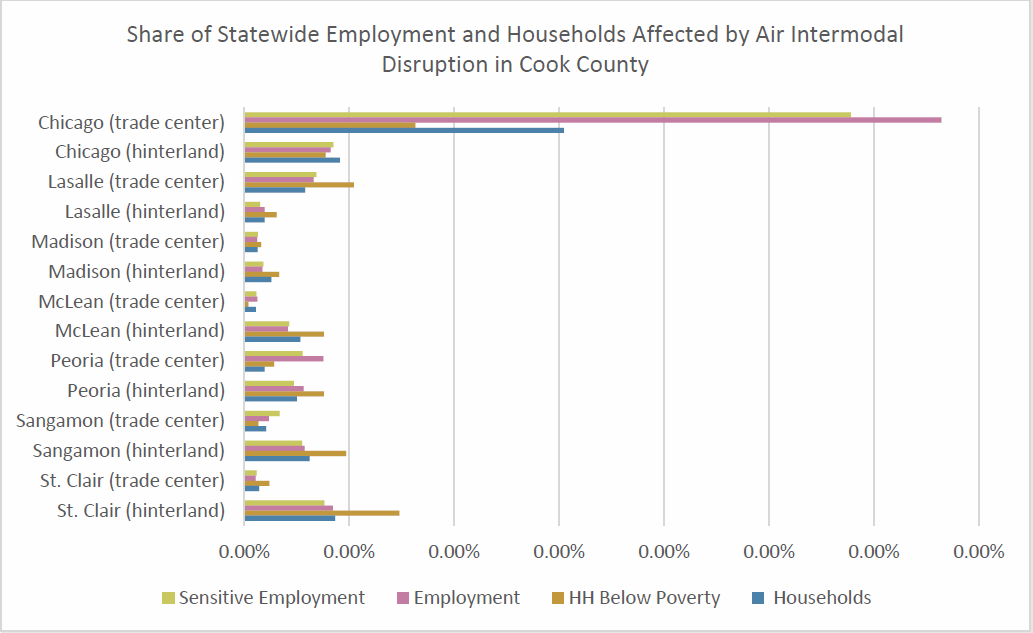
Impacted Employment and Households

The bar graphs in Figure 6 Figure 66 show the impacted employment (total and sensitive) and households (total and below poverty) as a share of statewide values for water mode. Figure 67 and Figure 68 show the same for rail and air mode, respectively.

Share of Statewide Employment and Households Impacted by Disruption in Water Intermodal
Figure 66: Share of Statewide Employment and Households Impacted by Disruption in Water Intermodal
Page 115
Suggested Citation: "6 Cascading Effects of Disruptions on Multimodal Facilities in a State." National Academies of Sciences, Engineering, and Medicine. 2024. Resilience in Transportation Networks, Volume 2: Network Resilience Toolkit and Techniques. Washington, DC: The National Academies Press. doi: 10.17226/27921.
Share of Statewide Employment and Households Impacted by Disruption in Rail Intermodal
Figure 67: Share of Statewide Employment and Households Impacted by Disruption in Rail Intermodal
Share of Statewide Employment and Households Impacted by Disruption in Air Intermodal
Figure 68: Share of Statewide Employment and Households Impacted by Disruption in Air Intermodal
Page 116
Suggested Citation: "6 Cascading Effects of Disruptions on Multimodal Facilities in a State." National Academies of Sciences, Engineering, and Medicine. 2024. Resilience in Transportation Networks, Volume 2: Network Resilience Toolkit and Techniques. Washington, DC: The National Academies Press. doi: 10.17226/27921.

Figure 69 shows the number of trips impacted in each region (trade center and hinterlands) from a disruption to a water freight-focused intermodal facility.

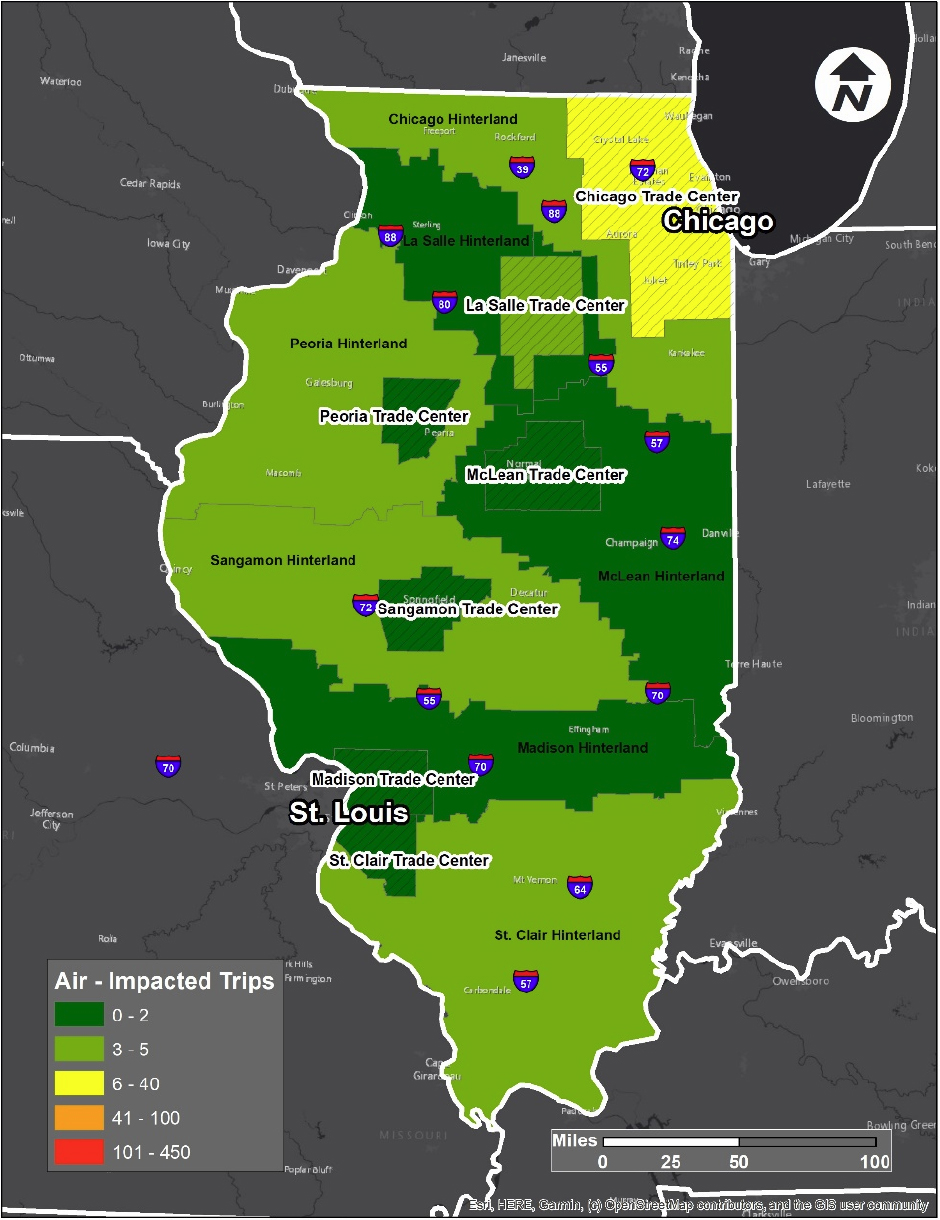
Figure 70 and Figure 71 show trips impacted by region from disruptions to rail and air intermodal facilities, respectively.
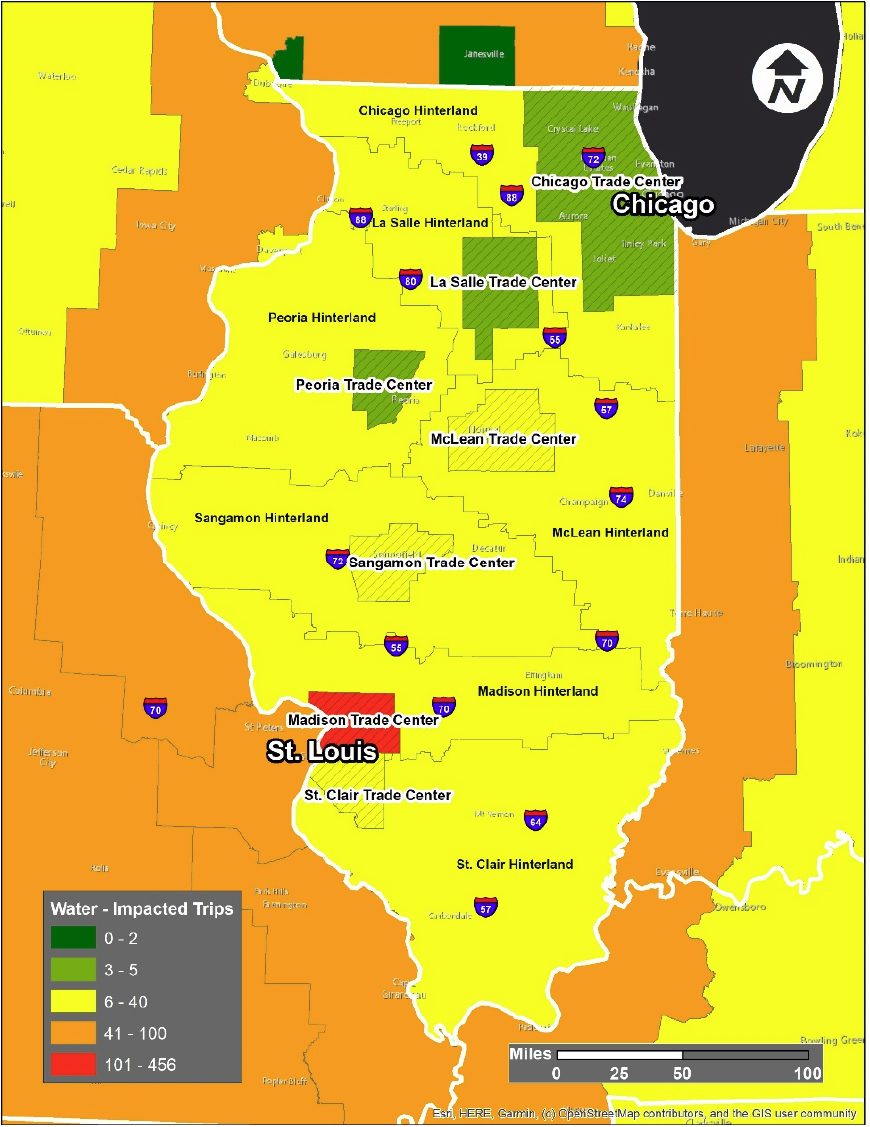
Water-Mode Trips Impacted by Region from Disruption to the Intermodal Facility in Madison County
Figure 69: Water-Mode Trips Impacted by Region from Disruption to the Intermodal Facility in Madison County
Page 117
Suggested Citation: "6 Cascading Effects of Disruptions on Multimodal Facilities in a State." National Academies of Sciences, Engineering, and Medicine. 2024. Resilience in Transportation Networks, Volume 2: Network Resilience Toolkit and Techniques. Washington, DC: The National Academies Press. doi: 10.17226/27921.
Rail-Mode Trips Impacted by Region from Disruption to the Intermodal Facility in Madison County
Figure 70: Rail-Mode Trips Impacted by Region from Disruption to the Intermodal Facility in Madison County
Page 118
Suggested Citation: "6 Cascading Effects of Disruptions on Multimodal Facilities in a State." National Academies of Sciences, Engineering, and Medicine. 2024. Resilience in Transportation Networks, Volume 2: Network Resilience Toolkit and Techniques. Washington, DC: The National Academies Press. doi: 10.17226/27921.
Air-Mode Trips Impacted by Region from Disruption to the Intermodal Facility in Madison County
Figure 71: Air-Mode Trips Impacted by Region from Disruption to the Intermodal Facility in Madison County

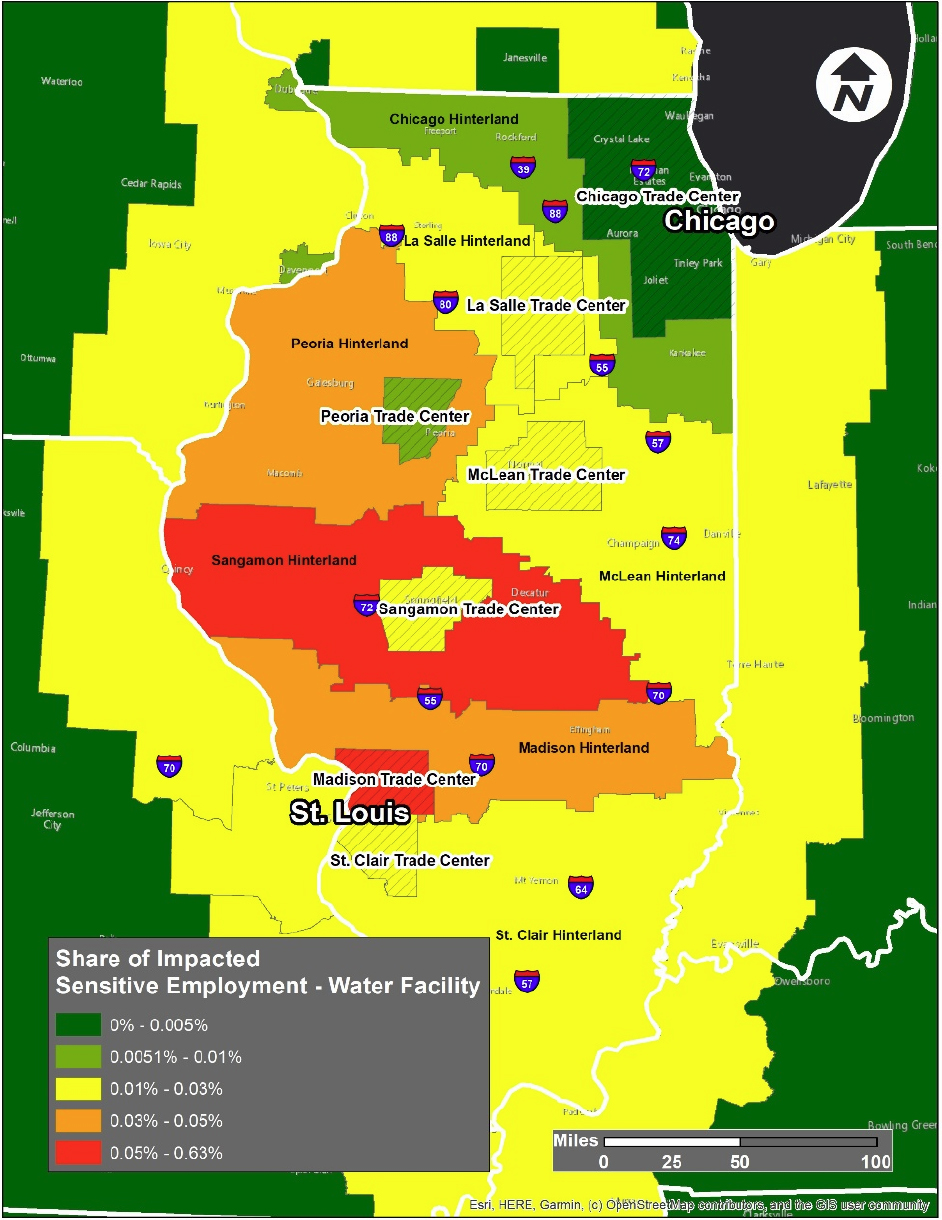
Figure 72 shows the percentage of sensitive employment impacted by a disruption in water intermodal facility to the total sensitive employment in the region. Variable values are weighted by impacted trip shares and divided by total value of that variable in the region.

Page 119
Suggested Citation: "6 Cascading Effects of Disruptions on Multimodal Facilities in a State." National Academies of Sciences, Engineering, and Medicine. 2024. Resilience in Transportation Networks, Volume 2: Network Resilience Toolkit and Techniques. Washington, DC: The National Academies Press. doi: 10.17226/27921.

Figure 73 and Figure 74 show percentage of sensitive employment impacted by disruption in rail and air intermodal facilities, respectively, to the total sensitive employment in each region.

Share of Sensitive Employment in Each Region Impacted by Disruption to a Water Intermodal Facility
Figure 72: Share of Sensitive Employment in Each Region Impacted by Disruption to a Water Intermodal Facility
Page 120
Suggested Citation: "6 Cascading Effects of Disruptions on Multimodal Facilities in a State." National Academies of Sciences, Engineering, and Medicine. 2024. Resilience in Transportation Networks, Volume 2: Network Resilience Toolkit and Techniques. Washington, DC: The National Academies Press. doi: 10.17226/27921.
Share of Sensitive Employment in Each Region Impacted by Disruption to a Rail Intermodal Facility
Figure 73: Share of Sensitive Employment in Each Region Impacted by Disruption to a Rail Intermodal Facility
Page 121
Suggested Citation: "6 Cascading Effects of Disruptions on Multimodal Facilities in a State." National Academies of Sciences, Engineering, and Medicine. 2024. Resilience in Transportation Networks, Volume 2: Network Resilience Toolkit and Techniques. Washington, DC: The National Academies Press. doi: 10.17226/27921.
Share of Sensitive Employment in Each Region Impacted by Disruption to an Air Intermodal Facility
Figure 74: Share of Sensitive Employment in Each Region Impacted by Disruption to an Air Intermodal Facility

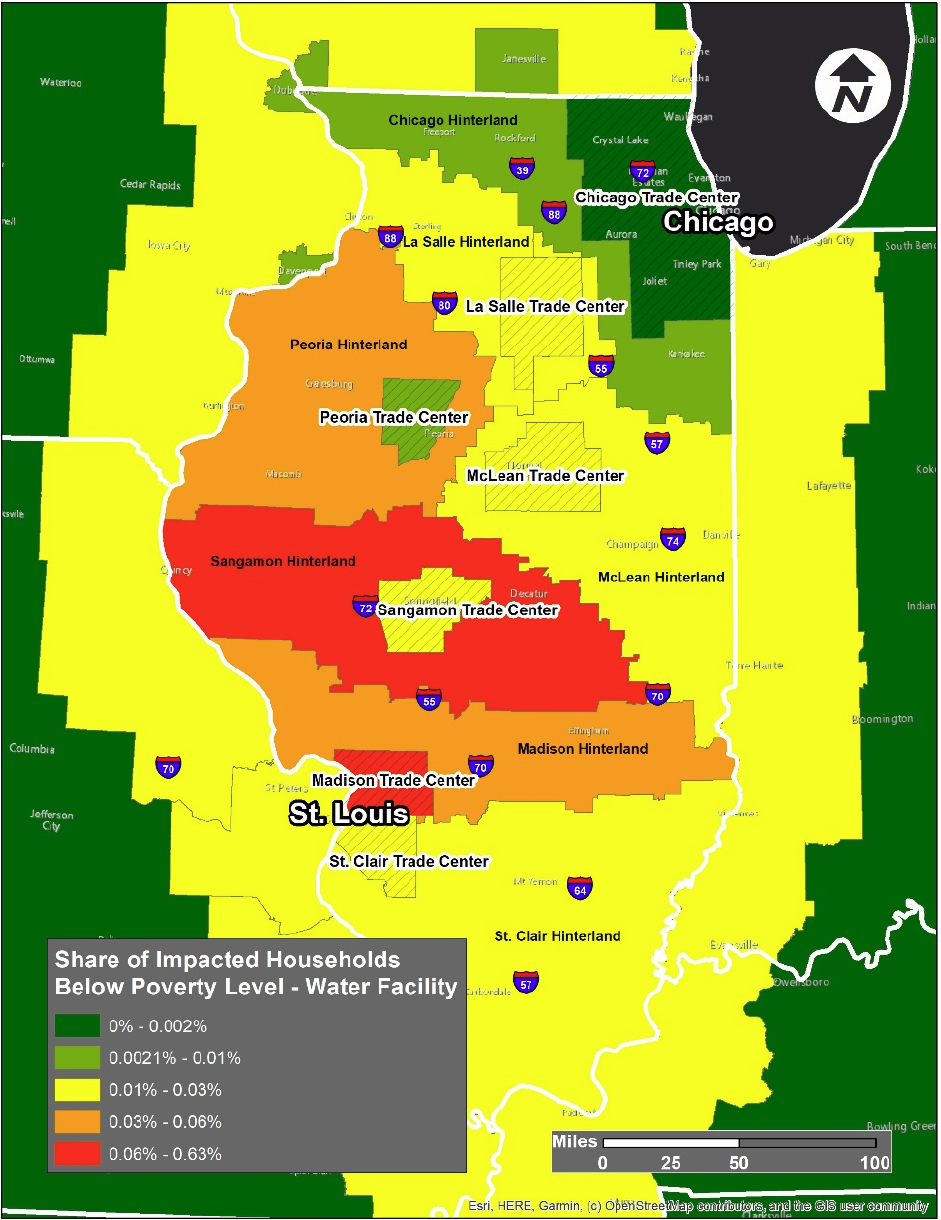
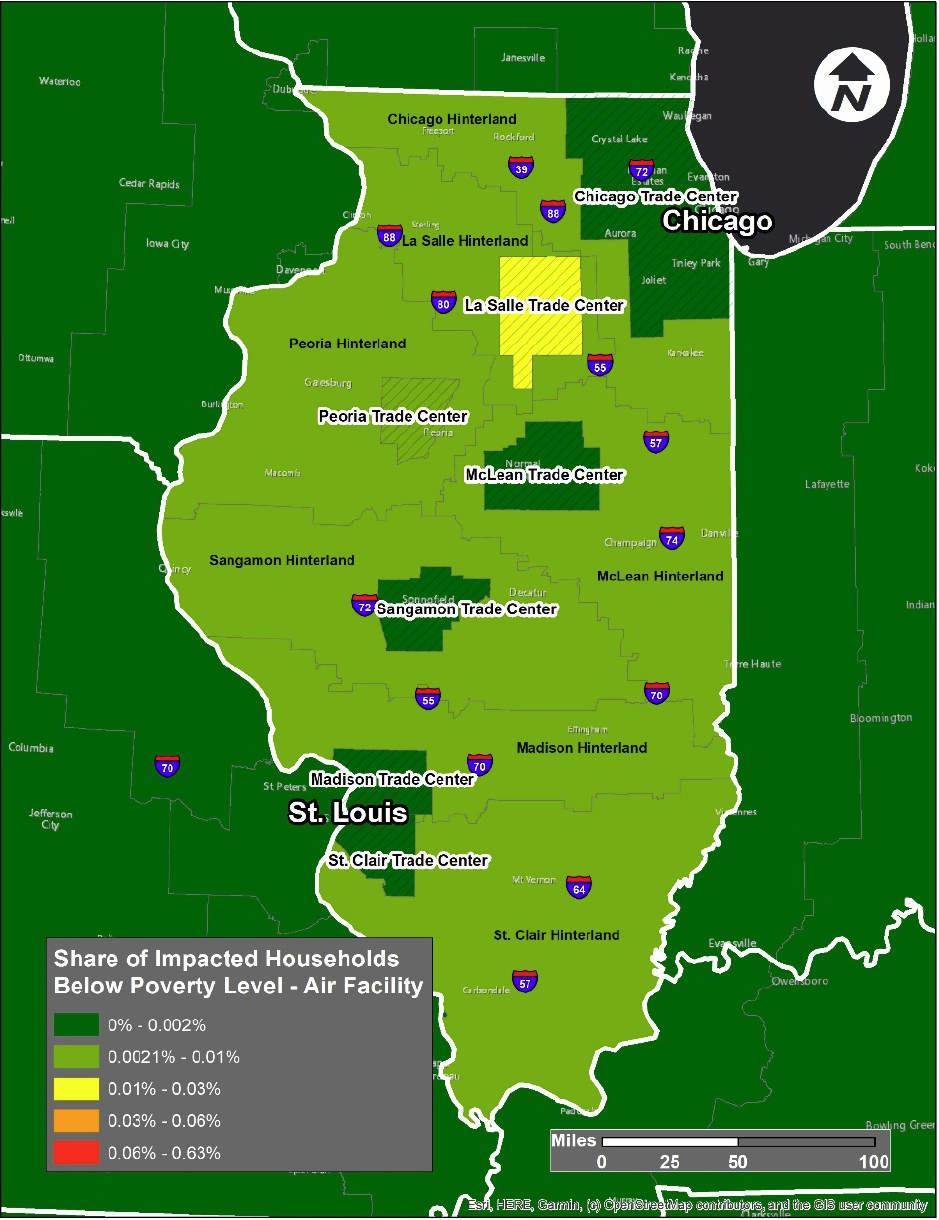
Figure 75 shows the share of households below poverty impacted by disruption to a water intermodal facility compared to the total households below poverty in the region. Variable values are weighted by impacted trip shares and divided by total value of that variable in the region.

Page 122
Suggested Citation: "6 Cascading Effects of Disruptions on Multimodal Facilities in a State." National Academies of Sciences, Engineering, and Medicine. 2024. Resilience in Transportation Networks, Volume 2: Network Resilience Toolkit and Techniques. Washington, DC: The National Academies Press. doi: 10.17226/27921.
Share of Households Below Poverty in Each Region Impacted by Disruption to a Water Intermodal Facility
Figure 75: Share of Households Below Poverty in Each Region Impacted by Disruption to a Water Intermodal Facility.

Figure 76 and Figure 77 show the same for disruption in rail and air intermodal facilities, respectively.
Page 123
Suggested Citation: "6 Cascading Effects of Disruptions on Multimodal Facilities in a State." National Academies of Sciences, Engineering, and Medicine. 2024. Resilience in Transportation Networks, Volume 2: Network Resilience Toolkit and Techniques. Washington, DC: The National Academies Press. doi: 10.17226/27921.
Share of Households Below Poverty in Each Region Impacted by Disruption to a Rail Intermodal Facility
Figure 76: Share of Households Below Poverty in Each Region Impacted by Disruption to a Rail Intermodal Facility
Page 124
Suggested Citation: "6 Cascading Effects of Disruptions on Multimodal Facilities in a State." National Academies of Sciences, Engineering, and Medicine. 2024. Resilience in Transportation Networks, Volume 2: Network Resilience Toolkit and Techniques. Washington, DC: The National Academies Press. doi: 10.17226/27921.
Share of Households Below Poverty in Each Region Impacted by Disruption to an Air Intermodal Facility
Figure 77: Share of Households Below Poverty in Each Region Impacted by Disruption to an Air Intermodal Facility
Page 125
Suggested Citation: "6 Cascading Effects of Disruptions on Multimodal Facilities in a State." National Academies of Sciences, Engineering, and Medicine. 2024. Resilience in Transportation Networks, Volume 2: Network Resilience Toolkit and Techniques. Washington, DC: The National Academies Press. doi: 10.17226/27921.
TAZ Maps

Figure 78 shows the number of trips in each TAZ affected by disruption to a water intermodal facility. Figure 79 and Figure 80 show the same for disruption to rail and air intermodal facilities, respectively.

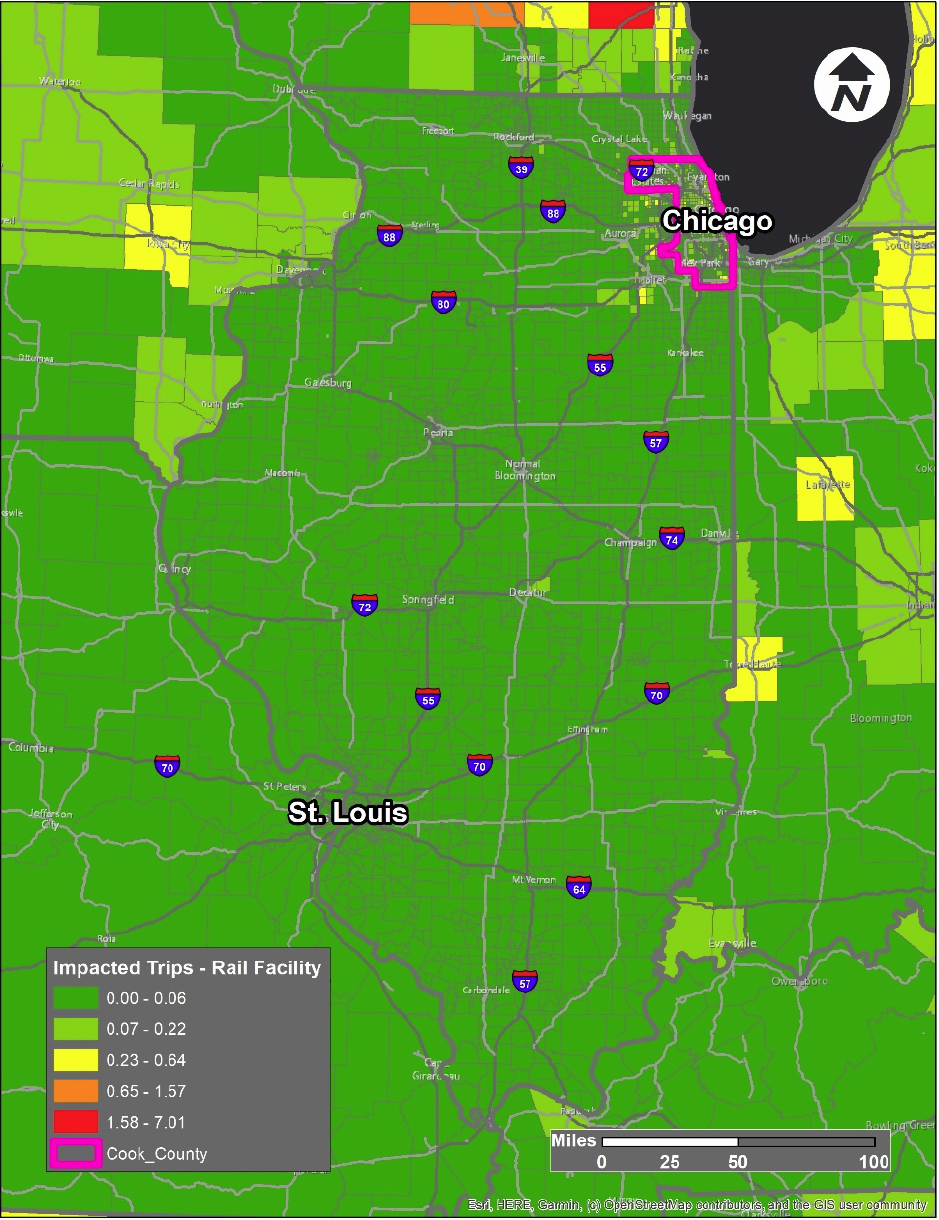
Number of Water-Borne Freight Trips in Each TAZ Impacted by Disruption to the Intermodal Facility in Madison County
Figure 78: Number of Water-Borne Freight Trips in Each TAZ Impacted by Disruption to the Intermodal Facility in Madison County
Page 126
Suggested Citation: "6 Cascading Effects of Disruptions on Multimodal Facilities in a State." National Academies of Sciences, Engineering, and Medicine. 2024. Resilience in Transportation Networks, Volume 2: Network Resilience Toolkit and Techniques. Washington, DC: The National Academies Press. doi: 10.17226/27921.
Number of Rail-Freight Trips in each TAZ Impacted by Disruption to the Intermodal Facility in Madison County
Figure 79: Number of Rail-Freight Trips in each TAZ Impacted by Disruption to the Intermodal Facility in Madison County
Page 127
Suggested Citation: "6 Cascading Effects of Disruptions on Multimodal Facilities in a State." National Academies of Sciences, Engineering, and Medicine. 2024. Resilience in Transportation Networks, Volume 2: Network Resilience Toolkit and Techniques. Washington, DC: The National Academies Press. doi: 10.17226/27921.
Number of Air-Freight Trips in Each TAZ impacted by Disruption to the Intermodal Facility in Madison County
Figure 80: Number of Air-Freight Trips in Each TAZ impacted by Disruption to the Intermodal Facility in Madison County
Page 128
Suggested Citation: "6 Cascading Effects of Disruptions on Multimodal Facilities in a State." National Academies of Sciences, Engineering, and Medicine. 2024. Resilience in Transportation Networks, Volume 2: Network Resilience Toolkit and Techniques. Washington, DC: The National Academies Press. doi: 10.17226/27921.

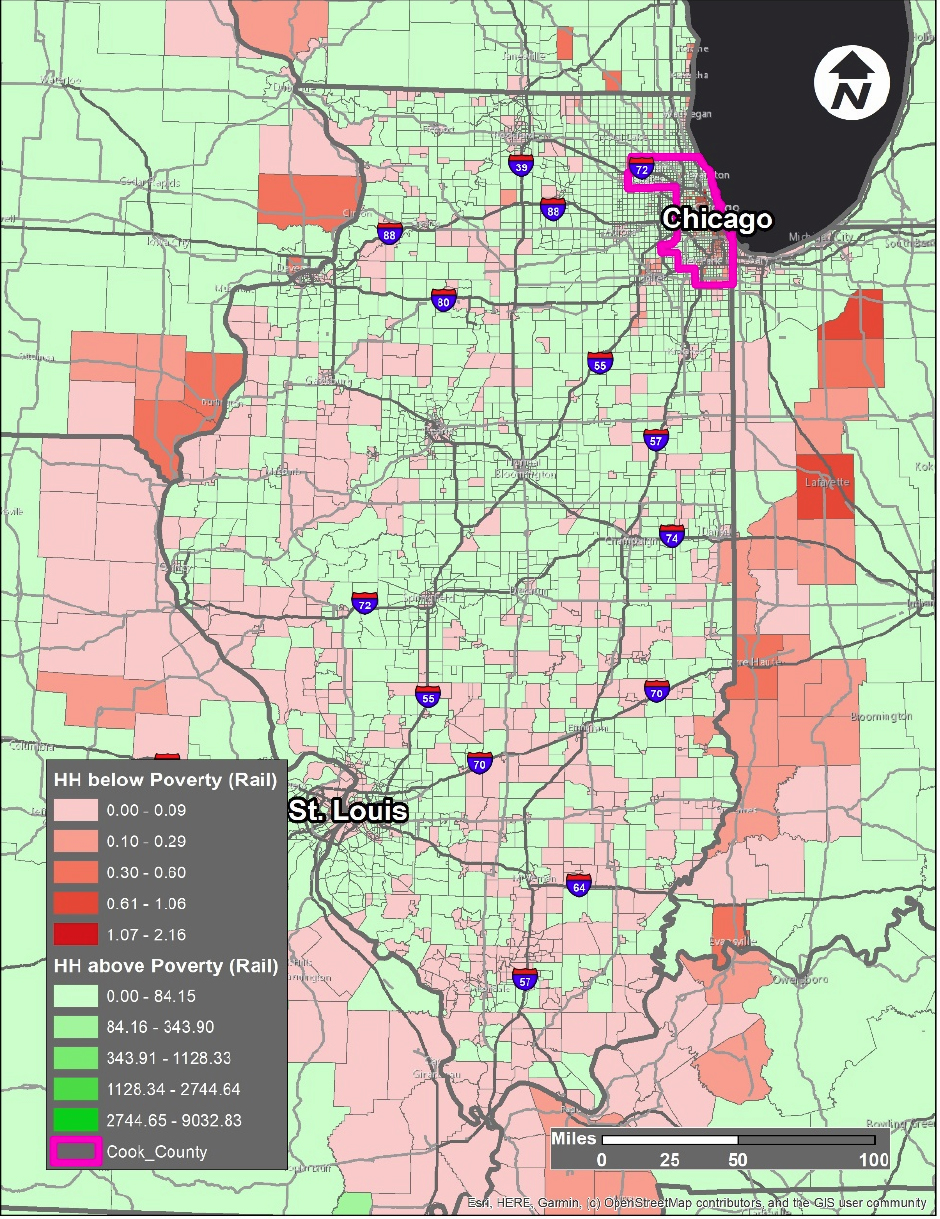
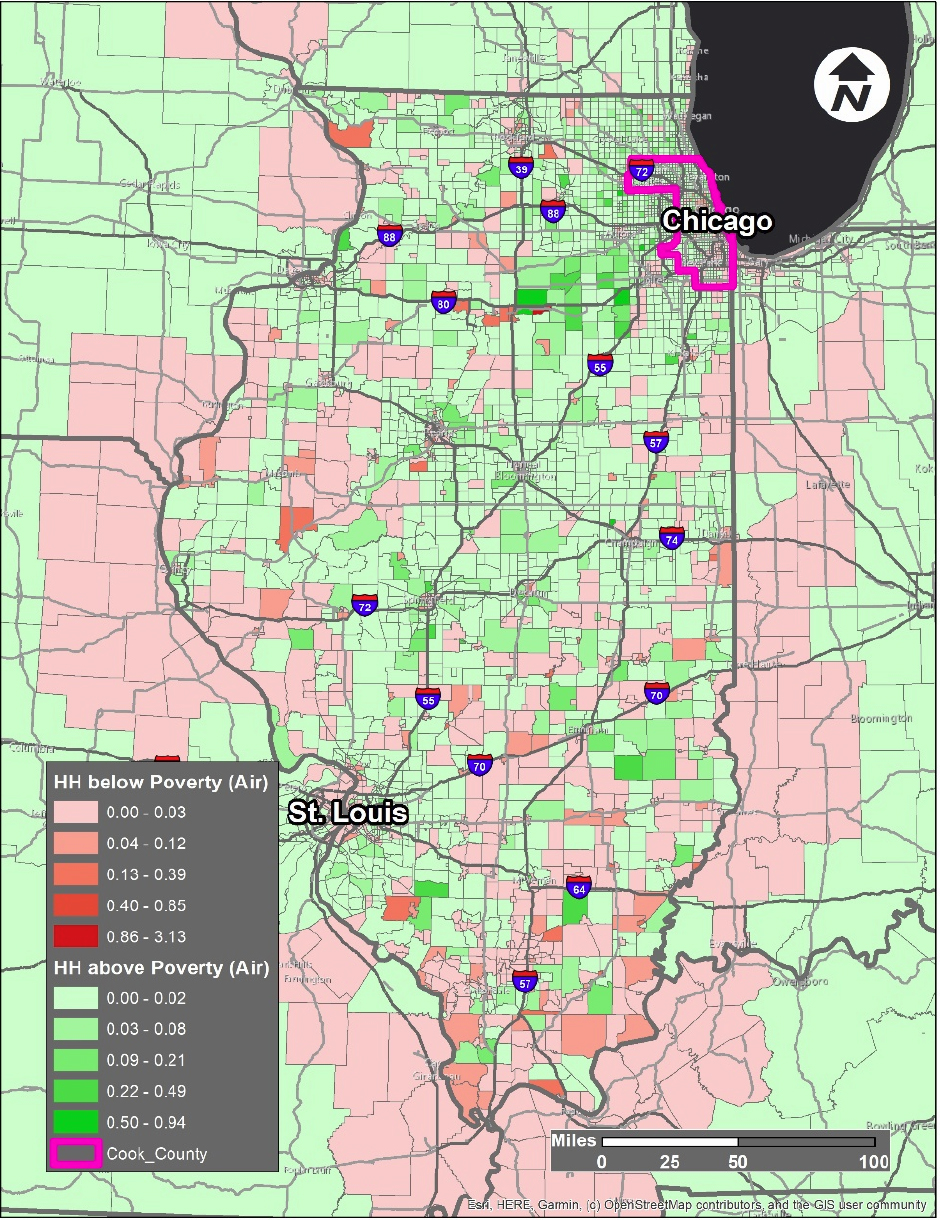
Figure 81 shows the number of households above and below the poverty level affected by disruption to a water intermodal facility. Figure 82 and Figure 83 show the same from disruption to rail and air intermodal facilities, respectively.

The Number of Households Above and Below Poverty Affected by Disruption to a Water Intermodal Facility
Figure 81: The Number of Households Above and Below Poverty Affected by Disruption to a Water Intermodal Facility
Page 129
Suggested Citation: "6 Cascading Effects of Disruptions on Multimodal Facilities in a State." National Academies of Sciences, Engineering, and Medicine. 2024. Resilience in Transportation Networks, Volume 2: Network Resilience Toolkit and Techniques. Washington, DC: The National Academies Press. doi: 10.17226/27921.
The Number of Households Above and Below Poverty Affected by Disruption to Rail Trips from the Cook County Intermodal Facility
Figure 82: The Number of Households Above and Below Poverty Affected by Disruption to Rail Trips from the Cook County Intermodal Facility
Page 130
Suggested Citation: "6 Cascading Effects of Disruptions on Multimodal Facilities in a State." National Academies of Sciences, Engineering, and Medicine. 2024. Resilience in Transportation Networks, Volume 2: Network Resilience Toolkit and Techniques. Washington, DC: The National Academies Press. doi: 10.17226/27921.
The Number of Households Above and Below Poverty Affected by Disruption to Air Trips at the Cook County Intermodal Facility
Figure 83: The Number of Households Above and Below Poverty Affected by Disruption to Air Trips at the Cook County Intermodal Facility

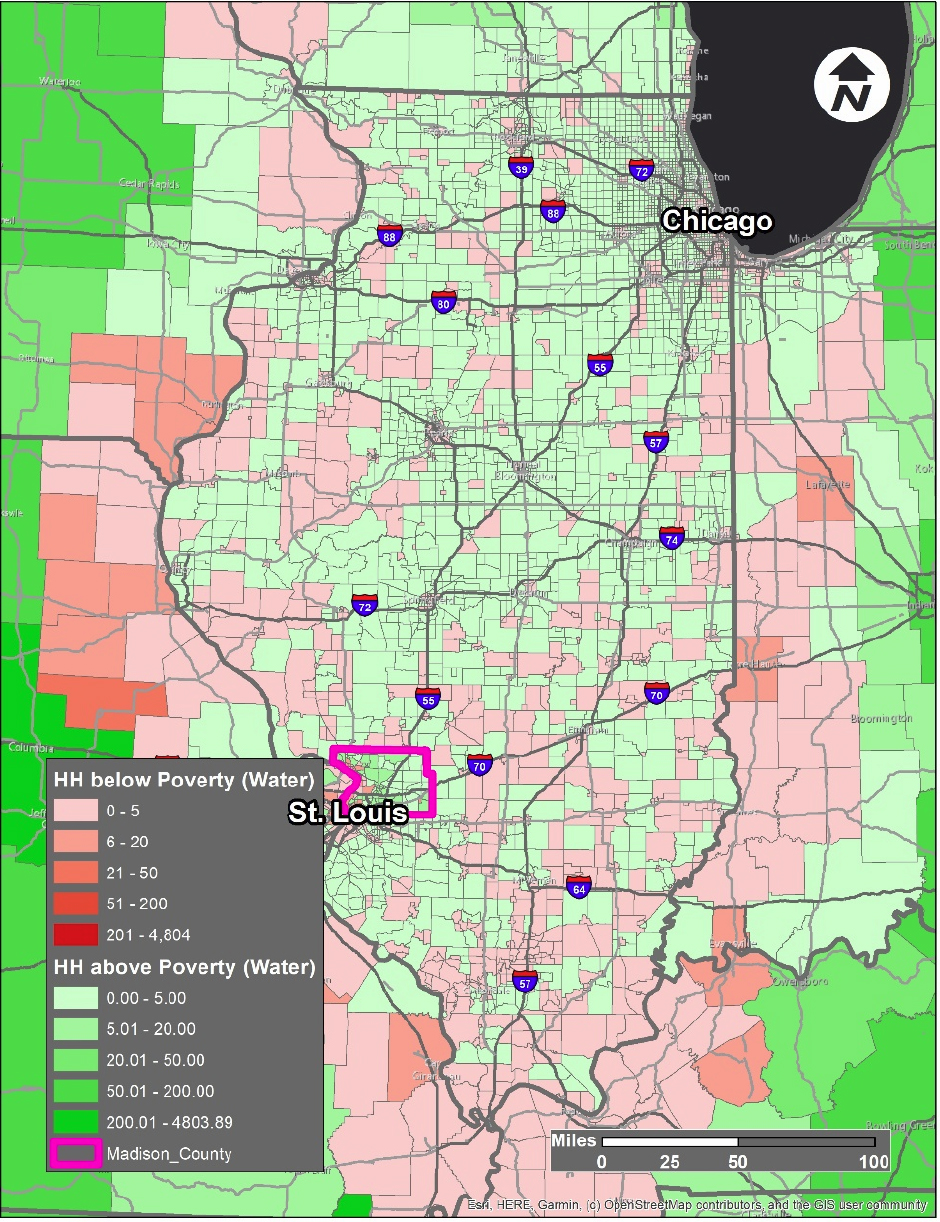
Figure 84 shows the regional share of employment (by zone) in high sensitivity categories weighted by share of impacted trips from disruption to a water intermodal facility.

Page 131
Suggested Citation: "6 Cascading Effects of Disruptions on Multimodal Facilities in a State." National Academies of Sciences, Engineering, and Medicine. 2024. Resilience in Transportation Networks, Volume 2: Network Resilience Toolkit and Techniques. Washington, DC: The National Academies Press. doi: 10.17226/27921.
Number of Jobs in High Sensitivity Categories Affected by Disruption to Water-Borne Freight at the Madison County Intermodal Facility
Figure 84: Number of Jobs in High Sensitivity Categories Affected by Disruption to Water-Borne Freight at the Madison County Intermodal Facility

Figure 85 and Figure 86 show the same from disruption to rail and air intermodal facilities, respectively.
Page 132
Suggested Citation: "6 Cascading Effects of Disruptions on Multimodal Facilities in a State." National Academies of Sciences, Engineering, and Medicine. 2024. Resilience in Transportation Networks, Volume 2: Network Resilience Toolkit and Techniques. Washington, DC: The National Academies Press. doi: 10.17226/27921.
Number of Jobs in High Sensitivity Categories Affected by Disruption to Rail-Borne Freight at the Madison County Intermodal Facility
Figure 85: Number of Jobs in High Sensitivity Categories Affected by Disruption to Rail-Borne Freight at the Madison County Intermodal Facility
Page 133
Suggested Citation: "6 Cascading Effects of Disruptions on Multimodal Facilities in a State." National Academies of Sciences, Engineering, and Medicine. 2024. Resilience in Transportation Networks, Volume 2: Network Resilience Toolkit and Techniques. Washington, DC: The National Academies Press. doi: 10.17226/27921.
Number of Jobs in High Sensitivity Categories Affected by Disruption to Airborne Freight at the Madison County Intermodal Facility
Figure 86: Number of Jobs in High Sensitivity Categories Affected by Disruption to Airborne Freight at the Madison County Intermodal Facility
Page 134
Suggested Citation: "6 Cascading Effects of Disruptions on Multimodal Facilities in a State." National Academies of Sciences, Engineering, and Medicine. 2024. Resilience in Transportation Networks, Volume 2: Network Resilience Toolkit and Techniques. Washington, DC: The National Academies Press. doi: 10.17226/27921.

6.2 Planning Context for Cascading-Effects Analysis in Illinois

Illinois’ statewide freight network is one of three test cases selected for pilot-testing network resilience tools as part of the NCHRP 20-125: Incorporating Resilience in Transportation Networks. Site testing includes working with local stakeholders, integrating local models and data, and developing processes for engagement that will enhance network resilience capacity. This document shares findings from both the stakeholder outreach and the cascading-effects analysis in Illinois.

Community Resilience Challenges

Illinois’ transportation network is susceptible to disruption on many fronts. The state is home to numerous transportation facilities such as international airports, railway networks, and expansive interstate highway connections. Its proximity to Canada and neighboring states creates the potential for far-ranging cascading effects, not only affecting counties and cities within Illinois, but also on neighboring states and even neighboring countries. With a population exceeding 12 million people, Illinois was the sixth most-populated state in the nation in 2022. Congestion is a large problem within Illinois, especially around Chicago. The I-90 and I-94 are some of the busiest highways in the United States, with average annual daily traffic counts on the I-90 totaling well over 300,000 vehicles. With so many vehicles traveling on this highway, crashes are bound to happen. One of the most severe crashes that took place on the I-90 in recent years is a multiple-fatality crash caused by a driver going the wrong way down a portion of the corridor in McHenry County, Illinois in July 2022. Moreover, in September 2022, a fatality occurred on the I-90 near Huntley, Illinois.

Severe weather impacts much of Illinois, especially during the colder months. Snowstorms, icy roads, black ice, and wind can affect millions of travelers on an annual basis. Typically, Illinois receives 30 to 40 inches of snow a year. In February of 2022, a severe snowstorm contributed to a 100-car pileup on the I-39 highway near El Paso, Illinois. That portion of the I-39 was closed off for almost 12 hours. Other highways around Illinois, such as the I-95 and I-74, also were affected by the snowstorms that swept through the state that winter.

Page 135
Suggested Citation: "6 Cascading Effects of Disruptions on Multimodal Facilities in a State." National Academies of Sciences, Engineering, and Medicine. 2024. Resilience in Transportation Networks, Volume 2: Network Resilience Toolkit and Techniques. Washington, DC: The National Academies Press. doi: 10.17226/27921.

Findings

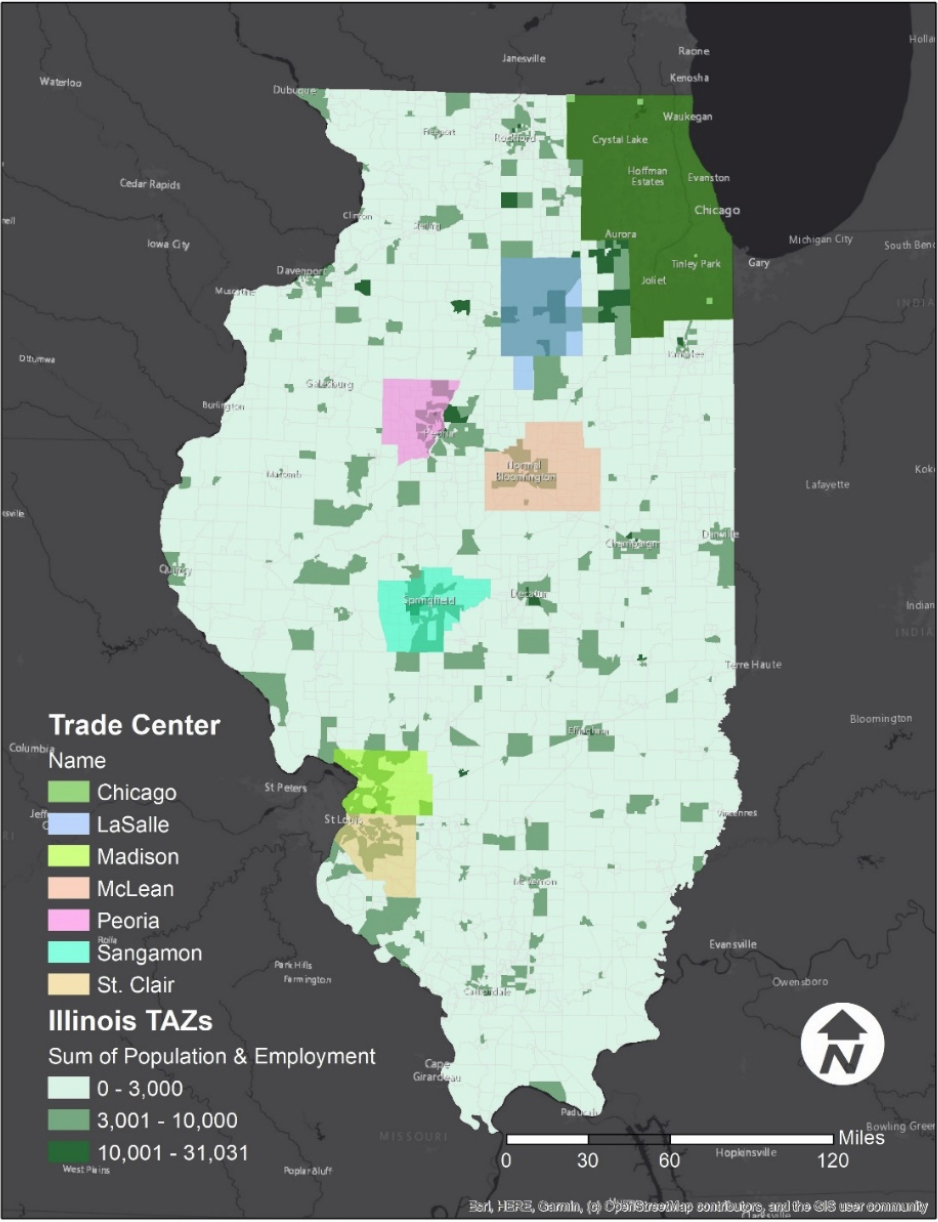
Figure 87 highlights statewide trade centers and hinterlands. Trade centers are major metropolitan areas within the state where economic activity revolving around freight occurs. Hinterlands are linked economically to trade centers. Employment by TAZ is the number of employees in various industry sectors working in each TAZ from Longitudinal Employment Household Dynamics (LEHD) data. Figure 88 highlights the TAZs.
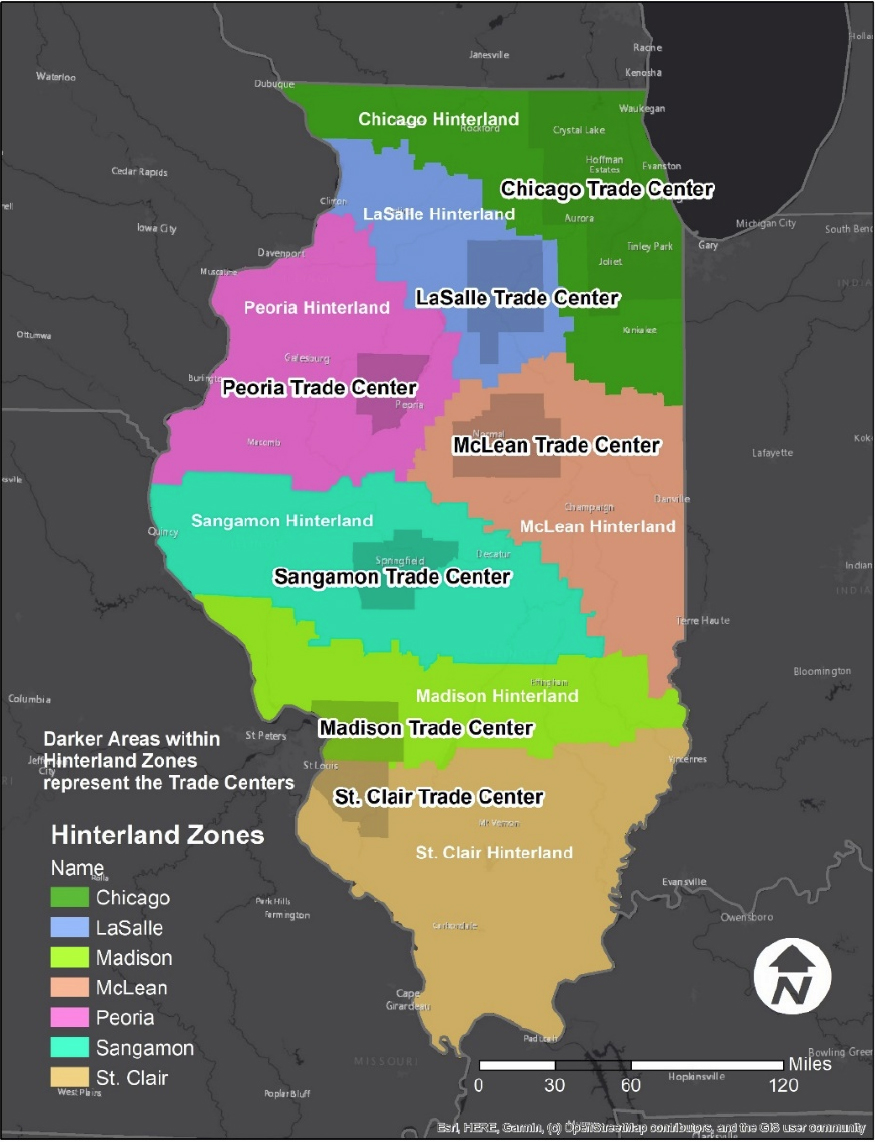
Trade Centers and Hinterlands
Figure 87: Trade Centers and Hinterlands
Page 136
Suggested Citation: "6 Cascading Effects of Disruptions on Multimodal Facilities in a State." National Academies of Sciences, Engineering, and Medicine. 2024. Resilience in Transportation Networks, Volume 2: Network Resilience Toolkit and Techniques. Washington, DC: The National Academies Press. doi: 10.17226/27921.
TAZs in Illinois
Figure 88: TAZs in Illinois

Critical corridors were identified by analyzing truck trip matrices, link volumes, and a distance-based assignment script. Based on the volumes, the corridors were categorized into three tiers. One route in each tier was selected to serve as an example:

Page 137
Suggested Citation: "6 Cascading Effects of Disruptions on Multimodal Facilities in a State." National Academies of Sciences, Engineering, and Medicine. 2024. Resilience in Transportation Networks, Volume 2: Network Resilience Toolkit and Techniques. Washington, DC: The National Academies Press. doi: 10.17226/27921.
  • Tier 1: I-55 and IL Route 66 between Mclean and Chicago – They are parallel routes, and both the routes were analyzed together.
  • Tier 2: I-70, east of Madison and St. Clair trade centers.
  • Tier 3: IL Route 29 between Peoria and Springfield.

Tier 1 (Red) is the most truck-traffic heavy (inter-region); Tier 2 (Orange) is a medium-level truck-traffic (inter-region) route; and Tier 3 (Yellow) is a relatively low-level truck-traffic (inter-region) route.

Figure 89 highlights link volumes on various roadway segments within Illinois. Five classifications are listed; however, only four are shown, as the 0-200 category range is ubiquitous throughout the map if shown. The I-55 corridor stretching from Chicago to the edge of the Sangamon County hinterland is a significant road segment as link volumes are quite high for in-state freight travel (see Figure 89).
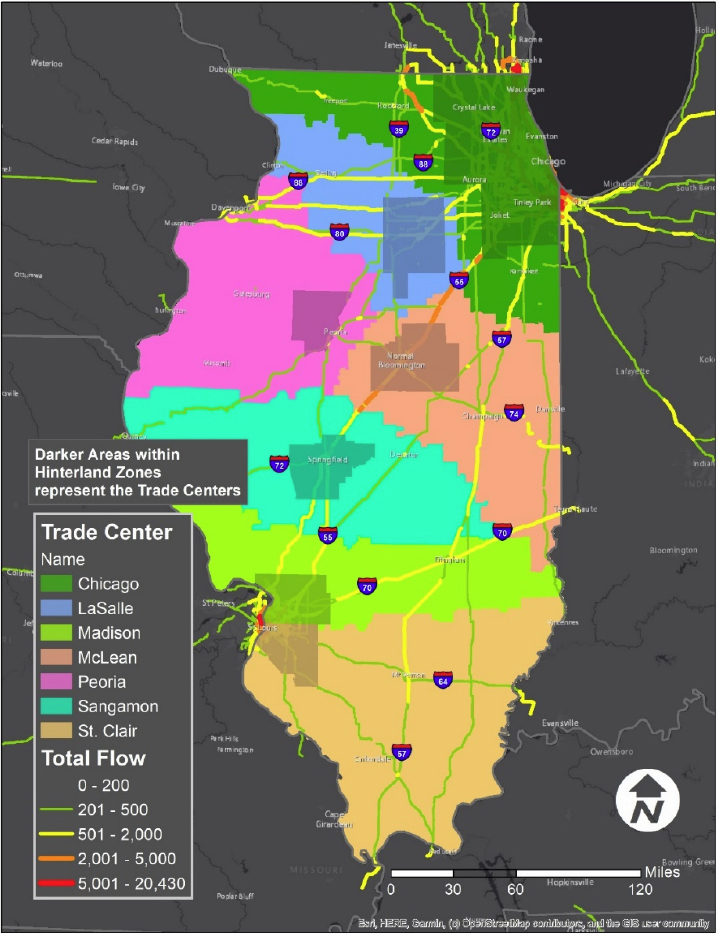
Link Volumes
Figure 89: Link Volumes
Page 138
Suggested Citation: "6 Cascading Effects of Disruptions on Multimodal Facilities in a State." National Academies of Sciences, Engineering, and Medicine. 2024. Resilience in Transportation Networks, Volume 2: Network Resilience Toolkit and Techniques. Washington, DC: The National Academies Press. doi: 10.17226/27921.
Region Maps

Figure 90 highlights the cascading effects from a disruption of the I-55 and IL Route 66 corridors (Tier 1 routes) on TAZs within Illinois. On this map and the next two maps, the trend is quite similar. TAZs that are close to the selected roadway segment are most affected by the disruption. For Figure 90, the affected TAZs are situated quite close to the selected route. There are numerous TAZs scattered around Illinois that are also affected by a Tier 1 disruption.

Tier 1 Zones by Volume and Sensitivity
Figure 90: Tier 1 Zones by Volume and Sensitivity
Page 139
Suggested Citation: "6 Cascading Effects of Disruptions on Multimodal Facilities in a State." National Academies of Sciences, Engineering, and Medicine. 2024. Resilience in Transportation Networks, Volume 2: Network Resilience Toolkit and Techniques. Washington, DC: The National Academies Press. doi: 10.17226/27921.

Figure 91 highlights TAZs impacted by disruptions to the I-70 corridor (Tier 2 route). TAZs affected by the Tier 2 route disruption are vast. Almost the entire southern half of Illinois looks to be affected by a disruption to the Tier 2 route.

Tier 2 Zones by Volume and Sensitivity
Figure 91: Tier 2 Zones by Volume and Sensitivity
Page 140
Suggested Citation: "6 Cascading Effects of Disruptions on Multimodal Facilities in a State." National Academies of Sciences, Engineering, and Medicine. 2024. Resilience in Transportation Networks, Volume 2: Network Resilience Toolkit and Techniques. Washington, DC: The National Academies Press. doi: 10.17226/27921.

Figure 92 shows cascading effects of a disruption to IL Route 29 (Tier 3) on TAZs within Illinois. For the Tier 3 route disruption scenario, TAZs that are affected are close to the disrupted route, as well as being quite scattered throughout the entire state.

Tier 3 Zones by Volume and Sensitivity
Figure 92: Tier 3 Zones by Volume and Sensitivity
Page 141
Suggested Citation: "6 Cascading Effects of Disruptions on Multimodal Facilities in a State." National Academies of Sciences, Engineering, and Medicine. 2024. Resilience in Transportation Networks, Volume 2: Network Resilience Toolkit and Techniques. Washington, DC: The National Academies Press. doi: 10.17226/27921.
Impacts of Disruptions to Key Freight Corridors (Tier 1, Tier 2 & Tier 3)
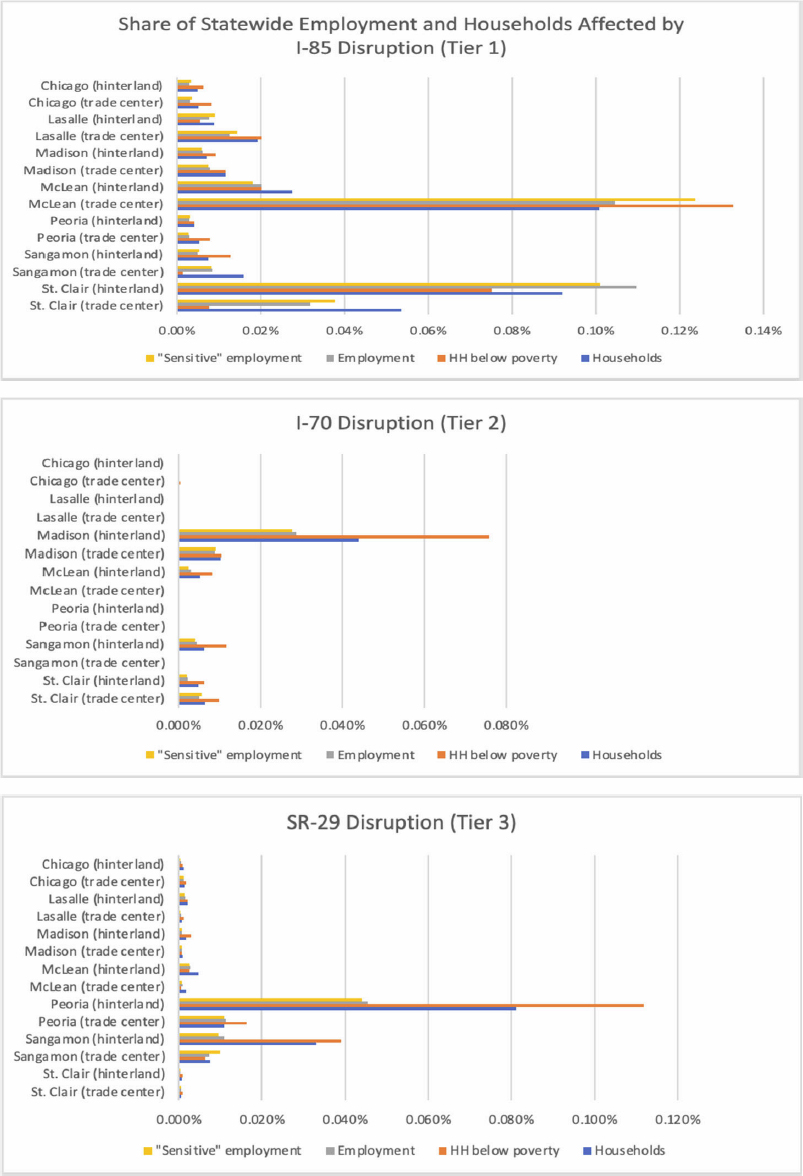
Figure 93: Impacts of Disruptions to Key Freight Corridors (Tier 1, Tier 2 & Tier 3)

In Figure 93, impacts of disruptions to key freight corridors (Tier 1, Tier 2 & Tier 3) are shown as the statewide share of households, households living in poverty, employment, and employment in “sensitive” job categories affected in each trade center and hinterland. For example, a disruption to I-55 south of Chicago would have the greatest impacts on employment and mobility in the McLean and in St. Clair areas. In McLean alone, the number of households living in poverty affected by a disruption to I-55 represents approximately 12 of every 10,000 households living in poverty statewide.

Page 142
Suggested Citation: "6 Cascading Effects of Disruptions on Multimodal Facilities in a State." National Academies of Sciences, Engineering, and Medicine. 2024. Resilience in Transportation Networks, Volume 2: Network Resilience Toolkit and Techniques. Washington, DC: The National Academies Press. doi: 10.17226/27921.

Figure 94 highlights where a disruption on the I-55 and IL Route 66 corridors (Tier 1) would affect freight trips by region. Regions within Illinois include seven trade centers and seven hinterlands. Regions adjacent to Illinois include three MPO service areas in Iowa, Missouri, and Wisconsin, as well as the “halo” region bordering Illinois. Trips to the rest of United States beyond Illinois and its halo are aggregated into Northeast, North-Central, Northwest, Southeast, South-Central, and Southwest. Trips to regions outside of Unites States include Canada and Mexico. The white boxes on the map indicate the number of impacted trips in regions beyond Illinois and its halo, including remaining regions of United States, Canada, and Mexico.
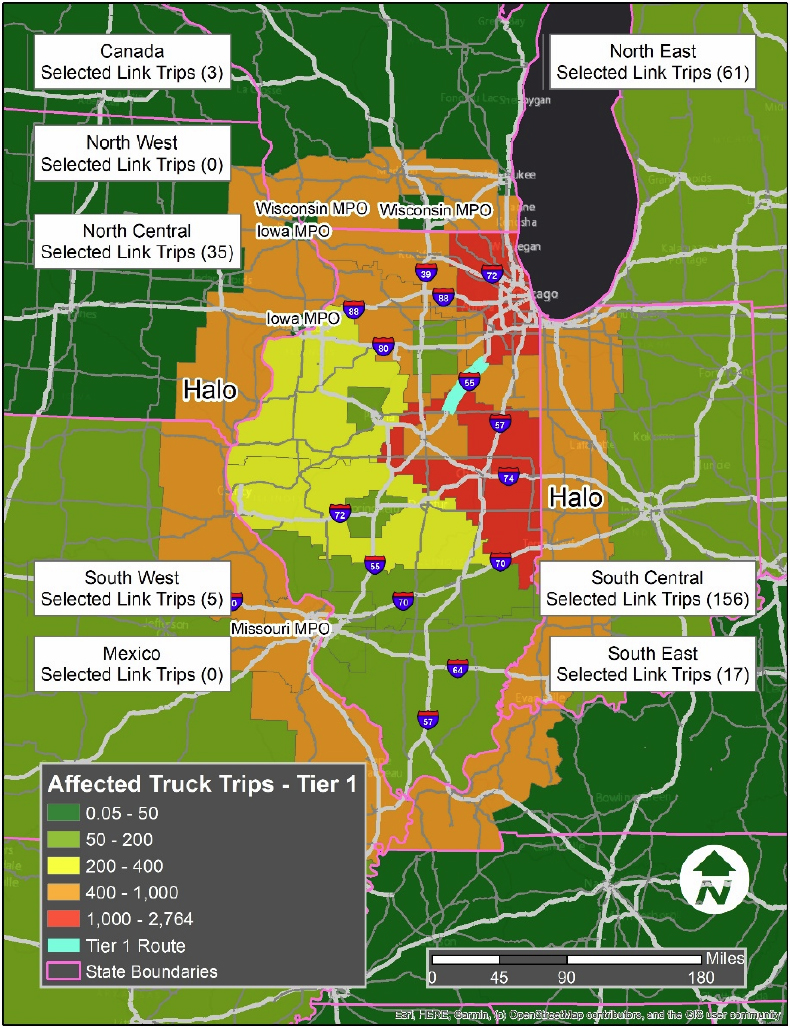
The Number of Truck Trips Affected by a Disruption to the I-55 & IL Route 66 (Tier 1) Corridors
Figure 94: The Number of Truck Trips Affected by a Disruption to the I-55 & IL Route 66 (Tier 1) Corridors
Page 143
Suggested Citation: "6 Cascading Effects of Disruptions on Multimodal Facilities in a State." National Academies of Sciences, Engineering, and Medicine. 2024. Resilience in Transportation Networks, Volume 2: Network Resilience Toolkit and Techniques. Washington, DC: The National Academies Press. doi: 10.17226/27921.

Figure 95 shows the regional share of employment in sensitive sectors impacted by disruption to the I-55 and IL Route 66 (Tier 1) freight corridor. Values are weighted by select-link trip shares and divided by total value of that variable in the region to create regional share. A large portion of the eastern region in Illinois has a particularly high employment sensitivity impacted by the Tier 1 corridor disruption.

Regional Share of Employment in Sensitive Categories Affected by Disruption to I-55 and IL Route 66 Corridor (Tier 1)
Figure 95: Regional Share of Employment in Sensitive Categories Affected by Disruption to I-55 and IL Route 66 Corridor (Tier 1)
Page 144
Suggested Citation: "6 Cascading Effects of Disruptions on Multimodal Facilities in a State." National Academies of Sciences, Engineering, and Medicine. 2024. Resilience in Transportation Networks, Volume 2: Network Resilience Toolkit and Techniques. Washington, DC: The National Academies Press. doi: 10.17226/27921.

Figure 96 shows the regional share of households below poverty impacted by a disruption to the I-55 and IL Route 66 corridor. Variable values are weighted by select-link trip shares and divided by total value of that variable in the region to create regional share. There is a high percentage share of households below poverty impacted by a Tier 1 corridor disruption on the eastern side of Illinois. There is also a significant number of households below poverty that are affected in the central and western portion of Illinois.

The Regional Share of Households Below Poverty Affected by a Disruption to the I-55 and IL Route 66 (Tier 1) Corridor
Figure 96: The Regional Share of Households Below Poverty Affected by a Disruption to the I-55 and IL Route 66 (Tier 1) Corridor
Page 145
Suggested Citation: "6 Cascading Effects of Disruptions on Multimodal Facilities in a State." National Academies of Sciences, Engineering, and Medicine. 2024. Resilience in Transportation Networks, Volume 2: Network Resilience Toolkit and Techniques. Washington, DC: The National Academies Press. doi: 10.17226/27921.

Figure 97 shows the number of truck trips that would be affected by a disruption on the I-70 (Tier 2) corridor. The white boxes on the map indicate the number of impacted trips to regions beyond Illinois and its “halo,” including trips to other regions of United States, as well as Canada and Mexico.

The Number of Truck Trips Affected by a Disruption to the I-70 (Tier 2) Corridor
Figure 97: The Number of Truck Trips Affected by a Disruption to the I-70 (Tier 2) Corridor
Page 146
Suggested Citation: "6 Cascading Effects of Disruptions on Multimodal Facilities in a State." National Academies of Sciences, Engineering, and Medicine. 2024. Resilience in Transportation Networks, Volume 2: Network Resilience Toolkit and Techniques. Washington, DC: The National Academies Press. doi: 10.17226/27921.

Figure 98 shows the regional share of employment in sensitive categories that would be impacted by a disruption to the I-70 (Tier 2) corridor east of the Madison and St. Clair trade centers. Variable values are weighted by select-link trip shares and divided by total value of that variable in the region to create regional share. From this calculation, we can see there is a particularly large region that looks like a red belt that is heavily impacted by a Tier 2 disruption.

Regional Share of Employment in Sensitive Categories Affected by a Disruption to the I-70 Corridor (Tier 2)
Figure 98: Regional Share of Employment in Sensitive Categories Affected by a Disruption to the I-70 Corridor (Tier 2)
Page 147
Suggested Citation: "6 Cascading Effects of Disruptions on Multimodal Facilities in a State." National Academies of Sciences, Engineering, and Medicine. 2024. Resilience in Transportation Networks, Volume 2: Network Resilience Toolkit and Techniques. Washington, DC: The National Academies Press. doi: 10.17226/27921.

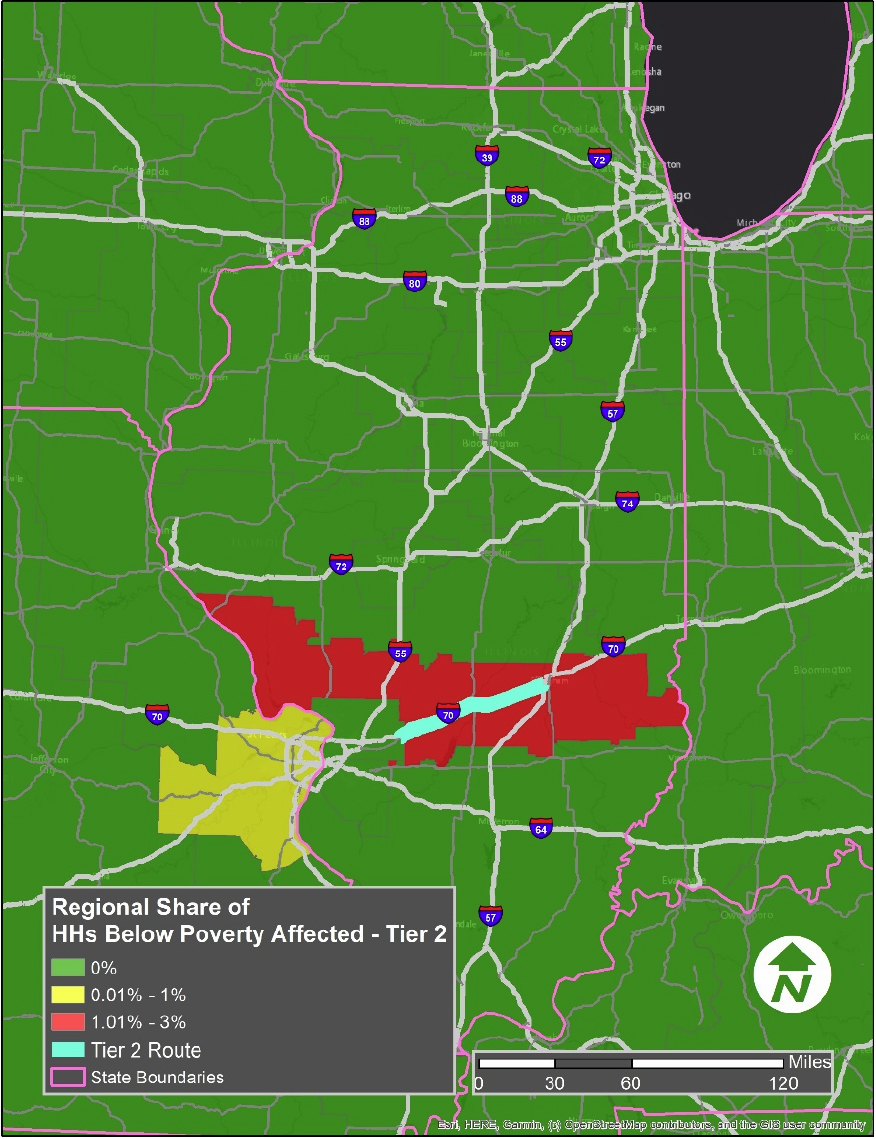
Figure 99 highlights the regional share of households below poverty impacted by a disruption to the I-70 corridor (Tier 2). Variable values are weighted by select-link trip shares and divided by total value of that variable in the region to create regional share. The red belt appears again with the calculations, and parts of eastern Missouri (St. Louis area) are affected by a Tier 2 disruption scenario.
The Regional Share of Households Below Poverty Affected by a Disruption to the I-70 Corridor (Tier 2)
Figure 99: The Regional Share of Households Below Poverty Affected by a Disruption to the I-70 Corridor (Tier 2)
Page 148
Suggested Citation: "6 Cascading Effects of Disruptions on Multimodal Facilities in a State." National Academies of Sciences, Engineering, and Medicine. 2024. Resilience in Transportation Networks, Volume 2: Network Resilience Toolkit and Techniques. Washington, DC: The National Academies Press. doi: 10.17226/27921.

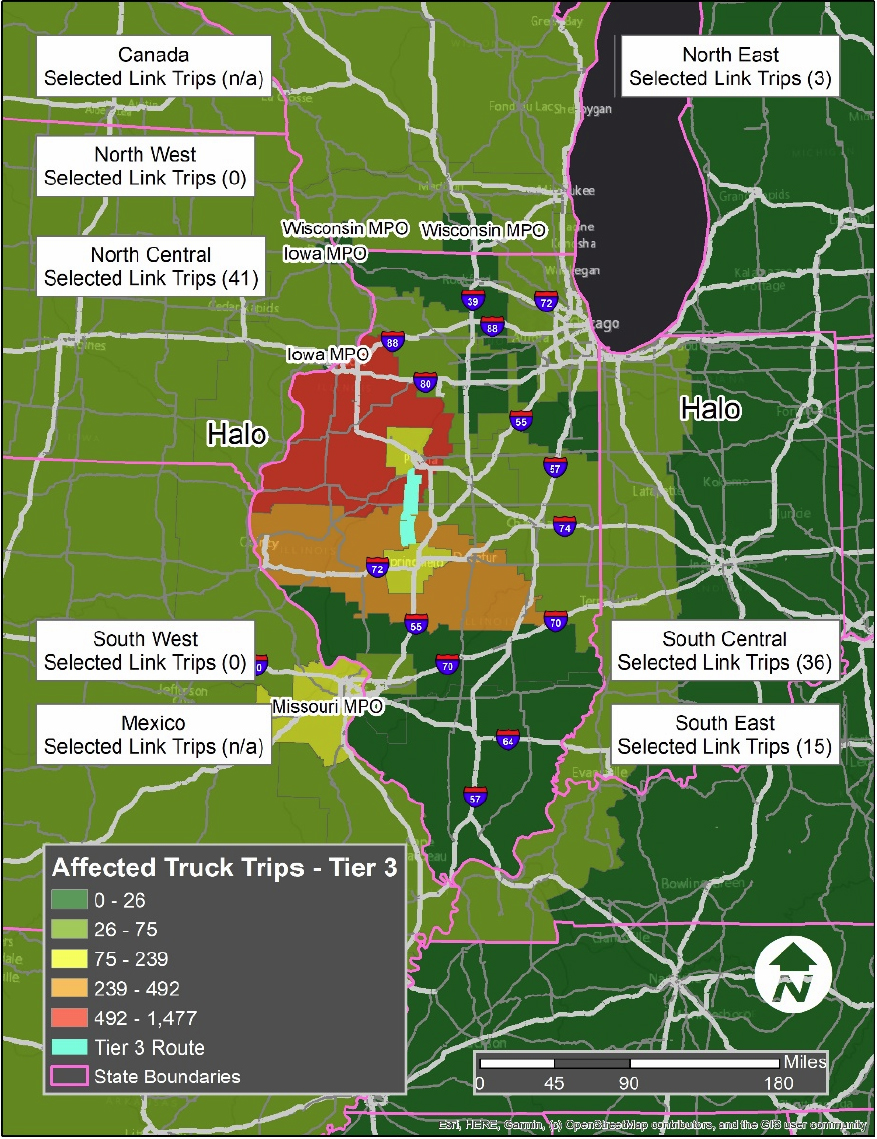
Figure 100 indicates the number of truck trips that would be affected by a disruption on the IL Route 29 corridor (Tier 3). The white boxes on the map indicate the number of impacted trips to regions beyond Illinois and its “halo,” including other regions of United States, Canada, and Mexico.
The Number of Truck Trips Affected by a Disruption to the IL Route 29 Corridor (Tier 3)
Figure 100: The Number of Truck Trips Affected by a Disruption to the IL Route 29 Corridor (Tier 3)
Page 149
Suggested Citation: "6 Cascading Effects of Disruptions on Multimodal Facilities in a State." National Academies of Sciences, Engineering, and Medicine. 2024. Resilience in Transportation Networks, Volume 2: Network Resilience Toolkit and Techniques. Washington, DC: The National Academies Press. doi: 10.17226/27921.

Figure 101 highlights the regional share of employment in sensitive categories impacted by a disruption to the IL Route 29 corridor (Tier 3). Variable values are weighted by select-link trip shares and divided by total value of that variable in the region to create regional share. From this calculation, we can see there is a particularly large region located within the northwestern part of Illinois that is affected by a Tier 3 disruption.
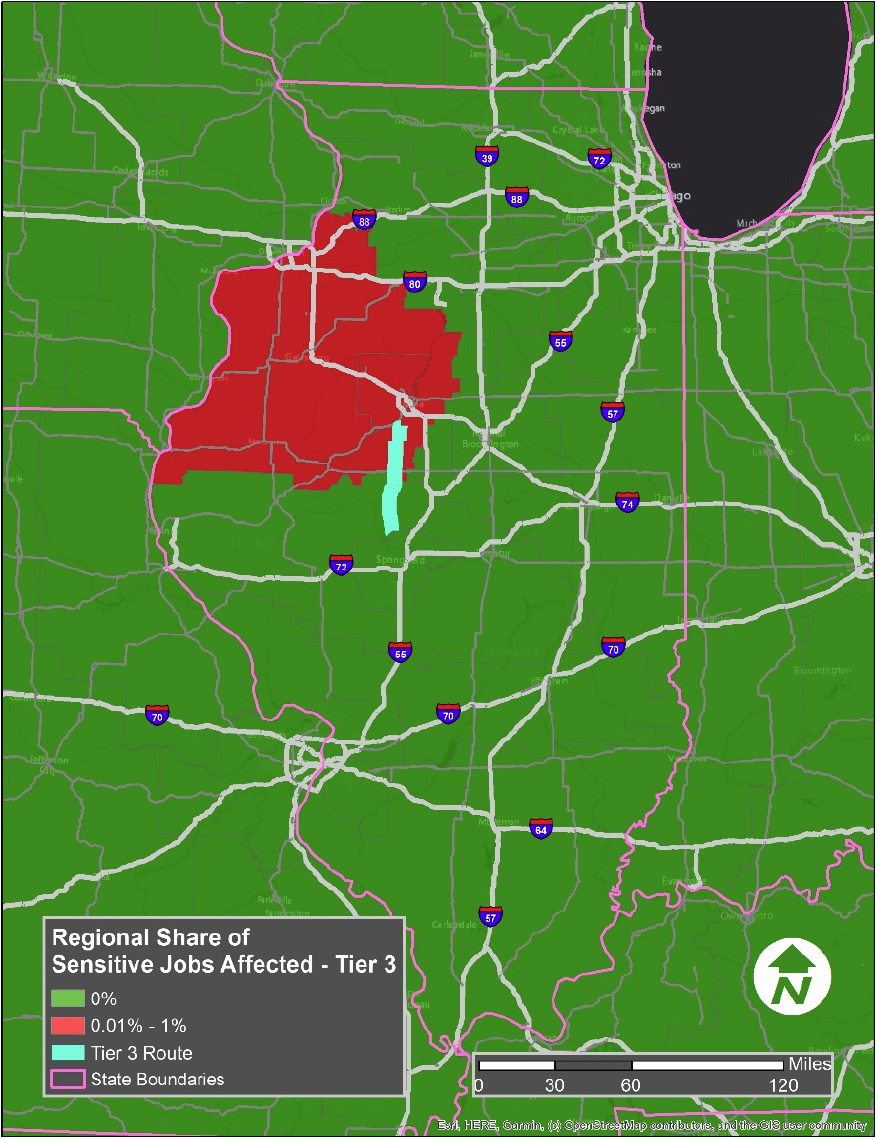
Regional Share of Employment in Sensitive Categories Affected by a Disruption to the IL Route 29 Corridor (Tier 3)
Figure 101: Regional Share of Employment in Sensitive Categories Affected by a Disruption to the IL Route 29 Corridor (Tier 3)
Page 150
Suggested Citation: "6 Cascading Effects of Disruptions on Multimodal Facilities in a State." National Academies of Sciences, Engineering, and Medicine. 2024. Resilience in Transportation Networks, Volume 2: Network Resilience Toolkit and Techniques. Washington, DC: The National Academies Press. doi: 10.17226/27921.

Figure 102 shows the percentage of households below poverty impacted by a disruption to the IL Route 29 (Tier 3). Variable values are weighted by select-link trip shares and divided by total value of that variable in the region to create regional share. Based on the calculations, the northwest portion of Illinois seems to have the most impact households below poverty based on a Tier 3 disruption. Moreover, households within the central Illinois seem to be affected as well.
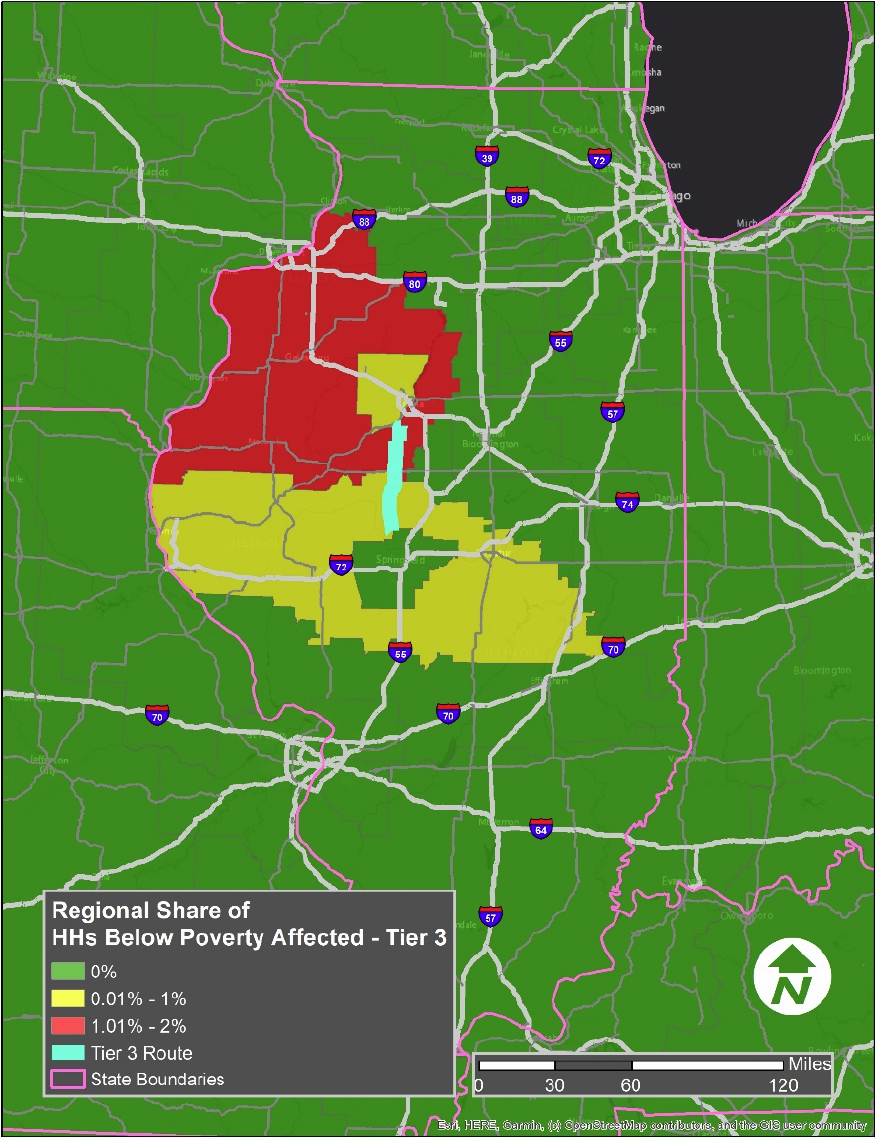
The Regional Share of Households Below Poverty Affected by a Disruption to the IL Route 29 (Tier 3) Corridor
Figure 102: The Regional Share of Households Below Poverty Affected by a Disruption to the IL Route 29 (Tier 3) Corridor
Page 151
Suggested Citation: "6 Cascading Effects of Disruptions on Multimodal Facilities in a State." National Academies of Sciences, Engineering, and Medicine. 2024. Resilience in Transportation Networks, Volume 2: Network Resilience Toolkit and Techniques. Washington, DC: The National Academies Press. doi: 10.17226/27921.
TAZ Maps

Figure 103 shows the number of households below the poverty level affected by a disruption to the I-55 and IL Route 66 (Tier 1) corridor between Mclean and Chicago.

The Number of Households Below the Poverty Level Affected by a Disruption to the I-55 and IL Route 66 Corridor (Tier 1)
Figure 103: The Number of Households Below the Poverty Level Affected by a Disruption to the I-55 and IL Route 66 Corridor (Tier 1)
Page 152
Suggested Citation: "6 Cascading Effects of Disruptions on Multimodal Facilities in a State." National Academies of Sciences, Engineering, and Medicine. 2024. Resilience in Transportation Networks, Volume 2: Network Resilience Toolkit and Techniques. Washington, DC: The National Academies Press. doi: 10.17226/27921.

Figure 104 shows the number of households above the poverty level affected by a disruption to the I-55 and IL Route 66 (Tier 1) corridors between Mclean and Chicago, east of Madison and St. Clair trade centers.

The Number of Households Above the Poverty Level Affected by a Disruption to the I-55 and IL Route 66 (Tier 1) Corridor
Figure 104: The Number of Households Above the Poverty Level Affected by a Disruption to the I-55 and IL Route 66 (Tier 1) Corridor
Page 153
Suggested Citation: "6 Cascading Effects of Disruptions on Multimodal Facilities in a State." National Academies of Sciences, Engineering, and Medicine. 2024. Resilience in Transportation Networks, Volume 2: Network Resilience Toolkit and Techniques. Washington, DC: The National Academies Press. doi: 10.17226/27921.

Figure 105 shows the number of freight trips by TAZ affected by a disruption to the I-55 and IL Route 66 (Tier 1) corridor. Most zones are primarily located right on the border of Illinois. As expected, zones are located close to the selected corridor. Other zones are scattered throughout the state as well as the region.
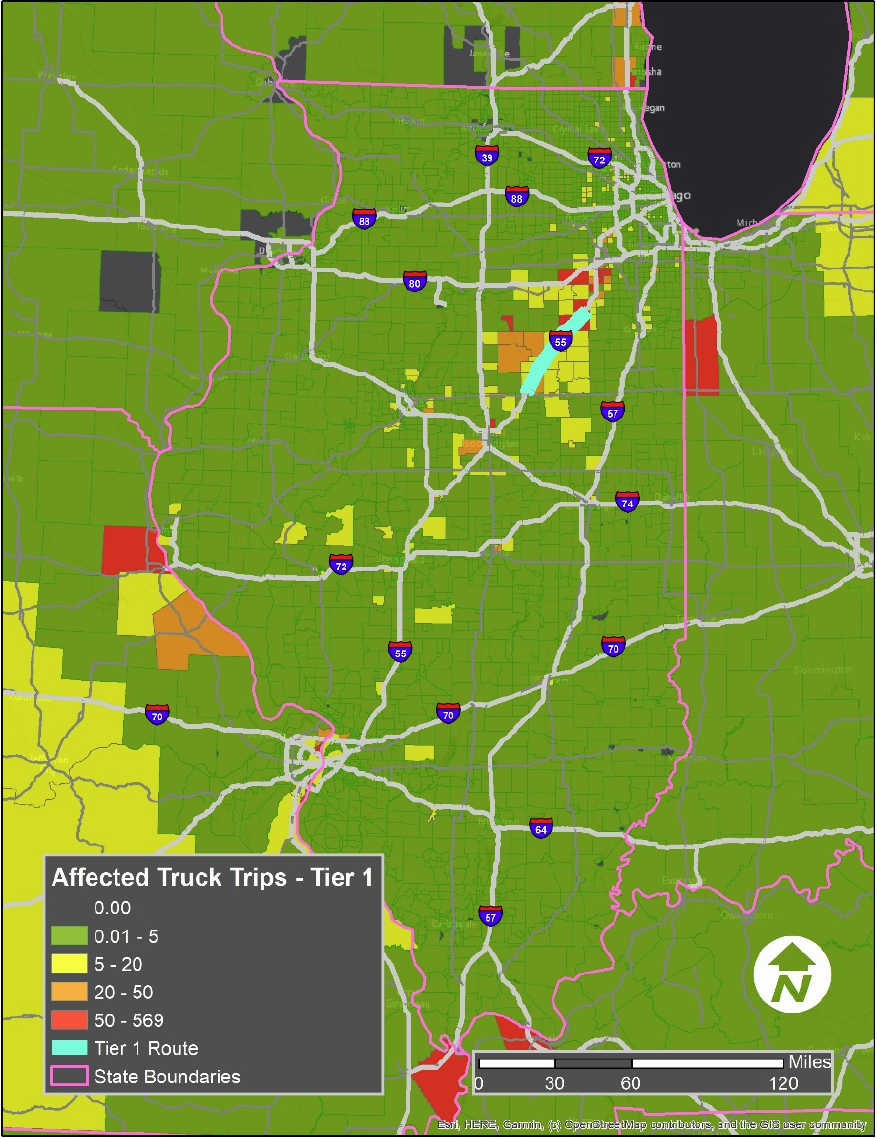
The Number of Freight Trips by TAZ Affected by a Disruption To The I-55 And IL Route 66 (Tier 1) Corridor
Figure 105: The Number of Freight Trips by TAZ Affected by a Disruption To The I-55 And IL Route 66 (Tier 1) Corridor
Page 154
Suggested Citation: "6 Cascading Effects of Disruptions on Multimodal Facilities in a State." National Academies of Sciences, Engineering, and Medicine. 2024. Resilience in Transportation Networks, Volume 2: Network Resilience Toolkit and Techniques. Washington, DC: The National Academies Press. doi: 10.17226/27921.

Figure 106 shows the number of jobs in high sensitivity categories (by zone) affected by a disruption to the I-55 and IL Route 66 (Tier 1) corridor weighted by share of trips using the corridor. As shown on the map, zones with relatively high sensitivity are located on the Tier 1 route, along with zones being affected in and out of Illinois. A large number of zones are affected within Missouri.
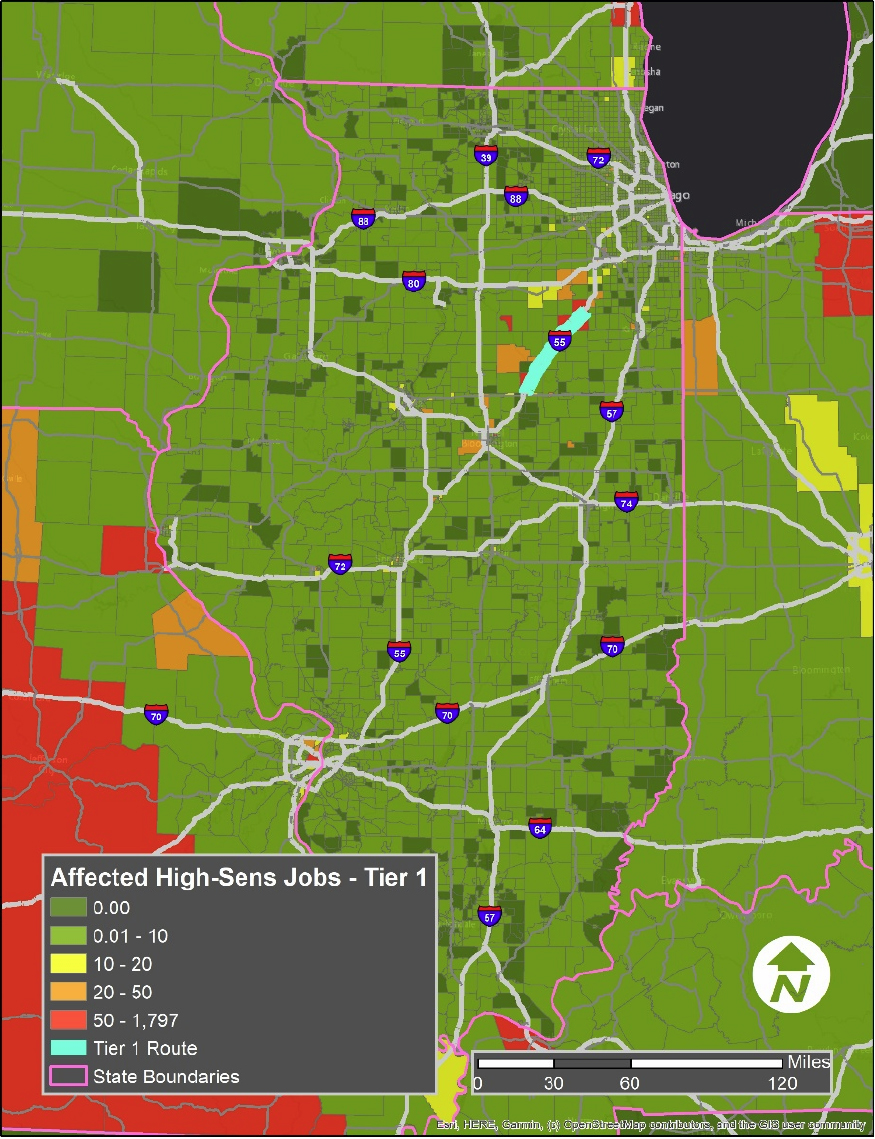
The Number of Jobs by TAZ In High Sensitivity Employment Categories Affected by a Disruption to the I-55 and IL Route 66 (Tier 1) Corridor
Figure 106: The Number of Jobs by TAZ In High Sensitivity Employment Categories Affected by a Disruption to the I-55 and IL Route 66 (Tier 1) Corridor
Page 155
Suggested Citation: "6 Cascading Effects of Disruptions on Multimodal Facilities in a State." National Academies of Sciences, Engineering, and Medicine. 2024. Resilience in Transportation Networks, Volume 2: Network Resilience Toolkit and Techniques. Washington, DC: The National Academies Press. doi: 10.17226/27921.

Figure 107 shows the number of households below the poverty level affected by a disruption to the I-70 (Tier 2) corridor east of the Madison and St. Clair trade centers.
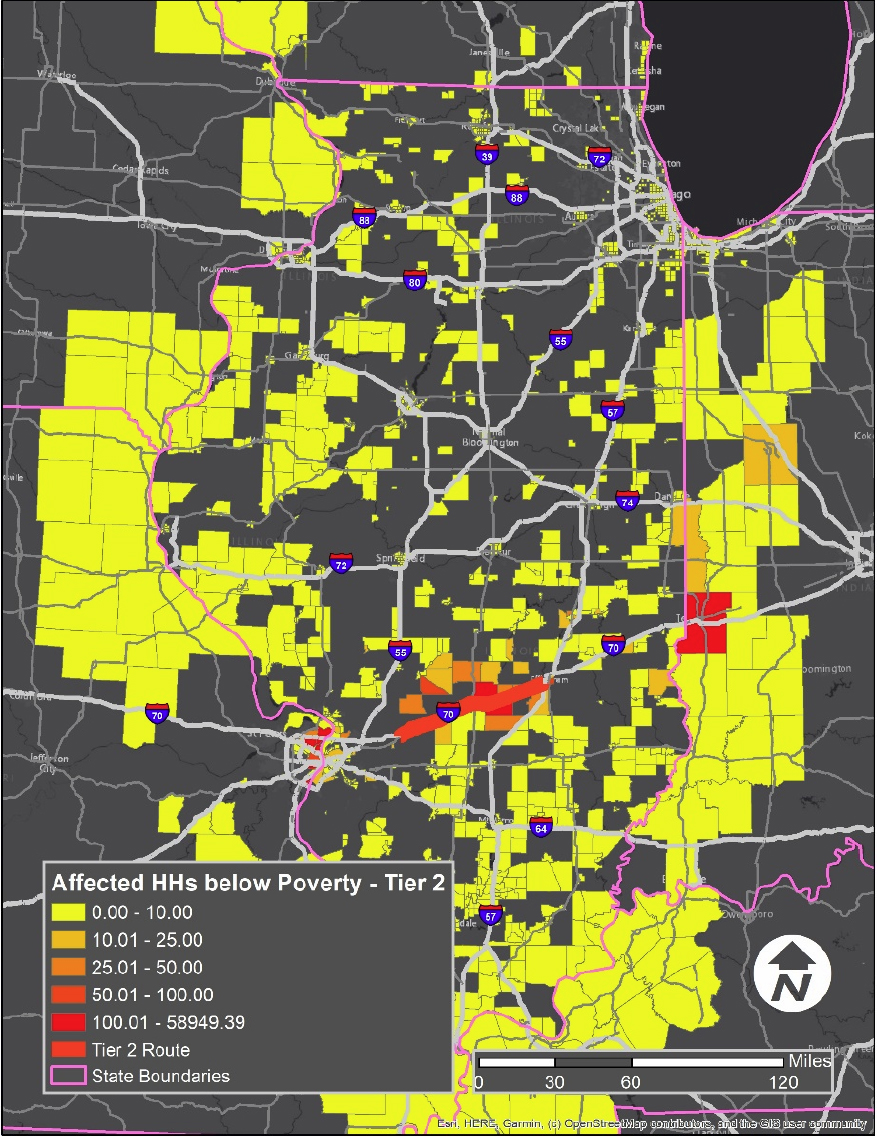
The Number of Households Below the Poverty Level Affected by a Disruption to the I-70 (Tier 2) Corridor
Figure 107: The Number of Households Below the Poverty Level Affected by a Disruption to the I-70 (Tier 2) Corridor
Page 156
Suggested Citation: "6 Cascading Effects of Disruptions on Multimodal Facilities in a State." National Academies of Sciences, Engineering, and Medicine. 2024. Resilience in Transportation Networks, Volume 2: Network Resilience Toolkit and Techniques. Washington, DC: The National Academies Press. doi: 10.17226/27921.

Figure 108 shows the number of households above the poverty level affected by a disruption to the I-70 (Tier 2) corridor east of the Madison and St. Clair trade centers.

The Number of Households Above the Poverty Level Affected by a Disruption to the I-70 (Tier 2) Corridor
Figure 108: The Number of Households Above the Poverty Level Affected by a Disruption to the I-70 (Tier 2) Corridor
Page 157
Suggested Citation: "6 Cascading Effects of Disruptions on Multimodal Facilities in a State." National Academies of Sciences, Engineering, and Medicine. 2024. Resilience in Transportation Networks, Volume 2: Network Resilience Toolkit and Techniques. Washington, DC: The National Academies Press. doi: 10.17226/27921.

Figure 109 shows the number of trips by TAZ affected by a disruption to the I-70 (Tier 2) corridor. Based on the map, there are not many trips taking the Tier 2 route. The most significant zones are the ones located in Indiana close to the eastern border of Illinois. There are also a few zones located in the southern portion of Illinois, along with zones in St. Louis, Missouri, near the western border of Illinois.
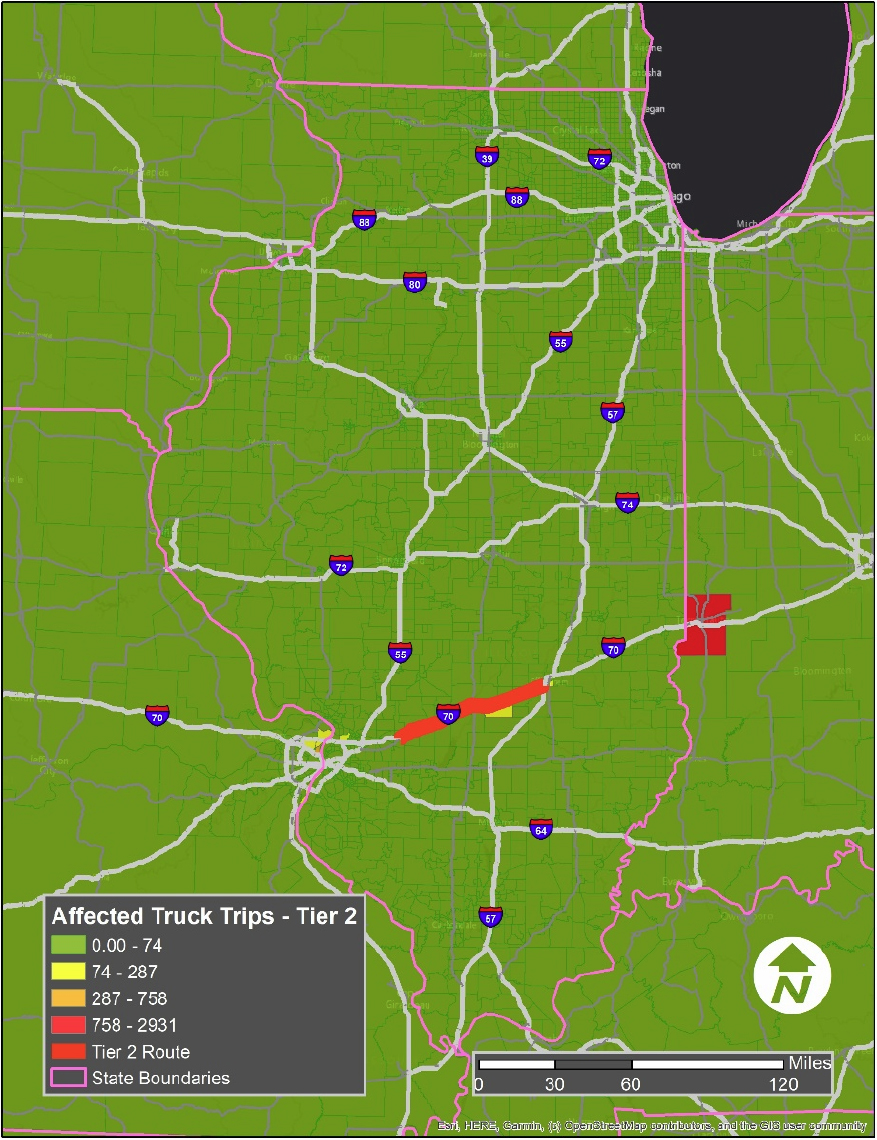
The Number of Freight Trips by TAZ Affected by a Disruption to the I-70 (Tier 2) Corridor
Figure 109: The Number of Freight Trips by TAZ Affected by a Disruption to the I-70 (Tier 2) Corridor
Page 158
Suggested Citation: "6 Cascading Effects of Disruptions on Multimodal Facilities in a State." National Academies of Sciences, Engineering, and Medicine. 2024. Resilience in Transportation Networks, Volume 2: Network Resilience Toolkit and Techniques. Washington, DC: The National Academies Press. doi: 10.17226/27921.

Figure 110 shows the number of jobs in high sensitivity employment categories affected by a disruption to the I-70 (Tier 2) corridor weighted by share of trips using the corridor. The most affected zones are in Indiana, near the eastern border of Illinois, Indianapolis, Indiana, and many zones located within central Missouri. Interestingly, there are essentially no zones within Illinois.
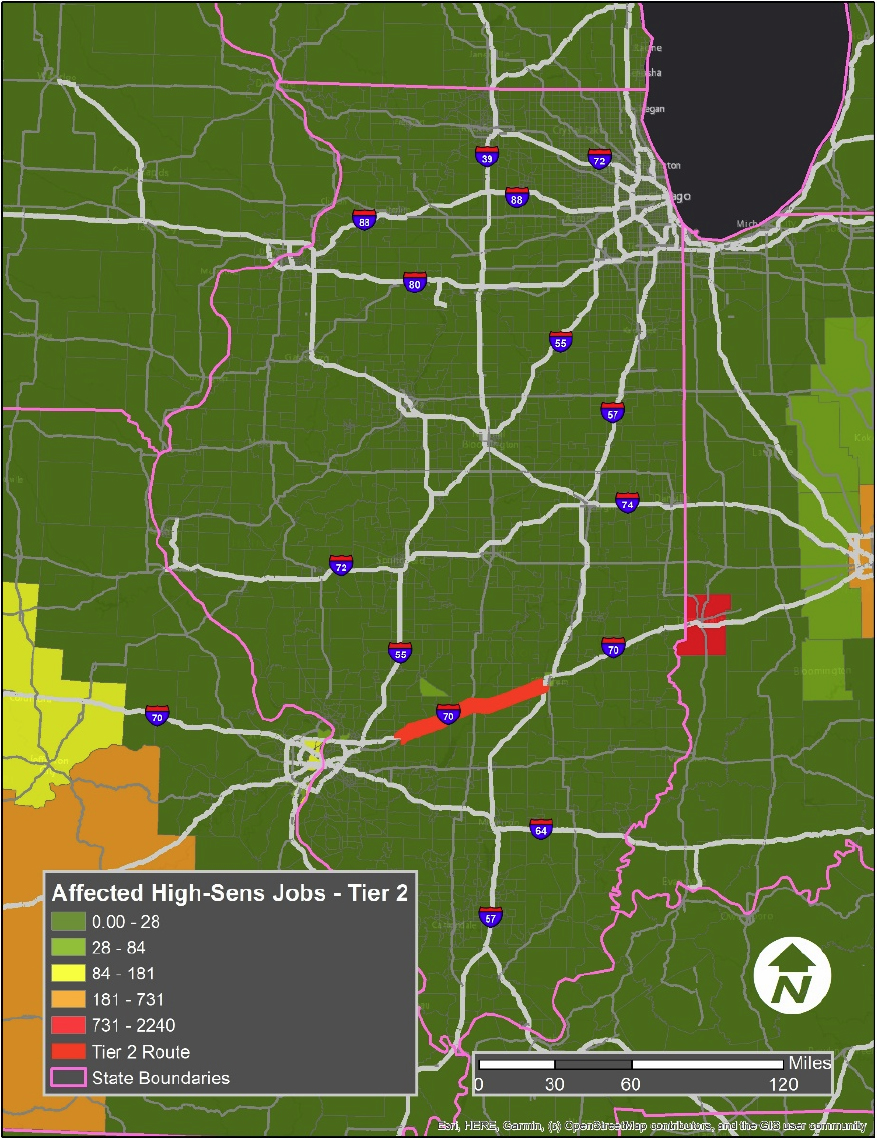
The Number of Jobs by TAZ in High Sensitivity Employment Categories Affected by a Disruption to the I-70 (Tier 2) Corridor
Figure 110: The Number of Jobs by TAZ in High Sensitivity Employment Categories Affected by a Disruption to the I-70 (Tier 2) Corridor
Page 159
Suggested Citation: "6 Cascading Effects of Disruptions on Multimodal Facilities in a State." National Academies of Sciences, Engineering, and Medicine. 2024. Resilience in Transportation Networks, Volume 2: Network Resilience Toolkit and Techniques. Washington, DC: The National Academies Press. doi: 10.17226/27921.

Figure 111 shows the number of households below the poverty level affected by a disruption to the IL Route 29 (Tier 3) corridor.

The Number of Households Below the Poverty Level Affected by a Disruption to the IL Route 29 (Tier 3) Corridor
Figure 111: The Number of Households Below the Poverty Level Affected by a Disruption to the IL Route 29 (Tier 3) Corridor
Page 160
Suggested Citation: "6 Cascading Effects of Disruptions on Multimodal Facilities in a State." National Academies of Sciences, Engineering, and Medicine. 2024. Resilience in Transportation Networks, Volume 2: Network Resilience Toolkit and Techniques. Washington, DC: The National Academies Press. doi: 10.17226/27921.

Figure 112 shows the number of households above the poverty level affected by a disruption to the IL Route 29 (Tier 3) corridor.
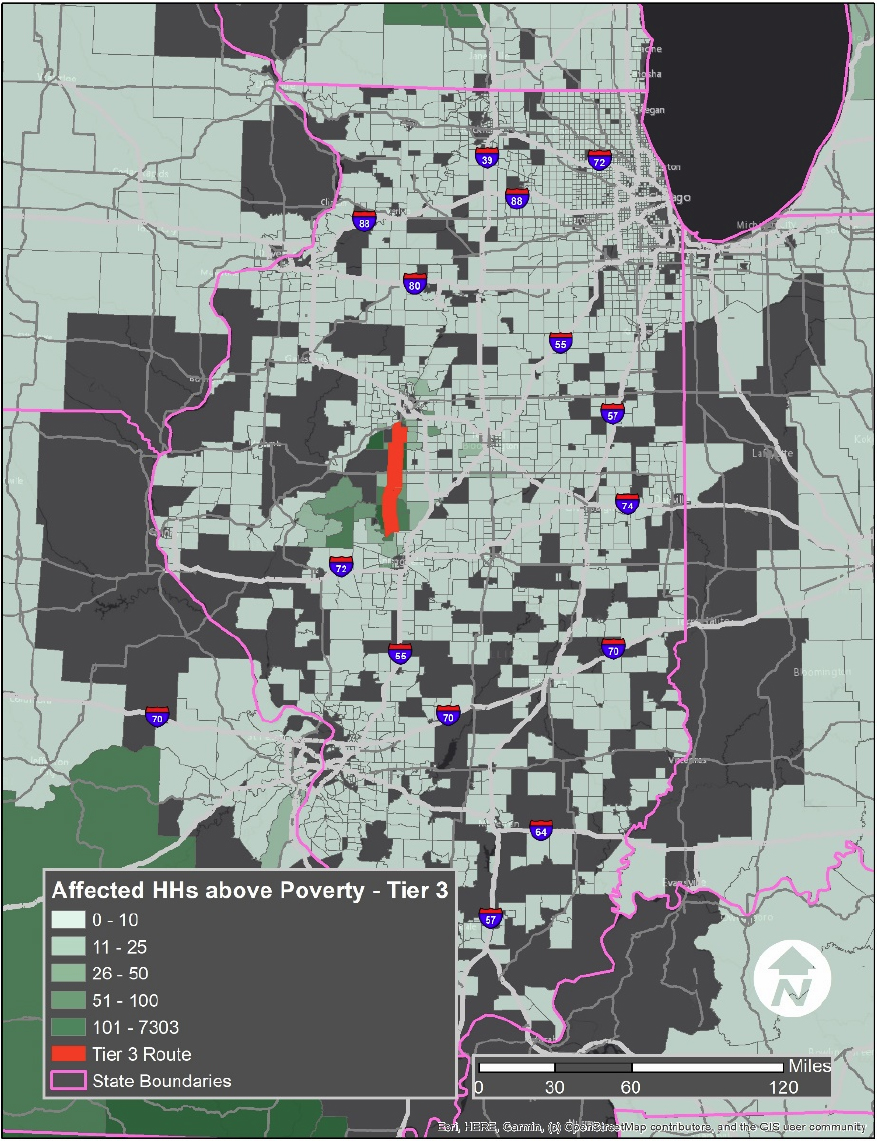
The Number of Households Above the Poverty Level Affected by a Disruption to the IL Route 29 (Tier 3) Corridor
Figure 112: The Number of Households Above the Poverty Level Affected by a Disruption to the IL Route 29 (Tier 3) Corridor
Page 161
Suggested Citation: "6 Cascading Effects of Disruptions on Multimodal Facilities in a State." National Academies of Sciences, Engineering, and Medicine. 2024. Resilience in Transportation Networks, Volume 2: Network Resilience Toolkit and Techniques. Washington, DC: The National Academies Press. doi: 10.17226/27921.

Figure 113 shows the number of trips by TAZ affected by a disruption to the IL Route 29 (Tier 3) corridor. Based on the map, the highest number of trips using the selected corridor occur in zones close to the corridor itself. Other trips are scattered throughout the region.

The Number of Freight Trips by TAZ Affected by a Disruption To The IL Route 29 Corridor (Tier 3)
Figure 113: The Number of Freight Trips by TAZ Affected by a Disruption To The IL Route 29 Corridor (Tier 3)
Page 162
Suggested Citation: "6 Cascading Effects of Disruptions on Multimodal Facilities in a State." National Academies of Sciences, Engineering, and Medicine. 2024. Resilience in Transportation Networks, Volume 2: Network Resilience Toolkit and Techniques. Washington, DC: The National Academies Press. doi: 10.17226/27921.

Figure 114 shows the number of jobs in high sensitivity employment categories (by TAZ) affected by a disruption to the IL Route 29 (Tier 3) corridor weighted by share of trips using the corridor. Most affected zones are located close to the selected corridor. More affected areas outside of Illinois are primarily located in Missouri, as outlined by the orange masses located on the map below.

The Number of Jobs in High Sensitivity Employment Categories (by TAZ) Affected by a Disruption to the IL Route 29 (Tier 3) Corridor
Figure 114: The Number of Jobs in High Sensitivity Employment Categories (by TAZ) Affected by a Disruption to the IL Route 29 (Tier 3) Corridor
Page 163
Suggested Citation: "6 Cascading Effects of Disruptions on Multimodal Facilities in a State." National Academies of Sciences, Engineering, and Medicine. 2024. Resilience in Transportation Networks, Volume 2: Network Resilience Toolkit and Techniques. Washington, DC: The National Academies Press. doi: 10.17226/27921.

Conclusion

The methodologies that were used in this pilot site were successful in highlighting many different cascading effects that may occur using three selected roadway corridors (Tiers 1, 2, and 3). The analysis is sufficient in its findings for the relevant analysis. The sourced data is accurate and provides a clear understanding of cascading impacts for the three routes that were selected.

Page 104
Suggested Citation: "6 Cascading Effects of Disruptions on Multimodal Facilities in a State." National Academies of Sciences, Engineering, and Medicine. 2024. Resilience in Transportation Networks, Volume 2: Network Resilience Toolkit and Techniques. Washington, DC: The National Academies Press. doi: 10.17226/27921.
Page 104
Page 105
Suggested Citation: "6 Cascading Effects of Disruptions on Multimodal Facilities in a State." National Academies of Sciences, Engineering, and Medicine. 2024. Resilience in Transportation Networks, Volume 2: Network Resilience Toolkit and Techniques. Washington, DC: The National Academies Press. doi: 10.17226/27921.
Page 105
Page 106
Suggested Citation: "6 Cascading Effects of Disruptions on Multimodal Facilities in a State." National Academies of Sciences, Engineering, and Medicine. 2024. Resilience in Transportation Networks, Volume 2: Network Resilience Toolkit and Techniques. Washington, DC: The National Academies Press. doi: 10.17226/27921.
Page 106
Page 107
Suggested Citation: "6 Cascading Effects of Disruptions on Multimodal Facilities in a State." National Academies of Sciences, Engineering, and Medicine. 2024. Resilience in Transportation Networks, Volume 2: Network Resilience Toolkit and Techniques. Washington, DC: The National Academies Press. doi: 10.17226/27921.
Page 107
Page 108
Suggested Citation: "6 Cascading Effects of Disruptions on Multimodal Facilities in a State." National Academies of Sciences, Engineering, and Medicine. 2024. Resilience in Transportation Networks, Volume 2: Network Resilience Toolkit and Techniques. Washington, DC: The National Academies Press. doi: 10.17226/27921.
Page 108
Page 109
Suggested Citation: "6 Cascading Effects of Disruptions on Multimodal Facilities in a State." National Academies of Sciences, Engineering, and Medicine. 2024. Resilience in Transportation Networks, Volume 2: Network Resilience Toolkit and Techniques. Washington, DC: The National Academies Press. doi: 10.17226/27921.
Page 109
Page 110
Suggested Citation: "6 Cascading Effects of Disruptions on Multimodal Facilities in a State." National Academies of Sciences, Engineering, and Medicine. 2024. Resilience in Transportation Networks, Volume 2: Network Resilience Toolkit and Techniques. Washington, DC: The National Academies Press. doi: 10.17226/27921.
Page 110
Page 111
Suggested Citation: "6 Cascading Effects of Disruptions on Multimodal Facilities in a State." National Academies of Sciences, Engineering, and Medicine. 2024. Resilience in Transportation Networks, Volume 2: Network Resilience Toolkit and Techniques. Washington, DC: The National Academies Press. doi: 10.17226/27921.
Page 111
Page 112
Suggested Citation: "6 Cascading Effects of Disruptions on Multimodal Facilities in a State." National Academies of Sciences, Engineering, and Medicine. 2024. Resilience in Transportation Networks, Volume 2: Network Resilience Toolkit and Techniques. Washington, DC: The National Academies Press. doi: 10.17226/27921.
Page 112
Page 113
Suggested Citation: "6 Cascading Effects of Disruptions on Multimodal Facilities in a State." National Academies of Sciences, Engineering, and Medicine. 2024. Resilience in Transportation Networks, Volume 2: Network Resilience Toolkit and Techniques. Washington, DC: The National Academies Press. doi: 10.17226/27921.
Page 113
Page 114
Suggested Citation: "6 Cascading Effects of Disruptions on Multimodal Facilities in a State." National Academies of Sciences, Engineering, and Medicine. 2024. Resilience in Transportation Networks, Volume 2: Network Resilience Toolkit and Techniques. Washington, DC: The National Academies Press. doi: 10.17226/27921.
Page 114
Page 115
Suggested Citation: "6 Cascading Effects of Disruptions on Multimodal Facilities in a State." National Academies of Sciences, Engineering, and Medicine. 2024. Resilience in Transportation Networks, Volume 2: Network Resilience Toolkit and Techniques. Washington, DC: The National Academies Press. doi: 10.17226/27921.
Page 115
Page 116
Suggested Citation: "6 Cascading Effects of Disruptions on Multimodal Facilities in a State." National Academies of Sciences, Engineering, and Medicine. 2024. Resilience in Transportation Networks, Volume 2: Network Resilience Toolkit and Techniques. Washington, DC: The National Academies Press. doi: 10.17226/27921.
Page 116
Page 117
Suggested Citation: "6 Cascading Effects of Disruptions on Multimodal Facilities in a State." National Academies of Sciences, Engineering, and Medicine. 2024. Resilience in Transportation Networks, Volume 2: Network Resilience Toolkit and Techniques. Washington, DC: The National Academies Press. doi: 10.17226/27921.
Page 117
Page 118
Suggested Citation: "6 Cascading Effects of Disruptions on Multimodal Facilities in a State." National Academies of Sciences, Engineering, and Medicine. 2024. Resilience in Transportation Networks, Volume 2: Network Resilience Toolkit and Techniques. Washington, DC: The National Academies Press. doi: 10.17226/27921.
Page 118
Page 119
Suggested Citation: "6 Cascading Effects of Disruptions on Multimodal Facilities in a State." National Academies of Sciences, Engineering, and Medicine. 2024. Resilience in Transportation Networks, Volume 2: Network Resilience Toolkit and Techniques. Washington, DC: The National Academies Press. doi: 10.17226/27921.
Page 119
Page 120
Suggested Citation: "6 Cascading Effects of Disruptions on Multimodal Facilities in a State." National Academies of Sciences, Engineering, and Medicine. 2024. Resilience in Transportation Networks, Volume 2: Network Resilience Toolkit and Techniques. Washington, DC: The National Academies Press. doi: 10.17226/27921.
Page 120
Page 121
Suggested Citation: "6 Cascading Effects of Disruptions on Multimodal Facilities in a State." National Academies of Sciences, Engineering, and Medicine. 2024. Resilience in Transportation Networks, Volume 2: Network Resilience Toolkit and Techniques. Washington, DC: The National Academies Press. doi: 10.17226/27921.
Page 121
Page 122
Suggested Citation: "6 Cascading Effects of Disruptions on Multimodal Facilities in a State." National Academies of Sciences, Engineering, and Medicine. 2024. Resilience in Transportation Networks, Volume 2: Network Resilience Toolkit and Techniques. Washington, DC: The National Academies Press. doi: 10.17226/27921.
Page 122
Page 123
Suggested Citation: "6 Cascading Effects of Disruptions on Multimodal Facilities in a State." National Academies of Sciences, Engineering, and Medicine. 2024. Resilience in Transportation Networks, Volume 2: Network Resilience Toolkit and Techniques. Washington, DC: The National Academies Press. doi: 10.17226/27921.
Page 123
Page 124
Suggested Citation: "6 Cascading Effects of Disruptions on Multimodal Facilities in a State." National Academies of Sciences, Engineering, and Medicine. 2024. Resilience in Transportation Networks, Volume 2: Network Resilience Toolkit and Techniques. Washington, DC: The National Academies Press. doi: 10.17226/27921.
Page 124
Page 125
Suggested Citation: "6 Cascading Effects of Disruptions on Multimodal Facilities in a State." National Academies of Sciences, Engineering, and Medicine. 2024. Resilience in Transportation Networks, Volume 2: Network Resilience Toolkit and Techniques. Washington, DC: The National Academies Press. doi: 10.17226/27921.
Page 125
Page 126
Suggested Citation: "6 Cascading Effects of Disruptions on Multimodal Facilities in a State." National Academies of Sciences, Engineering, and Medicine. 2024. Resilience in Transportation Networks, Volume 2: Network Resilience Toolkit and Techniques. Washington, DC: The National Academies Press. doi: 10.17226/27921.
Page 126
Page 127
Suggested Citation: "6 Cascading Effects of Disruptions on Multimodal Facilities in a State." National Academies of Sciences, Engineering, and Medicine. 2024. Resilience in Transportation Networks, Volume 2: Network Resilience Toolkit and Techniques. Washington, DC: The National Academies Press. doi: 10.17226/27921.
Page 127
Page 128
Suggested Citation: "6 Cascading Effects of Disruptions on Multimodal Facilities in a State." National Academies of Sciences, Engineering, and Medicine. 2024. Resilience in Transportation Networks, Volume 2: Network Resilience Toolkit and Techniques. Washington, DC: The National Academies Press. doi: 10.17226/27921.
Page 128
Page 129
Suggested Citation: "6 Cascading Effects of Disruptions on Multimodal Facilities in a State." National Academies of Sciences, Engineering, and Medicine. 2024. Resilience in Transportation Networks, Volume 2: Network Resilience Toolkit and Techniques. Washington, DC: The National Academies Press. doi: 10.17226/27921.
Page 129
Page 130
Suggested Citation: "6 Cascading Effects of Disruptions on Multimodal Facilities in a State." National Academies of Sciences, Engineering, and Medicine. 2024. Resilience in Transportation Networks, Volume 2: Network Resilience Toolkit and Techniques. Washington, DC: The National Academies Press. doi: 10.17226/27921.
Page 130
Page 131
Suggested Citation: "6 Cascading Effects of Disruptions on Multimodal Facilities in a State." National Academies of Sciences, Engineering, and Medicine. 2024. Resilience in Transportation Networks, Volume 2: Network Resilience Toolkit and Techniques. Washington, DC: The National Academies Press. doi: 10.17226/27921.
Page 131
Page 132
Suggested Citation: "6 Cascading Effects of Disruptions on Multimodal Facilities in a State." National Academies of Sciences, Engineering, and Medicine. 2024. Resilience in Transportation Networks, Volume 2: Network Resilience Toolkit and Techniques. Washington, DC: The National Academies Press. doi: 10.17226/27921.
Page 132
Page 133
Suggested Citation: "6 Cascading Effects of Disruptions on Multimodal Facilities in a State." National Academies of Sciences, Engineering, and Medicine. 2024. Resilience in Transportation Networks, Volume 2: Network Resilience Toolkit and Techniques. Washington, DC: The National Academies Press. doi: 10.17226/27921.
Page 133
Page 134
Suggested Citation: "6 Cascading Effects of Disruptions on Multimodal Facilities in a State." National Academies of Sciences, Engineering, and Medicine. 2024. Resilience in Transportation Networks, Volume 2: Network Resilience Toolkit and Techniques. Washington, DC: The National Academies Press. doi: 10.17226/27921.
Page 134
Page 135
Suggested Citation: "6 Cascading Effects of Disruptions on Multimodal Facilities in a State." National Academies of Sciences, Engineering, and Medicine. 2024. Resilience in Transportation Networks, Volume 2: Network Resilience Toolkit and Techniques. Washington, DC: The National Academies Press. doi: 10.17226/27921.
Page 135
Page 136
Suggested Citation: "6 Cascading Effects of Disruptions on Multimodal Facilities in a State." National Academies of Sciences, Engineering, and Medicine. 2024. Resilience in Transportation Networks, Volume 2: Network Resilience Toolkit and Techniques. Washington, DC: The National Academies Press. doi: 10.17226/27921.
Page 136
Page 137
Suggested Citation: "6 Cascading Effects of Disruptions on Multimodal Facilities in a State." National Academies of Sciences, Engineering, and Medicine. 2024. Resilience in Transportation Networks, Volume 2: Network Resilience Toolkit and Techniques. Washington, DC: The National Academies Press. doi: 10.17226/27921.
Page 137
Page 138
Suggested Citation: "6 Cascading Effects of Disruptions on Multimodal Facilities in a State." National Academies of Sciences, Engineering, and Medicine. 2024. Resilience in Transportation Networks, Volume 2: Network Resilience Toolkit and Techniques. Washington, DC: The National Academies Press. doi: 10.17226/27921.
Page 138
Page 139
Suggested Citation: "6 Cascading Effects of Disruptions on Multimodal Facilities in a State." National Academies of Sciences, Engineering, and Medicine. 2024. Resilience in Transportation Networks, Volume 2: Network Resilience Toolkit and Techniques. Washington, DC: The National Academies Press. doi: 10.17226/27921.
Page 139
Page 140
Suggested Citation: "6 Cascading Effects of Disruptions on Multimodal Facilities in a State." National Academies of Sciences, Engineering, and Medicine. 2024. Resilience in Transportation Networks, Volume 2: Network Resilience Toolkit and Techniques. Washington, DC: The National Academies Press. doi: 10.17226/27921.
Page 140
Page 141
Suggested Citation: "6 Cascading Effects of Disruptions on Multimodal Facilities in a State." National Academies of Sciences, Engineering, and Medicine. 2024. Resilience in Transportation Networks, Volume 2: Network Resilience Toolkit and Techniques. Washington, DC: The National Academies Press. doi: 10.17226/27921.
Page 141
Page 142
Suggested Citation: "6 Cascading Effects of Disruptions on Multimodal Facilities in a State." National Academies of Sciences, Engineering, and Medicine. 2024. Resilience in Transportation Networks, Volume 2: Network Resilience Toolkit and Techniques. Washington, DC: The National Academies Press. doi: 10.17226/27921.
Page 142
Page 143
Suggested Citation: "6 Cascading Effects of Disruptions on Multimodal Facilities in a State." National Academies of Sciences, Engineering, and Medicine. 2024. Resilience in Transportation Networks, Volume 2: Network Resilience Toolkit and Techniques. Washington, DC: The National Academies Press. doi: 10.17226/27921.
Page 143
Page 144
Suggested Citation: "6 Cascading Effects of Disruptions on Multimodal Facilities in a State." National Academies of Sciences, Engineering, and Medicine. 2024. Resilience in Transportation Networks, Volume 2: Network Resilience Toolkit and Techniques. Washington, DC: The National Academies Press. doi: 10.17226/27921.
Page 144
Page 145
Suggested Citation: "6 Cascading Effects of Disruptions on Multimodal Facilities in a State." National Academies of Sciences, Engineering, and Medicine. 2024. Resilience in Transportation Networks, Volume 2: Network Resilience Toolkit and Techniques. Washington, DC: The National Academies Press. doi: 10.17226/27921.
Page 145
Page 146
Suggested Citation: "6 Cascading Effects of Disruptions on Multimodal Facilities in a State." National Academies of Sciences, Engineering, and Medicine. 2024. Resilience in Transportation Networks, Volume 2: Network Resilience Toolkit and Techniques. Washington, DC: The National Academies Press. doi: 10.17226/27921.
Page 146
Page 147
Suggested Citation: "6 Cascading Effects of Disruptions on Multimodal Facilities in a State." National Academies of Sciences, Engineering, and Medicine. 2024. Resilience in Transportation Networks, Volume 2: Network Resilience Toolkit and Techniques. Washington, DC: The National Academies Press. doi: 10.17226/27921.
Page 147
Page 148
Suggested Citation: "6 Cascading Effects of Disruptions on Multimodal Facilities in a State." National Academies of Sciences, Engineering, and Medicine. 2024. Resilience in Transportation Networks, Volume 2: Network Resilience Toolkit and Techniques. Washington, DC: The National Academies Press. doi: 10.17226/27921.
Page 148
Page 149
Suggested Citation: "6 Cascading Effects of Disruptions on Multimodal Facilities in a State." National Academies of Sciences, Engineering, and Medicine. 2024. Resilience in Transportation Networks, Volume 2: Network Resilience Toolkit and Techniques. Washington, DC: The National Academies Press. doi: 10.17226/27921.
Page 149
Page 150
Suggested Citation: "6 Cascading Effects of Disruptions on Multimodal Facilities in a State." National Academies of Sciences, Engineering, and Medicine. 2024. Resilience in Transportation Networks, Volume 2: Network Resilience Toolkit and Techniques. Washington, DC: The National Academies Press. doi: 10.17226/27921.
Page 150
Page 151
Suggested Citation: "6 Cascading Effects of Disruptions on Multimodal Facilities in a State." National Academies of Sciences, Engineering, and Medicine. 2024. Resilience in Transportation Networks, Volume 2: Network Resilience Toolkit and Techniques. Washington, DC: The National Academies Press. doi: 10.17226/27921.
Page 151
Page 152
Suggested Citation: "6 Cascading Effects of Disruptions on Multimodal Facilities in a State." National Academies of Sciences, Engineering, and Medicine. 2024. Resilience in Transportation Networks, Volume 2: Network Resilience Toolkit and Techniques. Washington, DC: The National Academies Press. doi: 10.17226/27921.
Page 152
Page 153
Suggested Citation: "6 Cascading Effects of Disruptions on Multimodal Facilities in a State." National Academies of Sciences, Engineering, and Medicine. 2024. Resilience in Transportation Networks, Volume 2: Network Resilience Toolkit and Techniques. Washington, DC: The National Academies Press. doi: 10.17226/27921.
Page 153
Page 154
Suggested Citation: "6 Cascading Effects of Disruptions on Multimodal Facilities in a State." National Academies of Sciences, Engineering, and Medicine. 2024. Resilience in Transportation Networks, Volume 2: Network Resilience Toolkit and Techniques. Washington, DC: The National Academies Press. doi: 10.17226/27921.
Page 154
Page 155
Suggested Citation: "6 Cascading Effects of Disruptions on Multimodal Facilities in a State." National Academies of Sciences, Engineering, and Medicine. 2024. Resilience in Transportation Networks, Volume 2: Network Resilience Toolkit and Techniques. Washington, DC: The National Academies Press. doi: 10.17226/27921.
Page 155
Page 156
Suggested Citation: "6 Cascading Effects of Disruptions on Multimodal Facilities in a State." National Academies of Sciences, Engineering, and Medicine. 2024. Resilience in Transportation Networks, Volume 2: Network Resilience Toolkit and Techniques. Washington, DC: The National Academies Press. doi: 10.17226/27921.
Page 156
Page 157
Suggested Citation: "6 Cascading Effects of Disruptions on Multimodal Facilities in a State." National Academies of Sciences, Engineering, and Medicine. 2024. Resilience in Transportation Networks, Volume 2: Network Resilience Toolkit and Techniques. Washington, DC: The National Academies Press. doi: 10.17226/27921.
Page 157
Page 158
Suggested Citation: "6 Cascading Effects of Disruptions on Multimodal Facilities in a State." National Academies of Sciences, Engineering, and Medicine. 2024. Resilience in Transportation Networks, Volume 2: Network Resilience Toolkit and Techniques. Washington, DC: The National Academies Press. doi: 10.17226/27921.
Page 158
Page 159
Suggested Citation: "6 Cascading Effects of Disruptions on Multimodal Facilities in a State." National Academies of Sciences, Engineering, and Medicine. 2024. Resilience in Transportation Networks, Volume 2: Network Resilience Toolkit and Techniques. Washington, DC: The National Academies Press. doi: 10.17226/27921.
Page 159
Page 160
Suggested Citation: "6 Cascading Effects of Disruptions on Multimodal Facilities in a State." National Academies of Sciences, Engineering, and Medicine. 2024. Resilience in Transportation Networks, Volume 2: Network Resilience Toolkit and Techniques. Washington, DC: The National Academies Press. doi: 10.17226/27921.
Page 160
Page 161
Suggested Citation: "6 Cascading Effects of Disruptions on Multimodal Facilities in a State." National Academies of Sciences, Engineering, and Medicine. 2024. Resilience in Transportation Networks, Volume 2: Network Resilience Toolkit and Techniques. Washington, DC: The National Academies Press. doi: 10.17226/27921.
Page 161
Page 162
Suggested Citation: "6 Cascading Effects of Disruptions on Multimodal Facilities in a State." National Academies of Sciences, Engineering, and Medicine. 2024. Resilience in Transportation Networks, Volume 2: Network Resilience Toolkit and Techniques. Washington, DC: The National Academies Press. doi: 10.17226/27921.
Page 162
Page 163
Suggested Citation: "6 Cascading Effects of Disruptions on Multimodal Facilities in a State." National Academies of Sciences, Engineering, and Medicine. 2024. Resilience in Transportation Networks, Volume 2: Network Resilience Toolkit and Techniques. Washington, DC: The National Academies Press. doi: 10.17226/27921.
Page 163
Next Chapter: 7 Robustness & Recoverability Modeling for MPOs and Statewide Networks
Subscribe to Email from the National Academies
Keep up with all of the activities, publications, and events by subscribing to free updates by email.