Sustaining Zero-Fare Public Transit in a Post COVID-19 World: A Guide for State DOTs (2024)

Chapter: Appendix: Practitioners' Tool User Instructions

Previous Chapter: References
Page 43
Suggested Citation: "Appendix: Practitioners' Tool User Instructions." National Academies of Sciences, Engineering, and Medicine. 2024. Sustaining Zero-Fare Public Transit in a Post COVID-19 World: A Guide for State DOTs. Washington, DC: The National Academies Press. doi: 10.17226/27927.

presentation

APPENDIX

Practitioners’ Tool User Instructions

Introduction

The intent of the practitioners’ tool is to provide a format and process for the analysis of fare-free operation in terms of quantitative (cost and ridership) and qualitative (equity, security, and so forth) aspects. The tool does not provide a decision recommendation. Rather, it provides information with which an informed decision can be made. The tool is agnostic so as to provide a full picture of the potential costs and benefits of fare-free operation.

The intended audience for the tool is state DOTs and transit agencies faced with the decision to initiate, continue, or cease fare-free operations. While the tool is comprehensive, there are several factors to consider in its application to ensure that the best information is derived to inform the decision-making process. The tool can be found on the National Academies Press website (nap.nationalacademies.org) by searching for NCHRP Research Report 1126: Sustaining Zero-Fare Public Transit in a Post COVID-19 World: A Guide for State DOTs.

Step-by-Step Instructions

General Usage

The following bullets provide the overall steps to enter data in the practitioners’ tool:

  • Start with the 1-Instructions tab and move through the other tabs from left to right.
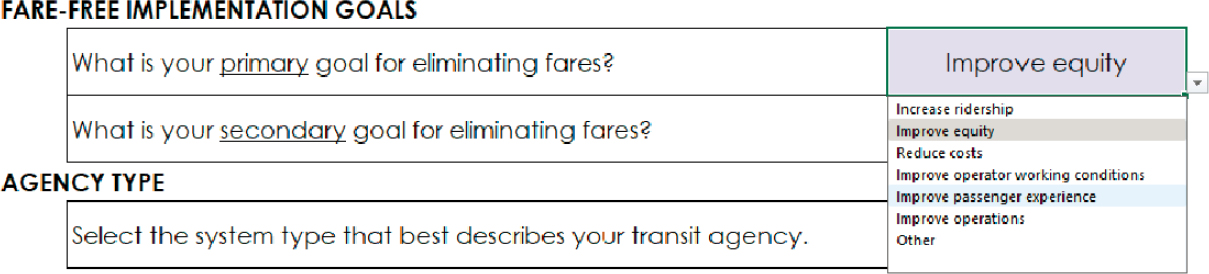
  • Enter text and data only in the purple-shaded cells. Where provided, use the dropdowns to select the most appropriate input. Dropdowns are illustrated in Figure A-1. Most inputs are on the 2-Analysis Setup and 3-Inputs tabs. Optional inputs are on the 4-Quantitative Results tab.
  • All input data should reflect a common base year.
  • Review quantitative results in detail on the 4-Quantitative Results tab.
  • Review qualitative results in detail on the 5-Qualitative Results tab.
  • Review both quantitative and qualitative results and use both to inform decision-making.
  • The 6-Summary tab presents key elements of the quantitative and qualitative results in a printable format.

Getting the Most Value out of the Tool

  • Fully understand the goals that you hope to achieve and how realistic they are. Improving ridership and addressing equity concerns are likely outcomes. Some fare collection cost savings can be expected, but rarely will these savings offset lost revenues.
Page 44
Suggested Citation: "Appendix: Practitioners' Tool User Instructions." National Academies of Sciences, Engineering, and Medicine. 2024. Sustaining Zero-Fare Public Transit in a Post COVID-19 World: A Guide for State DOTs. Washington, DC: The National Academies Press. doi: 10.17226/27927.
Example of drop-down menu
Figure A-1. Example of drop-down menu.
  • Understand the context in which you are making decisions about fare-free operations. Knowing the community and its needs and having the community’s support are critical. Current challenges may get better or worse but must be fully understood.
  • If you are evaluating partial versus full fare-free operation, enter data only for the portion of the system affected by fare-free operation. There are many places in the tool for entering applicable agency data. For full fare-free operation, the values entered should be for the entire agency and the entire system. If fare-free operation is only for a specific area or mode, only the data for that area or mode should be entered. (For example, if fare-free operation is for bus services only, then only ridership data for bus services should be entered.) Fare collection cost savings must be carefully determined in the case of partial fare-free operation. For example, if a portion of the system—such as a bus rapid transit (BRT) route or a downtown circulator—is fare-free, but the rest of the system is still collecting fares, the people, facilities, and processes that the agency uses to secure, collect, reconcile, and manage fares must remain in place. Accounting for socially based fare programs can be especially complex, and additional research references need to be considered.
  • Recognize that ridership data for the impacts of fare-free operation are limited—particularly for partial fare-free operation. Use your knowledge of the local system to place ridership growth assumptions in the proper context. Ridership is likely to increase, but this will often not be through a shift from single-occupant vehicles (SOVs). Without this shift from SOVs to transit, any reduction in emissions is likely not to be realized.
  • Look outside the boundaries of fare-free operation for the full context. Whether these boundaries are within the agency or at regional or state lines, riders may need to cross these lines for trips, and vehicles (and their fare collection equipment) may face different requirements. A bus used both in and out of a fare-free area must be prepared to serve both eventualities. Transfers across these lines can be complicated and confusing for riders. Make sure these characteristics are reflected in the data entered into the tool.
  • Thoroughly understand the perspective of design riders, or riders who represent diverse actual users and potential users of your transit services. Does fare-free service help them, and to what extent? Consider a system with fare-free bus service but fares for train service. If commuting to a job location requires a train trip for one leg of the trip, the rider still needs to pay a fare for the trip. The equity benefit of the fare-free bus service is limited by the necessity to pay the fare for the train trip.
  • Consider the perspective of transit vehicle operators. Fare-free operation may eliminate negative driver–passenger interactions over fares but increase the number of disruptive passengers and passenger–passenger conflicts. Operators are on the front line of service and will have valuable input. Reach out to operators and their unions.
Page 45
Suggested Citation: "Appendix: Practitioners' Tool User Instructions." National Academies of Sciences, Engineering, and Medicine. 2024. Sustaining Zero-Fare Public Transit in a Post COVID-19 World: A Guide for State DOTs. Washington, DC: The National Academies Press. doi: 10.17226/27927.
  • Fully consider potential second-order impacts. For example, how much will paratransit ridership and costs increase if fares are eliminated? How will the agency compensate for lost fare revenues in operations and capital investments? If fare revenues are unrestricted for use as a local match, will the local revenues used to replace fare revenues be similarly unrestricted?
  • Costs can increase dramatically under fare-free operations, so the impacts of fare-free operations should be considered carefully. The identification of a funding source to offset the loss in fares and potential net increased costs is essential to the long-term success of a fare-free implementation.

Examples of Tool Application

The examples provided in this section represent three contexts for applying the tool. Additional contexts (e.g., a region in which one transit agency provides fare-free service while an adjacent transit agency does not) are possible but are not directly reflected in these examples.

Example #1 – Multicounty Rural Transit Agency

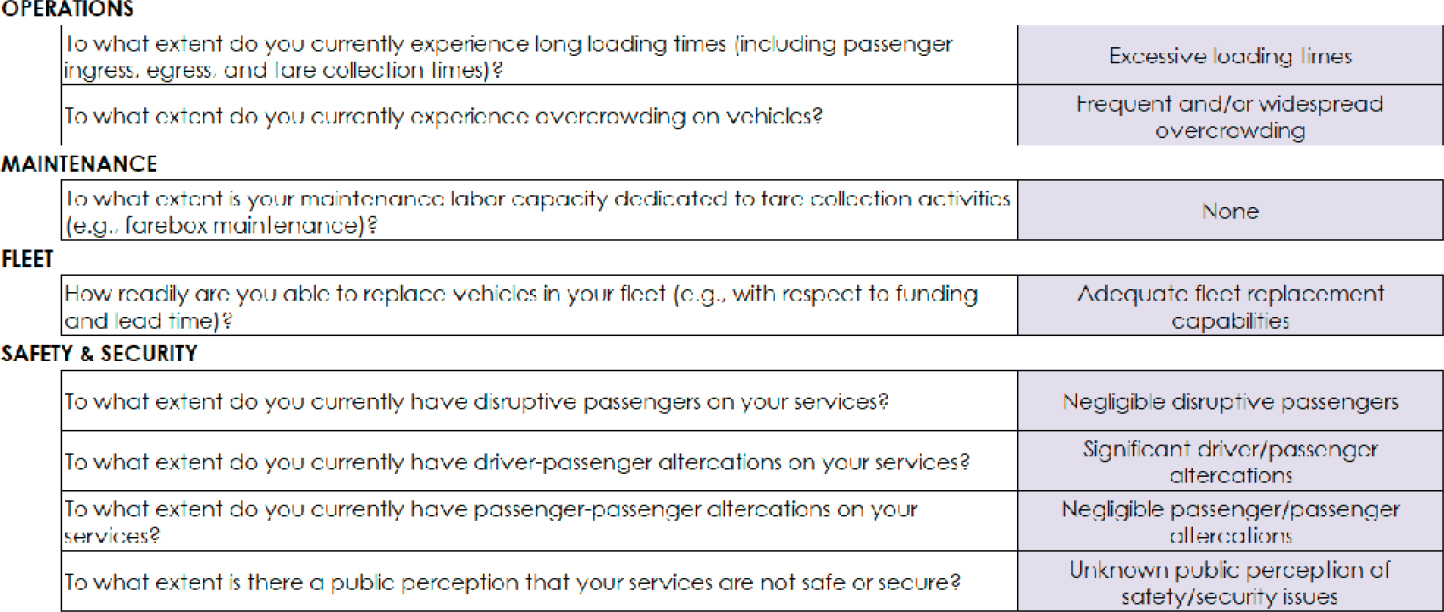
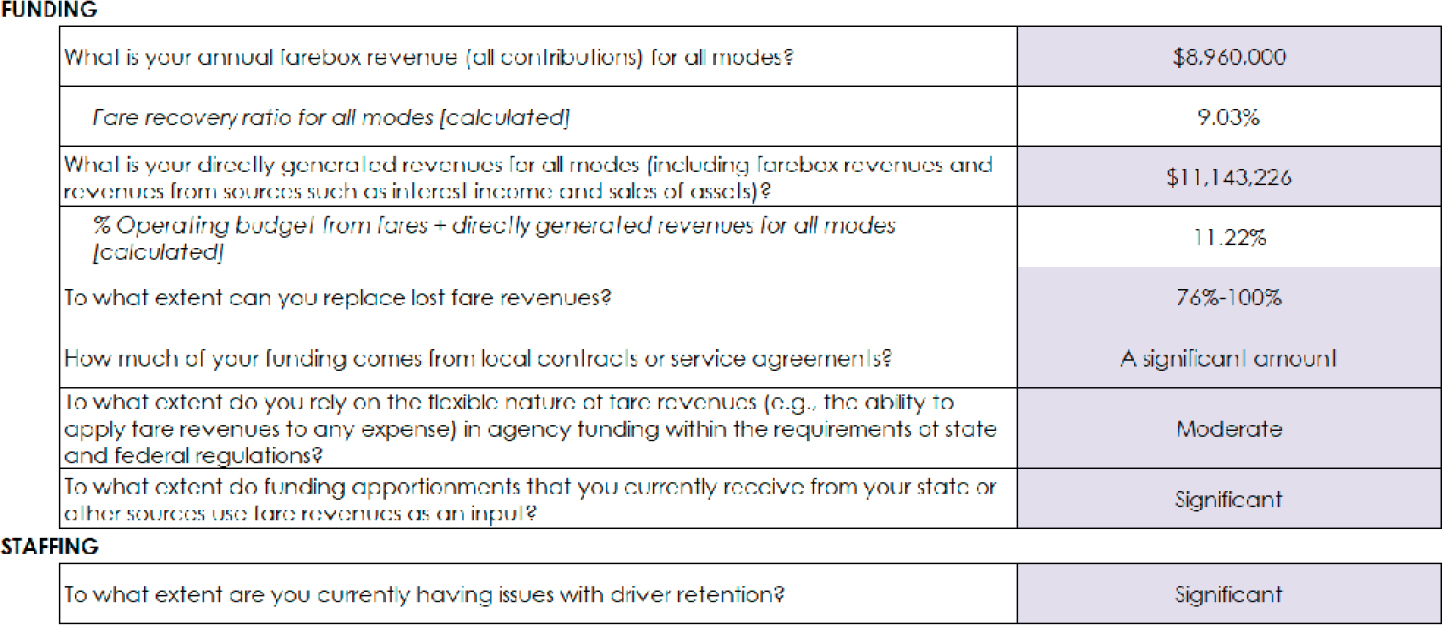
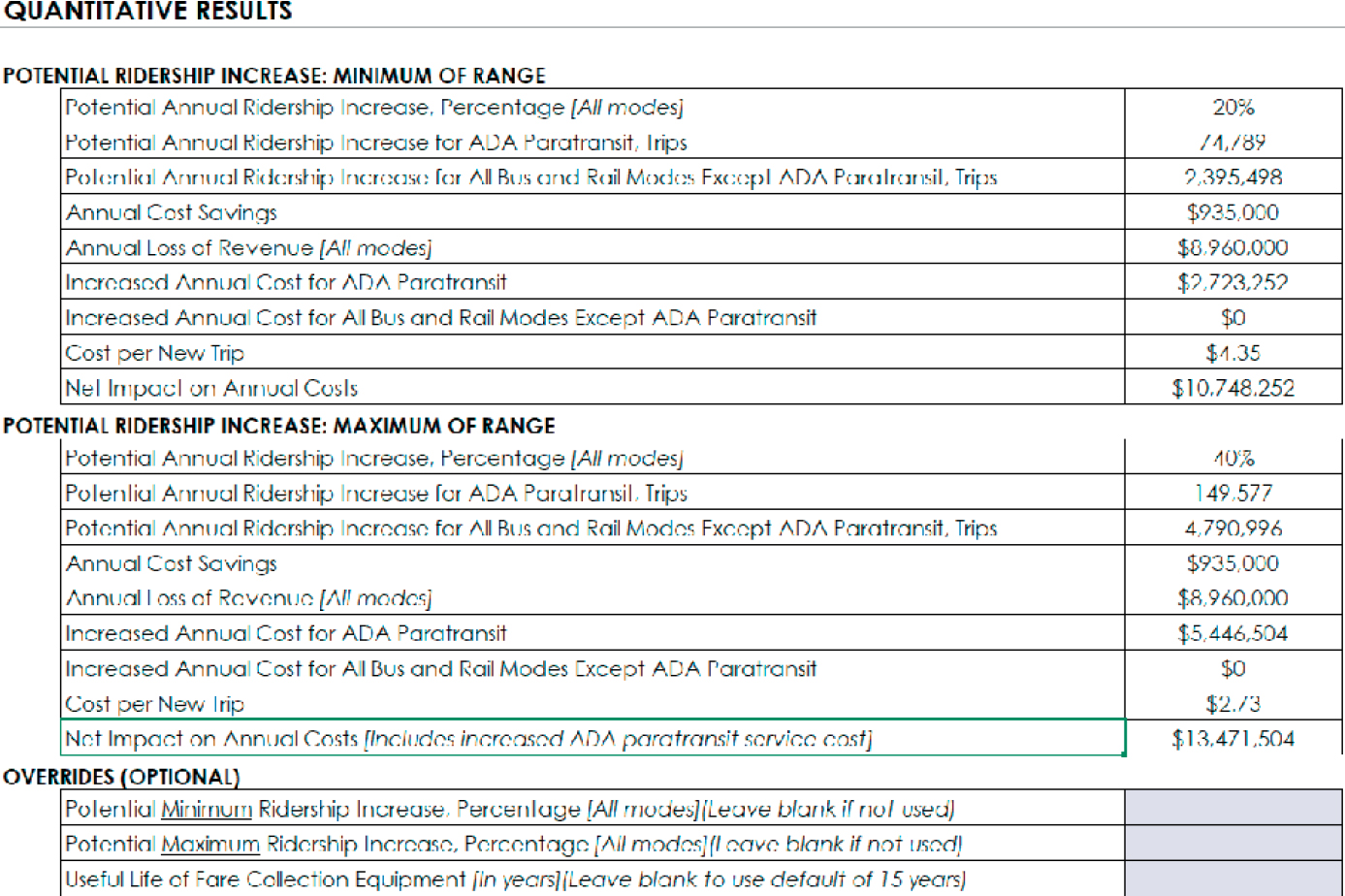
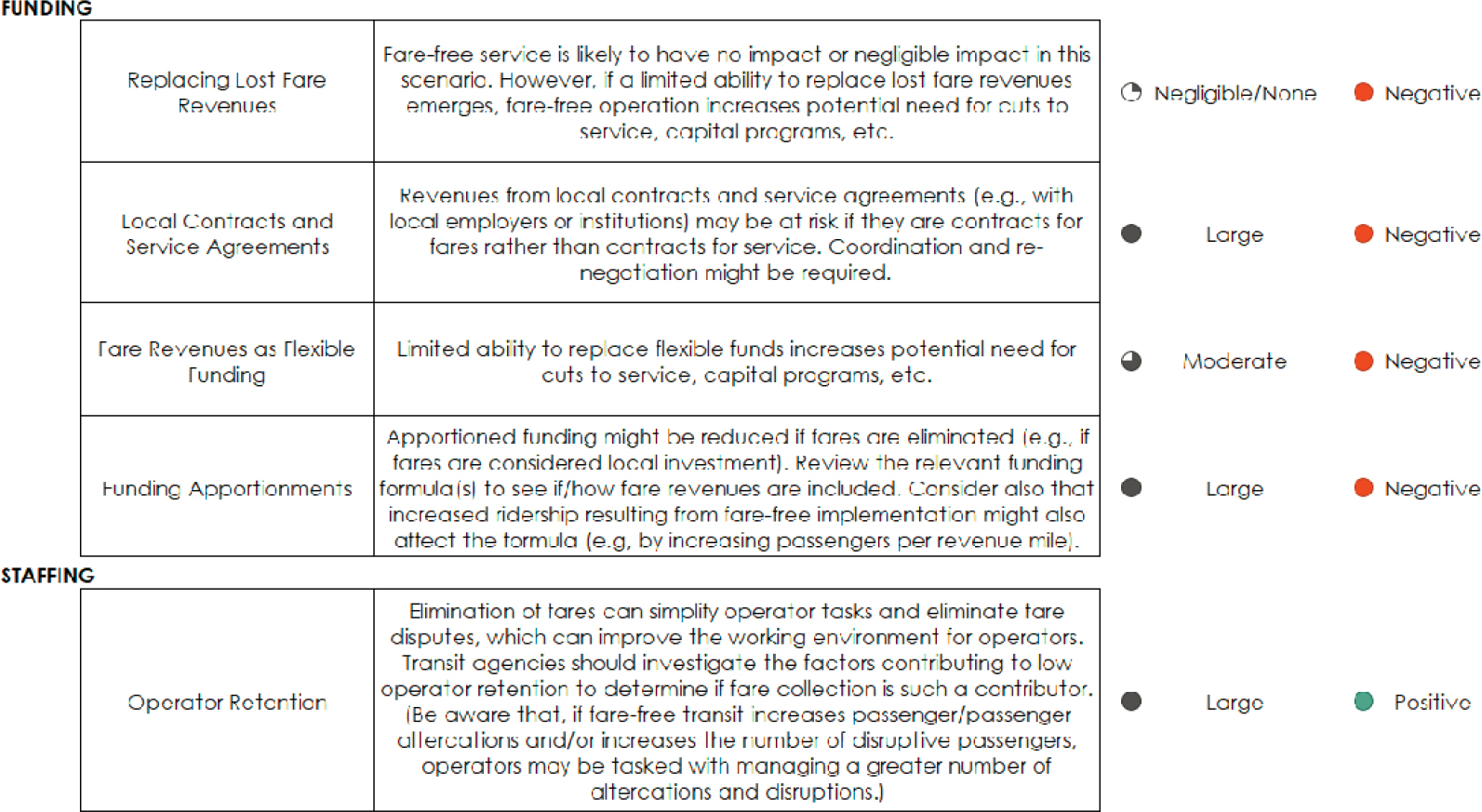
The series of figures that follows illustrates tool inputs and outputs for a multicounty rural transit agency that is considering implementing full fare-free service. The quantitative results show that fare-free service could result in a net increase in costs. The agency should carefully consider qualitative impacts as well.
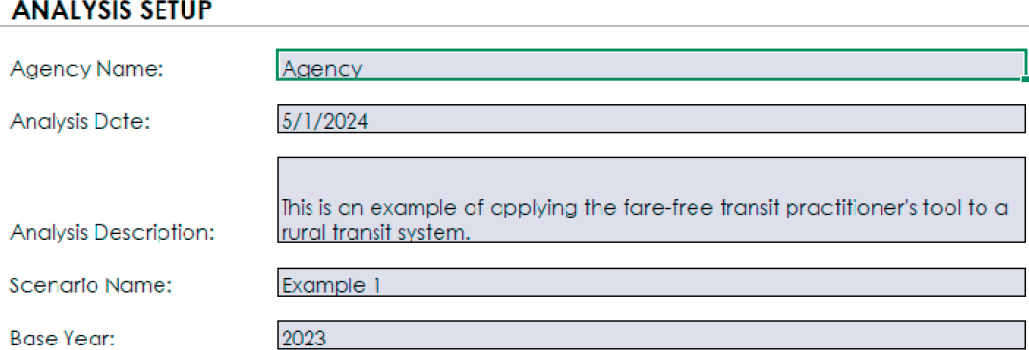
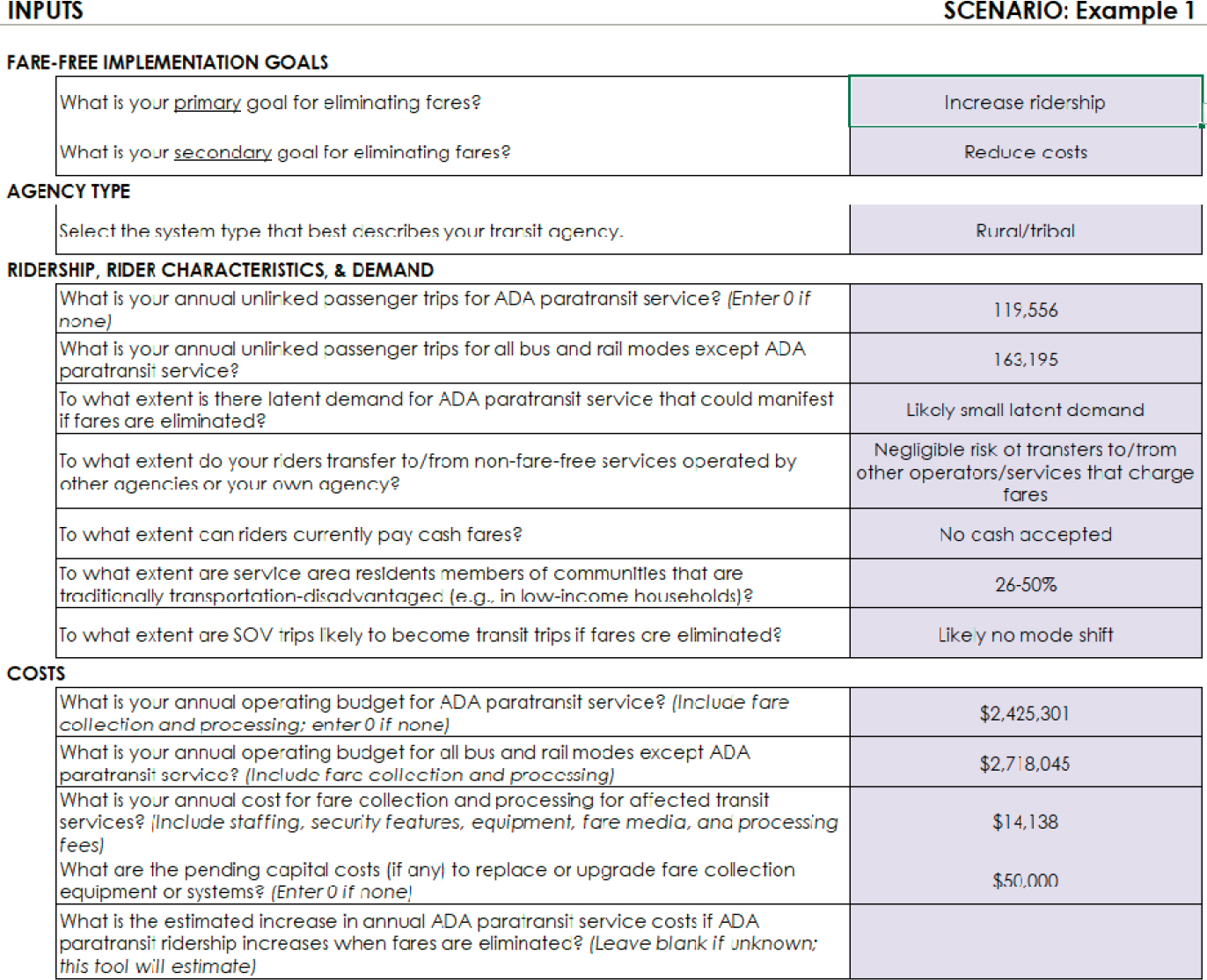
Example #1 analysis setup
Figure A-2. Example #1 analysis setup.
Page 46
Suggested Citation: "Appendix: Practitioners' Tool User Instructions." National Academies of Sciences, Engineering, and Medicine. 2024. Sustaining Zero-Fare Public Transit in a Post COVID-19 World: A Guide for State DOTs. Washington, DC: The National Academies Press. doi: 10.17226/27927.
Example #1 inputs (1 of 3)
Figure A-3. Example #1 inputs (1 of 3).
Example #1 inputs (2 of 3)
Figure A-4. Example #1 inputs (2 of 3).
Page 47
Suggested Citation: "Appendix: Practitioners' Tool User Instructions." National Academies of Sciences, Engineering, and Medicine. 2024. Sustaining Zero-Fare Public Transit in a Post COVID-19 World: A Guide for State DOTs. Washington, DC: The National Academies Press. doi: 10.17226/27927.
Example #1 inputs (3 of 3)
Figure A-5. Example #1 inputs (3 of 3).
Example #1 quantitative results
Figure A-6. Example #1 quantitative results.
Page 48
Suggested Citation: "Appendix: Practitioners' Tool User Instructions." National Academies of Sciences, Engineering, and Medicine. 2024. Sustaining Zero-Fare Public Transit in a Post COVID-19 World: A Guide for State DOTs. Washington, DC: The National Academies Press. doi: 10.17226/27927.
Example #1 qualitative results (1 of 3)
Figure A-7. Example #1 qualitative results (1 of 3).
Page 49
Suggested Citation: "Appendix: Practitioners' Tool User Instructions." National Academies of Sciences, Engineering, and Medicine. 2024. Sustaining Zero-Fare Public Transit in a Post COVID-19 World: A Guide for State DOTs. Washington, DC: The National Academies Press. doi: 10.17226/27927.
Example #1 qualitative results (2 of 3)
Figure A-8. Example #1 qualitative results (2 of 3).
Page 50
Suggested Citation: "Appendix: Practitioners' Tool User Instructions." National Academies of Sciences, Engineering, and Medicine. 2024. Sustaining Zero-Fare Public Transit in a Post COVID-19 World: A Guide for State DOTs. Washington, DC: The National Academies Press. doi: 10.17226/27927.
Qualitative results (3 of 3)
Figure A-9. Qualitative results (3 of 3).
Example #1 summary (1 of 2)
Figure A-10. Example #1 summary (1 of 2).
Page 51
Suggested Citation: "Appendix: Practitioners' Tool User Instructions." National Academies of Sciences, Engineering, and Medicine. 2024. Sustaining Zero-Fare Public Transit in a Post COVID-19 World: A Guide for State DOTs. Washington, DC: The National Academies Press. doi: 10.17226/27927.
Example #1 summary (2 of 2)
Figure A-11. Example #1 summary (2 of 2).

Example #2 – Small Urban Transit Agency

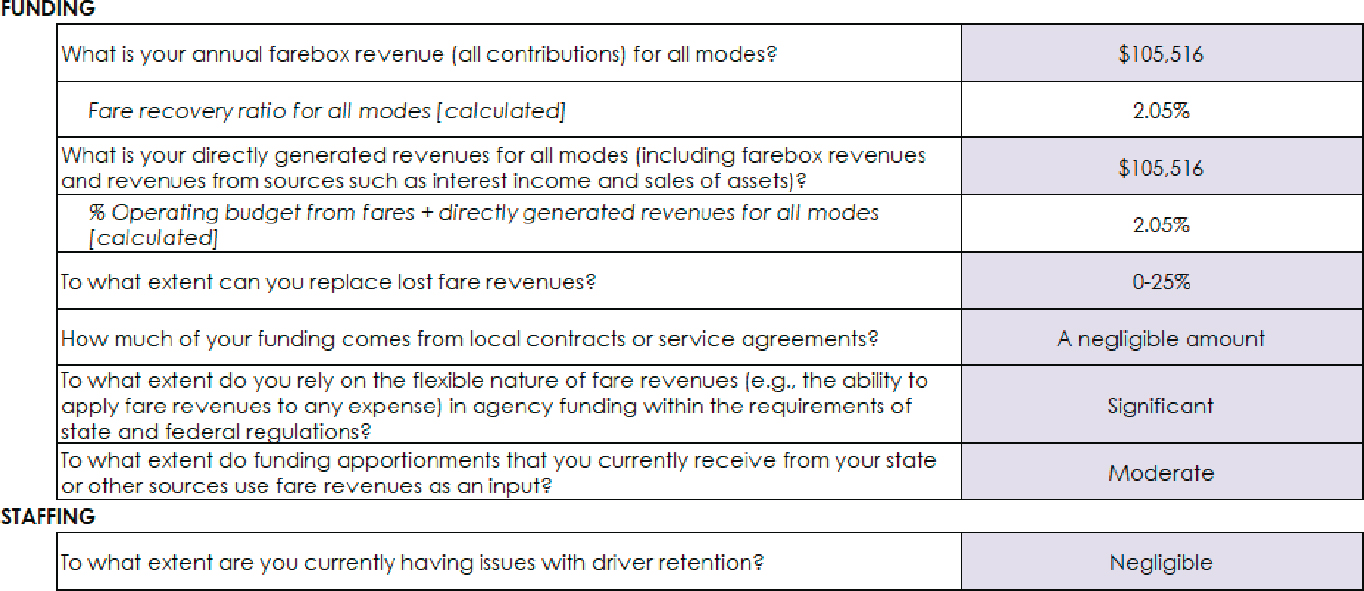
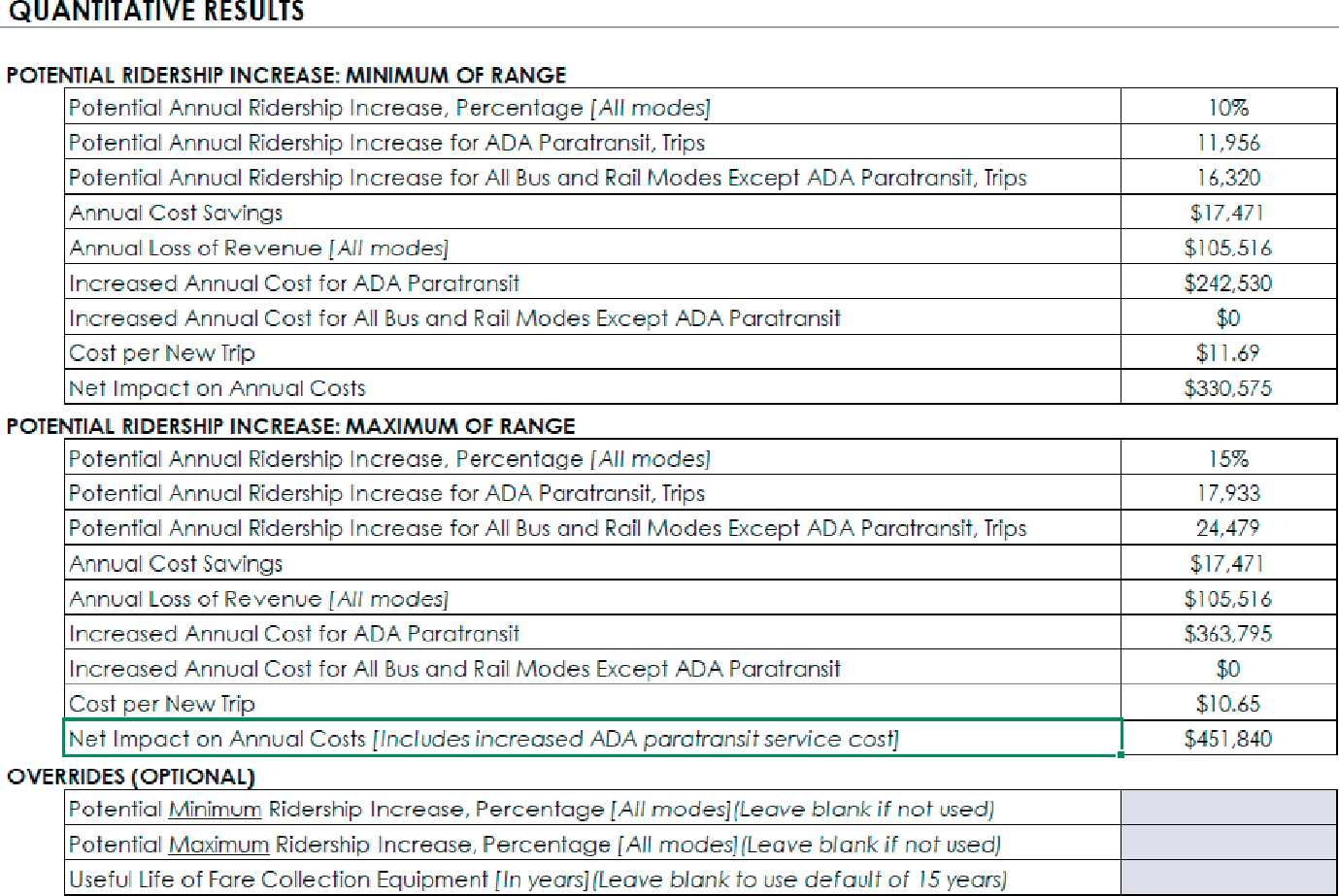
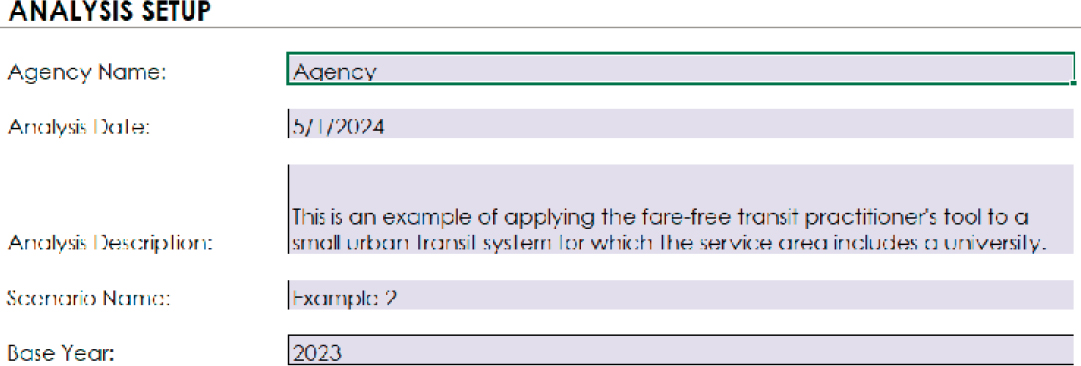
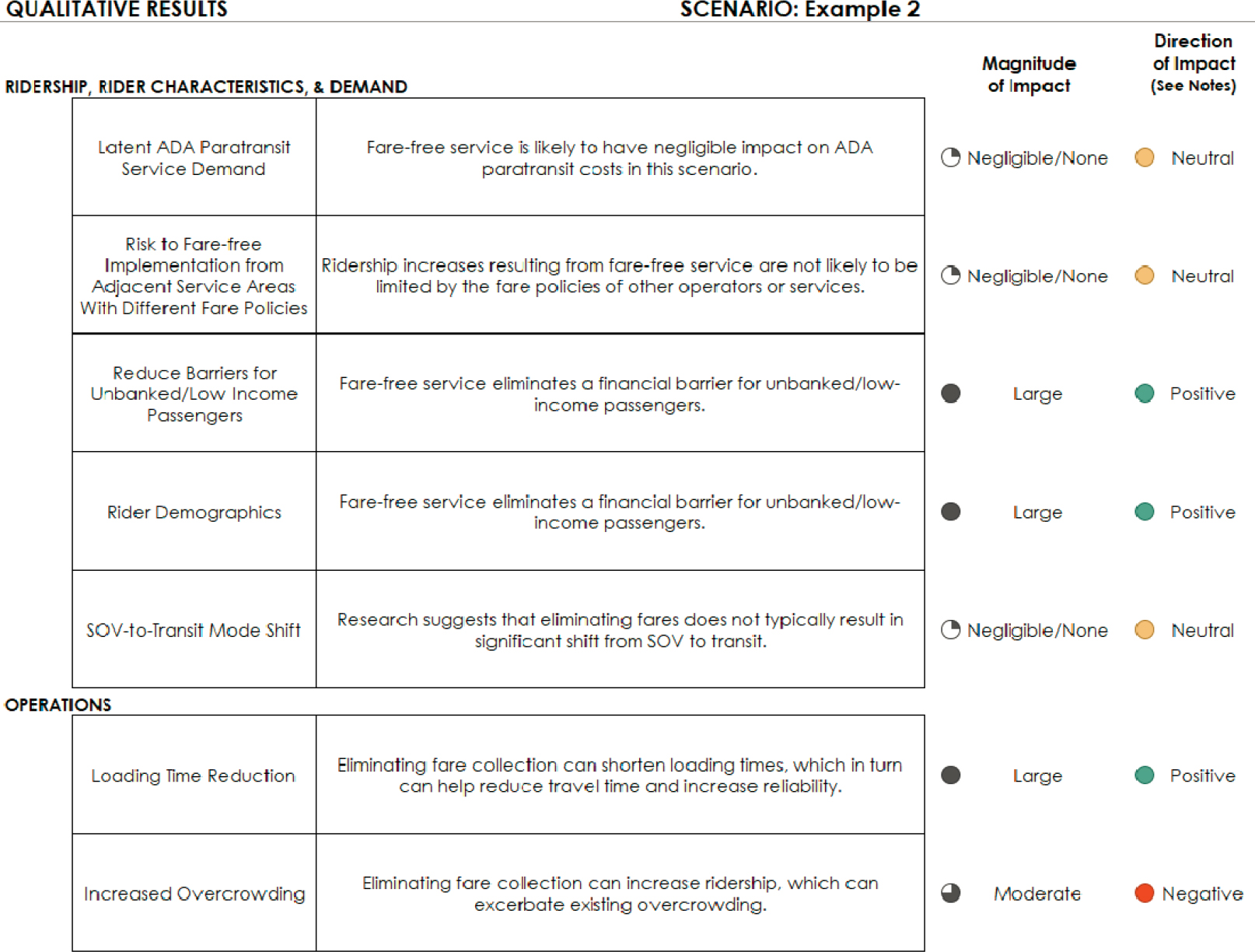
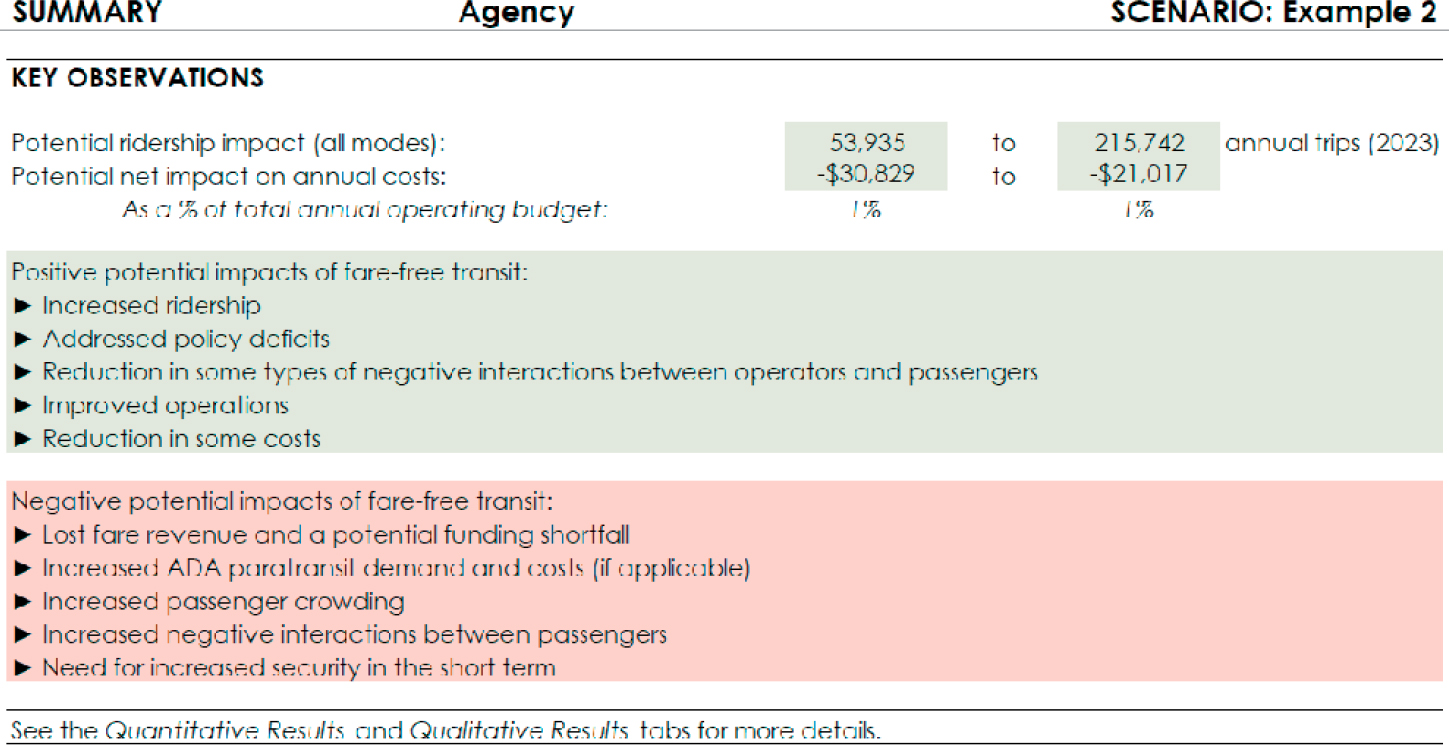
The series of figures that follows illustrates tool inputs and outputs for a small urban transit agency that is considering fare-free service. The service area includes a university that contracts service from the transit agency. Assuming the university contracts remain in place, the quantitative results show that fare-free service could result in net cost savings for the transit agency. The agency should carefully consider qualitative impacts as well.

Example #2 analysis setup
Figure A-12. Example #2 analysis setup.
Page 52
Suggested Citation: "Appendix: Practitioners' Tool User Instructions." National Academies of Sciences, Engineering, and Medicine. 2024. Sustaining Zero-Fare Public Transit in a Post COVID-19 World: A Guide for State DOTs. Washington, DC: The National Academies Press. doi: 10.17226/27927.
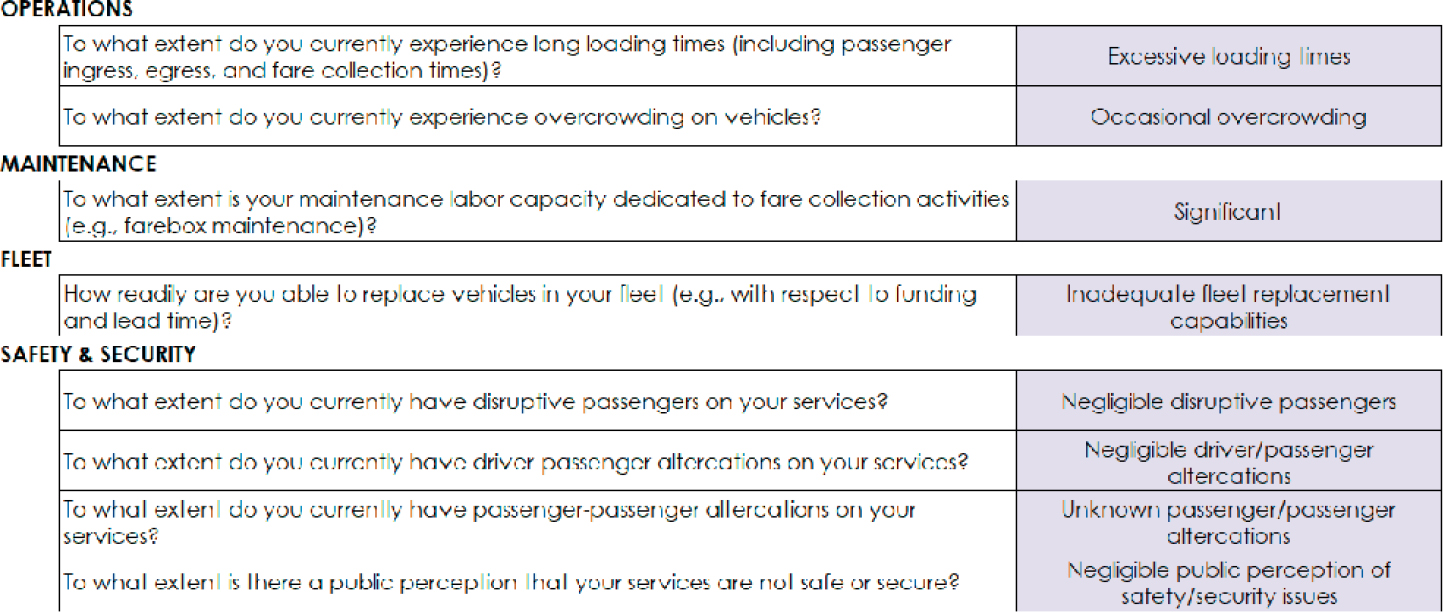
Example #2 inputs (1 of 3)
Figure A-13. Example #2 inputs (1 of 3).
Example #2 inputs (2 of 3)
Figure A-14. Example #2 inputs (2 of 3).
Page 53
Suggested Citation: "Appendix: Practitioners' Tool User Instructions." National Academies of Sciences, Engineering, and Medicine. 2024. Sustaining Zero-Fare Public Transit in a Post COVID-19 World: A Guide for State DOTs. Washington, DC: The National Academies Press. doi: 10.17226/27927.
Example #2 inputs (3 of 3)
Figure A-15. Example #2 inputs (3 of 3).
Example #2 quantitative results
Figure A-16. Example #2 quantitative results.
Page 54
Suggested Citation: "Appendix: Practitioners' Tool User Instructions." National Academies of Sciences, Engineering, and Medicine. 2024. Sustaining Zero-Fare Public Transit in a Post COVID-19 World: A Guide for State DOTs. Washington, DC: The National Academies Press. doi: 10.17226/27927.
Example #2 qualitative results (1 of 3)
Figure A-17. Example #2 qualitative results (1 of 3).
Page 55
Suggested Citation: "Appendix: Practitioners' Tool User Instructions." National Academies of Sciences, Engineering, and Medicine. 2024. Sustaining Zero-Fare Public Transit in a Post COVID-19 World: A Guide for State DOTs. Washington, DC: The National Academies Press. doi: 10.17226/27927.
Example #2 qualitative results (2 of 3)
Figure A-18. Example #2 qualitative results (2 of 3).
Page 56
Suggested Citation: "Appendix: Practitioners' Tool User Instructions." National Academies of Sciences, Engineering, and Medicine. 2024. Sustaining Zero-Fare Public Transit in a Post COVID-19 World: A Guide for State DOTs. Washington, DC: The National Academies Press. doi: 10.17226/27927.
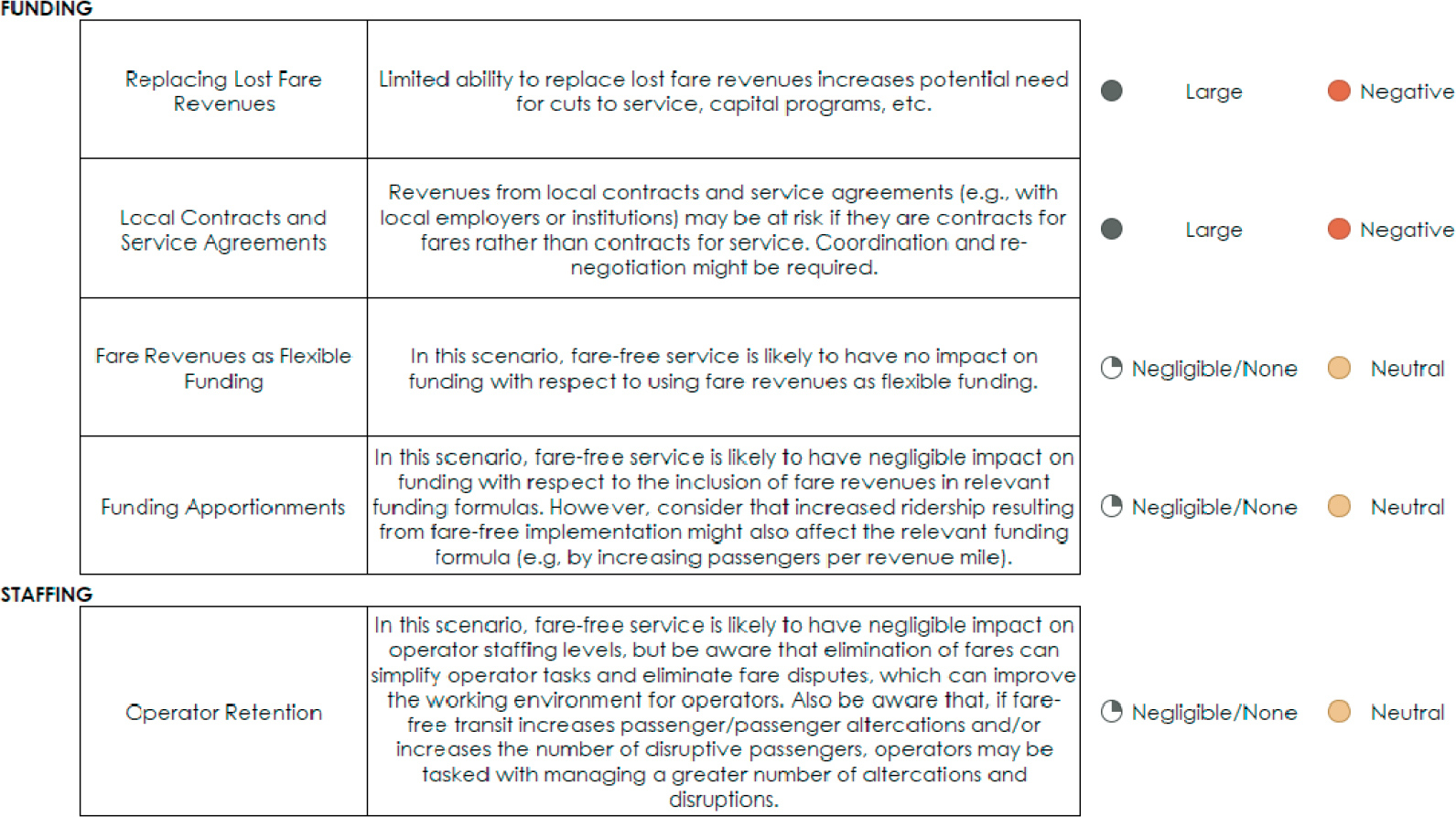
Example #2 qualitative results (3 of 3)
Figure A-19. Example #2 qualitative results (3 of 3).
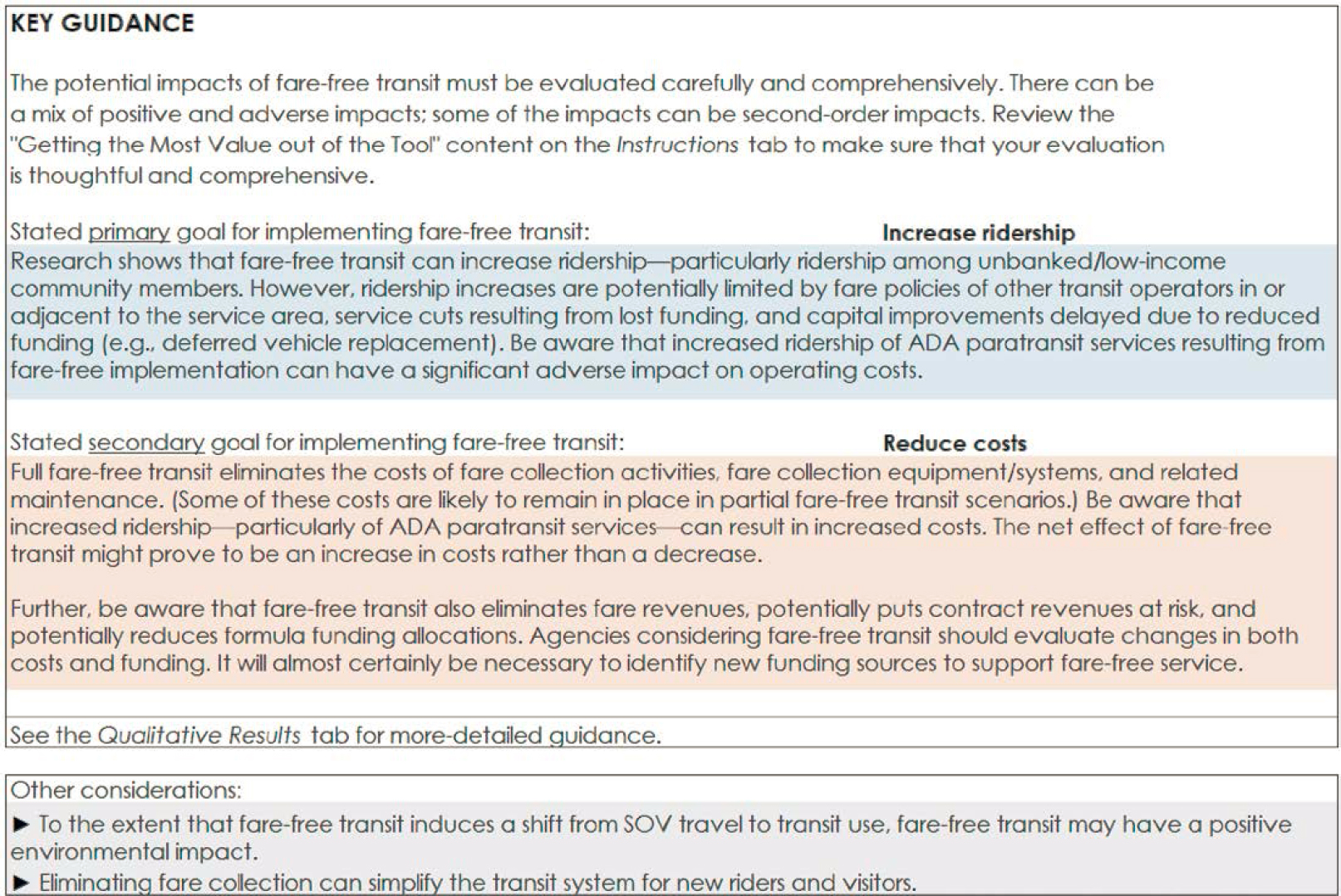
Example #2 summary (1 of 2)
Figure A-20. Example #2 summary (1 of 2).
Page 57
Suggested Citation: "Appendix: Practitioners' Tool User Instructions." National Academies of Sciences, Engineering, and Medicine. 2024. Sustaining Zero-Fare Public Transit in a Post COVID-19 World: A Guide for State DOTs. Washington, DC: The National Academies Press. doi: 10.17226/27927.
Example #2 summary (2 of 2)
Figure A-21. Example #2 summary (2 of 2).

Example #3 – Large Urban Transit Agency

The series of figures that follows illustrates tool inputs and outputs for a large urban transit agency that is considering implementing full fare-free service. The quantitative results show that fare-free service could result in a net increase in costs. The agency should carefully consider qualitative impacts as well.

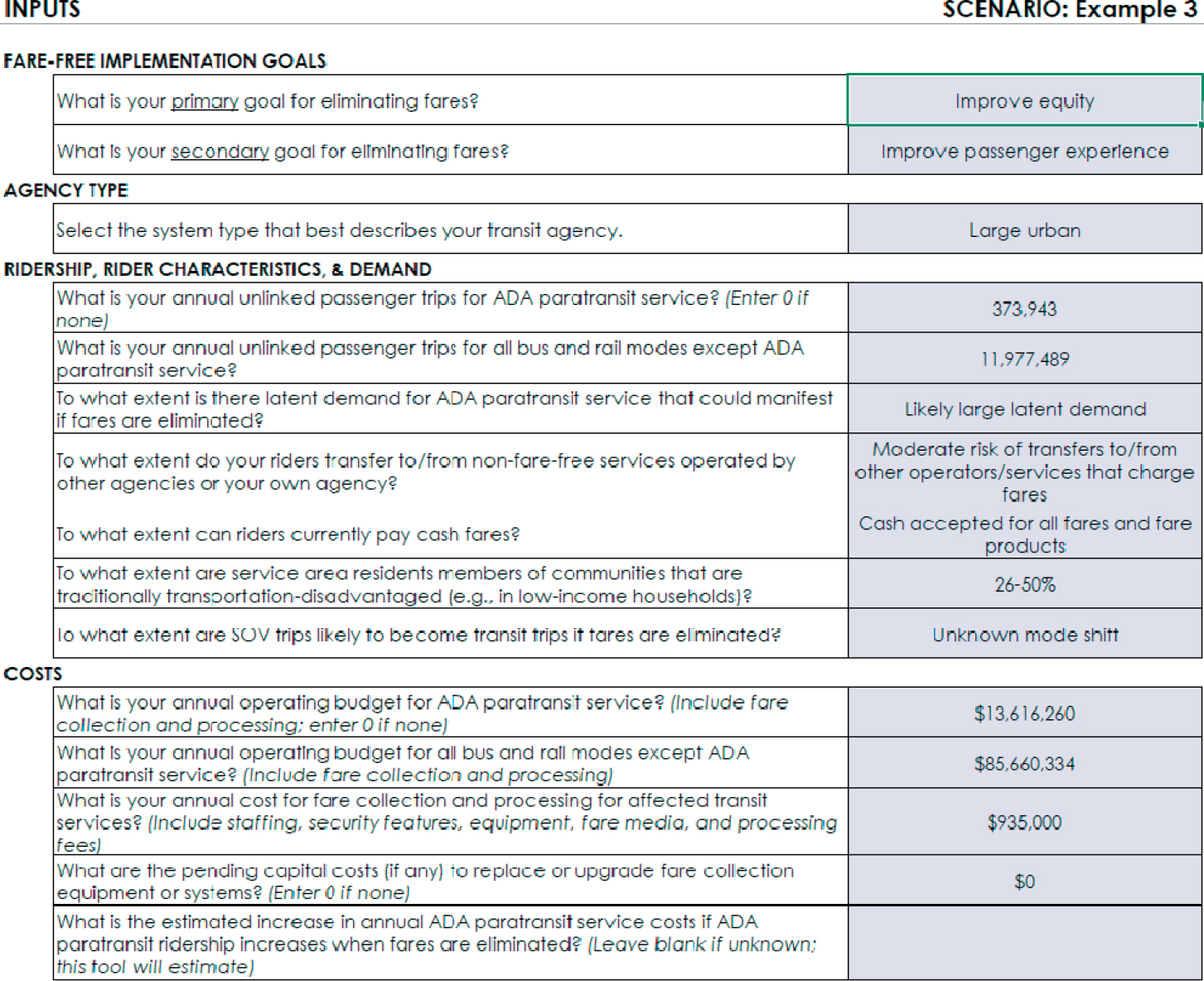
Example #3 analysis setup
Figure A-22. Example #3 analysis setup.
Page 58
Suggested Citation: "Appendix: Practitioners' Tool User Instructions." National Academies of Sciences, Engineering, and Medicine. 2024. Sustaining Zero-Fare Public Transit in a Post COVID-19 World: A Guide for State DOTs. Washington, DC: The National Academies Press. doi: 10.17226/27927.
Example #3 inputs (1 of 3)
Figure A-23. Example #3 inputs (1 of 3).
Example #3 inputs (2 of 3)
Figure A-24. Example #3 inputs (2 of 3).
Page 59
Suggested Citation: "Appendix: Practitioners' Tool User Instructions." National Academies of Sciences, Engineering, and Medicine. 2024. Sustaining Zero-Fare Public Transit in a Post COVID-19 World: A Guide for State DOTs. Washington, DC: The National Academies Press. doi: 10.17226/27927.
Example #3 inputs (3 of 3)
Figure A-25. Example #3 inputs (3 of 3).
Example #3 quantitative results
Figure A-26. Example #3 quantitative results.
Page 60
Suggested Citation: "Appendix: Practitioners' Tool User Instructions." National Academies of Sciences, Engineering, and Medicine. 2024. Sustaining Zero-Fare Public Transit in a Post COVID-19 World: A Guide for State DOTs. Washington, DC: The National Academies Press. doi: 10.17226/27927.
Example #3 qualitative results (1 of 3)
Figure A-27. Example #3 qualitative results (1 of 3).
Page 61
Suggested Citation: "Appendix: Practitioners' Tool User Instructions." National Academies of Sciences, Engineering, and Medicine. 2024. Sustaining Zero-Fare Public Transit in a Post COVID-19 World: A Guide for State DOTs. Washington, DC: The National Academies Press. doi: 10.17226/27927.
Example #3 qualitative results (2 of 3)
Figure A-28. Example #3 qualitative results (2 of 3).
Page 62
Suggested Citation: "Appendix: Practitioners' Tool User Instructions." National Academies of Sciences, Engineering, and Medicine. 2024. Sustaining Zero-Fare Public Transit in a Post COVID-19 World: A Guide for State DOTs. Washington, DC: The National Academies Press. doi: 10.17226/27927.
Example #3 qualitative results (3 of 3)
Figure A-29. Example #3 qualitative results (3 of 3).
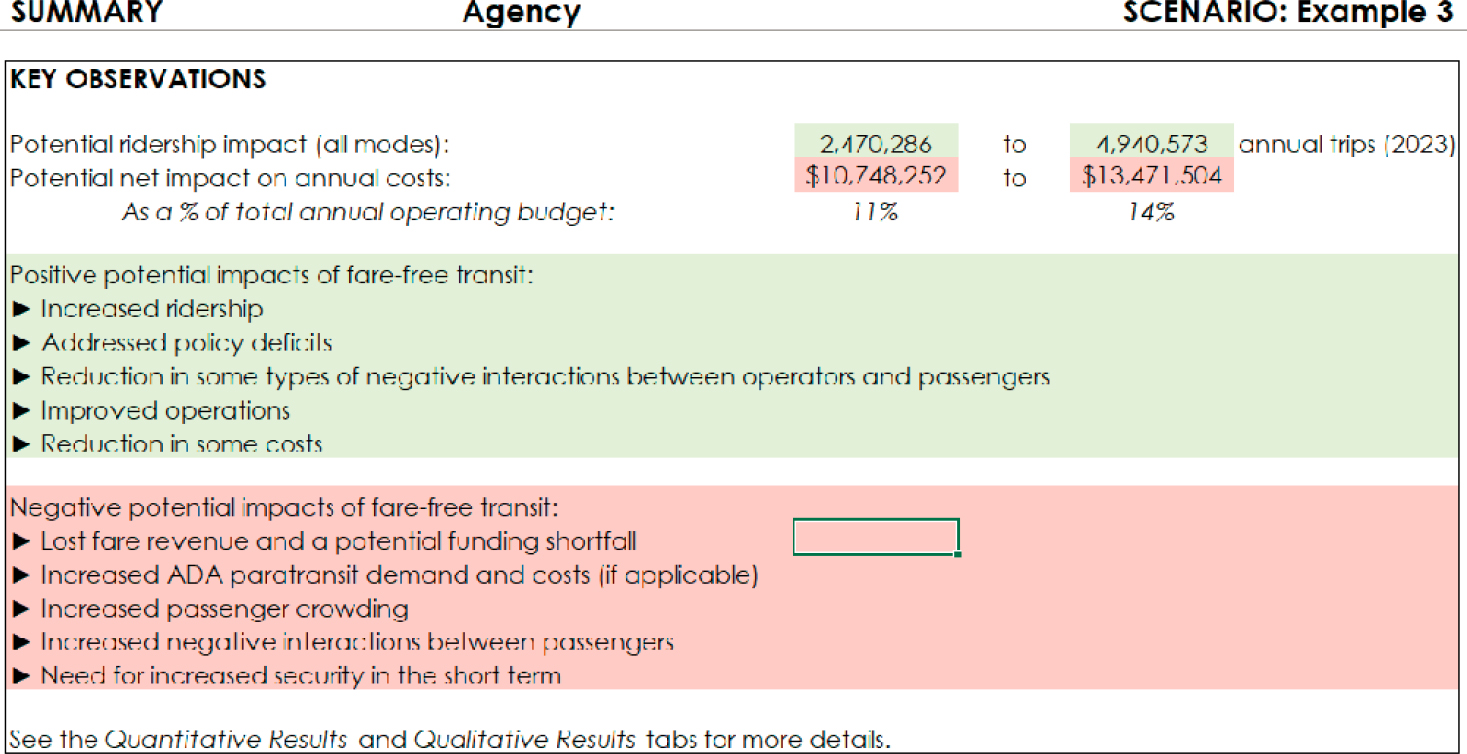
Example #3 summary (1 of 2)
Figure A-30. Example #3 summary (1 of 2).
Page 63
Suggested Citation: "Appendix: Practitioners' Tool User Instructions." National Academies of Sciences, Engineering, and Medicine. 2024. Sustaining Zero-Fare Public Transit in a Post COVID-19 World: A Guide for State DOTs. Washington, DC: The National Academies Press. doi: 10.17226/27927.
Example #3 summary (2 of 2)
Figure A-31. Example #3 summary (2 of 2).

Conclusion

These instructions and examples provide guidance for the proper use of the practitioners’ tool. Proper application of context and local experience is as important as entering the data properly.

Page 64
Suggested Citation: "Appendix: Practitioners' Tool User Instructions." National Academies of Sciences, Engineering, and Medicine. 2024. Sustaining Zero-Fare Public Transit in a Post COVID-19 World: A Guide for State DOTs. Washington, DC: The National Academies Press. doi: 10.17226/27927.

This page intentionally left blank.

Page 65
Suggested Citation: "Appendix: Practitioners' Tool User Instructions." National Academies of Sciences, Engineering, and Medicine. 2024. Sustaining Zero-Fare Public Transit in a Post COVID-19 World: A Guide for State DOTs. Washington, DC: The National Academies Press. doi: 10.17226/27927.

Abbreviations and acronyms used without definitions in TRB publications:

A4A Airlines for America
AAAE American Association of Airport Executives
AASHO American Association of State Highway Officials
AASHTO American Association of State Highway and Transportation Officials
ACI–NA Airports Council International–North America
ACRP Airport Cooperative Research Program
ADA Americans with Disabilities Act
APTA American Public Transportation Association
ASCE American Society of Civil Engineers
ASME American Society of Mechanical Engineers
ASTM American Society for Testing and Materials
ATA American Trucking Associations
CTAA Community Transportation Association of America
CTBSSP Commercial Truck and Bus Safety Synthesis Program
DHS Department of Homeland Security
DOE Department of Energy
EPA Environmental Protection Agency
FAA Federal Aviation Administration
FAST Fixing America’s Surface Transportation Act (2015)
FHWA Federal Highway Administration
FMCSA Federal Motor Carrier Safety Administration
FRA Federal Railroad Administration
FTA Federal Transit Administration
GHSA Governors Highway Safety Association
HMCRP Hazardous Materials Cooperative Research Program
IEEE Institute of Electrical and Electronics Engineers
ISTEA Intermodal Surface Transportation Efficiency Act of 1991
ITE Institute of Transportation Engineers
MAP-21 Moving Ahead for Progress in the 21st Century Act (2012)
NASA National Aeronautics and Space Administration
NASAO National Association of State Aviation Officials
NCFRP National Cooperative Freight Research Program
NCHRP National Cooperative Highway Research Program
NHTSA National Highway Traffic Safety Administration
NTSB National Transportation Safety Board
PHMSA Pipeline and Hazardous Materials Safety Administration
RITA Research and Innovative Technology Administration
SAE Society of Automotive Engineers
SAFETEA-LU Safe, Accountable, Flexible, Efficient Transportation Equity Act: A Legacy for Users (2005)
TCRP Transit Cooperative Research Program
TEA-21 Transportation Equity Act for the 21st Century (1998)
TRB Transportation Research Board
TSA Transportation Security Administration
U.S. DOT United States Department of Transportation
Page 66
Suggested Citation: "Appendix: Practitioners' Tool User Instructions." National Academies of Sciences, Engineering, and Medicine. 2024. Sustaining Zero-Fare Public Transit in a Post COVID-19 World: A Guide for State DOTs. Washington, DC: The National Academies Press. doi: 10.17226/27927.

presentation

Page 43
Suggested Citation: "Appendix: Practitioners' Tool User Instructions." National Academies of Sciences, Engineering, and Medicine. 2024. Sustaining Zero-Fare Public Transit in a Post COVID-19 World: A Guide for State DOTs. Washington, DC: The National Academies Press. doi: 10.17226/27927.
Page 43
Page 44
Suggested Citation: "Appendix: Practitioners' Tool User Instructions." National Academies of Sciences, Engineering, and Medicine. 2024. Sustaining Zero-Fare Public Transit in a Post COVID-19 World: A Guide for State DOTs. Washington, DC: The National Academies Press. doi: 10.17226/27927.
Page 44
Page 45
Suggested Citation: "Appendix: Practitioners' Tool User Instructions." National Academies of Sciences, Engineering, and Medicine. 2024. Sustaining Zero-Fare Public Transit in a Post COVID-19 World: A Guide for State DOTs. Washington, DC: The National Academies Press. doi: 10.17226/27927.
Page 45
Page 46
Suggested Citation: "Appendix: Practitioners' Tool User Instructions." National Academies of Sciences, Engineering, and Medicine. 2024. Sustaining Zero-Fare Public Transit in a Post COVID-19 World: A Guide for State DOTs. Washington, DC: The National Academies Press. doi: 10.17226/27927.
Page 46
Page 47
Suggested Citation: "Appendix: Practitioners' Tool User Instructions." National Academies of Sciences, Engineering, and Medicine. 2024. Sustaining Zero-Fare Public Transit in a Post COVID-19 World: A Guide for State DOTs. Washington, DC: The National Academies Press. doi: 10.17226/27927.
Page 47
Page 48
Suggested Citation: "Appendix: Practitioners' Tool User Instructions." National Academies of Sciences, Engineering, and Medicine. 2024. Sustaining Zero-Fare Public Transit in a Post COVID-19 World: A Guide for State DOTs. Washington, DC: The National Academies Press. doi: 10.17226/27927.
Page 48
Page 49
Suggested Citation: "Appendix: Practitioners' Tool User Instructions." National Academies of Sciences, Engineering, and Medicine. 2024. Sustaining Zero-Fare Public Transit in a Post COVID-19 World: A Guide for State DOTs. Washington, DC: The National Academies Press. doi: 10.17226/27927.
Page 49
Page 50
Suggested Citation: "Appendix: Practitioners' Tool User Instructions." National Academies of Sciences, Engineering, and Medicine. 2024. Sustaining Zero-Fare Public Transit in a Post COVID-19 World: A Guide for State DOTs. Washington, DC: The National Academies Press. doi: 10.17226/27927.
Page 50
Page 51
Suggested Citation: "Appendix: Practitioners' Tool User Instructions." National Academies of Sciences, Engineering, and Medicine. 2024. Sustaining Zero-Fare Public Transit in a Post COVID-19 World: A Guide for State DOTs. Washington, DC: The National Academies Press. doi: 10.17226/27927.
Page 51
Page 52
Suggested Citation: "Appendix: Practitioners' Tool User Instructions." National Academies of Sciences, Engineering, and Medicine. 2024. Sustaining Zero-Fare Public Transit in a Post COVID-19 World: A Guide for State DOTs. Washington, DC: The National Academies Press. doi: 10.17226/27927.
Page 52
Page 53
Suggested Citation: "Appendix: Practitioners' Tool User Instructions." National Academies of Sciences, Engineering, and Medicine. 2024. Sustaining Zero-Fare Public Transit in a Post COVID-19 World: A Guide for State DOTs. Washington, DC: The National Academies Press. doi: 10.17226/27927.
Page 53
Page 54
Suggested Citation: "Appendix: Practitioners' Tool User Instructions." National Academies of Sciences, Engineering, and Medicine. 2024. Sustaining Zero-Fare Public Transit in a Post COVID-19 World: A Guide for State DOTs. Washington, DC: The National Academies Press. doi: 10.17226/27927.
Page 54
Page 55
Suggested Citation: "Appendix: Practitioners' Tool User Instructions." National Academies of Sciences, Engineering, and Medicine. 2024. Sustaining Zero-Fare Public Transit in a Post COVID-19 World: A Guide for State DOTs. Washington, DC: The National Academies Press. doi: 10.17226/27927.
Page 55
Page 56
Suggested Citation: "Appendix: Practitioners' Tool User Instructions." National Academies of Sciences, Engineering, and Medicine. 2024. Sustaining Zero-Fare Public Transit in a Post COVID-19 World: A Guide for State DOTs. Washington, DC: The National Academies Press. doi: 10.17226/27927.
Page 56
Page 57
Suggested Citation: "Appendix: Practitioners' Tool User Instructions." National Academies of Sciences, Engineering, and Medicine. 2024. Sustaining Zero-Fare Public Transit in a Post COVID-19 World: A Guide for State DOTs. Washington, DC: The National Academies Press. doi: 10.17226/27927.
Page 57
Page 58
Suggested Citation: "Appendix: Practitioners' Tool User Instructions." National Academies of Sciences, Engineering, and Medicine. 2024. Sustaining Zero-Fare Public Transit in a Post COVID-19 World: A Guide for State DOTs. Washington, DC: The National Academies Press. doi: 10.17226/27927.
Page 58
Page 59
Suggested Citation: "Appendix: Practitioners' Tool User Instructions." National Academies of Sciences, Engineering, and Medicine. 2024. Sustaining Zero-Fare Public Transit in a Post COVID-19 World: A Guide for State DOTs. Washington, DC: The National Academies Press. doi: 10.17226/27927.
Page 59
Page 60
Suggested Citation: "Appendix: Practitioners' Tool User Instructions." National Academies of Sciences, Engineering, and Medicine. 2024. Sustaining Zero-Fare Public Transit in a Post COVID-19 World: A Guide for State DOTs. Washington, DC: The National Academies Press. doi: 10.17226/27927.
Page 60
Page 61
Suggested Citation: "Appendix: Practitioners' Tool User Instructions." National Academies of Sciences, Engineering, and Medicine. 2024. Sustaining Zero-Fare Public Transit in a Post COVID-19 World: A Guide for State DOTs. Washington, DC: The National Academies Press. doi: 10.17226/27927.
Page 61
Page 62
Suggested Citation: "Appendix: Practitioners' Tool User Instructions." National Academies of Sciences, Engineering, and Medicine. 2024. Sustaining Zero-Fare Public Transit in a Post COVID-19 World: A Guide for State DOTs. Washington, DC: The National Academies Press. doi: 10.17226/27927.
Page 62
Page 63
Suggested Citation: "Appendix: Practitioners' Tool User Instructions." National Academies of Sciences, Engineering, and Medicine. 2024. Sustaining Zero-Fare Public Transit in a Post COVID-19 World: A Guide for State DOTs. Washington, DC: The National Academies Press. doi: 10.17226/27927.
Page 63
Page 64
Suggested Citation: "Appendix: Practitioners' Tool User Instructions." National Academies of Sciences, Engineering, and Medicine. 2024. Sustaining Zero-Fare Public Transit in a Post COVID-19 World: A Guide for State DOTs. Washington, DC: The National Academies Press. doi: 10.17226/27927.
Page 64
Page 65
Suggested Citation: "Appendix: Practitioners' Tool User Instructions." National Academies of Sciences, Engineering, and Medicine. 2024. Sustaining Zero-Fare Public Transit in a Post COVID-19 World: A Guide for State DOTs. Washington, DC: The National Academies Press. doi: 10.17226/27927.
Page 65
Page 66
Suggested Citation: "Appendix: Practitioners' Tool User Instructions." National Academies of Sciences, Engineering, and Medicine. 2024. Sustaining Zero-Fare Public Transit in a Post COVID-19 World: A Guide for State DOTs. Washington, DC: The National Academies Press. doi: 10.17226/27927.
Page 66
Subscribe to Email from the National Academies
Keep up with all of the activities, publications, and events by subscribing to free updates by email.