Sustaining Zero-Fare Public Transit in a Post COVID-19 World: A Guide for State DOTs (2024)
Chapter: 4 Scenario Development and Analysis

CHAPTER 4
Scenario Development and Analysis
4.1 Scenario Development
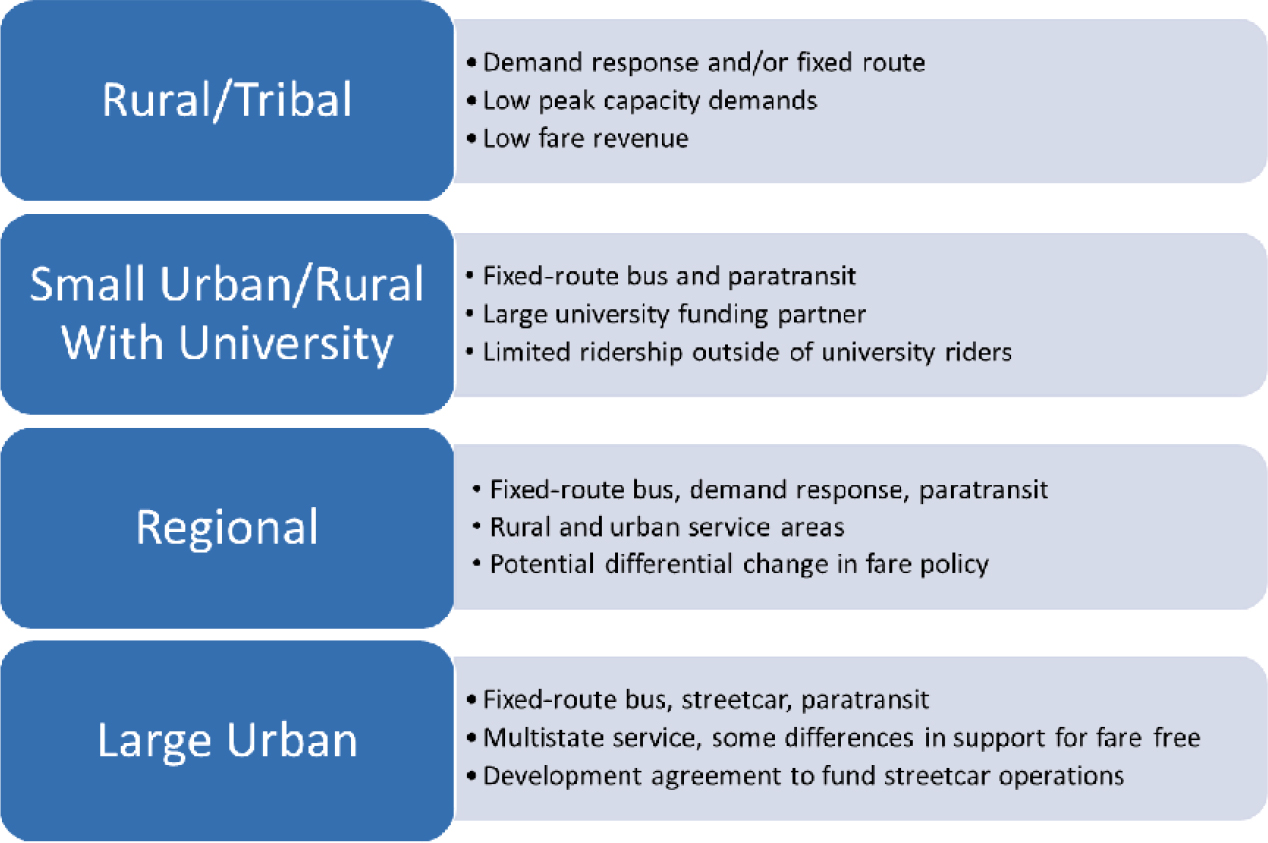
A range of scenarios was developed to ensure that the practitioners’ tool was usable in all likely circumstances. Four scenarios were developed for analysis based on general service areas and types: (1) rural/tribal, (2) small urban/rural with university funding partner, (3) regional, and (4) large urban. The analysis of these scenarios was further used to inform the next steps in this research. Figure 4 describes each of these scenarios.
4.1.1 Rural/Tribal
The rural/tribal scenario is reflective of small rural transit districts that often have fairly low fare revenues and high fare collection costs. Capacity issues are generally not critical, and the sensitivity to outside funding is minimal. Ridership is often low, and the proportion of low-income riders may be higher than at other types of transit systems.
4.1.2 Small Urban/Rural with University Support
Transit agencies operating near large college/university campuses have great ridership opportunities and often partner financially with the institutions in various forms. (Such partnerships could also include large employers or municipal/county agencies.) The small urban/rural with university support scenario is reflective of the importance of preserving these financial partnerships to a transit agency if fare-free services are implemented. Systems serving colleges and universities often have high concentrations of ridership on the routes linking student housing to the campus.
4.1.3 Regional
The regional scenario is reflective of the risk of having a part of a regional system go fare-free while another part does not. In this scenario, it was assumed that the urban portion of the system has decided to discontinue fare-free operation. Many of the benefits of fare-free operations in one area can be fully or partially negated if an adjacent area does not continue fare-free operations. If any fares are collected, fare collection processes must all be in place. This disjoint in policy also greatly affects the intended policy goals. The differing needs of a system with both urban and rural elements can drive conflicting goals.
4.1.4 Large Urban
The large urban scenario includes bus, paratransit, and fixed guideway services. This scenario is reflective of the importance of fares in the overall finances of a larger urban area. These areas also have a greater potential for security issues and increased paratransit service costs (the paratransit fare being double the fixed-route fare). This scenario also includes the participation of a development district and streetcar operator. In this scenario, it was also assumed that the transit agency serves parts of two states, which carries the risk of different levels of support for fare-free implementation and the subsequent loss of benefits. Vehicle overcrowding is also possible.
4.2 Scenario Analysis
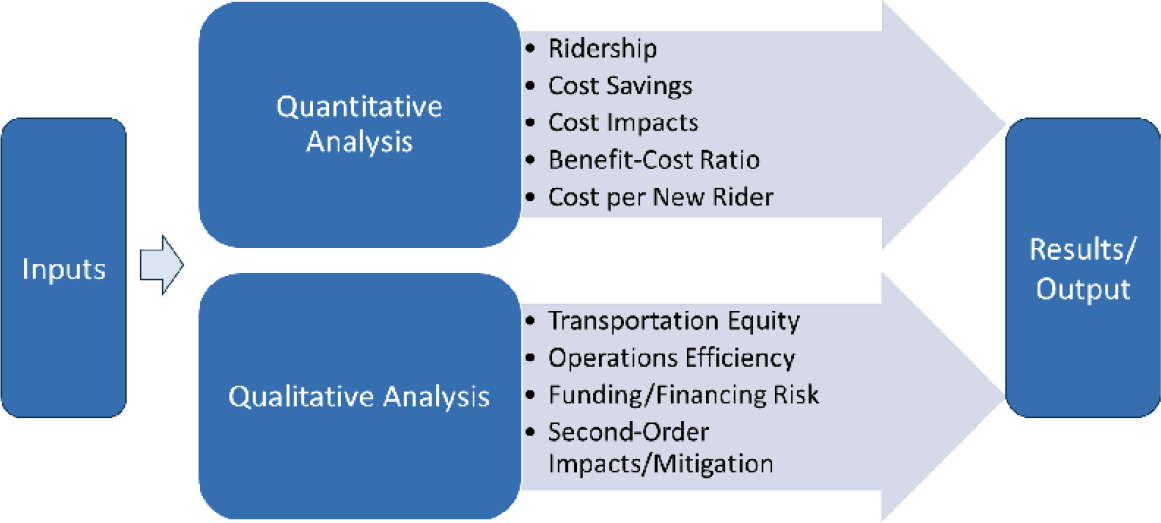
The primary purpose of the scenario analysis and, ultimately, the practitioners’ tool is to provide the inputs needed for informed decision-making rather than offer a definitive recommendation. Figure 5 shows the framework used to develop the practitioners’ tool. The following considerations, shaped by the literature review and agency outreach, were used by the research team for this development:
- State DOT and agency goals for fare-free transit services: Define the desirable end state.
- Cost and operations: Determine inputs based on local conditions and context.
- Operations efficiency and ridership: Determine benefits and challenges with operations, including ridership. Note that fare elasticity—the impact of fare increases or decreases on ridership—for partial fare-free operations was not discussed in the literature.
- Cost impacts and savings: Determine inputs based on applicable costs that are newly incurred or that can be reduced/eliminated.
- Funding/financing: Understand the risks associated with existing funding sources and consider alternative financing opportunities.
- Transportation equity: Determine inputs based on historic transportation investments, social capital outlays/underinvestment, regional demographics, community, and ridership profiles.
- Possible second-order impacts: Identify the risks of unintended consequences from fare-free policies.
- Mitigation: Identify steps to improve the likelihood of fare-free transit service success.
Resulting analysis outputs include a reasonable ridership range, an estimated cost per new rider, a benefit–cost ratio, and a summary of service-specific and other regional aspects (qualitative or quantitative) related to fare-free transit services specifically applicable to that agency.
The scenario analysis was used to test the proposed approach while also allowing for a thorough review of the scenarios’ ability to approximate actual comparable transit agencies. Key findings from the scenario analysis included the following:
- Replacing revenue from lost fares is critical for ongoing vehicle maintenance and replacement and future service improvements.
- Understanding the impacts of increased paratransit ridership (e.g., latent demand) as a result of fare-free policies is critical to the analysis. These types of trips are often the most expensive to provide on a per-trip basis.
- A strictly quantitative analysis of costs and cost savings only tells part of the story, often providing a negative perception of fare-free transit services that does not consider the social/equity benefits that are generally difficult to quantify with a dollar value. The practitioners’ tool results provide the required information to support detailed benefit–cost calculations but did not include the benefit–cost ratio as a direct output.
- The ability to easily compare alternatives (side by side) using the practitioners’ tool will be important. For example, such a comparison is essential in demonstrating the critical role of university partnerships in fare-free operations.
- Based on the agency outreach findings, the increased ridership that follows fare-free transit service implementation is likely attributable to more frequent trips by the same riders rather than to new riders. While this phenomenon benefits the quality of life and transportation access, it does not remove cars from the road or reduce greenhouse gas emissions (both assumed to be unlikely in most cases). If able to be estimated, users are referred to their metropolitan planning organization for emissions reduction calculations.
- Central to the evaluation of fare-free transit services is the consideration of both quantitative and qualitative aspects. Many of the qualitative aspects can be key drivers of the decision process but do not readily lend themselves to numeric analysis. Users provide structured inputs that drive the analysis and the resulting evaluation.


