Exploring Airport Employee Commuting and Transportation Needs (2024)
Chapter: 3 Literature Review

CHAPTER 3
Literature Review
Only a few people work where they live. For most employees, a regular commute to and from work is an ordinary activity (Emre and De Spiegeleare, 2021, p. 2443).
In reviewing the literature on employee commuting and transportation, it became clear that few studies have been completed specifically on airport employee commuting. This discovery is supported by Yilmaz et al. (2023), who state, “There is a dearth of studies that have dealt with [airport] employee ground access” (p. 40). Thus, the literature review was expanded to include employees of businesses in the general economy, about which much has been written.
Ground Access
Airport ground access users can be divided into four categories: (1) passengers, (2) employees, (3) visitors, and (4) suppliers. Ground access users place varying demands on the system. Although each of these categories is worthy of further study, this synthesis specifically focuses on the category of “employee.” Employees can be defined as “people working on the airport site and employed by companies including airport operators, airlines, ground handling firms, cargo and maintenance firms, governmental agencies, and other tenant companies” (Yilmaz et al., 2023, p. 40). As explained by Yilmaz et al. (2023), “Airport employes tend to vary from the other airport users in the different demands and needs they have of the ground access system” (p. 40). (As presented in Chapter 1, the majority of employees choose to commute via SOV.)
For the purpose of this synthesis, employees of the airport operator include those employees working directly for the airport in departments such as finance, marketing, and operations. Employees of airport tenants include employees of airlines, food and beverage concessionaires, retail concessionaires, the FAA, and TSA.
Although many airports are more focused on the overall passenger experience, including parking availability, the experience of airport employees may also be a concern. As explained by Ricard (2012), although the vast majority of commercial service airports have placed great emphasis on providing various automobile parking options for passengers, “a small amount of attention has been paid to the provision of airport employee commute options” (p. 1). “Compared with passengers, airport employees have more regular travel patterns, a need to travel at unsocial hours, and a high dependency on private car use” (Yilmaz et al., 2023, p. 39). “From an airport ground
access perspective, here lies a dichotomy: how can airports address ground access related issues by promoting more sustainable travel behaviors among airport employees and also passengers, while also actively adapting to a highly uncertain [post] COVID-19 world” (Yilmaz et al., 2023, p. 40).
Maintaining congestion-free airport ground access can be challenging. As Risby et al. (2022) state, “Surface access is an important part of airport operations. Poor surface access can limit growth and prevent a positive end-to-end passenger experience. It is important to employees too, as good surface access will allow employees to report to work on time” (p. 1).
“The literature on airport employee ground access reveals that the characteristic features of employee ground access trips and challenges of addressing the employee specific issues are particularly complex and necessitate careful consideration by airport management” (Yilmaz et al., 2023, p. 41). Thus, it is important for airport staff to fully understand the ground access dilemma and the nature of commuting by employees who work at the airport. This is most effectively accomplished with regular employee surveys.
Airport Ground Access Considerations
- The majority of airport employees commute via SOV, which may be the only option for some employees.
- Providing sufficient parking spaces to accommodate employee SOV use is a consideration in ensuring the commuting needs of employees are satisfied.
- Balancing accommodation of SOV use with more sustainable commuting modes (such as public transit and carpools) can be challenging for airports.
Environmental Sustainability
The National Environmental Policy Act (NEPA) of 1970 requires federal agencies to assess the environmental effects of their proposed actions prior to making decisions. FAA Order 1050.1F Environmental Impacts: Policies and Procedures, “serves as the FAA’s policy and procedures for compliance with the National Environmental Policy Act (NEPA) and implementing regulations issued by the Council on Environmental Quality (CEQ)” (FAA, 2015, p. i). This Order “provides a discussion of the FAA’s requirements for implementing NEPA and clarifies requirements in order to facilitate environmental reviews of FAA actions” (FAA, 2015, p. i). Related to the topic of this synthesis, projects where an environmental review is required may include new parking garages or a new roadway. The FAA identifies three types of environmental analysis under NEPA:
- Categorical exclusion (CATEX). A CATEX applies to categories of actions that the FAA has determined, based on previous experience, do not have significant individual or cumulative impact on the quality of the human environment except in extraordinary circumstances. A CATEX is not an exemption or waiver of NEPA review; rather, it is a level of NEPA review and documentation that must be prepared for the project file to identify why no additional environmental review is necessary.
- Environmental assessment (EA). An EA is prepared by an airport sponsor to determine whether a proposed action will have a significant effect on the human environment. A significant effect would exceed regulatory thresholds/limits. An EA describes a proposed project and its alternatives, summarizes the environmental analysis and conclusions, and is circulated to the public. The public may comment on an EA. Based on the EA analysis, the FAA will either approve the proposed action by issuing a finding of no significant impact (FONSI) or require further analysis.
- Environmental impact statement (EIS). Under NEPA, the FAA must prepare an EIS for proposed actions that can cause a significant effect on the human environment by exceeding regulatory thresholds/limits and for which mitigation is not available to reduce those impacts below regulatory thresholds. An EIS describes a proposed project and its alternatives, summarizes the environmental analysis and conclusions, and is circulated to the public. The public may comment on an EIS. If the FAA approves the proposed action upon completion of the EIS, it will issue a record of decision (ROD) (Ward et al., 2017).
Additionally, some states have a state-level version of NEPA. For example, the California Environmental Quality Act (CEQA) is a state-level version of NEPA. According to the State of California, “CEQA requires public agencies to ‘look before they leap’ and consider the environmental consequences of their discretionary actions. CEQA is intended to inform government decision-makers and the public about the potential environmental effects of proposed activities and to prevent significant, avoidable environmental damage” (State of California, 2024).
Some states have mandates for airports to provide commuting options, reduce emissions, or otherwise generate specific environmental impacts. For example, in the District of Columbia, the Sustainable DC Act of 2014 was designed to reduce traffic and pollution by encouraging transit use and by making commuting more affordable for employees. Since January 1, 2016, employers with 20 or more employees in DC have been required to offer access to one or more transit benefit options, including (1) employee-paid, pretax benefit; (2) employer-paid, direct benefit; or (3) employer-provided transit. Airports, such as Ronald Reagan Washington National Airport, are obligated under this law to provide employee commute benefits. Airport tenants, such as airlines, are likely also obligated, depending on their number of employees.
The Clean Air Act of 1970 established federal air quality standards for acceptable levels of air pollutants. The Clean Air Act was amended in 1977 to require regional attainment plans for areas not meeting the national ambient air quality standards. In 1990, the Clean Air Act was once again amended to enhance requirements and procedures for attaining federal air quality standards. Within the 1990 amendments, each state was required to develop a state implementation plan designed to attain minimum desired air quality standards within nonattainment areas. Some states developed their own legislation with state-specific requirements designed to meet or exceed federal air quality requirements. For example, California’s Clean Air Act of1988 required all nonattainment air basins to develop new attainment plans to meet state and federal ambient air quality standards. In 1991, an Air Quality Management Plan (AQMP) was adopted by the South Coast Air Quality Management District (SCAQMD) and the Southern California Association of Governments to address smog and air quality standards unique to the LA basin. Strategies of the 1991 AQMP were:
- Use of clean fuels,
- Rapid introduction of clean vehicles,
- Conservation of natural gas and electricity,
- Reduction of emissions from all sources, and
- Reduction of vehicle miles traveled (VMT) (Hoffman, 1995).
Related to this study, airports are responsible for a variety of sources of air pollution and certainly contribute to vehicle emissions and vehicle miles traveled. “Airport employees generate a significant number of vehicle trips to and from the airport each day, which affects air quality, airport
traffic conditions, and traffic in the communities surrounding the airport and on the freeway system” (Ricard, 2012, p. 1). As Hoffman (1995), explains, “Most air quality improvement measures being implemented at airports consist primarily of programs to reduce airport employee vehicle trips. Employee-related airport trips typically make up a significant portion of the total daily airport trips” (p. 94). In addition, some airports are improving air quality by reducing taxicab emissions, replacing diesel buses with electric buses, and creating bike lanes on airport property.
“Commuting is also related to social and environmental issues, such as traffic congestion, pollution, and carbon emissions” (Gimenez-Nadal et al., 2020, p. 3). “Phenomena such as air pollution, climate change induced by greenhouse gas or congestion are common knowledge and often associated with motorized individual transport” (Kersting et al., 2021, p. 2128). “Commuting alone by car is not just bad for the environment (24% of global energy-related CO2 emissions come from transportation), it’s also bad for business. Car commuters report higher levels of stress and lower job satisfaction compared to train commuters—in large part because car commuting can involve driving in traffic and navigating tense road situations” (Kristal and Whillans, 2019, para. 1).
One study discovered, “A staggering 92% of respondents indicated some level of concern over global warming, and 68% think it is important that their employers share their level of environmental conscientiousness” (“The Impact of Commuting on Employees,” 2008, para. 6). Thus, the “task of policy and decision-makers is to provide green, fair, and appropriate infrastructural frameworks that vary by region and the corresponding user-groups characteristics” (Kersting et al., 2021, p. 2128).
The triple bottom line also considers economic aspects of sustainability, and employees are part of the solution. “When considering sustainability options that generate revenue and save money, the most valuable asset in any organization is often overlooked—the employees. Employees are the key to achieving sustainability successfully. When sustainability plans are integrated strategically into employees’ daily activities, the opportunity is created for positive change” (Sattler and Davis, 2014, p. 32).
Airport operators desiring to make progress with sustainability can consider how employee commuting affects sustainability efforts. For example, if an airport makes progress in one area, such as recycling, but fails to make progress in reducing vehicle emissions, the net improvement in environmental impacts may not be as significant as intended. It is most effective to consider the airport as a system, with multiple activities causing environmental impacts. Employee commuting is a significant component of these impacts within this system.
Airport Environmental Sustainability Considerations
- NEPA, the Clean Air Act, and other pieces of legislation are important components of airport solutions to the employee commuting dilemma.
- As airports consider how to influence employee commuting behavior to more sustainable methods, consider if other modes are accessible to employees.
- The triple bottom line can be useful in considering the airport as a system with multiple activities (including employee commuting via SOV) causing environmental impacts.
Transportation Demand Management
The field of considering airport ground access—including employee commuting needs—has evolved into transportation demand management, or TDM, at some airports. The practice of TDM has risen as the policy of choice in responding to growth, congestion, air pollution, and
constrained transportation budgets. “TDM is aimed at reducing congestion by restricting travel demand, rather than providing more transportation capacity. It includes strategies such as shifting solo drivers to carpools or transit, allowing more employees to work at home, or adjusting work schedules to avoid peak period auto travel” (Wachs and Giuliano, 1992, p. 1). Although not always possible at airports, Yilmaz et al. (2023) propose that “There needs to be a reconfiguration focusing on the relative merits of active travel, home working, if possible, and the use of videoconferencing technologies” (p. 47).
“Reducing commuting congestion and related issues have been a long-lasting challenge in transportation. In addition to infrastructure expansion (rare nowadays) and efficient travel control schemes (e.g., traffic signal control, routing, etc.), adequate travel demand management methods are critical. Travel demand management focuses on developing relatively longer-term planning and coordination strategies to help manage people’s time and modes of travel with the purposes of eliminating certain trips, switching them to more efficient modes (such as transit), or changing trip starting time (e.g., peak spreading)” (Fan and Ban, 2022, p. 18).
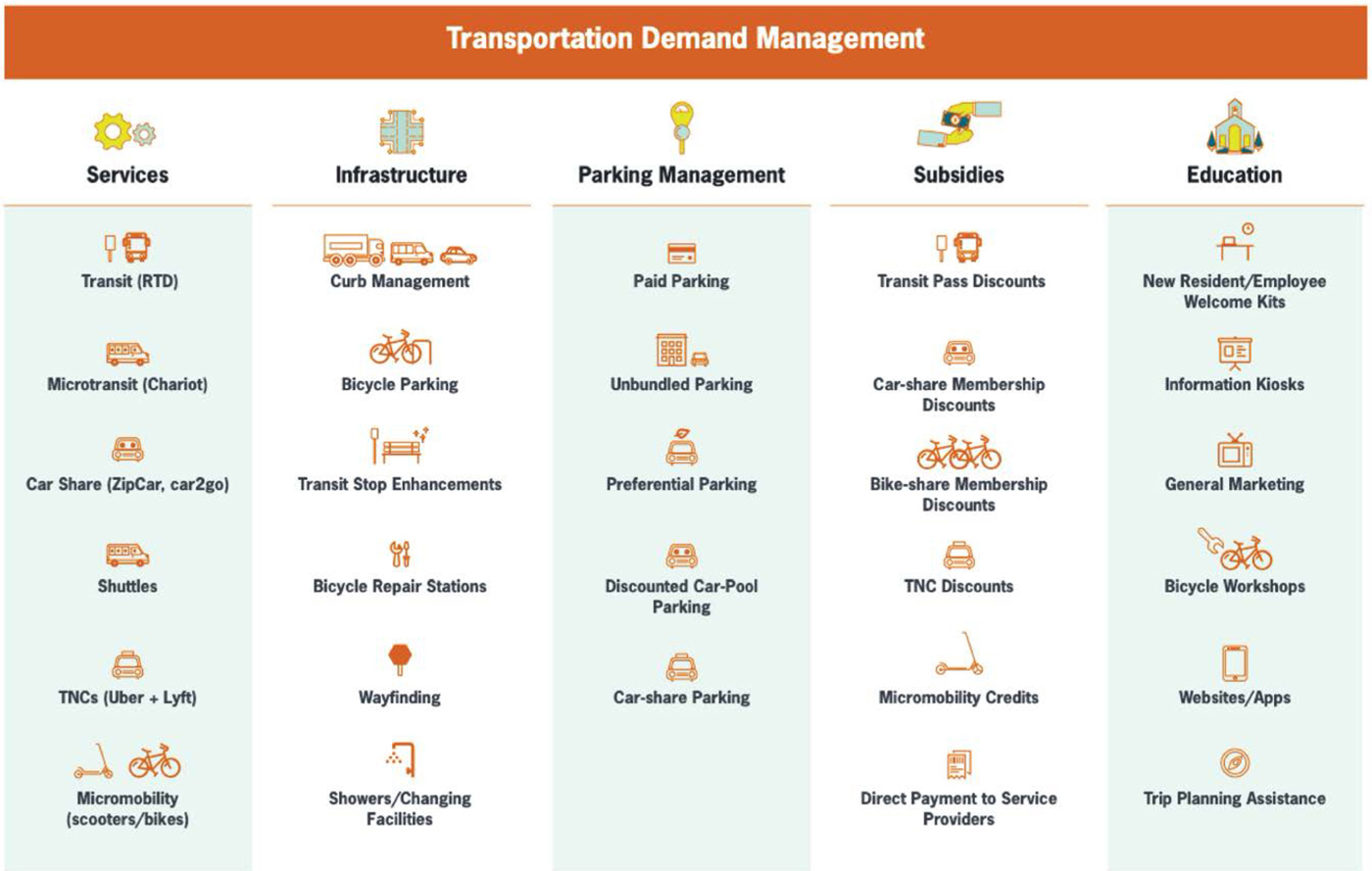
As presented in Figure 4, TDM consists of at least 29 strategies in five main categories, including services, infrastructure, parking management, subsidies, and education. The diversity of available strategies can allow an airport to create a multi-pronged approach to TDM. Rather than attempting to figure out which one strategy will be best, it can be useful to adopt multiple strategies targeting diverse commuting challenges experienced by employees. Employees often have unique transportation challenges, and multiple strategies may be more effective, resulting in greater benefits for all employees. Transportation equity can be better ensured by a comprehensive approach to TDM.
According to Penny (2011), common commute reduction strategies that may be adopted by an airport operator include:
- Public transit passes. Free or discounted passes are attractive to commuters who live near transit stops. Allowing employees to purchase passes with pretax earnings provides an additional benefit.
- Parking cash-out. Employees can choose between a free parking space or money in exchange for utilizing alternative transportation. The actual dollar amount will vary by airport and may be based on cost recovery; however, to be effective, it will be sufficient enough to influence employee behavior.
- Carpools/vanpools. Employees may be more likely to try a carpool or vanpool if the airport operator organizes it.
- Transportation management associations. Depending on the airport operator’s goals and resources available, a TMA may be worthwhile.
- Telecommuting. Telecommuting is an alternative transportation strategy that may work for some employees. In this case, no transportation will be needed.
Airport Transportation Demand Management Considerations
- Managing demand, or TDM, is aimed at reducing congestion by restricting travel demand rather than providing more transportation capacity. Building additional surface lots to accommodate employees commuting via SOV does little to manage demand.
- TDM consists of numerous strategies that may be adopted by airports. A package of solutions will generally be more successful than only one strategy.
Transportation Management Association/Organization
Related to demand management and often created as a result, transportation management associations (TMAs) or transportation management organizations (TMOs) are defined as “an organized group applying carefully selected approaches to facilitating the movement of people and goods within an area” (Mobility Investment Priorities, n.d., para. 1). More fully, “Transportation Management Associations (TMAs) are nonprofit, member-controlled organizations that provide transportation services in a particular area. They are generally public-private partnerships, consisting primarily of area businesses with local government support” (Victoria Transport Policy Institute, n.d., para. 1).
These groups of employers, which may involve the airport and other regional agencies on a wider scale, or the airport operator and airport tenant employers on a narrower scale, work together to solve common transportation issues and pool resources to offer commute services and benefits to member employees. The establishment of a TMA/TMO is a “well-accepted strategy around the world for managing traffic demand” (LAX, 2021). A TMA/TMO can help “reduce traffic, improve air quality, increase options for employees, and reduce Vehicle Miles Traveled… . TMAs can be formed to provide services that are not currently being met by existing transportation agencies and advocacy groups” (Mobility Investment Priorities, n.d., para. 7).
Many TMAs were formed in the 1980s to address the challenges of urban congestion. By “assisting employers with rideshare databases, alternative work schedules, and even lobbying for transportation infrastructure and service improvements” TMAs served a very supportive role as employers and local and regional transportation agencies collaborated to reduce traffic congestion and improve commuting options for employees (Mobility Investment Priorities, n.d., para. 3).
In 2019, Los Angeles World Airports (LAWA) commissioned a study to understand transportation conditions LAX employees face and to explore the establishment of a campus-wide TMO. LAWA requested recommendations on how to improve employee commutes and reduce vehicle miles traveled (VMT). The report’s recommendation was to expand LAWAs existing rideshare program by forming a TMO that would provide alternate commute services to employees, helping them find more convenient, sustainable ways to get to work. Having a campus-wide TMO for all LAX employees will help maximize resources and increase alternate commute options by enabling TMO staff to coordinate and collaborate with employers across the LAX campus. While various employers already offer alternate commute options, the TMO will be a “one-stop shop” for employees across the campus to learn about and sign up for programs such as carpools, vanpools, the FlyAway shuttle service, trip planning, and other services. The TMO will also advocate for new services when coordinating with transit agencies (LAX, 2021).
Transportation Management Coordinators (or Employee Transportation Coordinators) are professionals who work for TMAs or TMOs or individual employers (Victoria Transport Policy Institute, n.d., para. 1).
The Employee Transportation Coordinator (ETC) is the person at a work site responsible for promoting and organizing programs that encourage commuting to and from work via modes other than the single occupant vehicle. The ETC disseminates information about bus and transit schedules and may also sell discounted transit tokens or passes. In addition, the ETC is responsible for carpool and vanpool matching and the promotion of pooling among members of the workforce. This may involve the distribution of
promotional information, answering employee inquiries, and administrative tasks such as preparing bills for vanpool participants. The ETC may also be the person responsible for organizing the employer’s telecommuting program. He or she is often the link between the employment site and regional ridesharing agencies. In short, the ETC is the work site’s expert on commute alternatives (Wachs and Giuliano, 1992, p. 1).
For those employed as transportation management professionals, the Association for Commuter Transportation offers a credentialing program, known as the TDM-Certified Professional (TDM-CP). The program is designed to “recognize a professional’s knowledge of Transportation Demand Management (TDM) and experience in planning, developing, administering, implementing, and evaluating TDM programs and services” (Association for Commuter Transportation, 2021, p. 4).
Airport operators generally have three primary options for a TMA/TMO [as explained by the Denver International Airport Pena Boulevard Mobility Study (n.d.)]:
- Join an existing TMA/TMO. The airport operator could join an existing TMA/TMO and arrange for the development and delivery of the airport’s program. The organization would have an existing board and staff. The airport operator would likely pay an annual membership fee to cover the cost of delivering TDM services at the airport. There are currently more than 140 TMAs in existence in the United States. Other less-known options may also exist, such as joining an existing Community Improvement District (CID). A CID, which may not exist in all circumstances and can be in different forms, is generally a special self-taxing district that collects revenue within its boundaries to provide infrastructure, planning, and management services.
- Create a TMA/TMO. The TMA/TMO could serve the areas “within the fence” or all businesses on airport property. A formal TMA/TMO would be a nonprofit with an independent board. The airport operator and all airport tenant employees would be members of the TMA/TMO. Staff for the TMA/TMO could be hired directly, or service delivery could be outsourced. Funding could come from a combination of grants, membership fees, and payments from the airport.
- Operate an internal program. The airport operator could operate an internal TDM program similar to how it operates other activities, such as parking and associated shuttle services. Employees could be hired to operate the program, or staffing could be outsourced to a third party. Funding could be provided by internal funds, tenant fees, or possible grants.
There are benefits and challenges to each option. No option is best in all situations, requiring the airport operator to fully consider structure, governance, and funding models, as well as the pros and cons of each option. Revenue diversion is to be avoided, to ensure compliance with FAA airport sponsor grant assurances (Texas A&M Transportation Institute, n.d.).
For airports considering the establishment of a TMA/TMO, specific steps are required:
- Identify an Employee Transportation Coordinator. This individual will be responsible for providing transportation information and resources.
- Set up a Transportation Resource hub. Whether online or via written materials, the hub will serve as a single point of information for employees.
- Conduct a site evaluation survey. The survey will identify physical characteristics of the work site, including parking, access, and commuter amenities. For additional information
- Write a commute benefits document. This document will list all commuting benefits and transportation programs that the company has in place.
- Promote alternatives to single-occupant commuting. TMAs reduce the number of vehicles using the transportation systems at their most congested hours: the morning and afternoon commute (Mobility Investment Priorities, n.d., para. 8). TMAs can study and recommend elements for the ECO. A successful ECO offers a variety of options to meet employee commuting needs.
that will aid in developing a sustainable commute program that meets employee needs, consider surveying employees as to their commuting methods.
Once developed, TMAs/TMOs can provide a variety of services that encourage more efficient use of transportation and parking services by employees. Services may include:
- Commuter financial incentives,
- Flextime support,
- Freight transportation management,
- Guaranteed ride-home services,
- Marketing and promotion,
- Parking management and brokerage,
- Pedestrian and bicycle planning,
- Pedways,
- Rideshare matching and vanpool coordination,
- Shared parking coordination,
- Shuttle services,
- Special event transport management,
- Telework support,
- Tourist transport management,
- Transit improvements,
- Transit pass program,
- Transportation access guides,
- Transportation benefit (pretax) withholding, and
- Wayfinding and multimodal navigation tools (Victoria Transport Policy Institute, n.d., para. 3).
For airports planning to establish a TMA/TMO, it is important to undertake a feasibility analysis. By understanding the commuting practices and needs of employees, proper planning can take place to design a TMA/TMO that is most effective. Depending on the number of employees who need to be served, and the unique local and regional challenges to commuting, the necessary planning and subsequent organization of a TMA/TMO can require one year or longer, depending upon staff and available resources.
Financial resources are a key consideration. Startup costs include creating a brand for the TMO, developing a website, creating a rideshare toolkit, purchasing office supplies and outreach materials, and creating a transportation video for new employees. Ongoing fixed costs include staff, administration, office space, marketing, and education. Ongoing variable costs include a guaranteed ride home, a try transit program, and ongoing subsidy programs. Additional costs may include a shuttle operation, for example.
Although startup and ongoing costs may vary significantly by airport, annual budgets can range from $150,000 to more than $1 million. The number of staff dedicated to the TMA/TMO will significantly impact ongoing costs. In developing the budget, the funding source will also need to be considered. “TMOs are typically funded by a combination of membership fees and grants” (LAX, 2021). At LAX, a fee of $10 per employee is charged (capped at $10,000 annually per LAX employer) to fund expanded TMO programming. The TMO fee is expected to generate
$300,000–$400,000 annually (LAX, 2021). The user-fee model adopted by airports such as LAX may be prudent to consider, as tenant employers and their employees will benefit from the TMA/TMO. Cost sharing may be reasonable in light of the benefits to be conveyed.
Airport Transportation Management Association (TMA)/Organization (TMO) Considerations
- Airports can consider a TMA/TMO to more formally collaborate with tenant employers and possibly local/regional agencies to solve common transportation issues and provide commute services and benefits to member employees.
- There are several methods available to create or join a TMA/TMO. With a feasibility analysis, costs can be considered and goals can be established.
- By hiring or appointing an employee transportation coordinator, transportation information and resources can be better developed and disseminated.
Employee Commute Options
Airports that actively seek to address employee commuting needs, typically as an outgrowth of a TMA/TMO, often develop an ECO program. “Employers are increasingly interested in creating commute programs for their employees who are seeking out alternatives to traditional transportation” (Uber, 2023, para. 6). Such programs are defined as a program provided by an employer or a TMA, offering incentives, information, and services to encourage employees to commute to work using alternatives to SOVs. Although tailored to provide benefits to employees to assist in their commuting challenges, Ricard, in 2012, found that “Very few U.S. airport operators provide comprehensive ECO programs for their employees” (Ricard, 2012, p. 55). Fortunately for employees, this is no longer the case. Although ECO are a relatively recent phenomenon in the airport industry, a growing number of airports, recognizing the benefits, are now creating ECO programs.
Airport operators with well-developed and successful ECOs have learned that program management is important. Employing sufficient staff for the ECO can make or break the effort. Expecting one employee to “do it all” is not advisable, as one employee will likely not be able to provide the services expected of all employees, especially for those considering shifting to a more environmentally friendly commuting mode. Due to the complexity of influencing employees to try more sustainable commuting modes, it is in the airport operator’s best interest for the ECO to be fully staffed and capable of providing sufficient resources and information to employees to make a mode shift as easy as possible for employees.
Airports with successful ECOs have also learned to include all airport employers in this effort. Consider the airlines, retail and food and beverage concessionaires, contractors such as janitorial or parking, TSA, etc. Inviting all airport employers into the TMA will produce airport-wide benefits. As shared by Ricard (2012), collective efforts by all airport employers “could include the exchange of ideas on a formal or informal basis, pooling resources to develop initiatives and marketing materials, securing outside resources such as grants, or developing a mechanism for employees to communicate to form carpools and vanpools” (p. 49). “If you offer commuting benefits, take care to avoid charges of discrimination by offering them to employees of all levels who live a certain distance from work” (Bahls, 2005, p. 94).
Los Angeles International Airport (LAX) surveyed airport tenant employers, as part of their 2020 LAX TMO Study, to gauge their level of interest in a TMA/TMO. Employers requested assistance with marketing and communications, programs and services, and advocacy for improved infrastructure and transit services. The study recommended a program consisting of Marketing & Education, Carpool Program, Transit Pass Program, Vanpool Program, Guaranteed Ride Home, and ETC Education & Support (LAX, 2021).
In various localities, “airports are subject to regulations and commitments for which ECOs are either required or are a logical course of action for the airport operator” (Ricard, 2012, p. 3). Many airports often share a goal of shifting airport employees from commuting by SOV to modes that generate fewer vehicle trips per employee (Ricard, 2012, p. 45). “Commuting-related strategies should be considered in [an] employer’s overall strategy for improving job performance. These strategies should aim to promote active commuting and shorten commuting time” (Yilmaz et al., 2023, p. 139).
Of course, to ensure that employees are aware of the options provided by the ECO, a promotional effort that is part of a larger marketing campaign can generate sufficient employee awareness. Indeed, airport operators have discovered that a successful ECO program provides information to employees on a regular basis regarding what transportation modes are available, benefits of choosing certain modes, and how to participate. Airport experience has shown that “ensuring a large pool of employees … helps considerably in forming vanpools and carpools” (LAX, 2021). According to Ricard (2012), information may be produced in a number of ways, as discussed in the following.
- Bilingual communications. Consider the demographic of employees. There may be some employees for which English is not their primary language. Producing information in multiple languages can expand the reach.
- Campaigns with certain slogans. Using a slogan that is clever and easy to remember can be helpful to generate employee interest. For instance, “Join the vanpool to stay cool.”
- Email messages. Sending regular email messages to employees, especially on sign-up deadlines, new services, etc., can be quite helpful, especially for employees who are searching for information on commuting options.
- Employee newsletters. Existing employee newsletters can be used to promote the ECO. Every issue can provide various options for employees commuting, including showcasing various incentives.
- Informational website or intranet site. Whether on an external website or internal intranet site, it can be useful to provide information on alternative commuting options for employees. Including sign-up forms and other resources will provide employees with a one-stop shop to access alternative commuting modes.
- New employee orientation materials. As part of new employee onboarding, commuting options can be shared. This may be the best opportunity to influence employee commuting modes before new employees develop habitual commuting preferences.
- Printed materials. Whether in the form of brochures, posters, pamphlets, or other written materials, employees can often be reached with printed materials.
- Promotional events. Holding a separate event to showcase environmentally friendly commuting options, such as ridesharing, walking, or biking, can generate enthusiasm among employees. Alternatively, showcasing commuting options as part of a health fair, wellness fair, or environmental showcase can be beneficial.
- Social media. With the prevalent use of social media and the desire to reach any employees at an airport with information on the ECO and commuting options, airports may engage with employees on the topic of commuting. Consider the value of developing an online community for the ECO. This can also play a role in reducing any stigma associated with using public transit.
Once materials are produced, they may be distributed in a number of ways. It is important to remember that not all employees work in an office or regularly check email. Reaching employees in all possible work sites and break rooms, such as those in the following list, can ensure greater awareness of ECO options among employees.
- Airline offices
- Airport badging offices
- Break rooms
- Bus stops
- Employee parking lots
- Employee restrooms
- Ramps
- Ticket counters
Singapore International Airport was seeking to improve employee satisfaction with a better commuting experience and reduce costs through automation and more efficient vehicle routing. In partnership with a local commuter van/sedan service, 230 employees now commute via vanpool or carpool each day. Through an app-based platform, employees can request a ride that is either pre-scheduled or on-demand. Riders are ensured guaranteed pickup and arrival times. The van service uses a mixed fleet of six passenger vans and four passenger sedans. The average ride is 26 minutes in duration and is shared with three or four coworkers. Surveys indicate more than 80% of employees using the service rate their commute 4+ out of 5 stars (Rideco, n.d.).
Airport Employee Commute Options Considerations
- Successful ECOs include all employees at the airport, including employees of the airport operator and airport tenants.
- The ECO will need to produce information in multiple formats.
- It is most useful if the ECO considers how best to reach employees by developing a distribution strategy designed to reach employees in numerous venues (work sites) and on all shifts.
Disadvantages of Commuting
Commuting is not without disadvantages. “Commuting has an impact on both the individual and society. Spending an hour in the car or train means losing an hour that could be spent at home or on other activities, but it also means that valuable natural and individual resources are being used up. A car ride in rush hour contributes to traffic congestion, and almost all commuting activities involve the usage of non-renewable natural resources” (Emre and De Spiegeleare, 2021,
p. 2443). As expressed in the literature, “Commuting is one of the activities with the most negative impact on individuals’ satisfaction with their daily lives” (Albert et al. 2019, p. 2457).
Excess commuting is a term that refers to “the difference between the time workers actually spend on their journeys between their usual residence and their place of work and the minimum amount of time that could be spent on such journeys given the spatial configuration of homes and jobs” (Albert et al., 2019, p. 2456). Employees generally make note of the time spent commuting, adding it to the total to determine the actual length of their workday. Longer commutes equate to a longer workday in an employee’s mind.
Additionally, even once the commute is over, the effects may linger. “If people are stuck in traffic for an hour to get to work, they’re not necessarily arriving at work in the best mental state” (Penny, 2011, p. 30). According to Caywood and Rinaca (2021), “Employees rate the commute as the worst part of their day. Miserable commutes do not just lead to rough mornings, they lead to depression, weight gain, costly expenses, and decreased productivity” (p. 107). “But our daily commutes—whether pleasant or aggravating—set the tone for the rest of our workday. Both workers and employers need to give more thought to the impact that the stress of commuting may have on their lives” (Leonard, 2001, p. 27). “Studies say that workplace commuting not only increases the stress level but also creates stress at home, decreased life satisfaction and disruption of social life” (Santhosh, 2015, p. 16). This will resonate with airport leadership that places a high priority on the welfare of employees.
As shared by Emre and De Spiegeleare (2021):
The time spent while commuting is valuable time which could otherwise be spent on other activities. This perceived loss of time might induce stress for the employee, but the commute itself might also cause stress because of frustration with road congestion, delays, overcrowded public transport options or dangers of driving. A commute obviously requires some physical effort, but also requires some cognitive effort in case there is a need to make extensive planning for more complex commutes with multiple vehicle changes. In addition, there is an affective component due to the potential unpleasant feelings that can be triggered by the conditions experienced during the commute (p. 2445).
Ma and Ye (2019) explored whether the employee’s daily commute impacted employee productivity at work. The researchers proposed that employee productivity, defined in terms of “the efficiency of a worker,” may be negatively impacted by a long commute, but could be positively impacted by an active commute, such as bicycling. These researchers discovered that commuting distance is positively associated with the number of employee absence days for health and other reasons. The authors theorize that “Workers with long commutes are more likely to get ill and therefore are more likely absent for health reasons” (Ma and Ye, 2019, p. 134). The authors also propose that “Workers with long commutes receive lower net wages and less leisure time and therefore are more likely absent to avoid the commuting cost and time” (Ma and Ye, 2019, p. 134). “Employees who commute more are also diagnosed with health problems like high cholesterol, neck or back pain and even obesity” (Santhosh, 2015, p. 14). “Commuting behavior has been found to have an impact on worker health and well-being, including psychological problems, increased stress, subjective health, and various measures of well-being” (Gimenez-Nadal et al., 2020, p. 2).
Airport Disadvantages of Commuting Considerations
- Commuting, although necessary, can have significant effects on employee health and work-life balance. Airports will need to consider these effects in an effort to develop programs that reduce the negative impacts of commuting on employees.
- Airports can highlight the negative effects of commuting to encourage employees to choose commuting methods that are not only more sustainable but also less impactful on employee well-being.
Balance of Utility
Why then would employees accept a job that requires a commute? The balance of utility concept states that “commuting costs—monetary, physiological, or other—are offset in the labor or housing market” (Albert et al., 2019, p. 2459). Thus, if an individual accepts a new job with a longer commute, the new job will compensate them in some way to balance utility. This compensation could be in higher income but could also be in more prestige with a more prominent position, or improved residential conditions (such as lower rent, better neighborhoods, or better schools). If all variables are the same with each position, and yet a longer commute is endured, there will be a perceived imbalance of utility, possibly leading to lower morale or reduced employee retention. “Employees spend a considerable amount of time travelling between home and workplace. It creates mental and physical burden and is only chosen if it is either compensated by the job or by a pleasant living environment” (Santhosh, 2015, p. 13).
As Pindek et al. (2023), state, “The negative aspects of the commute are often balanced by the better employment, income, or housing that is made possible by the longer commute - highlighting the tradeoffs that employees must often weigh” (p. 45). As stated by Pindek et al. (2023), “The commute appears to be considered by workers as part of their ‘exchange’ with their employer. This suggests that workers who see their pay as inequitable with their commute could perceive the situation as unjust, and seek to ‘balance the scales’ with their organization by engaging in counterproductive work behaviors. For example, employees may steal time from their organization because they rationalize that their long commute should ‘count’ as part of the time they are giving to their organization” (p. 57). Emre and De Spiegeleare (2021) observed that “long commutes negatively affect the employee’s commitment to the organization and his/her subjective well-being. There are no easy solutions for decreasing the time spent commuting. Switching jobs, moving the company, or moving residence are often not feasible” (p. 2461).
Airport Balance of Utility Considerations
- The balance of utility concept, whether consciously or not, becomes part of the employee decision-making process regarding employment, which can impact employee recruitment and retention at airports.
- Airport operators can proactively partner with airport tenant employers to develop commuting solutions that support the balance of utility.
Me-Time/Benefits of Commuting
Although a large part of the literature indicates the disadvantages of commuting, including the impacts on work-life balance, there is a small group of researchers that point out the benefits of commuting. Commuting “enables employees to combine desirable living conditions with a job of their liking. More generally, physical mobility and transportation capabilities have dramatically increased human potential since the beginning of civilization” (Emre and De Spiegeleare, 2021).
Additionally, the commute may actually enhance work-life balance. “Work-life balance is an important concept that has been studied by many researchers for a long time and it is known to affect absenteeism rates, satisfaction levels, and performance. It refers to the idea that there should be a healthy proportion between the time and energy expenditure on work and non-work activities in life” (Emre and De Spiegeleare, 2021, p. 2450). Similarly, “Well-being is an overall assessment about one’s life and depends on a multitude of factors” (Emre and De Spiegeleare, 2021, p. 2447).
Organizations can be intentional about creating a better work-life balance for employees. “If companies can improve their employees’ work-life balance, they might offset some of the negative consequences of a long commute” (Emre and De Spiegeleare, 2021, p. 2459). “In addition to the eradication of some effects of an unpleasant commute, it would be reasonable to expect improvements in commitment and well-being due to increase levels of flexible work scheduling, increasing control over working time and increased workplace support” (Emre and De Spiegeleare, 2021, p. 2459).
“We argue that employees with a healthy work-life balance can manage the negative effects of commuting better as they are inherently more resourceful when it comes [time] to unwind and recover from work” (Emre and De Spiegeleare, 2021, p. 2445). “Besides providing transition time, a commute can be a gift, because it can supply a much-needed time-out, including from one’s work and family responsibilities” (Pindek et al., 2023, p. 45–46). This concept of the commute being a “gift” certainly may not be a perspective shared by all employees. However, for those who see the benefits of the commute, the “geographical separation of work and private life can also contribute to the mental well-being of employees due to implied detachment from work” (Emre and De Spiegeleare, 2021; Misan and Rudnik, 2015; van Hooff, 2013). Commuting can be used to effectively transition or manage boundaries between the work and home spheres (Jachimowicz et al., 2021, p. 70).
Some employees may also benefit from the “me-time” a commute provides. Although most “still conceptualize the commute as simply a necessary transition between domains (i.e., work and home),” a study by Pindek et al. (2023) considered “me-time” as a benefit to commuting. As defined by the researchers, “Me-time during one’s commute is a unique form of leisure-crafting (i.e., the proactive pursuit and engagement in leisure activities targeted at fulfilling personal needs, such as human connection or personal development)” (Pindek et al., 2023, p. 46). See Table 3 for some examples of me-time activities based on the type of travel mode.
This concept of “me time” can also generate benefits for employers. “Additionally, employers are likely to benefit indirectly from employees’ decisions to engage in ‘me-time’ during their commutes, as the recovery and well-being benefits are likely to spill over into other domains,
Table 3. Examples of me-time activities.
| Activities in Different Travel Modes | |||
|---|---|---|---|
| Need | Solo Car | Public Transportation | Walking/Biking |
| Physiological | Specialized form of isometric exercises Eat/groom | Minor exercise (e.g., walking from home to the bus) Sleep/eat | Exercise |
| Mastery (competence) | Consume information (listening) | Consume information (listening/reading), writing | Consume information (listening) |
| Relatedness | Socializing (over phone or with passenger) | Socializing (phone, messaging, or with other commuters) | Socializing (over phone) |
| Relaxation | Entertainment (music, audiobook/podcast, enjoying the scenery, reflective thought, or daydreaming) | Entertainment (music, book, video, playing games, audiobook/podcast, enjoying the scenery, reflective thought, or daydreaming) | Entertainment (music, audiobook/podcast, enjoying the scenery, reflective thought, or daydreaming) |
Adapted from Pindek et al. (2023).
including work. Accordingly, it’s in the best interest of employers to create conditions that make it easier for employees to secure their ‘me-time’ (rather than continue working during the commute). For instance, supervisors can engage in better boundary practices themselves, and can ensure that employees are not contacted (e.g., via email) after their official ‘workday’ has ended” (Pindek et al., 2023, p. 61).
The possibility of “me-time” varies with the type and duration of the commute. “Different modes of travel for one’s commute (e.g., car, train, biking, walking), the length of the commute, as well as additional commute characteristics (e.g., its predictability, the potential existence of a commuting partner) generate constraints or facilitators for ‘me-time’ during one’s commute” (Pindek et al., 2023, p. 49).
Airport Me-Time and Benefits of Commuting Considerations
- Some employees appreciate the “me-time” aspect of the commute.
- Airports may choose to highlight the benefits of “me-time” that are more possible with certain commuting modes in their effort to influence employee commuting decisions. While commuting via SOV certainly affords “me-time,” other commuting modes do as well.
Active Commuting
Commuting can be via inactive or active means. Active commuting is commuting by walking or bicycling, and this “has both psychological and health benefits, which in turn promote job productivity” (Ma and Ye, 2019; p. 139). “Active commuting helps reduce air pollution, greenhouse gas emissions, and noise – factors that provide healthier environmental contexts to all people in society” (Gimenez-Nadal et al., 2020, p. 2). Ma and Ye (2019) found that “encouraging active commuting not only improves the physical and mental health of employees, but may also enhance their job performance, contributing to economic benefits to employers and society” (p. 139). “Active commuting is specifically associated with reduced cardiovascular disease risk, physical fitness, and weight control in adults” (Yang et al. 2015, p. 213). Research has found that active commuting is perceived as more relaxing and exciting. This process leaves the employee with a better mindset for work than commuting by car and public transportation—both are perceived as being more stressful and boring, leaving the employee with a poor mindset for work (Gatersleben and Uzzell, 2007; Ma and Ye, 2019).
Worldwide, there has been a greater emphasis on more sustainable methods of commuting, including active commuting. “Policy makers around the world aim to promote active commuting to work. Active commuting has a vast potential to generate positive effects on the physical activity— and hence well-being—levels in the general population” (Gimenez-Nadal et al., 2020, p. 1).
Cycling is a particularly attractive means of active commuting to work, because short to medium distances can be covered in an acceptable time period, traffic-related problems can be reduced, and on-site mobility of employees can be facilitated (Gimenez-Nadal et al., 2020, p. 1). E-bikes have also made cycling much less strenuous for commuters. “E-bikes are emerging as a game-changing option that can replace cars for moderate distance urban trips such as 2- to 10-mile commutes. E-bikes are significantly faster than their traditional counterparts, maintaining speeds of 20 mph and sometimes higher. They also significantly reduce the exertion required for pedaling, which allows employees to avoid the need to shower or freshen up afterwards, while still allowing for moderate exercise” (Caywood and Rinaca, 2021, pp. 116–117).
As some airports have discovered, providing showers, lockers, and a safe place to store bicycles can promote active commuting by bicycle. “While many people own bicycles, they are often not used to commute to work for several reasons. The main factors are time constraints, traffic safety concerns, concerns related to distance, concerns about appearance, as well as factors such as the built environment, physical discomfort, and health problems” (Gimenez-Nadal et al., 2020, p. 2).
To encourage bicycling and downplay any stigma, companies have developed events such as a Bike to Work Day, Ride to Work Day, and Bike to Work Breakfast. Events such as these “promote the bicycle as a means of transportation to commute to and from work, and are also examples of good practices. They have a substantial effect on change in human behaviors and their habits” (Biernat et al. 2020, p. 396).
“It is worth arguing that airports need to consider having more specific targets for cycling and walking since the mode-based targets could provide an important goal to work toward” (Yilmaz et al., 2023, p. 47). “Physically active Americans claim that in order to believe and be convinced about the necessity of regular physical activity and integrate it into daily routines, it is necessary to experience the benefits” (Biernat et al., 2020, p. 397).
“Active travel is likely to play a key role considering its health benefits… . Thus, cycling and walking facilities including designated pedestrian routes, cycle lanes, shelters, showers, and lockers could be increased at all airports regardless of size. Likewise, airports could put in place cycling schemes offering tax-/interest-free loans to encourage bike purchases. On top of these, airports could ensure that there are well-developed marketing and information provision initiatives to increase the staff awareness of all existing incentives and promotions available to them” (Yilmaz et al., 2023, p. 48).
Certain active modes of transportation may be perceived as improper or not appropriate for the individual. For instance, in a study by Biernat et al. (2020), 6% of participants stated that it is improper for managers to cycle to work. Likewise, 4% of participants stated it is improper for older people to cycle to work. Thus, when an employee considering using a bike is self-conscious of that method of commuting, or other employees express disappointment in that employee’s mode choice, this obstacle may be strong enough to dissuade that employee from choosing this active commuting strategy. Thus, it is important for airport operators to consider these obstacles in encouraging active alternative commuting modes for employees.
The Heart Foundation has campaigned for governments to support active commuting strategies, including walking and cycling. In a survey by the Heart Foundation and Cycling Promotion Fund, more than 70% of respondents support financial incentives to cycle to work (Messenger, 2014). Airport operators may wish to consider such incentives.
“Despite the benefits of an active commute, walking or biking are incompatible with many activities, including reading, writing, or using a screen. Therefore, there are limits that these commuters can engage in simultaneously” (Pindek et al., 2023, p. 49). Further, despite the benefits of active commuting, “active commuting is not widely practiced in the U.S., where more than 90% of the population use automobiles and less than 10% use other modes of transport, including public transit, walking, and cycling as their usual mode of travel to work” (Yang et al., 2015, p. 213). Ma and Ye (2019) discovered that “Walking, bicycling, and car commuters were more satisfied with their commuting compared with transit commuters” (p. 138). Although their
findings generally support an airport’s goal to reduce trips made by employees in SOVs, their finding that car commuters are generally satisfied with their commute will create a challenge for airports attempting to influence employee commuting behavior.
Airport Active Commuting Considerations
- Airports may choose to highlight the health benefits of active commuting.
- Active commuting is considered a sustainable commuting mode. Thus, airports will need to consider how to best accommodate employees choosing to actively commute (such as bike lockers, showers, etc.).
Influencing Employee Commuting Behavior
Airports seeking to increase employee use of more sustainable transportation modes will likely implement efforts to influence employee commuting behavior. As explained by Yilmaz et al. (2023), “At most international airports, private vehicle use is the dominant form of airport ground access. As such, airport managers and local transport authorities increasingly focus on maximizing the economic opportunity of airport activity [associated primarily with passenger parking] while addressing the associated negative environmental impact. Primarily, this has been through encouraging a change in travel behavior, such as the increased use of public transport, active travel, and car sharing” (p. 40).
Such programs are most successful if they address employee needs. Penny (2011) recommends specific steps to boost morale and gain green points with an alternative transportation plan. Green points may be provided by an employer to reward employees for choosing environmentally friendly commute modes. For example, when an employee chooses greener travel options, such as carpool, vanpool, bus, bike, or telecommute, earned points can be redeemed for restaurant coupons, retailer discounts, and tickets to shows and attractions. Additional steps include:
- Understand local regulations and resources. “The people who coordinate regional public transit would like to get more riders, and if they can capture a whole company’s worth of riders, that’s very cost-effective for them.” “Locations with high levels of air pollution, such as southern California and Houston, may offer alternative transportation assistance through a local or regional air quality management agency as part of their efforts to reduce smog.”
- Narrow your focus. “Start by finding out how employees currently get to work” “Once you’ve narrowed your focus to a few potential projects, you can start running the numbers to determine which are the most feasible.”
- Answer the cost question. “Start by unbundling parking.” Unbundling is a critical TDM measure. By unbundling the cost of parking from the employee’s paycheck, the true cost of driving is experienced, possibly leading more employees to choose sustainable options, such as light rail, bus, walking, bicycling, or carpooling. “Alternatively, you can present employees with a choice between a free parking space or a cash incentive to use some other form of transportation, a practice commonly called ‘parking cashout?’”
- Measure your success. “The most basic measurement you should take on a regular basis is an annual survey asking how employees get to work. Compare the results with the initial survey you took before implementing alternative transportation measures. The comparison will show whether there has been a significant shift away from driving to work in single-occupancy vehicles.”
In 2015, a group of researchers developed some employee intervention strategies at an unnamed European airport to influence employee commuting behavior. First, the researchers sent letters to 15,000 employees encouraging them to sign up for their airport’s existing private carpool program. The program matched employees living in the same area and provided benefits that would make carpooling seem more appealing, such as priority parking and a free 24/7 emergency ride-home service. Fewer than 100 employees actually signed up for the carpool service. Second, the researchers conducted two additional experiments with a total of 7,500 employees. In the first experiment, the researchers were curious if providing one week of free bus tickets would increase the purchase of discounted transit passes. In the second experiment, researchers followed up with employees who had not used the free bus tickets and reminded them they were leaving money on the table. Neither of these strategies had an effect on the use of transit passes. Finally, in another experiment with more than 1,000 employees, researchers evaluated the impact of customized pamphlets that promoted the different ways employees could commute to work to save both time and money. There was no effect on reducing SOV use (Kristal and Whillans, 2019).
Kristal and Whillans (2019) point out three primary reasons for failed interventions:
- Employees did not have to bear the full financial cost of car commuting.
- Taking transit or carpooling can benefit society, but it is often less convenient for an individual commuter.
- These approaches required changing a habitual behavior, which is notoriously difficult to change.
As airport operators consider influencing employee commuting behavior, Kristal and Whillans (2019) suggest the following options for altering habitual commuting behavior:
- Make the full cost of driving salient for employees. Avoid subsidizing parking or other infrastructure that masks the full cost of driving to work alone.
- Make driving harder and make other forms of commuting easier. By making driving and parking less convenient, you can enhance the convenience, safety, comfort, and cost savings of other modes like carpooling. More substantial cash and non-cash incentives could also be used to motivate riders to shift their commuting behavior from driving alone.
- Change the default work arrangement. You can also change the norm by letting employees only park at work three out of five days per week, and/or allowing them to work from home or work from anywhere, so they commute to the office less often.
- Think about timing. Because people are more likely to change their commuting behavior when they move or start a new job, or when there is a serious disruption that forces them to temporarily abandon their habits, these are the times when employers could try using behaviorally informed messaging and light-touch incentives—that is, incentives that are easy to convey.
Airport management can most effectively influence employee commuting behavior by understanding why they choose specific modes. “Understanding the key variables that determine access mode choice decisions is subsequently of key significance to airport authorities and transportation managers. These implications include, but are not limited to, revenue from car parking and surface transportation services, determination of strategies and capacity requirements to reduce the share of trips made by private automobile, capital expenditure, and development of landside facilities” (Alkaabi, 2016, p. 577–578). “It could be claimed that the best approach would be balanced parking management, which consider both the staff relations (retention and recruitment) and environmental sustainability goals of airports” (Yilmaz et al., 2023, p. 48). Yet this balance can be difficult to achieve in some circumstances.
Airport Influencing Employee Commuting Behavior Considerations
- Attempts to influence employee commuting behavior are not without risks.
- Understanding how employees currently commute and establishing goals for employee commuting will stimulate airport considerations about how to most effectively influence employee commuting behavior toward more sustainable modes.
- It is important to consider why intervention strategies commonly fail, to ensure the best success.
Incentives and Disincentives
To alter employee commuting behavior, adopting a series of incentives or disincentives is important. Without actions to persuade or dissuade employees, airports cannot expect employees to change commuting behavior simply to “try something new.” Humans are creatures of habit, and changes can be difficult. Airport operators can adopt measures to stimulate a desired change in employee behavior.
Airport operators may adopt various incentives that may motivate employees to transition from SOV commuting to more environmentally friendly alternatives. As shared by Yilmaz et al. (2023), “Providing staff with information, raising their awareness of available sustainable transport options, offering discounted tickets, travel cards, cycle and car sharing schemes, and marketing of new developed and improved sustainable transport facilities were highlighted as among the most important priorities to ensure that employees can make an informed decision in favor of more sustainable mobility” (Yilmaz et al., 2023, p. 46).
Airport operators may also adopt various measures to dissuade certain employee behaviors. Such disincentives are designed to deter employees from choosing certain modes of transportation, such as SOV. Some options for disincentives include:
- Parking pricing. Although airport parking is generally free or priced substantially less than the cost of providing the space, parking rates for employees could be assessed or increased to create a financial burden for employees who choose to commute using an SOV. Ricard (2012) suggests that one approach is to “set the monthly price of parking equal to or greater than that average cost of a monthly public transit pass” (p. 48). Of course, the airport will need to consider employees who carpool and still need to park their cars in employee parking. Carpool spots or differential parking could possibly be arranged to encourage carpools.
- Parking location. Although some airports may have convenient employee parking, others have provided employee parking at a satellite location, requiring employees to take a bus or shuttle to access their work site in the airport terminal. Many employees will endure what is collectively called the “second commute,” which includes waiting at a shelter for a bus, for the privilege of driving their SOV to work. Airports desiring to disincentivize the SOV may consider creating convenient parking spots for vanpools or carpools, even eliminating the second commute, by providing parking adjacent to the work site (Ricard, 2012, p. 48).
In addition to a framework of incentives and disincentives, airports actively engaged in influencing employee commuting practices consider various support strategies. This requires the airport operator, typically through an ECO, to provide reasonable commuting options to employees. It also requires regular support of those employees who choose to alter their commuting practices in line
with airport preferences. The goal is not only to influence employee commuting behavior but to affirm their continued use of alternative commuting modes. Options include:
- Ride-matching services. Airports encouraging employees to use carpools and vanpools have learned it is necessary to provide a service to employees assisting them in their being matched with the appropriate carpool or vanpool. Serving as a sort of clearinghouse for such shared-ride services can be very useful to employees.
- Guaranteed ride home/emergency ride home. Employees may occasionally be asked by their employer to stay late to cover a needed shift that may end past public transit operating hours. Employees may need to leave due to a family emergency during the middle of their shift, such as picking up a sick child from school. In those cases, the employees may miss their scheduled carpool, vanpool, or public transit. Guaranteeing employees a ride home or an emergency ride home can ease the anxiety associated with forgoing the convenience of an SOV. Depending on the arrangement, employees may be limited in the number of guaranteed ride homes or emergency ride homes each month, quarter, or year. This prevents abuse of this alternative.
- Preferential parking for carpools and vanpools. By providing more convenient parking for carpools and vanpools, the second commute may be completely eliminated, thus greatly enhancing the benefits of commuting via carpool or vanpool.
- Transportation for midday trips. Occasionally, employees may prefer to travel off-site for lunch or to run some errands. This may not be possible for the employee commuting via alternative methods. However, the airport can make transportation available for these trips, such as van service to the local mall during the lunch hour.
- On-site amenities. Airports providing an on-site daycare, dry cleaner, and gym not only enhance employee recruitment and retention but also provide services for employees choosing to commute via alternative modes.
- Commuting by bicycle. Not all employees live within a reasonable distance from the airport, such that commuting by bicycle is a reasonable option; however, for those who do, providing bicycle infrastructure is important. Consider bike racks and secure bicycle parking facilities, safe bicycle routes on airport property, showers and locker facilities, and even financial support for employees who would like to purchase a bicycle for their commute. Some employees may use a bicycle for their second commute, such as from the nearest bus station to their work site at the airport (Ricard, 2012, pp. 47–48).
Employees benefit when the airport considers the financial burden of commuting. “Using mass transit can save a commuter not only the frustration of driving, but also provide more take-home money. Transit, qualified parking expenses, and some multi-passenger vehicles are eligible for some relief under the provisions of the Internal Revenue Code Section 132. It enables employers to offer employees the opportunity to use pretax earnings to cover certain public transportation costs” (“Mastering Management,” 2006, p. 62).
Airport Incentives and Disincentives Considerations
- Influencing employee commuting behavior is most effective with appropriate incentives and/or disincentives.
- Reasonable commuting options will need to be in place before adopting a framework of incentives or disincentives. In other words, if employees are willing to consider commuting via more sustainable modes, ensure that employees will have access to these alternative modes sufficient to meet potential demand.
Employee Recruitment and Retention
Airports continue to confront a changing workforce landscape. As airport operators and airport tenant employers focus on employee retention, as well as recruiting qualified candidates to fill vacancies, it is important to consider the preferences of candidates in the job pool.
Best Workplaces for Commuters is a site that “promotes environmentally friendly commuting by encouraging multimodal transportation and alternatives to reduce stress and traffic congestion. Best Workplaces for Commuters demonstrates that options for commuting, such as transit, carpools, vanpools, and teleworking are economically and environmentally beneficial, yielding value to workers, employers, and our communities” (Best Workplaces for Commuters, 2023, para. 1). If an airport or tenant employer is ranked by Best Workplaces for Commuters, employee recruitment will likely benefit.
Generally, on initial acceptance of an airport job offer, the new employee may not truly consider the commute. “Workers take the job thinking they can make it work. They think they’ll figure out the transportation system, but they don’t, and they find out how expensive it is and they quit. Well, that’s a burden on employers who have to pay for federal background checks, badging, and training for each new hire” (Yamanouchi, 2018, para. 13). If new employees encounter commuting challenges, they may consider resigning, which creates retention issues with the employer. This can lead to higher recruiting and onboarding costs, as positions must be advertised, employees screened, and so on.
According to a 2018 study conducted by human resources consulting firm Robert Half, 23% of workers have quit a job because of a bad commute (Hess, 2018, para. 5). In 2020, four times more employees cited commuting as a reason for quitting than in 2010. The resulting employee turnover is a costly problem, as vacancies need to be made up by other employees, which creates more strain in the workplace. Considering factors like recruiting expenses, loss of expertise, and time loss due to retraining, “the average cost of replacing a single employee is 30% of that employee’s salary” (Caywood and Rinaca, 2021, p. 108). The commuting experiences of employees can have an impact on employee retention, as well as recruitment. “Employers are reaching farther and farther out [geographically] for talent, which means many workers are adding two hours to their workday as a result of their commute. This is yet another challenge for employers and their workers to develop commuting strategies that strike a balance between work and life issues” (Leonard, 2001, p. 27).
Transportation equity in the workplace is an important consideration when focusing on employee recruitment and retention. Simply, equity in the workplace concerns “ensuring all employees access the same opportunities, resources, and treatment. Equity means employees are valued based on their skills, knowledge, and abilities in a workplace, rather than their characteristics” (Long, 2023). Related to commuting, transportation equity involves ensuring all employees (regardless of employer, pay scale, location of work site, shift start/end times, etc.) have access to the same transportation options to enable a commute to the airport. Airport operators will need to ensure that a circumstance is not created whereby only certain employees have access to specific commuting options. Consider, for example, why a barista would choose to work at the airport coffee shop rather than a coffee shop several miles away. Are more developed commuting options provided for those working at the airport? If so, the airport will be in a better position to hire quality employees, benefiting the airport operator and airport tenant employers. If not, employee recruitment and retention will be negatively impacted.
At Hartsfield-Jackson Atlanta International Airport, transportation equity is a concern. For instance, employees working at the airport’s south-side cargo facilities have no access to this work site without a vehicle. It is not served by
any form of transit. As a result, employers located at the south-side cargo facilities have encountered significant staffing challenges, as not all individuals own or have access to a vehicle. For instance, at one point, Swissport had 500 vacant positions, and as a ground handler for Amazon Air was unable to service additional aircraft operations planned by Amazon. Thus, commuting challenges not only impact employee recruitment and retention but also airport operations.
As Dauth and Haller (2020) explain, “Commuting is a necessary evil that allows individuals to choose housing according to their preferences even if it is not located right where the best fitting jobs are - or vice versa. This advantage usually comes at a cost: Since time spent for commuting is usually neither productive nor recreative, each additional kilometer of commuting reduces an individual’s utility” (p. 1). Crawley (2014) found that “commuting time has a negative impact on job satisfaction regardless of the mode of transport used, with the exception of workers with higher incomes” (p. 1275). In the study by Pindek et al. (2023), “When asked what their ideal commuting time would be, most individuals chose a travel time of 30 minutes or less” (pp. 49–50).
Even with various commuting challenges, employees generally exhibit some commitment to their employer. The concept of “organizational commitment” refers to “the attachment of the employee to the organization” (Emre and De Spiegeleare, 2021, p. 2446). As airport operators plan for succession and adopt strategies to retain the current workforce, an employee’s strength of identity with the airport and their current employer is an important element of retention. Commitment contains three distinct elements:
- Affective commitment. Refers to the emotional attachment the employee feels to their organization, meaning they can identify with it personally.
- Normative commitment. Refers to the feelings of obligation to remain in the organization. Employees feel they owe the company their loyalty.
- Continuance commitment. Refers to the situation in which employees are committed to their organization because they fear the consequences and costs related to an exit from the organization (Emre and De Spiegeleare, 2021, p. 2446).
“Commuting constantly demands energy and time from employees and leaves the individual short on resources to cope with the demands. By losing the ability to cope with the demands, employees will reduce the level of obligation towards the organization and thus their commitment will suffer” (Emre and De Spiegeleare, 2021, p. 2449). Assuming all employees will remain committed to the organization, regardless of commuting challenges, is shortsighted.
It is in the best interest of airport management to stimulate organizational commitment, which will enhance employee retention. Although many variables impact organizational commitment, commuting options can play a role. Alternatives in the list below may impact organizational commitment.
- Subsidies. Employers may subsidize all, or in part, the cost for employees to commute by public transportation, ridesharing, or other environmentally friendly modes. Oftentimes a subsidy may make all the difference for employees, especially for those employees finding the costs of commuting to represent a large share of their monthly expenses (to include fuel for a vehicle, insurance, etc.).
- Vanpools. Shared-ride vans are provided by the airport operator, program sponsor, regional transit agency, or other provider. The costs for leasing and maintenance, insurance, and fuel may be paid for by the airport operator or program sponsor. Typically, there are monthly fees,
- Pretax earnings. Employees may pay their portion of costs for public transportation van-pools or other preferred modes of commuting via pretax earnings.
- Transportation discounts. Providing employees with a discount on full-fare public transportation or privately operated vans or buses can generate more employee participation.
- Parking cash-out. The employee may be provided with cash to pay for parking or take an alternative mode of transportation to the SOV. This degree of “cash-out” may be the financial incentive that alters employee commuting behavior, as drivers of SOVs would not receive any “cash-out.”
-
Work schedules.
- Telecommuting. Employees in positions that lend well to telecommuting can avoid commuting and work from home. This work arrangement reduces the number of employees who commute, thereby having an immediate impact on roadway congestion and the environment without the need to alter employee commuting behavior.
- Compressed Work Week. Some airports have discovered benefits in requiring employees to work longer shifts, thereby compressing a 40-hour work week into four days, for example. The City of Riverside, California, operator of Riverside Municipal Airport, allows employees to work a 9–80 schedule, meaning that 80 hours are worked by employees in 9 days, resulting in an extra day off every 2 weeks.
- Flextime. With a flexible schedule, employees can alter the start and end time of shifts to better coincide with the availability of public transit or vanpool availability.
-
Rewards.
- Cash. Employees can be paid a cash bonus for selecting an alternative commuting method. Depending on the structure of the cash reward program, employees may be provided a monthly stipend to commute via preferred modes a certain number of days per month or may be provided a cash stipend per day when an alternative commuting mode is used.
- Paid Leave. Employees are rewarded with paid vacation time depending on the number of days an alternative commuting mode was used.
- Goods and Services. Awarding points to employees for each day they utilize an alternative commuting mode allows these employees to redeem points for goods or services, such as branded airport merchandise.
- Drawings. Employees utilizing alternative modes of commuting are entered into monthly drawings for prizes (Ricard, 2012, pp. 45–47).
which may be completely paid or partially subsidized by the employer. The critical link for a successful vanpool is providing ride-match services. A guaranteed ride home (for employees working overtime or on late shift outside normal vanpool operating hours) may also be included.
In addition to these commuting options alternatives, some airports have learned that “branding” can be effective in employee recruitment and retention. Creating a brand that focuses on the customer and employee experience can generate pride among both customers and employees. Creating branded “swag” including shirts, keychains, and lunch bags can also stimulate employee commitment and devotion to both the airport operator and their employer. An additional benefit will be to create a “buzz” about working at the airport, aiding in recruiting efforts by the airport operator and tenant employers.
Research by Alkaabi (2016) at Dubai International Airport discovered factors that encourage employees to use alternative commuting modes, as presented in Table 4.
To gauge the success of various initiatives to reduce employee commuting via traditional modes, Penny (2011) recommends specific performance metrics:
- Awareness. The percentage of potential users who are aware of the program
- Response. How many people respond to your outreach efforts
Table 4. Factors that encourage public transit among Dubai International Airport employees.
| Factors That Encourage Airport Workers to Use Public Transport for Their Journey to Work | Percentage of Responses | Factors That Discourage Airport Employees from Driving Their Car to Work | Percentage of Responses |
|---|---|---|---|
| Discount tickets/passes available at work | 32.8% | Quicker journey by alternative mode | 27.3% |
| Information on public transport, to help me establish the most convenient route to work | 16.6% | Cheaper journey by alternative mode | 18.7% |
| Availability of transport at work to enable me to carry out my duties | 17.8% | Easier journey by alternative mode | 18.3% |
| Others | 3.4% | Airport policy | 12.5% |
| Nothing | 29.4% | Health considerations | 8.0% |
| Social conscience/peer pressure | 6.6% | ||
| Lack of airport car parking space | 8.6% |
Source: Alkaabi, 2016
- Participation. How many people use your transportation services or alternative modes of commuting
- Utilization. The number or portion of trips using a travel service or alternative mode
- Mode split. The percentage of travelers using each transportation mode offered
- Mode shift. The number or percentage of single-occupant automobile trips that have shifted to other modes of transportation
- Average vehicle occupancy. The number of people traveling in private vehicles, divided by the number of private vehicle trips (this excludes public transit users and walkers)
- Average vehicle ridership. All trips divided by the number of private vehicle trips
- Vehicle trips or peak-period vehicle trips. The number of private vehicles arriving at a destination
- Vehicle trip reduction. The number or percentage of vehicles removed from traffic
- Vehicle miles of travel reduced. The number of trips reduced multiplied by the average trip length
- Energy and emissions reductions. The estimated reduction of vehicle emissions, calculated by multiplying the vehicle miles of travel reduced by the average vehicle energy consumption and emission rates
- Cost per unit of reduction. A measure of cost-effectiveness calculated by dividing program costs by a common unit of change, such as cents per trip reduced or tons of air pollution avoided
Clearly, adopting detailed metrics such as these requires regular data collection from employees. Airports active in this regard commonly survey employees and employers annually or biannually.
Airport Employee Recruitment and Retention Considerations
- Commuting challenges experienced by employees can be so significant as to drastically impact the recruitment and retention of employees of the airport operator and tenant employers.
- Transportation equity is an important consideration for airports, especially as some airports may not be adequately connected to public transit, lack parking spaces, or are otherwise impacted. Strive to ensure that all employees have access to the same or similar transportation opportunities and resources.
- Consider employee commitment and strategies to enhance this commitment, including subsidies, rewards, and other enticements.
Challenges in Providing Commuting Options
Airports encounter challenges in influencing employee commuting behavior and providing reasonable alternatives to the traditional SOV commute. These challenges, as highlighted by Ricard (2012), are discussed per mode.
- Public transportation system. In many cities, public transportation is only used by a minority of airport workers. This is often due to three main issues: (1) insufficient hours of operation to meet all airport employee work schedules, (2) insufficient geographic route coverage to either airport employees’ residences or the airport itself, and (3) lengthy commutes with multiple transfers.
- Employee parking. Although airports may require employees working at the airport to pay for parking, oftentimes, airport parking fees are subsidized by their employer. This serves to encourage commuting by single-occupant vehicle, rather than discourage it. Further, airports have limitations to employee parking that employees may not understand because visually, they may think, “Plenty of parking is available to park my car, so why would I commute any other way?” Airports may consider several options to overcome the challenge presented by many employees parking or inexpensive employee parking.
- Employee participation. A challenge faced by airports is the lack of employee participation in ECO programs. Employees may be unaware of the program, not interested in program elements, or feel that incentives or disincentives are not significant enough to alter their preferred mode of commuting. To enhance employee participation, airports may consider how to better promote the program, but also better understand why employees are not interested. Is it due to lack of promotion or, on the other hand, are employees fully informed but not interested due to comfort with their current commuting mode and perceived insufficient benefits to changing modes? Either way, the program can be revised to better meet the needs of employees in hopes of better employee participation.
- Employer participation. Airport tenants, including airlines, concessionaires, and the FAA/TSA, may offer their own ECO. It is important for the airport to interact with these employers to collaborate on airport-wide efforts to influence employee commuting choices. If not, various programs may be striving for opposing goals. For example, if the airport increases employee parking rates in an attempt to discourage commuting by SOV, but the airlines increase their subsidy of these increased rates, it will have no effect on employee commuting behavior.
- Data availability. Understanding employee commuting challenges (and developing appropriate solutions) requires regular data collection. For example, what percentage of employees travel to work via the light-rail system, as opposed to bicycling? If these attributes are not known, the airport will find it challenging to develop an effective ECO. Consider employer and employee surveys that gather data on the number of employees, employee commuting mode, employee distance from work and commute duration, number of vehicle trips, parking preference, etc. Without accurate data on employees regarding their commuting practices, the airport will be at a disadvantage in developing an ECO to influence employee commuting behavior. It is difficult to influence behavior you know nothing about.
- Funding. The ECO, to be effective, will need to be adequately funded—in terms of staff and programming—to support alternative commuting modes for employees. A cost recovery model may be adopted, requiring airport tenant employers to share in the cost. Although financial assistance may be available at the local, regional, state, or federal level to support the ECO, airports will need to avoid revenue diversion. Revenue diversion is prohibited at federal-obligated airports by FAA Grant Assurance 24, Airport Revenues:
All revenues generated by the airport and any local taxes on aviation fuel established after December 30, 1987, will be expended by it for the capital or operating costs of the airport; the local airport system; or other local facilities which are owned or operated by the owner or operator of the airport and which are directly and substantially related to the actual air transportation of passengers or property; or for noise mitigation purposes on or off the airport.
In essence, federally obligated airports are not permitted to divert airport revenues to a regional transit agency, for example, even if the goal is to provide commuting options for employees. It will be important to avoid such instances of revenue diversion, while at the same time ensuring proper funding for the ECO.
Airport Challenges in Providing Commuting Options Considerations
- Challenges in providing commuting options for employees are numerous.
- Attempting to immediately address all challenges can be frustrating for the airport.
- By surveying all employees at the airport to better understand the most common commuting challenges, the airport can begin addressing these first.
- Consider low-hanging fruit (i.e., commuting options that can be implemented with minimal cost).
Summary
The literature addresses many different areas of the employee commuting dilemma, recognizing that there are some drawbacks as well as benefits to commuting via various modes. The key is for airport leadership to understand why employees at their airport choose certain modes. By doing so, alternative methods can be developed with appropriate incentives or disincentives to influence employee commuting behavior away from traditional modes—which can produce benefits for the airport, community, and environment.


