Exploring Airport Employee Commuting and Transportation Needs (2024)
Chapter: 5 Case Examples

CHAPTER 5
Case Examples
Certainly, employee commuting is not a significant issue at all airports across the country. As part of the work conducted for this synthesis, many airports were contacted that had plenty of parking and minimal employee commuting challenges. To provide the most value for the reader, a decision was made in developing these case examples to highlight airports with large numbers of employees and known employee commuting challenges. Although some of the airports highlighted in these case examples are more advanced in their approach to solving employee commuting challenges, each has unique issues and solutions that will be insightful to the reader. Case examples are presented alphabetically by three-letter Airport ID.
Case Example 1: Hartsfield-Jackson Atlanta International Airport
The Hartsfield-Jackson Atlanta International Airport (ATL) is “Georgia’s largest employer, with more than 63,000 airline, ground transportation, concessionaire, security, federal government, City of Atlanta, and various airport tenant employees” (Development Authority of Clayton County, n.d., para. 1). To develop airport-focused transportation solutions for their employees, ATL partnered with UrbanTrans, a transportation planning and behavior change firm that specializes in transportation demand management.
The ATL Transportation Management Association (TMA) is one of several in the greater Atlanta area that partners with one or more Community Improvement Districts (CIDs). Specifically, the ATL TMA is linked to the ATL Airport CID, which is also a part of the Atlanta Regional Commission, which is a regional planning and intergovernmental coordination agency for the 11-county Atlanta region. In Georgia, a CID is a special self-taxing district that collects revenue within its boundaries to provide infrastructure, planning, and management services. In sum, the greater Atlanta area prioritizes transportation planning, mobility, and workforce development, and the airport has been at the leading edge of developing regional solutions to a number of challenging issues.
- MARTA (Metropolitan Atlanta Rapid Transit Authority) does not operate 24/7, as the airport does; thus, operating times may not serve employees scheduled for early-morning and late-evening shifts. Additionally, ATL is located seven miles south of Atlanta and is the southernmost station of the MARTA system. Due to the cost of living in the greater Atlanta area and wages earned for some airport employment, there are a number of airport employees who live south of the airport, effectively out of reach by the MARTA system and potentially airport employment.
- Employees may experience transportation challenges in the first and last mile of the employee commute (commonly known as the second commute). For instance, employees working at the airport’s south-side cargo facilities have no access to this work site without a vehicle. It is not served by any form of transit. As a result, these employers have encountered significant staffing challenges, as not all individuals own or have access to a vehicle.
| Case | Airport ID | Airport | Location | Sponsor | Total Employees | TMA/TMO | Structure | Website |
|---|---|---|---|---|---|---|---|---|
| 1 | ATL | Hartsfield - Jackson Atlanta International Airport | Atlanta, Georgia | City of Atlanta | 63,000 | Yes, CID linked | Aero | https://joinaero.com/ |
| 2 | BOS | General Edward Lawrence Logan International Airport | Boston, Massachusetts | Massachusetts Port Authority | 20,000 | Yes | Logan Express, Sunrise Shuttle | https://www.massport.com/logan-airport/getting-to-logan/logan-express |
| 3 | DCA | Ronald Reagan Washington National Airport | Washington, DC | Metropolitan Washington Airports Authority | 21,000 | No | Vanpool, airlines pay employee parking permit fee | https://www.mwaa.com/business/reagan-employee-parking |
| 4 | DEN | Denver International Airport | Denver, Colorado | City of Denver | 40,000 | Yes | Vanpool, EcoPass, guaranteed ride home, shuttles, etc. | https://www.flydenver.com/app/uploads/2024/02/DEN_TDM_Plan.pdf https://www.rtd-denver.com/fares-passes/pass-programs/ecopass |
| 5 | LAX | Los Angeles International Airport | Los Angeles, California | Los Angeles World Airports | 50,000 | Yes | commuteLAX, including vanpool, bike lockers, etc. | https://www.lawa.org/commutelax/transit |
| 6 | PDX | Portland International Airport | Portland, Oregon | Port of Portland | 10,500 | No | Cap on number of parking spots, free shuttle, mixed path connecting to bicycle/pedestrian network | https://www.flypdx.com/PDXEmployeeparking |
| 7 | SEA | Seattle-Tacoma International Airport | Seattle, Washington | Port of Seattle | 24,000 | Yes | Bike racks, waiting list for employee parking, sustainable funding model | https://info.myorca.com/using-orca/ https://www.portseattle.org/employee-services/airport-employee-parking |
| 8 | SFO | San Francisco International Airport | San Francisco, California | City and County of San Francisco | 46,000 | Yes | Go>SFO Shuttle, bike lanes that connect to the Bay Trail, designated bike parking | https://www.sfoconnect.com/gosfo-shuttle https://mtc.ca.gov/operations/regional-trails-parks/san-francisco-bay-trail |
Aero, formerly an acronym for Airport Employee Ride Options, was developed to address these and other challenges. A program of the ATL Airport Community Improvement Districts, Aero was created almost 10 years ago, Aero’s main goal is to “help ATL airport employees find reliable and rewarding ways to get to work.” This is accomplished through encouragement, information, and education. The Aero website contains a number of resources, including a five-step plan that will help employees “find a better way to get to work” By signing up via text message or email, employees can learn how to:
- Cut their gas and parking costs in half,
- Earn points (like a frequent flier program),
- Get a $150 cash reward,
- Turn their trip to work into a new side hustle, and
- Get to work without a car.
In partnership with airport tenants, Aero provides promotional materials for employees to share during new employee onboarding. Additionally, Aero encourages employers to provide commuter benefits such as pretax and subsidized commuter options. “Solving the region’s transportation challenges, including those experienced by the Airport’s employees, requires a partnership among all employers with innovative solutions being adopted” (K. Luten, personal communication, January 17, 2024).
The ATL TMA remains active in understanding the current transportation challenges of employees in hopes of developing future solutions that enhance transportation options for an even larger percentage of the airport workforce. All airport employees are electronically surveyed biannually regarding commuting patterns and transportation concerns and preferences, as well as interviewed monthly as they pass through security (K. Luten, personal communication, January 17, 2024).
Case Example 2: General Edward Lawrence Logan Boston International Airport
Located only 1 mile east of downtown Boston, Massachusetts, General Edward Lawrence Logan Boston International Airport (BOS) is owned and operated by the Massachusetts Port Authority (Massport). Approximately 20,000 employees commute to work at the airport. Of these 20,000 employees, approximately 1,000 work for the airport itself and are employed by Massport. Every two years, Massport surveys their own employees to better understand their commuting behavior. Currently, 70% of these employees drive SOVs to work, while 30% use public transit or work from home. Massport, in an effort to encourage alternative transportation use among employees, has recently increased the subsidy for commuting from $100 to $300 monthly.
“COVID certainly impacted employee commuting habits. There was a clear shift during the COVID pandemic toward SOV for life safety reasons. Although the economy-wide shutdowns are essentially over, employees have become comfortable with using SOV; thus, the long-term impacts of COVID on employee commuting behavior remain” (S. Lee, personal communication, February 2, 2024). Today, for example, BOS has fewer employees than pre-COVID, but greater demand for parking permits.
Due to a Massachusetts state law that stems from the federal Clean Air Act, the airport has limited airport employee parking spots to 2,250 (known as the Logan Airport Parking Freeze Area). Due to shift work, approximately 5,000 employees are able to park at the airport in those 2,250 spots. Additional employee parking is available off-airport, which requires employees using these sites to take a shuttle to the terminal. Additionally, Massport operates four suburban Park-and-Ride locations located strategically at various points just outside the I-95 beltway.
At each of these locations, employees can drive to the Park and Ride and then board a bus for transit to the airport. An in-urban bus service is provided as well.
In total, 7,000 employee parking permits are active for both on-airport and off-airport employee parking. With a total of 20,000 employees, not all employees are able to park a vehicle in close proximity to the airport. This has the effect of encouraging (through a disincentive of insufficient parking spots) employees to consider alternative transportation modes.
The BOS Transportation Management Association (TMA), which has been in existence for several decades, assists employees with not only considering alternative transportation modes but also taking advantage of these modes. For example, Logan Express is one product of the TMA. Logan Express is a free bus service operated by Massport that connects Back Bay, Braintree, Framingham, Peabody, and Woburn to the airport. Sunrise Shuttle was also created by the TMA. Designed for airport employees who need to commute to the airport before MBTA’s (Massachusetts Bay Transportation Authority) operating hours begin, the shuttle bus operates from 3 a.m. to 5:30 a.m., making stops at Day Square, Eagle Hill, Central Square, and Maverick Square in East Boston, as well as all airport terminals. The 18-passenger shuttles operate every 30 minutes. In total, 2.3 million riders (800,000 of which were airport employees) utilized the Logan Express in 2023.
The airport is served by the MBTA Blue Line, although the airport station is just outside the airport property line, requiring travelers to use a shuttle bus to continue to their work site in one of the terminals. This second commute requires employees to plan for the additional time to utilize the shuttle. The MBTA Silver Line (SL1) bus also serves the airport with free, direct access to the terminal.
The Assistant Director of Transportation Business Administration at Massachusetts Port Authority shared several lessons learned, including:
- Providing a wide array of transportation options is helpful.
- The preferred mode of transportation is SOV, which can be challenging, especially at airports where parking is limited.
- All airports should develop policies to meet employee needs.
“There is a balance between serving employees and the greater needs of the regional transportation system” (C. Grillo, personal communication, February 2, 2024). It is this balance that Massport continues to prioritize.
Case Example 3: Ronald Reagan Washington National Airport
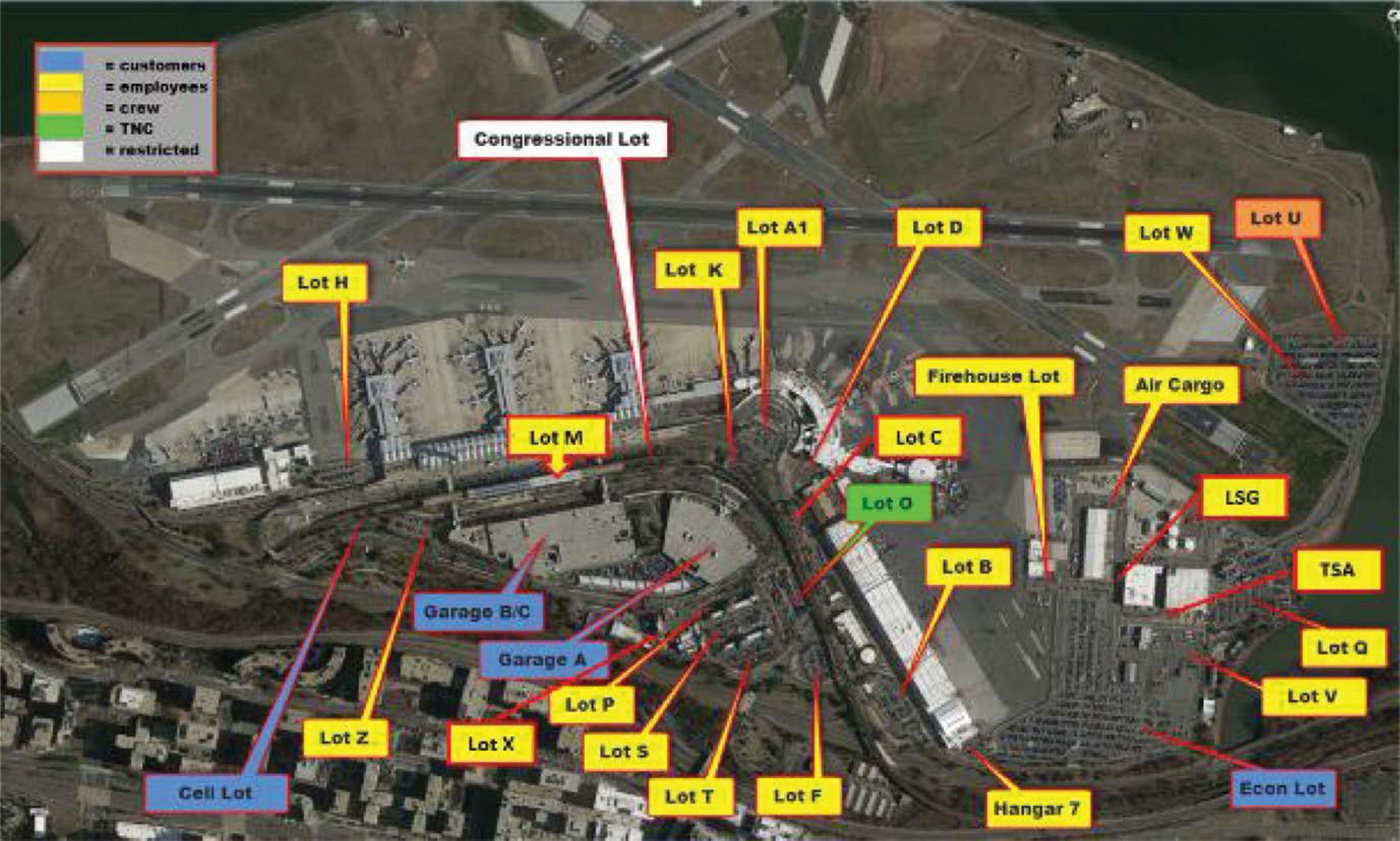
Located three miles south of Washington, DC, Ronald Reagan Washington National Airport (DCA) currently has 21,078 employees. At DCA, 75% of employees drive a vehicle to and from work. The airport accommodates 3,300 vehicles in 21 different surface lots (Figure 23). In 2023, the airport sold 9,140 parking permits—approximately three permits per available parking space. The airport relies on alternating shifts to accommodate all employees. Airlines are contractually required to pay the parking permit fee for their employees. Annual parking permit fees are $360 per employee. For an airline employee to obtain a parking permit, they must be stationed at DCA for at least 50% of the time.
The remaining 25% use various transportation modes, including the Metro public transit. Although DCA is directly served by the Metro (Metropolitan Area Transit Authority), the Metro operates Monday through Thursday, 5 a.m. until 12 a.m.; Friday, 5 a.m. until 1 a.m.; Saturday, 7 a.m. until 1 a.m.; and Sunday, 7 a.m. until 12 a.m. These operating hours do not accommodate all employees working at the airport. For example, food concessionaire employees start at 5 a.m.
and need to arrive prior to that time to allow sufficient time for parking at the airport, security processing, etc., making transit by the Metro not possible for these employees.
Commuting via bicycle is another option for some employees who live in close proximity to the airport. Although the Metro has bike racks, as does the airport, a small minority of employees bike to work. The airport has tried promoting a vanpool in the past, which included a designated parking spot, but this was not accepted by employees. “Commuting behavior has changed since COVID. Possibly due to concerns over exposure to sickness, employees are more comfortable in their personal vehicles” (A. Helms, personal communication, January 23, 2024). Even in 2024, employees have not expressed real and lasting interest in a vanpool.
“Our efforts are working. The Metropolitan Washington Airports Authority, the owner and operator of DCA, provides incentives for MWAA employees to use alternative transit. We are considering adding new parking spots, but are rather landlocked” (A. Helms, personal communication, January 23, 2024). The airport encourages all airport employers to consider providing subsidies and incentives for employees to commute.
Case Example 4: Denver International Airport
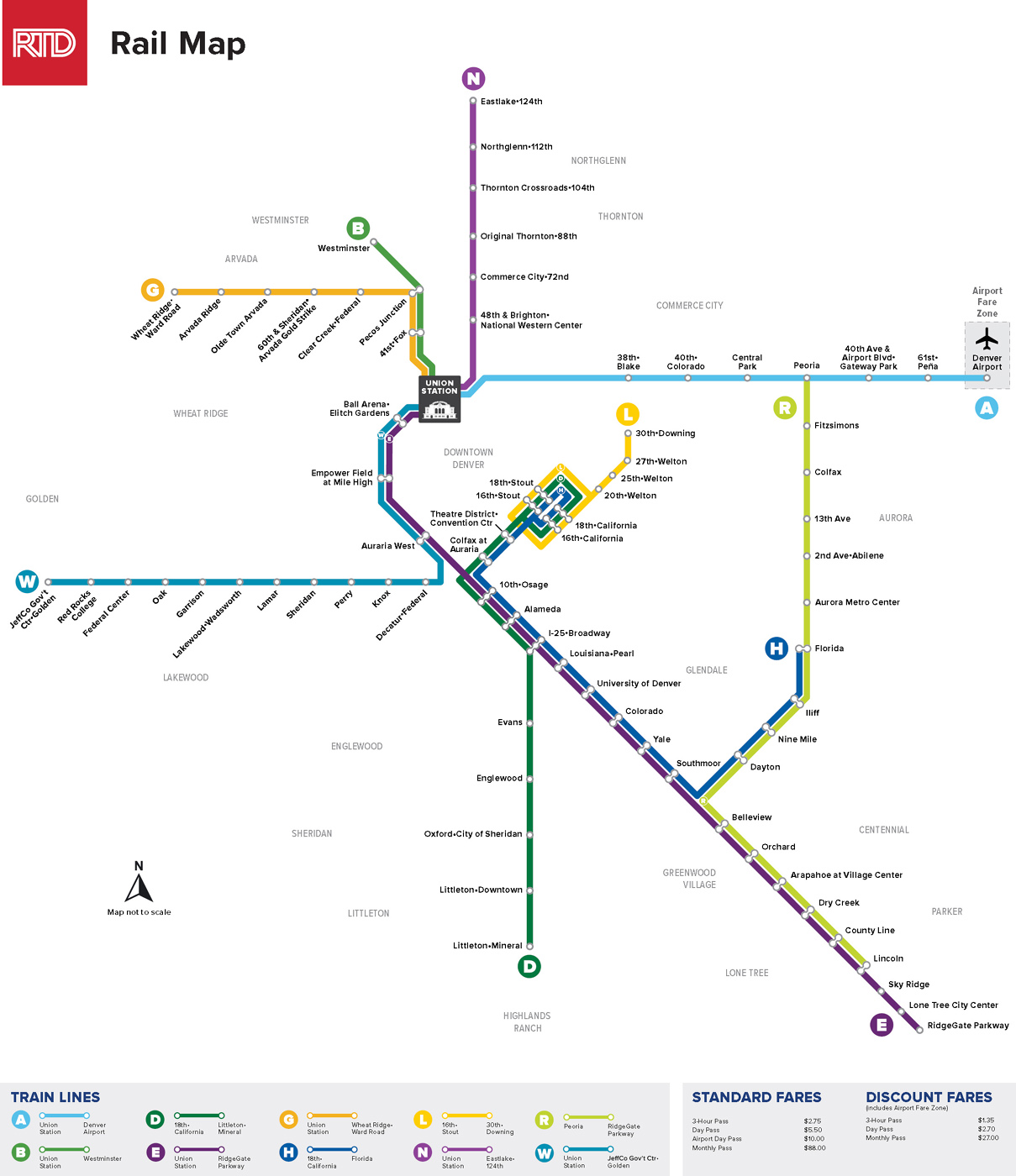
Located approximately 25 miles northeast of downtown Denver, with more than 1,200 companies employing 40,000 employees, Denver International Airport (DEN) can be challenging to reach for those without access to a vehicle or those living farther away from the airport. Employees living in the southeast area of Denver have few direct transit options to the airport. The commuter rail was extended to the airport in 2016 (Figure 24). If an employee does not live near a transit stop, the commute can remain challenging.
Due to these unique transportation challenges, DEN initiated a mobility study in 2022 to (1) establish a baseline that can be used to understand travel behavior, (2) identify available travel barriers and options, and (3) encourage more sustainable transportation to DEN. The deliverable of the study will be the DEN Transportation Demand Management (TDM) Plan. The study gathered data from passengers, employees, and employers. The study included a survey of 5,000 passengers to discover how these passengers traveled to and from the airport and the degree these passengers relied on public transit. More than 2,700 employees were also surveyed with similar questions and queried about possible employer subsidies. Finally, interviews were conducted with 50 airport employers to better understand how commuting challenges experienced by their employees contributed to retention issues, whether employers provided commuting subsidies or incentives, and the degree to which accessibility impacts employee recruitment.
The study found that 71% of employees drive alone to work while 17% utilize transit. Other commute modes include carpool (3%), airplane (2%), shuttle (1%), Uber/Lyft/taxi (1%), while 4% work from home and 1% utilize some other mode. The average commute time for drivers is 40 minutes, while the average commute time for those using transit is 38 minutes. Thus, choosing driving versus commuting does not generate appreciable time savings; rather, it is most likely selected for convenience. As the study uncovered, people who drive alone say that is the fastest, most reliable option, and they can make stops before and after work. Additionally, there is little financial impact to employees who drive (other than fuel and maintenance), because 63% of employers pay for employees’ parking permits.
Results from the study have generated 19 TDM strategies (Figure 25), including:
- Guaranteed ride home,
- Transit rider support and incentives,
- Carpool and vanpool programs,
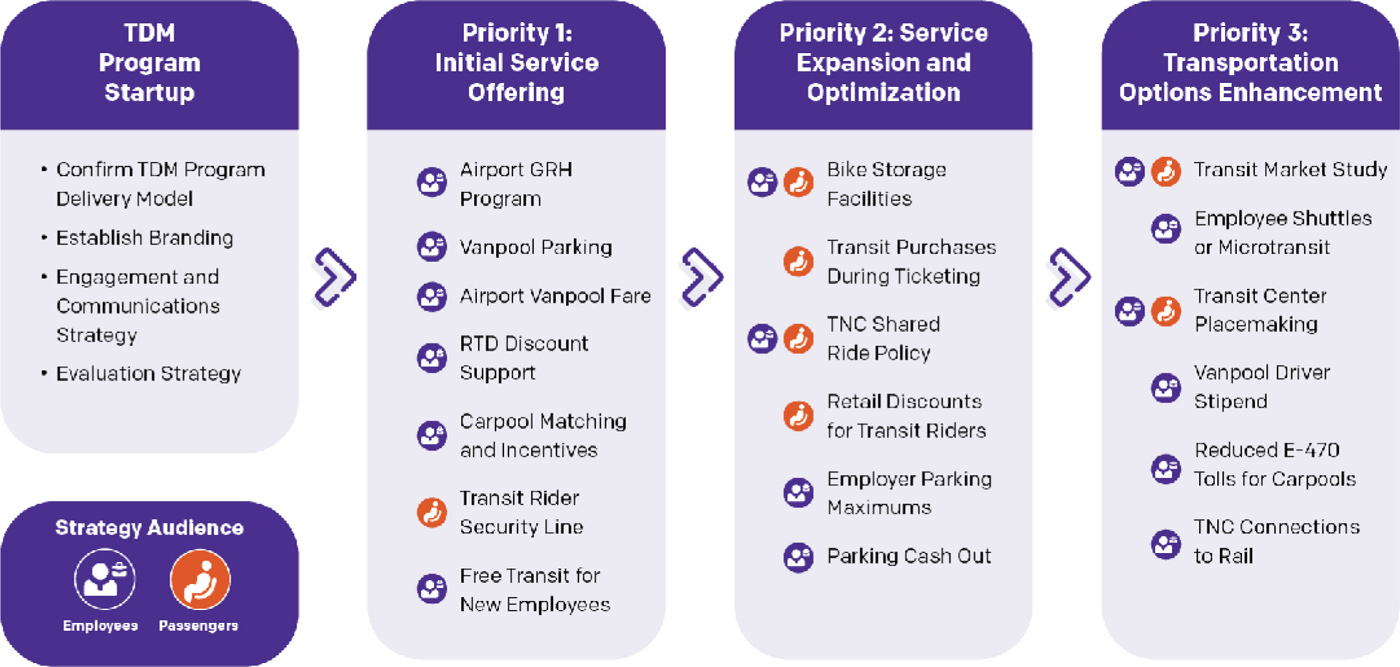
- Shuttles and micro-transit,
- First and last-mile connections, and
- Dedicated TDM staffing for airport users.
Similar to some other large airports, once employees arrive at the airport, they must generally take a second commute to reach their work site. This can require an additional 15–20 minutes. Thus, the commute for airport employees can require a significant portion of time. For concessionaire employees, for example, who begin a work shift at 4:30 a.m., the commute can begin at 3:30 a.m. or earlier. This has resulted in significant turnover for airport employers.
The airport now requires airport concessionaires to provide an EcoPass for employees. The EcoPass program is an annual prepaid transit pass purchased by an employer that provides unlimited usage of RTD (Regional Transportation District) services. According to the EcoPass program website, employee benefits include:
- Unlimited rides on RTD buses and trains;
- Unlimited rides to and from the airport;
- Reduce commuting and parking costs;
- Allows for use of pretax dollars (if cost sharing with the employer);
- Provides a safe and reliable transit option for those who live, work, and play in the Denver metro region; and
- Reclaim your time, catch up on reading and emails, take a nap, and let us do the driving for you!
In offering lessons learned, the Principal Airport Transportation Planner suggests that airports consider:
- A guaranteed ride home (to accommodate work shifts that do not coincide with public transit operating times),
- A vanpool program that provides efficient commuting for employees,
- The impact of constant turnover on airport employers,
- Creating an informational campaign to get employees interested in alternative transportation modes, and
- Encouraging employers to provide a transportation stipend.
“Employees express a wide range of reasons for selecting a particular commuting method. It is our job to ensure that the airport remains accessible for all employees” (L. Nguyen, personal communication, January 19, 2024).
Case Example 5: Los Angeles International Airport
Los Angeles World Airports (LAWA), the owner and operator of Los Angeles International Airport (LAX), directly employs over 3,000 personnel. More than 50,000 people employed by airlines, concessionaires, ground handlers, and other employers work at LAX. According to the LAWA Rideshare Program Administrator, 25,000 to 30,000 of these employees commute to LAX on a daily basis.
To better meet the commuting and ground access needs of these employees, in March 2021, a Transportation Management Organization (TMO) was established. With the establishment of the TMO, the LAWA Rideshare and LAX TMO programs merged to become one program known as commuteLAX. The TMO was an initiative of the 2019 Sustainability Action Plan, and directly intended to mitigate the level of employee traffic on frequently congested Southern California roadways. Designed in part to capitalize on LAWAs new Landside Access Modernization Program (LAMP) and Airfield and Terminal Modernization Plan (ATMP) infrastructure and transit connections, commuteLAX serves all employees of LAX.
CommuteLAX’s guiding principles are focused on providing transit options and encourage employees to use public transit. To ensure the success of commuteLAX, all LAX employers are required to participate. This participation includes regularly participating in two surveys:
- LAX Annual Employee Transportation Survey. This survey is distributed by LAX employers to their employees. Data collected include individual employee commute trip pattern (drive alone, transit, vanpool, etc.), shift time and commute start location (zip code/nearest intersection), and work location (parking lot).
- LAX TMO Annual Workforce Survey. This survey is completed by LAX employers to determine the number of LAX TMO employees. The annual workforce survey helps determine how many LAX employees report on-site on a regular basis. This information also helps calculate the LAX TMO employer’s annual TMO fee, currently $10 per LAX TMO employee, capped at $10,000 per LAX TMO employer per year.
As with any survey effort, LAX determines in advance how to utilize the survey data to create metrics and guide LAX efforts to improve the commuting options of employees. Providing transit options and encouraging employees to use public transit are the guiding principles of commuteLAX.
CommuteLAX has provided a number of commuting options to employees. The most popular include:
- Micro-transit (Iride). This is a unique option for those living in the nearby cities of Inglewood and Lennox. Funded by LAX and operated by the City of Inglewood, employees use an app to schedule a ride on Iride.
- Vanpool. Consisting of seven- and eight-passenger vans driven by volunteer employee drivers, vanpools leave from one central location on the home end and travel to a central destination on the work end. LAWA Vanpool Program participants pay a monthly fare based on their commute miles. The monthly fare covers all vehicle leasing and fuel costs. LAWA provides an employee discount of $60 per month for LAWA and City of Los Angeles participants. Pre-COVID there
- Bike to work. To accommodate commuting via bike, the airport has installed bike lockers at different locations throughout the airport. Additionally, the nearest Metro location to the airport will include the largest bike hub in the Metro system, which will provide showers and bike storage. Due to the popularity of this bike hub, LAWA is exploring the creation of bike lockers at additional stops in their system. Although there are currently no incentives offered to employees to commute via bicycle, this may change in the future.
were more than 500 vanpool participants. Currently, due to telecommuting and other hybrid work arrangements, there are approximately 280 vanpool participants.
Even though LAX has learned that driving an SOV is very common for employees living less than 15 miles from the airport, they have found that vanpools and carpools do enjoy more success for employees living more than 15 miles from the airport. Future improvements are also on the way. With the nearest Los Angeles Metro Rail (Metro) station 2 miles away from the airport, LAX has programmed a new automated people mover, which will connect to the Metro light-rail system.
Regardless of which commuting mode employees choose, “We have learned that it is so important to have transit access” (M. Molina, personal communication, January 18, 2024). Employers at LAX benefit when current employees are able to commute to work without significant obstacles, and these same employers benefit when they have a greater pool of employees from which to choose, generally made possible by additional commuting options in the region (M. Molina, personal communication, January 18, 2024).
Case Example 6: Portland International Airport
Owned and operated by the Port of Portland, Portland International Airport (PDX) is located four miles northeast of downtown Portland and has 10,500 employees. The senior aviation planner has asked, “How do we attract employees to a remote location, that is the airport?” (M. Coleman, personal communication, January 24, 2024). This drives PDX’s efforts at increasing mobility access to the airport.
The majority of airport employees commute to work at the airport via SOV. To ensure sustainability goals are achieved, the airport has placed a cap on the number of parking spaces, driven in part by air quality goals.
The airport is served directly by Portland’s MAX (Metropolitan Area Express) light-rail service, which operates daily from 5 a.m. to 10 p.m. For airport employees with early start times and late end times outside of operating hours, light rail is a poor choice. “For airport employees with shifts starting in the middle of the day, light rail works well” (M. Coleman, personal communication, January 24, 2024). That being said, for employees living on the Washington side of the Columbia River, light-rail service to PDX is minimal.
In 2024, the airport will update the Airport Master Plan and transit will be a significant part of the master planning effort. PDX does not currently offer a vanpool, nor does it have a TMA. Even so, the airport is pursuing diversified multimodal initiatives and making transit an area of focus. For example, the airport has partnered with Multnomah County to begin a shuttle service that connects to existing MAX light rail. This operates seven days weekly and is provided free to airport employees.
The City of Portland is known for a strong bicycle culture. For those employees commuting via bicycle, a new mixed path connecting the airport terminal to an extensive bicycle/pedestrian network is scheduled to open in 2024. “This will allow us to reach outside our boundaries but also connect to jobs along the path” (M. Coleman, personal communication, January 24, 2024).
Case Example 7: Seattle-Tacoma International Airport
Owned and operated by the Port of Seattle, Seattle-Tacoma International Airport (SEA) employs over 25,000 individuals who work for over 800 companies, including the Port of Seattle, the federal government, airlines, concessionaires, ground handling contractors, construction firms, and terminal services such as customer wayfinding and custodial. Located in the Pacific Northwest, the Port of Seattle places a high priority on sustainability and environmental stewardship. Likewise, SEA strives to minimize environmental impacts, including those from vehicle emissions from passengers as well as employees.
Aware of these impacts, SEA commissioned a Ground Transportation Access study in 2018 that investigated ways to affect and improve how both travelers and employees access the airport. Ten strategies were recommended to the Port of Seattle Commission, including the creation of a Transportation Management Association (TMA). Delayed by the COVID-19 pandemic, the port is now actively working on the formation of a TMA, which will be designed not only with the goal of reducing single-occupancy vehicle use by airport employees, but also creating more equity in the workforce by enabling a suite of options to support employees as they commute to and from work at the airport. “Our elected Port Commission places a high priority on workforce development and social equity for our vast airport labor pool. At SEA, encouraging airport employers to support their employees with better transportation benefits, and stepping in to fill in the gaps by providing commuting options and resources for all airport employees, is one way we contribute to those goals” (D. Tomporowski, personal communication, January 17, 2024).
Although the airport is served by Sound Transit Link light rail with a station at the airport, the hours of operation do not coincide with early start and late end shift times often experienced by airport employees. Further, the majority of airport employees live south of the airport due to a lower cost of living, and yet the Link light rail primarily serves areas north of the airport, with the airport as the second southernmost stop. Although bus service is available farther south of the airport, the buses more commonly serve commercial areas rather than residential areas.
Bikes, including e-bikes, and electric scooters are used by some employees for commuting purposes. For those employees living close enough to the airport, they may be able to travel via bike or scooter the entire route to work. For others, they load a bike onto a bus, for example, and use the bike for their “first-mile” or “last-mile” commute. For these employees, SEA provides inside and outside bike racks for securing their bikes.
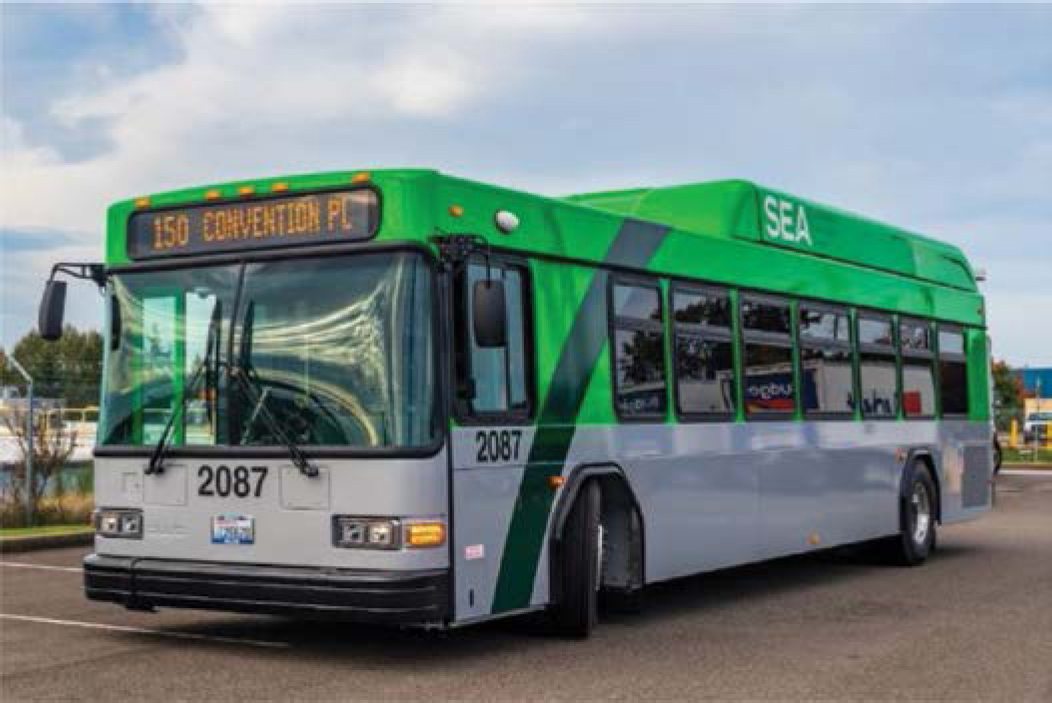
A large majority of SEA workers drive to work, and most park at the airport’s North Employee Parking Lot (NEPL), which has 4,100 spaces. A port-operated shuttle runs 24 hours a day, 365 days a year between NEPL, some air cargo facilities, and the main passenger terminal (Figure 26). NEPL parking is very popular; the lot is full and there is a waitlist for new parkers. Airline employees represent close to 90% of NEPL parkers (most airline employees receive fully subsidized parking). As such, the airlines have advocated for the expansion of the tenant parking program as they struggle to hire and onboard new staff without being able to offer parking.
The scarcity of—and demand for—additional employee parking by tenants is giving the Port an opportunity to link any expansion of parking with the TMA and robust commute trip reduction programming. A primary funding source for the TMA will be an added fee to the monthly cost of employer-provided paid parking. As parking expands, the fee will also increase commensurate with increased TMA programming.
In addition to linking the employee parking program to TMA funding, the port is also doing the following:
- The port has partnered with Port Jobs, a workforce development nonprofit based at the airport that helps tenant employers recruit and train new employees, and South King County Trips,
- The TMA will be formed around three core programs: a carpool parking incentive, a slate of bike and pedestrian encouragement events, and a universal transit pass program for eligible airport employees utilizing the region’s ORCA for Business account option.
- Staff will study the feasibility of setting up an airport employee shuttle operation, primarily to augment early-morning and late-night periods when public transit doesn’t operate. The shuttle would operate between the airport and areas with high concentrations of airport employee residences to the south.
a commute program of an airport-adjacent municipality, to provide commuting resources and support to airport employees immediately while more permanent programs are formed.
“Our 25,000 badged individuals all have different working hours, employer policies, benefit packages, living situations, and transportation needs. Given this varied and diverse workforce, the Port of Seattle, as the airport sponsor, operator, and landlord, can act as an overarching resource and convening entity to provide benefits and resources related to Commute Trip Reduction and Transportation Demand Management, for the benefit of all airport workers” (D. Tomporowski, personal communication, January 17, 2024).
Case Example 8: San Francisco International Airport
Located in the San Francisco Bay Area, eight miles southeast of San Francisco, the San Francisco International Airport (SFO) has 46,000 total employees. According to the senior planner in landside operations, 75% of these employees commute to and from work via SOV. The remaining 25% commute via numerous methods, including bicycle, although public transit is most frequently used. Although the majority of employees still commute via SOV, the airport has been active and successful at increasing the number of employees using more sustainable commuting methods.
One such sustainable commuting method is the Bay Area Rapid Transit (BART). Although the San Francisco Bay Area is relatively well served by BART, it also presents various challenges for airport employees. For instance, although generally paid competitive wages, airport employees generally cannot afford to live in higher cost-of-living areas (such as north of the airport) that are most commonly served by BART. Many employees live in the East Bay, which, although served by BART, requires a circuitous route into downtown and back out to the East Bay again. Those employees living northeast of the bay may have access to BART, but this may require driving to a Park and Ride and then taking a bus to the nearest BART station, which results in using multiple transportation modes
and can lead to a lengthy commute. Further, BART operates from 6 a.m. to midnight, and many employee shifts at the airport begin before 6 a.m. and end after midnight, making utilization of the BART system impossible for these employees. These challenges can negatively impact the ability of employees to efficiently commute to and from work at the airport, which also compounds the ability of airport employers to recruit and retain employees.
California has a state law requiring employers to provide transit benefits to employees. The Bay Area Air Quality Management District’s (Air District) Regulation 14, Rule 1 “requires Bay Area employers with 50 or more full-time employees within the Air District’s geographic boundaries to offer commuter benefits to employees” (Bay Area Air Quality Management District, 2014, p. 14-1-2). Prior to the passage of this regulation, San Francisco Airport had adopted airport regulations that set forth the same standards as the new law. Already in the business of using buses to transport passengers to the airport, to further address the commuting dilemma of employees, SFO questioned, Why not start a bus network to assist employees in commuting to and from work? Other Silicon Valley employers, such as Google and Facebook (now Meta) were already running employee bus systems. Airport staff met with the leadership of a large tech company near the airport to consider if airport employees would benefit from using that company’s existing employee shuttle. Unfortunately, the airport shift start and end times did not mesh up with the existing shuttle, which was geared toward tech employee shift times. Further, circulation times at the tech company prior to proceeding to the airport would have made this mode less competitive with driving.
In 2019, the airport performed a study to better understand airport employee commuting needs and examine housing costs, employee travel patterns, commuting challenges, and so on. The study identified some solutions with a few possible route types to assist employees with their commute:
- Expanded network. Link the two spokes of the radial BART network that proceed south from central San Francisco on both sides of the bay.
- Regions with limited transit service. Serve those areas without competitive or one-seat ride transit service.
- Early/late employee shifts. Serve those who may live in a BART service area but have shifts that begin before or after BART scheduled service times.
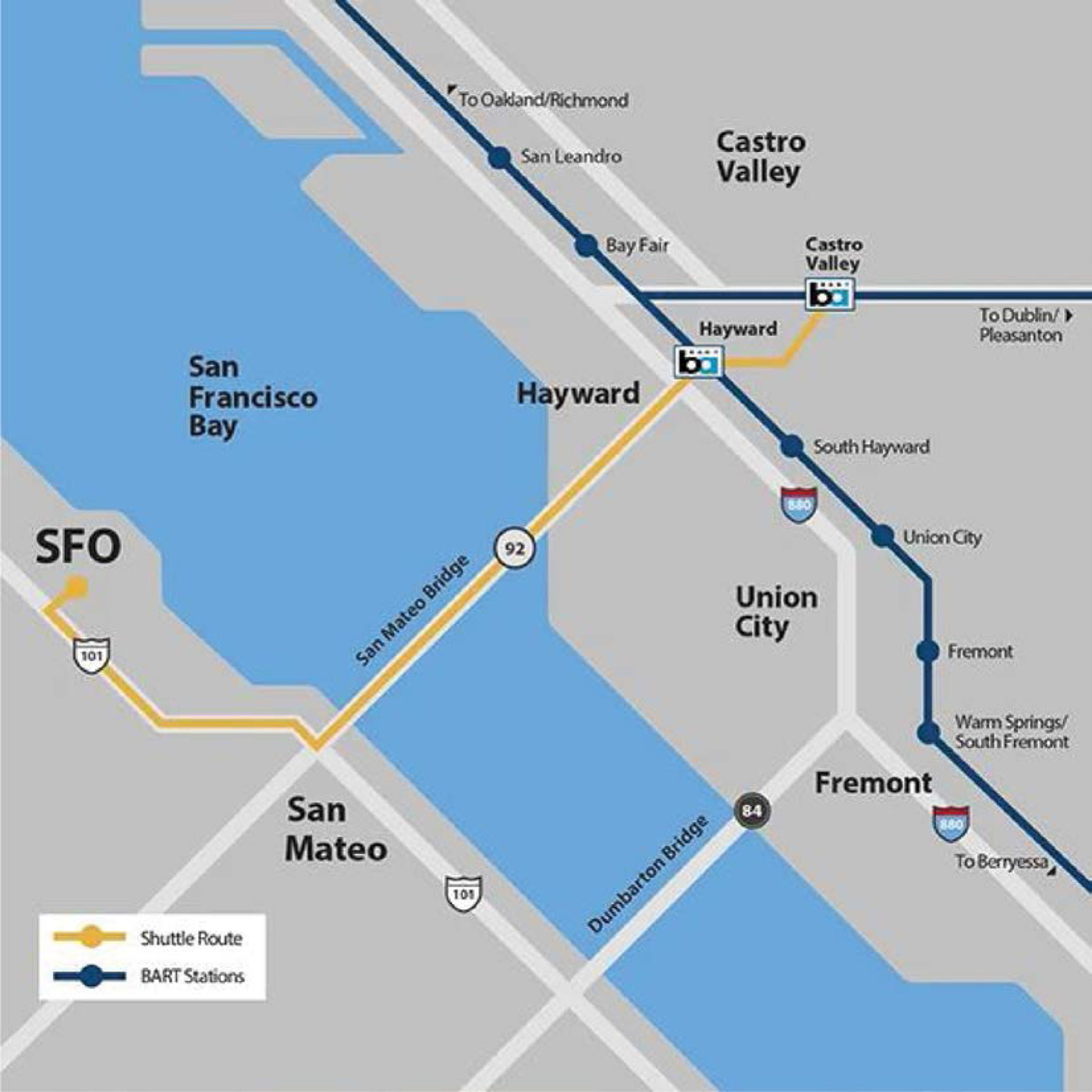
To address some of these route-type needs, SFO created the Go>SFO Shuttle in 2022 (Figure 27). This program was introduced as a “free, new commuter bus for all workers at SFO, serving the Castro Valley and Hayward areas! The direct route serves the Hayward and Castro Valley BART stations and the SFO terminals. It’s quick, easy and, for now, free for airport workers!” (Source: SFO LinkedIn). It was well-received by airport employees. As one United Airlines operations employee commented, “Thank you for starting this service! Even with an irregular work schedule the shuttle times are working out. It’s a great benefit for East Bay commuters!” (Source: LinkedIn comment).
The Go>SFO Shuttle is partially funded through the airport operations budget. The airport leaders believe that this program is integral to their operations and is therefore included in their operations budget. Today, to offset the costs of providing the service, users may purchase a monthly unlimited ride pass for $190, a 10-ride pass for $50, or a single-ride pass for $6.
Even with the rider fees, on average, each employee using the Go>SFO Shuttle saves $3,000 per year in commuting-related costs, such as fuel. The shuttle also provides significant environmental benefits, with reduced environmental impacts equivalent to planting a forest the size of Presidio and Golden Gate Park combined. “Our Go>SFO Shuttle confirms that we care about the well-being of our employees and the environment. At the end of the day, our primary goal is to make transit competitive with driving, and we are gradually succeeding” (S. Morgan, personal communication, January 12, 2024).
In addition to Go>SFO Shuttle, the airport encourages employees to ride bicycles to and from work. The airport provides bike lanes that access their facilities, and these lanes are connected on both ends to the Bay Trail, which serves hikers, joggers, bicyclists, skaters, and wheelchair users
on more than 350 miles of trails that circle the Bay. Additionally, the airport provides designated bike parking under cover and is designing bike rooms in large new commission buildings, which will allow for bikes to be stored inside.
Although approximately 60% of airport employees work within the terminal complex, approximately 40% work off-site, requiring a second commute. Fortunately, approximately half of those working off-site have access to the Airport’s AirTrain, which provides year-round service 24 hours a day, with station departures as frequent as every four minutes. The AirTrain Red Line connects all terminals, terminal garages, the BART Station, and the Grand Hyatt at SFO. The AirTrain Blue Line connects Long-Term Parking, the Rental Car Center, all terminals, terminal garages, the BART Station, and the Grand Hyatt at SFO.
When sharing lessons learned, the senior planner states, “Go big or go home! Our shuttle provides 30 minute serve all day long, 24/7, 365. Employees must have faith in the shuttle so they can leave their cars at home and still take a shuttle midday to pick up a sick child from school.” Additionally, “Be very sure of your market, such as when employees arrive to work and leave work, where people live, etc.” (S. Morgan, personal communication, January 12, 2024).


