Evaluating Traffic Safety Campaigns: A Guide (2025)
Chapter: Appendix C: Generic Traffic Safety Messaging Campaign Survey

APPENDIX C
Generic Traffic Safety Messaging Campaign Survey
Long Description.
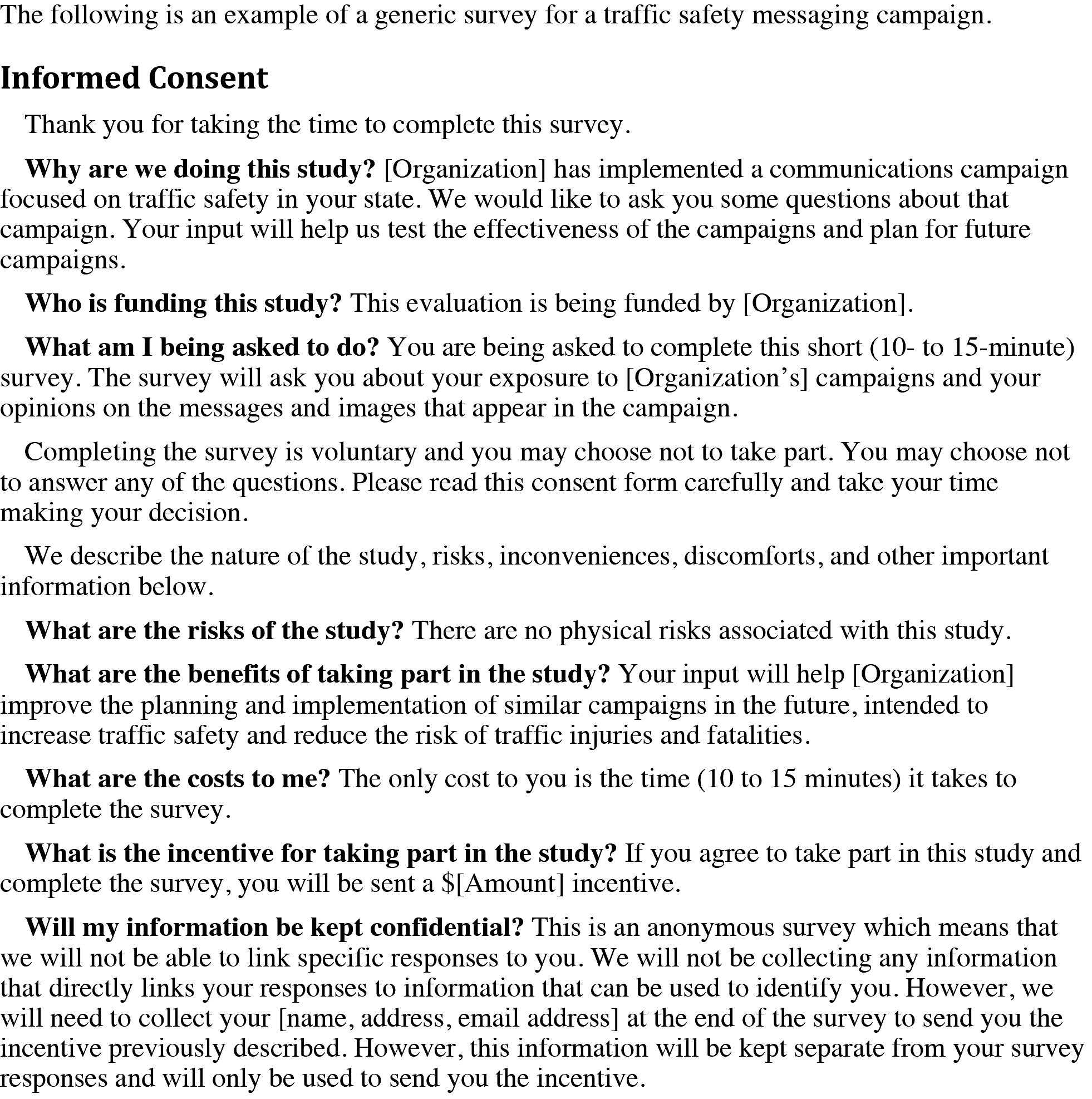
The survey form is titled 'Generic traffic safety messaging campaign survey.' The text below the survey reads the following:
The following is an example of a generic survey for a traffic safety messaging campaign.
Informed Consent
Thank you for taking the time to complete this survey.
Why are we doing this study? [Organization] has implemented a communications campaign focused on traffic safety in your state. We would like to ask you some questions about that campaign. Your input will help us test the effectiveness of the campaigns and plan for future campaigns.
Who is funding this study? This evaluation is being funded by [Organization].
What am I being asked to do? You are being asked to complete this short (10- to 15-minute) survey. The survey will ask you about your exposure to [Organization’s] campaigns and your opinions on the messages and images that appear in the campaign.
Completing the survey is voluntary, and you may choose not to take part. You may choose not to answer any of the questions. Please read this consent form carefully and take your time making your decision.
We describe the nature of the study, risks, inconveniences, discomforts, and other important information below.
What are the risks of the study? There are no physical risks associated with this study.
What are the benefits of taking part in the study? Your input will help [Organization] improve the planning and implementation of similar campaigns in the future, which are intended to increase traffic safety and reduce the risk of traffic injuries and fatalities.
What are the costs to me? The only cost to you is the time (10 to 15 minutes) it takes to complete the survey.
What is the incentive for taking part in the study? If you agree to take part in this study and complete the survey, you will be sent a U. S. dollar sign [Amount] incentive.
Will my information be kept confidential? This is an anonymous survey, which means that we will not be able to link specific responses to you. We will not be collecting any information that directly links your responses to information that can be used to identify you. However, we will need to collect your [name, address, email address] at the end of the survey to send you the incentive previously described. This information will be kept separate from your survey responses and will only be used to send you the incentive.
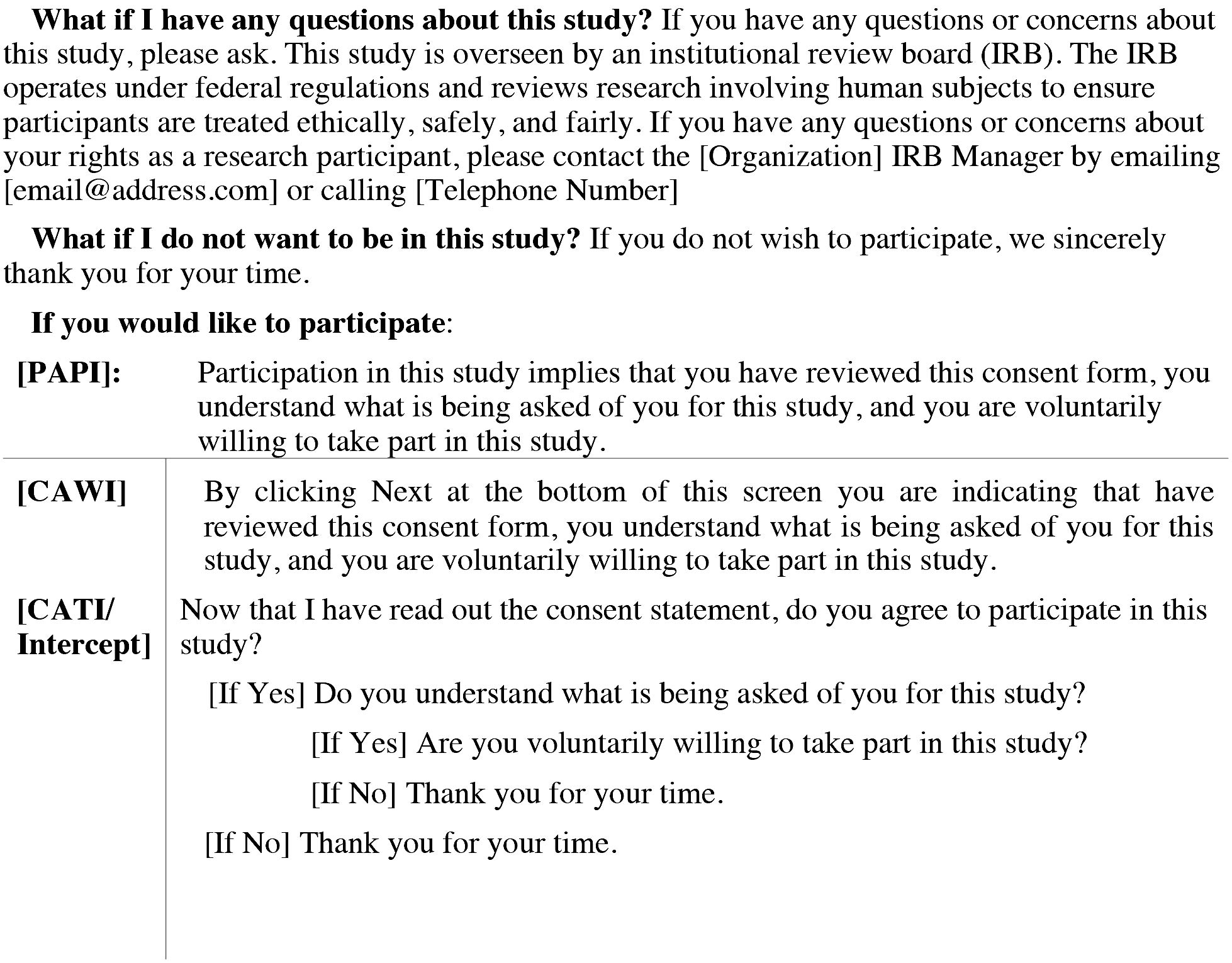
What if I have any questions about this study? If you have any questions or concerns about this study, please ask. This study is overseen by an institutional review board (IRB). The IRB operates under federal regulations and reviews research involving human subjects to ensure participants are treated ethically, safely, and fairly. If you have any questions or concerns about your rights as a research participant, please contact the [Organization] IRB Manager by emailing {email@address.com] or calling [telephone number].
Long Description.
What if I do not want to be in this study? If you do not wish to participate, we sincerely thank you for your time.
If you would like to participate:
[PAPI]: Participation in this study implies that you have reviewed this consent form, you understand what is being asked of you for this study, and you are voluntarily willing to take part in this study.
[CAWI] By clicking Next at the bottom of this screen, you are indicating that you have reviewed this consent form, you understand what is being asked of you for this study, and you are voluntarily willing to take part in this study.
[CATI or Intercept] Now that I have read out the consent statement, do you agree to participate in this study?
[If Yes] Do you understand what is being asked of you for this study?
[If Yes] Are you voluntarily willing to take part in this study?
[If No] Thank you for your time.
[If No] Thank you for your time.
Long Description.
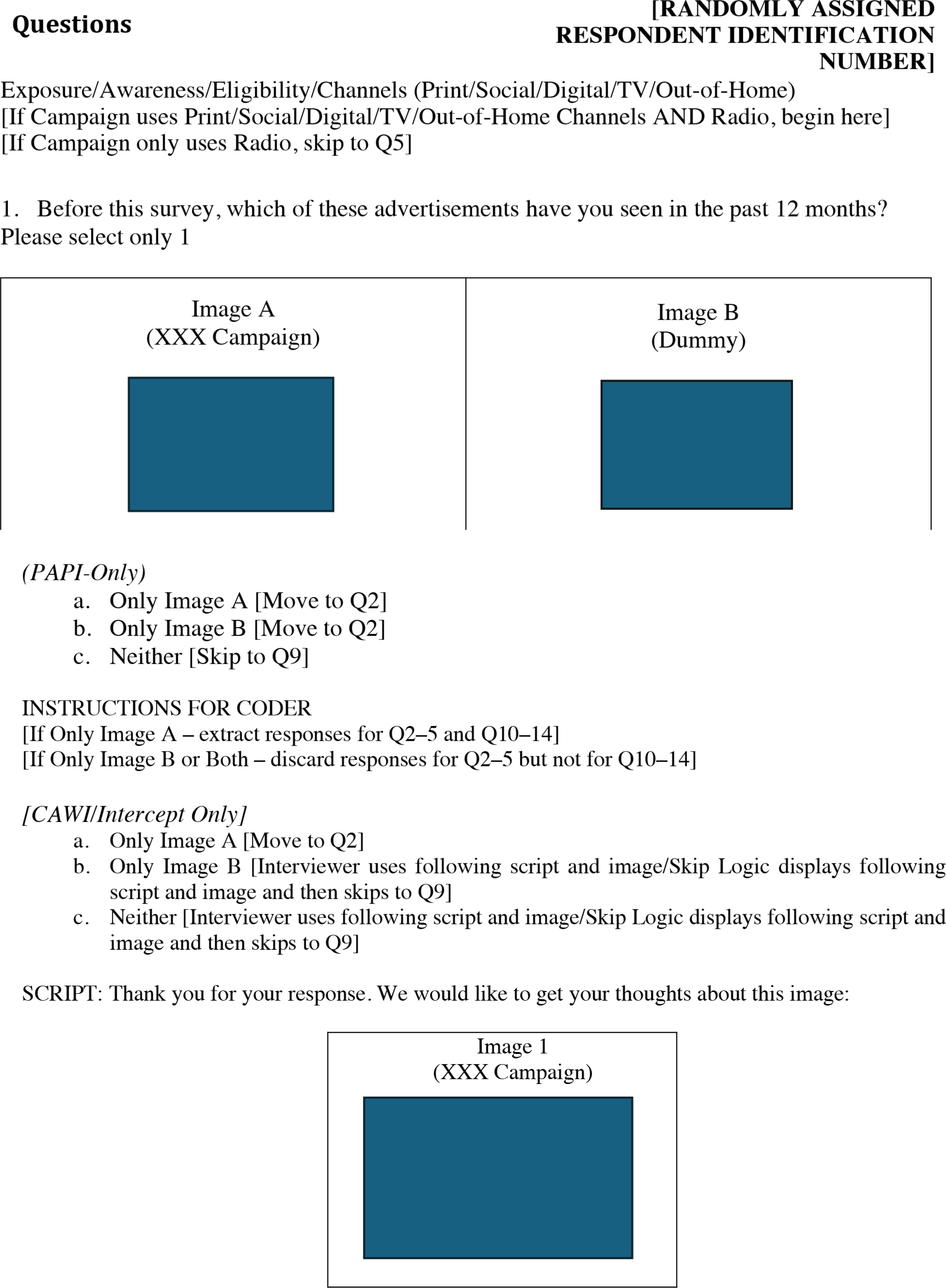
The text given in the screenshot reads as follows: Exposure, Awareness, Eligibility, Channels (Print, Social, Digital, TV, or Out-of-Home)
[If Campaign uses Print, Social, Digital, TV, or Out-of-Home Channels AND Radio, begin here]
[If Campaign only uses Radio, skip to Q5]
1. Before this survey, which of these advertisements have you seen in the past 12 months? Please select only 1.
Image A (XXX Campaign): Shows a rectangle shaded in blue.
Image B (Dummy): Shows a rectangle shaded in blue.
(PAPI-Only)
a. Only Image A [Move to Q2]
b. Only Image B [Move to Q2]
c. Neither [Skip to Q9]
INSTRUCTIONS FOR CODER
[If Only Image A – extract responses for Q2–5 and Q10–14]
[If Only Image B or Both – discard responses for Q2–5 but not for Q10–14]
[CAWI or Intercept Only]
a. Only Image A [Move to Q2]
b. Only Image B [Interviewer uses the following script and image, or Skip Logic displays the following script and image, and then skips to Q9]
c. Neither [Interviewer uses the following script and image, or Skip Logic displays the following script and image, and then skips to Q9]
SCRIPT: Thank you for your response. We would like to get your thoughts about this image:
Image 1 (XXX Campaign): Shows a rectangle shaded in blue.
Long Description.
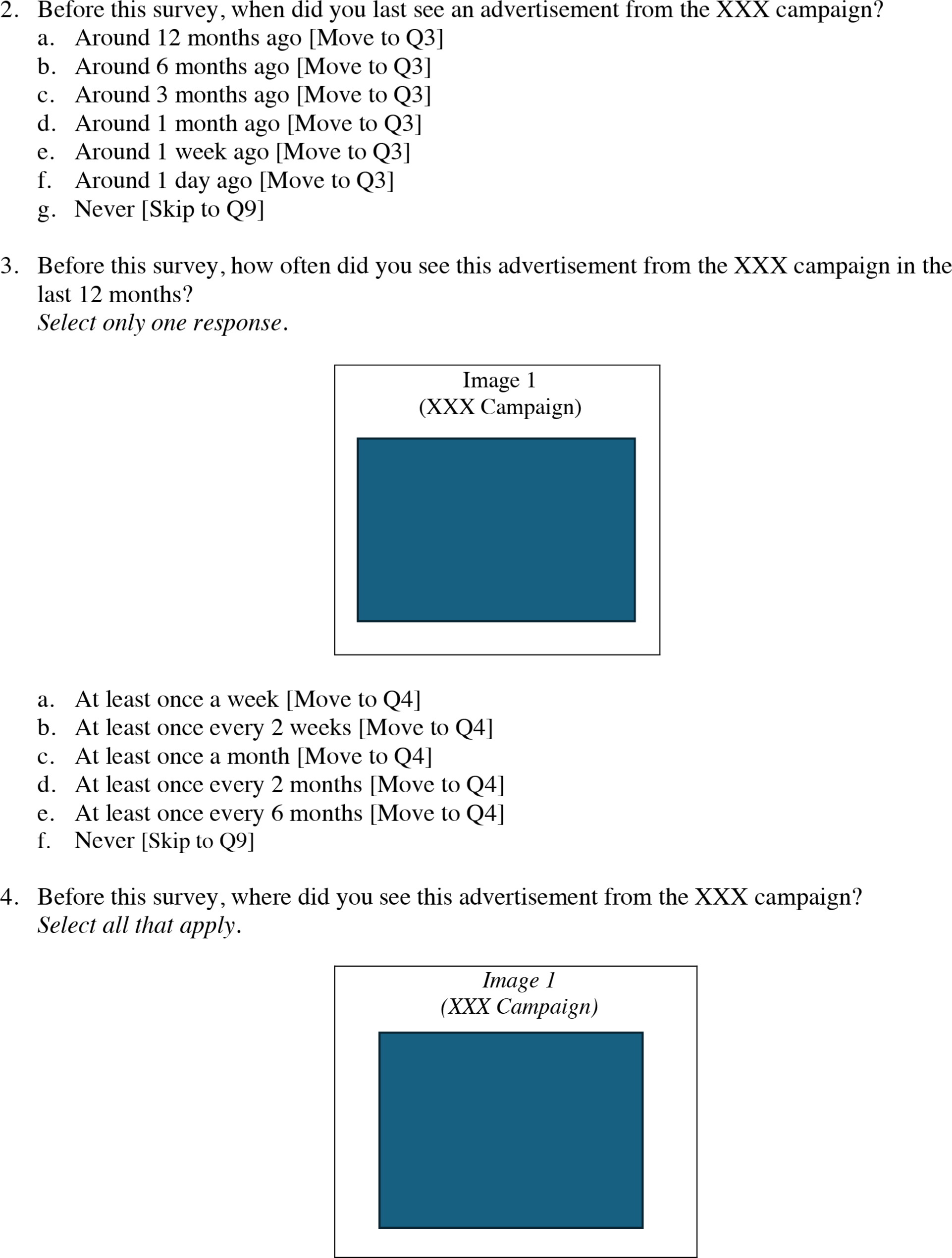
The text given in the screenshot reads the following:
2. Before this survey, when did you last see an advertisement from the XXX campaign?
a. Around 12 months ago [Move to Q3]
b. Around 6 months ago [Move to Q3]
c. Around 3 months ago [Move to Q3]
d. Around 1 month ago [Move to Q3]
e. Around 1 week ago [Move to Q3]
f. Around 1 day ago [Move to Q3]
g. Never [Skip to Q9]
3. Before this survey, how often did you see this advertisement from the XXX campaign in the last 12 months?
Select only one response.
Image 1 (XXX Campaign): Shows a rectangle shaded in blue.
a. At least once a week [Move to Q4]
b. At least once every 2 weeks [Move to Q4]
c. At least once a month [Move to Q4]
d. At least once every 2 months [Move to Q4]
e. At least once every 6 months [Move to Q4]
f. Never [Skip to Q9]
4. Before this survey, where did you see this advertisement from the XXX campaign? Select all that apply.
Image 1 (XXX Campaign): Shows a rectangle shaded in blue.
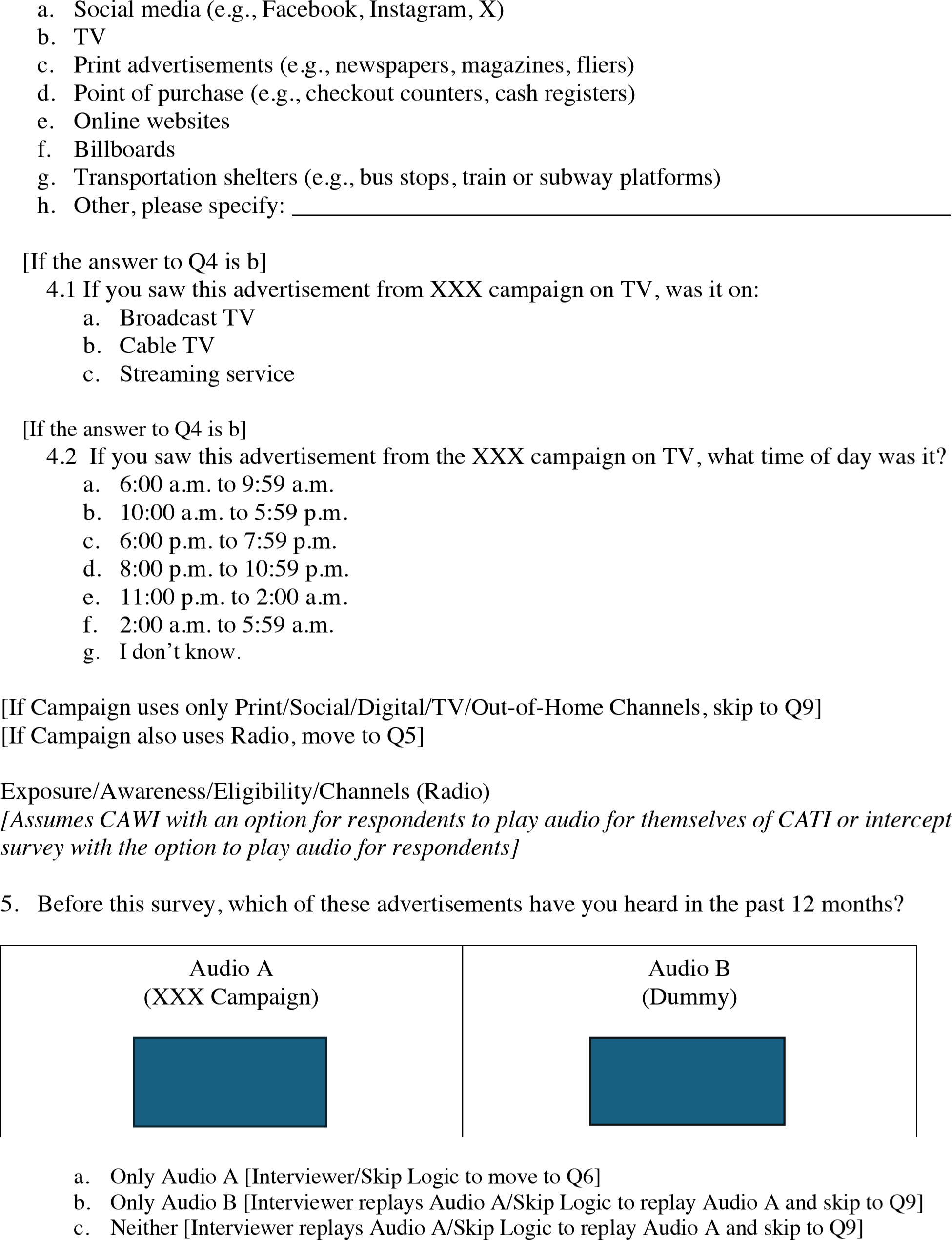
Long Description.
The text given in the screenshot reads as follows:
a. Social media ( e.g., Facebook, Instagram, X)
b. TV
c. Print advertisements (e.g., newspapers, magazines, fliers)
d. Point of purchase (e.g., checkout counters, cash registers)
e. Online websites
f. Billboards
g. Transportation shelters (e.g., bus stops, train or subway platforms)
h. Other, please specify:____
[If the answer to Q4 is b]
4.1 If you saw this advertisement from the XXX campaign on TV, was it on:
a. Broadcast TV
b. Cable TV
c. Streaming service [If the answer to Q4 is b]
4.2 If you saw this advertisement from the XXX campaign on TV, what time of day was it?
a. 6:00 a.m. to 9:59 a.m.
b. 10:00 a.m. to 5:59 p.m.
c. 6:00 p.m. to 7:59 p.m.
d. 8:00 p.m. to 10:59 p.m.
e. 11:00 p.m. to 2:00 a.m.
f. 2:00 a.m. to 5:59 a.m.
g. I don’t know.
[If Campaign uses only Print, Social, Digital, TV, or Out-of-Home Channels, skip to Q9]
[If Campaign also uses Radio, move Exposure, Awareness, Eligibility, or Channels (Radio)
[Assumes CAWI with an option for respondents to play audio for themselves, or CATI or intercept survey with the option to play audio for respondents]
5. Before this survey, which of these advertisements have you heard in the past 12 months?
Audio A (XXX Campaign): Shows a rectangle shaded in blue.
Audio B (Dummy): Shows a rectangle shaded in blue.
a. Only Audio A [Interviewer or Skip Logic to move to Q6]
b. Only Audio B [Interviewer replays Audio A or Skip Logic to replay Audio A and skip to Q9]
c. Neither [Interviewer replays Audio A or Skip Logic to replay Audio A and skip to Q9]
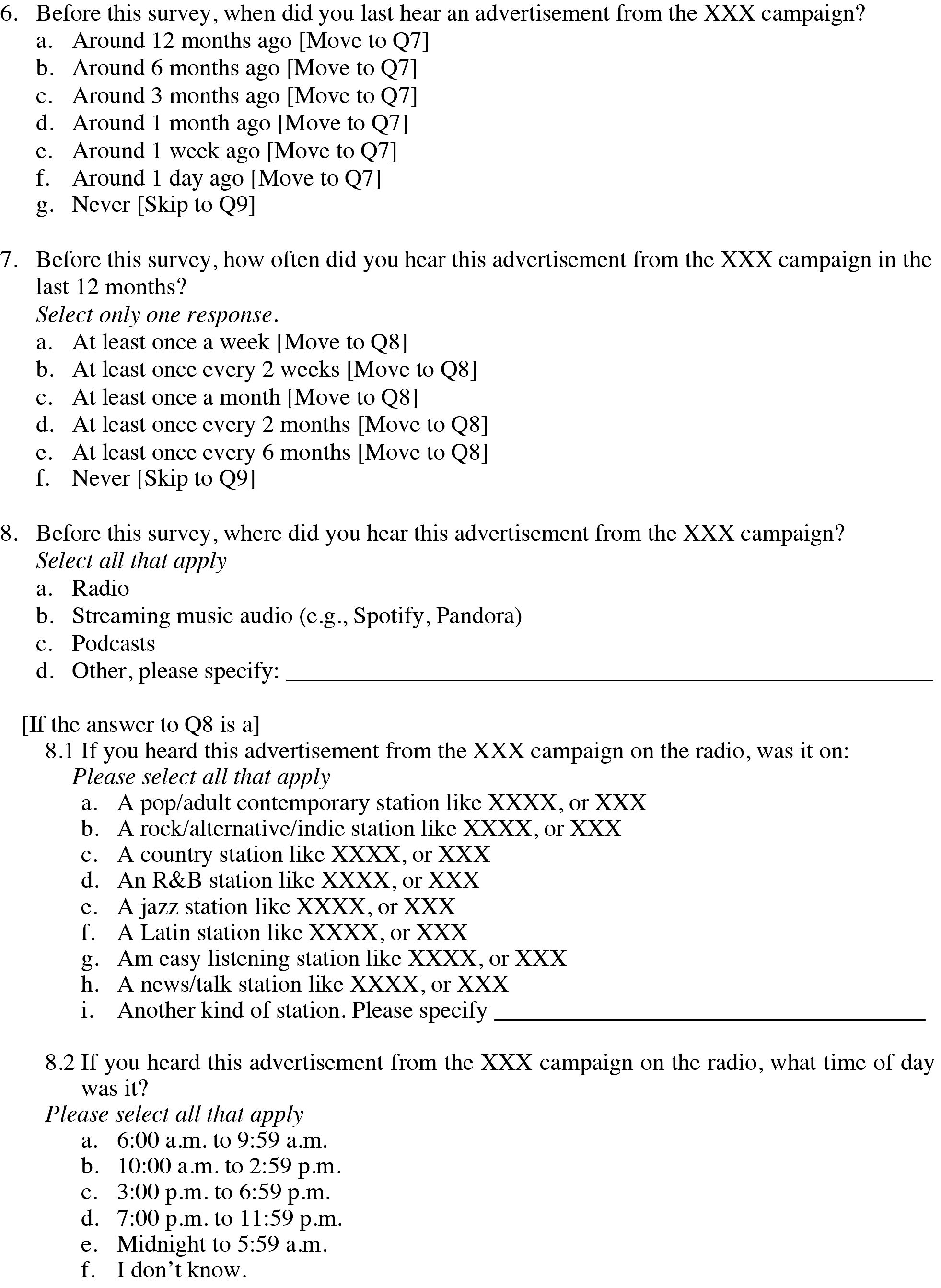
Long Description.
The text given in the screenshot reads as follows:
6. Before this survey, when did you last hear an advertisement from the XXX campaign?
a. Around 12 months ago [Move to Q7]
b. Around 6 months ago [Move to Q7]
c. Around 3 months ago [Move to Q7]
d. Around 1 month ago [Move to Q7]
e. Around 1 week ago [Move to Q7]
f. Around 1 day ago [Move to Q7]
g. Never [Skip to Q9]
7. Before this survey, how often did you hear this advertisement from the XXX campaign in the last 12 months? Select only one response.
a. At least once a week [Move to Q8]
b. At least once every 2 weeks [Move to Q8]
c. At least once a month [Move to Q8]
d. At least once every 2 months [Move to Q8]
e. At least once every 6 months [Move to Q8]
f. Never [Skip to Q9]
8. Before this survey, where did you hear this advertisement from the XXX campaign? Select all that apply
a. Radio
b. Streaming music audio (e.g., Spotify, Pandora)
c. Podcasts
d. Other, please specify: ______
[If the answer to Q8 is a]
8.1 If you heard this advertisement from the XXX campaign on the radio, was it on: Please select all that apply
a. A pop or adult contemporary station like XXXX, or XXX
b. A rock, alternative, or indie station like XXXX, or XXX
c. A country station like XXXX, or XXX
d. An R and B station like XXXX, or XXX
e. A jazz station like XXXX, or XXX
f. A Latin station like XXXX, or XXX
g. An easy listening station like XXXX, or XXX
h. A news or talk station like XXXX, or XXX
i. Another kind of station. Please specify ___
8.2 If you heard this advertisement from the XXX campaign on the radio, what time of day was it? Please select all that apply
a. 6:00 a.m. to 9:59 a.m.
b. 10:00 a.m. to 2:59 p.m.
c. 3:00 p.m. to 6:59 p.m.
d. 7:00 p.m. to 11:59 p.m.
e. Midnight to 5:59 a.m.
f. I don’t know.
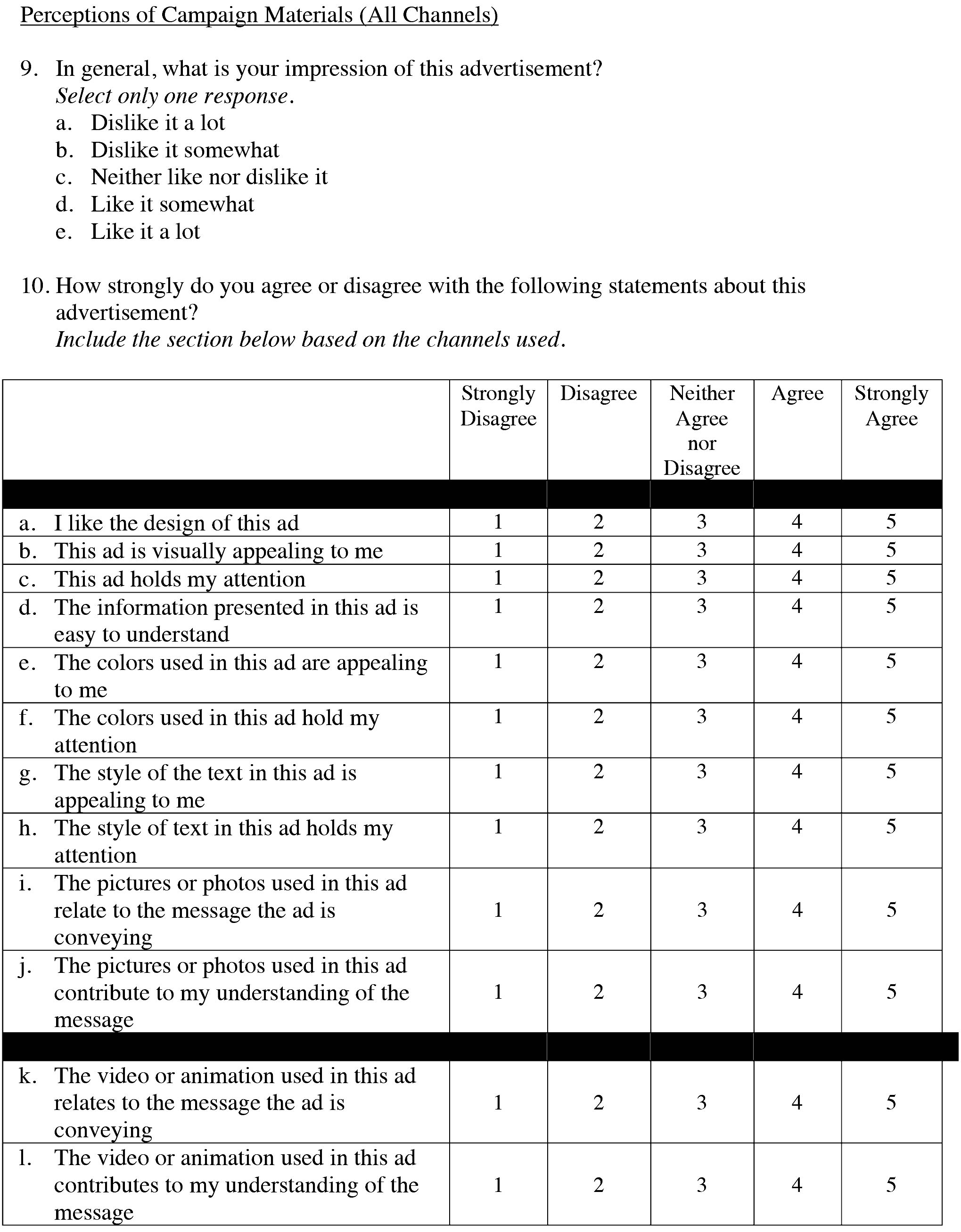
Long Description.
The text given in the screenshot reads as follows: Perceptions of Campaign Materials (All Channels) 9. In general, what is your impression of this advertisement? Select only one response.
a. Dislike it a lot
b. Dislike it somewhat
c. Neither like nor dislike it
d. Like it somewhat
e. Like it a lot
10. How strongly do you agree or disagree with the following statements about this advertisement? Include the section below based on the channels used. The column headers of the table are Type of Media, Strongly Disagree, Disagree, Neither Agree nor Disagree, Agree, Strongly Agree. The data given in the table row-wise are as follows:
Row a: I like the design of this ad: 1, 2, 3, 4, 5.
Row b: This ad is visually appealing to me: 1, 2, 3, 4, 5.
Row c: This ad holds my attention: 1, 2, 3, 4, 5.
Row d: The information presented in this ad is easy to understand: 1, 2, 3, 4, 5.
Row e: The colors used in this ad are appealing to me: 1, 2, 3, 4, 5.
Row f: The colors used in this ad hold my attention: 1, 2, 3, 4, 5.
Row g: The style of the text in this ad is appealing to me: 1, 2, 3, 4, 5.
Row h: The style of the text in this ad is appealing to me: 1, 2, 3, 4, 5.
Row i: The pictures or photos used in this ad relate to the message the ad is conveying: 1, 2, 3, 4, 5.
Row j: The pictures or photos used in this ad contribute to my understanding of the message: 1, 2, 3, 4, 5.
TV or Social video or Digital Video
Row k: The video or animation used in this ad relates to the message the ad is conveying: 1, 2, 3, 4, 5.
Row l: The video or animation used in this ad contributes to my understanding of the message: 1, 2, 3, 4, 5.
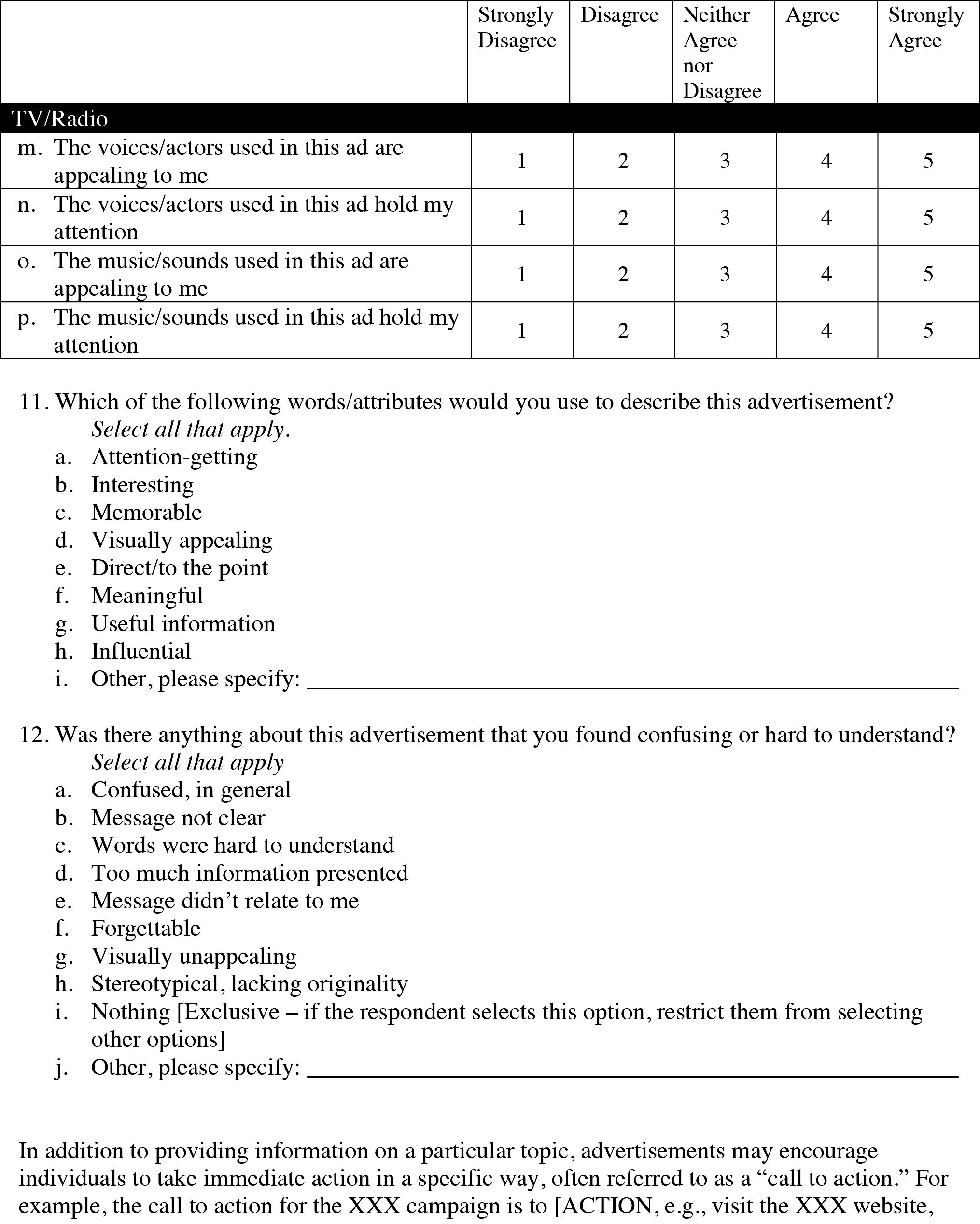
Long Description.
The column headers of the table are Type of media, Strongly Disagree, Disagree, Neither Agree nor Disagree, Agree, and Strongly Agree. The data given in the table row-wise are as follows:
TV or Radio
Row m: The voices or actors used in this ad are appealing to me: 1, 2, 3, 4, 5.
Row n: The voices or actors used in this ad hold my attention: 1,2, 3, 4, 5.
Row o: The music or sounds used in this ad are appealing to me: 1, 2, 3, 4, 5.
Row p: The music or sounds used in this ad hold my attention: 1,2, 3, 4, 5.
11. Which of the following words or attributes would you use to describe this advertisement? Select all that apply.
a. Attention-getting
b. Interesting
c. Memorable
d. Visually appealing
e. Direct or to the point
f. Meaningful
g. Useful information
h. Influential
i. Other, please specify: _____
12. Was there anything about this advertisement that you found confusing or hard to understand? Select all that apply
a. Confused, in general
b. Message not clear
c. Words were hard to understand
d. Too much information presented
e. Message didn’t relate to me
f. Forgettable
g. Visually unappealing
h. Stereotypical, lacking originality
i. Nothing [Exclusive – if the respondent selects this option, restrict them from selecting other options]
Other, please specify: ______
In addition to providing information on a particular topic, advertisements may encourage individuals to take immediate action in a specific way, often referred to as a “call to action.” For example, the call to action for the XXX campaign is to [ACTION, e.g., visit the XXX website,

Long Description.
The text given in the screenshot reads as follows: Text the XXX line for more information, talk to friends and family about traffic behavior, avoid risky traffic safety behavior, or adopt protective traffic safety behavior].
13. Which method are you more likely to use when responding to a call to action?
Select all that apply.
[SAMPLE ACTIONS]
a. Visit the XXX website
b. Text the XXX line for more information
c. Talk to friends and family about traffic behavior
d. Avoid risky traffic safety behavior
e. Adopt protective traffic safety behavior
f. [ADD OTHER ACTIONS AS NEEDED]
14. How likely would you be to take action to [ACTION]?
a. Not at all likely
b. Somewhat likely
c. Moderately likely
d. Very likely
e. Extremely likely
[REPEAT AS NECESSARY]
Thank you for completing this survey. Your responses to the survey will help inform changes to the XXX campaign and to future traffic safety campaigns intended to save lives and prevent injury.
Please go to the following URL to provide your Respondent ID and address or email address if you would like to receive an incentive. This step is intended to keep your contact information separate from your responses to the survey.
This page intentionally left blank.
Abbreviations and acronyms used without definitions in TRB publications: |
|
A4A |
Airlines for America |
AAAE |
American Association of Airport Executives |
AASHO |
American Association of State Highway Officials |
AASHTO |
American Association of State Highway and Transportation Officials |
ACI–NA |
Airports Council International–North America |
ACRP |
Airport Cooperative Research Program |
ADA |
Americans with Disabilities Act |
APTA |
American Public Transportation Association |
ASCE |
American Society of Civil Engineers |
ASME |
American Society of Mechanical Engineers |
ASTM |
American Society for Testing and Materials |
ATA |
American Trucking Associations |
CTAA |
Community Transportation Association of America |
CTBSSP |
Commercial Truck and Bus Safety Synthesis Program |
DHS |
Department of Homeland Security |
DOE |
Department of Energy |
EPA |
Environmental Protection Agency |
FAA |
Federal Aviation Administration |
FAST |
Fixing Americaʼs Surface Transportation Act (2015) |
FHWA |
Federal Highway Administration |
FMCSA |
Federal Motor Carrier Safety Administration |
FRA |
Federal Railroad Administration |
FTA |
Federal Transit Administration |
GHSA |
Governors Highway Safety Association |
HMCRP |
Hazardous Materials Cooperative Research Program |
IEEE |
Institute of Electrical and Electronics Engineers |
ISTEA |
Intermodal Surface Transportation Efficiency Act of 1991 |
ITE |
Institute of Transportation Engineers |
MAP-21 |
Moving Ahead for Progress in the 21st Century Act (2012) |
NASA |
National Aeronautics and Space Administration |
NASAO |
National Association of State Aviation Officials |
NCFRP |
National Cooperative Freight Research Program |
NCHRP |
National Cooperative Highway Research Program |
NHTSA |
National Highway Traffic Safety Administration |
NTSB |
National Transportation Safety Board |
PHMSA |
Pipeline and Hazardous Materials Safety Administration |
RITA |
Research and Innovative Technology Administration |
SAE |
Society of Automotive Engineers |
SAFETEA-LU |
Safe, Accountable, Flexible, Efficient Transportation Equity Act: A Legacy for Users (2005) |
TCRP |
Transit Cooperative Research Program |
TEA-21 |
Transportation Equity Act for the 21st Century (1998) |
TRB |
Transportation Research Board |
TSA |
Transportation Security Administration |
U.S. DOT |
United States Department of Transportation |

Transportation Research Board
500 Fifth Street, NW
Washington, DC 20001


