Gulf-Alaska Knowledge Exchange: Learning from the Legacy of Past Oil Spills: Proceedings of a Workshop Series (2025)
Chapter: 1 Introduction
1
Introduction
During the past four decades, the Southern Gulf Coast region—Alabama, Florida, Louisiana, Mississippi, and Texas—and the Gulf of Alaska have been directly impacted by large-scale oil spills of national significance. On March 24, 1989, more than 10 million gallons of oil were spilled when the Exxon Valdez oil tanker ran aground on Bligh Reef in Prince William Sound in Alaska. Just over two decades later, the Deepwater Horizon oil spill occurred in the waters along the Gulf Coast on April 20, 2010, when a well-blowout triggered an explosion on an oil platform that killed 11 workers and caused more than 134 million gallons of oil to spill into the Southern Gulf. While significantly different in size and scope, both oil spills resulted in devastating long-term environmental, economic, social, and human health impacts, and both regions have subsequently been sites of oil spill response, extensive and long-lasting recovery efforts, and forward-looking advances to improve the safety of the oil and gas industry and prevent future oil spills.
In addition to long-term experiences related to the oil spills, numerous additional parallels can be drawn between these two regions, including a reliance on marine resources, the important role of recreational and commercial fishing, tourism, Indigenous populations living a subsistence way of life, the primacy of the oil and gas industry, and the presence of large-scale shipping operations. Recognition of these numerous connections served as the impetus for this knowledge exchange, so regional representatives could share and learn from their combined experiences related to oil spill impacts
and preparedness. The lessons gleaned from oil spill preparedness, response, and recovery can reciprocally inform future actions in these two regions, or in other regions that might experience oil spills, with the goal of enhancing the efficacy, expediency, and fairness of subsequent regional recovery and resilience-building actions.
To facilitate this knowledge exchange, the Gulf Research Program (GRP),1 a division of the National Academies of Sciences, Engineering, and Medicine,2 assembled a planning committee to develop a three-workshop series to foster information sharing and reciprocal learning between representatives from these two regions. The GRP was formed in 2013 in accord with the Deepwater Horizon BP/Transocean criminal settlement agreements, with a mandate to fund research to minimize future risk to human health and environmental resources, contribute to education and training efforts, and monitor the environment regarding the safety of offshore drilling and hydrocarbon production and transport. The statement of task given to the workshop planning committee by the GRP for this knowledge exchange is in Box 1-1.
Members of the 12-person workshop planning committee contributed expertise in the areas of human health effects of oil spills, ecological restoration from oil, post-disaster socioeconomic recovery, community resilience, and community engagement with stakeholders. While meeting in Seattle in mid-2024, the committee planned workshops for Anchorage, Alaska, in October 2024, Thibodaux, Louisiana, in December 2024, and Washington, D.C., in February/March 2025 that would each focus on aspects of proactive preparedness, response, and transformative recovery after an oil spill.
In planning the workshop series, the committee identified three key objectives they sought to accomplish through the effort. The first was to share lessons learned and identify remaining knowledge gaps around oil spill response, recovery, and preparation for high-risk regions based on experience gained from the Exxon Valdez and Deepwater Horizon oil spills. The second was to foster relationships between community members in the Gulf region and Alaska to bolster community resilience and be better prepared for future oil spills and other disasters. The third was to generate avenues for the exchange of ideas and experiences between various groups
___________________
1 Gulf Research Program. https://www.nationalacademies.org/gulf/about (accessed August 4, 2025).
2 National Academies of Sciences, Engineering, and Medicine. https://www.nationalacademies.org/ (accessed August 4, 2025).
BOX 1-1
Gulf-Alaska Knowledge Exchange Workshop Series Statement of Task
The Exxon Valdez oil spill in Alaska and the Deepwater Horizon oil spill in the Southern Gulf are the two spills of record in the United States that resulted in detrimental and long-lasting environmental, economic, and societal impacts for both regions. In recognition of this shared history, the Gulf Research Program (GRP) will host a workshop series to bring together representatives from both regions to share experiences, knowledge, strategies, and best practices to help prepare for and recover from potential future spills. This effort is in accord with GRP’s settlement agreement language, which refers to reducing risk of future harm to people, the environment, and the economy due to oil spills as a “national priority.”
An ad-hoc committee will plan up to three workshops that engage researchers, practitioners, and other stakeholders from both regions. The specific workshop topics will be developed by the planning committee to ensure they are relevant and beneficial to stakeholders from the two regions, while also being consistent with GRP’s mission and purpose.
of people (i.e., community members, academics, government officials, resource managers, etc.) in the Gulf and Alaskan regions.
To ensure a true dialogue between people from the two regions, travel expenses were provided so individuals could travel to workshops in each region (i.e., many Gulf Coast–based participants were flown to the Alaska workshop, many Alaska-based participants were flown to Louisiana) as shown in Figure 1-1. To ensure balanced representation from both regions, most workshop panels included equal representation from Alaska and the Gulf Coast region. Speakers, presenters, panelists, and additional invited participants were identified and selected from planning committee member recommendations, expert nominations, the National Academies’ internal database, and staff suggestions. Additional invitations were extended to individuals across sectors to increase engagement and provide a larger forum to facilitate the open exchange of experiences, suggestions, and forward-thinking strategies. Strong representation from all key sectors can be seen in Figure 1-2 for all three workshops.
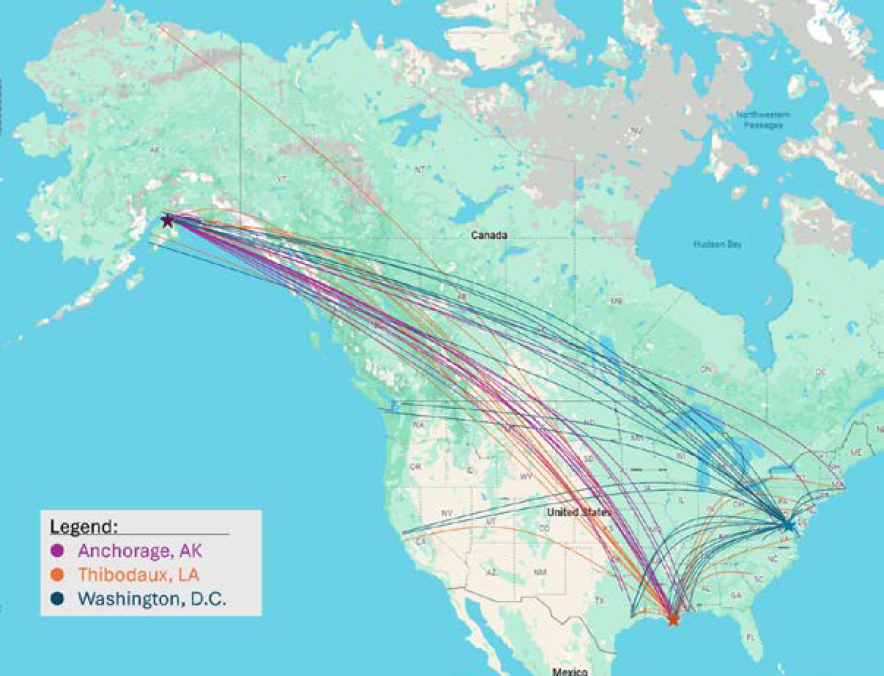
NOTE: Anchorage shown in purple, Thibodaux shown in orange, and Washington, D.C., shown in blue.
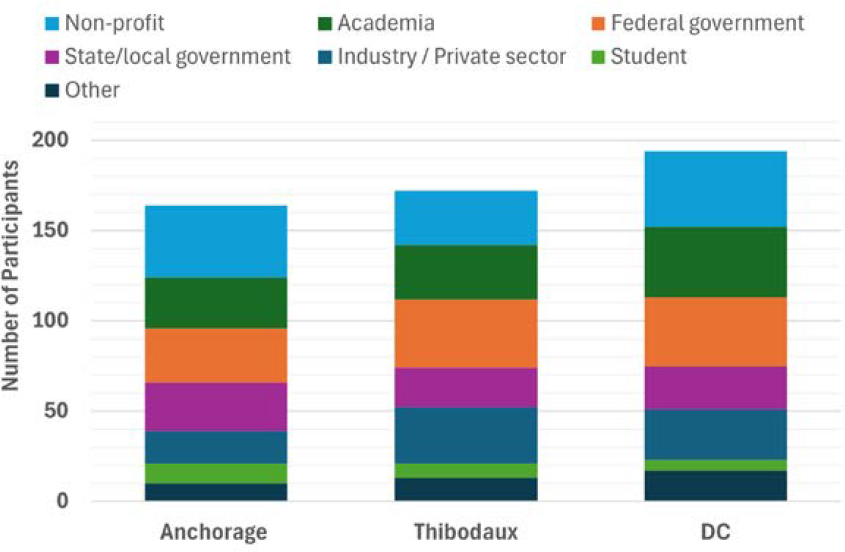
Nine main sessions were held across the three workshops, with close to 200 people attending in person and an additional 200 people participating online. One unique aspect of the workshop format was the emphasis on scheduling extended breakout sessions following abbreviated panel sessions to encourage more personal, small-group discussions and dialogue. The primary discussion topics from these groups (both in-person and online) were then shared with all workshop participants. The composition of the in-person breakout groups was tailored to include representatives from both regions, multiple sectors, and various disciplines to encourage an authentic knowledge exchange that included an array of backgrounds, experiences, and viewpoints. A variety of methods were used to ensure that all participant ideas and feedback were captured, from audio recordings to sticky notes on poster boards.
To capture the rich exchange of ideas and the correlations in lived experiences of people from these two regions, the GRP contracted with the Rational Middle Media video production company to document the workshop series. The Rational Middle team, consisting of Gregory Kallenberg, Chris Lyons, and Jeremy Spring, filmed each workshop and conducted one-on-one interviews with many workshop participants and planning committee members. The resulting video can be found on the GRP website at https://www.nationalacademies.org/our-work/gulf-alaska-knowledge-exchange-a-workshop-series.
This proceedings was prepared by GRP staff as a factual summary of what occurred at the workshops. The planning committee’s role was limited to planning and convening the workshops, and most planning committee members attended at least one—if not all—of the workshops. It should be noted that the views contained in the proceedings are not necessarily those of all workshop participants, the committee, the GRP, or the National Academies of Sciences, Engineering, and Medicine.
This page intentionally left blank.


