Gulf-Alaska Knowledge Exchange: Learning from the Legacy of Past Oil Spills: Proceedings of a Workshop Series (2025)
Chapter: 2 Workshop 1: Anchorage, Alaska
2
Workshop 1: Anchorage, Alaska
The first workshop in the Gulf-Alaska Knowledge Exchange Workshop Series was held at the William A. Egan Civic and Convention Center in Anchorage, Alaska, on October 8 and 9, 2024. This 1.5-day workshop focused on understanding the socioeconomic impacts of the Exxon Valdez and Deepwater Horizon oil spills for the fishing industry, the need for community-driven science, and strategies for increasing proactive preparedness for future disasters by building community capacity in these regions. Many diverse perspectives were shared by speakers, panelists, invited guests, and audience members representing communities, community-based organizations, agencies, and tribes in both regions. All workshop participants—in-person and online—took part in lively group discussions following each panel, and representatives from each breakout group shared their main discussion points and take-home messages with workshop attendees. There was spirited and impassioned participation from both in-person and virtual attendees.
DAY 1 OPENING REMARKS
Ed Levine (planning committee chair) welcomed the workshop attendees and opened the workshop by listing the overarching goals of the workshop series: understanding the socioeconomic impacts from the Exxon Valdez and Deepwater Horizon oil spills, the need for community-driven science, and strategies for proactively increasing preparedness for the future. Levine recounted several challenges he encountered while he was employed
with the National Oceanic and Atmospheric Administration’s (NOAA) Emergency Response Division and was deployed to Alaska after the tanker Exxon Valdez ran aground in Prince William Sound on March 24, 1989.
Levine described finding a chaotic situation when he arrived in Alaska shortly after the spill, and tensions were already running high between the Alaskan citizens and representatives from the state and federal governments. During the 2 years Levine spent in Anchorage, Homer, and Seward, he conducted overflights, shoreline surveys, countermeasures, and training; experimented with different techniques and processes; helped to set up animal rehabilitation centers; attended town meetings; coordinated cleanup-volunteers; and liaised with the media. He described this as a challenging time for everyone involved, with minimal cooperation or coordination between groups working in the region. State and federal agencies and Exxon each employed scientists who took samples and conducted independent analyses. Litigation ensued, discord was rampant, and large amounts of money were made and lost.
Twenty-one years after the Exxon Valdez spill, an explosion occurred on the Deepwater Horizon drilling platform in the waters along the Southern Gulf Coast. The explosion killed 11 workers, caused the rig to sink, and led to a catastrophic, protracted oil release from the well. When Levine arrived, the Incident Command System was in place and substantial resources had already been deployed. There was evident tension between the five states involved—Alabama, Florida, Louisiana, Mississippi, and Texas—and representatives from the federal government. Before the well was fully capped, more than 134 million gallons of oil spilled into the Gulf.
During the next year spent in Houma and at the spill headquarters in New Orleans, Levine oversaw the environmental unit, which provided trajectories, overflights, shoreline surveys, countermeasures, wildlife meetings, town halls, and communication with the media. His team provided substantial scientific advice and support regarding the use of dispersants, employed in situ burns to get rid of the oil, and implemented smart monitoring programs, among other strategies. He described corruption as rampant during this period. “It was pretty amazing to see life in Louisiana at that time and the way they dealt with things,” said Levine. For additional information on the spill, Levine referred people to the National Academies of Sciences, Engineering, and Medicine’s publication Oil in the Sea IV.1 He ended his opening remarks
___________________
1 NASEM (National Academies of Sciences, Engineering, and Medicine). 2023. Oil in the Sea IV: Quick Guide for Practitioners and Researchers. Washington, DC: The National Academies Press. https://doi.org/10.17226/27155 (accessed June 19, 2025).
by asking workshop attendees to think about how they can contribute toward a better future. “We’re always smarter later,” concluded Levine.
Following Levine’s workshop introduction, David Daniel (president emeritus, University of Texas at Dallas, and chair of the Gulf Research Program’s [GRP] Division Committee) provided a brief history and overview of the GRP. He described the GRP’s three primary pillars—offshore energy safety, environmental safety and stewardship, and human health and community resilience—and described how science grounds and informs all of the GRP’s work. Davin Holen (planning committee member) delivered a Land Acknowledgment. During his brief comments, Holen acknowledged the Dena’ina people who originally lived and settled the land where the workshop was taking place and recognized their adaptation skills and respect for the region’s lands, waters, and wild resources.
Donna Schantz (executive director, Prince William Sound Regional Citizens’ Advisory Council [PWSRCAC]) continued the opening remarks by briefly describing the Exxon Valdez oil spill. In March 1989, the Exxon Valdez, one of Exxon’s newest ships, was carrying 53 million gallons of North Slope crude oil when it ran aground on Bligh Reef in Prince William Sound and spilled an estimated 11 million gallons of oil (see Figure 2-1). Calm weather immediately after the spill allowed for some spill containment using available equipment and personnel on hand, but when storms moved through the area, the oil moved southwestward out of the sound. By day 56 after the spill, the oil had spread 470 miles past Kodiak Island. At the time this spill was the largest single-point release of oil in U.S. waters.
Immediately after the spill, efforts were made to address the inadequacies of spill prevention and response, though “little was done to address the social and psychological impacts of the disaster,” said Schantz. An emergency order was put in place by the State of Alaska’s governor that formed the basis for Alaska’s response planning standards, which were and still are some of the strictest standards in the country at the federal level. The Prince William Sound Council was formed after the Exxon Valdez spill, and a contract was established between the council and Alyeska Pipeline Service Company that guaranteed annual funding and ensured independence from Alyeska. “The advisory council provides a mechanism for citizens to have a seat at the table, to have a voice, and to involve those who have the most to lose from the disasters. It’s a very powerful tool,” explained Schantz. The council helps build resilience after a disaster and provides a mechanism for shared responsibility and ownership, where otherwise many people would feel powerless and discouraged.
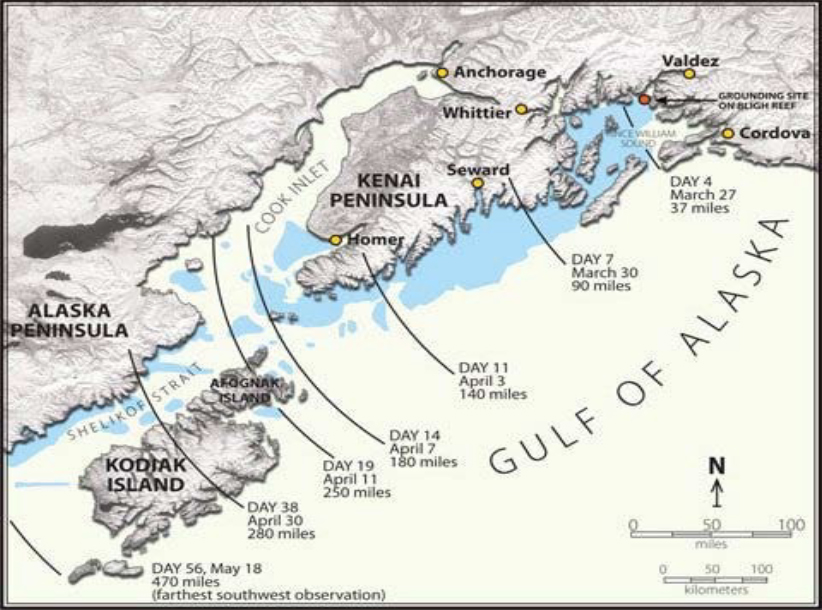
NOTE: The orange circle in the upper right-hand corner shows the grounding site and the area shaded in blue depicts where the oil moved.
SOURCE: Composite done by the Exxon Valdez Oil Spill Trustee Council from 1993 State On-Scene Coordinator’s Report.a
a Alaska Department of Environmental Conservation. 1993. The Exxon Valdez Oil Spill: Final Report, State of Alaska Response. https://babel.hathitrust.org/cgi/pt?id=uva.35007000667273&seq=5 (accessed August 6, 2025).
During the George H.W. Bush presidency, the Oil Pollution Act of 1990 (OPA 90) was passed.2 This comprehensive piece of legislation included details such as adding a light on Bligh Reef, requiring enhancements to the Coast Guard’s vessel traffic system, improving prevention and response, and requiring that two escort tugboats accompany each laden single-hull tanker through Prince William Sound. OPA 90 also created organizations such as the Oil Spill Recovery Institute and mandated two Regional Citizens’ Advisory Councils (RCAC)—the PWSRCAC and the Cook Inlet Regional Citizens’ Advisory Council (CIRCAC). Both provide a voice for citizens in decisions that affect the safe transportation of oil—though each operates independently and oversees a different geographic
___________________
2 Oil Pollution Act (OPA) of 1990, P.L. 101-380, 101st Congress, August 18, 1990. https://www.govinfo.gov/content/pkg/COMPS-2991/pdf/COMPS-2991.pdf (accessed June 18, 2025).
area—and they strive to work together and collaborate on issues of mutual concern. Congress found that complacency on the part of industry and regulators was a major factor in the Exxon Valdez oil spill and that involving local citizens was one way to combat complacency. “We consider ourselves an anti-complacency group,” said Schantz.
Schantz described some of the initial and ongoing impacts of the Exxon Valdez oil spill on the environment and the people living and working in the region. “There’s an estimated 23,000 gallons of oil remaining in the subsurface of beaches and islands in Prince William Sound,” said Schantz. Seabirds, otters, harbor seals, killer whales, and an untold number of herring, salmon, and fish species have perished. There were major social and economic impacts as the spill devastated coastal communities and towns. Drug abuse, divorce, and suicide all increased as people’s livelihoods were uncertain, and their futures were unknown. Fisheries operations and Alaska subsistence lifestyles were also greatly affected.
The PWSRCAC’s board of directors consists of 19 member organizations, with each representing a region affected by the oil spill and their related communities, including those related to commercial fishing, hatchery aquaculture, native recreation, tourism, and environmental groups. Each member organization designates a representative who works as an unpaid volunteer on the board of directors to promote the council’s mission. Five technical committees, composed of unpaid volunteers, focus on different aspects of the council’s work. There is an Oil Spill Prevention and Response Committee and a Port Operations and Vessel Traffic Systems Committee that advocate for the best available technology to escort tugboats and oil tankers. A Scientific Advisory Committee conducts independent research, including research focused on the social sciences, and a Terminal Operations and Environmental Monitoring Committee promotes improved air and water quality and best practices for operations and maintenance at the terminal. An Information and Education Committee fosters public awareness, responsibility, and participation through education and youth involvement activities. Between the board and the five technical committees, approximately 45 unpaid volunteers devote their time, energy, local knowledge, and expertise to promote the PWSRCAC’s mission. In addition to volunteers, the PWSRCAC has about 18 paid staff and continues to operate with support from the contract with Alyeska Pipeline Service Company. This contract allows for complete independence from the oil industry and provides funding for hiring technical experts and conducting scientific research as well as providing access to facilities,
personnel, and documentation. After the Deepwater Horizon spill there was an effort to form a citizen’s council for states in the Gulf Coast region that was not successful. “I think that this is something that is worthwhile to continue advocating for,” said Schantz.
“Prince William Sound Regional Citizens’ Advisory Council has accomplished quite a bit since its inception,” explained Schantz. The council was largely responsible for Environmental Protection Agency (EPA) regulations that greatly reduced the amount of hazardous air pollutants—including the cancer-causing agent benzene—that were being emitted from the terminal. The council also advocated for and succeeded in amending the two-tugboat escort requirement included in the OPA 90 legislation to also include all double-hull tankers. RCAC members consider these requirements to be the primary prevention measures they have in the Prince William Sound for oil tankers. The council also considers an ongoing Government Accountability Office (GAO) review of regulatory oversight at the terminal to be an accomplishment. For the past 10 years, the RCAC has been concerned about their perceived reduction in state and federal regulatory oversight at the terminal, primarily due to budget and staffing cuts, reorganizations, and high turnover leading to loss of institutional knowledge among the state and federal regulatory agencies. Considering these concerns, the council was successful in getting Alaska’s congressional delegation to request a GAO review of the oversight. This report was subsequently published in June 2025.3
Another council accomplishment highlighted by Schantz is the release of a Coping with Technological Disasters guidebook.4 After the oil spill, the council consulted with socioeconomic and technical disaster experts to study the community of Cordova, Alaska and build a mitigation program. From that effort, the guidebook—which includes a peer listener training program—was produced, and these materials have been updated several times since the spill. Recently, these materials were shared with a consortium of Sea Grant Programs in the Gulf Coast so that they could be adapted for communities in the Gulf region. “I think there is a lot more that can be done in this area to expand upon these materials, and also to try to promote
___________________
3 GAO (Government Accountability Office). 2025. Trans-Alaska Pipeline: Clarifying the Roles of Joint Pipeline Office Agencies Would Enhance Safety Oversight. GAO-25-107390. https://www.gao.gov/assets/gao-25-107390.pdf (accessed July 28, 2025).
4 PWSRCAC (Prince William Sound Regional Citizens’ Advisory Committee). Coping with Technological Disasters: A User Friendly Guidebook. https://www.pwsrcac.org/wp-content/uploads/Coping-with-Technological-Disasters-A-User-Friendly-Guidebook-Version-4.pdf (accessed March 11, 2025).
them a little bit more ahead of a spill to increase preparedness,” explained Schantz.
The Vessel of Opportunity program rounded out the list of council accomplishments described by Schantz. This program coordinates more than 350 precontracted local fishing vessels and their crews in Prince William Sound to help mitigate impacts on the environment, people, and communities. “We consider it the backbone of the response system,” emphasized Schantz, and the response capabilities of Alyeska and their ship escort response vessel system serves as a model used around the world. Schantz described that, ironically, the use of these vessels is currently being threatened by the Coast Guard. She explained that members of the RCACs believe that the Coast Guard’s misinterpretation of a 2023 law5 that was intended to support the Vessel of Opportunity program could instead lead to its dismantling, which would negatively affect Prince William Sound and the rest of the nation. Currently, the PWSRCAC and the CIRCAC are part of an industry-wide effort to try to correct this misinterpretation through additional legislation or a modification of the 2023 legislation.
Schantz ended her talk by describing a conversation she had with Stan Stephens, a mentor and founding member of the PWSRCAC. Stephens operated a glacier and wildlife tour boat company in Valdez at the time of the spill and then switched to working on spill response immediately after it occurred. When Stephens was asked how he was affected by the spill, he said that “it was like losing many, many members of his family all at one time,” and that really resonated with Schantz. She described how scars are left for those who suffer the consequences of an oil spill, and although those scars can never be erased, there can be healing, and there are ways to mitigate those impacts. “With really the right understanding of the impacts, and an open exchange of ideas and active listening like this workshop is designed to do, we can find ways to better prepare and build community resilience… and readiness,” concluded Schantz.
SESSION 1: SOCIOECONOMIC IMPACTS
Session 1 of the workshop—featuring two panelists from Alaska and two from the Gulf region—focused on the immediate and longer-term,
___________________
5 James M. Inhofe National Defense Authorization Act for Fiscal Year 2023, P.L. 117-263, 117th Congress, December 23, 2022. https://www.congress.gov/117/plaws/publ263/PLAW-117publ263.pdf (accessed June 26, 2025).
socioeconomic impacts of oil spills and oil spill responses. Moderated by Fran Ulmer, the panel featured perspectives from Sheri Buretta and Torie Baker from Alaska and Sandy Ha Nguyen and Beth Gendler from the Gulf Coast.
Opening Remarks from Moderator
Fran Ulmer (former lieutenant governor of Alaska, 2010 BP Deepwater Horizon Commission member,6 and planning committee member) opened the panel discussion by explaining that she was serving in the Alaska State Legislature when the Exxon Valdez oil spill occurred. After the spill, the legislature charged a special committee with exploring not only what happened in terms of the spill but also what could be done to help local communities. When her committee held hearings throughout the Gulf of Alaska region, she recalled hearing about the pain, suffering, anger, and fear experienced by people who came before the committee. “It was such an unimaginable disaster that they couldn’t really begin to comprehend what it would mean to their families, their lives, or their communities,” said Ulmer. Years later, when she served on the BP Deepwater Horizon Oil Spill Commission and hearings were held, the members of the commission heard similar sentiments and concerns—fear, anger, pain, and uncertainty. There was a tremendous sense of loss and an unwillingness to accept the unimaginable scale of the spill’s impacts. “Even though these places seem very different in some ways, they are really quite similar,” said Ulmer. Oil and gas production, fishing, tourism, culture, and local reliance on resources are all vitally important in Alaska and in the Gulf Coast region, yet a deep sense of loss remains in these regions as well. Ulmer emphasized that the aims of the workshop are to bring people together, to listen and learn from each other, and to strive to create a broader sense of community, based on not only what has happened, but also what can be done differently in the future.
Panelists’ Remarks
Sheri Buretta (Alaska Native leader and board chair for the Chugach Alaska Corporation) began her remarks by describing the Chugach Alaska
___________________
6 Executive Order 13543—National Commission on the BP Deepwater Horizon Oil Spill and Offshore Drilling, May 21, 2010. https://obamawhitehouse.archives.gov/the-press-office/executive-order-national-commission-bp-deepwater-horizon-oil-spill-and-offshore-dri (accessed June 17, 2025).
Corporation (formerly known as Chugach Natives, Inc.), which represents one of two regions that were formed during the Alaska Native Claims Settlement Act.7 The Chugach region includes Tatitlek, Valdez, Cordova, Port Graham, Nanwalek, Chenega, and Seward, all of which fall within the area directly affected by the Exxon Valdez oil spill. Buretta explained that though it has been 35 years since the Exxon Valdez oil spill occurred only 3 miles from her family’s village of Tatitlek, it seems like yesterday, and residual oil from the spill still exists in the environment. It has taken a long time for her to speak publicly about the effects of the spill, but she believes it is important to share how even though decades have passed since the oil spill occurred, people living in the Chugach region are still experiencing residual social and economic effects.
Buretta referenced a speech called The Day the Water Died,8 which was written by Walter Meganack, a Village Chief from Port Graham, that describes her peoples’ way of life and the effects the oil spill had on their communities. Following his example, her remarks focused on some of the impacts her people had from the oil spill and some of the challenges they are still facing today. Buretta explained that the primary mission at the Chugach corporation is profitability. In 1991, 2 years after the Exxon Valdez oil spill, the Chugach Alaska Corporation had to file for Chapter 11 bankruptcy. Without profitability, other aspects of the corporation’s mission—celebration of her peoples’ heritage and ownership of their land—are threatened. Since the bankruptcy filing, the Chugach Alaska Corporation has successfully secured government contract work and developed a commercial division that works in the state of Alaska. These efforts allowed the corporation to emerge from bankruptcy in 2000, after which shareholders began receiving dividends.
The Alaska Native Claims Settlement Act in 1971 gave Chugach Natives, Inc., ownership of their lands, but the original settlement primarily included only mountaintops and glaciers. A decade later, Chugach Natives, Inc., sued the federal government for an equitable land settlement and eventually received an agreement awarding it nearly a million acres of surface and subsurface estate. Buretta explained that there were also other lawsuits. In 1991, the Exxon Valdez Oil Spill (EVOS) Trustee Council, comprising
___________________
7 Alaska Native Claims Settlement Act (ANCSA), 43 U.S.C. 33 §§1601–1629h, December 18, 1971. https://www.govinfo.gov/content/pkg/STATUTE-85/pdf/STATUTE-85-Pg688.pdf (June 5, 2025).
8 Meganack, W. June 1989. The Day the Water Died. Speech written by Chief Walter Meganack. https://jukebox.uaf.edu/speech-written-chief-walter-meganack (accessed March 13, 2025).
three state and three federal trustees, was formed to oversee a $900 million settlement between Exxon and the state and federal governments to restore the ecosystem, including human services, that were damaged by the oil spill. Additionally, a $5 billion civil lawsuit eventually resulted in a significantly reduced $507 million award by the Supreme Court two decades later.9
Buretta explained that half of the settlement funds received by the Chugach have been used for scientific research and half for land purchases. The Chugach Alaska Corporation has purchased 242,000 acres of surface estate—mostly native land—of which Chugach retains the rights of the subsurface dominant estate. Buretta became board chair 27 years ago to ensure that Chugach land is not sold, and she continues that fight today. “Until that is done, I won’t be done with my work,” said Buretta.
Buretta discussed how the scientific work by the EVOS Trustee Council has not always been in sync with the aims of the Chugach people. While the Chugach were interested in learning more about oil spill impacts on their people and their food supplies, the EVOS scientists were solely focused on studying the environment, thereby excluding humans from their studies. There have also been conflicts over landownership. The Chugach have developed some of the lands where they own the subsurface, but the surface is owned by the federal government for the EVOS Trustee Council’s Habitat Protection Program. To resolve this split in land-ownership, Senator Murkowski (U.S. senator from Alaska since 2002) submitted a bill in the 118th Congress titled the Chugach Alaska Land Exchange Oil Recovery Act of 2024,10 but this split has yet to be resolved. When some of the Chugach land was purchased, the Chugach lost access to artifacts and human remains. “We have a lot of challenges moving ahead,” said Buretta. In concluding her comments, Buretta stressed how proud the Chugach are to be protecting their homeland, and they will continue to do so. The Chugach recently built the Chugach Naswik Suites, a hotel, in Valdez. They are also building a village in the city that will have a focus on science, technology, engineering, and mathematics and traditional ecological knowledge. To maintain their culture, the Chugach have leveraged funds from the EVOS Trustee Council to start the annual Nuuciq Spirit Camp and Tatitlek Lake Cultural Camp. These camps have been in operation for 30 years.
___________________
9 Exxon Shipping Co. v. Baker, 554 U.S. 471 (2008). https://supreme.justia.com/cases/federal/us/554/471/ (accessed June 7, 2025).
10 Chugach Alaska Land Exchange Oil Spill Recovery Act of 2024, S. 4310, 118th Congress, May 9, 2024. https://www.congress.gov/index.php/bill/118th-congress/senate-bill/4310/text (accessed July 28, 2025).
Sandy Ha Nguyen (founder and executive director of the Coastal Communities Consulting Group) began her remarks by sharing that everything she knows about preparedness she learned through her work with coastal families and commercial fishermen living along the Gulf Coast. Her office was established following the Deepwater Horizon oil spill, and since that time, she has honed her expertise on disaster recovery and learning how to maximally benefit fishermen in her seven-parish region.
Only 5 years into the recovery from Hurricane Katrina, the Deepwater Horizon oil spill occurred close to the town where Nguyen lived. Nguyen was 14 years old when she first started working on her parents’ behalf to help them recover from the oil spill, and she continued to do this work for community members through high school and college without earning a salary. Over the years, she has worked with thousands of fishing families to help them receive settlements. “I have intimate relationships with all these families,” explained Nguyen. She believes that BP had good intentions when they took responsibility for the spill after the Deepwater Horizon disaster; however, despite the company’s attempts to compensate those who were affected, things did not go smoothly. Her organization ended up processing approximately $45 million dollars in settlement claims for free through translation and financial training. Despite these successes, she is still concerned about the extreme mental health challenges that her community members experienced because of the oil spill.
Nguyen believes that much of the tension between BP and her community was the result of inadequate information sharing. Two big issues her organization and community struggled with were sharing information and translation, meaning not only translation from English to Vietnamese, Cambodian, or Spanish, but also the process of translating the spill-related science to standard terminology and making sure its meaning was understood by members of her local fishing communities. Nguyen provided a personal example of these translation challenges by sharing that there was a time when she did not understand the meaning of the word conservation when it was mentioned in scientific materials, and if fishermen complained about conservation efforts, she would get angry along with them because they all thought this was something that would harm their community. It was not until she learned what was meant by the term that she could start educating the local fishermen about why conservation was important for their community and their livelihood.
Nguyen believes the community members she works with possess invaluable local expertise in land and water issues specific to their area, and she questions why government agencies, researchers, academics,
and policymakers do not include members of her fishing community in conversations pertaining to issues such as conservation. Recently, NOAA initiated some “environmental projects from the bottom up and this has worked well,” said Nguyen. She is not convinced that her organization or community have all the answers they would need if another spill occurred, but she is eager to learn more so that she and the people she represents can be better prepared, should that happen.
Torie Baker (Cordova Marine Advisory Program agent, Alaska Sea Grant Advisory Committee, and commercial fisher) began her remarks by describing her 30 years of connection with the commercial fisheries in Prince William Sound and elsewhere in Alaska. When Baker enthusiastically moved to Alaska, the oil pipeline from the North Slope had already gone in and the Native Claims Settlement Act of 1971 had already become law. By the time of the spill, she had worked at several fisheries, had invested in her business, been married, and had started to raise a family. She was just beginning her career in 1989 when the Exxon Valdez ran aground on Bligh Reef in Prince William Sound.
Baker explained that Alaska has more than 40,000 miles of coastline and the Alaskan fishing industry is sustained by more than 50,000 people, including about 32,000 individual fishermen with families and businesses. The fishing community is composed of the fishermen who catch the fish and work directly with customers, the processors, and the people who buy the fish. There are 532 individual fishing operations in the salmon gillnet fishery and 200 seiners. On the distribution side, there are five major processors located in the port of Cordova—of which four are international processors—along with a collection of smaller family-owned, multigenerational operators. Baker stressed this distinction, saying there were certain dynamics in the post-spill litigation that involved the larger processors that did not trickle down to the individual litigants.
Baker advised that people in fishing communities should adopt social and fisheries scientists as early as possible, even if it is during a spill, explaining that the researchers can regularly collect samples, and if there were to be a spill, their data would be readily available for any subsequent legal proceedings. These relationships already exist in Alaska, because a very robust management system puts the offices and research institutions in the Alaskan coastal communities, including isolated communities. Baker explained that if another oil spill occurs in Alaska, there is already a strong relationship between researchers and members of the fishing industry, which would be especially important because after a spill there are often competing interests
vying for the researchers’ data. Baker encouraged researchers to reach out to local communities often and be there as often as possible.
In closing, Baker highlighted the work of social scientists, Dr. J. Steven Picou and his collaborators Dr. Duane Gill and Dr. Liesel Ritchie. Dr. Picou’s team started surveying Alaska community members after the Exxon Valdez spill and they continued to do so for 20 years, including through the extended litigation. Baker emphasized that through all this time, Picou’s team worked respectfully and quietly within their communities and in doing so, they were able to accumulate high-quality research that was rich with social and economic data. “They came, and then they came back again and again, and we appreciated that,” concluded Baker.
Beth Gendler (president and CEO of Gulf Shores and Orange Beach Tourism) began her remarks by describing Gulf Shores and Orange Beach, Alabama, two small tourism-dependent cities along the Alabama coast. Despite their relatively small populations (a combined residential population of 20,000–25,000 people), these cities are major tourism destinations for fishing, sports, and conventions, and they offer tourism-focused amenities such as a 10,000-seat amphitheater, 200 restaurants, and a plethora of shopping options to satisfy the needs of their out-of-town visitors. Over 80 percent of the city budgets for these municipalities come from bed tax, retail sales, and business licenses.
After the Deepwater Horizon oil spill occurred, Gulf Shores and Orange Beach residents had no idea what would happen to their respective cities and their livelihoods. They grappled with questions such as whether they should move, what would happen to the city businesses and their jobs, and what would happen to their 32 miles of white, sandy beaches. “You couldn’t fathom what happened and what the depth of it would be,” said Gendler. While they had diversity in their tourism product, the beaches and the water sports activities were the main attractions for tourists. People could still travel to these areas to participate in a sports tournament or stay in a hotel or a condo, but without the beach, these areas lost their main attraction, and thus their wide appeal to attract visiting tourists.
Gendler explained that the primary focus of her organization is to invite people to the Gulf Shores and Orange Beach areas with the goal of enhancing the quality of life for everyone—business owners, residents, and visitors. In 2009, the year before the Deepwater Horizon oil spill, their county welcomed approximately 4.6 million visitors who spent around “$2.3 billion and supported 40,000 jobs and almost a billion dollars in wages and salaries,” said Gendler. After the oil spill occurred in April 2010,
those tourism dollars decreased precipitously, declining by 42 percent in bed tax alone, not including lost retail sales and other spending declines in the region.
Facing the uncertain fate of the local tourism industry after the spill, Gendler’s organization pivoted from tourism marketing to crisis management and leaned into relationships that had been cultivated over the years. These relationships—with elected officials, their tourism customers, members of the Chambers of Commerce, and scientists from the Mississippi–Alabama Sea Grant Consortium—became vitally important after the spill. Gendler and her staff worked with elected officials and members of the Federal Banking and Finance Committee regarding issues such as how to avoid devaluing mortgaged businesses, charges levied from properties being devalued, and foreclosure. They worked with local Chamber of Commerce members to help business owners file oil spill–related damage claims and with Chamber of Commerce members and business owners to form a Coastal Resiliency Coalition. Her staff helped fishing charter captains join the new Vessels of Opportunity program since they were no longer able to operate fishing charters in the Gulf.
“Clear, transparent, and honest communication and taking full advantage of the BP mitigation dollars,” said Gendler, were key to the area’s recovery after the oil spill. Furnished with scientific information and materials provided by Mississippi–Alabama Sea Grant Consortium staff, Gendler’s organization was able to provide relevant and comprehensible scientific information to visitors and potential tourists regarding immediate effects on fish and wildlife, and potential long-term effects to the Gulf region and to the fishing complex, among other issues. They hired a local newscaster to feature live feeds from the beach, and their social media outreach increased threefold with people following what was happening. Using these strategies, Gendler’s organization was able to provide accurate up-to-date information, so people did not need to solely rely on media reports.
Gendler explained that other strategies were also helpful. The State of Alabama provided mental health counselors for people grappling with stress and uncertainty after the spill. Mitigation dollars from BP were used to purchase large ads that allowed the cities to tell their story and let their loyal customers know that these areas would rebound and survive. These funds also paid for advertisements to promote the Alabama coast to people unfamiliar with Alabama beaches, and to let people know that the Gulf coastline was going to recover. These efforts were vital in contributing to these cities’ rebound and sustaining and building the success of this region.
Through these efforts, Gulf Shores and Orange Beach have bounced back. Gendler described how last year Alabama welcomed 8.4 million visitors to the county, of whom 6.5 million went to Gulf Shores and Orange Beach and spent $6.5 billion and supported 55,000 jobs in the travel and tourism industry. Many lessons learned will inform their future planning. “We had some successes that came out of a huge tragedy,” concluded Gendler.
Socioeconomic Impact Panels Q&A
Following the panelists’ remarks, Fran Ulmer asked them to reflect on any helpful insights gained since the oil spill occurred, and what recommendations they have for individuals or communities to be better prepared if another oil spill occurs. Beth Gendler stressed the importance of building relationships before disasters strike and suggested that existing crisis plans (i.e., for hurricanes) can be adapted for use during manmade disasters. Lessons learned from other crises—such as alternate communication methods—can be adapted and useful for other times of need. Sandy Ha Nguyen emphasized the importance of understanding issues related to money, politics, and the potential for corruption when an oil spill occurs. She also stressed how difficult it is to adequately address mental health issues related to dealing with the myriad repercussions of a spill for community members already struggling to make ends meet. Sheri Buretta responded that the Chugach would demand a seat on the EVOS Trustee Council and would have a better understanding of the politics that drive recovery funds. She would emphasize building in her community, establishing relationships with scientists, and hiring independent scientists to investigate potential human impacts from the spill.
Torie Baker suggested that people should seek creative solutions and be open to the “spontaneous genius” that can occur when people are under duress. She shared that a couple years after the Exxon Valdez oil spill, pink salmon were not recovering, fishermen could not make state loan payments, and no loan relief was available. The Exxon Valdez Oil Spill Trustee Council was in disarray, and Exxon was ignoring their concerns. The Alaskan fishermen found that no one was listening or willing to help. One day after an impromptu meeting, around 80 fishers decided to draw attention to their concerns by using their boats to form a blockade in the Valdez Narrows to prevent the passage of oil tankers (see Figure 2-2). The blockade was in place for 3 days before the first oil tanker was allowed through. The blockade got the attention of people from several different sectors, from President Clinton and Secretary Babbitt of the Department of Interior to representatives
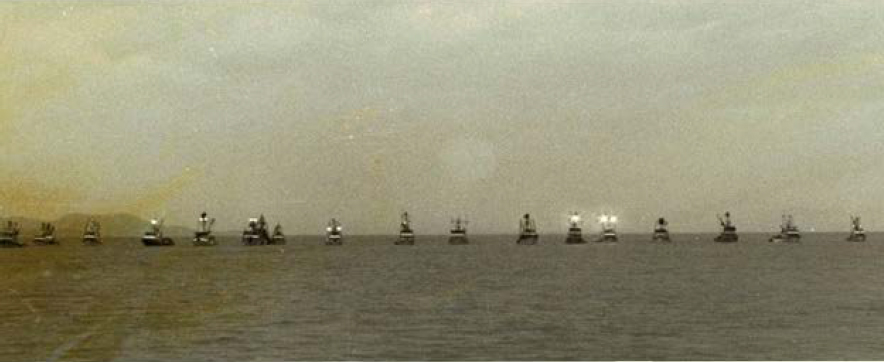
SOURCE: Jack Hopkins, Cordova District Fishermen United.
from Exxon. This spontaneous action galvanized people and provided an opportunity for fishers to articulate how the spill was still affecting them. In concluding her remarks, Baker urged people to “listen to the people who are closest to the waters, because they’re doing amazing things … they’re very articulate … they love where they live, and they love what they’re doing.”
Closing Remarks from Moderator
In bringing the socioeconomic panel to a close, Fran Ulmer briefly described the congressional response that occurred after the two spills. After the Exxon Valdez spill, Congress resolved its differences and unanimously passed the OPA 90. This important piece of legislation included some unwelcome restrictions on the oil industry. “It has made a huge difference in protecting the lands, waters, resources, and the people who rely on those resources for their well-being and their economies,” said Ulmer.
After the Deepwater Horizon oil spill, several recommendations were made to Congress—including the establishment of regional bodies very similar to the RCACs in Alaska—but none of these passed in Congress. “Industry was opposed and industry won,” said Ulmer. Congress did pass the RESTORE Act, which gave approximately 29 billion dollars to the Gulf region to support restoration and recovery.11 While these funds were
___________________
11 Resources and Ecosystems Sustainability, Tourist Opportunities, and Revived Economies of the Gulf Coast States Act, H.R. 4348, 112th Congress, July 6, 2012, amendment to the Moving Ahead for Progress in the 21st Century Act (MAP-21), in response to the Deepwater Horizon oil spill. https://home.treasury.gov/policy-issues/financial-markets-financial-institutions-and-fiscal-service/restore-act (accessed June 5, 2025).
welcomed, explained Ulmer, “times have changed in terms of actually being able to implement the kind of regulatory changes that are an important piece of prevention.”
In closing, Ulmer stressed the importance of prevention. “There is no oil spill where you can recover all the oil. There is no oil spill that isn’t going to have impacts on humans as well as the environment. There is no oil spill that isn’t going to result in the kind of mental health issues and economic shocks that we’ve been talking about. The only answer is prevention.” Ulmer explained that people who care about the impacts of oil spills and are interested in avoiding the consequences should focus on the topic of prevention—even if that can result in making some businesses unhappy—to avoid having to have panels like this when the next oil spill happens. “We all have an obligation to avoid that,” concluded Ulmer.
Facilitated Breakout Session 1
This breakout session asked workshop attendees—in-person and online—to identify and refine approaches to decrease socioeconomic impacts of oil spills. Reactions to the first session of the workshop underscored how deeply personal and long-lasting oil spill impacts are for communities, with many groups emphasizing that the social and emotional toll of oil spills can last for generations. Participants stressed that preparedness and response must include mental health support and recognize that cultural losses cannot be addressed solely through ecological metrics or economic compensation. Participants emphasized that resilience is rooted in strong relationships, local trust, and cultural continuity, especially among Indigenous communities who face threats not only to subsistence resources but also to the traditions tied to harvesting them. These threats were not described as hypothetical risks, but rather as lived realities in both regions still shaped by the legacy of oil spills.
Groups highlighted the wide-reaching economic consequences of oil spills, noting that immediate losses only scratch the surface. Long-term effects, such as losing access to valuable permits or shortened fishing seasons, cascade through entire communities and industries. They emphasized that preparedness must include support for the full spectrum of local economic systems. Clarifying decision-making authority during spills was seen as essential, particularly when setting protection priorities for ecological and cultural areas. Participants noted the need for pre-spill planning that incorporates traditional ecological knowledge and outlines how fisheries
can safely reopen, including the role of communities in restoring public confidence and addressing mental health consequences.
The limitations of mechanical recovery, which typically captures only a small fraction of spilled oil, were highlighted several times. Multiple groups emphasized the importance of building partnerships well in advance of disasters, with trained local fleets and equipment pre-positioned and regularly exercised. The success of Alaska’s RCACs and newly emerging stakeholder committees were cited as a model for embedding communities into response systems.
Communication challenges, particularly during the chaos of a response, were another key theme. Groups pointed out the evolving role of social media, the need for trusted local information channels, and the importance of practicing communication strategies outside of emergencies. Building mutual understanding between residents and outside responders was seen as critical. Multiple groups called for investment in leadership development, particularly among youth, and emphasized the need to embed community resilience measures into institutions before disaster strikes. Participants noted that disasters may be inevitable, but how communities prepare, and who is included in that process, can shape the outcome for decades to come.
SESSION 2: TRANSFORMATIVE RECOVERY
Session 2 of the workshop centered on community-focused science and how to include community well-being in recovery assessments. This session was moderated by Davin Holen (planning committee member) and featured panelists Theresa Dardar and Jane Nguyen from the Gulf region, and Dave Kennedy and R. J. Kopchak from Alaska.
Panelists’ Remarks
Theresa Dardar (president of advisory board, Lowlander Center; elder, Pointe-au-Chien Tribe) kicked off the session by describing how her community was affected after the Deepwater Horizon oil spill. Dardar was part of a delegation from the Gulf Coast region that traveled to Alaska after the oil spill to learn about recovery efforts after the Exxon Valdez oil spill. While the Alaskans were very good hosts, she found the spill responses in the two regions were distinct enough that the strategies they saw in Alaska were not applicable in the Gulf Coast.
Angst and anger in Dardar’s community after the Deepwater Horizon oil spill focused in large part on concerns regarding the safety of Gulf seafood. Shrimping, crabbing, catching oysters, and sport fishing provide not only profits for the fishing community, but also the primary source of sustenance for her community. Immediately after the spill, the Terrebonne Parish president called for an emergency shrimp opening so that fishermen could harvest shrimp before it could be affected by oil from the Deepwater Horizon spill. By the time representatives from the Louisiana Department of Wildlife and Fisheries stopped fishermen from shrimping a few days later, saying that the seafood was now unsafe, her husband had already filled multiple freezers with shrimp caught before the fishing areas were affected by the oil. Even after freshly caught seafood was later tested and deemed safe to eat by NOAA and others, Dardar’s family still only ate what was stored in their freezers—or sold or gave it away to community members—because Dardar’s own private testing results on the freshly caught seafood contradicted the findings of the official tests.
For almost 4 years Dardar’s family and members of her community avoided eating freshly caught seafood because they were not convinced it was truly safe to eat. Since fresh seafood has always been the mainstay of their diet, avoiding seafood meant they had to spend extra money for various groceries—chicken, pork, beef, and other items—causing considerable financial strain, especially since their profits had markedly declined because of constraints on fishing after the spill. Eventually shrimping rebounded and her community resumed eating local seafood, but Dardar would like to see a push to make companies operate more safely. When her husband had the opportunity to work for BP to help clean up oil after the spill, he was taken aback by the numerous safety precautions they required of workers—safety vests, hard hats, safety toe boots, and so forth. Her husband believed the spill would not have occurred if the oil companies adhered to such strict safety protocols prior to the spill.
Dave Kennedy (commissioner, U.S. Artic Research Commission) focused his remarks on the importance of open and honest communication with communities. Kennedy explained that in the past, “there has been a failure to adequately describe the processes that go into a spill response—who the players are, what the process looks like, and how it works, down to and including existing and future scientific research.” Knowing and understanding these specific details could provide some reassurance to affected communities. He has seen many instances when a disconnect exists between Incident Command and local communities and villages regarding basic
information such as the identity of individuals who are going into communities and what they are doing, or how the community can get involved. To remedy this disconnect, Kennedy emphasized the importance of exploring better methods of communication, especially for scientific issues that are vitally important to communities. Kennedy shared an experience of visiting a very rural community that was not affected by the spill. Despite scientific trajectories showing that this community would not experience impacts, the community members were convinced that the water was poisoned. This subsistence community did not have the information it needed to be able to continue to follow its traditional subsistence-based way of life.
In another example, Kennedy described how the commission conducted a series of community briefings after the Deepwater Horizon spill that included members of the Coast Guard and multiple scientists from different disciplines discussing what they were doing and what their findings were showing. Huge crowds would show up and community members were incredibly interested in better understanding the science behind what was happening and trying to get answers to their very well-informed questions. Kennedy stressed that conversations like that should be done more frequently.
While Kennedy has heard about progress being made since the Exxon Valdez spill regarding research that is being conducted and money being spent, he has heard little about science being conducted in coordination with communities. Kennedy posed the question, “How are the local communities and some of that local expertise being used to do that research?” As a member of the commission, he is involved in significant discussions that focus on Indigenous coproduction of knowledge and Indigenous-led research, two strategies that are becoming more prevalent and vitally important when considering scientific research before, during, and after a spill. Kennedy emphasized the need to spend more time thinking about how to involve local communities—including Indigenous communities—and gain and incorporate their knowledge.
Kennedy has been very impressed with the new associations and work that has been done with settlement funds stemming from the previous oil spill; however, he stressed that many Arctic communities surrounding the Bering Strait, Beaufort Sea, and Chukchi Sea have not benefited from the funding. With ship traffic increasing in North Alaskan waterways, there are concerns about how these communities will be supported if there is a spill in this region. People in these communities would like to have some sort of association or co-op and training with state and federal representation. He
would like to find a way to support some of the rural Alaskan communities, so that they have the knowledge, training, capability, and requisite gear to respond if there is a spill, and for this region to be incorporated into and connected to the whole spill response enterprise.
Jane Nguyen (project manager, Boat People SOS) described her work at Boat People SOS, an organization founded in the 1980s with the goal of conducting missions to rescue the Vietnamese boat people in the South Asian Seas. Her organization still works with the Vietnamese refugee communities and regularly helps to rescue the boat people working in fishing communities along the Southern Gulf Coast after disasters. Nguyen sees several similarities between Indigenous fishing communities in Alaska and Vietnamese fishing communities in the Gulf region, because they both have a deep-rooted cultural and economic dependence on fishing. Both fishing communities are vulnerable to environmental and economic impacts and must work to sustain their lives and cultural language and overcome barriers. Whenever manmade or natural disasters strike, there are huge cultural and language barriers when working with federal or state agencies and community organizations.
Boat People SOS has worked with the Vietnamese community along the Gulf Coast on several community-focused science initiatives post–Hurricane Katrina and the Deepwater Horizon oil spill. Nguyen described how the Gulf Coast was still struggling to recover after Hurricane Katrina when the Deepwater Horizon oil spill occurred only 5 years later, further devastating the Vietnamese community and causing unremitting stress for their community members. The pattern has been that these areas are repeatedly hit by disasters before natural habitats and the environment can recover. After the Deepwater Horizon oil spill, Boat People SOS supported several culturally tailored mental health services.
It has been an ongoing struggle for Boat People SOS to help communities keep their livelihoods afloat. Trying to change policies or advocating for the fishermen has been very difficult because the Vietnamese fishermen do not speak the language and representatives from her organization do not want to be their voice. They want these community members to be able to use their own voice to speak for themselves. “The language barrier has been a huge gap in them being able to tell their stories to advocate for policy change,” said Nguyen.
Nguyen explained that when scientists and researchers come into their community offering assistance or wanting to gather data for evidence-based research after a disaster, they should understand that there is a lot of
preexisting trauma and general mistrust of the government in this population, especially among Vietnamese refugees. Immediately after a disaster, people in these areas are overwhelmed with scientists trying to gather data and collect research. Nguyen suggested that the local communities and members of the science community should be proactive and preventative and work to establish and build relationships before a disaster strikes.
Nguyen shared that Steve Picou’s research team worked with members of her community after the oil spill and they were very respectful, culturally aware, and able to bring everyone to the table. She believes that if scientists want to work with the Vietnamese fishing community, they should not approach the community with preconceived research agendas and ideas, talk about how they can make things better, or have community members envision things that are unrealistic or unattainable. In addition, scientists should take a different approach with data collection or damage assessments. Scientific data or research could help communities determine the extent of any environmental damage, what habitats have been destroyed, or what areas are safe for fishing. Data could provide sustainable recovery efforts or suggestions for restoring damaged habitats. Scientific data on ecosystems and habitats are essential for recovery, and putting this information in layman’s terms so that the information can be easily understood by members of the Vietnamese fishing community would be invaluable. “Scientific assessments can be used, and scientists can work with these fishing communities to advocate for policies that can actually make a change for them, and to ensure that the sustainable use of the marine resources goes into the community,” concluded Nguyen.
R. J. Kopchak (development director, Prince William Sound Science Center) began his remarks by making a distinction between two kinds of scientific knowledge—traditional or local ecological knowledge and Western ecological knowledge. Traditional or local ecological knowledge is a way of knowing, understanding, using, and sharing information about the natural world based on being continually immersed in and observing your surroundings and environment. These observations are shared with peers, who confirm or challenge this observation. Over thousands of years the accumulated knowledge becomes deeply entrenched in world tradition, stories, and songs, and carefully preserved by elders, shamans, or other keepers of stories. Community and individual survival depend on the application of this knowledge.
Western ecological knowledge is a way of understanding, using, and sharing information based on observations during limited time frames,
repeating these observations, and then sharing the observation with peers who try to repeat and confirm the observation. The accumulated information is written down and published, reviewed, and amended, and over time becomes part of the published and peer-reviewed literature. Knowledge gained is most often spread across many institutions, but it is siloed and the transfer of the knowledge to those who could use it is severely challenged. Information and knowledge within disciplines is very diverse, and no one individual can know everything that needs to be known for developing comprehensive solutions. Finding solutions depends on individuals with different experiences and expertise working cooperatively and collaboratively.
“Current institutions, and the boundaries of their jurisdictions, do not match the spatial, temporal, or functional scales needed,” said Kopchak. He asserted that there is a tendency to accumulate data but a reluctance to integrate the available data and draw conclusions. Kopchak contended that good science represents what is needed to manage human activities in a rapidly changing natural system. Scale and resolution are relevant and important, and management is a significant challenge. “The solutions are contentious proposals governed by complicated interrelationships of perceived value, private rights, common interests, and corporate greed, along with absent administrators, poor policy, and an almost complete lack of understanding of how healthy ecosystems contribute to maintaining civil society,” said Kopchak. He contended that integrated regional science plans are currently nonexistent, and no efforts have been made to develop the needed databases to model and assess the continued health of any bioregion.
“Effective management must be bioregional in scale and all-inclusive,” said Kopchak. He asserted that components of a bioregion—oceanographic, geologic, hydraulic, and biotic—should be continually synthesized and integrated into a universally accessible knowledge system. Without open access to understandable information on a bioregion, successful management and the ability to develop relevant public policy is jeopardized. Kopchak posited on the need to develop a unique software-based knowledge system that “synthesizes the understanding of the human and natural systems across jurisdictions, disciplines, scales, and time.” The knowledge system would comprise data management and system software shared by agencies and academia to ensure that it is robust and regenerative. “The knowledge system technology would be used to link the ecosystem managers, stakeholders, academics, educators, and tribal communities together
for sharing knowledge, values, … languages …, and perspectives that are personal and sometimes community-wide on the bioregion,” said Kopchak.
From this basis, a new partnership is formed “across these cultures, agencies, and disciplines to study and better understand the challenges of managing the bioregion for long-term resilience.” A knowledge system would be developed that provides integrated and visualized information—spatially and temporally—on natural systems that can effectively serve citizens, educators, researchers, scientists, and resource managers. This knowledge and understanding would be incorporated into the decision-making process through formal and informal education, political engagement, and change, providing place-based perspectives on regional and global issues and challenges.
The challenge of “coupling four-dimensional biological functions to ocean physical problems and properties is a daunting but critical task,” said Kopchak. Effectively managing marine resources during climate shifts or impacts from oil spills will need the development of new natural systems management tools. Kopchak believes that the scale of both bioregions is about right for initiating this effort. He contended that ongoing efforts are commendable and the physical and biological data available offers sufficient opportunity to initiate his strategy. Kopchak stressed that commitment and money limit this effort, which he estimates would cost around $80 million.
Transformative Recovery Panel Q&A
Following the panelists’ presentations, Davin Holen posed a series of questions to the panelists. Responding to a question about strategies for conducting scientific research that is relevant to communities, R. J. Kopchak reiterated that everyone should be involved in developing an integrated system of organizing desired knowledge, with communities—including tribes or aboriginal communities—developing components that contribute to this system. Scientists across disciplines would be challenged to determine how they can integrate their knowledge and research into this system. Kopchak believes that this system can be developed by committing money, time, and agencies, while necessarily ensuring that tribes, industry, and communities are involved along with scientists.
In responding to a question about how to build collaboration, Theresa Dardar described the success of her community’s approximately 15-year engagement with the Mississippi–Alabama Sea Grant as a symbiotic
relationship that allows the community to take an active role in determining priority areas. “We may not have a Ph.D., but we know our lands and we know our waters. We know better than any scientist that comes out from in the community,” explained Dardar. David Kennedy and Jane Nguyen also stressed the importance of incorporating local knowledge and local communities—including Indigenous communities—into scientific studies and suggested that scientists could provide community members with information through workshops or educational pieces on topics such as climate adaptation or sustainable farming techniques.
Jane Nguyen and Dardar responded to a question posed by the moderator asking how communities work toward recovery. Nguyen shared her belief that collaborative science is imperative for equitable recovery. She described equitable recovery in terms of a community being like a fabric that is woven of many threads—representing many cultures, languages, and backgrounds. To transform this fabric of a community, all the threads need to be woven together. Everyone should have a voice in all proposed changes in their communities. She views transformative recovery as the science community, academia, and members of the affected community working collaboratively to find the best possible solutions. Dardar agreed, referring to the idiom one hand washes the other hand. She stressed that ideally scientists and community members should come together and talk about what needs to be done rather than having scientists or other people make determinations for communities. Change began in her community once community members spoke up and let their preferences be known. Dardar highlighted two organizations—Coalition to Restore Coastal Louisiana and Mississippi-Alabama Sea Grant—for letting local communities determine living shoreline locations. “If you have your scientists and community leaders all in the same room, you can make progress,” said Dardar, “but … them coming in and saying this is what we’re going to do, is not going to work.” She also stressed that, especially after a disaster, it is vitally important that people working in communities communicate with trusted community members, meaning the people who actually live, work, and worship in these communities. After the oil spill, she saw communities taken advantage of and outsiders speaking on behalf of communities where they never lived, in order to realize financial gain.
An audience member asked Kopchak to explain how it was practical to move from the current system to the vision he described, especially regarding commitment and money. In response, Kopchak contended that
a paradigm shift from the current approach is needed. He believes that the National Science Foundation (NSF) is the key to this shift in what is happening with the evolution of artificial intelligence, because this innovative capacity for processing and visualizing information is an entirely new frontier. To get people to collaborate, leaders and creative individuals need to visualize a new way of observing and processing information. He believes that connecting information to the regions where people live will enable them to access the information and “incorporate this new envisioning capacity into the education system.” Kopchak is convinced that the talent exists to make the system he envisions a reality if it is sufficiently funded. He stressed that NSF is one of the few entities that has the funding, the capacity, and the vision to pursue this effort.
An audience member questioned Kopchak’s emphasis on academics and NSF, stressing that the primary change needs to be done with and for the communities, and those who have a long-term goal and a long-term trajectory in mind. The questioner suggested that any effort needs to be a coproduction with significant thought given to what structure this should be and what change would need to happen for a whole system approach. “True transformation must be a societal transformation, not just from one of the sectors,” said the audience member. In response Kopchak clarified that his proposed system could be accomplished by an entity other than NSF, though he believes that NSF would have the money and capacity to lead change on a bioregional scale. He stressed that any change would have to slowly build over time and that building a new system would probably take more than a two-decade commitment.
Another audience member asked the panelists to identify one or two strategies that worked and should be continued. Jane Nguyen noted that seafood safety education for fishing communities was one success following the Deepwater Horizon oil spill. Her community was able to bring in scientists to provide educational information on seafood contamination. Workshops were implemented in the Vietnamese language with interpreters provided, and several post-disaster educational workshops and efforts occurred. She stressed that research conducted in a community should be made available to community members once it is completed. Nonprofit organizations and communities across the nation have been able to use scientific data from health journals as a basis for grants and proposals to obtain funding from various sources. Kopchak also mentioned that the EVOS program pioneered important scientific research, and that remarkable efforts
have been made on the geospatial and temporal presentation of complicated scientific concepts.
Facilitated Breakout Session 2
The second session in Anchorage centered on how recovery efforts can be made more effective, equitable, and community driven. The notions that each community possesses unique qualities and that recovery requires flexibility grounded in local context were consistent themes. Participants stressed that no universal templates for response or recovery exist. What works in one place may not work in another, especially when communities differ in size, culture, and governance.
Many groups emphasized that building trust takes time and must begin long before any disaster. Relationship-building, especially with historically underserved or remote communities, requires persistent outreach, listening, and respect. Rather than expecting communities to come to external agencies, the onus is on those institutions to go to communities, understand their needs, and engage them directly. Groups also called for a shift in how community-driven research is approached. Rather than treating local communities as data sources, researchers should start with the priorities and concerns of the people themselves. Multiple groups emphasized that recovery planning must incorporate the voices of those affected and respect local knowledge, even when it challenges scientific conventions. Some also noted that, in cases where scientific support is not possible, it is important to communicate those limits transparently.
Several groups highlighted the importance of integrating mental health and social well-being into recovery. They argued that these are not secondary considerations, but core components of resilience. Response plans must acknowledge that trauma and loss persist beyond the initial cleanup and that mental health support must be in place for both immediate and long-term needs. Groups also emphasized that recovery should not only restore conditions to what they were but also aim to improve them. A few groups mentioned that recovery should leave communities better prepared for the future. There was support for the idea that contingency planning and response structures should incorporate equity, justice, and opportunities for long-term improvement, not merely restoration.
Multiple groups strongly called for movement from short-term interventions toward sustained, transformative recovery. Some questions asked
whether current legal and institutional frameworks allow for system-wide recovery or whether they restrict action to narrowly defined injuries. True recovery should be long term, community led, and supported by institutions that retain both knowledge and relationships over time. Many groups noted that procedural barriers and bureaucracy often slow recovery efforts. Simplifying paperwork, accelerating the flow of resources, and providing immediate support through local or state mechanisms were identified as ways to make recovery more responsive. Several groups pointed out the need to tailor communication strategies to meet people where they are—from social media to printed flyers in public spaces—and to use community feedback to guide messaging. Multiple groups brought up the role of regional organizations and stakeholder committees, which are essential tools for grounding science and decision-making. Participants urged greater support for these efforts in the Gulf region, including stipends and funding for local participation, recognizing that meaningful engagement requires sustained resources and long-term commitment, not just good intentions.
DAY 2 OPENING REMARKS
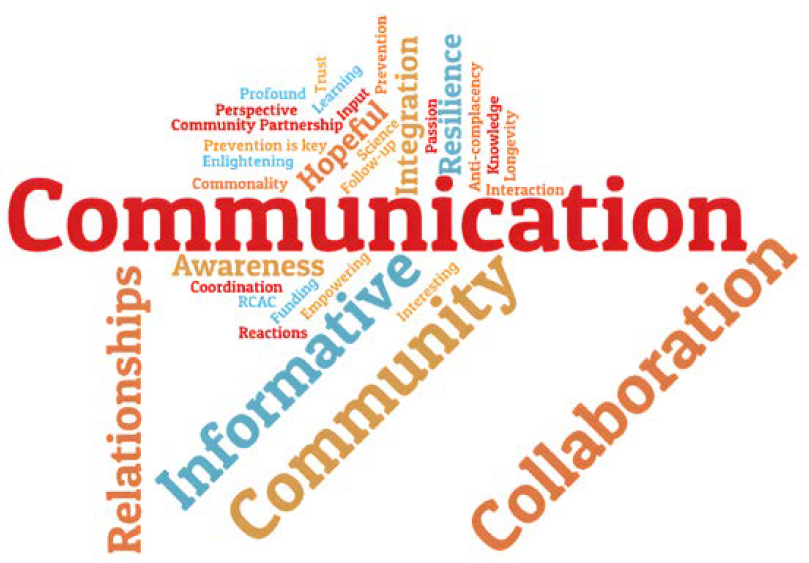
The second day of the workshop began with Ed Levine sharing a word cloud that had been compiled at the end of the first day of the workshop using in-person and online participants’ responses to the question “In a single word, what are some of the key takeaways from today’s discussion?” (see Figure 2-3). Respondents identified communication as the top response and Levine agreed, recalling that communication concerns were the primary topic discussed during most of his response drills and exercises. Levine also shared some of his takeaways from the first day—the importance of building relationships, community involvement with science, mental health issues, and shifting the paradigm.
SESSION 3: PROACTIVE PREPAREDNESS
Session 3 of the Anchorage workshop focused on building community capacity and increasing community awareness and involvement in protocols before spills occur. Moderated by Steve Sempier, the Proactive Preparedness Panel featured perspectives from Jereme Altendorf and Sarah Allen from Alaska and Reverend Tyrone Edwards and Brenda Dardar Robichaux from the Southern Gulf region.
Opening Remarks from Moderator
Steve Sempier (planning committee member) began the discussion by reminding the audience that the panel would be exploring potential strategies to help prepare for the next oil spill or disaster. As an example of preparedness, he referred to Hurricane Milton, a hurricane of record forecasted to hit Florida later that day, and how people in the path were in the final hours of preparing for that storm. He urged the audience to think about the differences between natural disasters and oil spills. Hurricane forecasts usually allow people and communities time to make final physical preparations and check in with friends and families for physical, emotional, and mental support. Conversely, an oil spill is a technological disaster that occurs with little to no lead time, so there is limited opportunity to prepare. “In the age of misinformation, malinformation, and disinformation, it’s even more paramount that we work together on preparedness from the community side, the academic side, the response community, and others,” said Sempier. He also reminded the workshop attendees that in addition to large-scale oil spills, many small-scale oil spills occur routinely in backyards, along beaches, and in fishing grounds, and all spills have the potential to negatively impact individuals and communities. Sempier urged workshop participants to explore how collaborations can help communities better prepare for any disaster.
Panelists’ Remarks
As a very recent Coast Guard retiree, Jereme Altendorf (chief, Director’s Action Team, Ted Stevens Center for Arctic Security Studies), clarified that his remarks were his own and did not reflect the views of the Coast Guard. He began by discussing communications pertaining to area committee work and regional response team meetings in Alaska. Since Altendorf’s move to Alaska in 2017, his work with the Coast Guard involved efforts to modernize the area planning for oil spills by organizing and collectively communicating their work. Drawing from his own experiences, Altendorf shared that attending regional response team meetings is one of the primary ways that communities can be more aware of what the state and federal governments are doing in response to oil and chemical spills.
Altendorf shared his opinion that limited preparedness for oil spills between spills is largely due to ongoing communication challenges and the slow pace of modernization. He remarked that mechanisms for communicating messages from the government to the public are often stymied by the slow adoption of new technologies, funding or budget issues, or other limitations on the government’s ability to adapt and harness the power of newer technology and communication methods (such as smartphones). “Communication in government to the public hasn’t changed in 25 years,” said Altendorf, and this lack of modernization has stymied communication by government to community members and stakeholders interested in understanding oil spill prevention, preparedness, and response. One effort to improve communication resulted in the Coast Guard and the State of Alaska working together and forming a partnership with the University of Alaska Anchorage to augment logistical and technological support. Through efforts like this university partnership, the Coast Guard and the federal government are making strides toward modernizing their modes of communication and improving external communication to communities. Coast Guard Sector Western Alaska and U.S. Arctic is also improving communication through adoption of HTML emails that allow the Coast Guard or EPA planners to manage who receives emails, who opens them, whether they are diverted to junk mail or returned due to inactive email addresses.
Altendorf also believes communication can be enhanced by improving the quality and effectiveness of dialogue between community members and government representatives. He recalled talking to communities about oil spills and finding that the people with whom he met lacked a fundamental
understanding of how government or the Federal Emergency Management Agency (FEMA) worked or failed to understand the difference between how federal agencies and states managed oil spills and chemical spills. “This friction causes some miscommunication,” said Altendorf. He suggested that local communities identify and partner with a government representative or someone in public safety who can act on their behalf as an oil spill or chemical spill expert. Representatives responsible for coordinating oil spill response and communicating how claims are managed also attend area committee meetings. Creating and nurturing these relationships is the best way for communities to stay engaged and prepared since when there is a spill, all the laws are written to make the polluter pay. If any entity owns or operates a bulk fuel farm and those bulk fuel tanks discharge or spill oil for any reason, that entity, to include municipal governments, is now responsible for cleaning up the spill and liable for costs associated with mitigating documented environmental damage from the spill. If a spill from a vessel impacts a coastal community, the state and federal government are going to respond and provide oversight to the responsible party. Regardless of the type of spill, it is always better if there are clear community expectations stemming from a preestablished relationship with a trusted government representative that local communities can work through to learn what is happening and why.
Reverend Tyronne Edwards (founder, Zion Travelers Cooperative) began his remarks by talking about his lifelong commitment to his community in Plaquemines Parish, Louisiana. Coming from this hurricane-prone area, Edwards said that people in his community have “been in preparation all our lives” for the wind and water that can overwhelm their community when a hurricane moves through his parish. After his community was devastated by Hurricane Katrina, they were surprised by how little help they saw going to the city of New Orleans to rebuild. Fearing their small community would also have to fend for themselves after the storm, Edwards founded the Zion Travelers Cooperative with the goal of helping to rebuild and restore their community with little to no government assistance.
When FEMA and other agencies started working in their community after Hurricane Katrina, community members found that representatives from these agencies did not respect their community’s culture or way of life. Unlike in 1965, when the Small Business Administration assisted their community after Hurricane Betsy by helping to rebuild and modernize their homes, community members failed to see the same response after
Hurricane Katrina. “There was nobody coming in to say we’re going to help you rebuild your community,” said Edwards.
Edwards shared several best practices for working with a community after disaster strikes. When representatives from an agency like FEMA enter a community there must be respect for all the people in community, including Indigenous community members, and there should be respect for the wisdom and experience community members have gained from living and working in their communities, often for generations. Rather than arriving with preconceived plans regarding community resources, for example, agency representatives should begin by learning about the community’s priorities. Mutual integrity and trust are integral to finding the best solutions and strategies. He also stressed that agencies must ensure they are dealing with recognized and respected leaders in their communities, leaders whose sole agenda focuses on agreed-upon community objectives and who can be instrumental in helping to develop strategies that work for their community. It is also imperative that there is appropriate community representation when topics are discussed. As an example, Edwards recalled a time when there was a meeting to discuss the Deepwater Horizon oil spill at the Incident Command Center, and William Nungesser (who currently serves as Louisiana’s lieutenant governor) allowed a fisherman to be included in talks because he knew he would be the most knowledgeable about the waters off the Louisiana coast. In closing, Edwards agreed with R. J. Kopchak that it is time for a paradigm shift and that community participation is essential. “I just believe everything we need to do needs to be community driven, because when it’s community driven, it will work,” concluded Edwards.
Sarah Allan (toxicologist, NOAA) introduced herself as a NOAA federal scientist lead for the Natural Resource Damage Assessment process, a science-based legal process that is aimed at restoring public resources that are affected by oil spills, and she has worked on oil and contaminant impacts on aquatic systems for decades. She was born and raised in Alaska, resides on the shores of Kachemak Bay, and lives in the Exxon Valdez oil spill area. She acknowledged that some voices were missing from the conversation, so she would only share her perspective.
Allan believes in the importance of considering the continuum of activities that go into oil spill response and preparedness, starting with prevention and moving through planning and preparedness, emergency response, damage assessment, and restoration and recovery. She emphasized that prevention, planning, and preparedness should continue throughout the time the emergency response happens after an incident. Allan acknowledged that incorporating community involvement in these elements is challenging
since organizations and federal and state agencies have different protocols and mandates for each of these different phases. To help navigate these challenges, she agreed with Jereme Altendorf that it would be helpful to have a point person who can learn to navigate these systems and help incorporate community engagement into the different elements.
Allan also emphasized the importance of having feedback loops between the different elements of oil spill response and preparedness and stressed that collecting feedback and lessons learned should be an ongoing process. What is learned from the damage assessment should inform the emergency response now, and in the future, and all of these lessons should all inform the planning and preparedness process. She underscored that it is imperative to have community input on all the feedback elements and clarified that this process is used for all types and sizes of spills and not just the spills of national significance and other major events.
Allan believes that prevention is key; once an oil spill occurs there might be opportunities to make the impact “less bad,” but there are no good options. For this reason, she believes that prevention is the most important place for engagement, and communities and stakeholders—the people most at risk of being affected by a spill—should have a meaningful way to engage and have oversight in prevention strategies. For Allan, the RCACs in Alaska serve as a very powerful model for having meaningful engagement because they have funding, authority, and an oversight mechanism. Although RCACs have not been successfully established in other areas, Allan believes “it’s an area that’s really worth advocating for as a national model.”
When appraising risk and benefit strategies in relation to oil spill impacts, Allan emphasized that trade-offs must be assessed, and longer-term implications and an ecosystem-wide approach should be considerations for any response. “This holistic approach should necessarily include the people who are part of the ecosystem and dependent on the ecosystem,” stressed Allan. There should also be an emphasis on synthesizing interdisciplinary knowledge, breaking down silos, and getting scientists to talk to one another. “Lessons learned should be integrated into planning and preparedness for all of those different elements of oil spills,” said Allan. For example, Allan shared that quite a bit has been learned about the environmental transport and fate of oil (i.e., how oil moves in the environment after it has been spilled and where it ends up) from previous oil spills. After the Exxon Valdez disaster, spill researchers learned that oil could persist in the shorelines for decades, and from the Deepwater Horizon spill they learned how oil can end up in the water column and the deep-sea environment, and how it could precipitate down from the surface to the bottom through
marine snow. Allan believes that integrating findings such as these into how oil spills are understood is critical. She also advocates for thinking about oil spill fate and effects that are more difficult to observe. Allan cautioned that we tend to focus on the shorelines and the charismatic megafauna—the cute, furry animals—because that is what we see. While these things are important, Allan noted that there are also critical ecosystem elements that are not as visible, such as the deep-sea organisms or fish larvae, that must be considered.
Allan also highlighted the need for greater transparency about uncertainties and unknowns, noting that it is important that scientists do not claim to know more they do. She contends it builds trust when researchers say they are doing their best with the information they have, while acknowledging there are still unknowns. Emergency response inherently involves making decisions based on incomplete knowledge, and it is important that this is understood. She also noted that scientists need to be clear about where science ends and when values come into play.
In closing, Allan talked about the importance of collaboration and communication, and specifically the importance of integrating community knowledge, and priorities into the planning, response, assessment, and restoration elements. She recommended that community engagement occur during the planning and preparedness phase—when there is time to engage with communities in whatever way they are willing and able to engage—rather than only during an emergency response. It is also important to balance the competing priorities of the response and to have the best available knowledge to protect resources while also balancing the rights of the information holders to not share that knowledge or to have proprietary knowledge, such as traditional ecological knowledge, protected. Allan also supports reciprocal rather than one-way communication so that everyone is clear on what is happening and noted that NOAA has an emergency response management application12 that can be helpful. NOAA has had some success working with communities to integrate information and knowledge about the communities’ priority environments and resources, while also protecting that information with robust data security protocols. This platform is then used to share updates regarding the emergency response and damage assessments back to the community in real time or near-real time. “This is not the only tool,” clarified Allan, “but it is a tool that NOAA can leverage to good effect.”
___________________
12 Environmental Response Management Application (ERMA). https://response.restoration.noaa.gov (accessed September 9, 2025).
Brenda Dardar Robichaux (former principal chief, United Houma Nation) began her remarks by describing the traditional way of life for people in the United Houma Nation and how their culture shaped her father’s experiences as a fisherman in the Gulf. Dardar Robichaux explained that the Houma people live along the southeastern coast of Louisiana and their relationship with their land is fundamental to their existence. Their medicines, their ancestral burial ground, plants for basket and doll making, and the fish, shrimp, crabs, and oysters her people harvest are all tied to the land. Her father attended the local settlement school, which only provided classes through the 7th grade. When he could no longer attend school, he went trawling and became an oysterman harvesting wild oysters. Dardar Robichaux described how he loved being out on the water and remained an oysterman his entire life until he passed away a few years ago.
The Deepwater Horizon oil spill wreaked havoc on everyone in her community, and especially for oystermen like her father. When the season opened after the spill and he resumed trawling and oystering after being told it was safe, he was devastated when he heard that someone from their community believed they may have received oil-contaminated shrimp from his catch. After this, her father stopped trawling and oystering for quite a while because he refused to put anything in the food chain that might be unsafe to eat. Dardar Robichaux helped her father navigate the processes for getting compensation from BP for the loss of his livelihood with little success. Although her father identified as a fisherman and an oysterman for his entire life, he repeatedly got denied for compensation. Dardar Robichaux’s father was devastated by these denials because he saw them as denigrating and devaluing his life’s work and identity.
Dardar Robichaux brought her father with her when she, as principal chief of the United Houma Nation, was invited to Washington, D.C., to testify before Congress and attend White House meetings regarding impacts from the oil spill. She was proud to have him with her to share his story and the experiences and challenges her community faced after the spill. Dardar Robichaux stressed that it was extremely important to make sure that her people had a seat at the table and their voices were heard.
By the time her father was able to go back to trawling and oystering, coastal erosion had radically changed the areas where he fished and harvested, and his oyster beds were buried in sediment. From her son, her father learned about oyster farming, and eventually they opted to move from traditional trawling and oystering to oyster farming since the traditional methods were not sustainable for the next generation. Since that time, her sons have carried on with their grandfather’s legacy and now sell
oysters to restaurants and an array of other venues. “My dad would be so proud to see that all this is happening … with the way he used to shuck oysters the old traditional way, and to see how it’s changed now,” said Dardar Robichaux. She concluded her talk by sharing some slides that showed a recent oil spill that occurred in a bayou near her home, which she noted are far too common. “You didn’t hear about it. Nobody made a fuss about it, and it was like it was just a normal something that had happened, which is really sad to see,” concluded Dardar Robichaux.
Proactive Preparedness Panel Q&A
Steve Sempier started off the Proactive Preparedness Q&A segment by asking panelists to share some examples of changes or new approaches to help with preparedness. Reverend Edwards stressed the importance of giving communities power and authority in community-based participatory research, while also noting that researchers and others who work with communities need to be truthful and genuine, especially about human health impacts, if they want to earn the trust of community members. Edwards also reiterated that community members should have an active role in decision-making. His community was able to rebuild because it was engaged at every level of the process. Brenda Dardar Robichaux noted that people going into a community must talk to the community leaders, who may not always be the elected official or the tribal council representative. “You need to go down into the bayous, into the areas, and find the community leaders who are in the trenches doing the work and have a pulse on what the needs are there … that’s who they need to be connecting with,” said Dardar Robichaux. Jereme Altendorf remarked that Coast Guard members typically live in communities where they work, which provides them with an opportunity to better understand their community’s needs; however, having additional funds to support sustained involvement with civilians in their area committee process could be more effective than having uniform personnel who transfer every 2 to 3 years. “The Coast Guard is only there for a short amount of time,” explained Altendorf, “so by the time you get used to us and you know our names, we’re gone.” Altendorf also advocated for additional statutory funding for preparedness, specifically for nationwide contracts. In Alaska, the Coast Guard directed $75,000 to fund the University of Alaska Anchorage to help with logistics for improved engagement. He would encourage similar collaborations across the nation
so that communities can be better prepared. Altendorf also explained that the $6 billion Oil Spill Liability Trust Fund the Coast Guard and EPA use to respond to spills does not provide money for preparedness. He noted that devoting a portion of these funds to preparedness would generate much more preparation between spills. Lastly, Altendorf noted that funding deployments in Alaska is incredibly expensive, and it is very challenging to find money to manage the logistics. Sarah Allan added that many of Alaska’s communities are rural, remote, difficult to access, frontline communities, and it is difficult and time consuming to get people there and to be responsive to a disaster. “Building capacity and capability and having materials and knowledge in the communities is critical,” said Allan. Occasionally, the Coast Guard gets support to work with targeted communities but then the funding goes away, people move, or they take on different roles, and the capacity is lost. Allan reiterated that having sustained investment in preparedness and response at the community level is vitally important.
An audience member familiar with the Exxon Valdez Trustee Council acknowledged the previous comments about the importance of communication, sharing of information, and having a common understanding of preparedness. He explained that in Alaska, the Council restoration fund was divided into two parts—a long-term observation and research fund and a habitat identification and conservation fund—but the observation and research funding that would provide for preparedness is being eliminated. He noted that preparedness funds have been minimal and stressed the importance of identifying, registering, and managing ecological areas as a way of strengthening the resilience and long-term conservation of communities and tribes in those areas. He surmised that protection of these areas has not happened because neither the oil industry nor the large industrial commercial fishing industry supported the idea because it would mean reducing the cumulative impacts, particularly with climate change. The speaker suggested that future discussions should focus on investment in long-term research, observation, and recommendations from communities, tribes, and Western science.
An audience member noted that while after-incident reports have hundreds of references to birds and turtles, almost none refers to humans or to mental and behavioral health. They asked, “How do you get to do proactive preparedness for something which has not been noticed or recognized by the agencies?” Altendorf responded that while the federal government; the statutes; the Clean Water Act; the National Oil and Hazardous Substances
Pollution Contingency Plan;13 and the Comprehensive Environmental Response, Compensation, and Liability Act of 1980 are all very clear about how to protect the safety of humans and work toward environmental recovery, they are challenged with acknowledging and managing the trauma that occurs from the spill effects in a community.14 Regarding response and preparedness, the Coast Guard is typically going to focus on Occupational Safety and Health Administration safety regulations, and Altendorf contends that it would take an act of Congress to realign the Coast Guard’s focus. Dardar Robichaux responded that reliving the spill—including all the processes involved, the community impacts, and the human health effects—is very emotional. Her husband was a physician who provided free treatment for people who became physically ill after the Deepwater Horizon spill—including Vessels of Opportunity program workers and wives who cleaned worker’s clothing—when other physicians would not get involved. He served more than 100 people who were affected by the oil spill, some with major medical complications and nowhere else to turn. Dardar Robichaux said, “BP worried about wildlife and vegetation, but human health was never acknowledged, recognized, or talked about.” She was part of a delegation that met with BP representatives to talk about what was happening in their community but left believing that they only cared about minimizing liability. Funds given to support community clinics only provided primary care services, but “they were never intended to treat the medical needs of people who were exposed to oil and were ill,” she said. Edwards also shared health-related concerns. Tents were set up in his parish where sick workers were seen, but rather than finding out about their illness, they were threatened with being fired if they told anyone what was happening. Edwards explained that he and others who hold political positions become the target of people’s mistrust for the government and noted that in his experience people tended to believe the government had been lying to them about their health when they found they had new, unexplained illnesses. “Many things happened between BP and the government related to healthcare that is still damaging people today,” concluded Edwards.
___________________
13 National Oil and Hazardous Substances Pollution Contingency Plan. https://www.epa.gov/emergency-response/national-oil-and-hazardous-substances-pollution-contingency-plan-ncp-overview (accessed July 10, 2025).
14 Clean Water Act (CWA; to amend the Federal Water Pollution Control Act), P.L. 92-500, 40 C.F.R. Subchapters D, N, and O (Parts 100–140, 401–471, and 501–503), 92nd Congress, October 18, 1972. https://www.congress.gov/crs-product/RL30030 (accessed July 19, 2025).
In response to an audience member’s question about how to engage communities that have never been involved in a spill, another participant responded that the most important factor after a disaster is information sharing. They stressed that when working in a community it is imperative to connect with the right community representative, and communities need to find their own connections when working with state or federal agencies. Additionally, they strive to get community news directly from community members rather than from news services. They also shared their belief that direct assistance provided by local aid offices—through grants, loans, and information sharing—help provide a great deal of mental health relief for community members. Edwards added that a community is generally open to outsiders if they are sincere, if they are respectful of their culture, and if they engage with the community in a meaningful way.
Another audience member asked panelists about the possibility of communities receiving funds from the Alaska Native Regional Corporations, World Wildlife Fund, Gordon and Betty Moore Foundation, or other nongovernmental organizations (NGOs). In response, Altendorf commented that when he was actively serving, the Coast Guard contacted several NGOs without success. Should a partnership form, the Coast Guard would want them at the Area Committee to connect with the state and federal on-scene coordinators and progress from there. Allan believes that some of this is happening. Village and regional corporations are investing in some preparedness work and in some regional training and equipment, but in her opinion, it is not enough. Allan believes that “when it’s the federal government permitting oil drilling and shipping, then it becomes a federal government responsibility to provide funding to the communities that are on the front lines.” While acknowledging that no mechanism currently exists to provide this funding, Allan noted that NGOs and corporations can be a part of the solution, but the federal government should not offload this responsibility. Edwards agreed that the federal government should provide funding for preparedness and added that funds should be designated for specific purposes and communities.
Facilitated Breakout Session 3
The third session’s breakout discussions focused on preparedness, institutional capacity, and the structural barriers that limit community engagement before and during disasters. While the urgency of being ready for the next spill was clear, groups stressed that true preparedness cannot rely
on ad hoc relationships or occasional training. Rather, it requires sustained coordination, reliable communication systems, and institutional structures that are trusted by the communities they serve.
Training emerged as a key need, especially in smaller and remote communities. While technical trainings, such as HAZWOPER15 and emergency planning exercises, are available, groups mentioned that many residents are unaware of them or unsure whether the information they share is trustworthy. Groups emphasized the importance of local awareness and ownership in emergency planning. Some groups suggested the need for independent, community-facing risk communication to “demystify” what constitutes danger and provide clarity during both the planning and response phases. Another recurring theme was that preparedness must extend beyond agencies and responders; it must include the public. Community members should be integrated into training exercises and planning efforts, both to increase capacity and to deepen trust. Participants pointed to Alaska’s use of trained Vessel of Opportunity operators and drills involving local residents as a model and contrasted it with the more limited community participation in other regions.
Groups also discussed the challenge of building relationships across different layers of government and community. Too often trust exists only at the ground level between individuals who have taken the time to connect, but as soon as those people move on, the relationship can vanish. The conversation moved to a call for more institutionalized structures, so that trust is not dependent on specific individuals. One metaphor used was the “zipper” model, ensuring that relationships are aligned at every level, from community to state and federal agencies. The role of communication, especially before an incident, was another major theme. Groups emphasized that transparency, ongoing dialogue, and inclusive messaging are all essential to reducing confusion and building public confidence. Some groups pointed to the diversity of communication needs across different regions, from social media to printed materials, and called for multichannel strategies that meet people where they are.
Several groups revisited the importance of mental health, both as part of community preparedness and post-disaster response. The absence of rapid-response mental health support for oil spills, compared with other types of disasters, was seen as a major gap. A few groups mentioned embedding
___________________
15 OSHA (Occupational Safety and Health Administration), Hazardous Waste Operations and Emergency Response (HAZWOPER), 54 Fed. Reg. 9294–9336, March 6, 1989. https://www.osha.gov/emergency-preparedness/hazardous-waste-operations/background (accessed July 8, 2025).
mental and behavioral health planning into the Incident Command System and ensuring community members and responders are prepared for both physical and emotional risks.
Finally, participants discussed the importance of future-facing planning. Communities must also consider climate change and compounding disasters, as well as tailoring preparedness efforts to each region’s needs, investing in education and youth engagement, and building leadership from within communities. Across conversations, there was a shared belief that true preparedness must be proactive, not reactive, and begins by listening to those who live closest to the risks.
WRAP-UP SESSION
Francis Wiese (senior scientific scholar, GRP) began his wrap-up of the workshop by noting that there are many similarities between the Southern Gulf region and Alaska that go well beyond oil spills. Though there are differences, the fundamentals that help communities prepare, recover, and respond are the same five things.
Information and communication. Communication needs to be a two-way street, involving both top-down and bottom-up information flow. There needs to be more effective communication that includes new technologies like social media, and there need to be strategies for combating and dealing with miscommunication.
Impacts are long-term and multigenerational. Recognition of these aspects is missing in the planning, recovery, sustained support, and particularly mental health impacts. Currently only short-term resources are made available, which is problematic because people experience long-term trauma after a disaster and these mental health issues need to be addressed. Long-term impacts need to be included in existing and new plans.
All the different phases—preparedness, response, and recovery—need to be thought of in a more holistic manner. This approach would apply to mental health issues, but would also include improving existing mechanisms so there are fewer restrictions on efforts related to people, resources, and money. Someone should ask about the potential for building back better, and the community should have a say about the answer. Taking a more holistic systems approach will create a whole system that is more resilient when future events occur.
Inclusion and sustained support. Local organizations, such as the RCACs and community foundations, are key to maintaining an inclusive
environment and sustained support and ensuring continued awareness so that community-driven and community-participatory research can be done appropriately and involve this codesign and coproduction. Without inclusion, voices are missing, and the work of these local organizations is not being done effectively. Somebody is getting shortchanged, and it is not going to be equitable.
Respect and trust. Relationships must be multifaceted and multilevel—within and across communities, scientists, federal and state agencies, responsible parties, and the private sector. There is a need to figure out how to build, create, maintain, and sustain those relationships. Those relationships are the glue that makes all the other things possible.
Final Thoughts from Panelists
Following Weise’s summary of the workshop, some panelists and planning committee members were asked to list their primary takeaway from the workshop. Some of their reflections are noted below.
Beth Gendler commented that there is a disconnect between government, people who can communicate on-the-ground science, researchers, and academics. It is vital to find a way to connect these entities to attain more sustainable communities into the future.
Torie Baker stressed the importance of creating mentoring-type opportunities to bring together people who have been working in this field with the new generation of emerging leaders so that there can be multigenerational learning.
Davin Holen stressed the need to continue sharing narratives of what people have experienced and to continue to create space and opportunity for these conversations to continue.
Jane Nguyen shared her observation that change is uncomfortable but inevitable—including climate change and community change—and communities need to learn how to adapt and evolve with change. Scientists need to adapt and shift as time and situations change and teach future generations to think outside of the box and learn how to incorporate and work better within their communities. It is also important to always appreciate the value of human life.
Barrett Ristroph (planning committee member) shared that there is so much injustice that comes out of these traumas, coupled with mental health trauma. She stated that “when disaster strikes be mindful that you’re not perpetuating and exasperating the injustice.”
Sandy Ha Nguyen shared that she has a lot of work to do when she gets back home. She was impressed to hear about everything being done in Alaska since the Exxon Valdez spill and hopes to take some of the ideas she has heard back to the Gulf Coast. She plans to research whether similar efforts may be under way there, and if not, she hopes to see what strides she can make.
Steve Sempier was impressed with how open everybody was, how willing people were to relive difficult experiences, and how generous people were with their emotions. He also expressed his appreciation for the time people invested in traveling and attending the workshop.
Sarah Allan was struck by the value of bringing together people from the science community, the agency community, Indigenous communities, and other groups who have different experiences, backgrounds, and ways of voicing their truth.
Dave Kennedy mentioned how he heard many common themes and powerful messages throughout the workshop, and he is happy that a proceedings will record what was said.
Reverend Tyronne Edwards noted that he is now viewing a lot of government workers differently, and he appreciated hearing all the passion and the work that has been done. “We need to be accountable and liberated gatekeepers and bring power to the truth,” said Edwards.
Donna Schantz stressed the importance of having trusted members representing the communities and individuals that have to live with the wide-ranging impacts of oil spills. Although community members may not be experts on oil spills, their expertise in local knowledge needs to be respected and incorporated. Communities also need technical assistance to navigate overly complicated policies and plans so that they can provide meaningful input into recovery and preparedness planning.
Bernie Goldstein (planning committee member) stressed the importance of respecting community knowledge and noted that respectful two-way communication is central and that cultural differences are real and meaningful. “We’ve come a long way, but we still have a long way to go,” said Goldstein.
Brenda Dardar Robichaux shared that being from the Gulf Coast and constantly being in a state of bracing for the next storm, she was encouraged to learn that her community is not alone in this process. She believes that agencies that are charged to provide aid after a disaster do not always provide adequate help to communities. Agency representatives are not always respectful or knowledgeable and often have different priorities than
the communities. She was encouraged by how open-minded and respectful everyone was when listening to the voices of the community.
Jereme Altendorf noted that the government does not acknowledge the toll on mental health during and following a disaster, and stressed the importance of prioritizing relationships and the difficulty of modernizing regulations. He also noted the need to build a mental health team into the National Contingency Plan and to expand safety protocols on human health in the oil section of the Plan.
R. J. Kopchak drew parallels between being a Vietnam veteran and a veteran of the Exxon Valdez oil spill in that both were traumatic and resulted in similar post-traumatic stress. He emphasized the importance of recognizing the mental health aspects and the need for rapid response. He closed by saying, “We’ve all shown wisdom. We’ve all shown objectivity. We’ve all brought knowledge to the table, and we shared empathy … Thank you.”
ANCHORAGE WORKSHOP THEMES
To recap the main points that were raised throughout the workshop by the participants and speakers, a summary table of themes was developed (see Table 2-1). Each theme was attributed to the speaker(s) and/or breakout group sessions that identified the theme.
TABLE 2-1 Themes from Anchorage Workshop with Attribution
| Audience | Theme | Attribution |
|---|---|---|
| All audiences | Prior to an oil spill, academics, government agencies, nonprofit organizations, and responders should establish and maintain reciprocal relationships and channels of communication with trusted leaders of vulnerable communities. Should a spill occur, decision-making and research objectives should actively integrate community expertise (e.g., Traditional Ecological Knowledge [TEK]), priorities, and feedback throughout the response and recovery. | Sarah Allan, Jereme Altendorf, Torie Baker, Sheri Buretta, Brenda Dardar Robichaux, Theresa Dardar, Tyronne Edwards, Beth Gendler, Dave Kennedy, Jane Nguyen, Sandy Ha Nguyen, Steve Sempier, Francis Weise, Breakout Groups |
| Communication strategies should be practiced outside of emergencies, transparent about uncertainties, and tailored to be accessible (e.g., language accommodations, culturally informed, and using appropriate and effective methods of communication) for target audiences. | Sarah Allan, Tyronne Edwards, Beth Gendler, Dave Kennedy, R. J. Kopchak, Jane Nguyen, Sandy Ha Nguyen, Breakout Groups | |
| More funding for preparedness is needed. | Sarah Allan, Jereme Altendorf, Tyronne Edwards, Breakout Group | |
| Communities | Recovery from a large oil spill has long-term generational effects (affecting physical and mental health, culture, economy, and the environment). | Brenda Dardar Robichaux, Sandy Ha Nguyen, Donna Schantz, Breakout Group |
| There is a need for investments in education (pre-K to gray), workforce development, and training related to oil spills. | Breakout Group | |
| Each recovery is different and must be flexible and locally informed. | Breakout Group | |
| Community members should attend Regional Response Team meetings to track the state and federal government response post-disaster. | Jereme Altendorf |
| Audience | Theme | Attribution |
|---|---|---|
| Government (federal, state, and local) | Citizen’s advisory groups, like the Regional Citizens’ Advisory Councils in Alaska, should be created in the Gulf region. | Sarah Allan, Donna Schantz, Breakout Groups |
| Human health and trauma-related mental health challenges should be accounted for in the Incident Command System after an oil spill. | Jereme Altendorf, Tyronne Edwards, Sandy Nguyen, Donna Schantz | |
| Existing crisis plans or lessons learned from other disasters (e.g., hurricanes) can be adapted during an oil spill. | Sarah Allan, Beth Gendler | |
| Cultural losses should be considered in alternative ways, as they cannot be quantified solely through ecological metrics or remedied with economic compensation. | Breakout Group | |
| Sustained, transformative recovery after a disaster should be prioritized over short-term interventions. | Breakout Group | |
| Reducing and streamlining arduous procedural barriers and bureaucracy can improve recovery efforts. | Breakout Group | |
| Academia and Researchers | Relevant scientific findings should be incorporated into future oil spill response efforts and disseminated to affected communities. | Sarah Allan, Breakout Groups |
| Additional research on critical ecosystem elements (such as deep-sea organisms) is needed. | Sarah Allan |


