Digital Transformation in the Department of the Air Force (2025)
Chapter: 1 Introduction
1
Introduction
A KEY QUESTION: WHAT IS DIGITAL TRANSFORMATION?
Growing global challenges and the rapid pace of technological evolution requires modernization to adopt state-of-the-art principles and practices. This pressing need must be aggressively addressed if the United States is to retain its qualitative superiority over emerging near-peer adversaries. In the words of former Air Force Chief of Staff General C.Q. Brown, “good enough today will fail tomorrow.” The United States, in other words, risks losing the “ability to secure our future” and “must accelerate change or lose … in order to remain the most dominant and respected Air Force in the world.”1
The U.S. Department of Defense (DoD) faces similar challenges with its acquisition process as it is “still struggling to deliver new technologies quickly, even while faced with constantly evolving threats,” not yet taking “full advantage of leading product development practices in a few programs, even though doing so can increase speed.”2 However, the focus of this necessary transformation should not be solely on acquiring improved versions of existing platforms. Instead, it should center on how technology and enablers—such as those discussed in this report—
___________________
1 C.Q. Brown, 2020, “Accelerate Change or Lose,” Chief of Staff of the United States Air Force, https://www.af.mil/Portals/1/documents/csaf/CSAF_22/CSAF_22_Strategic_Approach_Accelerate_Change_or_Lose_31_Aug_2020.pdf, p. 4.
2 Government Accountability Office, 2024, “Weapon Systems Annual Assessment: DOD Is Not Yet Well-Positioned to Field Systems with Speed,” GAO-24-106831, https://www.gao.gov/products/gao-24-106831.
can empower the Department of the Air Force (DAF) to do entirely new things: to build novel types of military forces, employ them in fundamentally different ways, and do so with high levels of confidence in efficacy, security, reliability, and resilience in the face of compromise.
Current DoD system development, acquisition, and sustainment are still by and large “document-intensive and stove-piped, leading to extended cycle times with systems that are cumbersome to change and sustain” and “hinder meeting the demands of exponential technology growth, complexity, and access to information.”3
Digital transformation (DT) is the comprehensive shift from traditional approaches to DoD system development, acquisition, and sustainment to integrated, model-centric, and consistency-managed digital methods that improve agility, decision making, and performance across an enterprise.
DoD must digitally transform to overcome the challenges it faces. More specifically, DoD must embrace a paradigm shift toward a comprehensive capture and integration of computational, operational, and experimental knowledge over the life cycle of systems. One aspect of this transformation is the transition from a document-centric approach, where critical information is exchanged between stakeholders in a non-centralized way, with no common interfaces, to a model-centric approach, where stakeholders exchange and collaborate through a confederation of interactive models, shown in Figure 1-1, that represent different domains and different disciplines, and can be of different levels of fidelity, and may share common frameworks, standards, and ontologies, etc.
The realization of this transformation is through the adoption of digital engineering (DE), defined as “an integrated digital approach that uses authoritative sources of system data and models as a continuum across disciplines to support life-cycle activities from concept through disposal.”4 However, simply adopting a model-based approach does not guarantee currency or effectiveness. Models must be actively maintained, validated, and governed to remain accurate, or else they risk becoming outdated artifacts rather than authoritative sources.5 Furthermore, transitioning from document-based workflows to model-centric systems requires deliberate investment in resources, training, infrastructure, and change management to ensure operational continuity and value realization.
In 2018, DoD took the initial and critical first step to release a DE strategy to “modernize how the Department designs, develops, delivers, operates, and sustains systems.” This involves (1) formalizing the development, integration, and use of
___________________
3 Office of the Deputy Assistant Secretary of Defense for Systems Engineering (ODASD(SE)), 2018, Department of Defense Digital Engineering Strategy June 2018, https://ac.cto.mil/wp-content/uploads/2019/06/USA001603-18-DSD.pdf, p. 13.
4 Ibid, p. 3.
5 P. Assef and J Geiger, 2023, “Adoption of Model-Based Systems Engineering in Traditional DoD Systems,” Defense Acquisition Research Journal 30(1):46–73, https://doi.org/10.22594/dau.22-892.30.01.
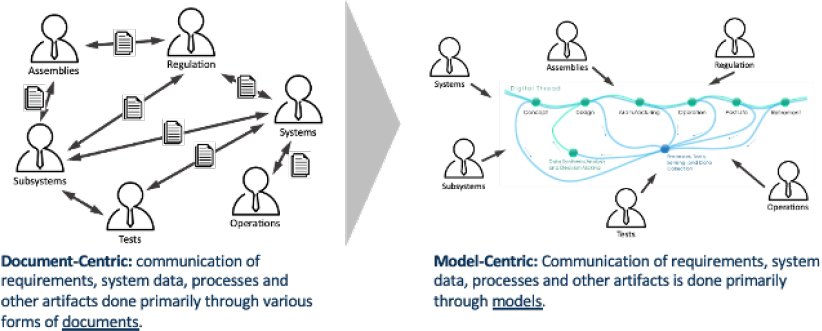
SOURCE: (Left) O. Pinon Fischer, 2021, “Digital Airworthiness Certification,” Presented at Digital Certification Keystone Panel Aircraft Airworthiness and Sustainment Conference 2021, Bonita Springs, FL; (Right center) From V. Singh and K.E. Willcox, 2018, “Engineering Design with Digital Thread,” AIAA Journal 56(11):4515–4528, reprinted by permission of the American Institute of Aeronautics and Astronautics, Inc.; (Right perimeter) AIAA Transformative Engineering of Systems Task Force, 2025, Transforming the Practice of Engineering Together, Presented at AIAA Transformative Engineering of Systems Workshop AIAA SciTech Forum 2025, Orlando, FL.
models to inform enterprise and program decision making; (2) providing an enduring, authoritative source of truth; (3) incorporating technological innovation to improve the engineering practice; (4) establishing a supporting infrastructure and environments to perform activities, collaborate, and communicate across stakeholders; and finally, (5) transforming the culture and workforce to adopt and support DE across the life cycle.6
DoD Instruction 5000.97 introduces the specific direction to adopt these principles and to “use DE methodologies, technologies, and practices across the life cycle of defense acquisition programs, systems, and systems of systems to support research, engineering, and management activities.”7 This instruction emphasizes that it “must be addressed in the acquisition strategy,” meaning during the earliest planning phases, and must be implemented for programs initiated after its release. To successfully implement this directive—and modernize—the military Services must transform their business practices. The mission to evolve is clear, but the real challenge lies in developing the specific process to do so. Therefore, each organiza-
___________________
6 ODASD(SE), 2018, Department of Defense Digital Engineering Strategy June 2018, https://ac.cto.mil/wp-content/uploads/2019/06/USA001603-18-DSD.pdf.
7 Office of the Under Secretary of Defense for Research and Engineering, 2023, “Digital Engineering,” DoDI 5000.97, https://www.esd.whs.mil/Portals/54/Documents/DD/issuances/dodi/500097p.PDF?ver=bePIqKXaLUTK_Iu5iTNREw%3D%3D.
tion (e.g., Service department) must create and implement an approach to digitally transform that is both specific to its own interests and those of the greater national security enterprise.
However, while it has been defined in the context of the acquisition and procurement of national defense systems, the application of DE is not limited to this context. As a matter of fact, DE can be thought of as a transformation of the implementation of all engineering (and associated disciplines) across an enterprise—and across system life cycles—to take full advantage of the digital integration of engineering work, data, knowledge, and wisdom across that enterprise.
The DAF created Digital Materiel Management (DMM) to “ensure critical processes employ digital methods across the entire life cycle—from invention to retirement—for both warfighting capabilities as well as installation and mission support capabilities.”8 This includes specific direction from the commander of the Air Force Materiel Command (AFMC), with “functional” DMM considerations to achieve life cycle successes. These include program management, contracting, financial management, logistics, and others which must be worked out in order to fully implement DMM.9
THE IMPORTANCE OF DIGITAL TRANSFORMATION
One of the more critical drivers behind the nation’s need for DT is the pacing challenge posed by the People’s Republic of China (PRC). As stated in the 2022 National Defense Strategy, “the most comprehensive and serious challenge to U.S. national security is the PRC’s coercive and increasingly aggressive endeavor to refashion the Indo-Pacific region and international system to suit its interests and authoritarian preferences.”10 This is accentuated by the PRC’s priority to modernize its conventional forces in order to offset the U.S. military’s qualitative advantage. Additionally, the PRC is accelerating modernization of its advanced capabilities in space, counterspace, cyber, electronic warfare, and information warfare as an integrated holistic capability. The Services’ inability to field solutions to counter these threats at pace or faster than the pace of the PRC puts the United States at a
___________________
8 K. Hurst, 2024, “DMM in the DAF Primer,” Presentation to the committee, July 9, National Academies of Sciences, Engineering, and Medicine.
9 K. Hurst, S.A. Turek, C.M. Steipp, and D.Z. Richardson, 2023, Digital Materiel Management: An Accelerated Future State, Air Force Materiel Command, https://media.defense.gov/2023/Jun/12/2003239595/-1/-1/0/DMM%20-%20AN%20ACCELERATED%20FUTURE%20STATE_FINAL_compliant_17AUG23.PDF.
10 U.S. Department of Defense, 2022, 2022 National Defense Strategy of the United States of America, https://media.defense.gov/2022/Oct/27/2003103845/-1/-1/1/2022-NATIONAL-DEFENSE-STRATEGY-NPR-MDR.pdf, p. 3.
competitive disadvantage. This gap will only widen as the Services rely on outdated, bureaucratic, and stovepiped approaches.
These advancements are not confined to physical assets; there is growing evidence that the PRC and Russia are also investing heavily in the digitalization of the battlespace. Both the of these nations have made significant strides in enhancing their capabilities in artificial intelligence (AI), machine learning (ML), and other areas of digital warfare.11,12 To maintain operational superiority, the United States must elevate data-informed insights and decision making to the mission engineering and operator level. Through the architecting of system and system-of-system processes, interfaces, and flows, DE facilitates the integration of data, models, and analytical capabilities to enable seamless end-to-end life-cycle management, from design through disposal.13,14 By helping connect previously isolated information sources and analysis processes, DE can help manage the growing complexity of systems and their development and operations, allowing for increased efficiency and quality of communication across both technical and non-technical disciplines.15
These drivers warrant the need for a defensive posture to be agile and enable responsiveness to change. Digital tools, especially those integrated across a system’s life cycle, would enable better data access and informed decision making and better integration among systems and across domains. Automated processing among activities would improve the cycle time between those activities as stakeholders operating in parallel learn from one another’s outcomes. These and other enablers associated with DT would build in resilience to changes or disruption in the environment.
METHODS AND ASSUMPTIONS
Nascent DT efforts have been incremental and largely assigned to specific programs, thereby rendering it difficult for the committee to properly assess DAF DT progress at the enterprise-level. Because of this and the lack of an integrated digital strategy across the DoD enterprise, the committee relied on largely qualitative
___________________
11 E.B. Kania, 2021, “Artificial Intelligence in China’s Revolution in Military Affairs,” Journal of Strategic Studies 44(4):515–542.
12 K. Zysk, 2021, “Defence Innovation and the 4th Industrial Revolution in Russia,” Journal of Strategic Studies 44(4):543–571.
13 American Institute of Aeronautics and Astronautics (AIAA) Digital Engineering Integration Committee, 2025, “Digital Engineering Workforce Development: Challenges, Best Practices, Recommendations.”
14 W.D. Schindel, 2022, “Realizing the Value Promise of Digital Engineering: Planning, Implementing, and Evolving the Ecosystem,” Insight 25(1):42–49.
15 R.A. Noguchi, M.J. Wheaton, and J.N. Martin, 2020, “Digital Engineering Strategy to Enable Enterprise Systems Engineering,” INCOSE International Symposium 30(1):1727–1741.
data-gathering and success-definition methods. In part informed by pockets of DT excellence from specific programs, such as the Northrop Grumman Corporation (NGC) 437, the committee assumed that while DT is a novel field, its implementation would prove beneficial to the DAF.
Data-Gathering Methods
The committee held nine data-gathering sessions, convening a broad range of key DT stakeholders and senior leaders from the DAF, including the Digital Transformation Office; the Office of the Secretary of Defense (OSD); the military Services; industry and commercial partners; and academia. Through in-depth interviews of these subject-matter experts, the committee collected information that formed the basis of its analyses. Some of these interviews provided quantitative data, and the committee supplemented the discussions by reviewing published DT plans, strategies, and DE literature. The committee considered several candidates for the use case examples examined in Chapter 4 and conducted interviews with Air Force Sustainment Center as well as both DAF and Boeing engineers working on the T-7A program. A complete list of all interviews can be found in Appendix B. The committee drew some conclusions at the program level based on available data but had to extrapolate enterprise-level assessments due to the absence of a DAF-wide approach.
Methods to Identify Digital Transformation Success
The modernization implied in DT, driven by the need for adaptation to evolving threats, is both a journey and a destination, measured by milestones along the way. In this report, the committee presents common elements that provide a lens for assessing and then accelerating DT. To identify success at the aggregate level, the committee arrived at three top-level goals that both define context and encapsulate success: mission execution success, program execution success, and risk management success.
Given the mission of the DAF and the U.S. military writ large—to deter conflicts but win them when necessary—mission execution success must be the primary measure of success for any modernization initiative. However, DT is a harder thing to measure than the performance of a new fighter aircraft, or electronic warfare system, etc. The committee believes that comprehensive DT can create in the DAF workforce the agility and ability to learn faster and make better decisions at every life-cycle stage: technology development, acquisition, fielding/operations, and sustainment. It is this workforce, efficiently equipped with better warfighting tools and informed by timely, relevant knowledge, that grants decision dominance and,
when necessary, kinetic success. This is the essential product of DT and the reason it is critical for winning wars of the future.
Mission commanders and their warfighting teams enter the fight with systems and tools that are realized through acquisition program execution. That is, warfighting success depends, among other factors, on program execution success. That success comes from each program considering almost countless options along the development life cycle and making assessments and trade-offs across many diverse factors. As highlighted in the 2024 Defense Business Board report Assessment of the Department of Defense: Creating a Digital Ecosystem,16 each DAF acquisition program and DT initiative must be instrumented to utilize key performance indicators to measure and track progress in areas such as cycle time, data alignment, and talent retention to identify and scale successful practices.
Risk management success underpins everything the DAF does. There is perhaps no role in the DAF that does not, ultimately, involve risk management—making choices that balance “reward” (benefits) with risk (both probability of a negative outcome and the consequence level of such an outcome). The Mitchell Institute identified better risk management and trade-offs as one area where DE (a component of DT) could make a major impact.17 DT provides a way to enable ambitious program concepts with acceptable program execution risk. It achieves this decoupling by enabling more immediate feedback and tighter decision cycles in life-cycle processes—the engineering analog of OODA (observe, orient, decide, act) loops with accelerated tempo. However, and more specifically, risk management is essential for success in the first two measures of DT success referenced in the two preceding paragraphs. Better risk assessment of threats through DT will likely require continuous learning organizations at all echelons of the DAF. This is best exemplified by the ability for mission engineers and commanders to use DT capabilities to quickly reinterpret past experiments, data, and analyses to answer new questions raised by new threats. In the context of capability development, DT could show evidence of success when all models are embedded with the means to be useful across the system life cycle, from development to test to operations, maintenance and logistics, and retirement.
___________________
16 S. Soloway, S. Leopoldi-Nichols, D. James, et al., 2024, “Assessment of the Department of Defense: Creating a Digital Ecosystem,” Defense Business Board, February 29, https://dbb.defense.gov/Portals/35/Documents/Reports/2024/FY24-03%20Digital%20Ecosystem%20-%20FINAL%20FOR%20PRINT%20with%20DOPSR%20Stamp%204-16-24.pdf.
17 H. Penney and B.J. Morra, 2024, “Digital Engineering: Accelerating the Defense Acquisition & Development Cycle in an Era of Strategic Competition,” Mitchell Institute Policy Paper 49, https://mitchellaerospacepower.org/wp-content/uploads/2024/05/Digital_Engineering_Policy_Paper_49.pdf.
Assumptions
Informed by DAF’s stated desires to digitally transform, existing literature, and the committee findings from the outlined methods, the committee framed its recommendations with the assumption that DE is an effective means for DT and that using DE for DT would provide benefits to the DAF.
Through the architecting of system and system-of-system processes, interfaces, and flows, DE facilitates the integration of data, models, and analytical capabilities to enable seamless end-to-end life-cycle management, from design through disposal.18,19 By helping connect previously isolated information sources and analysis processes, DE helps manage the growing complexity of systems and their development and operations, allowing for increased efficiency and quality of communication across both technical and non-technical disciplines.20 The ability to leverage digital models across the program life cycle, linking performance with business and logistics considerations, creates a knowledge engine that drives continuous learning.
Touchstone Example: Northrop Grumman Model 437
To illustrate assumed DE benefits learned through data-gathering sessions, the committee decided to cite its discussion21 with NGC on the Model 437 Vanguard aircraft, which flew its “first flight” in August 2024 employing wings that were designed, built, tested, and sustained using a single digital ecosystem.22 The wings evolved from concept into a flown capability in just 2 years.
While the committee recognizes that this effort is of a relatively smaller scale compared to the DAF enterprise, the proof-of-concept example at a smaller scale represents a major prototyping milestone along the path of large-scale DT efforts. It also indicates that a stepwise approach to adoption can yield increments of benefit, signaling that DE is not an all-or-nothing proposition, but rather that DE
___________________
18 AIAA Digital Engineering Integration Committee, 2025, “Digital Engineering Workforce Development: Challenges, Best Practices, Recommendations.”
19 W.D. Schindel, 2022, “Realizing the Value Promise of Digital Engineering: Planning, Implementing, and Evolving the Ecosystem,” Insight 25(1):42–49.
20 R.A. Noguchi, M.J. Wheaton, and J.N. Martin, 2020, “Digital Engineering Strategy to Enable Enterprise Systems Engineering,” INCOSE International Symposium 30(1):1727–1741.
21 M. Tang and J. Matlik, 2024, “Contractor Perspective on DAF Digital Transformation—Northrop Grumman Corporation,” Presentation to the committee, November 20, National Academies of Sciences, Engineering, and Medicine.
22 Northrop Grumman Corporation, 2024, “Northrop Grumman’s Digital Engineering Drives Down Costs and Schedule for Future Aircraft Programs,” Northrop Grumman Newsroom, August 29, https://news.northropgrumman.com/news/releases/northrop-grummans-digital-engineering-drives-down-costs-and-schedule-for-future-aircraft-programs.
adoption, thoughtfully accomplished, can have a highly favorable ratio of reward to cost and risk.
NGC saw benefits from a centrally funded set of DE capabilities. Program savings from preventing redundant DE tools, training, and infrastructure startup costs aided program profitability calculations and provided strong incentives for the program teams—including the 437 team—to adopt DE tools. When central tools only accomplished 80 percent of program needs, NGC’s Digital Transformation Office would collaborate with the program members to bridge the remaining gap of needed capabilities. This top-down DE investment helped reduce startup costs for program teams while also providing scalable solutions for existing programs. Program leaders can then resource mission-critical efforts rather than dilute their funds on duplicative capabilities.
Digitally engineered, standardized software and data helped ensure that Model 437 stakeholders could work from the same playbook, reducing delays and accelerating product development. Given the benefits derived from foundational data and interoperability, the 437 program used consistent data standards that supported continuity across the life cycle, regardless of the tools used. These standards and open collaboration contributed to a NG digital ecosystem that enable quick responses to change—specifically, the team completed a modification of structural layout and detailed design, a process that had previously taken NGC more than 6 months, in 2 weeks “because [they] were digitally connected.”23
The 437 digital ecosystem combined high-fidelity models with approved model validation schemes. This reduced requirements for time-consuming and costly ground and flight tests, further accelerating timelines. The 437 “demonstrates how high-fidelity models within our digital ecosystem serve as a single source of truth to streamline testing and certification on future aircraft, significantly saving cost and time for our customer.”24 Even partial use of digital threads had material benefits. The environment offered streamlined communication and efficient decision making with live digital traceability. This helped alignment, transparency, and efficiencies across all stages of the Model 437’s development.
The Model 437 metrics captured “proof points” that demonstrated positive impacts of DE. One of the most striking achievements of the program was the reduction of engineering rework to less than 1 percent of the program’s budget, compared to the traditional rework range of 15–20 percent of a program’s bud-
___________________
23 M. Tang and J. Matlik, 2024, “Contractor Perspective on DAF Digital Transformation—Northrop Grumman Corporation,” Presentation to the committee, November 20, National Academies of Sciences, Engineering, and Medicine.
24 Northrop Grumman Corporation, 2024, “Northrop Grumman’s Digital Engineering Drives Down Costs and Schedule for Future Aircraft Programs,” Northrop Grumman Newsroom, August 29, https://news.northropgrumman.com/news/releases/northrop-grummans-digital-engineering-drives-down-costs-and-schedule-for-future-aircraft-programs.
get. Additionally, NGC reported that manufacturing costs were reduced by more than 50 percent, in part because of the additive manufacturing discussed previously and also because the DE practices enabled manufacturing stakeholders to provide input earlier and more often in the development process, leading to cost savings and improved delivery timelines.
Although the DE tools used for this program were hosted by a commercial partner, NGC, the Model 437 team’s collaboration between commercial and government stakeholders demonstrated how DE can accelerate development timelines, reduce costs, and enhance product quality. The program’s use of standardized data, robust information technology infrastructure, and NGC’s centralized digital ecosystem enabled effective collaboration and transparency for this relatively small-scale effort.
Assumed Department of the Air Force Digital Transformation Acquisition Deliverables and Stakeholders
Upon assuming the successes of NGC’s DT, the committee translated how these DE benefits would appear within the DAF enterprise. Specifically, the committee assumes that DAF DT will include the following acquisition deliverables and stakeholders. DAF’s acquisition process will require more deliverables besides just a weapons platform—that is, an engineering model, a system model, an enterprise model, the developmental testing and evaluation (DT&E) simulation environment, the DT&E tests and results, and the development and operations platforms for software and AI system elements. Just as pilots need to be part of the design and testing of an aircraft, so should DoD operational and sustainment personnel be involved in the design and testing of the other deliverables to prevent fragmented environments. Figure 1-2 shows the DT acquisition deliverables and stakeholders.
Some examples of DT stakeholders include the following:
- Air Force Futures (A5) (and potentially the Joint Staff strategy, plans, and policies directorate [J5], which addresses strategy, plans, and policy) should be involved in the development and testing of the system model as they will be adopting this system model into operational planning. The systems model describes the physical characteristics of the weapons platform as well as its performance criteria (e.g., maneuverability) and its cybersecurity and resiliency criteria.
- The platform or hardware sustainers will need to be involved in the design and testing of the engineering models to ensure that these will be useful for the maintenance of the weapons platform. The engineering models enable “fly-through” and kinematic views of system parts and part design constraints.

- Software factories and AI developers will need to be involved in the design and testing of the AI and software tool chains at the factories, whether internally operated or externally contracted. This includes understanding the function and quality goals of the software and AI elements, as well as their deployment model and various unit, component, and validation tests to be created. Testing and evaluation processes need to include those who are developing and using the design and build tools.
- Finally, department research organizations such as the Air Force Research Laboratory should have access to the deliverables so that they can build on experience to conceive future capabilities.
Barriers Beyond Digital Engineering
While the committee assumes that DT through recommended DE strategies will provide benefits to the DAF enterprise, it recognizes that many programs and commands face barriers beyond what DT may remedy. Existing bureaucracy, strategy, and culture will hinder gained advantages from DT. For example, NGC faced challenges with its DE platform when individuals resisted centralized decisions to phase out historically favored tools. Additionally, collaboration and interoperability challenges will persist as stakeholders seek to protect proprietary capabilities.
The committee believes that these barriers contributed in part to the cost overruns and delays facing the limited examples of DoD programs using DE. The committee does not then conclude that these programs did not benefit from their DE practices and instead recognizes that some barriers will impact any defense program regardless of DT. Instead, the committee concluded that DT practices need to recognize these tensions and navigate these as they do with other engineering and business trade-offs. Regardless, the measurable benefits observed highlight the potential impact that other programs and that DAF could achieve through a cohesive approach to DT.
SYNERGY AMONG DIGITAL ENGINEERING, MODEL-BASED SYSTEMS ENGINEERING, AND DIGITAL TWINS
DT efforts can exploit the growing confluence in thinking among those practicing DE, model-based systems engineering (MBSE), and digital twins.
MBSE is a means to address specific quality aspects of systems engineering by using explicit and formalized models that can support diverse analyses. A goal of MBSE is for models to serve as primary representations of design intent and also as a basis to navigate trade-offs and sensitivity analyses. Documents can also be
generated from models, recognizing that, by and large, the documents are derived products.25,26,27
An important goal of MBSE is to complement DE and enable DT by providing multiple ways to model and analyze digital twins of physical assets with the appropriate levels of fidelity and accuracy to be “fit-for-purpose” at various stages of system evolution in the system life cycle. This is because MBSE models can facilitate analysis and testing in virtual environments, thereby improving predictions of system behavior under different conditions. As important, MBSE enables early exploration of design alternatives and optimization of system design and performance. By leveraging digital models and simulation, MBSE reduces the need for extensive physical testing, thereby accelerating development and reducing costs.28,29,30
Using digital twins can refine MBSE by providing digital representations of the physical world along with digital models of physical assets, thereby improving model traceability, and enabling early validation and verification through simulation and data analysis.31 The Digital Twin Consortium,32 the American Institute of Aeronautics and Astronautics,33 NASA,34 and the National Institute of Standards and Technology35 are currently driving the awareness, adoption, interoperability, and development of digital twin technologies. MBSE augmented by digital twins can enable rapid identification of issues, more informed decision making, and faster time-to-deployment with superior quality. Leveraging digital twins in MBSE en-
___________________
25 A. Madni and M. Sievers, 2018, “Model-Based Systems Engineering: Motivation, Current Status, and Research Opportunities,” Systems Engineering 21(3).
26 A.M. Madni, B. Boehm, D. Erwin, M. Moghaddam, M. Sievers, and M. Wheaton (eds.), 2022, Recent Trends and Advances in Model Based Systems Engineering, Springer.
27 A.M. Madni, N. Augustine, and M. Sievers (eds.), 2023, Handbook of Model Based Systems Engineering, Springer.
28 A. Madni and M. Sievers, 2018, “Model-Based Systems Engineering: Motivation, Current Status, and Research Opportunities,” Systems Engineering 21(3).
29 A.M. Madni, B. Boehm, D. Erwin, M. Moghaddam, M. Sievers, and M. Wheaton (eds.), 2022, Recent Trends and Advances in Model Based Systems Engineering, Springer.
30 A.M. Madni, N. Augustine, and M. Sievers (eds.), 2023, Handbook of Model Based Systems Engineering, Springer.
31 A.M. Madni, C.C. Madni, and D.S. Lucero, 2019, “Leveraging Digital Twin Technology in Model-Based Systems Engineering,” MDPI Systems 7(1).
32 A. Evans, N. Fehrenbacher, O. Fisher, et al., 2025, “Aerospace & Defense Digital Twin Research and Technology Gap Analysis,” Digital Twin Consortium.
33 AIAA Digital Engineering Integration Committee, 2023, “Digital Thread: Definition, Value and Reference Model.”
34 E.H. Glaessgen and D.S. Stargel, 2012, The Digital Twin Paradigm for Future NASA and US Air Force Vehicles, NF1676L-13293.
35 J. Voas, P. Mell, P. Laplante, and V. Piroumian, 2025, Security and Trust Considerations for Digital Twin Technology, National Institute of Standards and Technology, NIST IR 8356.
ables creation of a comprehensive view of the physical system operating in the real-world operational environment.36 The ability of digital twins to reflect real-time data updates bridges the gap between design, engineering, and operations in the real-world environment, thereby enabling more accurate simulations and analyses, which in turn enable superior predictions.37,38,39 This capability allows engineers to validate and refine system and operational environment models throughout the system’s life cycle, thereby improving accuracy of predicting performance and failures.
DE can enhance MBSE in several ways, including providing digital twins of assets and processes that contribute to enhancing system verification and testing,40 and digital threads that facilitate end-to-end process integration and interoperability.41 This capability can extend MBSE coverage into the later stages of the system life cycle.42 DE can also facilitate the integration of AI and ML techniques into MBSE, thereby enabling automation of routine processes and predictive analytics.43 In this context, AI can assist with tasks such as model creation, validation, and maintenance, thereby reducing manual effort while improving accuracy of models. MBSE can potentially enhance AI and ML application in a few important ways:
- MBSE provides a structured framework for consistent requirements definition and system architecture development; these capabilities can potentially enhance the development of responsive AI and ML algorithms.
- MBSE supports collaborative development of system design involving interdisciplinary teams; this capability can be exploited in developing AI and ML algorithms that also involve interdisciplinary teams.
- MBSE can be used to store and manage data sets used by ML algorithms, as well as data sets associated with the evaluation of ML algorithms.
___________________
36 A.M. Madni, C.C. Madni, and D.S. Lucero, 2019, “Leveraging Digital Twin Technology in Model-Based Systems Engineering,” MDPI Systems 7(1).
37 Ibid.
38 J. Vickers, 2024, “Digital Twins in a Nutshell—A New Era in Engineering and Manufacturing,” Paper presented at the DOE-NSF Workshop on Digital Twins for Manufacturing, https://ntrs.nasa.gov/citations/20240013986.
39 J. Voas, P. Mell, P. Laplante, and V. Piroumian, 2025, Security and Trust Considerations for Digital Twin Technology, National Institute of Standards and Technology, NIST IR 8356.
40 A.M. Madni, C.C. Madni, and D.S. Lucero, 2019, “Leveraging Digital Twin Technology in Model-Based Systems Engineering,” MDPI Systems 7(1).
41 AIAA Digital Engineering Integration Committee, 2023, “Digital Thread: Definition, Value and Reference Model.”
42 A.M. Madni, N. Augustine, and M. Sievers (eds.), 2023, Handbook of Model Based Systems Engineering, Springer.
43 A.M. Madni and N. Noguchi, 2025, “Exploiting Augmented Intelligence in Realizing and Operating a Digitally Transformed Enterprise,” Paper presented at 2025 Conference on Systems Engineering Research.
- MBSE provides the means to document knowledge and lessons learned from the use of specific AI and ML algorithms.
AI-assisted MBSE is being used in a variety of ways today. AI in the role of augmented intelligence is being used to offload systems engineers in cognitive tasks and in automated code generation using context engineering (beyond prompt engineering). Today AI-enabled MBSE assistants are capable of using computer vision to convert hand-drawn sketches into SysML models (diagrams), thereby automating the process of generating system architectures.
The specific benefits of DE that incorporates MBSE and digital twin technology include the following:
- Cost-effective early validation and verification: Digital twins and digital threads enable ongoing virtual testing and analysis of system performance before physical prototypes are built. This enables early identification and cost-effective resolution of potential issues thereby circumventing expensive rework resulting from late discovery of issues in the system life cycle.
- Improved traceability: DE essentially links requirements and design to actual system behavior, thereby enhancing traceability and management of the evolving physical system throughout its life cycle.
- Continuous model improvement: The ability of digital twins to access data in real-time from real-world sensors (onboard the physical twin and in the environment) and data streams from a variety of other relevant sources enables continuous improvement in system and environment models. This capability, in turn, allows real-time analysis, optimization, and predictive maintenance, leading to improved system performance and reliability.
- Accelerated development: By using digital twins in concert with MBSE, engineers can employ virtual simulations to reduce the need for expensive physical prototyping. With digital threads, development can be accelerated and time-to-deployment reduced.
- Enhanced decision making: The ability to simulate and analyze system behavior in a virtual environment empowers engineers to make increasingly more evidence-informed decisions, potentially leading to superior designs, that in turn, lead to enhanced performance and mission outcomes.
- Improved collaboration: DE provides a common platform for stakeholders to access, explore, analyze, and share system information from different perspectives. This capability when employed within distributed collaborative teams reduces communication barriers and accelerates building of consensus within these teams.
- Continuous improvement: Real-time data from physical twins, along with the body of engineering data associated with digital threads, allows for continuous monitoring and optimization of system performance within the virtual environment which, in turn, enables ongoing refinement, monitoring, and control of the physical system throughout its life cycle.


