Digital Transformation in the Department of the Air Force (2025)
Chapter: 5 Opportunities and Challenges Toward Creating a Unified Department of the Air Force Digital Enterprise
5
Opportunities and Challenges Toward Creating a Unified Department of the Air Force Digital Enterprise
The Department of the Air Force’s (DAF’s) future operational environment is characterized by increasing complexity, rapid change, increasing interconnection, and persistent cyber competition. To thrive in this environment, newly designed, produced, fielded, and maintained systems must demonstrate not only high levels of cybersecurity, but also resilience and adaptability—operating effectively as integral components within larger enterprise and system-of-systems architectures.
To maintain operational superiority, the DAF must broaden data-driven decision making across the full life cycle, including to the operator and sustainer levels. Achieving this capability requires robust digital continuity and traceability across the life cycle—from requirements through design, manufacturing, testing, evaluation, operations, sustainment, and mission execution,1 but also from system components to mission outcomes, facilitating the integration of kill chain and supply chain capabilities to meet evolving military needs in very dynamic technological, political, and socioeconomical contexts.
If executed successfully and anchored by a robust and carefully architected digital thread, the digital transformation (DT) of the DAF will offer many strategic and operational benefits. At its core, the digital thread enables seamless traceability of data, decisions, and artifacts across the entire life cycle of a system, from design and development through testing, fielding, operations, and sustainment. This end-to-end connectivity fosters consistency and continuity across disciplines and
___________________
1Defense Science Board, 2024, “Digital Engineering Capability to Automate Testing and Evaluation,” https://dsb.cto.mil/wp-content/uploads/2024/08/DSB_DE_Final-Report_050124_Stamped.pdf.
domains, reducing silos and ensuring that all stakeholders operate from a common, authoritative source of truth.
These foundational capabilities enhance agility by allowing stakeholders (designers, operators, sustainers, suppliers, etc.) to respond more rapidly and effectively to evolving mission requirements, operational environments, and system changes. Maintaining persistent linkage across models, simulations, analyses, and real-world data also supports faster and more reliable impact assessments, design updates, and sustainment strategies.
Additionally, the integration of advanced analytics and real-time data augment stakeholders’ decision-making capabilities. Enhanced traceability not only improves accountability and compliance but also enables more predictive and proactive approaches. This ultimately empowers leaders and engineers alike to make informed, high-confidence decisions at the speed of relevance, increasing their ability to support the warfighters in increasingly complex and contested environments.
Finally, the success of DT efforts will require the creation of new areas of responsibility and roles (e.g., consistency manager and data curator) as well as the development of new skills and competencies from entry-level to executive roles.2
The focus of the following sections is on the significance to DT of two sets of factors—organizational factors and engineering factors. These factors must be addressed at all life-cycle phases, starting with an emphasis on mission definition, requirements, and the benefits of making informed decisions early in the life cycle. A theme in this discussion is the structural challenge that DT can entail up-front costs and commitments, with benefits accruing throughout the life cycle. Technical explanation in support of the discussion of engineering factors can be found in Appendix F.
Recommendation 5-1: Department of the Air Force (DAF) leaders should embed digital transformation into strategic visioning, requirements, resourcing, and communications to ensure continuity across leadership transitions, using governance, policy, and roadmap alignment that is iteratively updated to maintain momentum. The DAF should clearly define new roles and responsibilities and who will fill them, including the roles of a consistency manager and data curator. Successful digital transformation will address the critical challenges of intellectual property ownership, stakeholder involvement, use of tools and associated engineering data, and culture.
___________________
2American Institute of Aeronautics and Astronautics Digital Engineering Integration Committee, 2025, “Digital Engineering Workforce Development: Challenges, Best Practices, Recommendations.”
ORGANIZATIONAL FACTORS
The organizational factors are as follows:
- Leadership, both within programs and in higher echelons in the DAF
- Budgeting process, also within programs and in higher echelons
- Workforce
- The role of commercial capabilities
Factor 1: Leadership
The DAF is already establishing digital engineering (DE) capabilities within several organizations, but the committee recognizes that the effects are limited by the scope of those organizations. As a result, digital models established in development phases may not be accessible or transferable—for example, to sustainment phases of the system life cycle. Digital artifacts that reside in one functional area are not linked to other areas that use the same information. Without coordination and a unifying vision, the goal of “an integrated digital approach that uses authoritative sources of system data and models as a continuum across disciplines to support life-cycle activities from concept through disposal” will not be achieved.
A full DT effort requires a comprehensive strategy that will drive an enterprise-wide architecture supported by standard policies, tools, and processes. In some firms, corporate leadership can exert authority to drive strategy across divisions, business units and functional areas. When done well—in a manner informed by engineering, organizational, and mission considerations—this can have significant benefits.
The DAF leadership structure and organizational scale present unique challenges for the development and implementation of a broad digital strategy. Elements of DE reside in several branches of the DAF leadership structure, including Acquisition and Logistics under the Air Force Secretariat, Logistics, Engineering and Force Protection under the Chief of Staff of the Air Force, the Air Force Sustainment Center (AFSC), and the Air Force Life Cycle Management Center (AFLCMC) under Air Force Materiel Command (AFMC), and office of the Chief Data and Artificial Intelligence Officer under the office of the Chief Information Officer in the Air Force Secretariat, as a few key examples. Sufficient technical expertise to support DT efforts may require leaders to engage with an existing Center of Excellence, federally funded research and development center, University Affiliated Research Center, or a trusted Systems Engineering and Technical Assistance contractor.
The strategy for DT needs to originate at a high-level of leadership with the ability to conceive the enterprise-wide architecture, direct the associated funding, and with the authority to compel support, adoption, and compliance across the disparate branches.
Recommendation 5-2: The Secretary of the Air Force should designate an officer or senior leadership position within the Department of the Air Force headquarters with accountability to lead digital transformation for both the U.S. Air Force and the U.S. Space Force, establish an enterprise-wide digital strategy and common mission architecture elements with standardized platforms and integrated tools. This position should have sufficient resources with operational and technical expertise and experience and the authority to direct program executive officers to use the enterprise capabilities.
Factor 2: Budget
Any effort to maintain, improve, or increase the digital enterprise capability requires planned and sustained funding. The fragmented and sometimes intermittent approach the DAF has taken to DT efforts means that the extant pockets of excellence are currently funded through a variety of sources—occasionally budget dollars, but more commonly fallout or discretionary funds. Each of these funding approaches has pros and cons. For example, AFMC’s Digital Materiel Management (DMM) efforts have been funded entirely through the AFMC commander’s reserve limited discretionary funds. Discretionary funding enables a faster implementation since the resources do not undergo a debate on use, but is dependent on consistent support during leadership changes. There is also a risk of a fragmented implementation. Efforts to create a more permanent budgetary line item for DMM have been stymied by the repeated congressional constraints posed by the extensive use of continuing resolutions to fund DoD operations.3
Of the 72 months of fiscal year (FY) 2020 through FY 2025, the DAF operated under a continuing appropriation for approximately 40 months. This means that, since the establishment of the U.S. Space Force in late calendar 2019, the DAF has been funded with a continuing appropriation more often than not. This freezes existing budgetary line items and complicates efforts to formally allocate money during the budget process. Budget funding as a program of record allows an enterprise approach to DE implementation, but there is a risk of reduced funding during the budget formulation process. In both methods, there is a risk of the DE infrastructure loss of currency due to budget reductions. Regardless of the funding approach used, leadership’s support is key.
In the broader context, funding includes three different perspectives. The first is the infrastructure necessary to accommodate tools, terminals, engineering data, and operational data. For instance, cloud storage infrastructure could be required for operational data on an intranet. While some existing infrastructure may already be in place,
___________________
3K. Hurst, 2024, “Quick Start Guide: 10 Steps to Consider for Digital Program Implementation,” Presentation to the committee, November 1, National Academies of Sciences, Engineering, and Medicine.
upgrades should be considered when necessary. The following perspective involves the software tools required to perform DE. These tools encompass computer-aided design, computer-aided manufacturing, and simulation software. A single purchase order should be utilized for tools across multiple locations to achieve economies of scale and enable better configuration control. This approach mirrors the Air Force method for Microsoft productivity software. Another approach would be to use software as a service to provide cloud-based capability as a service. An approach like the AFMC LaunchPad facilitates configuration control and minimizes license proliferation. The final area of funding is the sustainment of these various components. Sustainment funding is crucial to ensure vendor support (as vendors typically cease support for outdated versions) and maintain the current cybersecurity protection configuration.
A centralized DAF fund adaptable across programs could allow for the purchase and sustainment of shared digital tools, as well as improved identification and codification of best practices. Given these considerations, the committee recommends that the DAF formally allocate resources to DT activities through the program objective memorandum process.
Recommendation 5-3: U.S. Air Force and U.S. Space Force Service Acquisition Executives should formally ensure resources for digital engineering are included in the Program Objective Memorandum input.
Factor 3: Workforce
Workforce development is a cornerstone of DAF’s DT, which enables personnel across roles and career stages to acquire the digital competencies necessary to leverage and understand the variety of methodologies, tools, technologies, and constructs such as digital twins and digital threads. However, there is currently no unified vision for implementing DT workforce development. As an emerging field, the absence of standardized competency frameworks and return on investment (ROI) metrics often deprioritizes funding for DE skills building.
A robust approach should begin with clear competency frameworks and taxonomies that establish a shared language and expectations across academia, industry, and government. The existing Digital Engineering Competency Framework offers starting points but requires further augmentation to ensure comprehensive coverage of evolving skill requirements.4
Foundational skills in data management, systems thinking, and 3D modeling are essential for early-career engineers, while senior leaders must develop fluency in
___________________
4American Institute of Aeronautics and Astronautics (AIAA) Digital Engineering Integration Committee, 2025, “Digital Engineering Workforce Development: Challenges, Best Practices, Recommendations.”
interpreting model-based insights and understanding the limitations and assumptions underlying digital representations to guide strategic decision making. Additionally, hands-on learning environments, such as digital engineering sandboxes, enable both students and practitioners to apply concepts in practical contexts and accelerate adoption.
The rapid evolution of enabling technologies, including artificial intelligence, cloud infrastructure, Agile and DevSecOps software practices, and advanced modeling, requires a culture of continuous learning to keep pace with emerging demands.5
Programs such as the Air Force Research Laboratory’s Digital Learning Environment illustrates how cross-sector collaboration can accelerate skill development by sharing infrastructure, best practices, and lessons learned. To enhance recruitment, upskilling and retention, the DAF should adopt and implement targeted incentives such as career advancement pathways, requirements for role-based certifications, and performance-linked rewards, in alignment with the U.S. Department of Defense’s (DoD’s) DE strategy and its commitment to deliver mission-driven, data-informed capabilities at scale.
Recommendation 5-4: The Department of the Air Force should develop a comprehensive strategy to foster an innovative digital transformation culture and ensure a workforce equipped with the necessary digital transformation knowledge to perform all critical functions. This strategy should prioritize recruiting and retaining talent by creating clear career paths, offering incentives for upskilling and reskilling, and leveraging existing expertise.
Recommendation 5-5: To support continuous learning and collaboration, the Secretary-designated officer or senior leader should work with the Air Force Personnel Center to resource skill development pathways, establish digital sandboxes for hands-on experimentation, and implement adaptive processes that promote progressive knowledge sharing, a balance between technology innovation and standardization, and cross-functional engagement.
Factor 4: Assessment of Commercial Capabilities
The DAF would benefit from ongoing reviews of its use of commercial and open-source capabilities with a focus on anticipating its needs and articulating supporting policies to facilitate enterprise DE evolution. This is important to sustain
___________________
5AIAA Digital Engineering Integration Committee, 2025, “Digital Engineering Workforce Development: Challenges, Best Practices, Recommendations.”
U.S. advantage in the increasingly challenging operational environment. While there are clear advantages to leveraging commercial capabilities, DAF should do so with an enterprise understanding of the opportunities (e.g., encouraging competition) and potential downsides (e.g., vendor lock-in).
Conclusion 5-1: Department of the Air Force digital enterprise capabilities and the ability to establish digital threads for each system are often limited by federal workforce access to digital models and artifacts that reside with the prime contractors. This can have significant adverse impacts on test and evaluation, and on efficient sustainment.
To begin, DAF might consider convening a stakeholder review of the current environment to see what is working and where there may be issues. The review should consider the wide variety of existing contracts (e.g., for tools, products, services, and data) from the many and varied perspectives including the following:
- Users and key stakeholders (potentially a broader list than the list of users);
- Interface access—input and output;
- Information of interest (e.g., algorithms) and how it is and/or might be used (e.g., to document results or to inform follow-on processes);
- Identification and use of interim and final products—what they are, how they are used, and by whom (e.g., within the DAF), with external partners, with another vendor; and
- Sustained operations and evolution.
The discussions should provide the basis for developing a list of what is working and where there are issues. The types of potential issues could be broad, including topics such as lack of competition, cost, the proprietary nature of algorithms, interfaces, and so on, and the resulting implications for the DAF enterprise (e.g., limited access to interim and/or final data products).
Using this gap analysis as a starting point, DAF should develop and document plana and policies for leveraging commercial capabilities across the DE enterprise. The plan should address each of the key phases/activities, including requirements, acquisition, development, operations, and sustainment. With stakeholder concurrence, DAF should engage Acquisitions and Contracts to develop a list of terms and conditions for inclusion in its DE contracts.
Recommendation 5-6: The Secretary-designated officer or senior leader should perform an ongoing enterprise-level/enterprise-wide assessment of its current use of commercial and open-source digital engineering tools, licenses, intellectual property, and use the results of that assessment to prioritize upgrades. The Department of the Air Force should repeat this
process at regular intervals and monitor emerging technologies and solutions from the private sector.
Contract provisions for data access with primes should center on a mission perspective, taking into account the warfighter’s operational data needs. Contracts should include abilities for both the operational and acquisition communities to broadly access operational and business data. Recognizing that digital artifacts vary across the product life cycle, contracted ownership should consider each phase of the life cycle. The ideal contract approach would grant DAF operators access to current, trusted, and validated data. For this trust, DAF operators should have visibility to algorithms used for collecting, identifying, and processing data.
However, vendors seeking long-term funding streams may seek to minimize external interfaces with their products, offering self-sufficient capabilities while limiting government access to data maintenance and management. This practice is inconsistent with an interoperable, open data environment.6
To mitigate vendor lock and better balance government and contractor equities, contracting requirements for DT should prioritize an enterprise perspective for commercial partnerships and acquisition. These requirements should incorporate the application of commercial standards and interoperability requirements as well as ensure that purchased digital capabilities can support development and sustainment efforts.
Recommendation 5-7: The Secretary-designated officer or senior leader for digital transformation should establish policy and standardized contract requirements to ensure that the Department of the Air Force has the necessary data rights and maintains ownership or access over relevant data from prime contractors. Government-owned or -accessible data repositories should be established.
ENGINEERING FACTORS
There are strong arguments that the benefits of DT extend to the earliest phases of mission conceptualization, including mission architecture, requirements development, threat analysis, and acquisition planning.7 Many of the most important engineering decisions are made in the early stages of a program. But, unfortunately,
___________________
6Department of Defense Office of Inspector General, 2025, “Audit of Data License Rights in Air Force Weapon System Contracts,” DODIG2025147.
7Office of the Under Secretary of Defense for Research and Engineering Mission Capabilities, 2023, “Department of Defense Mission Engineering Guide Version 2.0,” https://ac.cto.mil/wp-content/uploads/2023/11/MEG_2_Oct2023.pdf.
with current practices the consequences for many of these decisions may not be easily assessed in a direct manner until much later in the process.
Predictive models are essential to mitigate the risks of this prolonged uncertainty. Specifically, as early decisions are made, predictive models and analyses can be used to de-risk these decisions. DT offers infrastructure to develop and analyze models at all stages and, importantly, to provide a means to actively manage and assure ongoing consistency of the models with emerging designs and as-built artifacts. Importantly, DT also provides a framework within which improvements in predictive models can be readily assimilated into program management and engineering processes. This explicit connection with models can enable the adoption of these early choices when it is necessary to do so. Validity is a significant challenge for these early models, and DT approaches to modeling and simulation and mission architecture can facilitate this by linking models to the data used to verify and validate them, even extending into operations.
Integration into existing programs. It is important to note that most mission-focused systems engineering is in the context of existing programs, systems, and contracts. In these cases, on-boarding of DT capabilities becomes more of a challenge, since there are existing choices regarding tooling, engineering models and data, and other technical elements that would need to be accommodated and potentially adjusted. These adaptations can create near-term costs that, despite a promise of significant benefits in the long term, might not be supported within budgets.
There are significant benefits in overall program cost, execution risk, and system capability from considering certain engineering choices as early as possible in the life cycle. These benefits can also extend to include programs already in progress, where DT introduction may create opportunities to realize benefits. The sections below expose some of the dimensions of engineering planning. In each of these cases, even for programs already in planning or development—and even sustainment—there are benefits to adopting carefully selected DT techniques including explicit capture and retention of engineering data including models and designs.
Three sets of engineering factors. There are three principal factors that frame any significant engineering activity: elements of systems and the architectural organization of those elements; the activity of developing, operating, maintaining, sustaining and adapting those systems; and the ways we assess and form judgments regarding those systems.
The committee examined these factors because the practice and technology of DT creates benefit and some costs with regard to all of these aspects. This exploration is significant because of the fundamental disconnection of points of commitment, whether to requirements, design, or quality, in a systems engineering process and the points of understanding, later in the process, when the consequences of those commitments are understood.
The engineering factors are as follows:
- The structure of what is built: Technical architecture and design choices;
- The practice of building it and evolving it: Process, engineering data, and tooling; and
- The means to make judgments about what is built: Capability, security, and quality.
Technical background on these factors is provided in Appendix F. The sections below examine features of the interplay among these factors in the context of DE and DT.
Factor 1: Technical Architecture in Support of Design, Description, and Baselining
As DAF’s operating environment becomes a more interconnected and complex enterprise, organized as a system of systems, it becomes increasingly important to effectively manage and communicate about system architecture. Without a common understanding of how these systems are structured and interact, collaboration can become fragmented and integration efforts hampered.
The core concepts of technical architecture are outlined in Appendix F, which can inform a framing for cost-benefit analysis for committing resources and time to architecture development.
Architectural description supports communication of design choices. One of the challenges in architecting systems is expressing the choices made in the architecture development process to enable them to be communicated, evaluated, and potentially revisited.
An architectural descriptive framework provides that common language—a structured approach to organizing models and defining the necessary views to comprehensively represent a system’s architecture. This ensures that all stakeholders, from engineers to operators, share a consistent understanding of the system’s design, facilitating more effective decision making. These frameworks typically employ a “grid” approach to model the different aspects of an architecture, where columns correspond to different aspects of the system (architectural aspects), and rows capture various perspectives (stakeholder domain).8,9
___________________
8J. Martin, 2021, “Aspect-Oriented Architecting Using Architecture Frameworks,” INCOSE International Symposium 31(1):220–226, https://doi.org/10.1002/j.2334-5837.2021.00834.x.
9J. Martin and D. O’Neil, 2021, “Enterprise Architecture Process Guide for the Unified Architecture Framework (UAF),” Presented at 31st Annual INCOSE International Symposium, https://sef.aerospace.org/files/2022/01/Enterprise-Architecture-Process-Guide.pdf.
An example of such architectural descriptive framework is the Unified Architecture Framework (UAF), which has been developed by the Object Management Group to address the complexity of large-scale systems and enterprises.10 UAF extends beyond its predecessors, such as the DoD Architecture Framework and the Ministry of Defense Architecture Framework and is broadly applicable beyond defense applications.11 There are good examples of the application of UAF to support mission engineering activities.12,13
The engineering elements commonly described within descriptive frameworks are intended to support life-cycle phases from mission conceptualization through operations, and to address quality attributes including cybersecurity and resiliency, and to include plans for implementation. Ideally, architectural elements should be consistent with standards and industry norms, most especially with DoD modular open systems design patterns. There may, however, be rationale (see below) for specific variances or for adjustments to the DoD patterns, noting that architectures are also subject to evolution, though ideally much slower than systems.14 This consistency can best be accomplished and with maximum benefit to DoD if the DoD design patterns are modular and focus on critical design aspects, and avoid over-commitment.
Architecture choices are strongly influenced by business considerations. There are multiple business issues that are strongly influenced by architecture. These include, among others:
- Data management plans that support attributes such as cyber, security, access availability and latency, and resilience overall system (required redundancy, along with capacity for adaptiveness and policies of least privilege).
- An approach to intellectual property (IP) and data rights that addresses key functions including acquisition, contracting, security, operations, and development.
- A clearly communicated, principled supply chain management approach that includes deciding when/how to use commercial as opposed to U.S. government capabilities.
___________________
10Object Management Framework, 2022, “About the Unified Architecture Framework Specification Version 1.2,” https://www.omg.org/spec/UAF/1.2/About-UAF.
11J. Martin, 2021, “Aspect-Oriented Architecting Using Architecture Frameworks,” INCOSE International Symposium 31(1):220–226, https://doi.org/10.1002/j.2334-5837.2021.00834.x.
12Object Management Framework, n.d., “United Architecture Framework,” https://www.omg.org/uaf, accessed March 13, 2025.
13J. Martin and K. Alvarez, 2023, “Using the Unified Architecture Framework in Support of Mission Engineering Activities,” INCOSE International Symposium 33(1):1156–1172, https://doi.org/10.1002/iis2.13075.
14Defense Standardization Program, n.d., “Modular Open Systems Approach (MOSA),” https://www.dsp.dla.mil/Programs/MOSA, accessed June 18, 2025.
An additional consideration is at the enterprise level, in particular DAF’s ability to evolve the enterprise at the pace necessary to sustain success in this increasingly competitive threat environment. DoD’s June 2018 Digital Engineering Strategy highlights some of the following enterprise concepts:
- Provide an enduring, authoritative source of truth: “Capturing historical knowledge, and connecting authoritative versions of the models and data,” providing “the technical elements for creating, updating, retrieving, and integrating models and data,” and enabling “contract deliverables [to] be traced and validated from the authoritative source of truth.”15
- Improve management of contracts: Facilitating establishment and management of requirements, monitor the impact of ongoing decisions related to change management, and support for certification of delivered capabilities including validation of contractor deliverables.
- Establish supporting infrastructure and environment for collaboration: Supporting of DE objectives across the enterprise and life cycle, including protection of IP while using models to collaborate.16
- Improve support for training and experimentation: Including use of LVC (live, virtual, constructive) environments building on multi-domain DE infrastructure, models, and data.17,18
Effective use of DE requires both supporting technical infrastructure and training for stakeholders and participants. Without these two elements, successful adoption of DE is less likely. DE, however, does not require an entirely new suite of tools and infrastructure. Rather, DE goals can be supported through combinations of existing and new tooling and infrastructure.
- Policies and mechanisms are required to assist the stakeholders and participants in mastering the DE environment and using it effectively. Policies are also required to maintain the DE environment.
___________________
15Office of the Deputy Assistant Secretary of Defense for Systems Engineering, 2018, Department of Defense Digital Engineering Strategy June 2018, https://ac.cto.mil/wp-content/uploads/2019/06/USA001603-18-DSD.pdf, pp. 8–11.
16Ibid, pp. 15–18.
17The Services are increasing use of LVC environments for training. See Marine Corps Training and Education Command, “Live Virtual Constructive Training Environment,” https://www.tecom.marines.mil/Units/Divisions/Range-and-Training-Programs-Division/LVC-TE, accessed June 18, 2025.
18D. Henley, 2022, “Joint Warfighters Train in LVC Environment Prioritizing Agility and Sustained C2 Capes,” Air Combat Command, https://www.acc.af.mil/News/Article/3165437/joint-warfighters-train-in-lvc-environment-prioritizing-agility-and-sustained-c.
- Robust, well-supported information technology (IT) infrastructure, including tools to support research, development, test, operations, and sustainment, must enable operations with acceptable resilience and latency as the legacy environment is modernized. The IT infrastructure should support multiple DE baselines, as noted below.
Adoption of DE can be accomplished incrementally, building on existing tooling, but it requires a deliberate and purposeful strategy if the benefits are to be achieved.
DE can facilitate use of multiple program and enterprise baselines. To maximize the benefit from such enterprise activities, the DAF should consider providing adequate infrastructure and resources to support development and maintenance of multiple enterprise baselines:
- As-built (what exists, which may be in multiple mission-specialized baselines)
- As-programmed (what is being developed and/or is on contract)
- Future state
As-built baselines should reflect the systems currently in use. The models and data in these baselines can be used to support analyses to investigate gaps and define requirements, and also to support LVC experiments and training. The as-built baselines should routinely be tested against operational results to check currency and accuracy.
The as-programmed baseline should include the combination of systems in use, and of systems that are being added and/or modified. For the systems being added and/or modified, this baseline should reflect the current contractual performance requirements. This baseline can be used to assess expected performance, to include the operational implications of any changes incurred as developments and implementations proceed.
The future baseline can be used for more extensive experimentation in assessing anticipated options or trades as technology, and both the operational and threat environment(s), evolve. This requires a unique tandem transition. From a DE perspective, the transition from the evolving program-focused model-based systems engineering (MBSE) environment to an enterprise-scale MBSE capability that can be used to support decisions about the priorities and requirements across the enterprise. This may require significant work, preferably as early as possible, to plan and implement a DE infrastructure that can accommodate the three baselines, including models and data. A potential complication is the on-going effort within the DAF to plan and manage the transition from existing, monolithic systems and systems of systems to a DoD enterprise architecture, with the intent of facilitating
rapid response to the changing mission engineering and also rapid introduction of new technologies, such as currently emerging AI capabilities.
Recommendation 5-8: The Department of the Air Force’s robust, secure information technology infrastructure should support three different kinds of digital engineering baselines systems as-built, systems as-programmed, and what the systems may look like in the future.
Factor 2: Practice and Engineering Data for Building and Evolving Systems
Engineering data are key to DT. Many of the most significant benefits of DT are derived from accruing engineering data, curating it, and sustaining its consistency against the as-built and additional relevant baselines. DT provides the framework to enable the efficient and active management of engineering data, with benefits in facilitating knowledge reuse, enabling decision traceability, and reducing information loss, and the consequent costs when recovery is necessary for design decisions and models. Moving toward a more deliberate approach to digital asset management will not only reduce redundancy but also facilitate seamless access and knowledge transfer within organizations, fostering greater collaboration across disciplines.19 This echoes the familiar principles of knowledge management,20 which emphasize the importance of capturing, distributing, and effectively using organizational knowledge. A critical enabler for effective DT is shifting from fragmented, often disorganized resources to well-managed, structured, and curated digital assets. A robust system of curated digital assets will serve as a catalyst for cross-disciplinary innovation—enabling engineers to build upon existing work, identify synergies, and accelerate development cycles.21 This aligns with research on combinatorial creativity, demonstrating that novel solutions often arise from combining existing ideas in new ways.22 Ultimately, treating U.S. digital artifacts as strategic assets—not just byproducts of individual projects—is critical for maximizing the ROI in DE initiatives.23 In the database community, this approach is sometimes referred
___________________
19R. Graves and K. Henderson, 2024, “Digital Curation for Aerospace System Product Development in a Science and Technology Ecosystem.” AIAA SCITECH 2024 Forum 1130.
20T. Davenport and L. Prusak, 1998, Working Knowledge: Managing What Your Organization Knows, Harvard Business School Press.
21J. Kambhampaty, G. Schlichting, C. Coletti, et al., 2024, “Graph-Based Digital File Curation for Engineering Reuse: Methodology and Case Study,” AIAA SCITECH 2024 Forum 1133.
22R. Sawyer and D. Henriksen, 2024, Explaining Creativity: The Science of Human Innovation, Oxford University Press.
23D. Rhodes, 2019, “Model Curation: Requisite Leadership and Practice in Digital Engineering Enterprises,” Procedia Computer Science 153:233–241.
to as a “single source of truth” about a project (even though there can be multiple baselines within that corpus of engineering data).
Some of the engineering data may be directly associated with particular tools—for example, in support of modeling and analyses, and verification and validation activities. Tools in support of DT can be diversely sourced, including proprietary vendor tools, open-source tools, and bespoke tools especially tailored to the needs of the program. DT benefits are maximized when, regardless of tool sourcing, the associated models and analyses are integrated into the corpus of engineering data.
The digital thread is an integrating concept. This comprehensive linkage of models and related data typically includes multiple types and instances of digital models, about multiple systems with different properties, and is commonly referred to as the digital thread,24 shown in Figure 5-1. The digital thread should also encompass the entire product life cycle and include customers, suppliers, partners, and configuration management.
DT can have particular benefits with respect to both reducing information loss and mitigating technical debt, since DT improves the feasibility and affordability of capture, retention, and exploitation of engineering evidence, including engineering models, analyses, design decisions, rationale, and other elements. Eventually, this needed digital continuity and comprehensive integration of digital artifacts throughout the product life cycle also help support the development of robust and adaptive designs. Figure 5-2 illustrates how digital threads can provide integration across life-cycle stages.
Tools must support consistency management within the corpus of engineering data. The need to actively manage consistency among the diverse and evolutionary models, data sets, practices, and regulatory requirements across the life cycle is key. However, as systems grow in complexity, maintaining consistency across numerous models, documents, and data sets within and across enterprises, becomes a significant challenge. Inconsistencies discovered late in the development life cycle can lead to costly rework, schedule delays, and ultimately impact program success. Pattern-based MBSE helps in identifying and resolving inconsistencies across digital artifacts. This not only improves internal consistency but also fosters greater interoperability among different teams and stakeholders, accelerating knowledge sharing and enabling more efficient collaboration and communication. Examples include the Agile Systems Engineering Life Cycle Management pattern initially introduced by INCOSE (the International Council on Systems Engineering), which has evolved into a comprehensive model-based tool for analyzing and strategizing innovation ecosystems across multiple industries.25
___________________
24American Institute of Aeronautics and Astronautics Digital Engineering Integration Committee, 2023, “Digital Thread: Definition, Value and Reference Model.”
25W. Schindel, 2022, “Realizing the Value Promise of Digital Engineering: Planning, Implementing, and Evolving the Ecosystem,” Insight 25(1), https://doi.org/10.1002/inst.12372.
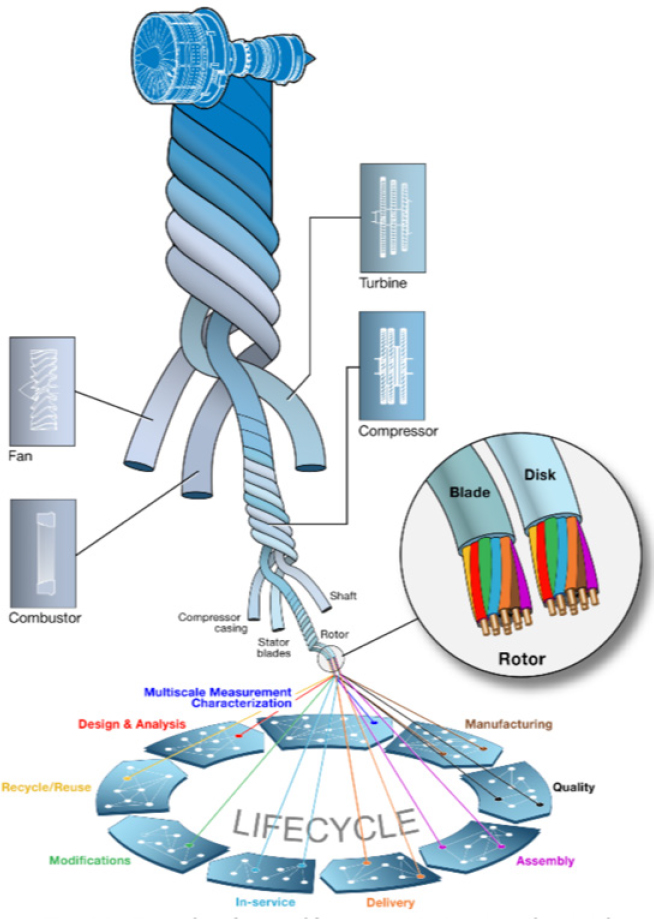
SOURCE: From AIAA Digital Engineering Integration Committee, 2023, “Digital Thread: Definition, Value and Reference Model,” reprinted by permission of the American Institute of Aeronautics and Astronautics, Inc.
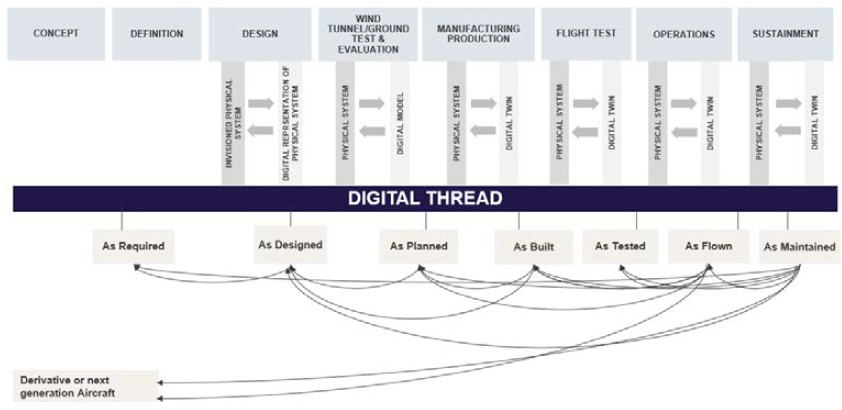
SOURCE: Data from D.N. Mavris and O.J. Fischer, 2017, “Vision Formulation for an MBSE-Enabled Approach to Digital Overall Aircraft Design.”
The committee notes that standardized modeling formalisms such as SysMLv2 can be adopted without commitment to specific tools, as can various formalisms, such as state charts, for state machines and other specialized models.
Tool ecosystems are a concern. Engineering data, properly managed, can also be useful for complex systems with multiple baselines—for example, airframes within a product line that are tailored to specific missions. Hence, an important aspect of DAF DT should involve addressing the complex and often fragmented tool ecosystems currently in place. Traditionally, many engineering efforts have been constrained by proprietary tools and data formats, creating silos that hinder interoperability and limit knowledge sharing. Vertically integrated tool ecosystems with proprietary approaches to engineering data can created “walled gardens” or “cylinders of excellence” that may require significant translation effort and duplicated effort as different teams recreate similar models using disparate tools. This can slow down development cycles and potentially introducing errors. The “vendor lock-in” many organizations find themselves confronted with makes it difficult and costly to switch tools, use tools from multiple vendors, integrate new capabilities, and share data across programs, contractors, and allied partners. The DAF has yet to sufficiently integrate data license rights into contracts in order to mitigate this “vendor lock-in.”26
___________________
26U.S. Department of Defense Office of Inspector General, 2025,” Audit of Data License Rights in Air Force Weapon System Contracts,” DODIG2025147.
Collaborative open digital environments or ecosystems can serve as an integrating fabric, establishing standardized interfaces and data exchange protocols that allow disparate tools to communicate and share information effectively. In other words, for digital environments to be accessible and interoperable it requires that they be architected around non-proprietary principles and leverage open standards and architectures as well as data formats that facilitate seamless exchange across different platforms.
Recommendation 5-9: The Secretary-designated officer or senior leader should prioritize curation of engineering data, leveraging existing tools and software whenever feasible and appropriate. When new tools are necessary, they should be developed with interoperability in mind, including open approaches to engineering data, and adhere to open standards (particularly for associated engineering data) to ensure seamless integration and collaboration.
Factor 3: Digital Engineering Data in Support of More Confident and Efficient Test and Evaluation, Including for Cybersecurity
The technical debt of legacy systems can be a consequence of the loss of engineering information. Many of the challenges of evolving legacy systems relate to information loss and consequent uncertainties regarding design choices, rationale, and technical workings of existing systems.27 Indeed, for many legacy systems, there is often a hidden accumulation of technical debt, as described above. This technical debt can be in the form of a backlog of repairs and refactorings that are required to rectify expedient implementation decisions made in order to address immediate challenges—for example, of cost or schedule.
Technical debt can also be in the form of lost information regarding models, design choices, invariants, and rationale that would need to be recovered (e.g., through reverse engineering) in order to make changes safely, including repairs or enhancements, whether to meet new threats, respond to new mission imperatives, or exploit emerging new technologies.
Test and evaluation (T&E) is facilitated when engineering information is retained. Much of the activity of T&E teams is focused on capturing engineering information and assessing its consistency with as-built baselines. An effective DE process can thus significantly reduce this cost, since engineering information is curated throughout the life cycle, and so costs to recover, rediscover, and assure consistency of engineering information can be eliminated.
___________________
27Cybersecurity and Infrastructure Security Agency, 2025, “Closing the Software Understanding Gap,” https://www.cisa.gov/resources-tools/resources/closing-software-understanding-gap.
Benefits to T&E can be further improved when T&E stakeholders participate early in the process, when choices regarding DE are made, enabling good alignment of engineering information with T&E needs. This can include operational data, essential to support system evolution in response to shifts in the threat environment, enhancements to mission concepts, and emergence of new technologies.
Engineering information is particularly important for evaluations in support of cybersecurity and resilience. This includes threat models, vulnerability analyses, and assurance of compliance with architectural principles. Architectural choices that are relevant can include adherence to the principle of least privilege, such as through zero-trust and related practices, reduction in coupling among system elements, integrity checking at internal communication and data-sharing interfaces, use of metadata tags, and other practices. Many of these choices need to be made early. Partnering with T&E organization can help inform good choices.
All significant programs are driven by the goals and objectives of mission planners for new and improved capabilities. The most challenging job for mission planners is to consider constraints of resources and schedule, engineering capability, risk tolerance, and a feasible scope. Improvements in technology are the most obvious enabler of increased capability, but so are improvements in engineering predictability, producibility, risk management, and judgment. These are the key elements that frame the business case for DT, because it can significantly contribute in most of these aspects, and in all phases of systems engineering life cycle.
Recommendation 5-10: The Department of the Air Force should more aggressively incorporate cybersecurity and build security into its digital engineering ecosystem. This includes architectural choices that enhance resilience and security, accumulation of evidence to support more confident security-related test and evaluation, and modeling and threat-informed analysis to reduce attack surfaces, minimize vulnerabilities, and generally impose a high work factor on adversaries. Most importantly, security and resilience considerations should be considered at the earliest stages of program development. The Secretary-designated officer or senior leader should evaluate cybersecurity implementation.
The Intersection of Artificial Intelligence and Digital Engineering
The rapid evolution and emergence of modern neural-network AI offers increasing opportunities for those capabilities to complement DE. Most obviously, AI can assist in accelerating technical design development while optimizing the performance of the resulting system. Most importantly, as the volume and complexity of the information generated through DE has grown, AI applications can provide sense-making services by analyzing large sets of data to identify correlations and
trends, enabling engineers to uncover meaningful insights that inform model development and engineering decisions. It can detect anomalies and outliers, alerting teams to potential issues that require further investigation. AI can also facilitate scenario simulations to explore various outcomes based on different parameters, to enhance understanding and optimize engineering processes.
When DE data are appropriately structured for AI applications, currently available tools can assist engineers in numerous aspects of their work within the digital environment:
- Requirements generation and allocation of requirements to subsystems and components;
- Requirements extraction from textual sources and conversion into structured formats (e.g., sysML diagrams);
- Evaluation of model correctness and completeness;28,29,30
- Evaluation of model compliance with standards;31
- Design optimization through generative design and topology refinement;
- Intelligent support for technical decisions and resource optimization;
- Analytics to predict system performance, failure modes, and operational support requirements;
- Automation of time-consuming activities such as the conduct of design reviews and the development of hardware refinements, software codes, engineering reports, test equipment design, test procedures, bills of material, and manufacturing instructions, maintenance schedules, etc.;
- Improved testing and validation through virtual prototyping exercised in performance simulations;
- Translation of hardware models for advanced manufacturing;
- Knowledge representation and management; and
- Enhanced collaboration through facilitated knowledge sharing and cross-disciplinary integration.
___________________
28R.A. Tikayat, B.F. Cole, O.J. Pinon Fischer, R.T. White, and D.N. Mavris, 2023, “aeroBERTClassifier: Classification of Aerospace Requirements Using BERT,” Aerospace 10(3):279, https://doi.org/10.3390/aerospace10030279.
29R.A. Tikayat, O.J. Pinon Fischer, R.T. White, B.F. Cole, and D.N. Mavris, 2024, “Development of a Language Model for Named-Entity-Recognition in Aerospace Requirements,” Journal of Aerospace Information Systems 21(6):489–499.
30R.A. Tikayat, B.F. Cole, O.J. Pinon Fischer, A.P. Bhat, R.T. White, and D.N. Mavris, 2023, “Agile Methodology for the Standardization of Engineering Requirements Using Large Language Models,” Systems 11(7):352.
31E. Karagoz, D.N. Mavris, and O.J. Pinon Fischer, 2024, “Identification of Missing Knowledge in MBSE System Models Using Graph-Based Machine Learning,” Authorea, https://doi.org/10.22541/au.173438072.22752141/v1.
For AI to be effective, the underlying data must be of high quality and properly structured. In the context of DE, this would require the following:
- Standardization: Data should adhere to industry standards to ensure consistency and interoperability across different systems and tools.
- Pedigreed: As designs evolve through engineering development, numerous data sets will be generated that represent different configurations in that design continuum as well as configurations developed for different purposes (e.g., proof of concept, prototype testing, integration testing, qualification). Metadata that capture the specific configuration; the tools, versions, and settings that generated associated data; and other administrative details are essential to ensuring the integrity of analytical results, especially when assisted by AI.
- Completeness: Comprehensive data sets that capture all relevant aspects of the engineering process are essential for accurate AI modeling.
- Accessibility: Data must be easily accessible to AI algorithms, to make effective correlations and accurately summarize results and provide new insights.
- Consistent: Data should be consistent with the evolving engineering baseline.
A well-structured data architecture is a key element of a successful DE program, and it needs to be sustained through disciplined application of data standards. Once established, a data governance process should also be in place to provide continued management and adjustments as needs change. AI can assist in monitoring systems for adherence to data standards, in addition to supporting the design development process.
The intersection of AI and DE presents a unique opportunity to transform the design and development landscape. By ensuring that DE data are AI-ready, organizations can harness the power of AI to enhance design optimization, automate repetitive tasks, and provide intelligent decision support. As industries continue to evolve, the cautious adoption of AI and its integration into DE practices will be essential for driving innovation, improving efficiency, and maintaining a competitive edge.


