Digital Transformation in the Department of the Air Force (2025)
Chapter: 4 Department of the Air Force Digital Transformation Use Case Examples
4
Department of the Air Force Digital Transformation Use Case Examples
As part of its task, the committee was asked to assess the Department of the Air Force’s (DAF’s) digital adoption progress to date through two representative use case examples. The committee examined several possible options, and as exploration and analysis continued, it observed that there was variance across the DAF enterprise with regard to the degrees of digital adoption various programs had achieved, with some fragmented pockets of excellence within the larger area of the enterprise. No DAF program had obtained a seamless digital thread across life-cycle phases and commands. Nonetheless, the committee found that these partial adoptions were yielding benefits, in most cases across multiple life-cycle phases.
The committee chose to examine the Air Force Sustainment Center (AFSC), which has implemented a 5-year effort to incorporate digital engineering (DE) into its work, and the T-7A program, a digitally engineering training aircraft developed by Boeing and the DAF.
USE CASE EXAMPLE: AIR FORCE SUSTAINMENT CENTER
The effort at the AFSC provides an instructive example of an enterprise approach to DT. The AFSC is 5 years into an effort to utilize DE to integrate all aspects of the depot sustainment. This standing effort is aligned into the Air Force Materiel Command’s (AFMC’s) 2023 Digital Materiel Management (DMM) strategy.
The AFSC is a geographically dispersed organization responsible for diverse weapon systems. There are three major air logistics centers (ALCs), called depots: Oklahoma City Air Logistics Complex (OC-ALC), Ogden Air Logistics Complex (OO-ALC), and Warner Robins Air Logistics Complex (WR-ALC), with multiple satellite locations
worldwide.1 The role of AFSC is “depot maintenance, supply chain management, and operations and installation support.” The 2024 AFSC Strategic Plan has four lines of effort:2
- Deliver combat readiness
- Deliver supply chain readiness and resiliency
- Modernize and posture the organic industrial base
- Attract, develop, and retain world-class airmen
The AFSC, at the outset, already possessed a great deal of digital capability. However, most of this capability was located on isolated workstations with little integration at the same location, much less across the enterprise. The legacy infrastructure represented a hindrance to integration across the enterprise. The advent and acceptance of cloud infrastructure enabled the transition from this environment. Successful DT and digital modeling benefits legacy system sustainment, presenting opportunities to reverse-engineer existing hardware or improve hardware repair through additive manufacturing.
Approximately 5 years ago, AFSC began the effort to better integrate across the various AFSC activities. An important infrastructure to support this integration is an intranet between major centers for sharing information and coordinating business. This intranet utilizes commercially available products from companies such as Cisco, ThingWorx, and Corsha, configured in a manner tailored to the mission. Additionally, the Air Force Product Lifecycle Management (AF-PLM) effort is enabled by AFSC’s DMM. AFSC’s DMM ecosystem touches all lines of effort of the 2024 Strategic Plan and is best examined using the common elements to accelerate the DT described earlier.
LEADERSHIP AND ADOPTION CULTURE
There is a strategic communication effort to ensure the DAF workforce understands AFSC’s DMM strategy and guides the culture change. This communication effort includes a weekly collaboration between the Air Force Life Cycle Management Center (AFLCMC), AFSC Engineering, the Nuclear Weapons Center, and the A6 Communications Directorate. Additionally, there are regular working groups, including the DMM Implementation Framework, the Digital Acceleration Task Force, Distribution Depot Warner Robbins, and the DMM Workshop.
The longevity of the AFSC DE journey for 5 years and evident support of the current commander suggests that leadership continues to endorse the DT. This
___________________
1Air Force Sustainment Center (AFSC), n.d., “Air Force Sustainment Center,” https://www.afsc.af.mil/About-Us, Accessed February 20, 2025.
2AFSC, 2024, Air Force Sustainment Center Strategic Plan 2024, https://www.afsc.af.mil/Portals/24/documents/AFSC%20Strategic%20Plan%202024-FINAL.pdf?ver=_CazgDykOaX2EzfnpWsfsQ0%3d%3d.
has enabled the involvement of AFSC, AFLCMC, and program office leadership to create a direct impact on successful integration across platforms.
The messaging is reinforced by providing the necessary training for educating individuals on the DMM processes and applications. This training includes 98 hours of available training in the courses listed in Table 4-1.
Funding and Incentives
In order to ensure maximum funding flexibility and direct financial authority, AFSC funds DMM efforts through its working capital fund. This revolving fund supports the sustainment mission and provides benefits to integrated materiel management, auditiability, and maintenance execution. Additionally, The AFSC uses an annual program objective memorandum (POM) planning factor to generate requests for new DMM expenditures according to the stated priorities for the year’s POM. AFSC’s strategic use of funding communicates to leaders the benefits of DMM sustainment capabilities from a business process integration perspective.
Software and Data Standards
As part of the DMM migration, AFSC “inventoried” existing software tools in use across the enterprise. Unsurprisingly, this was met with an initial reluctance, since stakeholders had fears over losing essential capabilities. This tension is similar to that noted in the Model 437 touchstone. Multiple software tools are likely needed to sustain compatibility with a weapon system’s original equipment manufacturer (OEM) development tools. But it is also beneficial to support commonality for engineering data and, from a budget perspective, to consolidate buying power for multiple licenses where able. The compromise is to provide multiple tools and to maintain unique OEM tools to support compatibility. Additionally, software available on AFMC’s Launchpad are also used.
There are 48 DE baseline tools accessible across AFSC encompassing the capabilities listed in Table 4-2. The number of tools serves as an acknowledgment that given the multiple OEMs, a “one-size-fits-all” approach is not warranted.
TABLE 4-1 Digital Materiel Management Training Summary: Training Courses by Level
| Level | Courses | Estimated Training Time (hours) |
|---|---|---|
| Introductory | 14 | 3 |
| Foundational | 4 | 38 |
| Focus | 39 | 57 |
| Total | 57 | 98 |
SOURCE: Data from the AFSC, 2024, “AFSC DMM,” Presentation to the committee, November 21, National Academies of Sciences, Engineering, and Medicine.
Two minimum viable products were developed using a model-based environment and the Cameo and AnyLogic commercial toolsets. The first was the 309th Electronics Maintenance Group Units Under Test Model and the second the 402nd Commodities Maintenance Group Propeller line. The committee was told that both demonstrated significant cost saving and reduced flow days.
Legacy weapon systems, such as the B-52, do not have a true engineering bill of material (BOM) because drawings and related engineering documents are not captured in a modern engineering data management system. To remedy this, there has been an effort over the past 3 years to increase the fidelity of the BOM for the legacy systems. The “BOM 360” effort objective is to use automation and machine learning (ML) to create a master BOM for all legacy weapon systems, including roughly 1,600 illustrated parts breakout manuals and the ingestion of additional manuals. The objective is to create a consolidated and corrected BOM. An added benefit of the BOM effort will be candidate additive manufacturing parts list determination.
Hardware and Secure Information Technology Infrastructure
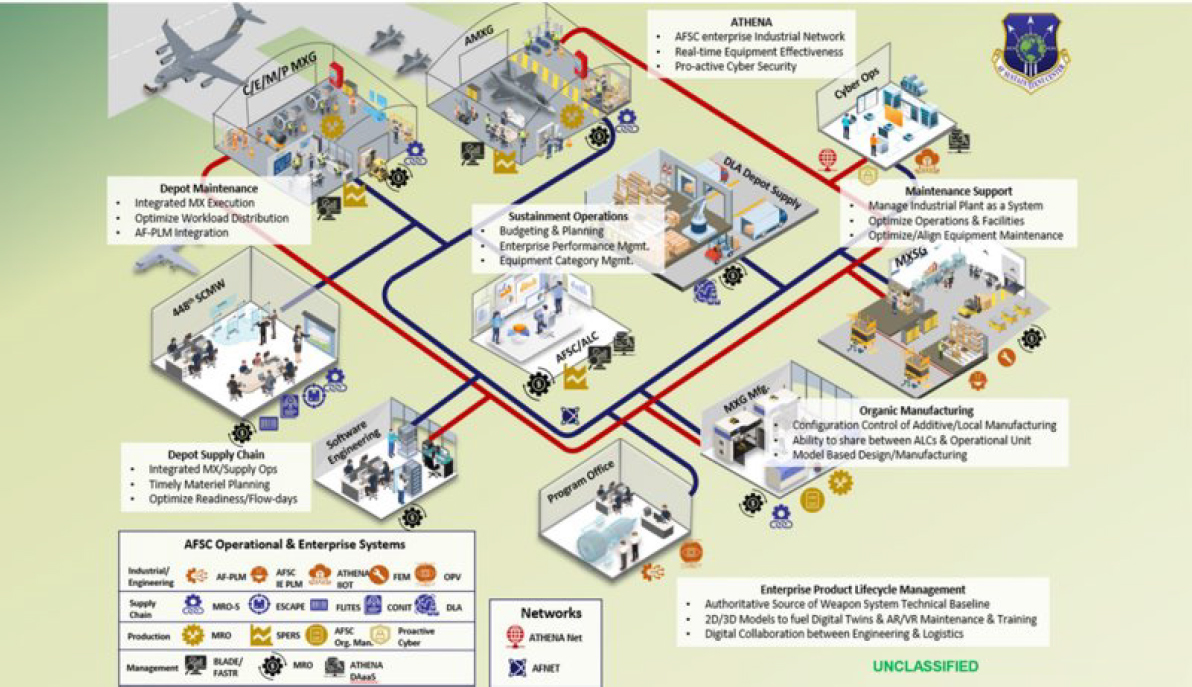
The main component of AFSC’s logistics information technology (IT) is Athena, an intranet system utilizing commercial hardware and software, which is fully connected. The operational technology (OT) backbone of Athena is based on the Purdue Model which, “provides a framework for segmenting industrial control system networks from corporate enterprise networks and the internet.”3 AFSC’s enterprise industrial network infrastructure of Athena is illustrated in Figure 4-1.
TABLE 4-2 Air Force Sustainment Center Digital Engineering Baseline Tools
| Tool Category | Number of Tools and Applications |
|---|---|
| Design | 13 |
| Manufacturing | 10 |
| Data analysis | 10 |
| Data simulation | 7 |
| Management | 6 |
| Coding | 2 |
SOURCE: Data from AFSC, 2024, “AFSC DMM,” Presentation to the committee, November 21, National Academies of Sciences, Engineering, and Medicine.
___________________
3D. Garton, 2019, “Purdue Model Framework for Industrial Control Systems and Cybersecurity Segmentation,” Topic Paper 4-14, National Petroleum Council, November 12, https://www.energy.gov/sites/default/files/2022-10/Infra_Topic_Paper_4-14_FINAL.pdf.
SOURCE: AFSC, 2024, “AFSC DMM,” Presentation to the committee, November 21, National Academies of Sciences, Engineering, and Medicine. The appearance of U.S. Department of Defense (DoD) visual information does not imply or constitute DoD endorsement.
The major attributes of Athena are cybersecurity, data analytics, industrial Internet-of-Things application, and OT network (on prem Cloud One). Cybersecurity is based on a key cyber terrain concept. This approach borrows from a ground commander’s concept of using terrain (hill, valleys, waterways, etc.) to gain operational advantage. In the case of cyber, terrain is virtual, not physical.4 This approach facilitates the formulation of offensive and defensive cybersecurity strategy. OT enables the three ALCs to be connected to Athena. The goal is capability attached to Athena will also be attached to the manufacturing equipment thereby eliminating the current air gap challenge.
Metrics
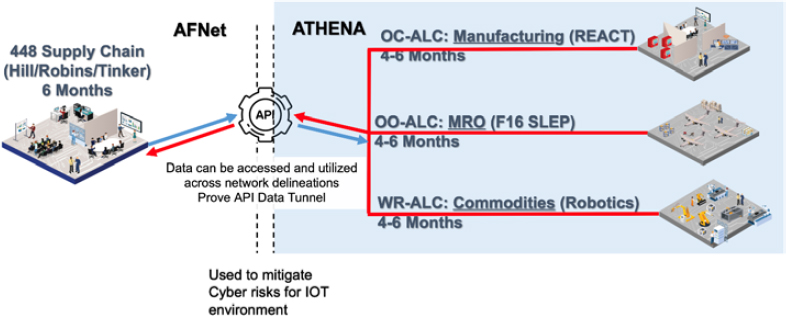
While there was not any discussion or indications of specific metrics, four dedicated acceleration efforts were presented as a way to track digitization progress as shown in Figure 4-2. Three of these efforts focus on the Athena intranet involving the individual ALCs and the remaining is directed toward the Air Force Network (AFNet) interface.
OO-ALC is in the process of fully digitizing the F-16 SLEP effort. This included the establishment of the AF-PLM and digital tools capabilities, maintenance process, digital modeling, and management. The engineering parts and assemblies used during the SLEP process were modelled. The SLEP effort was digitized using
SOURCE: AFSC, 2024, “AFSC DMM,” Presentation to the committee, November 21, National Academies of Sciences, Engineering, and Medicine. The appearance of U.S. Department of Defense (DoD) visual information does not imply or constitute DoD endorsement.
___________________
4D. Raymond, G. Conti, T. Cross, and M. Nowatkowski, 2014, “Key Terrain in Cyberspace: Seeking the High Ground,” In 2014 6th International Conference on Cyber Conflict, P. Brangetto, M. Maybaum, and J. Stinissen, eds.
a maintenance/manufacturing process planning tool, which facilitated an optimization of the process. Additionally, the engineering, manufacturing, and process BOMs were included in the effort. Digital data was used to develop electronic work instructions. Finally, the F-16 SLEP work requirements were incorporated into the maintenance execution system.
The Manufacturing, Reverse Engineering and Critical Tooling (REACT) provides reverse engineering capability coupled with additive manufacturing to provide parts that are no longer commercially available and at a potentially lower cost. This capability makes use of the Siemens Teamcenter PLM software. The effort is to integrate Teamcenter with Athena or establish a connection to Cloud One. Additionally, a Teamcenter instance that supports the supply chain is currently isolated to the landing gear supply chain activities at Hill Air Force Base. The objective is to consolidate that into the larger Air Force cloud. Unlike the previous efforts that are Athena-facing, the 448th instance is AFNet-facing.
Conclusion 4-1: The Air Force Sustainment Center (AFSC) has conducted a 5-year effort to utilize digital engineering to integrate all aspects of depot sustainment, representing one of the most mature digital transformation efforts in the Department of the Air Force (DAF). AFSC is reaping benefits of these efforts and is a representative “pocket of excellence” whose efforts have not been duplicated elsewhere in the DAF.
USE CASE EXAMPLE: BOEING T-7A RED HAWK ADVANCED JET TRAINER
The committee reviewed the use of DE on the T-7A Advanced Pilot Training (APT) program from the perspectives of both Boeing and AFLCMC. This program was planned to be Boeing’s first clean sheet development that would be built from the beginning on model-based definition (MBD). AFLCMC was also focused on applying DE to build the life-cycle program, starting with qualification of the system against requirements. Since the contract bridged the establishment of key DE standards, the program was challenged to fully leverage the initial MIL-STD-31000A “Technical Data Packages” (TDP) that were in place at the time of contract award in 2017, but the subsequent version B which drives 3D models as the deliverable for TDPs was yet to be released. As a result, there were differences in the benefits that were realized from DE by each organization.
On previous programs, beginning in the 1990s, Boeing applied digital models for increased design efficiency to meet performance requirements with reduced time and cost. They later evolved to use DE to better flow design information to their production floor and suppliers to ensure that hardware builds met the design intent.
Boeing teamed with Saab on the T-7A. Boeing developed the forward fuselage, empennage and wings, while Saab developed the aft fuselage. Although they did not use the same computer-aided design (CAD) tools (Boeing used Siemens NX, Saab used Dassault Catia) the models were integrated at assembly level through Teamcenter, which supports PLM.
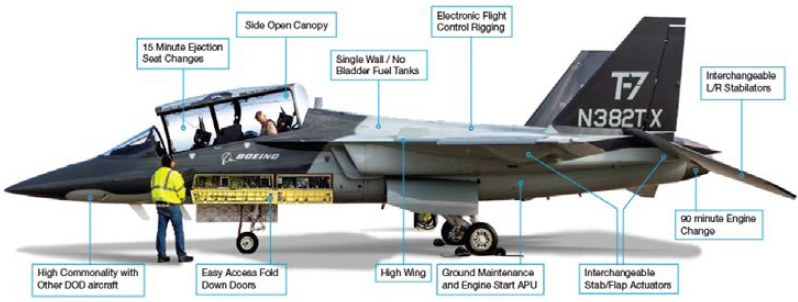
From the beginning of the T-7A program, Boeing has focused the application of DE to improve affordability and maintainability, while maintaining the ability to continually evolve training capabilities through software upgrades enabled by an open-systems architecture. These goals were achieved through central leadership direction in combination with increased use of DE tools and methods. In previous development programs, the production and maintenance engineers would not have significant visibility into the aircraft features until after preliminary design was released and initial parts were on order, at which point substantiative changes cannot be made without incurring substantial cost and schedule penalties. With model-based systems engineering (MBSE), specialty engineers had access to the design concept as it was emerging and were able to identify improvements that were not obvious to aerodynamicists that are focused primarily on performance. This created an environment where design trades could be made in real-time to better balance affordability and maintenance concerns with flight performance. Figure 4-3 identifies specific features that improved factory assembly processes and ease of maintenance, which would not have been incorporated without concurrent design collaboration that was enabled by MBSE.
For its work ensuring logistic services for the T-7A, AFLCMC’s Capability Support Office has leveraged previous DE infrastructure that was established for the A-10 program and extended the capabilities significantly, as the AF-PLM.
SOURCE: Boeing, 2024, “Reshaping the Industry: 7 Ways T-7 Advances Pilot Training,” September 17, https://www.boeing.com/features/2024/07/reshaping-the-industry-7-ways-t-7-advances-pilot-training. Courtesy of Boeing.
Leadership and Adoption Culture
Early on, Boeing leadership had an expectation of broad collaboration across all aspects of design, with particular focus on producibility and maintainability. Representatives of those disciplines were members of the team, and the culture was that “everyone in the room has an equal voice,” per Boeing T-7A chief engineer David Neely, with each engineering domain signing off on every engineering release. This was a shift from previous programs where decisions were primarily the result of trades between the structural engineers and aerodynamicists.
On T-7A, Boeing’s perspectives on other domains were incorporated into the trade-offs during initial model-based layouts of components and assemblies, and throughout design development. Concerns that were raised during reviews by stakeholders in any of the engineering domains had to be addressed.
Funding and Incentives
The APT contract to Boeing was firm-fixed price with no requirement for them to deliver MBSE models or MBD. The stipulation was for 2D drawings with 3D CAD models, but these were not to be provided prior to critical design review, nor were they uploaded by the prime contractor directly into a government system. For several decades as the tools evolved, Boeing had increasingly applied DE capabilities with realized schedule and cost savings. By the beginning of the T-7A program, they had matured these to the point that models could be transferred to their suppliers and the production floor, eliminating the need to create and translate 2D drawings, further reducing schedule and cost. As a result, the senior leadership team made the decision to have the T-7A be “born digital” to gain an advantage for their proposal in the APT contract competition.
Interestingly, the APT contract was awarded prior to DAF and U.S. Department of Defense (DoD) prioritization of DE. During the period of the contract, the DAF shifted from having individual system program offices fund DE tools and activities, to an enterprise-wide infrastructure. AFMC covers the digital tool licenses. This eliminates the need to manage individual tool licenses and install software onto each workstation. It standardizes many processes for acquisition and sustainment, and the use of DE is enforced by the established workflows. Launchpad is funded by the DAF, providing wide access to Cameo Systems Modeler, Cameo Enterprise Architect, and Cameo Teamwork Cloud (collaborative model building with real-time access), as well as MATLAB and a number of other digital tools.
Software and Data Standards
Boeing’s successful collaboration was enabled through direct interaction of the teams with the DE single-source of truth models, as distinct from legacy practices
based on PowerPoint charts. For these purposes, fully detailed models were developed for all mechanical parts, with electrical modules being represented by their outer mold lines (OMLs) and interfaces. The solid models were also pulled directly through the integrated tool suites for finite element and other analyses, to support design decisions. Use of the models informed Boeing’s full-scale determinant assembly, a manufacturing technique that benefited from digitization. Models were applied on the production floor to provide visualization of how the parts would be built and assembled, and they informed the design of production tooling. Suppliers also received the fully detailed MBDs, but these did not interface directly with the suppliers’ production machining equipment. For quality purposes, Boeing maintains complete control of how its components are built by providing detailed processing and assembly instructions to its suppliers. Boeing does not want its vendors developing manufacturing processes on their own. The MBDs support open collaboration to guide how parts will be assembled into sections, with the models incorporated into manufacturing instructions.
In addition to the T-7A aircraft, Boeing delivers ground training systems that replicate the flight environment through identical cockpit hardware and electrical functionality, seat motors to apply vibration and pull-back that simulates g-loading, and enhanced audio providing aero acoustics, engine noise, alerts, and communications. The use of MBD accelerated the establishment of the ground-based weapons system trainer, maintains its equivalency with the aircraft design, and supports “one-push software” by which a single version of operational flight software is simultaneously flowed to the aircraft and the trainers, and eliminating flight software differences that have troubled other U.S. Air Force (USAF) programs.
AFLCMC adopted Siemens TeamCenter to support AF-PLM, with its common suite of integrated DE tools identified as the most “enterprise-ready” DT capability. As Scott Boller conveyed to the committee, AF-PLM provides a common set of PLM tools into one integrated system that can be applied on each program:
- Electronic technical assistance requests provide a mechanism to request engineering guidance beyond what is available in the published technical publications to repair aircraft or address unanticipated damage conditions. This capability is required for all aircraft.
- BOM management provides for management of parts lists associated with each aircraft.
- TDP management provides the repository for the engineering models/drawings that define each aircraft.
- Contract data management provides the repository for artifacts delivered by contractors in fulfillment of their requirements.
- Digital flight test tracking pulls requirements from Boeing’s Dynamic Object-Oriented Requirements System database, test plans, and test points and
- converts them into formats that are useable by Cameo, links them, then imports them into an MS Access database along with MS Excel information from a Viper database (established under F-16 program) that is organized into different formats and loaded into Power Business Intelligence, a scalable Microsoft platform for visualization and data analytics. This tool reduces manual labor with automated data transformations to track flight test completions, requirements verification, and progress toward completing them. Senior leaders can monitor the completion of key performance parameters to achieve Milestone C.
- Condition-based maintenance applies sensor-based algorithms, being developed with AI code to predict replacement prior to failure.
Due to the contract limitations, AFLCMC does not have T-7A digital models available on a government system, but it does have access to Boeing virtual machine readers that provide viewing of the 3D models. This capability enables AFLCMC subject-matter experts to conduct system verification. The services of KBR were employed to build SysML models for the maintenance training system, and Cameo models that include mission profiles that demonstrate the system meets requirements, to support the Milestone C decision. Each of these activities help to fill gaps resulting from lack of direct access to Boeing’s digital models, but at the loss of efficiency and full insight into T-7A design and performance. The Air Force does not have a T-7A performance simulation or knowledge of the aircraft flight control law.
While the contractors leveraged digital technologies, the DAF did not receive access to the results and today cannot use these to develop performance simulations, technical publications, or maintenance instructions to support follow on development and sustainment. Providing this access would provide a more direct benefit to AFLCMC.
Hardware and Secure Information Technology Infrastructure
The full use of DE and MBDs allowed Boeing and Saab to go from design start to first flight in less than 3 years. Since the build of the first two prototypes, they have since evolved to the first production relevant jets with no deviations to the OML, except to accommodate an actuator, such that the aerodynamic performance characteristics have remained unchanged. Since airframe component models can be imported directly into structural and thermal analysis tools, they are fully characterized to predict how they will respond to the stresses induced during fabrication and assembly. Any resulting deformations/deviations that would affect interfaces or joints can be addressed and eliminated prior to production of the initial parts. Although the forward fuselage was designed in St. Louis and the aft fuselage was designed in Sweden, the initial physical joining of those parts was accomplished
in 30 minutes, including all fasteners and electrical connections, compared to the typical multi-day operation for a first “splice.” The largest deviation of the OML measured by light detection and ranging (LIDAR) scans from tip to tail was 0.007 inches including paint (which is not in the model), compared to 0.25 inches for previous prototype aircraft. Static testing has replicated the finite element analyses and flight performance is also as predicted, with the exception of aerodynamic deviations at the highest angles of attack. Other advantages over previous aircraft designs include increased parts accessibility and ease of maintenance (e.g., easy access service doors that drop down), line replaceable units are at waist to shoulder height (instead of underneath the fuselage requiring maintainers to lay under the aircraft), and there are more common parts, which reduces the number of components that need to be stocked. The T-7A engine can be replaced in 90 minutes.
Metrics
While not yet formally adopted, an additional AF-PLM capability, Life Cycle Management Process Integrated Data Environment provides an executive-level dashboard that pulls data from multiple sources to track key metrics and provide the ability to drill down into data through a cloud-based architecture.
Program Timeline and Status
First conceived in 2003, the program to replace the T-38 Talon trainer did not reach a budget proposal until fiscal year (FY) 2013, where the USAF targeted an FY 2016 T-7 contract award. Boeing teamed up with Saab and unveiled their first T-X prototype in September 2016, followed by first flight during program competition in December 2016. Boeing-Saab submitted this design as their entry to compete for the T-7 program that same month and were awarded the development contract in September 2018. Named the T-7A Red Hawk in September 2019, the aircraft entered the Engineering Manufacturing and Development phase in February 2021. Design development progressed to the T-7 rollout in April 2022, but in May 2023, a Government Accountability Office report detailed problems with the ejection seat and aircraft instability at high angles of attack (AoA).5 The T-7A subsequently conducted its first flight test in June 2023, and the first tail number shipped to the USAF in September of that year. The award for the initial production contract, originally scheduled for 2025, has been delayed to 2026.
Although the program realized technical issues, these issues did not detract from the advantages that were gained from the implementation of DE. Proper ap-
___________________
5Government Accountability Office, 2023, “Advanced Pilot Trainer: Program Success Hinges on Better Managing Its Schedule and Providing Oversight,” GAO-23-106205, https://www.gao.gov/products/gao-23-106205.
plication of DE tools could have potentially provided earlier identification of the issues with the ejection seat and high AoA instability. However, it should be noted that for high-performance aircraft, and especially at the edges of the flight envelope where aerodynamic effects are less predictable, modeling capabilities are continuing to mature. These problems reinforce that while DE can provide a significant advancement, it is not sufficient to ensure flawless program development.
Concluding Thoughts
The T-7A program is a representative use case showing the state of DAF’s DT efforts because it not only showcases the use of integrated DE applications to realize program benefits but it also demonstrates challenges that are driven by the dynamic environment as digital capabilities are introduced and matured, and the limitations of DoD contracts to keep pace. Here are some examples of the benefits realized through the emphasis on digital activities:
- The DAF benefited from Boeing/Saab applying DE to achieve the first T-7A flight within 3 years of design start, with significant improvements in aircraft performance features, producibility, affordability and maintainability over previous aircraft. The ground-based weapon system trainer is also highly representative of the cockpit environment and maintains equivalency with the aircraft hardware and software.
- In spite of AFLCMC’s limited access to Boeing 3D CAD models, they were able to conduct remote verification of some system-level requirements by DAF subject-matter experts.
- AFLCMC is effectively applying an enterprise-wide DE platform and tool suites that are increasing efficiencies in managing the APT and other programs. They are realizing significant reductions in time and cost to integrate digital data to manage system verification and monitor qualification flight test progress toward Milestone C decision.
Lessons learned from the T-7A use case contracting:
- The limitations of the contract impeded the ability of AFLCMC to efficiently incorporate Boeing’s MBD and MBSE into its support infrastructure. Going forward, AFLCMC should include requirements for direct access to desired DE models and artifacts in prime contracts. Contractor delivery of the same into the USAF’s TeamCenter platform would also accomplish the immediate need, but with significant risk of losing currency as engineering changes are implemented and the additional costs associated with extra labor required to maintain a separate database.
- Ideally, contracts would have an affordable mechanism to adapt as DE capabilities evolve.
- For future contracts, a mechanism should be incorporated for AFLCMC to pull Boeing 3D models directly into DAF technical publications and maintenance instructions. This would realize the same benefits as Boeing has achieved through pulling the same models into its production environments.
Conclusion 4-2: The T-7A program is a representative use case showing the state of the Department of the Air Force’s (DAF’s) digital transformation efforts because it showcases the use of integrated digital engineering (DE) applications to realize program benefits and points to further advantages that could be realized in future contracts. There is nothing unique about the T-7A example that precludes the same approach and benefits for other DAF programs. The DAF benefited from Boeing/Saab’s application of DE, and the Air Force Life Cycle Management Center (AFLCMC) was able to conduct remote verification of some system-level requirements by DAF subject-matter experts. AFLCMC is also effectively applying an enterprise-wide DE platform. However, the limitations of the contract impeded the ability of AFLCMC to most efficiently incorporate Boeing’s model-based systems engineering into the Air Force Sustainment Center’s support infrastructure.


