Impacts and Performance of State DOT Resilience Efforts (2025)
Chapter: 1 Introduction and Project Purpose
CHAPTER 1
Introduction and Project Purpose
Transportation agencies face an increasing frequency and magnitude of risks from a range of stressors and hazards, including natural hazard variability. Now more than ever, a strategic approach to planning, investing, and monitoring conditions to help enhance asset and system resilience, reduce impacts of disruptions, and track the effectiveness of resilience efforts, is needed to integrate resilience into state DOT practices.
This research is a critical foundational step towards establishing a performance-based management and investment approach to resilience, in alignment with the federal focus on transportation performance management. In this environment of limited funding and competing system needs, it is even more critical to define the performance outcomes of resilience investments to support funding decisions, particularly given the uncertainty and long-term nature of realization of some of the potential benefits.
There is limited research and body of work to evaluate the effectiveness of policies, programs, project implementation, and other resilience actions from state DOTs. Having a standardized set of performance measures encourages the data-driven use of potential investments and the incorporation of resilience into agency practices and programming. It helps to communicate the strategic link between investment decisions and goals through clearly structured evaluation, monitoring, and reporting methods. DOTs are looking to develop approaches, methods, and tools for evaluating, tracking, and communicating the impacts of stressors on their transportation system. Thus, this research was conducted to:
- Identify or develop key RPMs for state transportation agencies for roadway transportation systems for various classes of assets (e.g., bridges, intelligent transportation systems (ITS), pavement, culverts).
- Develop an approach that uses performance measures to assess the effectiveness of resilience strategies.
- Develop a guide to aid state transportation agency practitioners in applying RPMs.
This report summarizes the approach, tasks, and key takeaways over the course of the research, spending additional time highlighting how the development and implementation of three key deliverables (see the bullet list below) respond to the three main research objectives:
- Filterable Excel Compendium of 13 RPMs and seven accompanying RPM Templates.
- SIM.
- NCHRP Research Report 1159 for Selecting and Implementing RPMs.
As Figure 1 illustrates, the three key deliverables are directly tied to the primary research objectives.
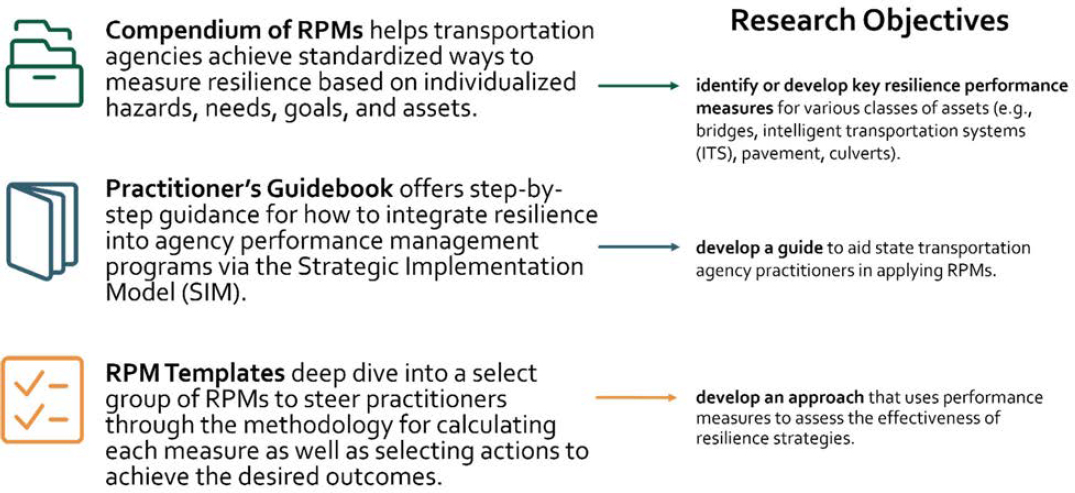
These deliverables have several additional layers of information that will be of value to transportation practitioners, including seven RPM templates appended to the guide that walk practitioners through the steps of developing and implementing an RPM (i.e., the SIM) of the RPMs (see Chapter 4). The SIM is a step-by-step process model that starts from Step 1 “understanding resilience” adapting into familiar transportation performance management processes like Step 4 “baseline assessment” in which DOTs begin to measure their resilience initiatives. This model helps position state DOTs and other transportation agencies in integrating RPMs into their existing performance-based planning and programming processes.
The Compendium of RPMs (see Chapters 3 and 4) enumerate over a dozen options for state DOTs to measure the resilience of various roadway assets, and NCHRP Research Report 1159 provides instructions on how to establish, apply, and integrate RPMs into agencies’ existing performance management activities. These resources are envisioned to help practitioners and agencies establish more concrete methods for measuring the resilience of their transportation system while also understanding the impact of their resilience investments and strategies.

