Understanding the Introduction of Pathogens into Humans: Preventing Patient Zero: Proceedings of a Workshop (2026)
Chapter: 7 Opportunities to Prevent Patient Zero
7
Opportunities to Prevent Patient Zero
The last session was moderated by Daniel Bausch, National University of Singapore, and included a panel discussion on potential next steps for bolstering global capacity to prevent patient zero. Each panelist shared reflections on the previous workshop sessions, followed by a moderated discussion.
Mekaru said that when it comes to pandemic preparedness and mitigation, often only industry, pharmaceutical companies, and the life sciences are considered. She noted that it is also important to engage the business community to communicate risk of pandemic emergence to the broader public. Businesses exist to make a profit, and they function best when they can avoid or plan for a disruption. COVID-19 showed many business leaders that they might weather the pandemic better than their competitor by providing personal protective equipment (PPE) or flexible sick leave. Some enduring mechanisms are now in place in the business community that are useful for academics and scientists, she said. Businesses that are publicly traded have securities requirements through the financial industry regulatory authority and need to have business continuity plans and emergency contact information plans. Over the course of the past several years, businesses have become aware that biological threats pose a risk to economic stability. Therefore, there are opportunities to engage with the business sector outside of the life sciences, she said, to discuss what their role in prevention might be. Discussions of incentives and regulations can be broadened to engage different stakeholders that can come together and act to advance national security, economic security, and global stability, she explained.
Sleeman addressed some consistent themes that were discussed throughout the workshop, starting with misaligned incentives. Pandemic control and prevention affects economic activities, and there is a need to address competing objectives, he said. Further, there was discussion on the importance of moving away from top-down to bottom-up approaches and discussions. Potentially looking at the root causes of some of the issues, or drivers of spillover events, may help uncover solutions that were previously hidden, he said. Finally, he noted the need for embedding metrics for success in the approaches taken. He explained Kotter’s eight stages of transformative change, in which one of the key steps is articulating the vision for the future (Kotter, 2012). Moving toward change is stressful, but if global health practitioners can communicate the vision for the change and how people are going to benefit, it may have more success, he explained.
Sleeman also noted that the development of new technologies—such as artificial intelligence and machine learning, advances in forecasting and prediction, and environmental sampling—seem to have outpaced policy and management actions. He said that it is important to discuss how to better integrate these new streams of data into decision making, rethink and reimagine policy approaches, and build on engaging industry to gain support for implementing new interventions.
Finally, he noted there are still some significant knowledge gaps, and that it is important to think about how to accelerate research to become more efficient in data collection and understanding the systems. Nature-based solutions are promising, but it is essential to determine whether these will be successful or whether there will be unintended consequences, he concluded.
Kevin Anderson, formerly with the Department of Homeland Security, said that disease and pathogen exposures will continue to happen, and response to these threats must continue to evolve and improve. His described his experience establishing a biological characterization program with the U.S. government, which was a risk-based analysis that examined the full cycle of a potential bioterrorism event, from the introduction of the pathogen through the mitigation of its consequences. This approach allowed his team to identify the characteristics of concern that would enhance pathogenic potential. Risk-based approaches, he said, can inform how to use resources most effectively. Risk-based approaches must also evolve to account for both natural exposures and the risks that may be posed by emerging technologies, he said.
Matiangai Sirleaf, University of Maryland, began by reflecting on patient zero in an Ebola outbreak in West Africa in 2014 and 2015. In this case, an infected person went to an underresourced health facility without PPE and other necessities for successful treatment and containment, which rendered both the patient and health care worker vulnerable and
susceptible to transmission, leading to a large outbreak. To truly understand the introduction of pathogens into humans and prevent the next patient zero, she said, it is critical to understand the social determinants of health, which include political, legal, and economic factors, along with institutional processes and social norms. Further, it is essential to determine how these social determinants of health shape the distribution of power and resources, which determine people’s lived experiences, Sirleaf said. Instead of an approach that only looks at individual behavior or even country-level behavior, there is a need to examine the larger global social, legal, and physical environments that lead to epidemics and pandemics, she emphasized. The way in which diseases spread, she said, is not merely a naturally occurring event but is shaped in part by the actions of states, international actors, and global institutions.
The responsibility for addressing disease spread must be shared across a wide range of actors, she continued. There is a need to reconceptualize how international responsibility is understood that is much more forward looking than conventional approaches to responsibility, said Sirleaf. This shared responsibility should mean that states, international organizations, and other nonstate actors would have a legal duty to recognize and act upon the threats posed by pathogens. This duty could be derived from several frameworks, she said, such as principles of global justice and distributive justice, but also from legal obligations and duties within international human rights law and legal obligations of international cooperation. Given that pathogens do not remain within borders, there is a need to build a realistic understanding of responsibility, she posited.
PREVENTING PATIENT ZERO
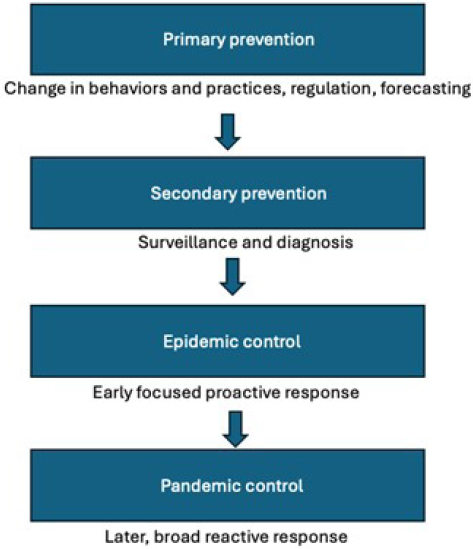
Bausch discussed a proposed framework that depicts the process of preventing patient zero, beginning with primary preventions and ending with pandemic control, mirroring the discussions of the previous workshop sessions (Figure 7-1).
The figure is a very simplified notion of mitigating infectious diseases, he said. During this workshop, there was discussion of primary prevention, including how a first infection can be prevented and how initial infections can be controlled. Secondary prevention, he continued, relates to disease surveillance and diagnosis after patient zero has occurred and approaches to mitigate infection transmission to prevent an outbreak or epidemic. Since the COVID-19 pandemic has waned, most of the discussion has focused on the last item of pandemic preparedness, but Bausch stated that this is not the most effective focus. When the focus is not on prevention and early mitigation, there is an opportunity for an outbreak to progress and lead to a pandemic, he said.
SOURCE: Presented by Daniel Bausch, January 16, 2025.
However, Busch said that there is skepticism of the ability to prevent an initial infection given the myriad opportunities for pathogen spillover. He said that incredible new technologies were discussed during the workshop but raised questions as to whether these technologies are sufficiently scalable. He asked the panel how to practically shift the collective focus back from pandemic preparedness to primary prevention. Mekaru responded that the disease surveillance systems that are used to understand the drivers of disease emergence can also be applied to primary prevention. The monitoring of disease drivers has multiple uses, and there are other consumers of that information in other academic disciplines and in business, she said. She proposed the academic scientific community could lead in developing disease surveillance tools or opportunities that have that broader appeal, which would be more likely to obtain diversified funding and a coalition of interest when there is a broad consensus of the value. In a rapidly changing world, tools with multifaceted use and diverse supportive coalitions will be more likely to endure in turbulent times, she said.
Sleeman agreed that there is a need to focus on all the different stages of disease mitigation that Bausch addressed. While it is possible to reduce
the number and severity of spillover events and epidemics, he does not think that all disease events can be prevented. Therefore, he said, it is important to take a risk-based approach and focus the primary interventions on the highest-risk activities. He added that in terms of scalability, it is important to ensure that basic infrastructure is present in all sectors, including public health, agriculture, and wildlife research, to conduct these prevention activities. Funding tends to surge when there is an emergency, he said, but when the emergency goes away, the funding declines and sometimes disappears. He said that there is a need to focus on creating sustainable funding streams to maintain basic infrastructure. Anderson replied that taking a risk-based approach to primary prevention would include a focus on the characteristics of pathogens that suggest enhanced pandemic potential, such as transmissibility, host range, and whether there is any herd immunity. Anderson emphasized the importance of primary prevention, which can limit downstream consequences, and that mitigation measures should be evaluated based on the characteristics of the pathogen.
Sirleaf connected primary prevention to the Sustainable Development Goals (SDGs), which were adopted by the United Nations in 2015. Goal 3 of the SDGs centers on ensuring healthy lives and promoting well-being for all at all ages (UN, 2023). Targets listed under this goal include seeking to achieve universal health coverage. This target includes financial risk protection; access to quality essential health care services; access to safe, effective, and affordable essential medication and vaccines for all; and ensuring universal access to sexual and reproductive health care services, she said. Ongoing evaluations reveal that most countries are far from reaching the targets, especially those related to health, Sirleaf added. The problem is not one of scarcity; a significantly higher level of health and well-being for all people is attainable through better use of global resources, she stated. The current maldistribution in health and well-being is not inevitable or natural, she continued. She said her concern with risk-based models is that they will include a political calculation that prioritizes the health of some people over others, which will allow profound inequality to persist and remain. She said that the vast amount of inequality was created and sustained through laws and policies. Change in laws and policies can significantly affect health outcomes, she concluded.
Bausch noted that there are several efforts on pathogen prioritization but that it is a challenge to go beyond listing pathogens; there is often no funding to move forward with developing diagnostics for such pathogens, for example. Anderson responded that there is a need to project downstream consequences of not taking active measures against these pathogens. There are opportunities for investment in combating pathogens with the most potential to cause societal disruptions and economic consequences, he said, but fewer opportunities for the pathogens with limited spread and impact.
Gurley commented that different categories of pathogens may require different mitigation strategies. Some pathogens require some kind of evolution step to become highly transmissible between humans and cause a pandemic; if primary prevention fails, there is the option of epidemic control, secondary prevention, and epidemic control to prevent a pandemic. However, she said, for pathogens that are highly transmissible to humans from patient zero, there is a need to implement pandemic control immediately. Gurley reflected on her research comparing three coronavirus outbreaks, which revealed that first infections were detected earlier over time. Despite the improved detection, SARS-CoV-2 still caused a pandemic. No country was able to control transmission even if it were detected quickly because it was highly transmissible, she said. Bausch replied that there are indeed many nuances to pandemic prevention and agreed that early detection does not necessarily mean early control.
ENGAGING DIFFERENT STAKEHOLDERS
Bausch suggested that one challenge in gaining support for broad public health action is that members of the public typically do not speak up in support of these efforts. Constituents have advocated for some public health issues such as HIV/AIDS, which had a significant effect in advancing a public health agenda. Bausch asked the panel for their thoughts on engaging the public.
Sleeman said it is a challenging issue, but there are many groups and professional organizations that have an interest in public health or focus on different diseases, and uniting these groups could bring together a coalition of stakeholders. Creating networks of organizations and entities that support a One Health approach, including agriculture, wildlife, and different disease interest groups, could help mobilize support, he said. Sirleaf added that there is a health justice movement, which builds on the HIV/AIDS movement, that is aimed at transformational change to eliminate health inequities. A shared interest can be built through these different transnational networks who are advocating for more progressive health reforms, she said. Building a shared interest is based on communitarian ethics of care and reframing the relationship between health, public health, and thinking about social determinants of health.
In response to questions as to whether there is resistance to these movements, Sirleaf replied that the beginning of the COVID-19 pandemic showed that some nations were willing to waive intellectual property protection on pharmaceuticals, acknowledging the need for greater access to diagnostics and therapeutics. This resulted in more sharing of technological know-how to lower- and middle-income countries. Though pharmaceutical actors and several nations were opposed to the waivers, there was a
shift that allowed greater access to tools and technologies in the context of COVID-19.
Mekaru added that one strategy for inspiring action is not just the building of coalitions but also reducing the resistance. Misinformation makes it challenging for some audiences to hear the messages that public health practitioners would like to share, she said. There is a need for the scientific health-minded community to look at the science of misinformation and talk about engagement strategies to reduce these barriers, she said. Mekaru added that experts and businesses can effectively discuss the implications of an emerging threat in closed meetings, which allow for frank discussions and timely follow-up actions.
A participant asked about the role of airlines and other nontraditional stakeholders in disease mitigation. Bausch said that the airline industry is a nontraditional stakeholder that is not often present at these discussions but would benefit from being part of these conversations. Travel regulations are controversial but are often implemented even though they may not have a major effect on disease spread, Bausch said. Sirleaf added that there may be a business case for airlines to implement some disease mitigation measures. For example, installing high-efficiency particulate air (HEPA) filters on aircraft could remove viruses, allergens, and other particles affecting people’s health from the cabin air, which could also be a salient marketing point. Pilots and flight attendants would also benefit, and airlines might experience fewer sick staff and absenteeism, she said. Mekaru said that businesses such as airlines have to think about how they can realistically integrate disease surveillance into their daily operations. There is interest from the airlines, she said, but there is not enough expertise in the industry to implement solutions. Sessions like this one broaden the audience, but there is further need for each discipline to expand beyond its comfort zone to further engage all important stakeholders in the pandemic prevention community.
Sleeman added that youth need to be more actively engaged in these discussions. The younger generation right now tend to be very engaged on such issues as climate change and environmental justice but are somewhat less well versed on issues of public health, he said. Educational campaigns that bring youth into the conversation are critical, added Sleeman.
INTEGRATING PUBLIC AND ECOSYSTEM HEALTH
An audience member asked about the potential of developing metrics that can demonstrate the economic benefit of preventing epidemics or pandemics. Sleeman replied that in September 2022, the National Academies held a workshop that explored how to better integrate public health with ecosystem health (NASEM, 2023). There is a significant amount of evidence
that demonstrates the human health benefits of healthy ecosystems, he said, and that workshop suggested that a challenge of integrating the two approaches is that there are no metrics that measure benefits of those ecosystem services. Therefore, he said, it is important for economic development projects to also include the effect on the environment into the costs of the project and ensure overall benefit while accounting for ecological services. Bausch pointed out that many parts of the world do not require environmental impact assessments for development, so this tool may only be applicable in some contexts.
Sirleaf added that it is important to consider law and political economy, not just the economics of dealing with a challenge posed by a pathogen. Short-term economic gain is often prioritized over long-term economic thinking, she said. This has been shown with COVID-19 and with the climate crisis. It is important to make sure that sustainable recommendations are feasible to implement in the short term, she added. Mekaru responded that one of the ways to foster a shift toward long-term solutions is to develop requirements for businesses and developers that have long-term goals in mind. Bausch agreed and said there is a need to find a way to work with entities whose primary interest is economic development, which is a challenge. He noted that each individual conducts a personal risk assessment and perceives a likelihood of a particular event happening to them. Spending money to prevent something that does not happen is not an attractive proposition to voters, he said.
BROADER APPROACHES
Clements commented that it would be beneficial to advance prevention measures that are effective against multiple pathogens, rather than measures that are specific to one pathogen. For instance, reducing contact between bats and humans can reduce potential transmission of multiple pathogens. Vaccines are a great tool, but they are generally pathogen specific, and some vaccines must be updated regularly. Improved biosecurity measures on farms can potentially exclude many different pathogens, he noted. Sleeman replied that disease control will be context specific, and mitigation must be informed by localized information. However, there might be practices, behaviors, and regulations that are more generalizable that can be implemented now to address multiple situations. Taking a two-tiered approach in which both pathogen-specific and broader preventative measures are implemented may be most effective, he said. Bausch commented that he is uncertain that enough information is available to develop targeted mitigation measures for each priority pathogen and priority family of pathogens. Since resources are limited, it will be challenging to have diagnostics,
vaccines, and therapeutics for every priority pathogen, he said. The efficient use of resources may require exploring mitigation strategies beyond medical countermeasures, he said.
A workshop participant stated the importance of focusing risk-based approaches on vulnerable communities and building and strengthening the ecosystem integrity and resilience of vulnerable marginalized communities. Using pathogen-agnostic approaches allows for codeveloping disease surveillance with these vulnerable communities in a way that will recognize known and unknown pathogens, potential pandemic risks, and other health risks of more local relevance, they said. Sirleaf said that historically global health has taken a disease-specific approach, where disease importance was partially based on contact with the disease. The first treaties within global health law focused on a few named diseases that most affected imperial trade. In international lawmaking, there has been a move away from preordaining the diseases of concern in favor of an all-hazards approach to better assess the risk of a pathogen’s effect on global health and trade, she said.
TRADE-OFFS
Saenz said that when it comes to sharing resources internationally, it is important to realize that health authorities may be asked to divert resources from their own constituents to benefit citizens of other countries, and to openly acknowledge this to their constituents. This is a challenging prospect for most health authorities, she said. Saenz noted that meeting the needs of constituents and meeting the needs of other countries are both good actions. To encourage successful prioritization in the future, it is important for public health entities to understand the trade-offs and consider how to best explain and justify these decisions, she suggested.
Sirleaf pointed out that during the COVID-19 pandemic in the United States, free vaccines, free testing, and eviction moratoriums were implemented rapidly. This demonstrated that a social safety net is possible, said Sirleaf, despite years of arguments that such solutions are impractical. These solutions were implemented when there was political will to do so, but they were quickly dismantled, she added. Bausch replied that the equity issue is often misunderstood. It is expected that countries will prioritize their own constituents, he said, and criticizing this approach is not productive. However, Bausch stated, there can still be ways to build equity into systems. For example, through universal health coverage, people can access individual care and receive a diagnosis that could have broader health implications for a population.
INCENTIVES
Sleeman noted that in order to reach a win-win situation, it is important to ensure that incentives and goals are aligned. One Health collaboration platforms at a national level can facilitate equity in decision making and transparency in discussions by integrating multiple critical perspectives. Bausch reflected on the importance of community engagement. If the role of a local community as a stakeholder can be enhanced and the economic value of public health can be communicated, he said, community engagement can have more impact on policy than a top-down approach.
Sirleaf mentioned the success of ozone treaties as an example of incentivizing actions that promote well-being. Factors such as industry desire to use ozone-depleting chemicals, and Global North and South tensions were key challenges, but the ozone layer was largely viewed as a purely public good. Several laws and policies were enacted regulating ozone-depleting chemicals, which over time allowed for the reduction of the hole in the ozone layer, she said. Sirleaf added that public health actors can take some inspiration from the idea that collective action is possible, and that governments, businesses, and climate scientists are able to come together to implement a solution to a serious environmental health problem. Many factors, including political will, are required, but this recent example demonstrates that success is possible.
IN CLOSING
Mekaru ended the workshop by reflecting on the themes that she took away from the workshop, which included broadening perspectives on pandemic prevention, gaining more stakeholder interest, aligning incentives, speaking in one voice, and developing situational awareness. While there is much work to be done, Mekaru noted, convenings, such as this workshop, play a crucial role in providing a place to address challenges and integrate the multiple needed perspectives in global efforts to advance human well-being.


