Incorporating Uncertainty into Long-Range Transportation Planning: A Guide (2026)
Chapter: 1 Introduction: How and Why to Use This Guide

CHAPTER 1
Introduction: How and Why to Use This Guide
State departments of transportation (DOTs) and metropolitan planning organizations (MPOs) play an important role in anticipating the uncertainties inherent to transportation planning, including those related to demographics, economic patterns, technology, workforce, and many more. Long-range planning, a cornerstone of federally mandated processes, is a pivotal tool for shaping transportation strategies. Despite advancements in understanding uncertainty through scenario planning, risk analysis, and advanced modeling, a key challenge persists: translating insights into actionable decision-making. The goal of this guide is to provide frameworks and resources to better address and manage uncertainty in planning.
1.1 Why Address Uncertainty?
For decades, state DOTs, MPOs, and other transportation agencies have developed multimodal long-range transportation and capital investment plans as required by federal law to ensure the plans meet future and forecasted needs. These plans have anticipated trends and considered uncertainty. However, state DOTs and MPOs are facing new and compounding uncertainties that require adaptation of planning, organizational, and analytical approaches.
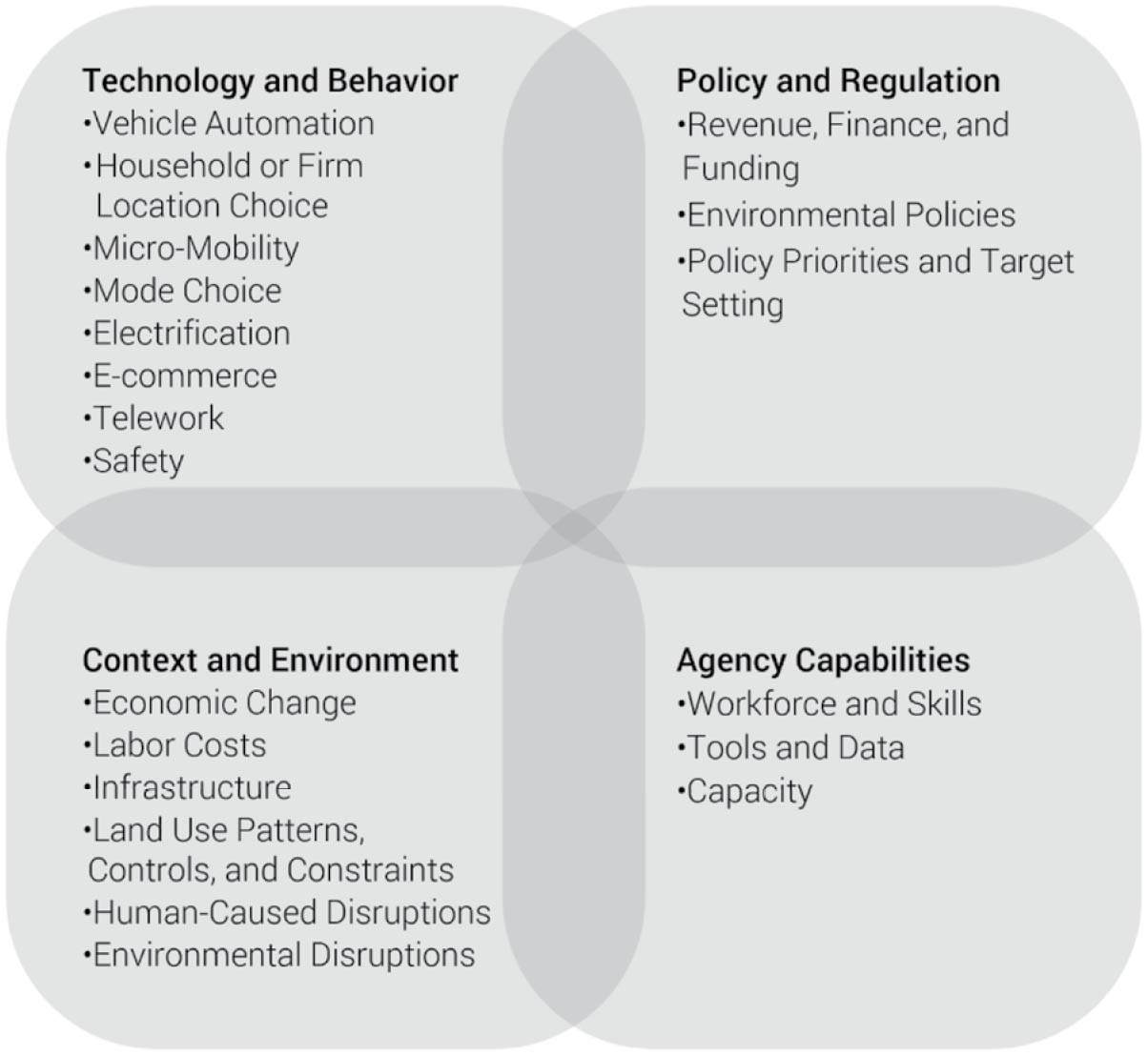
Long-range transportation planning is fraught with uncertainty across multiple interacting dimensions, including technology and behavior, policies and regulations, the socioeconomic context and environment, and agency capabilities (see Figure 1). Any of these dimensions alone can have difficult to predict impacts on future transportation needs, system performance, and the ability of a transportation agency to meet its goals and serve its community. Together, these factors can often combine in a manner that creates deep uncertainty.
Deep uncertainty: According to the Society for Decision Making Under Deep Uncertainty (DMDU), “Deep uncertainty exists when parties to a decision do not know, or cannot agree on, the system model that relates action to consequences, the probability distributions to place over the inputs to these models, [and] which consequences to consider and their relative importance. Deep uncertainty often involves decisions that are made over time in dynamic interaction with the system.” (DMDU Society n.d.)
Uncertainty introduces both risks and opportunities. Not engaging with uncertainty can introduce risks such as:
- Investing limited resources in unnecessary or over-designed long-lasting infrastructure.
- Making policy or design choices that overly constrain future choices.
Long Description.
The top-left quadrant, labeled Technology and Behavior, includes items like Vehicle Automation, Household or Firm Location Choice, Micro-Mobility, Mode Choice, Electrification, E-Commerce, Telework, and Safety. The top-right quadrant, titled Policy and Regulation, lists Revenue, Finance, and Funding; Environmental Policies; and Policy Priorities and Target Setting. The bottom-left quadrant, named Context and Environment, features Economic Change, Labor Costs, Infrastructure, Land Use Patterns, Controls, and Constraints, Human-Caused Disruptions, and Environmental Disruptions. The bottom-right quadrant, labeled Agency Capabilities, includes Workforce and Skills, Tools and Data, and Capacity.
- Limiting responsiveness in times of disruption.
- Being unaware of new needs due to insufficient tracking of changing conditions.
- Failing to execute plans and meet goals due to changes in available resources or the effectiveness of strategies that were reliable in the past.
Actively exploring uncertainty and seeking opportunities to be proactive and adaptive can yield benefits, including:
- Increased accountability to decision-makers and the public.
- Enhanced effectiveness of strategies across multiple future possibilities and the ability to coalesce around core priorities.
- Improved organizational and staff readiness to make the most of new opportunities.
- Strengthened ability to learn and adapt to improve the effectiveness of future actions.
- Heightened capacity to source and integrate new information to guide decision-making.
- Increased confidence in prioritization of limited resources.
- Stronger interdisciplinary problem-solving and partnerships.
Planning for uncertainty can help move the locus of certainty from a calculation such as “I am certain that the prediction is accurate,” to a plan, for instance, “I am certain that my plan is robust in the face of many possible futures.”
1.2 Research Process
This guide was developed by the team based on two years of research overseen by a panel of experts. The research team began with foundational research into literature and practice, documenting sources of uncertainty, decision-making frameworks, data and methods, and the regulatory context. Next, information was collected on the landscape of practice for managing uncertainty within state DOTs and MPOs through an online questionnaire. Focus groups were
conducted and interviews were designed to involve experts from diverse backgrounds outside of the state and regional transportation planning organizations. From there, the team engaged in “deep discovery” through four case studies of state DOT and MPO approaches to managing uncertainty. Through each case, the research team sought to understand the impacts of these approaches on decision-making and operations and to identify lessons learned, including gaps in practice. The research team used findings from the first phase of research to develop the guide structure and articulate the types of questions readers of this guide may have, such as:
- What uncertainties could be considered, and in which business processes?
- How can a strategic and long-range planning process help manage key uncertainties across business processes? What can be done to make agency processes more robust and resilient?
- How can I set my organization up for continuous learning and adaptation through monitoring of external conditions and agency effectiveness?
- What organizational capacity—in terms of workforce, procedures, training, and technical resources—need to be built up to plan for, manage, and monitor uncertainty?
In the second phase of research, resources were developed that form the core content of the guide. The research team then partnered with five testing agencies to work through individual sections of the guide as applied to a specific agency situation. Staff from each agency selected focus areas most relevant to their goals. The research team facilitated a workshop for each agency and included invitees from multiple departments or areas of focus. Participants worked through testing activities using materials from the guide. Participants were invited to reflect on the workshop and provide feedback on testing at the end. A peer exchange in which test agencies presented on their experience and participants further discussed challenges and opportunities of addressing uncertainty in planning was also coordinated.
The research team is grateful to all who participated in this research, whether by answering a questionnaire, participating in a case study or interview, or volunteering time and attention in testing workshops. This guide is a product of collective learning.
Detailed findings from interim phases of the research can be found in the associated deliverable, NCHRP Web-Only Document 440: Developing a Guide for Incorporating Uncertainty into Long-Range Transportation Planning.
1.3 Success Factors for Managing Uncertainty
Through the research, guiding principles for managing uncertainty were identified. While the rest of this guide includes more specific activities and organizational or technical resources, these general factors provide a foundation for success:
Accept uncertainty, plan for change. There is no pathway to eliminating all sources of uncertainty. While improving forecasting and modeling tools is an important form of learning, this must be coupled with planning for change and adaptation over time.
Target points of flexibility and influence. Managing uncertainty requires the consideration of points of flexibility and influence within the existing decision-making process. Where are the “on-ramps” and “off-ramps” of projects or policies, i.e., key decision points and actions over time that can allow something to either be moved into the pipeline for action or put on pause if conditions warrant it?
Establish a learning culture focused on agility and responsiveness. Organizations are more responsive when they can respond to feedback and learn. Managing feedback and leveraging it in decision-making can aid agencies in reducing uncertainty over time from identified sources, identifying emerging issues of uncertainty, and reacting to unexpected occurrences. In the context
of long-term planning and plan implementation, this means leveraging cyclical planning processes in which prior rounds and related products effectively informed subsequent planning and implementation. There are multiple avenues of implementation for knowledge gained from considering uncertainty including adjustments to project prioritization, identification of trends to track and contingent actions, identification of needed communication and coordination, organizational and workforce capacity building, and more.
Build a “family” of interconnected cyclical planning processes. Agencies are better equipped to address uncertainty when they consider their activities within a “family of plans.” Rather than undertaking each long-range plan in isolation, true learning and adaptation to address uncertainty requires a more holistic perspective that connects long-term planning with more mid- and short-term actions.
Maximize limited resources. By focusing on the implementation of uncertainty insights, this guide aims to help agencies make the most of technical, engagement, or organizational efforts, rather than repeatedly conducting resource-intensive processes that sit on a shelf or are duplicated in disparate divisions of planning processes within an agency.
1.4 Start Where You Are
Before jumping in, take a moment to reflect on current and recent practices within your agency related to uncertainty to better understand where you are building from. Ask yourself:
- What were the motivating factors for opening this guide? Are there challenges or opportunities you know you want to address?
- Was uncertainty addressed in your last long-range plan? What about in other recent planning efforts?
- Where are you in your planning cycles? What is coming next? What are you trying to implement?
- Are there sources of uncertainty that you already know are relevant to your agency and community?
It is ok if your answers and knowledge feel partial at this stage. These questions are to help you navigate the guidebook and what you want out of it.
1.5 How to Use This Guide
Uncertainty often stems from or is enhanced by the interconnectedness of transportation systems and the environments within which they operate. Questions of uncertainty such as, “Will my state have enough funding to keep roads in a state of good repair over the next 30 years?” can be daunting when conceptualizing the variety of causal pathways that can affect the outcome. For example, funding availability for pavement maintenance is affected by federal, state, and local policy; fleet electrification and vehicle efficiency can influence fuel tax revenue; and project costs can vary. Pavement condition deterioration can be caused by factors that are hard to predict such as changing weather, as well as traffic volumes and vehicle weights, which are influenced by changes in the economy. Complex interconnectedness is also a characteristic of transportation agencies and their operations. The ability to deliver a project depends on a whole series of decisions and actions across many parts of a transportation agency, each of which may be subject to unexpected changes in priorities, funding, or workforce capacity.
This interconnectedness speaks to the scale of the challenge, but it also highlights the scale of opportunity for improvement. Addressing uncertainty is not a “one-and-done” activity, but rather a
process of management and learning over time. Moreover, users of this guide may have one or more motivating factors for wishing to improve their planning for uncertainty. For example, an agency may be struggling with a particular source of uncertainty [e.g. connected and autonomous vehicles (CAVs), economic change] or may wish to start with a specific part of the planning process. Accordingly, this guide is designed to provide multiple points of entry for the reader. Please feel free to navigate through in any order and to use those portions of the guide that are most relevant to your needs.
1.5.1 Guide Structure
This guide is organized to address different phases of the long-range planning cycle:
Chapter 2: Scoping. The resources in this chapter will help an agency map out a planning process to better address uncertainty. The information will be most relevant before an agency starts a long-term planning activity and is intended to help identify where to focus resources and how to set up a planning process to yield desired insights into uncertainty. This chapter offers background on commonly considered sources of uncertainty, presents exercises to decide which are most relevant for a given planning effort and agency, and provides guidelines on defining plan components and outcomes.
Chapter 3: Long-Range Plan Development. This chapter addresses topics that are of most relevance when an agency is actively working on a long-range plan (or similar long-term planning activity), including methods related to forecasting, needs estimation, and uncertainty analysis, as well as strategies for communications with decision-makers and stakeholders.
Chapter 4: Implementation. This chapter focuses on activities that leverage the outcomes of long-range planning activities, with the goal of helping an agency determine how insights into uncertainty can be carried forward into action before the next plan update. The chapter sections provide value by extending the impact of planning efforts to continue influencing agency goal achievement in an uncertain world beyond plan publication. They also can support reflection on learning and refinement for subsequent plan cycles. Topics include assigning roles and responsibilities, monitoring implementation, establishing feedback loops, tracking trends and targets, and prioritization.
Chapter 5: Capacity Building. The sections in this chapter address cross-cutting topics that are essential to building a flexible, responsive organization. These include workforce development, managing and sharing data, and building partnerships to better understand and respond to changing conditions.
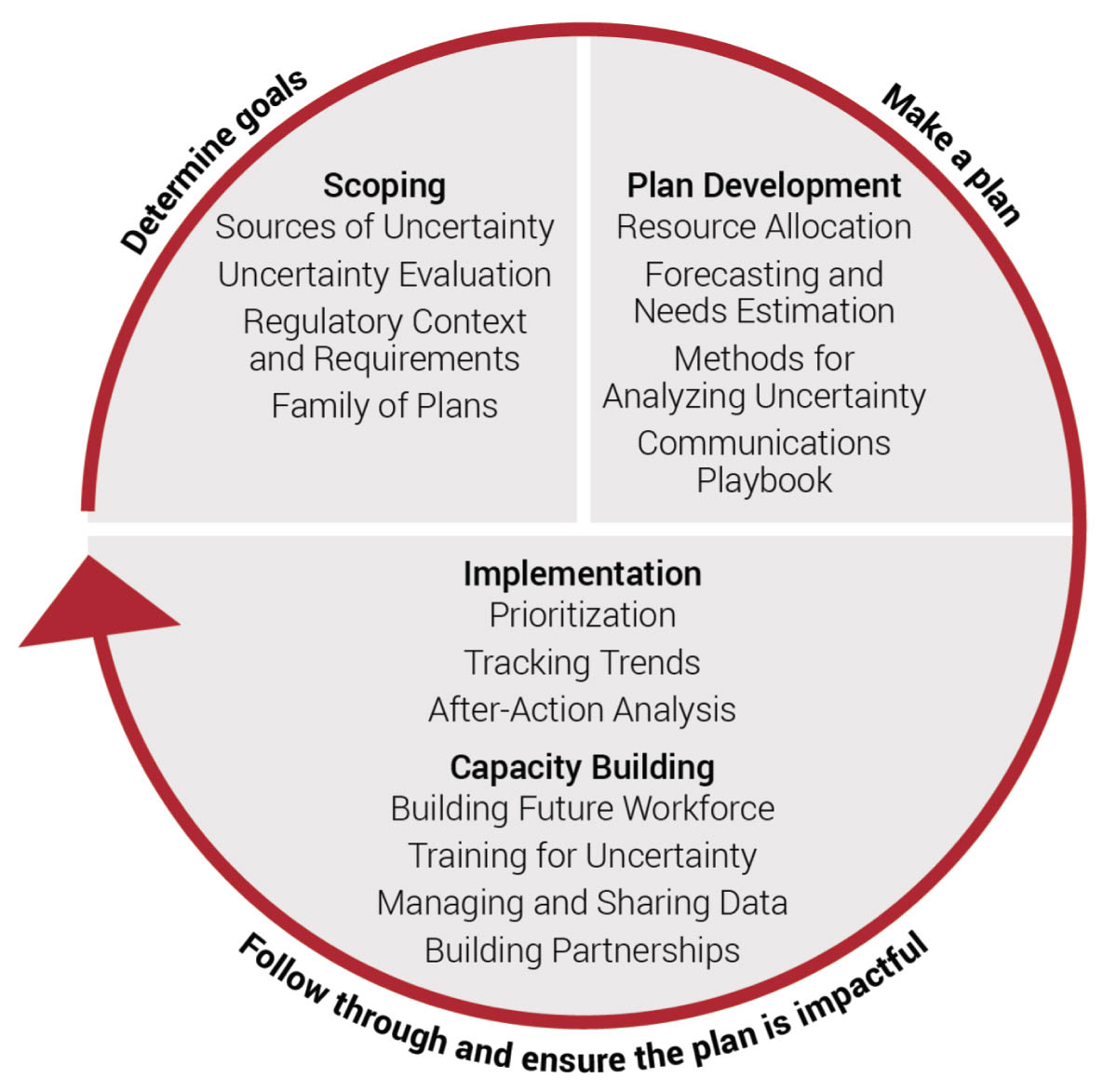
The format for content of the guide varies across topics and includes elements such as simple how-to descriptions, illustrative examples, and templates or exercises an agency may complete. Because tools, methods, and data are dynamic, the guide focuses on why and how a particular strategy can support management of uncertainty and on providing enough information to support someone who wishes to dig more deeply into an approach. Select examples and references are also provided in the form of text boxes and sidebars. For a visual representation of the guide structure, see Figure 2.
1.5.2 Uncertainty in the Planning Process
This guide places its core focus on strategic planning and long-range planning as structuring processes that can set up a state DOT or MPO to better manage uncertainty throughout their business practices. Strategic and long-range planning provides the long-term perspective to consider many types of uncertainties and offers an opportunity to establish goals, procedures, performance measures, and analytical resources that can serve agencies in other parts of their planning and programming.
Long Description.
The chart presents the structure of a guide divided into four main sections: Scoping, Plan Development, Implementation, and Capacity Building. Scoping includes Sources of Uncertainty, Uncertainty Evaluation, Regulatory Context and Requirements, and Family of Plans. Plan Development lists Resource Allocation, Forecasting and Needs Estimation, Methods for Analyzing Uncertainty, and Communications Playbook. Implementation includes Prioritization, Tracking Trends, and After Action Analysis. Capacity Building includes Building Future Workforce, Training for Uncertainty, Managing and Sharing Data, and Building Partnerships. Arrows around the perimeter indicate a continuous, clockwise flow through the phases and are labeled “determine goals,” “make a plan,” and “follow through and ensure the plan is impactful.”
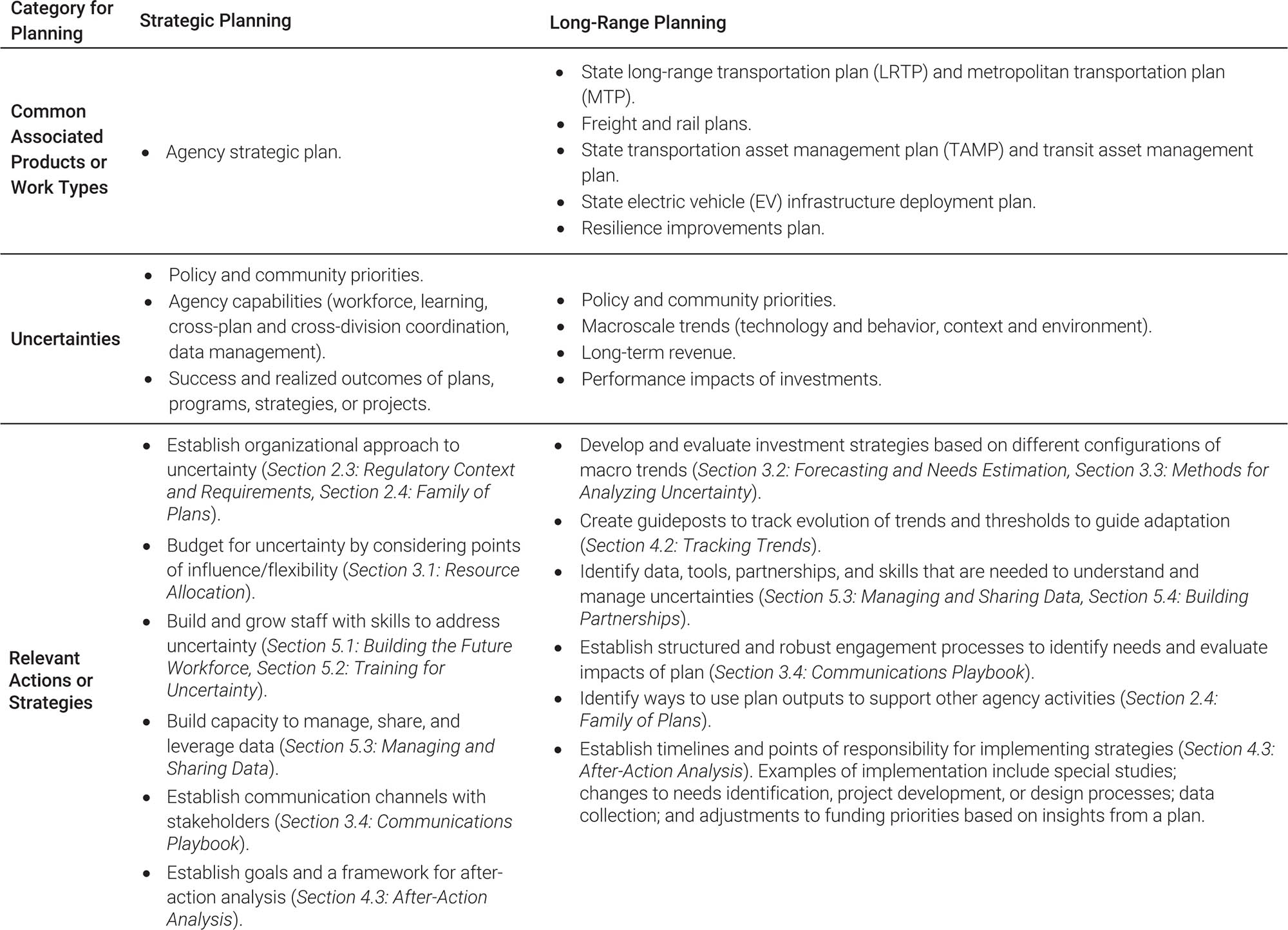
To reflect this perspective, specific strategies and actions that are relevant to strategic and long-range planning are outlined. Table 1 shows uncertainties, work products, and potential strategies and actions that transportation agencies may take in strategic and long-range planning. Note that long-range planning can encompass multiple plans an agency may undertake, each of which employ a long-term perspective.
Table 1 is designed to connect the dots between (a) individual planning processes and work products, (b) uncertainties that apply at the timescale of each process, and (c) relevant actions or strategies. In addition to the annotated outline in Section 1.5.3, this table can be used to find the topic of most relevance.
1.5.3 Annotated Table of Contents
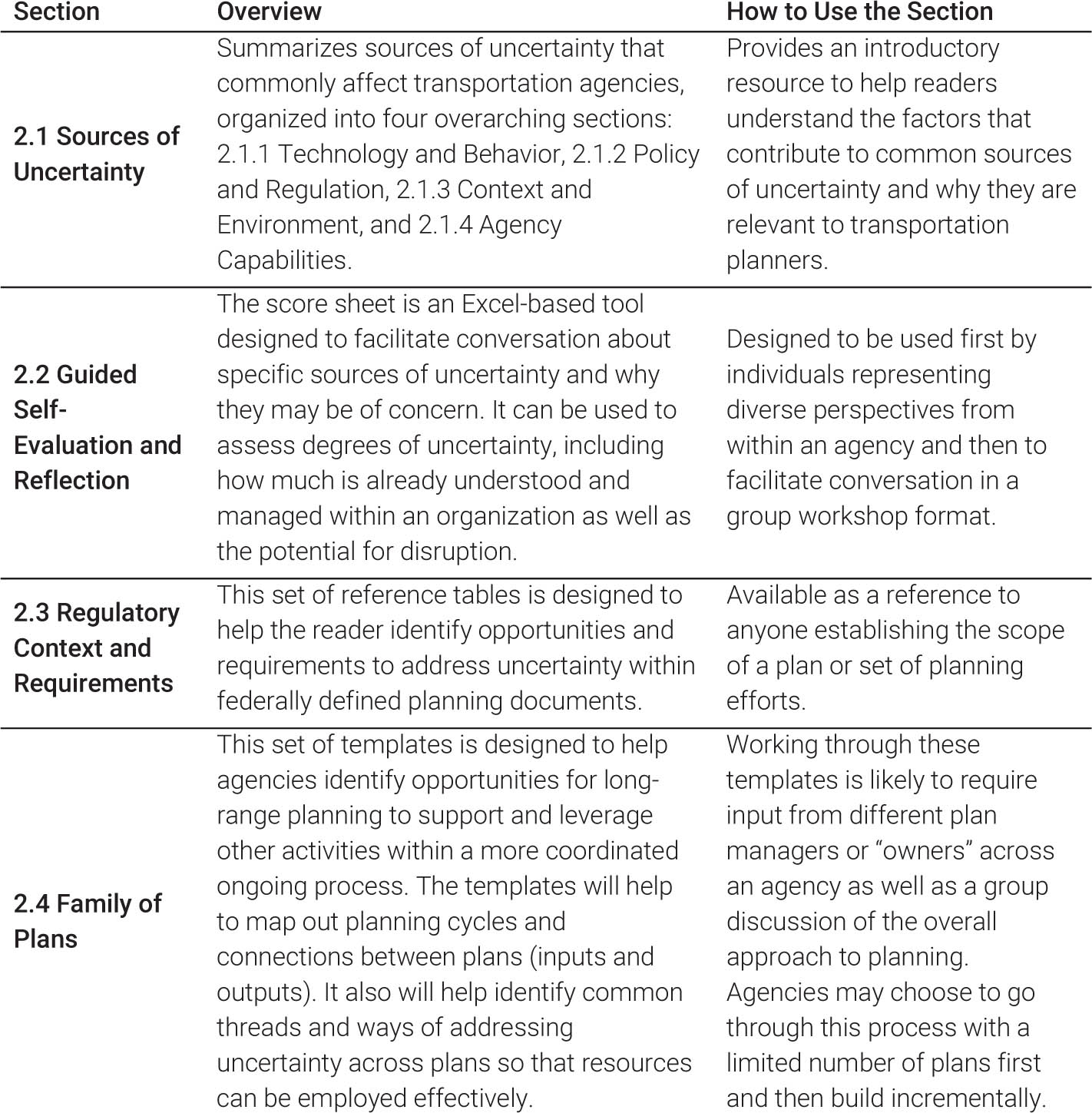
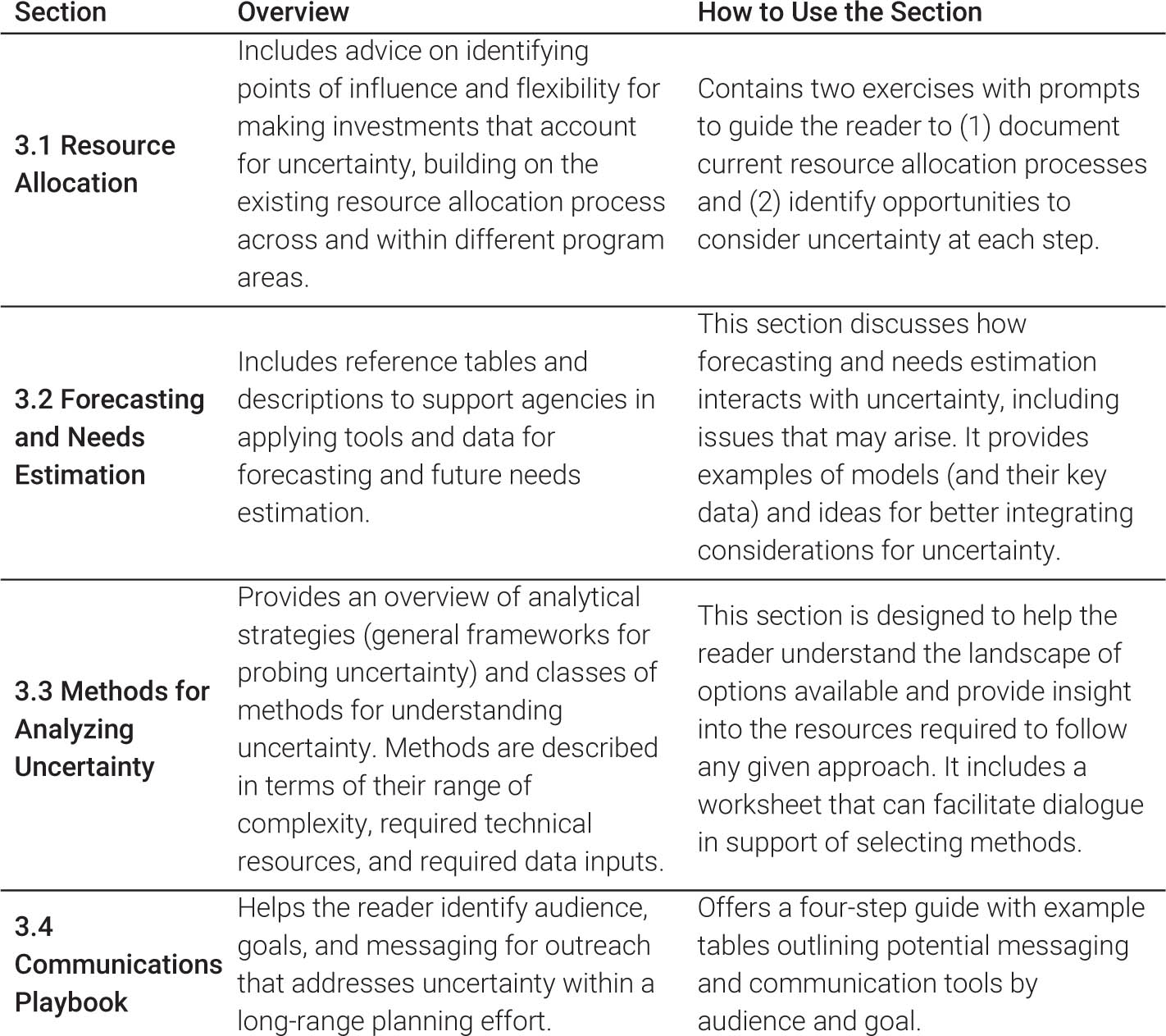
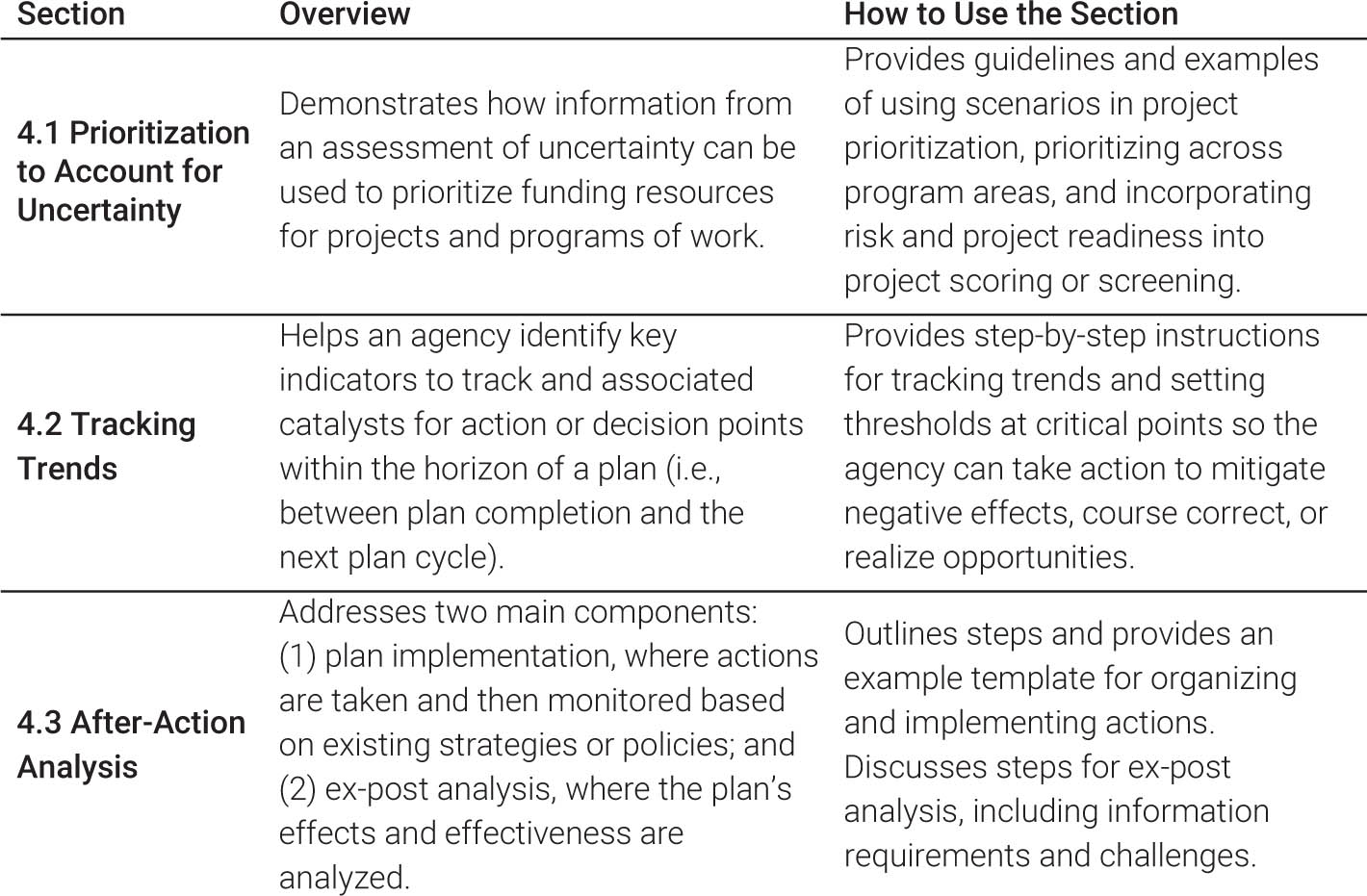
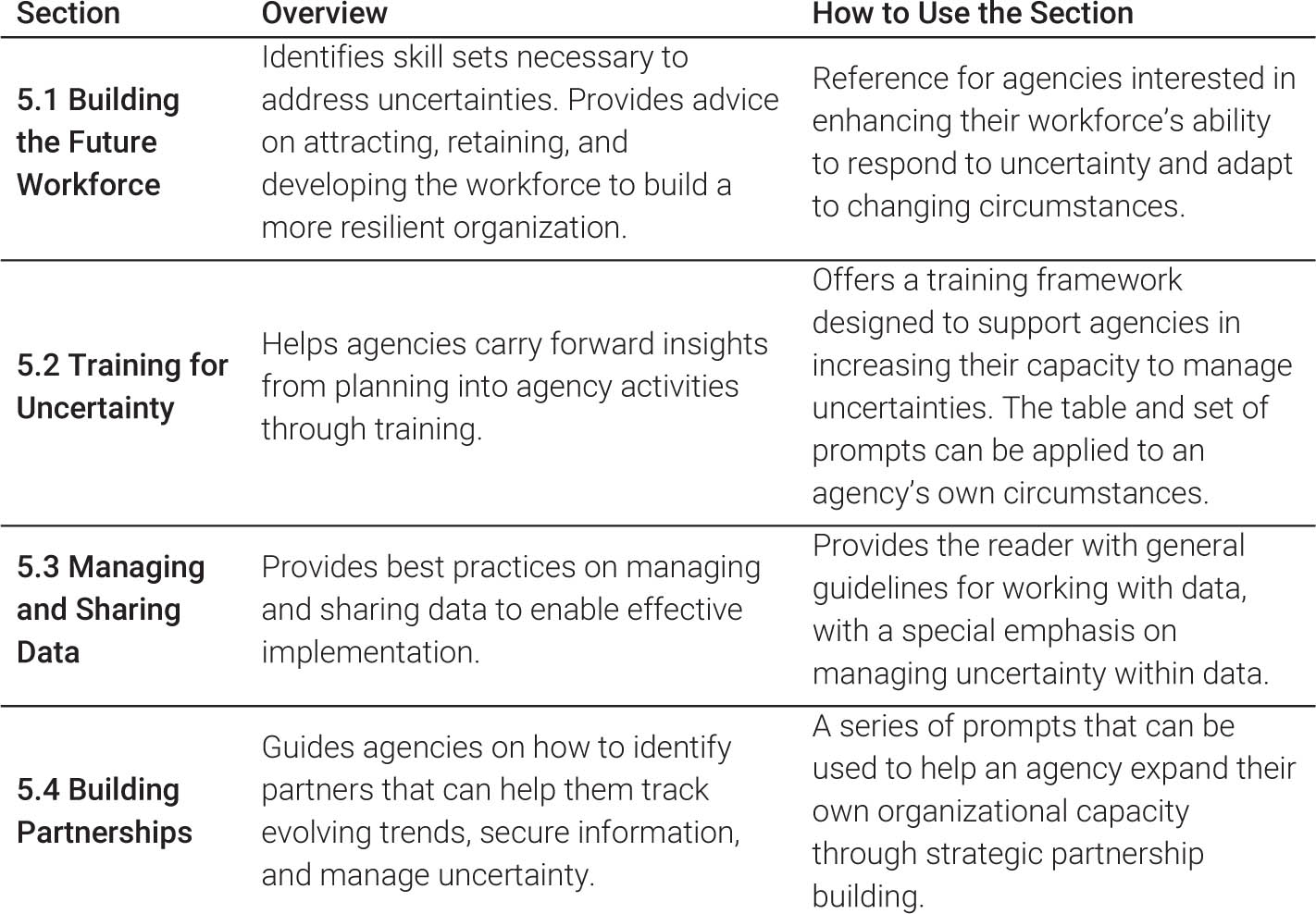
Tables 2 through 5 summarize each chapter, including a general overview and a description of how the sections of the chapter are intended to be used.
Long Description.
The first column header is Category for Planning. The second and third column headers are Strategic Planning and Long-Range Planning. The data given in the table row-wise are as follows:
Row 1: Common Associated Products or Work Types; Agency Strategic Plan; State Long Range Transportation Plan (LRTP) and Metropolitan Transportation Plan (MTP). Freight and Rail Plans. State Transportation Asset Management Plan (TAMP) and Transit Asset Management Plan. State Electric Vehicle (EV) Infrastructure Deployment Plan. Resilience Improvements Plan.
Row 2: Uncertainties; Policy and community priorities. Agency capabilities (workforce, learning, cross-plan and cross-division coordination, data management). Success and realized outcomes of plans, programs, strategies, or projects; Policy and community priorities. Macroscale trends (technology and behavior, context and environment). Long-term revenue. Performance impacts of investments.
Row 3: Relevant Actions or Strategies; Establish organizational approach to uncertainty (Section 2.3: Regulatory Context and Requirements, Section 2.4: Family of Plans). Budget for uncertainty by considering points of influence or flexibility (Section 3.1: Resource Allocation). Build and grow staff with skills to address uncertainty (Section 5.1: Building the Future Workforce, Section 5.2: Training for Uncertainty). Build capacity to manage, share, and leverage data (Section 5.3: Managing and Sharing Data). Establish communication channels with stakeholders (Section 3.4: Communications Playbook). Establish goals and a framework for after-action analysis (Section 4.3: After Action Analysis); Develop and evaluate investment strategies based on different configurations of macro trends (Section 3.2: Forecasting and Needs Estimation, Section 3.3: Methods for Analyzing Uncertainty). Create guideposts to track the evolution of trends and thresholds to guide adaptation (Section 4.2: Tracking Trends). Identify data, tools, partnerships, and skills that are needed to understand and manage uncertainties (Section 5.3: Managing and Sharing Data, Section 5.4: Building Partnerships). Establish structured and robust engagement processes to identify needs and evaluate impacts of plan (Section 3.4: Communications Playbook). Identify ways to use plan outputs to support other agency activities (Section 2.4: Family of Plans). Establish timelines and points of responsibility for implementing strategies (Section 4.3: After Action Analysis). Examples of implementation include special studies, changes to needs identification, project development, or design processes; data collection; and adjustments to funding priorities based on insights from a plan.
Long Description.
The three column headers are Section, Overview, and How to Use the Section. The data given in the table row-wise are as follows:
Row 1: 2.1 Sources of Uncertainty: Summarizes sources of uncertainty that commonly affect transportation agencies, organized into four overarching sections: 2.1.1 Technology and Behavior, 2.1.2 Policy and Regulation, 2.1.3 Context and Environment, and 2.1.4 Agency Capabilities; Provides an introductory resource to help readers understand the factors that contribute to common sources of uncertainty and why they are relevant to transportation planners.
Row 2: 2.2 Guided Self-Evaluation and Reflection: The score sheet is an Excel-based tool designed to facilitate conversation about specific sources of uncertainty and why they may be of concern. It can be used to assess degrees of uncertainty, including how much is already understood and managed within an organization as well as the potential for disruption; Designed to be used first by individuals representing diverse perspectives from within an agency and then to facilitate conversation in a group workshop format.
Row 3: 2.3 Regulatory Context and Requirements: This set of reference tables is designed to help the reader identify opportunities and requirements to address uncertainty within federally defined planning documents; Available as a reference to anyone establishing the scope of a plan or set of planning efforts.
Row 4: 2.4 Family of Plans: This set of templates is designed to help agencies identify opportunities for long-range planning to support and leverage other activities within a more coordinated ongoing process. The templates will help to map out planning cycles and connections between plans (inputs and outputs). It will also help identify common threads and ways of addressing uncertainty across plans so that resources can be employed effectively; Working through these templates is likely to require input from different plan managers or “owners” across an agency, as well as a group discussion of the overall approach to planning. Agencies may choose to go through this process with a limited number of plans first and then build incrementally.
Long Description.
The three column headers are: Section, Overview, and How to Use the Section. The data given in the table row-wise are as follows:
Row 1: 3.1 Resource Allocation: Includes advice on identifying points of influence and flexibility for making investments that account for uncertainty, building on the existing resource allocation process across and within different program areas; Contains two exercises with prompts to guide the reader to (1) document current resource allocation processes and (2) identify opportunities to consider uncertainty at each step.
Row 2: 3.2 Forecasting and Needs Estimation: Includes reference tables and descriptions to support agencies in applying tools and data for forecasting and future needs estimation; This section discusses how the forecasting and needs estimation interacts with uncertainty, including issues that may arise. It provides examples of models (and their key data) and ideas for better integrating considerations for uncertainty.
Row 3: 3.3 Methods for Analyzing Uncertainty: Provides an overview of analytical strategies (general frameworks for probing uncertainty) and classes of methods for understanding uncertainty. Methods are described in terms of their range of complexity, required technical resources, and required data inputs; This section is designed to help the reader understand the landscape of options available and provide insight into the resources required to follow any given approach. It includes a worksheet that can facilitate dialogue in support of selecting methods.
Row 4: 3.4 Communication Playbook: Helps the reader identify audience, goals, and messaging for outreach that addresses uncertainty within a long-range planning effort; Offers a four-step guide with example tables outlining potential messaging and communication tools by audience and goal.
Long Description.
The three column headers are: Section, Overview, and How to Use the Section. The data given in the table row-wise are as follows:
Row 1: 4.1 Prioritization: Demonstrate how information from an assessment of uncertainty can be used to prioritize funding resources for projects and programs of work; Provides guidelines and examples of using scenarios in project prioritization, prioritizing across program areas, and incorporating risk and project readiness into project scoring or screening.
Row 2: 4.2 Tracking Trends: Help an agency identify key indicators to track and associated catalysts for action or decision-points within the horizon of a plan (i e, between plan completion and the next plan cycle); Provides step-by-step instructions for tracking trends and setting thresholds at critical points so the agency can take action to mitigate negative effects, course correct, or realize opportunities.
Row 3: 4.3 After Action Analysis: Addresses two main components: (1) plan implementation, where actions are taken and then monitored based on existing strategies or policies, and (2) ex-post analysis, where the plan’s effects and effectiveness are analyzed; Outlines steps and provides an example template for organizing and implementing actions. Discusses steps for ex-post analysis, including information requirements and challenges.
Long Description.
The three column headers are Section, Overview, and How to Use the Section. The data given in the table row-wise are as follows:
Row 1: 5.1 Building the Future Workforce: Identifies skill sets necessary to address uncertainties. Provides advice on attracting, retaining, and developing the workforce to build a more resilient organization; Reference for agencies interested in enhancing their workforce’s ability to respond to uncertainty and adapt to changing circumstances.
Row 2: 5.2 Training for Uncertainty: Helps agencies carry forward insights from planning into agency activities through training; Offers a training framework designed to support agencies in increasing their capacity to manage uncertainties. The table and set of prompts can be applied to an agency’s own circumstances.
Row 3: 5.3 Managing and Sharing Data: Provide best practices on managing and sharing data to enable effective implementation; Provide the reader with general guidelines for working with data, with a special emphasis on managing uncertainty within data.
Row 4: 5.4 Building Partnerships: Guides agencies on how to identify partners that can help them track evolving trends, secure information, and manage uncertainty; A series of prompts that can be used to help an agency expand their own organizational capacity through strategic partnership building.


