Incorporating Uncertainty into Long-Range Transportation Planning: A Guide (2026)
Chapter: 5 Capacity Building

CHAPTER 5
Capacity Building
This chapter addresses cross-cutting topics that are essential to building a flexible and responsive organization. They are generally relevant at any point in the planning process.
Chapter 5 Components
5.1 Building the Future Workforce
Agencies face a wide range of sources of uncertainty. One category of uncertainty comes from within agencies themselves: the ability and capacity of their staff, processes, and resources to identify, measure, and manage uncertainty.
In considering uncertainty, many agencies start with technical questions such as:
- Do we own the right tools, data, and information systems to track and study uncertainty?
- Do we know what assumptions our models make and why?
- Are our models and their applications robust enough to handle uncertainties?
However, the ability to answer these questions effectively depends on having the right people with the right skills and training. Moreover, engaging with uncertainty often requires knowledge in areas that lie beyond the historical boundaries of transportation agencies in addition to engagement with dynamic and evolving domains.
Developing effective responses to uncertainty will vary based on the nature of uncertainty and the agencyʼs existing capacity to address it. For instance, if the source of uncertainty is the result of significant change in public policy, the first step to identifying workforce-related needs and strategies is to review this area of the agencyʼs business practices, staff resources/capacity, and organizational structure. Table 34 is a proposed framework to aid agencies in self-assessment and planning for workforce development. The goal is to identify skill sets necessary to address uncertainties and provide a framework for agency actions.
 Resource. NCHRP Research Report 980: Attracting, Retaining, and Developing the Transportation Workforce: Transportation Planners developed knowledge, skills, abilities, education, and experience (KSAEE) characteristics and talent profiles for transportation planners that reflected existing needs as well as capabilities likely to be needed to meet future work efforts. It provides a guide for transportation agencies on how to attract, develop, manage, and retain future transportation planners (Meyer et al. 2021).

1Knowledge, skills, abilities, education, and experience.
Long Description.
The table is titled, ‘Identify a source of uncertainty, for example, connected and automated vehicle technologies or Artificial Intelligence. Then review the agency’s current: If insufficient, consider the following:’
The column headers are Organizational Readiness, KSAEE, Actions, and Strategies. The data in the given column are as follows:
Column 1, Organizational Readiness: What is the level of technology penetration? Would new legislation or regulation be required? Did past planning efforts deal with part of the uncertainty or provide a foundation for further action? Are there readily available lessons learned? Is the agency organized to respond swiftly? Are there staff with sufficient knowledge to lead the effort? If not, could consulting services be engaged? Are there existing partnerships to leverage and synergize efforts within the state or externally? Are there any existing champions or departments in a related area? Other - specify.
Column 2, KSAEE: Experienced staff or existing subject matter specialists.
Readily available support from consultants. Domain knowledge, such as: Knowledge of technology, Data collection and analysis of technology, Related regulations and legislation, Synthesis of information or impacts, Project development and performance metrics, Project programming, Modal operations and infrastructure, finance, risk management, strategic visioning, public engagement, environmental impact analysis, economic and community impact, analysis and forecasting, land use and transportation connection, and other - specify.
Column 3, Actions: Designate lead person and or division responsible, review past staff engagement surveys, Access and build or enhance internal and external staff capacities, Identify collaborative partners, Outline organizational risks and opportunities, Identify strategic organizational realignment, if necessary, Develop an agenda and timeline for action, Define the budget and implementation timeline, and Other - specify.
Column 4, Strategies: Attend training aimed at increasing knowledge base. Partner with other agencies to build capacity. Introduce specific on-the-job training. Develop technology champions and mentors. Review compensation and other factors to attract, recruit, and retain tech-savvy staff. Target broader, nonconventional sources and disciplines for recruitment. Partner and encourage focused training from local institutions such as universities or community colleges. Crosstrain staff, especially junior and entry-level staff. Institute staff or job orientation. Encourage ‘lunch and learn’ discussions on key aspects of the uncertainty. Review or rewrite existing job advertisements to reflect current needs of the department and appropriate experience and educational background. Engage a pool of diversified hiring managers to assist and enable agency to assess and recruit a more diversified staff. Other - specify.
After completing the self-assessment in Table 34, the next step for an agency is to focus on strategies to answer these three questions:
- How do we attract a workforce with the skills and training needed to manage uncertainty?
- How do we retain this workforce to provide for long-term resilience?
- What should we do to provide continuous development for the workforce and to support a culture of learning and adaptation?
5.1.1 Attracting the Workforce
Identifying and responding to uncertainty often demands a multidisciplinary approach and skills that are not always in abundance at transportation agencies. Relevant areas of knowledge include skills in data science, computer science and technology, non-transportation engineering disciplines such as electrical engineering, strategic communication, and people and relationship management.
To attract workers with these various skills, agencies should consider:
- Expanding their recruitment channels to include advertising and “nontraditional networks,” such as schools and related organizations in the fields of civil engineering and urban and regional planning.
- Review and revise appropriate job advertisements and positions to reflect and match future needs that include considerations for uncertainties that the agency may face. This may include
- noting different desired skills or considering a broader range of degrees and training. It may also require reviewing and revising human resources/civil service regulation, if necessary.
- Train and use hiring managers with increased understanding of the various elements necessary to address uncertainty in the planning process. These elements may include various technical areas and heightened emphasis on communications, engagement of stakeholders, and skills for being flexible and adaptable.
- Develop and articulate compelling merits and contributions of the public sector to society and target private-sector candidates with these desired skills.
- Build partnerships with local universities and other training institutions that may not be sources for hiring a “traditional” workforce but that may be possible avenues for recruiting new skills or upskilling the existing workforce to address uncertainty.
5.1.2 Retaining the Workforce
Many agencies face significant challenges in retaining experienced staff. This can make managing uncertainty particularly challenging, as more experienced staff often have the depth of knowledge, leadership, and cross-departmental experience best suited to addressing uncertainty. For example, staff from Massachusetts DOT noted in a workshop conducted during this research that one of the biggest risks in managing the transportation workforce is having the right number of experienced middle- and senior-level civil engineers who, in addition to their engineering backgrounds and skill sets, have project management experience. The DOT emphasized the need to prioritize retention so that they are not caught without enough highly seasoned employees and effective leaders, especially when confronted with uncertainty.
Traditional retention strategies, which generally have included giving individuals greater responsibility, providing standardized work environments, and providing salary incentives (if possible), may not be as effective in retaining staff across different generations in a post-pandemic world. Research conducted for NCHRP Research Report 980: Attracting, Retaining, and Developing the Transportation Workforce: Transportation Planners highlighted how different generations of transportation planners exhibit different values and desires with respect to the work environment. For example, Gen Z planners—who are currently at the beginning stage of their careers and are expected to carry the torch to advance the goals of the organization—are different in terms of attitudes, skills, and values compared to baby boomers. And yet, many of todayʼs transportation agency human resource structures were designed and are still oriented toward a typical baby boomer employee (Meyer et al. 2021).
Reexamination of current transportation agenciesʼ human resource practices to ensure that they are adequately addressing multigenerational employee needs is important in creating a strong retention policy. Retention strategies should also recognize and address the needs of employees with varied skills who have been attracted to an agency to help manage uncertainty.
A future-oriented retention strategy that considers the needs of younger career professionals would include:
- Establishing a career path with upward mobility for various disciplines and skill sets.
- Emphasizing unique opportunities for leadership, contribution, and community involvement as part of a job.
- Promoting environments of mutual respect for staff with varying experiences and backgrounds (if an employee feels uncomfortable in this environment, the chances of leaving are greatly increased).
- Instituting individual achievement awards and recognizing special achievements immediately or on an ad hoc basis.
- Making accommodations for flexible work styles, as able.

Gen Z workers (those born between the mid- to late-1990s and early 2010s) are:
- The most racially diverse entry-level employee pool of all generations.
- The most educated entry-level employee pool of all generations.
- Technologically savvy.
- Often seeking more personal interaction, especially with authority.
- More socially, culturally, and environmentally aware and concerned.
- Prioritizing job security as the most important factor in job satisfaction.
- Expecting opportunities for recognition and professional/career growth.
- More comfortable with and often expecting flexible work arrangements (Meyer et al. 2021).
5.1.3 Workforce Development
Transportation agencies have several methods for developing their workforce, including:
- On-the-job training through mentoring, shadowing, or pairing with more experienced staff. Current post-COVID hybrid work arrangements pose significant challenges to this opportunity with varied work schedules. However, this could be managed well with appropriate strategies that include:
- Scheduling dedicated in-person training days for team members.
- Developing structured mentorship programs.
- Creating opportunities for cross-training.
- Structured training, which, in most cases, provides development opportunities tailored to specific disciplines or areas of specialties.
- Outside resources such as conferences, seminars, and special professional development opportunities.
To prepare their workforce for handling uncertainty, agencies also should consider being more intentional with multidisciplinary workforce development opportunities. This could be implemented by creating and encouraging cohorts or communities of learners who are not only growing in their specific areas of expertise but are also learning and developing the various skills necessary to manage uncertainty such as strategic partnerships, systems thinking, and communication, together. An intentional platform such as this seeds good will needed for collaboration, adaptability, and creativity, which are critical attributes for addressing uncertainty.
Another avenue to develop the workforce is the strengthening of intentional cross-training programs. Many DOTs used this model as part of rotational training programs for new staff during their first 2 years of employment. They encouraged or required entry-level engineers to rotate to a different section or division of the department with different responsibilities and skills approximately every 6 months during this 2-year period. Over the years this model has been weakened, or, in some agencies, abandoned due to significant limited resource pressures and a focus on addressing more immediate needs.
Because addressing uncertainty frequently requires interdisciplinary problem-solving, cross-training is an opportunity to increase agency capacity to address uncertainty. Agencies, based on their existing knowledge of uncertainty, could identify core infrastructure areas or planning disciplines and the key skills necessary to address them, and offer limited rotational training to
select staff to prepare and expand their capacity to manage uncertainty. Offering cross-training to mid-level staff could help develop a cohort of project managers equipped with increased capacity to manage the complexities resulting from uncertainty.
5.2 Training for Uncertainty
Closely related to workforce development is the need for specific training to support staff in understanding, analyzing, and managing uncertainty. Moreover, staff training is critical for moving planning insights that may come from a specific process or analysis into the day-to-day activities of an organization. For example, if a dataset or tool was developed within a long-range plan to identify risks to infrastructure that should be accounted for in project development and design, then the only way this resource will have impact is if staff are appropriately trained on when, how, and why it should be used. Adoption of new concepts, strategies, data, and tools also requires learning over time and the availability of feedback loops. Given the dynamic nature of uncertainty, it is important to try to build adaptability and responsiveness into organizational culture. Training and related activities can provide an opportunity not only for one-way transmittal of information, but also for listening and learning about what is and is not working about a given dataset, tool, or process. Finally, given the complexity of many sources of uncertainty, cross-training and knowledge management and transfer practices are needed to build and maintain a resilient organization over time.
Table 35 offers a training framework designed to support agencies in increasing their capacity to manage uncertainties.

1Knowledge, skills, abilities, education, and experience.
Long Description.
The table is titled, ‘Identify a source of uncertainty, for example, connected and automated vehicle technologies or Artificial Intelligence. Then review the agency’s current: If insufficient, consider the following:’
The column headers are Organizational Readiness Training, KSAEE, Actions, and Strategies. The data in the columns are as follows:
Column 1, Organizational Readiness Training: What is the agency’s approach to staff development and training? Are there formal knowledge management and transfer practices or procedures? Are current trainings focused on ‘hard’ skills, ‘soft’ skills, or both? Are there staff with sufficient knowledge to lead the training effort? If not, would consulting services be needed? Are there existing partnerships to leverage and synergize efforts? Could existing training or development programs be modified or expanded? Is there a designated lead trainer or human resources representative? How would training impact be assessed?
Other - specify.
Column 2, Examples of Possible KSAEE Needed for Managing Uncertainty: GIS: Data collection and extraction, or integration of different databases. Specific data tools. Travel behavior and modeling. Specific modal, operational, or infrastructure development and maintenance. Meeting facilitation. Synthesis of information sources. Working within a team and collaboration. Cultural competency.
Interpersonal skills. Effectively interacting with elected officials and the public. Performance management. Project or program development process. Critical or Strategic thinking. Cost Benefit Analysis. Other - specify.
Column 3, Actions: Identify training needs and timeline for implementation. Articulate a plan to balance ongoing tasks and desired training. Identify joint opportunities to collaborate with other departments, agencies, or organizations. Establish budget and expected performance indicators. Get senior leadership buy-in. Other - specify.
Column 4, Strategies: Develop small groups known as “Academies” for information and learning in specific areas. Establish “train-the-trainer” programs to accelerate knowledge and skills transfer. Expand or refocus leadership programs to emphasize key leadership skills such as risk management and critical and strategic thinking. Contract with experts to provide the agency with customized training. Provide incentives for staff to seek training to increase their capacity and comfort in identifying, analyzing, and managing uncertainty. Collaborate with local public and private institutions to build individual and organizational capacity. Develop, reinforce, or expand existing mentorship programs. Cross-train staff. Establish a multi-disciplinary team to champion and communicate changes and why the changes are happening. Other - specify.
5.3 Managing and Sharing Data
Handling data across organizations, departments, or external staff can be challenging, and it often becomes more complex when addressing uncertainty in planning. Incorporating uncertainty may entail creating copies or additional versions of data (for example, multiple forecasts or scenarios) or working with additional stakeholders to create, manage, and use data. The following sections provide general guidelines for working with data, with a special emphasis on managing uncertainty within data.
Resources. More information can be found in NCHRP Research Report 952: Guidebook for Managing Data from Emerging Technologies for Transportation and NCHRP Synthesis 508: Data Management and Governance Practices (Pecheux et al. 2020, Gharaibeh et al. 2017).
5.3.1 Data Coordination
Data may be used across multiple staff, departments, or agencies, making data coordination an important step. Bringing everyone who will use or contribute to the data together into a discussion or meeting helps to clarify what is needed from the data, thereby avoiding multiple different versions of data housed in different places. Choose a data manager and one location for the data to live; this could include a database such as Microsoft Access or SQL if the data are large. If analysis of uncertainty will generate multiple iterations or versions of data, it is important to consider how and where different versions of the data will be kept and how they can be clearly identified, managed, and shared.
Questions to consider:
- Who are the stakeholders for the dataset? Who generates the data and who uses it?
- How does the data fit into a workflow or decision process?
- Who will oversee managing and validating the data?
- Where will the data live?
- What does one observation (or one row) of the data represent?
- Are fields or naming conventions needed for dates, times, or versions?
- When will the data be updated? How will updates be shared with downstream users?
- How will differing versions of data be managed (different columns, sheets, tables, or files)?
- Who should have access to the data, and should there be any limitations on sharing the data? Will some users have editing privileges while other users have “read-only” access?
 Example: Data Management at Florida DOT (FDOT)
In 2015, FDOT launched an initiative to advance Reliable, Organized and Accurate Data Sharing (ROADS) [FDOT n.d.(a)]. The ROADS initiative included development of a comprehensive IT Strategic Plan to identify unmet information needs across the enterprise and develop solution blueprints. Efforts resulting from ROADS include definitions of data
governance roles, development of an enterprise business glossary of common terms, and a Data Management Planning Resource to guide each phase of the data life cycle (FDOT 2020). FDOT also maintains an ArcGIS online platform for organizing and managing spatial data across districts and functional areas within the department. The goal of the collaborative cloud-based platform is to eliminate the need for data duplication and allow staff from across the organization to easily use, create, and share data [FDOT n.d.(b)].
5.3.2 Notating Data
It can be challenging to use data when it comes with unknowns regarding when it was updated, what the source of the data is, and what its limitations are. Notating data in some fashion addresses this need by recording this information and saving it alongside the data source. In Excel, a separate “ReadMe” sheet can be added to the document. In other file formats, a text or Word document can be saved. In published data, a formal documentation PDF can be made publicly available. No matter the format of the documentation, it is important to answer and record information about your data.
Questions to consider when notating data:
- What is the source of the data?
- What is the vintage of the data and when was it last updated?
- What do the variables mean? If applicable, what units do they use?
- Are there any limitations to the data? For example, are any values missing? Is there a small sample size or large margin of error? Are there major events or recent changes that might affect the representativeness of the data (e.g., the COVID-19 pandemic or local events)?
- Are there any missing data?
- Which columns represent IDs that can be joined to other datasets?
- If there are multiple versions of data, what differentiates them?
- Who oversees managing the dataset and its validity, and how can one contact this person?
- Is the data sensitive, and does it have limitations on how it should be shared?
5.3.3 Spatial Data
Spatial data can be incredibly useful for planning purposes, but it also requires extra software and skill to manage. When addressing uncertainty, it is very common to generate, edit, and combine spatial data on the environment, demographics, economy, and transportation infrastructure and services. The use of spatial data can be further complicated by projections and networks if they are not handled appropriately. Making some decisions at the organization level—such as which software to use, how and where to save files, and what projection to use—will help keep data organized and usable across the organization. Handling spatial data generally involves some kind of GIS software, but it also often involves some type of scripting to pre- or post-process data. TDMs may also have their own spatial data and spatial processing capabilities.
Questions to consider with spatial data:
- What software systems will the organization use, and how will they interact with each other?
- Who will manage the spatial data? Is this person knowledgeable in GIS?
- How will spatial data be validated?
- What projection does the organization use?
- What types of files will the organization use (this could be geodatabases, geoJSON files, or Keyhole Markup Language files)?
5.4 Building Partnerships
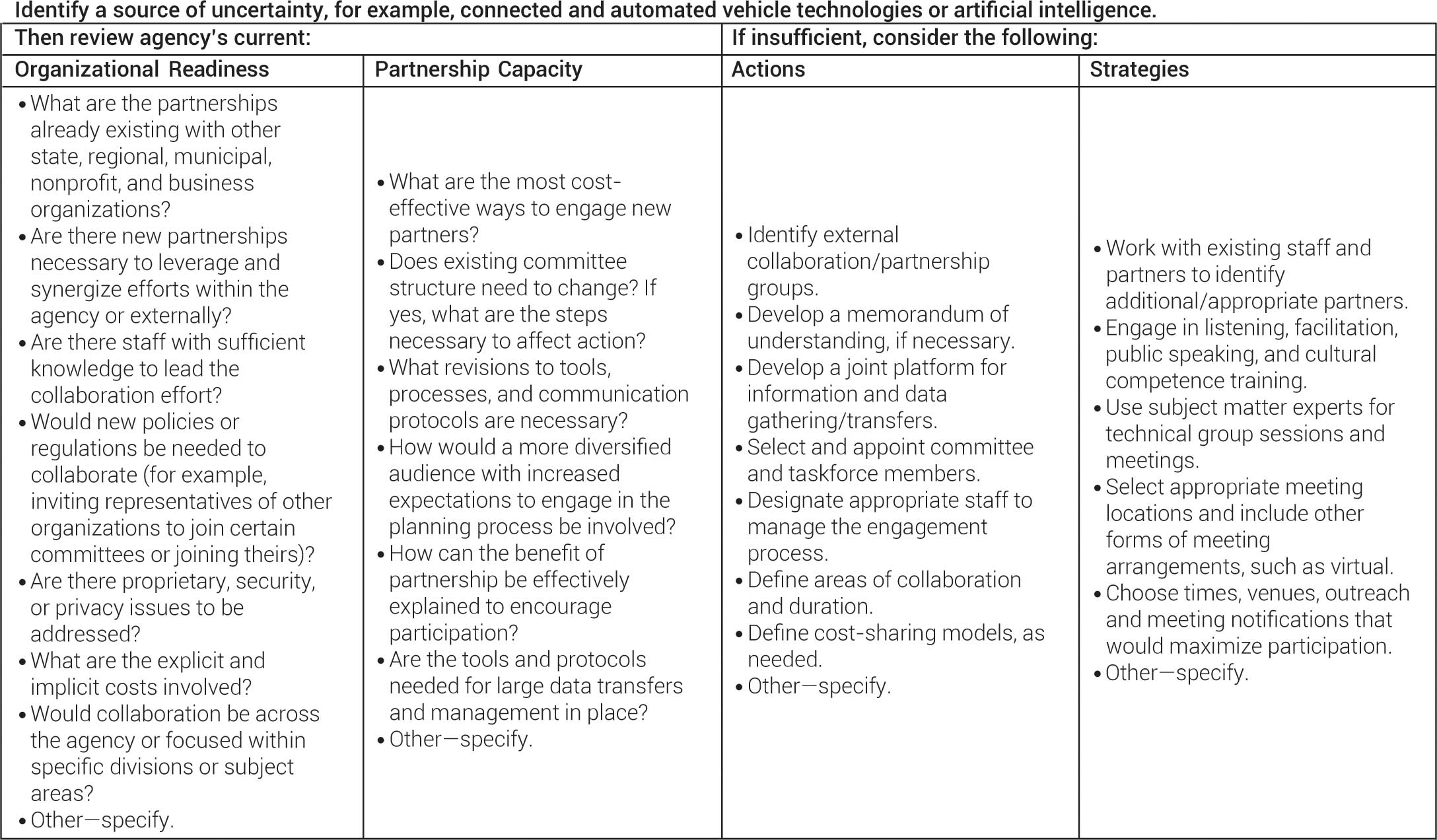
Transportation agencies likely will not have all the in-house knowledge, capacity, or influence to track evolving trends (e.g., in technology, weather, or supply chains), secure information, and manage uncertainty. Therefore, identifying, building, and maintaining partnerships can be a strategy to supplement and strengthen an organization. Table 36 offers a framework for agencies to identify partnerships and associated actions to address uncertainties.
Example: Hawaii DOT Partnering with U.S. Geological Survey (USGS) to Analyze Storm Impacts
When the Hawaii DOT Highways Division sought to better understand, plan for, and mitigate risks to infrastructure assets due to exposure to potential environmental stresses and lava flows, staff engaged with outside partners to understand and integrate specialized data and methodologies. For instance, HDOT staff worked with the USGS to develop equations on water expected during storms (based on interviews with agency staff conducted in 2023). Similarly, Ohio DOT has connected with technology companies around emerging technologies like automated, connected, and electrified vehicles through the Drive Ohio initiative [Ohio DOT n.d.(a)].
Long Description.
The table is titled, ‘Identify a source of uncertainty, for example, connected and automated vehicle technologies or Artificial Intelligence. Then review the agency’s current: If insufficient, consider the following:’ The column headers are Organizational Readiness, Partnership Capacity, Actions, and Strategies. The data given in the columns are as follows:
Column 1, Organizational Readiness: What are the partnerships already existing with other state, regional, municipal, non-profit, and business organizations? Are there new partnerships necessary to leverage and synergize efforts within the agency or externally? Are there staff with sufficient knowledge to lead the collaboration effort? Would new policies or regulations be needed to collaborate (for example, inviting representatives of other organizations to join certain committees or joining theirs)? Are there proprietary, security, or privacy issues to be addressed? What are the explicit and implicit costs involved? Would collaboration be across the agency or focused on specific divisions or subject areas? Other - specify.
Column 2, Partnership Capacity: What are the most cost-effective ways to engage new partners? Does existing committee structure need to change? If yes, what are the steps necessary to affect action? What revisions to tools, processes, and communication protocols are necessary? How would a more diversified audience with increased expectations to engage in the planning process be involved? How can the benefit of partnership be effectively explained to encourage participation? Are the tools and protocols needed for large data transfers and management in place? Other – specify.
Column 3, Actions: Identify external collaboration or partnership groups. Develop a Memorandum of Understanding, if necessary. Develop a joint platform for information and data gathering or transfers. Select and appoint committee or task force members. Designate appropriate staff to manage the engagement process. Define areas of collaboration and duration. Define cost-sharing models, as needed. Other - specify.
Column 4, Strategies: Work with existing staff and partners to identify additional or appropriate partners. Engage in listening, facilitation, public speaking, and cultural competence training. Use Subject Matter Experts for technical group sessions or meetings.
Select appropriate meeting locations and include other forms of meeting arrangements, such as virtual. Choose times, venues, outreach, or meeting notifications that would maximize participation. Other - specify.


