Review of the SBIR and STTR Programs at NASA (2026)
Chapter: 2 The NASA SBIR/STTR Programs and the NASA and Space Ecosystem
2
The NASA SBIR/STTR Programs and the NASA and Space Ecosystem
Innovation is central to NASA’s mission, enabling advances in science, exploration, aeronautics, and the technologies required to support complex space and Earth-based activities. Innovation in support of this mission is not generated by a single organization but emerges from a broader ecosystem—including multiple parts of government, private firms, universities, research institutions, and international partners. This ecosystem is supported by a range of programs, including NASA’s Small Business Innovation Research (SBIR) and Small Business Technology Transfer (STTR) initiatives, which facilitate the participation of small firms in technology development. Many technologies initially developed to meet mission-specific needs have subsequently contributed to broader economic and societal applications, including satellite communications, Earth observation, and navigation systems. Since its founding, NASA has maintained an extensive and evolving set of partnerships with external organizations, including small businesses, recognizing their role in advancing specialized and emerging technologies. Within this system, the SBIR/STTR programs serve as targeted mechanisms for supporting early-stage technology advancement and enabling small firms to engage with NASA’s mission-oriented innovation activities.
This chapter provides a framework for understanding the role of the SBIR/STTR programs within the broader ecosystem. It outlines the structure and evolution of NASA’s innovation system; examines the interaction between the agency’s SBIR/STTR programs and the processes of technology development and procurement; and situates these programs within the changing landscape of the U.S. space sector, including the emergence of a rapidly expanding commercial space industry.
THE NASA INNOVATION SYSTEM
In the wake of the launch of Sputnik by the Soviet Union in 1957, NASA was established through the National Aeronautics and Space Act of 1958 “to provide for research into problems of flight within and outside the Earth’s
atmosphere.”1 Over the next decade, NASA led a series of landmark achievements during the Space Race—including the Apollo Moon landings—establishing U.S. leadership in space and generating enduring advances in sciences and technology. While the agency’s relative budgetary scale and centrality within federal priorities declined in subsequent decades, NASA continues to play a critical role in advancing scientific discovery, technological innovation, and the broader aerospace ecosystem. Although it maintains many aspects of its original mission, NASA has refined and evolved its mandate over time. Notably, its most recent 2022 Strategic Plan articulates this mission clearly: to discover by expanding human knowledge through scientific advances; to explore by extending human presence to the Moon and toward Mars; to innovate by catalyzing economic growth and addressing national challenges; and to advance by strengthening the capabilities and operations required for sustained mission success (NASA, 2022). These objectives underscore that NASA’s mission is not limited to scientific discovery or exploration but encompasses a broader role in technological advancement and national innovation. Achieving these goals requires the development and execution of complex, high-risk space and aeronautics programs that depend on the integration of multiple advanced technologies under conditions of uncertainty.
NASA has sought to meet this challenge through a combination of in-house technical capabilities and reliance on external partners, including large aerospace firms, small businesses, universities, international partners, and other research institutions. This hybrid model of combining internal expertise with a distributed network of contributors continues to define how NASA identifies technology needs, organizes development efforts, and transitions new capabilities into operational use (NASEM, 2024).
The 1960s NASA Space Race era was predominantly top-down in its definition of mission objectives, with priorities set at the highest levels of the federal government and translated into specific programs and technical priorities set by NASA leadership (Launius, 1994; McCurdy, 1994). Early human spaceflight programs—Mercury, Gemini, and Apollo—were characterized by clear national objectives, aggressive schedules, and substantial federal investment. Reflecting this legacy, NASA continues to organize its innovation activities around clearly defined missions and programs. These missions, ranging from human spaceflight and planetary exploration to Earth science and aeronautics, establish the technical requirements that guide technology development across the agency. In contrast to agencies that primarily support investigator-driven research (e.g., National Science Foundation, National Institutes of Health), NASA’s technology investments are largely driven by anticipated mission needs, with priorities established through mission directorates and associated planning processes (NASEM, 2024).
___________________
1 U.S. Congress, National Aeronautics and Space Act of 1958, P.L. 85-568, Section 102, 72 Stat. 426 (1958).
Within this structure, programs are translated into projects and missions, each of which requires the coordinated development and integration of multiple subsystems, components, and enabling technologies. Innovation within NASA is a means of achieving defined technical and operational goals. This mission-driven approach continues to characterize initiatives such as the Artemis program2 and major science missions (Launius, 1994; NASEM, 2024). In other words, building on a long history as a mission-oriented agency, NASA continues to conceptualize its innovation objectives in relation to missions rather than around generalized support for innovation. Table 2-1 provides a high-level chronology of NASA’s major initiatives and priority areas.
Across these eras, NASA has consistently undertaken high-risk, long-horizon scientific and technological challenges that exceed the incentives of private markets alone. At the same time, its methods of execution—particularly
TABLE 2-1 Selected Major NASA Initiatives and Their Institutional Significance
| Period | Initiative | Significance for Innovation System |
|---|---|---|
| 1958–1972 |
Mercury, Gemini, Apollo |
Strong mission focus, rapid scaling of contractor-based development, expansion of NASA center capabilities |
| 1970s–2011 |
Space Shuttle |
Shift toward reusable systems, sustained operations, and long-term integration among centers and contractors |
| 1990s–present |
Major space science missions (e.g., Hubble, Mars Rover and successors) |
Greater reliance on science-driven priority-setting and specialized instrumentation networks |
| 2000s–present |
International Space Station and international collaboration |
Increased coordination across international partners, long-horizon operations |
| 2010s–present |
Commercial Cargo and Commercial Crew |
Expanded use of milestone-based partnerships and greater reliance on private operators |
| 2017–present |
Artemis program |
Integrates long-term exploration strategy, combining prime contractors, commercial firms, and international partners |
SOURCE: Committee generated based on NASA, n.d.k.
___________________
in procurement, partnerships, and technology development—have evolved in response to changing technological and economic conditions (Launius, 1994; NASEM, 2024). Two features of NASA’s approach—the relationship between mission directorates and geographically distributed NASA centers, and its reliance on a multilayered supply chain—are particularly important for understanding how technologies are developed, advanced, and ultimately incorporated into mission systems, and for situating the role of the SBIR/STTR programs within this broader structure.
NASA’s Mission Directorates and Centers
A defining feature of NASA’s innovation system is the relationship between mission direction at headquarters and execution through a geographically distributed set of field centers. NASA’s mission directorates establish strategic priorities, define programmatic objectives, and allocate resources across broad areas such as science, exploration, aeronautics, space operations, and technology development (see Table 2-2). The centers, in turn, provide the engineering, testing, program management, and operational capabilities required to translate those priorities into missions, projects, and technology development activities. In this way, NASA’s innovation system is both mission driven and organizationally distributed (Szajnfarber and Weigel, 2013; Vertesi, 2020).
This relationship is important for understanding how NASA identifies and advances technologies. Mission directorates provide the high-level framework within which needs are defined and priorities are set, but implementation typically occurs through programs and projects in which one or more centers assume lead responsibility, often in coordination with other centers and with external partners. The result is neither a purely centralized nor a purely decentralized system. Rather, it is a structure in which priorities are set at the agency level, while technical problem-solving, testing, and integration are distributed across specialized organizational units.
As this structure suggests, technology development at NASA is not confined to a single mission directorate or organizational unit. Rather, it occurs across multiple mission areas, often in ways that reflect both mission-specific requirements and broader, cross-cutting technical needs. That said, the Space Technology Mission Directorate plays a distinctive role in advancing enabling technologies and supporting mechanisms for technology transfer and small business engagement (NASEM, 2024).
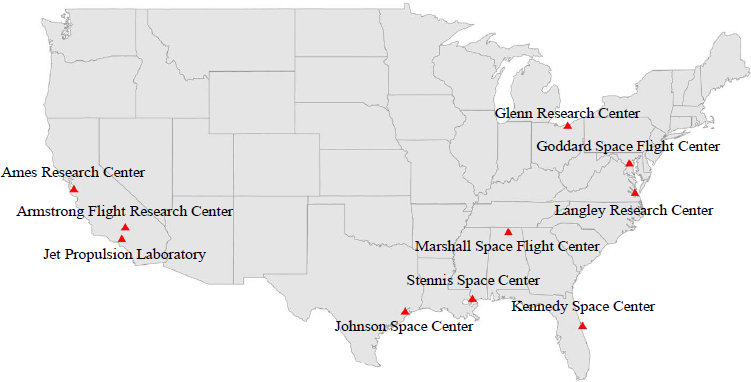
NASA’s geographically distributed field centers reinforce the distributed nature of this system. Since the early decades of the agency, NASA has relied on centers across the United States with distinct technical capabilities, facilities, and areas of specialization. These centers serve not simply as research sites, but as focal points for engineering, testing, program management, mission support, and engagement with external partners (see Table 2-3 and Figure 2-1). The geographic
TABLE 2-2 Primary Responsibilities of the NASA Mission Directorates
| Mission Directorate | Primary Areas of Responsibility |
|---|---|
|
Science Mission Directorate (SMD) |
Planetary science, astrophysics, heliophysics, Earth science |
|
Exploration Systems Development Mission Directorate (ESDMD) |
Moon-to-Mars architecture, deep-space human exploration systems, Orion, Space Launch System, Gateway |
|
Space Operations Mission Directorate (SOMD) |
International Space Station, commercial crew and cargo, space communications, launch and flight support |
|
Space Technology Mission Directorate (STMD) |
Cross-cutting and enabling technologies, technology maturation, technology transfer, support for small business innovation |
|
Aeronautics Research Mission Directorate (ARMD) |
Aeronautics research, advanced air vehicles, sustainable aviation, air traffic management |
|
Mission Support Directorate (MSD) |
Agency capabilities, mission support functions, workforce and institutional support |
SOURCE: NASA, n.d.e.
diversity of NASA SBIR/STTR awardees is explored in Chapter 3, and that of the research partner collaborators is discussed in Chapter 5.
The centers do more than provide technical capability. In many cases, they also help define technical needs, formulate research topics, evaluate proposals, and manage the progression of technologies toward mission use. This role is particularly visible in programs such as SBIR and STTR, where center-based technical staff help identify subtopics, assess technical merit, and guide projects toward potential infusion. The centers function not only as implementers of mission priorities but also as important intermediaries linking mission requirements, technical opportunities, and external performers.
These centers differ not only in formal technical focus but also in institutional culture, engineering practices, and relationships with external partners. The Jet Propulsion Lab (JPL), for example, operates as a federally funded research and development center with a distinctive mission-oriented laboratory culture. Other centers are more directly embedded within NASA’s civil service structure. These differences shape how projects are defined, how firms are engaged, and how technologies are advanced toward mission use (Vertesi, 2020). As a result, the NASA innovation system is best understood not as a single
uniform structure, but as a set of interconnected organizational units with differentiated capabilities and roles.
Together, the mission directorates and centers provide the organizational framework through which NASA translates high-level strategic objectives into specific technology development and mission activities. That framework also shapes the channels through which external organizations—including large contractors, universities, and small businesses—engage with NASA, leading to the second distinctive feature of the NASA innovation system: its multilayered supply chain.
TABLE 2-3 Locations and Primary Focus Areas of NASA Centers
| Center | Location | Primary Focus Areas |
|---|---|---|
|
Johnson Space Center (JSC) |
Houston, Texas |
Human spaceflight, astronaut operations, mission operations |
|
Marshall Space Flight Center (MSFC) |
Huntsville, Alabama |
Propulsion, launch systems, exploration hardware |
|
Jet Propulsion Laboratory (JPL) |
Pasadena, California |
Robotic exploration, planetary missions, deep-space systems |
|
Goddard Space Flight Center (GSFC) |
Greenbelt, Maryland |
Earth science, astrophysics, satellite systems |
|
Kennedy Space Center (KSC) |
Merritt Island, Florida |
Launch operations, integration, infrastructure |
|
Langley Research Center (LaRC) |
Hampton, Virginia |
Aeronautics, atmospheric science, structures |
|
Glenn Research Center (GRC) |
Cleveland, Ohio |
Power systems, propulsion, materials |
|
Ames Research Center (ARC) |
Moffett Field, California |
Computing, autonomy, simulation |
|
Armstrong Flight Research Center (AFRC) |
Edwards, California |
Atmospheric flight research |
|
Stennis Space Center (SSC) |
Hancock County, Mississippi |
Propulsion, launch systems |
NOTE: Unlike the other NASA centers, JPL is a federally funded research and development center managed by the California Institute of Technology. In addition to these main field centers, NASA has a number of other communication and telescope facilities and manufacturing, test, and research facilities.
SOURCE: NASA, n.d.c.
The NASA Supply Chain
A defining feature of NASA’s approach to innovation is its longstanding reliance on an external industrial base. From the early years of the space program, NASA made a strategic decision to contract out a substantial portion of research, development, and production activities to private firms. This approach reflected both the need to rapidly scale technical capacity and an explicit effort to mobilize a national industrial base in support of space exploration (Kantor and Whalley, 2025). During the Apollo era (see Table 2-1), most personnel supporting NASA missions were employed by contractors rather than by the agency itself, and this contractor-based model, though evolving in its details, continues to characterize NASA’s approach to technology development.
One immediate consequence of NASA’s mission-driven structure is that demand for new technologies is often limited in scale and highly specific to mission or programmatic needs. Unlike broader research and development systems in which demand for innovation may be continuous and generalized (or result in large, multiyear procurements), NASA’s requirements tend to arise in connection with discrete missions, each with its own technical constraints, timelines, and performance requirements. As a result, demand for specific capabilities may be episodic and uneven across technical areas, and not all areas of strategic interest will attract a corresponding level of activity at any given time. Demand for any single procured item may be very low (e.g., 1–3 items). This pattern reinforces the importance of understanding the SBIR/STTR programs as
part of a system in which both the demand for and supply of innovation are shaped by mission-specific considerations.
NASA has addressed this need by developing a layered supply chain structure that links mission requirements to technology development and, ultimately, to procurement and system integration. Unlike a simple buyer–supplier relationship, this structure involves multiple tiers of actors, each of which plays a distinct role in shaping how technologies are generated, evaluated, and incorporated into mission systems.
NASA’s Space Centers Within the Supply Chain
NASA centers occupy a central position within this supply structure, acting as technical intermediaries between mission directorates and external performers. In addition to executing programs and missions, centers help define technical requirements, identify capability gaps, formulate research topics, and evaluate emerging technologies. They also oversee testing, validation, and integration processes that determine whether a technology is sufficiently mature for mission use. In programs such as SBIR and STTR, center-based technical staff play a direct role in identifying subtopics, assessing proposals, and guiding projects toward potential infusion. As a result, centers are not only implementers of mission priorities but also key actors in shaping the direction of technological search and selection.
Prime Contractors as System Integrators
Large aerospace firms serve as system integrators within the NASA innovation system, providing systems engineering, manufacturing, certification, and program management capabilities required for complex space and aeronautics systems. These firms are responsible for assembling mission architectures and ensuring that components meet stringent performance and reliability requirements. Because primes ultimately determine how subsystems are incorporated into larger platforms, their procurement practices and risk tolerance play a critical role in shaping which technologies—particularly those developed by smaller firms—are adopted. In this sense, primes act as gatekeepers in the transition from technological capability to operational system.
Subprime Contractors and Specialized Engineering Firms
Below the level of system integration is a set of subprime contractors and specialized engineering firms that contribute subsystems and technical modules. These organizations often develop or produce instruments, propulsion components, avionics, or software systems and are frequently involved in later-stage development and refinement. Their role is particularly important in bridging the gap between early-stage innovation and system-level integration, as they translate component-level advances into forms that can be incorporated into mission architectures.
Small Businesses and Entrepreneurial Firms
At the lower tiers of the supply chain, small businesses and entrepreneurial firms contribute highly specialized capabilities, including sensors, materials, electronics, software, and control systems. These firms are often the source of novel technical approaches and are disproportionately active in early-stage development. Programs such as SBIR and STTR provide important entry points for these firms into the NASA ecosystem. However, their ability to transition technologies depends on alignment with center priorities, acceptance by integrators, and compatibility with mission requirements. As a result, small firms rarely serve as system integrators themselves; instead, their technologies are typically incorporated into larger systems through collaboration with prime and subprime contractors.
Universities and Research Institutions
Universities and nonprofit research institutions play a complementary role by generating foundational scientific knowledge, developing and even designing instruments and experiments, and training the technical workforce. Through collaborations with NASA centers and industry, including through STTR, these institutions contribute to both early-stage research and applied technology development. They also serve as an important source of new ideas and talent, linking advances in basic science to mission-driven technological challenges.
International Partners
International cooperation further extends NASA’s innovation system, with foreign space agencies and research institutions contributing mission elements, scientific instruments, and operational capabilities. Programs such as the International Space Station and Artemis illustrate the extent to which NASA’s missions are embedded in a global network of technical collaboration. These partnerships expand the available knowledge base and distribute both the risks and costs of complex missions, while also introducing additional coordination and integration challenges.
Implications for the NASA Innovation System
Taken together, this layered supply structure supports a distinctive model of technology development. NASA combines top-down, mission-driven requirements with a distributed process of technological exploration across multiple organizational levels. Early-stage technologies are often developed through relatively small-scale projects—frequently involving small businesses or university partners—and subsequently refined, validated, and incorporated into mission systems through interactions with centers and system integrators. This process reflects both directed technological change, guided by mission needs, and
decentralized experimentation across a diverse set of actors (Mazzucato and Robinson, 2016).
At the same time, the procurement implications of this system differ in important ways from those of larger mission agencies such as the Department of Defense (DOD). NASA missions typically involve limited quantities of highly specialized systems, often produced for a single mission or a small number of deployments. As a result, procurement is frequently one-off or small batch in nature, rather than involving sustained, large-scale production. The primary value of participating in NASA’s innovation system therefore lies less in large procurement contracts and more in contributing critical components, capabilities, or technologies to mission systems. This distinction has important implications for firms—particularly small businesses—whose engagement with NASA is often part of a broader portfolio spanning multiple agencies and commercial markets.
A central challenge in a system characterized by distributed innovation and mission-specific integration is how to assess whether a given technology is sufficiently mature for incorporation into a mission. NASA addresses this challenge using Technology Readiness Levels (TRLs), a standardized framework for evaluating the maturity of technologies as they progress from basic principles to operational deployment. TRLs provide a common language across mission directorates, centers, and external partners for assessing technological progress and readiness for integration. The framework spans a sequence from early-stage conceptual work (TRL 1–2), through laboratory validation and prototype development (TRL 3–5), to demonstration in relevant and operational environments (TRL 6–9), with progression along this scale often requiring successive rounds of testing, validation, and system-level refinement (see Box 2-1 and Table 2-4). While not determinative on their own—since ultimate deployment depends on mission timing, system-level integration, and programmatic priorities—TRLs offer a systematic means of gauging whether a component, instrument, or subsystem has reached a threshold consistent with potential mission use. In this way, TRLs play an important coordinating role within NASA’s innovation system, enabling the agency to manage technological uncertainty and align distributed development efforts with mission requirements (NASEM, 2026).
TRLs are also particularly relevant for understanding the role of the SBIR/STTR programs within this system. Many SBIR/STTR projects are explicitly oriented toward advancing technologies across intermediate stages of development—often from early proof of concept toward demonstration in relevant environments—making the TRL framework a useful tool for tracking progress and assessing potential for transition. At the same time, progression along the TRL scale is not purely mechanical and often reflects iterative interactions between NASA centers and external performers, including feedback from testing, evolving mission requirements, and system-level considerations. As a result, the effectiveness of SBIR/STTR investments can be understood, in part, through their contribution to moving technologies along the TRL spectrum, even
in cases where eventual mission integration depends on broader programmatic factors.
Furthermore, while this structure is suited to the development of complex, high-risk systems that require integration across multiple technological domains, it introduces challenges related to coordination, risk management, and technology advancement. The successful incorporation of new technologies depends not only on technical performance but also on alignment across centers, integrators, and mission programs. Understanding this layered system is therefore essential for assessing how NASA develops and deploys new technologies and for situating the role of the SBIR/STTR programs within the broader innovation ecosystem.
BOX 2-1
Technology Readiness Levels in the NASA Innovation System
Technology Readiness Levels (TRLs) provide a widely used framework for assessing the maturity of a technology, ranging from early-stage conceptual research to proven operational systems. Originally developed within NASA and subsequently adopted by other federal agencies that conduct research and development, TRLs offer a standardized approach for evaluating whether a technology is ready to advance toward integration into larger systems.
The TRL scale ranges from 1 (basic principles observed) to 9 (system proven in operational use). Intermediate levels capture key stages of development, including laboratory validation, testing in relevant environments, and demonstration in operational contexts. In practice, technologies typically must reach approximately TRL 6—demonstration in a relevant environment—before they can be considered for integration into mission systems (NASEM, 2026).
TRLs serve several functions within NASA. First, they provide a consistent metric for evaluating technological progress across diverse domains, including propulsion, instrumentation, materials, and software. Second, they facilitate coordination between mission directorates, centers, and external partners by establishing shared expectations regarding technological maturity. Third, they support decision-making about resource allocation, helping to determine when a technology is sufficiently developed to justify further investment or integration into a mission.
At the same time, TRLs are an imperfect measure of readiness. Advancement along the TRL scale can require substantial time and resources, particularly at later stages of development, and does not guarantee eventual deployment. A technology may reach a high level of maturity but still not be incorporated into a mission because of changes in mission priorities, integration challenges, or budget constraints. Conversely, some technologies may be incorporated at lower TRLs when mission timelines or strategic priorities warrant.
As a result, TRLs are best understood not as a deterministic measure of success, but as a coordinating tool within a broader innovation system. They enable NASA to track and compare technological progress in a complex, distributed environment, while recognizing that ultimate mission integration depends on factors beyond technological maturity alone.
TABLE 2-4 Technology Readiness Level Definitions
| Level | Definition |
|---|---|
| 1 |
Basic principles observed and reported |
| 2 |
Technology concept and/or application formulated |
| 3 |
Analytical and experimental critical function and/or characteristic proof-of-concept |
| 4 |
Component and/or breadboard validation in laboratory environment |
| 5 |
Component and/or breadboard validation in relevant environment |
| 6 |
System/subsystem model or prototype demonstration in a relevant environment (ground or space) |
| 7 |
System prototype demonstration in a space environment |
| 8 |
Actual system completed and “flight qualified” through test and demonstration (ground or space) |
| 9 |
Actual system “flight proven” through successful mission operations |
SOURCE: Drawn from NASA, 2023.
Finally, the geography of NASA’s innovation system follows directly from these institutional features. Because NASA operates through multiple centers and relies on a distributed industrial base, its innovation activities are geographically dispersed across the United States. This pattern emerged early in the agency’s history, as contracting decisions were tied to existing technical capabilities and industrial specialization rather than to a single centralized location (Kantor and Whalley, 2025). As a result, NASA-related innovation is organized across a set of interconnected regional clusters that are linked to particular centers, contractors, and areas of technical expertise, rather than concentrated in a single location. Contractor activity has historically been concentrated in sectors such as aerospace, electronics, computing, and scientific instrumentation, and in regions with established capabilities in these domains. At the same time, the distributed nature of NASA’s procurement system has enabled participation by firms located outside traditional aerospace hubs, particularly in areas involving enabling technologies such as software, sensing, and advanced materials.
This distributed structure has important implications for firm participation in the NASA innovation system. For small and innovative firms in particular, engagement requires not only technical capability but also the ability to connect to the relevant organizational and geographic nodes of the system. Programs such as SBIR and STTR provide one mechanism for establishing these connections, allowing firms to engage with NASA centers and align their technologies with mission-relevant needs. However, longer-term participation typically depends on the ability to navigate a more complex set of relationships involving centers, system integrators, and other partners. In this sense, the challenge for firms is not only to develop viable technologies, but also to effectively “plug into” a distributed and multilayered system in which
opportunities for development, testing, and integration are shaped by both organizational structure and geography.
THE ROLE OF THE SBIR/STTR PROGRAMS IN THE NASA INNOVATION SYSTEM
The SBIR/STTR programs at NASA are best understood not as standalone small business initiatives, but as embedded mechanisms within the broader mission-driven innovation system described above. The programs function not only as sources of early-stage funding but also as a gateway through which small firms enter, learn to navigate, and potentially become embedded within NASA’s broader innovation and supply ecosystem.
NASA’s implementation of its SBIR/STTR programs, as discussed in more detail in Chapter 4, reflects this broader structure. Historically, while there was a coordinating function attached to the central SBIR/STTR office within NASA headquarters, the large share of administering the programs was carried out within the centers. More recently, under a program reorganization put in place early in 2024, the role of the central office has increased, particularly in its ability to manage some of the administrative activities. One thing not changed is that program topics are derived from technology needs identified by mission directorates and centers, and awards are evaluated in part on their relevance to these needs. This “mission pull” distinguishes NASA’s programs from more investigator-driven approaches and helps ensure that supported projects are connected to areas of agency demand (NASEM, 2016, 2024). In other words, the programs provide a mechanism for exploring a range of potential approaches to those needs, often involving firms or technologies that would not otherwise be incorporated into NASA’s existing supplier base. Of course, the realized portfolio of SBIR/STTR awards reflects not only NASA’s stated priorities but also the distribution of capabilities within the applicant pool. As a result, while solicitations are strategically defined, the specific projects funded depend in part on the alignment between mission needs and the technologies proposed by participating firms (Boroff and Vertesi, 2026). In this sense, the NASA SBIR and STTR programs have the ability to expand the set of technological options available to the agency and maintain alignment with mission objectives, with the caveat that these new options must be closely related to the capability base of SBIR and STTR firms.
NASA SBIR/STTR projects are typically oriented toward advancing technologies across early and intermediate stages of development—from proof of concept and laboratory validation toward demonstration in relevant environments (i.e., advancing along the TRL scale). In doing so, these programs contribute to iterative processes of testing, refinement, and evaluation, often involving sustained interaction between external performers and NASA centers. Advancement along the TRL scale is therefore not purely linear, but reflects
feedback from technical review, evolving mission requirements, and system-level considerations (Mazzucato and Robinson, 2018; NASEM, 2024).
At the same time, advancing technology to a higher level of maturity does not, on its own, ensure its incorporation into a mission. NASA’s innovation system is structured around a layered supply chain in which centers, system integrators, and other actors jointly determine how technologies are incorporated into mission architectures. SBIR/STTR-supported technologies are therefore subject to the same constraints as other innovations: they must align with mission timelines, meet system-level requirements, and be accepted by integrators responsible for assembling complex systems. In this respect, the SBIR/STTR programs can be best understood as contributing to the advancement of technological capabilities within the system, rather than determining their ultimate use. Therefore, the impact of these programs is more likely to be realized through technology incorporation, follow-on development, or integration into larger systems than through standalone procurement contracts.
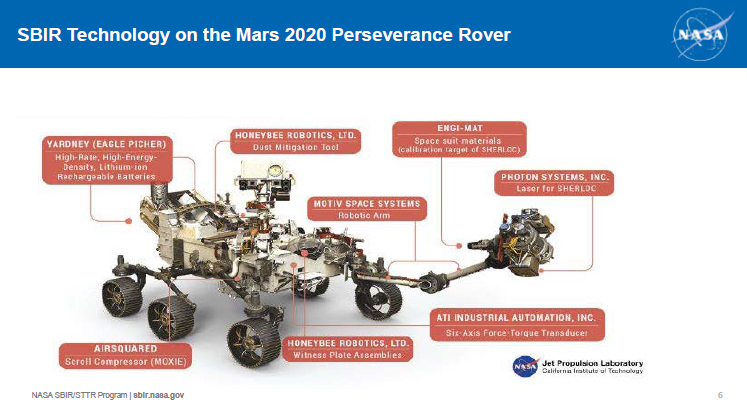
To be clear, a subset of SBIR/STTR-supported projects do progress to direct use in NASA missions. In these cases, technologies initially developed through early-stage SBIR/STTR awards are further matured—often through follow-on funding and integration with system contractors—and ultimately incorporated into flight systems, instruments, or mission-critical subsystems. While such outcomes represent only a portion of SBIR/STTR activity, they illustrate an important pathway through which small-firm innovations contribute directly to NASA’s mission objectives. For example, analyses at JPL identified at least eight distinct instruments and subsystems on the Mars 2020 Perseverance Rover that incorporate technologies developed through the SBIR/STTR pipeline (see Box 2-2).3 An examination of earlier rovers reveals the incorporation of SBIR/STTR technologies. For example, lenses developed by Optimax Systems and funded by NASA and DOD SBIR contracts were used on the 2011 Curiosity Rover and the 2005 Spirit & Opportunity Rover (Nelson et al., 2015; Optimax, n.d.).
However, this type of direct connection to the mission represents but one pathway—rather than the sole gateway—through which SBIR/STTR participants engage and contribute to the NASA mission. Firms may also participate in NASA’s innovation system through subcontracting relationships, ongoing work with other federal agencies, or activities in commercial space markets. The result is a system in which participation is multidirectional and cumulative, rather than sequential or exclusive.
One element to note along these lines is that, as illustrated in subsequent chapters, many firms participating in NASA’s SBIR/STTR programs operate across multiple federal agencies and funding streams, and often develop capabilities in parallel with work supported by other agencies or markets. In this context, SBIR/STTR participation at NASA can be understood as a point at which
___________________
3 Presentation to the committee by Mark Davidson, NASA Jet Propulsion Laboratory, July 30, 2024, Irvine, California.
these broader capabilities are aligned with specific NASA mission priorities and mission strategies. Rather than representing a closed system of innovation, the program frequently draws on technologies and expertise that are being developed more generally and adapts them to mission-specific needs.
This structure and the experience of these firms within this system may also shape outcomes. Evidence from other mission-oriented agencies suggests that firms often require repeated engagement to effectively navigate complex technical, contracting, and organizational environments and to align their capabilities with agency needs. In the NASA context, this confirms that
BOX 2-2
The SBIR/STTR Programs and the Mars 2020 Perseverance Rover
NASA’s Mars 2020 Perseverance Rover incorporates multiple components and subsystems that trace back to firms and technologies supported by the Small Business Innovation Research and Small Business Technology Transfer (SBIR/STTR) programs. According to NASA Jet Propulsion Laboratory program materials, at least eight distinct elements of the rover—including components related to sensing, electronics, and instrumentation—were developed through the SBIR/STTR pipeline and subsequently integrated into the mission (see Figure 2-2). These contributions highlight how SBIR/STTR-supported technologies, when successfully advanced and aligned with mission needs, can be incorporated into flight systems operating in demanding environments.
SOURCE: Presentation to the committee by Mark Davidson, NASA Jet Propulsion Laboratory, July 30, 2024, Irvine, California.
participation in the SBIR/STTR programs often extends beyond individual projects, as participation builds familiarity with mission requirements, relationships with centers and integrators, and the capacity to engage in subsequent opportunities. The benefits of SBIR/STTR participation may therefore be cumulative rather than confined to a single award.
This characterization also helps frame the types of outcomes that may be expected from SBIR/STTR activities. Within NASA’s innovation system, impacts are likely to be reflected in multiple, complementary dimensions. One dimension involves the extent to which SBIR/STTR-supported firms can access additional NASA resources or participate in follow-on activities, reflecting the degree to which initial awards are leveraged within the broader system. A second dimension involves the advancement of technologies along the TRL spectrum, providing a measure of progress in reducing technical uncertainty and increasing readiness for potential use. A third dimension involves outcomes external to NASA, including the ability of participating firms to attract private investment, form partnerships, or generate intellectual property. These pathways are not mutually exclusive, and their relative importance may vary across technologies and firms. At the same time, these pathways are often indirect and not fully observable. Technologies developed through NASA’s SBIR/STTR programs may be incorporated into mission systems through subcontracting relationships, integration by prime contractors, or acquisition of small firms, and these channels are not always captured in available data. As a result, any assessment based on observable outcomes will necessarily provide a partial view of the programs’ broader contribution to NASA’s innovation system.
Finally, it is important to recognize that these outcomes depend not only on the design and execution of the SBIR/STTR programs themselves, but also on the broader ecosystem in which they operate. As NASA’s approach to partnerships, commercialization, and engagement with the private sector continues to evolve—including recent efforts to streamline and centralize aspects of program management—the role of the SBIR/STTR programs will be shaped by how effectively they are integrated into the agency’s overall approach to technology development.
THE EMERGING COMMERCIAL SPACE SECTOR AND THE NASA SBIR/STTR PROGRAMS
Over the past decade, and at an increasing rate in the last 5 years, the U.S. space sector has undergone a significant transformation, marked by the rapid growth of a commercial space sector. Whereas NASA historically operated at the center of a largely government-directed system of space exploration and technology development, a more decentralized and commercially oriented ecosystem has emerged in recent years in which private firms play an increasingly prominent role in both developing and executing space-based activities (Weinzierl and Rosseau, 2025).
Several factors have contributed to this shift. Most notably, the cost to access space has declined dramatically, driven by advances in launch technologies, miniaturization of satellite systems, and new operational approaches adopted by private firms (Bouzoukis et al., 2025). Launch costs have fallen by orders of magnitude over the past several decades, while the number of active satellites has increased substantially, reflecting the growing economic viability of space-based activities (Jones, 2018). These developments have enabled the expansion of commercial activity across a wide range of domains, including telecommunications, Earth observation, and data analytics; going forward, these developments may include the scaling of in-space manufacturing, resource utilization, and space tourism. At the same time, the proliferation of commercial satellites and space-based infrastructure has introduced new challenges, including congestion in orbital space, debris management, and the governance of shared resources.
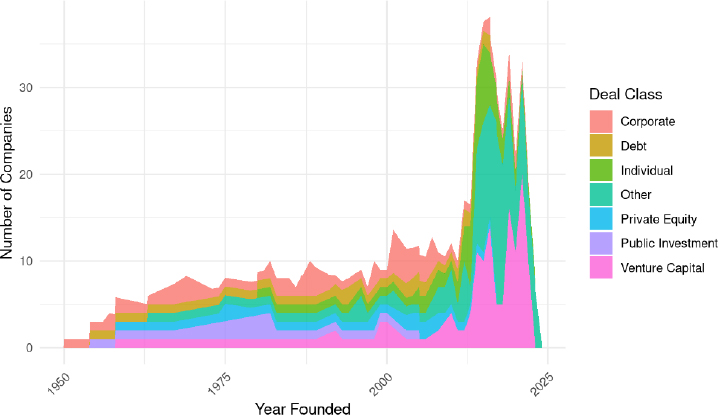
The resulting “New Space” sector includes both established aerospace firms and a growing set of entrepreneurial and venture-backed companies. Firms such as SpaceX and Blue Origin have played a leading role in developing launch capabilities and supporting infrastructure, while a broader ecosystem of firms has emerged to exploit new opportunities associated with space-based data, services, and applications. Venture capital investment in the sector has increased substantially, supporting the entry of hundreds of start-ups and the development of new business models that extend beyond traditional government procurement (Weinzierl and Rosseau, 2025; see Figure 2-3). These developments reflect a
SOURCE: Committee generated based on data from PitchBook.
broader shift from a centralized, government-led model of space activity toward a more distributed system in which private firms increasingly shape both the pace and direction of innovation. At the same time, recent research suggests that established aerospace companies have played a more important role in driving changes in space innovation than have start-ups and venture capital–backed firms (Gaetani and Whalley, 2026).
These changes have important implications for the role of the NASA innovation system and the NASA SBIR/STTR programs. NASA continues to play a central role in defining and pursuing mission-driven objectives in areas such as exploration, science, and aeronautics, particularly where technological challenges are high risk, long horizon, or unlikely to be addressed by private markets alone. At the same time, NASA’s engagement with the commercial sector has evolved, with increasing reliance on partnership- and service-based models that leverage private-sector capabilities. Programs such as the Commercial Orbital Transportation Services initiative and its successors illustrate a shift toward models in which NASA acts as a customer and partner, rather than as the sole developer and operator of space systems (Weinzierl and Rosseau, 2025).
Within this evolving ecosystem, the role of the SBIR/STTR programs remains distinct but increasingly relevant. These programs are designed to support early- and intermediate-stage technology advancement aligned with NASA mission needs, often at the level of components, subsystems, and enabling technologies. While the leading firms in the commercial space sector typically operate at the level of system integration, platform development, or service provision—and rely on a broad mix of funding sources, including private capital and large-scale contracts—SBIR/STTR-supported firms frequently contribute to these systems as specialized suppliers. SBIR-funded technologies in areas such as sensing, materials, propulsion components, electronics, software, and autonomy may serve as critical inputs into both government and commercial space architectures.
This supplier-oriented role is closely linked to the dual-use nature of many SBIR/STTR-supported technologies. Technologies developed to meet NASA mission requirements—such as those related to environmental sensing, communications, navigation, or advanced materials—often have applications in commercial markets, including telecommunications, agriculture, climate monitoring, and data analytics. NASA has increasingly recognized the importance of these dual-use pathways, including through targeted initiatives such as the SBIR Ignite program, which seeks to facilitate connections between NASA-supported technologies and broader commercial applications.4 While such efforts remain relatively modest in scale, they reflect a broader recognition that technologies developed within NASA’s mission-oriented system may contribute to a wider set of economic activities beyond traditional federal missions.
It is useful to highlight both the complementarity and distinction between the role of NASA’s SBIR/STTR programs and the drivers of growth in the
___________________
commercial space sector. The emergence of large-scale commercial space enterprises has been shaped by a combination of factors, including substantial private investment, entrepreneurial initiative, and large government contracts beyond SBIR/STTR awards. While some SBIR and STTR firms have done work that now underpins and sets the stage for the New Space economy, the SBIR/STTR programs are not the primary mechanisms through which these firms have developed (see Box 2-3).
This section has demonstrated that boundaries between NASA’s mission-driven innovation system and the commercial space ecosystem are increasingly porous. Firms often operate across multiple domains, combining SBIR/STTR funding with other federal awards, commercial contracts, and private investment. As a result, technologies and capabilities developed within NASA’s ecosystem may find application in commercial contexts, while developments in the commercial sector may, in turn, shape NASA’s technology needs and procurement strategies. Understanding SBIR/STTR within this broader and evolving context is essential for assessing its role not only in supporting NASA missions, but also in contributing—directly and indirectly—to the development of the wider space economy.
BOX 2-3
Made In Space (MIS) and the NASA SBIR/STTR Program
The trajectory of Made In Space (MIS) illustrates how sustained engagement with NASA’s Small Business Innovation Research and Small Business Technology Transfer (SBIR/STTR) programs can help develop capabilities that ultimately support both NASA’s mission needs and emerging needs in the commercial space sector. Founded in 2010, MIS focused on developing in-space manufacturing technologies, including additive manufacturing systems designed to operate in microgravity. Over time, the company received multiple NASA SBIR Phase I and II awards, supporting early-stage technology development and advancing its core technology through several Technology Readiness Levels. These SBIR-supported efforts were complemented by follow-on NASA programs, including the Tipping Point initiative, which was designed to accelerate the advancement of technologies with both mission relevance and broader application potential. By the mid-2010s, MIS developed and demonstrated technologies that were ultimately deployed on the International Space Station, providing a proof of concept for in-space manufacturing capabilities. Importantly, these successes within the NASA ecosystem facilitated the acquisition of MIS by Redwire in 2020, enabling technologies initially developed through mission-oriented programs to be incorporated into a larger commercial space strategy. While SBIR/STTR funding represented only one component of this broader process (and one cannot draw out a causal impact of the NASA program on MIS in isolation), MIS demonstrates the role that NASA SBIR/STTR program participants are playing in the emerging commercial space industry.
SOURCE: Weinzierl and Rosseau, 2025.
SUMMARY
This chapter has provided a framework for understanding the role of the SBIR/STTR programs within the ecosystem that drives innovation in support of the NASA mission. NASA’s supply chain, including inputs to innovation for technologies required to support complex space- and Earth-based activities, emerges from a broad set of players that includes NASA mission directorates and centers, prime contractors and system integrators, subprime contractors and specialized engineering firms, small businesses and entrepreneurial firms, universities and research institutions, and international partners. Because NASA missions typically involve limited quantities of highly specialized systems, these players cannot rely on NASA for large procurement contracts. While SBIR/STTR funding plays an important role for innovative small businesses operating in the space industry, emergence of large-scale commercial space companies has been driven by substantial private investment and large government contracts (both from NASA as well as DOD) rather than by SBIR/STTR contracts.
FINDINGS
Finding 2-1: NASA’s SBIR/STTR’s topics and subtopics are closely aligned with the agency’s mission needs and advance technologies that support its objectives, including the integration of those technologies into mission systems.
Finding 2-2: NASA’s SBIR/STTR awards support early-stage, enabling technologies, advancing their technical maturity and broadening the range of options available for mission applications.
Finding 2-3: NASA’s SBIR/STTR programs are an important entry mechanism among the multiple pathways by which small businesses engage with the agency.
Finding 2-4: The rapid expansion of the commercial space sector presents both opportunities and challenges for NASA’s SBIR/STTR programs, as new sources of private-sector funding and commercial demand complement—rather than replace—NASA’s mission-driven innovation system.


