Review of the SBIR and STTR Programs at NASA (2026)
Chapter: 6 Outcomes of the NASA SBIR/STTR Programs
6
Outcomes of the NASA SBIR/STTR Programs
The Small Business Innovation Research/Small Business Technology Transfer (SBIR/STTR) programs are designed to fulfill multiple congressionally mandated objectives, including meeting federal research and development (R&D) needs through small businesses and promoting technological innovation and commercialization in the private sector. Evaluating program impact requires consideration of both internal, mission-oriented outcomes and external indicators of innovation performance. This chapter examines the observable outcomes associated with participation in NASA’s SBIR/STTR programs, with the aim of assessing how these programs contribute to the agency’s mission-oriented R&D and acquisition objectives. The analysis employs a set of complementary metrics to capture the role of participating firms both within NASA’s innovation ecosystem and in the broader technology and commercial landscape.
NASA’s dual objectives are shaped by the agency’s distinctive, mission-driven approach to innovation. NASA organizes technology development around mission requirements, with innovation occurring through a distributed network of centers, system integrators, specialized suppliers, and research institutions. Within this innovation ecosystem, SBIR and STTR awards typically support early- and intermediate-stage technology advancement, contributing to the development of components, subsystems, and enabling technologies that may ultimately be incorporated into mission architectures.
SBIR/STTR-supported firms also generate impacts beyond NASA. Prior research across federal agencies links SBIR funding to follow-on federal funding, private investment, patenting, and firm growth (Howell, 2017; Lanahan and Armanios, 2018; Lerner, 1999; Myers and Lanahan, 2022). However, the relevance and magnitude of these outcomes depend on institutional context. In NASA’s case, the mission-driven nature of technology development, the structure of the space innovation ecosystem, and the limited scale of procurement imply that commercialization outcomes may differ from those observed in other agencies.
The analysis adopts a multidimensional approach. It examines whether SBIR/STTR serves as an entry point into NASA’s innovation ecosystem and the extent of subsequent engagement through follow-on funding. It then assesses
technology advancement using Technology Readiness Levels (TRLs) and evaluates external indicators of innovation, including private financing and patenting, recognizing that these measures capture only part of the program’s broader impact.
MEASURING THE OUTCOMES OF NASA’S SBIR/STTR PROGRAMS
Evaluating the NASA SBIR/STTR program impact presents several challenges. The pathways through which SBIR/STTR-supported technologies contribute to missions are multistage and nonlinear, often involving follow-on funding, integration into subsystems, or incorporation through supply-chain relationships that are not consistently captured in available data. Commercialization outcomes also emerge over long time horizons and through varied channels. As a result, empirical analysis based on observable data provides only a partial view of program impact.
A central challenge in the NASA context is that no single, consistently tracked mechanism captures the downstream incorporation of SBIR/STTR-supported technologies into mission systems. NASA maintains detailed information on technology development through the Technology Portfolio Management System (TechPort), which includes measures of TRLs and the pathways through which technologies are ultimately integrated into complex supply chains and NASA missions. These pathways include incorporation into subsystems by prime contractors, use in follow-on projects outside the original award scope, and deployment through subcontracting arrangements that are not consistently observable in administrative data. As a result, measuring outcomes requires combining multiple indicators that reflect different aspects of participation and technological progress.
A larger challenge is identifying causal effects associated with NASA investment. Firms receiving SBIR/STTR awards may differ systematically from nonrecipients in ways that also affect outcomes. Although the committee explored applicant-level comparisons, the limited number of years for which these data are available and the absence of a clear funding cutoff preclude strong causal inference. Accordingly, the results are best interpreted as descriptive patterns rather than causal estimates. However, the results are informative when considered alongside qualitative evidence and institutional context.
To assess the outcomes associated with participation in NASA’s SBIR/STTR programs, it is necessary to construct measures that capture how technologies and firms supported through the programs are subsequently connected to activities within NASA and, more broadly, to the NASA innovation ecosystem. The committee considered a range of potential approaches, drawing on both the academic and policy literature on SBIR/STTR and related innovation programs (Howell, 2017; Lanahan and Armanios, 2018; Myers and Lanahan, 2022).
First, the committee examined follow-on NASA funding received by SBIR/STTR firms, capturing the extent to which these firms continue to engage
with NASA through R&D and contracting activities beyond the initial award. This measure, while not specific to technologies or projects, provides an indicator of continued demand within NASA for engaging the capabilities of participating firms.
Second, the committee evaluated technology advancement using Technology Readiness Levels (TRLs), a standardized framework widely used within NASA to assess technological maturity. Drawing on TechPort data, which include both initial and final TRL levels for a large set of projects, the committee constructed measures of change in TRL and indicators of whether projects advanced by two or more levels. These measures provide a consistent basis for assessing whether SBIR/STTR-supported activities are associated with meaningful progress in technological maturity, while recognizing that reaching higher TRLs does not guarantee eventual mission integration.
Third, the committee considered traditional indicators of innovation outcomes, including patenting and the receipt of private financing. These measures provide information on the extent to which SBIR/STTR-supported firms participate in broader innovation and commercialization activities beyond NASA. However, their interpretation requires care, as technologies developed for mission-specific applications may be embedded within larger systems or deployed through noncommercial channels.
Taken together, this multidimensional approach provides a structured way to assess outcomes across internal and external dimensions. While each measure has limitations, their combined use allows the committee to characterize how SBIR/STTR participation is associated with continued engagement within NASA, progress in technological capability, and broader innovation activity.
NASA’S SBIR/STTR PROGRAMS AS A GATEWAY TO R&D AND FOLLOW-ON CONTRACTING
A central question in assessing the outcomes of NASA’s SBIR/STTR programs is whether they serve as a gateway for small businesses to engage with NASA’s broader R&D and contracting activities. To address this question, the committee linked firms receiving NASA SBIR/STTR awards to subsequent NASA funding observed in administrative data. Rather than focusing solely on whether firms receive follow-on funding, the analysis examines the sequencing of engagement—specifically, whether firms that participate in both SBIR/STTR and non-SBIR/STTR activities tend to first engage with NASA through the SBIR/STTR programs. Figure 6-1 shows that a clear majority of these firms—roughly two-thirds to three-quarters—receive their first NASA funding through the SBIR/STTR programs, while a smaller share first engage through other mechanisms.1
___________________
1Figure 6-1 is best interpreted as conditional on firms that receive both types of funding and does not capture the full population of participants. Nonetheless, it provides evidence that SBIR/STTR plays a meaningful gateway role within a broader set of entry pathways.
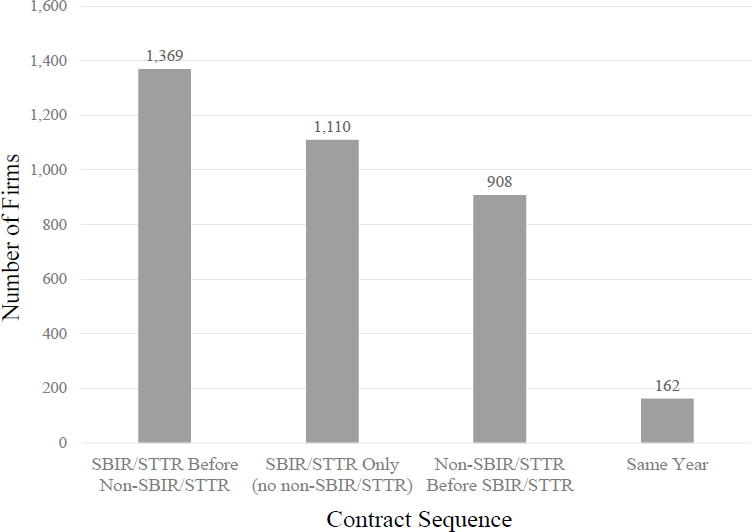
SOURCES: Committee calculations based on data from the Small Business Administration’s SBIR/STTR Awards database (SBIR.gov) and USAspending.gov.
This pattern indicates that the SBIR/STTR programs often serve as an entry point into NASA’s innovation ecosystem, enabling firms to establish relationships and demonstrate technical capabilities that support subsequent engagement. At the same time, the presence of firms that enter through other pathways underscores that the SBIR/STTR programs are important, but not exclusive, mechanisms for participation.
The gateway role of the SBIR/STTR programs at NASA appears less exclusive than in some other agencies, particularly the Department of Defense. Firms enter NASA’s innovation ecosystem through multiple pathways, including prior work with other federal agencies, subcontracting relationships, and participation in the commercial space sector. In some cases, firms establish capabilities through work with other agencies and subsequently engage with NASA. As a result, the SBIR/STTR programs operate within a more distributed pattern of entry, providing an important mechanism for introducing small, often early-stage firms—especially those aligned with mission needs—while subsequent engagement frequently reflects a broader set of relationships and prior experience. By lowering barriers to entry and supporting early-stage development, the program expands participation, while operating alongside other federal and commercial pathways into the space innovation ecosystem.
SBIR/STTR AND NON-SBIR/STTR CONTRACTING AT NASA: THE LEVERAGE RATIO
Another central question is whether NASA’s SBIR/STTR programs contribute to the agency’s mission needs. One way to assess this is by examining the extent to which firms receiving SBIR/STTR awards obtain additional, non-SBIR/STTR funding from NASA. Such follow-on funding provides an observable indicator that the agency values the capabilities, technologies, and services of these firms beyond the initial award. Although this measure does not establish that a specific SBIR/STTR-supported technology was incorporated into a mission, it indicates that other parts of NASA allocated R&D and contracting resources to these firms.
To construct this measure, the committee linked NASA SBIR/STTR awardees to non-SBIR/STTR NASA funding using data from the Small Business Administration (SBA) and USAspending.gov. This broader category includes both R&D funding and other NASA contracting obligations, capturing continued engagement regardless of whether it occurs through R&D, mission support, or other activities. While incomplete—particularly where downstream contributions occur through subcontracting or are not fully observable in administrative data—this measure provides a useful and systematic indicator of sustained NASA demand for the capabilities of SBIR/STTR firms.
The committee finds that NASA SBIR/STTR firms receive substantial follow-on funding from NASA outside the SBIR/STTR program. The total amount of non-SBIR/STTR NASA funding received by these firms exceeded total SBIR/STTR funding by more than a factor of three over the period examined (see Figure 6-2). Put differently, for every dollar NASA invested through SBIR/STTR, firms that received those awards subsequently obtained more than three dollars in additional non-SBIR/STTR NASA funding. This pattern suggests that NASA components beyond the SBIR/STTR program frequently choose to continue working with these firms after the initial award period.
It is not appropriate to interpret this ratio as a conventional return on investment. The additional funding reflects subsequent NASA expenditures directed to the same firms, not revenue returned to the agency. Instead, the leverage ratio is best understood as an indicator of continued internal demand for the capabilities of SBIR/STTR-performing firms. It reflects the willingness of NASA program managers, centers, and contracting entities to allocate additional resources to firms initially supported through the SBIR/STTR programs, consistent with the view that these firms provide technologies, engineering capabilities, and specialized services valued for mission needs.
Many SBIR/STTR firms are small, technically specialized organizations that contribute not only discrete products but also R&D, testing, engineering support, and mission-relevant services. This aligns with the structure of NASA missions, which depend on the integration of highly specialized components and subsystems and rely on diverse contributors rather than large-scale production alone.
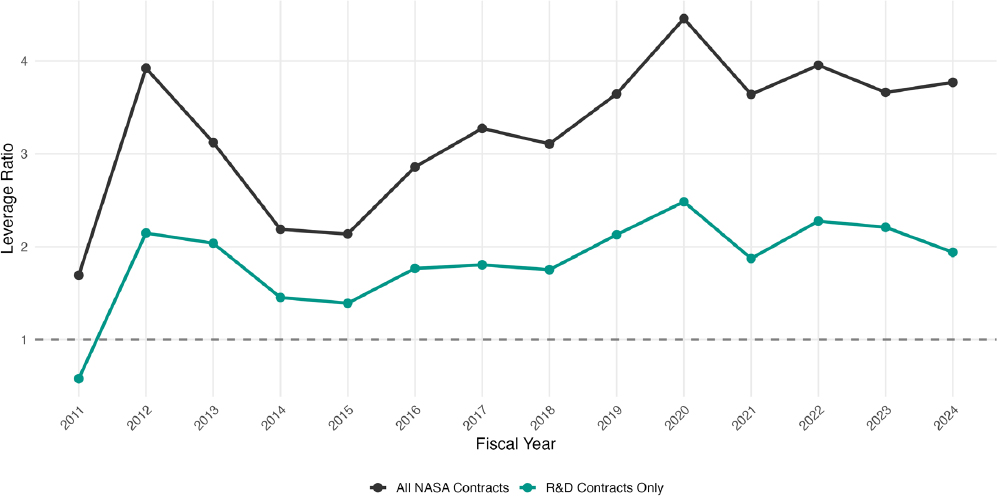
NOTES: R&D = research and development. Inflation adjusted using the Consumer Price Index with 2024 as the base year. Phase III included. Fiscal Year 2020 spike likely reflects COVID-era supplemental NASA procurement.
SOURCES: Committee calculations based on data from the Small Business Administration’s SBIR/STTR Awards database (SBIR.gov) and USAspending.gov.
The time pattern of the leverage ratio is also informative. The ratio increased in the early 2010s and has remained elevated over the past decade, suggesting a strengthening and subsequent stabilization of the relationship between SBIR/STTR and broader NASA funding activities. While not interpreted causally, this pattern is consistent with NASA increasingly using the SBIR/STTR programs to identify and engage firms with mission-relevant capabilities.
These findings indicate that SBIR/STTR plays an important role not only in early-stage technology development but also in connecting capable firms to follow-on opportunities within NASA. The substantial level of continued funding suggests that the program helps identify firms whose capabilities are valued across the agency. At the same time, this measure captures only one dimension of program outcomes. Firms may contribute through follow-on R&D, service contracts, or less visible supply-chain roles, and some impacts extend beyond NASA into other federal or commercial markets. Even with these limitations, the leverage analysis provides evidence that SBIR/STTR firms often remain engaged with NASA after their initial awards.
NASA SBIR/STTR AND NON-NASA FEDERAL CONTRACTING
The committee examined the extent to which NASA SBIR/STTR firms receive funding from other federal agencies. This provides an indicator that other agencies value the capabilities, technologies, and services of NASA’s SBIR/STTR firms by allocating R&D and contracting resources to these firms.
To construct this measure, the committee linked NASA SBIR/STTR awardees to non-SBIR/STTR federal funding using data from SBA and USAspending.gov. This category includes both R&D funding and other procurement obligations, capturing continued engagement across agencies through R&D and contracting activities. As with NASA-based measures, this approach is incomplete, particularly where downstream contributions occur through subcontracting or are not fully observable in administrative data. Figure 6-3 shows that NASA SBIR/STTR–funded firms received a substantial amount of money from other federal agencies, demonstrating that those agencies value the knowledge created from NASA’s SBIR/STTR firms.
Phase III awards, especially those resulting from subcontracting and direct commercial investment, are not easily tracked using current government data sources and reporting systems (NASEM, 2026). Problems tracking Phase III awards were addressed in the recent reauthorization of the programs, which requires Phase III awards, including Phase II subcontracting awards, to be included in both the SBA database as well as the federal procurement data system, including a requirement for government contracting officer to “reference an SBIR or STTR contract identification number for relevant prior SBIR or STTR work” in order to facilitate better tracking of this follow-on funding.2
___________________
2U.S. Congress, Small Business Innovation and Economic Security Act, P.L. 119–83 (April 13, 2026), Section 8(b).
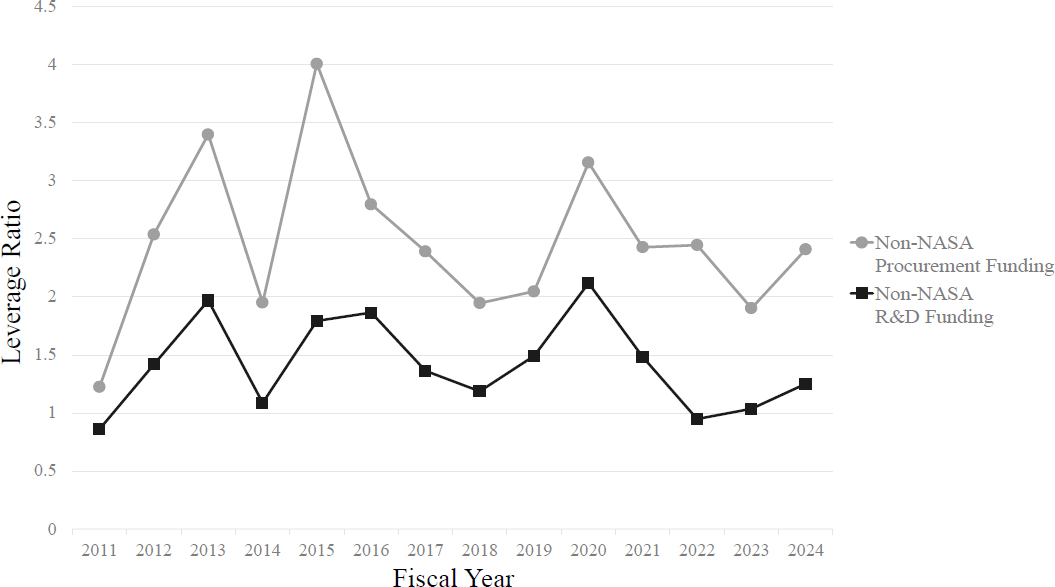
NOTE: R&D = research and development.
SOURCES: Committee calculations based on data from the Small Business Administration’s SBIR/STTR Awards database (SBIR.gov) and USAspending.gov.
TECHNOLOGY ADVANCEMENT AND TECHNOLOGY READINESS LEVELS
To further assess the outcomes associated with NASA’s SBIR/STTR programs, the committee examined whether SBIR/STTR-supported projects are associated with measurable advances in technological maturity. One of the central purposes of the NASA SBIR/STTR program is to help advance promising technologies toward levels at which they may become relevant for mission use, with TRLs as a standardized framework for tracking the maturity of technologies (see Chapter 2 for more detail). While TRL assessments involve subjective judgment, they provide a common metric within NASA for evaluating progress in technology development.
The committee’s analysis draws on project-level data from NASA’s TechPort system. A particular advantage of the NASA context is that TechPort includes both initial and final TRL assessments for a large set of projects, making it possible to examine technology advancement more directly than is feasible in many other federal settings. The analysis compares SBIR/STTR-supported projects with other externally performed technology development projects recorded in TechPort, including university collaborations, other private-sector contracts, and cooperative projects involving a NASA center and an external research team. These projects are broadly comparable in that they are mission-oriented technology advancement efforts for which NASA tracks progress. In addition, the projects in both the SBIR/STTR group and the comparison group are similar in scale, in the range of approximately $100,000 to $1 million.
To assess whether SBIR/STTR-supported projects exhibit different patterns of technology advancement, the committee estimated a set of ordinary least squares regressions using three dependent variables. The first is the change in TRL over the course of the project. The second is an indicator for whether a project advances by two or more TRL levels, a threshold intended to capture meaningful progress beyond incremental movement or variation in assessment. The third is an indicator for whether a project reaches TRL 7 or higher, representing later-stage readiness consistent with potential mission insertion (see Table 6-1).
For each outcome, the committee reports two specifications. The first is the raw association between SBIR/STTR status and the TRL outcome. The second adds controls for project start year, initial TRL level, technology division, and target destination (e.g., Earth, Moon, Mars), accounting for observable differences that may independently affect technology progression. Projects that begin at different TRLs or operate in different technical or mission areas may face distinct opportunities for advancement.
Across specifications, SBIR/STTR-supported projects are associated with somewhat greater technology advancement than other external projects recorded in TechPort. In the raw results, these projects exhibit larger average
| Dependent Variable | Change in TRL | TRL Increased by 2 or More | Project Reaches Mission Readiness (TRL 7 or Larger) | |||
|---|---|---|---|---|---|---|
| (1) | (2) | (3) | (4) | (5) | (6) | |
| Grant SBIR/STTR |
0.175*** (0.020) |
0.101*** (0.028) |
0.145*** (0.011) |
0.093*** (0.015) |
0.016*** (0.006) | 0.008 (0.007) |
| Fixed Effects | ||||||
| Grant Start Year | No | Yes | No | Yes | No | Yes |
| Grant Start TRL | No | Yes | No | Yes | No | Yes |
| Technology Division | No | Yes | No | Yes | No | Yes |
| Target Destination | No | Yes | No | Yes | No | Yes |
| Observations | 8,337 | 7,093 | 8,337 | 7,093 | 8,337 | 7,093 |
| R-squared | 0.009 | 0.088 | 0.021 | 0.084 | 0.001 | 0.380 |
*** Indicates statistical significance of p < 0.01.
NOTES: Ordinary least squares regression. Sample is all projects publicly available in NASA’s Technology Portfolio Management System (TechPort). Independent variable is equal to 1 if the award is an SBIR/STTR award and 0 otherwise. Target Destination refers to the assigned destination of the technology for NASA (e.g., Earth, Moon, Outside Solar System). TRL = Technology Readiness Level.
SOURCE: Committee calculations based on data from TechPort (https://techport.nasa.gov).
increases in TRL and are more likely to advance by two or more levels. These relationships remain statistically significant after introducing controls, although the magnitudes are reduced. The results are best interpreted as descriptive rather than causal, reflecting both potential selection into the program and the effects of participation. Overall, they indicate that SBIR/STTR projects are associated with slightly greater progress in moving technologies forward along the readiness spectrum relative to comparable NASA-supported activities.
In contrast, the evidence is weaker for later-stage advancement. While SBIR/STTR status is positively associated with reaching TRL 7 or higher in the raw specification, this relationship becomes small and statistically insignificant once controls are included. This pattern is consistent with the program’s role within NASA’s innovation system, which is oriented toward advancing emerging technologies rather than carrying them through to full mission readiness. Achieving higher TRLs typically requires additional development, integration, and testing beyond the scope of a single SBIR/STTR award.
When interpreting these findings, it is also important to consider the limitations of TRL-based measures. TRL assessments provide a standardized but imperfect indicator of technological maturity, and progression along the scale does not guarantee eventual mission use. Even at higher TRLs, incorporation into a mission depends on factors such as system integration, mission timing, budget constraints, and programmatic priorities. Nevertheless, the availability of systematic TRL data in TechPort provides a valuable basis for assessing whether SBIR/STTR contributes to measurable progress in technology development.
The results indicate that NASA SBIR/STTR is associated with meaningful advancement in early and intermediate stages of technology development. The greater likelihood of multilevel TRL advancement is consistent with the program’s role in maturing promising technologies. At the same time, the limited association with late-stage readiness reinforces the conclusion that SBIR/STTR supports primarily upstream technology development rather than serving as the final step toward mission deployment.
EXTERNAL INNOVATION AND COMMERCIALIZATION OUTCOMES
The committee considered whether participation in the SBIR/STTR programs is associated with broader indicators of innovation and commercialization. These external outcomes include the ability of firms to attract private financing and to generate formal intellectual property. While these metrics provide useful information, their interpretation in the NASA context requires care, as the structure of the space innovation ecosystem and the mission-oriented nature of technology development differ from those of more commercially oriented sectors.
The committee first examined patterns of private financing using data drawn from PitchBook, with a robustness check using data from Crunchbase. The analysis compares firms that receive SBIR/STTR awards with those that apply
but do not receive an award, focusing on the timing of financing activity relative to the first SBIR/STTR application. The evidence indicates that firms receiving NASA SBIR/STTR awards are, on average, less likely to have prior venture capital financing than firms that apply but do not receive an award. This pattern suggests that SBIR/STTR awardees may be less oriented toward venture-backed growth strategies at the time of application and instead may be more focused on developing specialized technologies aligned with NASA mission needs.
At the same time, firms that receive NASA SBIR/STTR awards show a modest increase in private financing following their initial award. Awardees are more likely than nonawardees to experience financing events after their first award (see Figure 6-4). However, this increase is relatively modest compared with
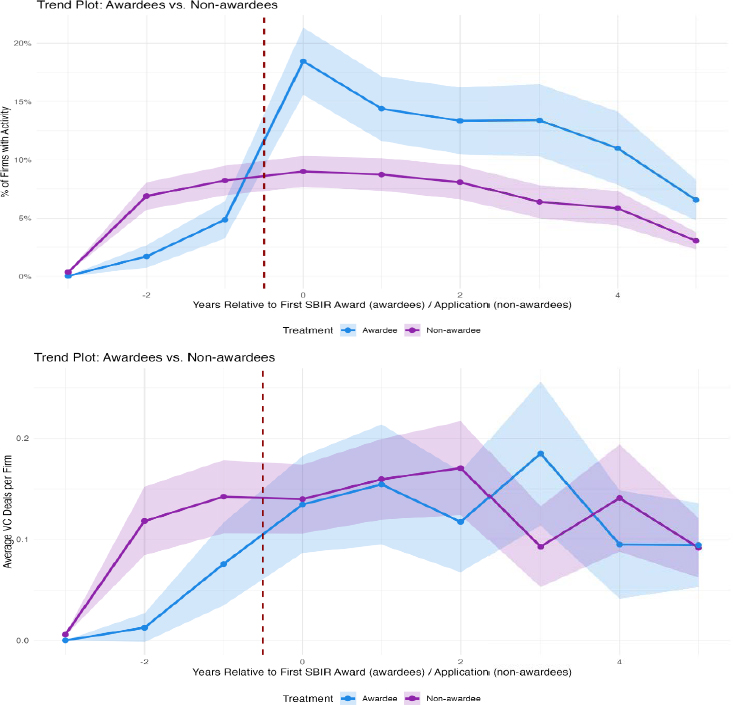
NOTE: VC = venture capital.
SOURCES: Committee calculations based on data from the Small Business Administration’s SBIR/STTR Awards database (SBIR.gov) and PitchBook.
patterns observed in some other agencies. These results suggest that while SBIR/STTR participation is associated with some increase in access to external capital, it is not the primary pathway through which NASA SBIR/STTR firms generate value.
The committee also examined patenting behavior among NASA SBIR/STTR applicants. The analysis indicates that many firms participating in the program exhibit significant patenting activity prior to their initial SBIR/STTR application (Figure 6-5). This finding reinforces the interpretation that the program attracts firms that are already engaged in innovative activity and possess established technical capabilities. When examining patenting trajectories over time, the committee finds no evidence of a substantial increase in patenting following receipt of an SBIR/STTR award. While patenting continues for many firms, the rate of patenting does not appear to change markedly relative to preaward levels.
Taken together, these results suggest that external commercialization outcomes associated with NASA SBIR/STTR participation are present but differ in important ways from those observed in more market-oriented settings. Participation in the program is associated with some increase in access to private financing, but not with a pronounced shift toward venture-backed scaling.

NOTE: Compares first-year funded and unfunded applicants, with 95% confidence intervals.
SOURCES: Committee calculations based on data from the Small Business Administration’s SBIR/STTR Awards database (SBIR.gov) and the United States Patent and Trademark Office.
Similarly, while many participating firms generate intellectual property, SBIR/STTR participation does not appear to lead to a discrete increase in patenting activity. These patterns are consistent with the broader role of SBIR/STTR within the NASA innovation ecosystem.
SUMMARY
The NASA SBIR/STTR programs are best understood as a mission-oriented innovation and procurement pipeline, not as general-purpose commercialization or venture-development programs. Their strongest impacts occur where program design aligns closely with NASA’s institutional role—namely, early-stage technology development, certification of technical capability, and integration into federal R&D and acquisition networks. Outcomes that depend on external private markets, such as venture capital investment or patenting, appear to be secondary and highly heterogeneous.
Within NASA, SBIR/STTR projects report a higher average increase in their TRLs over the course of the R&D support from NASA, and are, in particular, more likely to report an advance of at least two TRLs. However, NASA projects are no more likely than comparable TechPort-reported projects to achieve a TRL of 7 or above, which is reached when a prototype is demonstrated in space, and they achieve a TRL level of 9, where the system is proven through successful mission operations, only in rare circumstances.
The strongest and most consistent outcome associated with NASA SBIR/STTR participation is increased engagement in federal contracting, both within NASA and from other federal agencies. NASA SBIR/STTR awardees receive substantial follow-on funding from both NASA and other federal agencies. Firms that have participated in NASA’s SBIR/STTR programs receive a disproportionately large share of NASA’s non-SBIR/STTR contract dollars to small businesses relative to their share of SBIR/STTR funding. Taken together, these patterns suggest that the SBIR/STTR programs function as a certification and onboarding mechanism within the federal innovation ecosystem.
In contrast to conventional narratives that frame the SBIR/STTR programs as a certification for private investors, the evidence provides limited support for a generalized venture capital catalysis effect. Firms that ultimately receive NASA SBIR/STTR awards are less likely to have venture capital backing prior to application than unsuccessful applicants, and postaward venture activity does not increase in a sustained or systematic manner relative to nonawardees. Where postaward capital activity does occur, it is more often associated with private equity or other non–venture capital transactions and is driven by a small number of large outliers rather than broad-based increases across firms. These results suggest that venture capital is not the dominant or intended commercialization pathway for many of NASA’s SBIR/STTR-funded technologies, and that reliance on venture capital–based metrics may mischaracterize program performance.
Measures of innovative output, particularly patenting activity, further reinforce the importance of selection effects. Firms that receive NASA SBIR/STTR awards tend to be more patent active prior to applying than firms that are not funded, indicating that the program selects firms with existing innovative capacity. However, event-study analyses show no clear increase in patenting following award receipt. This absence of a postaward patent increase does not imply an absence of innovation impact. Rather, it suggests that SBIR funding may redirect effort toward applied development, system integration, and mission-specific problem-solving, activities that are not well captured by patent counts. These findings highlight the limitations of patent-based indicators for evaluating mission-oriented R&D programs such as NASA SBIR/STTR.
As discussed in earlier chapters, the programs support a heterogeneous population of firms. Some participants pursue growth-oriented strategies that involve attracting private capital and expanding into commercial markets, including emerging segments of the space sector. However, a substantial share of SBIR/STTR participants appear to be small, technically specialized firms that develop capabilities and technologies aligned with NASA mission needs. For these firms, value creation may occur through continued engagement with NASA, participation in supply-chain relationships, or contributions to mission-specific systems, rather than through traditional commercialization pathways such as venture-backed growth or patent-driven licensing.
Accordingly, the committee interprets the external commercialization evidence as complementary to the internal outcomes documented earlier in this chapter. While SBIR/STTR participation may contribute to broader innovation activity for some firms, the primary role of the program in the NASA context appears to lie in supporting the development of mission-relevant technologies and in enabling the participation of specialized firms within NASA’s innovation system. External metrics such as private financing and patenting provide useful, but partial, indicators of these broader outcomes.
FINDINGS
Finding 6-1: NASA’s SBIR/STTR programs have served as an effective and strategic mechanism for developing and advancing technologies that are critical to the agency’s missions and priorities.
Finding 6-2: NASA’s SBIR/STTR programs have played an important role in contributing to technologies and companies engaged in the growing commercially oriented space sector.
Finding 6-3: Firms that have received both SBIR/STTR and non-SBIR/STTR funding from NASA typically receive their first NASA funding through the SBIR/STTR programs.
Finding 6-4: NASA SBIR/STTR awardees tend to attract significant non-SBIR/STTR funding from NASA, at a ratio of more than 3:1.
Finding 6-5: NASA SBIR/STTR firms attract significant non-SBIR/STTR funding from other federal agencies.
Finding 6-6: Relative to other R&D projects tracked in NASA’s TechPort, NASA SBIR/STTR projects report larger average gains in TRLs over the course of their support from NASA and are more likely to report an advance of at least two TRLs. However, NASA projects are no more likely than comparable TechPort-reported projects to achieve a TRL of 7 or above, and they achieve a TRL of 9 only in rare circumstances.
Finding 6-7: Relative to other private firms, NASA SBIR/STTR awardees tend to be less well connected to private venture capital prior to their engagement with the SBIR/STTR programs, suggesting that these firms may be more interested in serving the agency’s mission than in expanding the scale of their sales or operations.
Finding 6-8: NASA SBIR/STTR awardees tend to attract some form of publicly reported private capital (but not a higher level of venture capital) after receiving their first NASA SBIR/STTR award.
Finding 6-9: Although many NASA SBIR/STTR awardees do receive formal intellectual property protections (patents), these firms experience no “boost” in the rate of patenting after receiving their first NASA SBIR/STTR award. This observation may reflect a relative lack of reliance on patents in the NASA innovation ecosystem.
RECOMMENDATIONS
Recommendation 6-1: NASA’s contracting and procurement workforce should advocate for the maximum practicable use and transition of products, services, and technologies developed under the Small Business Innovation Research/Small Business Technology Transfer (SBIR/STTR) programs into NASA missions by means of Phase III awards to small businesses, as Congress required in the 2026 reauthorization of the SBIR/STTR programs.
Recommendation 6-2: NASA should consider a range of strategies for how best to accelerate and support the emerging set of start-ups and scale-ups in the commercial space sector. The agency’s Small Business Innovation Research and Small Business Technology Transfer programs should continue to play a key role in facilitating
the advancement of technologies and components important to this emerging sector, while recognizing that the capital and scaling opportunities required for certain technologies require the involvement of other programs and/or private-sector initiatives.
Recommendation 6-3: Congress should require agencies to submit scoring information on applicants to the government database so as to facilitate analysis of the impact of NASA’s Small Business Innovation Research/Small Business Technology Transfer (SBIR/STTR) funding on applicants. Scoring information could enable the determination of a well-defined funding cutoff, which would help identify any cause-and-effect relationship between NASA’s SBIR/STTR funding and outcomes.
This page intentionally left blank.


