Review of the SBIR and STTR Programs at NASA (2026)
Chapter: 4 NASA's SBIR/STTR Processes
4
NASA’s SBIR/STTR Processes
This chapter reviews NASA’s processes for executing the Small Business Innovation Research/Small Business Technology Transfer (SBIR/STTR) programs, including such activities as topic and subtopic selection, outreach to applicants, and selection of and support for awardees. The chapter provides a detailed assessment of the application and award processes. It also describes some key domains in which opportunities for change might be helpful, especially with regard to improved training opportunities for contracting and procurement personnel, reviewers, technical experts, and potential applicants.
The principal sources of data for this chapter were nearly 20 in-depth discussions between committee members and SBIR/STTR program managers and staff from NASA mission directorates and centers and the NASA SBIR/STTR Program Office, conducted throughout 2024 and 2025 (see Appendix C). The program managers oversee the processes and procedures in the programs and rely on technical experts in the centers to determine specific research topics and monitor the small businesses’ performance. Targeted conversations with SBIR/STTR unit leads and the SBIR/STTR program executive highlighted the implications of a recent NASA SBIR/STTR program reorganization and explored evolving roles and relationships within the organization. These discussions were supplemented by systematic searches of the NASA SBIR website and related sources, ensuring a comprehensive view of relevant processes and policies. Insights from committee members and presentations by SBIR/STTR, entrepreneurship, and space innovation experts at committee meetings further informed the committee’s analysis.
A list of interviewees and their duty stations is provided in Appendix C of this report. Each discussion followed a similar protocol (also found in Appendix C) and lasted approximately 60–90 minutes. These discussions provided a foundation for understanding current practices and organizational dynamics within the SBIR/STTR programs at NASA. The discussion protocol focused on eliciting detailed information about program operations, decision-making, and organizational structure. However, as noted, the programs were undergoing reorganization at the time, and changes in personnel rules in the executive branch
in 2025 (including a return-to-office mandate, deferred resignation program, and 20-percent reduction in the overall NASA workforce) also led to changes in NASA’s workforce composition. On top of this, the legislative authorization for the SBIR/STTR programs expired at the end of September 2025, and Congress did not reauthorize the programs until March 2026.1 These factors inhibited the committee’s ability to evaluate the effectiveness of the programs’ processes and procedures, especially with regard to the efficacy of the organizational changes.
PROGRAM STRUCTURE, MANAGEMENT, AND REORGANIZATION EVOLUTIONS
The reorganization of the NASA SBIR/STTR program structure was implemented early in 2024. The program changed from a decentralized model operated across ten NASA centers to a unified program that brings together staff from the mission directorates and centers into four units.
The reorganization was motivated by three factors: (1) SBIR/STTR modernization efforts from 2015 to 2109 that centralized the review process (Gustetic et al., 2019); (2) new leadership put into place in 2021; and (3) NASA’s SBIR/STTR strategic planning in 2022, which identified three program goals: create and measure societal benefits, ensure equitable access and diverse representation, and provide exemplary service for awardees. After the strategic plan was finalized, an internal assessment determined that a reorganization was needed to execute the strategy, noting gaps in core operations that needed to be addressed; the possibility to become a more efficient, collaborative, and learning organization; and opportunities to improve capacity and accountability.
The new structure moved the SBIR/STTR programs at NASA from a center-based operations-and-management model to a centralized, matrix, enterprise approach organized around core functions and stages in the SBIR/STTR administration process. The reorganization was designed to encourage collaboration across NASA, breaking down barriers across centers and enabling staff to understand the full life cycle of the programs in a unified way. The SBIR/STTR Program Office envisions rotating team assignments intended to develop deeper expertise and broader perspectives across the organization; however, these rotations have not yet begun.
The reorganization established four distinct units: Acquisition Management, Customer Management, Systems Management, and Business Intelligence. The new model aimed to eliminate redundant roles, such as multiple independent acquisition management teams, and it centralized support services with the goal of better meeting the needs of all centers. For instance, contracting is now done through the NASA Shared Service Center, located at Stennis Space Center. The newly created Business Intelligence Unit enables the SBIR/STTR programs to prioritize and advance analytical work; provides insights, goals for
___________________
1 U.S. Congress, Small Business Innovation and Economic Security Act, P.L. 119–83 (April 13, 2026).
operations, and success stories; and centralizes and automates the congressionally mandated due diligence process.
The Acquisition Management Unit (AMU) and Customer Management Unit (CMU) are linked by three cross-cutting teams that align with the awardee administration cycle: Solicitation and Requirements Development, Proposal Review and Selection, and Post-Selection Support and Analysis. These teams are structured around the front, middle, and back processes. The front process handles inquiries from firms and stakeholders and manages external communications, such as newsletters and success stories. The middle process, or acquisition management, focuses on the internal execution of program initiatives, including the creation of solicitation content and the selection of proposals. The back process manages award-tracking and post–Phase II opportunities, overseeing acquisitions such as support contracts and collaborating with external partners to gather market insights. This structure ensures that both internal needs and external market demands are addressed throughout the program life cycle. Each team has a lead as well as support from center and mission directorate staff, who serve as liaisons between the SBIR/STTR programs and their directorate or center.
AMU and CMU (and their three cross-cutting teams) are responsible for internal and external outreach, serving both innovative small businesses seeking funding and the broader NASA community that creates subtopics and reviews proposals. External outreach is conducted by attending events such as TechConnect and the use of email lists and newsletters released in cadence with Phase I and II opportunities and deadlines. The Help Desk, part of CMU, collaborates closely with the Systems Management Unit to implement system changes that are identified through the work of the Help Desk and from the input of team members and others throughout NASA.
The Business Intelligence Unit is responsible for preparing reports, when requested, such as tracking the development of specific NASA technologies over time and highlighting the SBIR/STTR programs’ contributions to its progress. The unit also conducts foreign-affiliation due diligence required by law and, in collaboration with the Systems Management Unit, facilitates the transition from the programs’ previous interface (the Electronic Handbook) to the new system, which is known as ProSAMS (Proposal Submissions and Award Management System).
As is suggested by the above, the Systems Management Unit is responsible for the SBIR/STTR internal and external systems, including system security. This team ensures that changes are implemented whenever policies shift or when internal or external customers encounter issues using the system. All changes, including minor ones, are tracked through a change management process.
As discussed, in addition to having dedicated SBIR/STTR staff, unit teams also include center liaisons and mission directorate liaisons and other center and mission directorate staff. Each of NASA’s ten centers has unique research and development (R&D) needs, while the five mission directorates that offer SBIR/STTR awards also have strategic road maps that guide their projects and
initiatives. The interplay between these roles and responsibilities is fundamental to achieving NASA’s overarching goals. The center and mission directorate liaison positions are important for connecting the agency’s priorities. Center liaisons are responsible for representing their center and assisting various stakeholders with their needs, ranging from guidance to support in incorporating topics into solicitations, while mission directorate liaisons highlight and ensure that their directorate’s mission, goals, and annual strategy are reflected in the SBIR/STTR programs. Discussions with NASA SBIR/STTR staff indicated that team members who juggle both team and liaison roles often find themselves stretched thin, which can compromise their effectiveness.
Contractors are also an integral part of these teams and appear to work seamlessly with the unit teams. For example, they support communication and outreach and lead the change process. They conduct regular check-ins, present goals, solicit feedback, and ensure team alignment with proposed directions.
The matrix model of the new structure facilitates more horizontal communication and collaboration across units. Regular meetings among unit and team leads have fostered the sharing of knowledge and best practices. This shift has improved the programs’ ability to make changes, such as enhancing solicitation development and increasing mission directorate engagement. Within units, proactive check-ins during weekly meetings encourage team members, including the Help Desk team, to share any issues or concerns. At these meetings, unit leads and other team members discuss challenges and resolve issues. These meetings also help to maintain and improve working relationships. This feedback loop is the primary method for understanding internal and external customer challenges and gathering insights. Each unit also meets weekly to plan and discuss progress on its activities and identify challenges.
SBIR/STTR program leadership holds regular meetings to provide policy updates, discuss progress on implementing new approaches and tools, and listen to SBIR/STTR staff. For instance, information concerning the SBIR/STTR reauthorization has been discussed at these meetings, even when the potential program changes were unclear. This information-sharing helps team members who are not in leadership meetings understand matters concerning upcoming workloads and priorities.
Overall, NASA team members described the communication in the new structure as transparent and open, with no barriers to leadership. This multidirectional flow of communication, occurring vertically (up and down) and horizontally across teams, indicates that NASA’s SBIR/STTR team culture values collaboration and supporting one another.
NASA’S SBIR/STTR APPLICATION AND AWARD PROCESSES
As described above, NASA’s SBIR/STTR programs have a strong leadership infrastructure, and their cross-cutting teams allow cohesive operation. The SBIR/STTR Program Office, consisting principally of the program executive
and deputy, reside institutionally at NASA headquarters. Day-to-day program management is delegated to Ames Research Center in Silicon Valley, California, led by a program manager and deputy program manager. Other SBIR/STTR staff are located at mission directorates and centers across NASA and work together through the four enterprise units described above. This section continues by describing the major steps in administering the SBIR/STTR programs.
Development of Topics and Subtopics
AMU and CMU are responsible for managing NASA’s SBIR/STTR topic development. They ensure that topics and subtopics remain relevant to small businesses by collaborating closely with NASA’s technical community, which is primarily composed of civil service staff in the centers and project personnel working in the mission directorates. Topic areas are broadly defined categories, such as propulsion, air, space, and safety, that guide the development of specific subtopics for inclusion in program solicitations. About 90 percent of solicitation topics remain consistent from year to year. Once topic areas are identified, the NASA technical community is invited to submit subtopic proposals that address high-tech and high-need gaps, specifically those that small firms can address. According to NASA, the new ProSAMS system facilitates the creation of SBIR/STTR topics and subtopics for inclusion in the agency’s program solicitations more quickly than was possible with the Electronic Handbook system.
The SBIR/STTR programs have recently announced plans to begin offering funding opportunities through a broad agency announcement (BAA) instead of offering a single solicitation per year. The goal of moving to a BAA is to be more responsive to the agency’s evolving priorities, particularly with a focus on the Artemis program,2 enabling stakeholders to submit topics year-round rather than being confined to a single time frame.
Development of subtopics for the STTR program emphasizes grassroots involvement, with the NASA chief technologist playing a key role in identifying critical technology needs that may not be linked directly to mission directorates. Overall, this collaborative process is designed to foster innovation and project development while ensuring that the resulting technologies remain accessible to small businesses and universities.
While other agencies offer open topics for their SBIR/STTR programs, thereby allowing small businesses to define and propose solutions to problems, NASA does not. Because of NASA’s smaller and more limited budgets and NASA’s focus on mission-specific technology development, the agency’s SBIR/STTR staff are concerned that they could not absorb the large number of proposals that open topic solicitations tend to generate.
___________________
Overview of Program Phases
The SBIR/STTR programs have three phases, with only the first two phases including financial support from the SBIR/STTR programs (see Figure 4-1).
Phase I
During Phase I, the “idea generation” phase, small business awardees (in cooperation with their research institution partners in the case of STTR awardees) “establish the scientific, technical, commercial merit and feasibility of the proposed innovation” (NASA, n.d.h, para. 1). For fiscal year (FY) 2026, the maximum award size is $ 225,000, an increase from the previous maximum of $ 150,000 but still under the statutory maximum allowed of over $ 3 00,000. Under Phase I, SBIR awardees have 6 months to study the scientific, technical, and commercial feasibility of their SBIR award, and STTR awardees have 13 months, a timeline that accommodates the academic calendar. SBIR and STTR awardees must submit their Phase II proposals by the end of the Phase I period of performance.
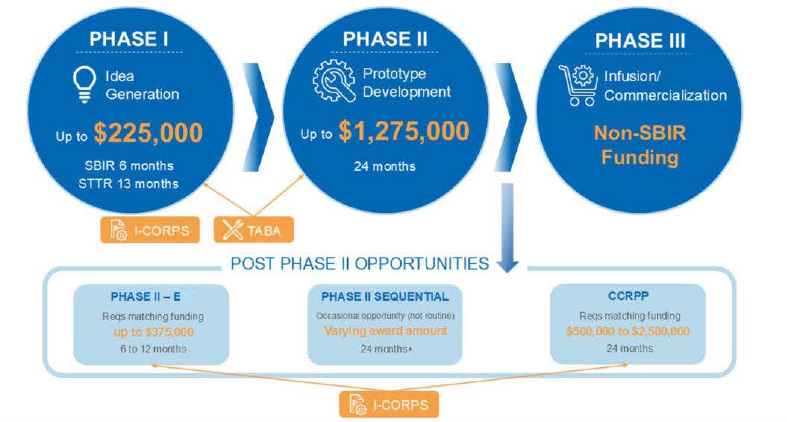
NOTES: CCRPP = Civilian Commercial Readiness Pilot Program; Phase II- E = Phase II-Extended; TABA = Technical and Business Assistance.
SOURCE: NASA, n.d.j.
Phase II
Phase II focuses on the “development, demonstration, and delivery of a technology innovation” (NASA, n.d.i, para. 1). Phase II awards are made to small businesses (working in cooperation with their research institution partners in the case of STTR) who “successfully demonstrated the feasibility of their technology idea during Phase I” (NASA, n.d.i, para. 1). Until the FY2026 reauthorization, only small businesses that were awarded a Phase I were eligible to apply for Phase II and only immediately after or near the end of their corresponding Phase I award.3 Phase II awardees have 24 months to develop, demonstrate, and deliver their innovation. Phase II contracts in FY2026 will have a maximum funding of $1.275 million, an increase from previous levels but well below the statutory maximum of over $2 million.
Post–Phase II Funding Opportunities
NASA offers additional funding opportunities to some of its Phase II awardees to further develop the results developed under Phase II.
Phase II-Extended (II-E) Awards4
Small businesses with a current Phase II award can apply to participate in this program, which extends their Phase II award for up to an additional 6–12 months with NASA SBIR/STTR funds matched by an outside investor(s) or non-SBIR/STTR funds. Phase II-E funding is used to further R&D efforts and the commercialization of innovations developed during Phase II. Although it has a smaller overall funding amount than the other post–Phase II opportunities, Phase II-E support provides up to $375,000 in matching funds for a total of $750,000 for eligible Phase II projects.
Although Phase II-E applicants do not have to compete for this support as long as the technology shows promise and matching funds are verified, there is no guarantee of receiving these additional funds from NASA. What is more, matching funds cannot come from other SBIR/STTR awards from any agency.
Phase II Sequential Awards5
The Small Business Administration’s (SBA’s) approval of a waiver request from NASA to allow larger-than-normal Phase II awards has enabled the agency to provide what it calls Phase II Sequential awards. Phase II Sequential funding focuses on high-priority technology sectors or technical need areas. It is set aside by NASA to ensure sufficient available SBIR/STTR funding to support significant advancements with a higher chance of transitioning into practical applications and is available to Phase II awardees that are focused on agency-
___________________
3 U.S. Congress, Small Business Innovation and Economic Security Act, P.L. 119–83 (April 13, 2026), Section 10(a)(2).
4 https://www.nasa.gov/sbir_sttr/phase-ii-e/#phaseiiextendedguidelines.
specified topics. A Phase II awardee may receive only one Phase II Sequential award on top of its original Phase II support.
Civilian Commercialization Readiness Pilot Program (CCRPP)6
CCRPP is designed to accelerate a technology’s transition to NASA missions as well as commercial markets after the completion of a Phase II award. Under CCRPP, the NASA SBIR/STTR programs will match between a minimum of $500,000 and a maximum of $2.5 million of the external investment (which may include non-SBIR/STTR funding from NASA) during a period of performance of 24 months, typically. According to NASA, CCRPPs are “not designed for the incremental changes of earlier phases of development”; rather, these technologies need to be on an “accelerated path into transitioning to NASA missions and applications as well as commercial markets” (NASA, n.d.b, para. 1). Box 4-1 highlights a success story of a CCRPP awardee.
SBIR Ignite
To operate alongside its traditional Phase I and Phase II programs, NASA introduced the SBIR Ignite program. SBIR Ignite is a small pilot program that
BOX 4-1
Success Story: Civilian Commercialization Readiness Pilot Program
Mango Materials, a woman-owned small business in San Francisco, California, received NASA Small Business Technology Transfer (STTR) funding to create biodegradable plastic alternatives from waste methane gas from landfills and wastewater treatment facilities. The idea stemmed from the company founders’ research at Stanford University and from a vision to reduce environmental harm caused by traditional plastics. Mango Materials applied for and received a Phase I STTR award, in collaboration with the Colorado School of Mines. This funding propelled the development of a system that converts methane into a plastic substitute.
Following early success, the team secured Phase II and subsequently Phase II-Extended Small Business Innovation Research/STTR funding, allowing it to refine the technology for commercial markets and space, including concepts to support human missions to Mars through in situ resource utilization. After completing these research phases, Mango Materials applied to the STTR Civilian Commercialization Readiness Pilot Program and obtained $6 million in combined funding from the program and private investors, including the fashion industry. The fashion industry is interested in these fibers as a greener alternative to polyester, addressing a major source of plastic pollution. This infusion of capital accelerated the optimization and scaling of Mango Materials’ biopolymer products.
SOURCE: NASA, n.d.d.
___________________
offers Phase I and Phase II awards that are similar in size to those of the traditional programs but are designed to promote innovation by identifying technologies with strong commercial potential that can address market needs and support NASA applications. SBIR Ignite offers a streamlined application process, requiring only a 15-page technical proposal. The review process used to begin with an assessment of abstracts and commercialization scores, after which finalists are selected for pitches, but now Ignite proposals are reviewed for commercial potential and technical merit. Additionally, Phase I Ignite awardees must submit their Phase II proposal by the end of the fourth month of their award. This requirement is designed to minimize the wait time between the completion of Phase I and the start of Phase II.
Some Ignite processes, such as Ask Me Anything sessions, have already been incorporated into the regular SBIR/STTR processes. Other practices, such as Reverse Pitch Days and a topic/subtopic selection process that includes evaluation by external reviewers, represent potential future improvements. By staggering its solicitation release date later in the year, SBIR Ignite allows companies to respond to multiple calls, creating a more equitable process. One of the three annual solicitations under the BAA, planned to start in 2026, will be for SBIR Ignite.
Phase III
Although not funded by the SBIR/STTR programs, Phase III is the next stage for a small business to either transition its technology into a NASA mission or another federal agency or commercialize its technology in the private sector. It includes companies receiving funds from NASA; another government agency; or the private sector, such as venture capital funding (perhaps a mix of these), to continue work toward commercialization or the use of their innovations. SBIR/STTR-funded firms can be awarded Phase III contracts from the government without competition, and the firms retain their data rights under such contracts. (For more information on data rights, see NASEM, 2026.)
Review and Approval Process
Subtopic managers choose reviewers for both the main SBIR/STTR and Ignite programs. NASA reviewers are primarily NASA center civil servants, with occasional use of contractors. External personnel, such as Air Force and Space Force members, are sometimes asked to participate as reviewers because of their expertise and overlapping interests. However, access to NASA’s electronic system for proposal submission and review is restricted, and individuals outside of NASA must go through a permission process, which can complicate their participation. As a result, NASA primarily uses reviewers who already have access to internal systems.
As part of the review process for traditional SBIR/STTR Phase II and SBIR Ignite Phase I and II applications, outside experts are assembled into a team
by a NASA contractor to assess commercial potential during both Phase I and Phase II. Phase II requires a formal commercialization plan (accounting for 5 percent of the weight for scoring the proposal). Phase I emphasizes technical feasibility, while reviewers also consider prospects for future commercialization; Phase II emphasizes strategies for transitioning the technology to market.
Proposals undergo an initial review to ensure compliance with solicitation requirements, including completed forms and adherence to page limits. Subtopic managers evaluate proposals for relevance to the current subtopic and assess whether firms are attempting to fit outdated proposals into new categories. They are responsible for identifying and assigning qualified reviewers from their technical community. Reviews are conducted independently by reviewers without panels.
Subtopic managers conduct a quality check by reviewing all evaluations and determining whether a third reviewer is needed based on any discrepancies that arise. Subtopic managers prioritize meritorious proposals from a technical perspective. Topic managers further prioritize proposals by aligning them with higher-level agency objectives and strategic priorities. In addition, at the time that the committee spoke to NASA staff, a convex optimization software tool developed by REI Systems (2023), referred to internally as the Portfolio Selection Support Tool, is used in Phase I to prioritize other factors such as underserved locations and first-time applicants. The algorithm enables the program to weight certain factors to align with that cycle’s priorities. While this tool may help speed up the selection process, at the time that the committee undertook this study, some NASA SBIR personnel mentioned that they did not understand the algorithm used to weight the applications.
The commercialization score is weighted more heavily in Phase II than in Phase I: Phase I uses a 0–100 scale for technical review, while Phase II uses 0–95 for the technical review + 5 points for commercial potential. Phase II has a separate commercial review and additional board meetings with mission directorate leadership for strategic investment considerations.
Mission directorate leadership has more input at Phase II because of the higher funding levels. Once the proposals are ranked, the source selection official makes final decisions about which proposals to award. For Phase I, a technical monitor manages the award, and for Phase II, a contracting officer representative interacts with the principal investigator about the SBIR/STTR award.
OUTREACH TO APPLICANTS AND STAKEHOLDERS
NASA’s SBIR/STTR programs depend on attracting high-quality applicants. An explicit objective of the SBIR/STTR programs is to foster and encourage participation in technological innovation by woman-owned and socially and economically disadvantaged small businesses. The program employs a centralized, multifaceted outreach strategy that includes webinars, conferences, and collaborations with state organizations.
NASA’s SBIR/STTR program outreach occurs externally and internally (see Box 4-2). External outreach efforts focus on seeking new applicants, such as small, innovative companies that may not be aware of the SBIR/STTR programs. These external outreach efforts aim to educate potential future applicants about opportunities at NASA. Internally, outreach is directed at identifying mission directorates and centers that can champion topics and facilitate the transition of Phase II awards into follow-on contracts or procurements. This internal effort demands persistence, strong networking, and in-depth knowledge of the programs and NASA mission requirements.
The extent of outreach activity varies with the program’s budget and staffing capabilities. Outreach is centralized under the NASA SBIR/STTR Program Office’s CMU and remains collaborative, often involving staff from AMU with expertise in outreach engagements. Personnel attend both traditional and nontraditional events to connect with potential applicants. Examples of connecting events include SBA Road Tours, conferences for professional organizations (e.g., Society for Advancement of Chicanos/Hispanics and Native Americans in Science, National Society of Black Engineers), and specialized gatherings.
Outreach and administration of the programs are currently funded in part by a pilot program originally authorized in the SBIR/STTR Reauthorization Act of 2011,7 which allows agencies to allocate 3 percent of their SBIR/STTR budgets to administer the programs. This funding addresses a chronic issue within the programs’ original authorized structure, under which no funds allocated for the programs could be used for their administration. Within NASA’s SBIR/STTR programs, these funds are used broadly for administrative costs associated with running the programs, though a limited budget requires the programs to leverage events hosted by other organizations rather than mount independent national campaigns.
The programs’ outreach capacity has been substantially affected by COVID-19 impacts, organizational changes, and budget constraints. The loss of major outreach events and reduced travel funding have affected program visibility.
Some stakeholders, including leadership, have questioned the value of traditional outreach efforts because of a lack of metrics demonstrating their success in generating competitive proposals from targeted populations. The lack of robust metrics to evaluate outreach effectiveness is a persistent challenge. Without clear evidence linking specific outreach activities to measurable outcomes—such as increases in applications from targeted populations or regions, or improvements in proposal quality—it is difficult to justify resource allocation to particular activities or to refine outreach strategies based on demonstrated effectiveness. Staff perceptions of the effectiveness of their outreach efforts vary
___________________
7 U.S. Congress, National Defense Authorization Act for Fiscal Year 2012, P.L. 112–81, Section 5141 (December 31, 2011) and subsequent legislation, which extended the provision.
BOX 4-2
Examples of SBIR/STTR Outreach Strategies and Activities
SBIR IGNITE
The SBIR Ignite program serves as a critical “sandbox” for process experimentation within NASA’s Small Business Innovation Research/Small Business Technology Transfer (SBIR/STTR) operations. SBIR Ignite serves as a testbed for piloting new outreach methods before they are considered for adoption into the main program. Among the innovations developed through Ignite are Catalyst events—presolicitation market-scouting gatherings that gauge industry interest in potential research topics and engage new firms before formal solicitations are released. These events use dedicated contractors to host sessions that help the program office understand market capabilities while simultaneously introducing potential applicants to NASA’s SBIR/STTR opportunities.
First-time applicants have identified training sessions and Ask Me Anything (AMA) sessions as highly valued resources. These interactive formats provide opportunities for potential applicants to receive direct guidance on program requirements, proposal preparation, and the review process. Successful pilots from Ignite, including the Catalyst events, are being considered for adoption into the mainline SBIR/STTR programs, which have already adopted AMA sessions.a
ACADEMIC PARTNERSHIPS AND MSI ENGAGEMENT
The NASA SBIR/STTR programs maintain specific focus on engaging minority-serving institutions (MSIs), including historically Black colleges and universities (HBCUs). The STTR component, which requires a small business to partner with a research institution, presents particular opportunities for university engagement. While STTR collaborations with MSIs account for 24 percent of NASA STTR awards (fiscal years 2015–2024), HBCU partnerships represent only 1.3 percent of awards during the same period. Despite well-resourced HBCUs with strong master’s and PhD engineering programs—including North Carolina A&T State University, Florida A&M University, Howard University, and Morgan State University—HBCU participation in STTR collaborations remains limited.
This low participation rate persists even for institutions with geographic proximity to NASA centers, such as Howard University and Morgan State University, both near Goddard Space Flight Center, indicating that barriers extend beyond technical capacity to include network access, value proposition concerns, and administrative burden. A notable exception is Alabama A&M University, which has been a research partner for five awards and is in close geographic proximity to the Marshall Space Flight Center.
Some universities may not find that a potential $30,000 share (30 percent of a Phase I award) is worth the substantial administrative effort required to establish intellectual property agreements and submit a competitive 19-page proposal, particularly when larger federal funding opportunities are available.
NASA previously operated the Minority Partnership Learning Award Notification (MPLAN), which was designed to provide enhanced support for participation by underresourced institutions. However, this program was discontinued after well-resourced R1 research universities with MSI designations—such as Virginia Polytechnic
Institute (i.e., Virginia Tech) (ranking #1 as the research partner for 30 awards), Arizona State University (#4, for 22 awards), University of Central Florida (#7, for 19 awards), and The University of Texas at San Antonio (#18, for 9 awards)—were participating in MPLAN while serving as major STTR partners. This ran contrary to the program’s intent to support underresourced institutions. Despite these challenges, MPLAN produced HBCU successes such as Oakwood University, which received both Phase I and Phase II awards (NASA, 2024).
Following its experience with MPLAN, NASA SBIR/STTR leadership has been exploring new engagement models. A notable example is a formal entrepreneurship course at Howard University designed to create a direct pipeline to the SBIR/STTR program. This approach represents a shift from award-based support to curriculum-integrated preparation, potentially reaching students and faculty before they consider SBIR/STTR participation. This effort represents better opportunities for measuring outcomes compared with traditional outreach efforts such as periodic visits introducing SBIR/STTR to faculty and students.
CENTER-LEVEL PARTNERSHIPS
Individual NASA centers have developed effective local partnerships, including collaborations with state Federal and State Technology Partnership organizations that provide valuable connections to regional innovation ecosystems. However, successful practices developed at individual centers are not shared across the program systematically, representing a missed opportunity to leverage successful engagement models program wide.
POSTAWARD SUPPORT
The Post-Selection Support and Analysis team (formerly Awardee Support and Tracking) manages programs such as welcome webinars for new awardees and sessions focused on post–Phase II opportunities. These activities are designed to help awardees maximize the value of their awards and successfully navigate the transition from research funding to commercialization.
a https://www.nasa.gov/sbir_sttr/2025-phase-1-subtopic-amas.
considerably. The program lacks direct authority or a dedicated budget for “Phase Zero” support—the kind of preproposal assistance that could help underresourced or new applicants prepare competitive submissions before entering the formal solicitation process. This constraint necessitates reliance on “soft” outreach methods and informal guidance. For some institutions, the SBIR/STTR award size may not be worth the substantial effort required to apply, considering larger opportunities from other sources. Weighting factors are built into award selection tools to help balance the portfolio across various dimensions, but the effectiveness of these mechanisms depends on the accuracy of underlying data and the transparency of parameter settings.
In response to these concerns, the programs have initiated a data-driven approach to identifying underserved regions with untapped aerospace capability.
Through contracted analysis with an outside contractor, Public Spend Forum, NASA is assessing states with significant Department of Defense (DOD), Department of Energy, or other federal aerospace investments but with limited NASA SBIR/STTR participation. This approach targets regions with existing technical infrastructure and university capacity rather than areas requiring fundamental institutional development, enabling more efficient allocation of outreach resources.
Beyond outreach to potential applicants, program stakeholders have identified a critical need for broader public communication about the SBIR/STTR programs’ value. This limited awareness poses a long-term risk to program authorization. It was suggested that highlighting accessible examples—such as technologies that help filter water for consumers or support agricultural productivity—may help the public understand how their tax dollars strengthen U.S. competitiveness and address everyday challenges.
To address challenges and support the NASA SBIR/STTR programs’ data-driven approach, there is a need for an integrated support system for underresourced and first-time applicants that includes: (1) a centralized resource portal with clear guidance and navigational pathways tailored for institutions without prior federal contracting experience; (2) remote engagement capabilities to reach geographically underserved regions; and (3) advocacy during times of SBIR/STTR reauthorization for explicit Phase Zero authority or a dedicated budget to enable structured preproposal assistance. The current NASA SBIR/STTR website provides comprehensive program information but lacks a clear entry point for first-time applicants, with navigation that assumes familiarity with SBIR/STTR terminology and processes.
Partially addressing these suggestions, NASA’s SBIR/STTR programs recently joined the SBIR Partnering Platform.8 According to NASA, this platform is a way for awardees and commercialization partners, whether they are research institutes, industry stakeholders, or investors, to discover each other.
TECHNOLOGY TRANSITION AND COMMERCIALIZATION ASSISTANCE MECHANISMS
Technology transition within the NASA SBIR/STTR program is a complex, multifaceted process designed to move innovative concepts from early-stage development toward practical application, both within the agency and in the broader commercial sector. NASA’s SBIR/STTR technology transition helps advance innovative technologies from concept to commercialization. These initiatives provide support through funding, mentorship, and networking, ensuring that promising technologies can successfully transition from the laboratory to real-world applications. Key components include targeted programs for start-ups; investment matching opportunities such as the CCRPP, which provides matching funds to accelerate technology transition; specialized training
___________________
(e.g., Technical and Business Assistance) provided to awardees; and opportunities to participate in I-Corps (see Box 4-3). By encouraging participation from underserved regions and encouraging new entrants, NASA expands the diversity and impact of its innovation pipeline.
Transition Pathways
The transition of NASA SBIR/STTR–supported technologies occurs primarily through two pathways (see Box 4-4). The first is commercialization via adoption by large systems integrators or other companies, enabling integration into multiple programs and broader markets. A notable example is the Autonomous Technologies Corporation, which developed autonomous rendezvous and docking technology under NASA and DOD SBIR awards—this technology ultimately contributed to the development of LASIK surgery (see Box 4-5). The second pathway focuses on transition or infusion within NASA, where technologies are developed for specific organizational centers or missions. Even if production is limited, these innovations often address critical agency needs and are incorporated into major NASA systems or missions. Success in this pathway is measured by the leverage of SBIR/STTR-supported technologies within the agency, their acquisition for mission-specific applications, and their role in advancing NASA’s objectives.
BOX 4-3
NASA’s Technology Transition Programs: Two Examples
NASA’s Small Business Innovation Research (SBIR) and Small Business Technology Transfer (STTR) programs offer Technical and Business Assistance (TABA)a as part of Phase I and Phase II awards (up to $6,500 in support for Phase I awardees and $50,000 for Phase II awardees). This supplemental funding can be used to contract with vendors to help shape a commercialization road map. TABA is not offered as part of post–Phase II opportunities, which are already focused on transitioning the technology towards infusion within NASA or commercialization in the marketplace.
Although I-Corps is not explicitly an SBIR/STTR program, NASA has linked the programs.b As the NASA SBIR/STTR program website notes, the goals of the two programs “overlap by encouraging the innovation and entrepreneurship of small businesses and enabling those businesses to commercialize their innovations” (NASA, n.d.a, para. 2). The I-Corps program trains participants by “developing their business model hypotheses” and “testing those hypotheses through the Customer Development Interview process” (NASA, n.d.a, para. 3). NASA offers I-Corps to Phase I awardees and those who have received a Phase II-Extended or Civilian Commercialization Readiness Pilot Program award.c
a https://www.nasa.gov/sbir_sttr/taba.
A company’s financial success may be achieved through product sales to large system integrators, corporate buyouts, or growth into major NASA suppliers; rarely, some innovations reach mass markets as spin-off products. Internal NASA success, however, offers a unique path that reduces risks somewhat and builds lasting relationships through ongoing sales of specialized products, trusted supplier status, and integration into NASA’s long-term ecosystem.
BOX 4-4
Pathways to Transitioning NASA SBIR/STTR–Supported Technologies
The transition of technologies supported by NASA’s Small Business Innovation Research/Small Business Technology Transfer (SBIR/STTR) programs occurs primarily through two pathways.
COMMERCIALIZATION
- Focuses on transitioning technology from concept to commercial market adoption.
- Begins with crafting a commercialization plan, identifying markets, and developing entry strategies.
- Emphasizes outreach to funders and partners, with NASA facilitating networking in early phases.
- In later phases, involves securing NASA and commercial funding, engaging directly with investors, and participating in formal technology transfer programs.
- Involves detailed market studies, refining sales strategies, and launching full-scale commercial sales.
- Customers may include NASA prime contractors, technology companies, and potentially mass-market consumers.
INFUSION INTO NASA TECHNOLOGIES AND PROCESSES
- Specifically designed for SBIR/STTR-funded technologies, targeting integration into NASA projects.
- Starts with a notional commercialization plan, formalized in Phase II, with direct engagement with NASA personnel, technical monitors, and contracting officer representatives.
- NASA program support is more direct, especially in later phases, with funding extensions and integration into NASA engineering and design processes.
- The end goal is deployment in NASA spacecraft or facilities, with application-specific engineering and limited production before full deployment.
- Focuses on success within NASA’s ecosystem, building relationships for ongoing sales and supplier status, with some opportunities for commercial spin-offs.
BOX 4-5
Spin-Off Technology from NASA’ s SBIR Awardees: Laser Vision Correction Surgery
Laser vision correction surgery, especially LASIK, has allowed many people to move beyond glasses and contacts by reshaping the cornea with an excimer laser. A major innovation in this area is Alcon’s LADARVision® 4000 system, which uses a highly precise laser radar (LADAR) eye-tracking device.
This technology comes from Small Business Innovation Research (SBIR) contracts awarded by NASA’s Johnson Space Center and the Department of Defense. In the 1980s, the Autonomous Technologies Corporation developed LADAR technology through SBIR contracts, originally intended for autonomous spacecraft docking and military target tracking. This pioneering work eventually led to the eye-tracking device used in vision correction.
Autonomous Technologies adapted its LADAR expertise to create the LADARVision excimer laser system for refractive surgery, receiving approval from the Food and Drug Administration (FDA) in 1998. After Autonomous Technologies merged with Summit Technology to form Summit Autonomous, the technology was acquired by Alcon in 2000. Alcon refined the system, introducing a small-spot laser beam for extremely precise corneal shaping.
The LADARVision 4000 has since become a leading system used in LASIK surgery, earning the first FDA approval for wavefront-guided procedures in 2002. This enabled more customized vision correction for patients. The story of LADARVision exemplifies how SBIR-funded aerospace technology can be transformed into groundbreaking advances in medical treatment.
SOURCE: NASA, 2003.
Important Factors in Transition Success
NASA’s budgetary considerations play a central role in technology transition, as financial resources are essential for advancing innovation. Active participation from NASA’s mission directorates in funding solicitations ensures alignment with agency priorities and maximizes the likelihood of successful transition. Strategic planning, ongoing feedback, and collaboration among stakeholders are crucial for guiding investments and accelerating the adoption of breakthrough technologies.
The transition process balances innovation with technical rigor, designing topics that meet agency needs while remaining broad enough to foster creative solutions from small businesses. Technology transition efforts begin with targeted mentoring, guidance, and opportunities for engagement. Active involvement from program staff helps small businesses navigate the technical and organizational complexities of mission-driven development.
To promote commercialization of SBIR/STTR-supported technologies, the program office highlights success stories through agency publications9 and showcases, providing visibility for SBIR/STTR-derived technologies through TechPort.10 This recognition serves as an endorsement to attract further investment and market opportunities. Strong communication practices ensure that eligible firms are informed of new opportunities, both within the program and through related initiatives. Efforts are also underway to create centralized resources and portals that would connect firms with relevant contacts and opportunities after initial funding phases, reducing reliance on individual support staff and enhancing overall program effectiveness. Key personnel often volunteer additional time to guide projects, reinforcing the collaborative culture of the transition process. To further support commercialization, the programs provide technology showcases, endorsements, and networking events that help firms gain visibility, attract investment, and access broader markets.
Challenges to Transitioning Technologies
A need remains to further define strategies for sustained engagement and support after initial awards, ensuring that companies continue to progress toward successful technology adoption. Formalized guidance and expanded support structures may strengthen connections and improve transition outcomes. However, consistent engagement by technical monitors and contracting officer representatives is not always achieved, hindering the seamless progression of some projects. Additionally, postsolicitation support for applicants can be limited, and successful transition frequently hinges on the engagement of specific individuals, making outcomes highly dependent on personal involvement. Rigorous testing requirements and extended project timelines further challenge sustained engagement, especially in the space sector. The recent reauthorization of the programs notes that transitions to Phase III awards could be improved, and agency heads are now required to establish training activities for contracting officers and other agency acquisition personnel in order to improve transitions to Phase III awards. Moreover, the recent legislation notes the challenges associated with federal contracting for small businesses and requires agencies to develop model contracts for Phase I, Phase II, and Phase III SBIR awards.11 As discussed in Chapter 5, many underresourced small businesses and potential research partners may have trouble complying with reporting requirements associated with federal contracts. More simplified contracting, such as fixed-price contracts or cooperative agreements, may lessen the administrative burden of federal contracting, as recommended in a previous National Academies report (NASEM, 2026).
___________________
11 U.S. Congress, Small Business Innovation and Economic Security Act, P. L. 119–83 (April 13, 2026).
Measuring these transitions can be challenging. As discussed in Chapter 6 and noted in a previous National Academies report (NASEM, 2026), Phase III awards are not reported uniformly, and subcontracting or other technology transfers to more established firms (e.g., through licensing or acquisitions) is not always transparent (NASEM, 2026). The recent reauthorization requires updates to reporting that will help make transitions to Phase III, including through subcontracting, more transparent.12
Overcoming Challenges to Transition
Despite these hurdles, the programs have demonstrated success in enabling breakthroughs and supporting innovative concepts that might otherwise lack funding. Even when commercial adoption is not immediate, the expertise and exposure gained are valuable for the companies and for the agency. The Reimagine initiative seeks to address some of the programs’ challenges by reevaluating and improving SBIR program processes; for example, it seeks to strengthen the Post Selection Support and Analysis processes to better support technology transition.
SUMMARY
NASA’s SBIR and STTR programs have been recently reorganized in order to facilitate collaboration across NASA and to reduce the administrative burden of the programs on both NASA personnel as well as small businesses in the space innovation sector. The reorganization has modernized a number of processes and procedures, and the recently introduced SBIR Ignite program has adopted initiatives that might improve efficiency in the implementation of the traditional SBIR/STTR programs.
The reorganization has, however, faced challenges. Since its implementation, the programs have completed only one full cycle of the SBIR/STTR process. During this time, there have been many changes, including an initial matrix restructuring, the Reimagine initiative, and a pause in the programs while waiting for congressional reauthorization.
By fully committing to the newly established reorganization, NASA SBIR/STTR program leaders can provide stability and clarity for staff and stakeholders, reduce disruptions caused by midcycle process or tool changes, and create a solid platform for further process improvements. Institutionalizing the structure will enable the program to proactively track data; enhance awardee support; and foster stronger connections between awardees, technical monitors, and NASA programs. Additionally, formal guidance and training for technical roles, together with a clear strategy for postaward engagement, will ensure that the program continues to evolve to meet the needs of both NASA and its awardees.
___________________
12 U.S. Congress, Small Business Innovation and Economic Security Act, P. L. 119–83 (April 13, 2026).
FINDINGS
Finding 4-1: The organizational structure and related processes of NASA’s SBIR/STTR programs facilitate the advancement of NASA’s mission and key priorities.
Finding 4-2: The NASA SBIR/STTR reorganization has enhanced collaboration and communication and has introduced both opportunities and challenges for staff as they adjust to the new structure.
Finding 4-3: NASA’s SBIR/STTR Program Office has adopted a number of modernization measures to help streamline topic announcements, proposal submissions, and award management. These measures include moving to a new electronic proposal and award management system and a planned move to offer funding opportunities through a broad agency announcement, which would allow release of subtopics on a rolling basis. Yet despite these modernization efforts, there remains a broad consensus among NASA staff and stakeholders that the processes are too complex and the required documentation is cumbersome for small business applicants.
Finding 4-4: The centralization and partial automation of NASA’s due diligence review for SBIR and STTR awards within the Business Intelligence Unit ensures that publicly funded innovations are not compromised by foreign affiliates of concern, reduces the burden of conducting due diligence on subtopic managers, and helps speed up the award process.
Finding 4-5: Responding to the rapid growth of the commercial space sector and the increasing focus on space within the Department of Defense (particularly through Space Command), NASA has undertaken initiatives aimed at more closely connecting its SBIR/STTR programs to this emerging sector. Most notable among these initiatives is the SBIR Ignite program, which offers a small number of awards focused on commercialization of technologies beyond those for which NASA is the ultimate customer. Yet while NASA Ignite serves as a critical experimental platform, it is a relatively small initiative.
Finding 4-6: NASA’s SBIR/STTR programs employ a multifaceted outreach strategy that has been diminished by the impacts of the COVID19 pandemic, organizational changes, and budget constraints. In the face of limited dedicated outreach funding, the programs leverage events hosted by other organizations. However, traditional outreach efforts, such as road tours, have not shown effectiveness in generating
competitive proposals, especially from new applicants or from underresourced research institutions or parts of the country.
Finding 4-7: NASA’s SBIR/STTR Program Office provides minimal training for SBIR/STTR team members, reviewers, and new applicants. Lacking direct authority and funding for application assistance, NASA’s SBIR/STTR programs have limited ability to provide structured preproposal assistance to underresourced applicants. Additional training, especially for technical monitors and reviewers, is needed.
Finding 4-8: There are limited awareness and clarity about how to use the tools and/or access metrics now collected and maintained by NASA’s SBIR/STTR Program Office. For example, SBIR/STTR team members varied in their understanding of the ranking system used to determine award selection.
Finding 4-9: Transitioning NASA SBIR/STTR–funded technologies to Phase III awards relies mainly on informal connections among program managers, technical monitors, and other NASA personnel.
Finding 4-10: Individual NASA centers have developed effective local partnerships with state Federal and State Technology Partnership Organizations and other regional entities, but these successful practices are not systematically shared programwide.
Finding 4-11: Experienced firms may have an advantage in the review process because of their greater experience and resources.
RECOMMENDATIONS
Recommendation 4-1: NASA’s Small Business Innovation Research and Small Business Technology Transfer program leaders should institutionalize the new organizational structure, complete process cycles without midcourse changes, and leverage the new structure as a foundation for ongoing improvements in program processes, data tracking, and postaward support.
Recommendation 4-2: NASA’s Small Business Innovation Research (SBIR) and Small Business Technology Transfer Program Office should apply more generally the best practices from the SBIR Ignite program. These practices include a strong external focus, external input into topic selection and outreach to new applicants, and streamlined application processes.
Recommendation 4-3: NASA’s contracting office should allow more flexibility in funding Small Business Innovation Research and Small Business Technology Transfer awards—for example, offering purchase orders or procurement for Phase I awards and cooperative agreements for Phase I or II.
Recommendation 4-4: Congress should not mandate that NASA offer open topics. Instead, Congress should allow more flexibility for agencies such as NASA to experiment with approaches that support technology development and infusion to meet various goals. Such an approach is exemplified by SBIR Ignite, which seeks innovative products that can be infused into NASA missions as well as external markets.
Recommendation 4-5: NASA’s Small Business Innovation Research/Small Business Technology Transfer (SBIR/STTR) Program Office should develop training modules, including refresher training, for technical monitors, subtopics managers, reviewers, and other SBIR/STTR personnel as needed. In addition, because of the concern that reviewers are overburdened, the NASA administrator should provide clear incentives for participating in the review process—for example, by including this participation as a significant strength during annual performance appraisals or providing a project code to cover time spent refereeing.
Recommendation 4-6: NASA’s Small Business Innovation Research (SBIR) and Small Business Technology Transfer Program Office should standardize and expand successful outreach models from the SBIR Ignite pilot—specifically, Catalyst events and Ask Me Anything sessions—while developing and evaluating new academic partnership models.
Recommendation 4-7: NASA’s Small Business Innovation Research and Small Business Technology Transfer Program Office should develop an integrated support system for underresourced and first-time applicants.
Recommendation 4-8: The NASA administrator should establish a pilot program to explore ways of strengthening and/or formalizing the process of transitioning Small Business Innovation Research/Small Business Technology Transfer (SBIR/STTR) technologies from Phase II to NASA-funded Phase III development of mission-critical components or subsystems, which might include SBIR/STTR-funded firms subcontracting to NASA and Department of Defense prime contractors.


