Exploring Cellular-Based Private Wireless Networks: Summary (2026)
Chapter: 2 Conceptual Considerations--an Executive Overview
A PWN is . . .
Mobile Technology
For this guide, mobile technology is synonymous with what was called cellular technology for many years. As a mobile network, a PWN provides wireless connectivity to people and things, whether stationary or in motion within the networkʼs coverage area. It further means that PWNs follow the same trusted technical standards that are used by the large mobile network operators that consumers have been using for many years (such as AT&T, T-Mobile, or Verizon). A PWN is simply a scaled-down version of those networks.
A Private Network
A PWN is owned by or at least controlled by a private organization or enterprise such as an airport operator. In other words, an airport operator can have its own 4G LTE or 5G network (and in the future, 6G, 7G, and beyond). For details on mobile technology generations, see Chapter 3.
Although “private wireless network” could generally describe any wireless network (for example: Wi-Fi), for the purpose of this guide, the term refers specifically to the description here.
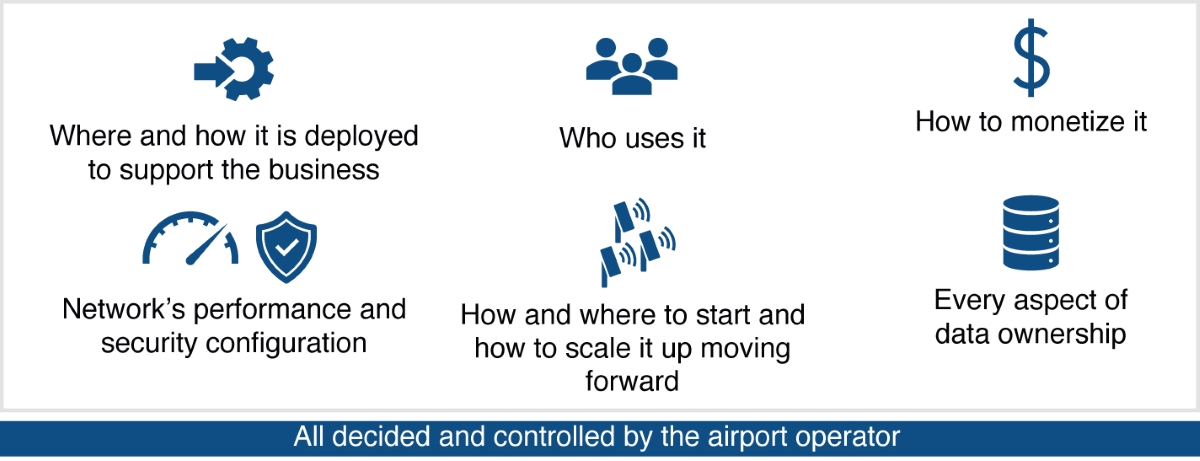
Because a PWN is based on proven mobile technology, it can provide at least the same level of performance and security as that of public networks that the world has trusted for years. And because it is a private network, it can enable an airport operator to improve performance and security (even above that of public networks) as desired, as well as maintain control over all aspects such as those in Figure 1.
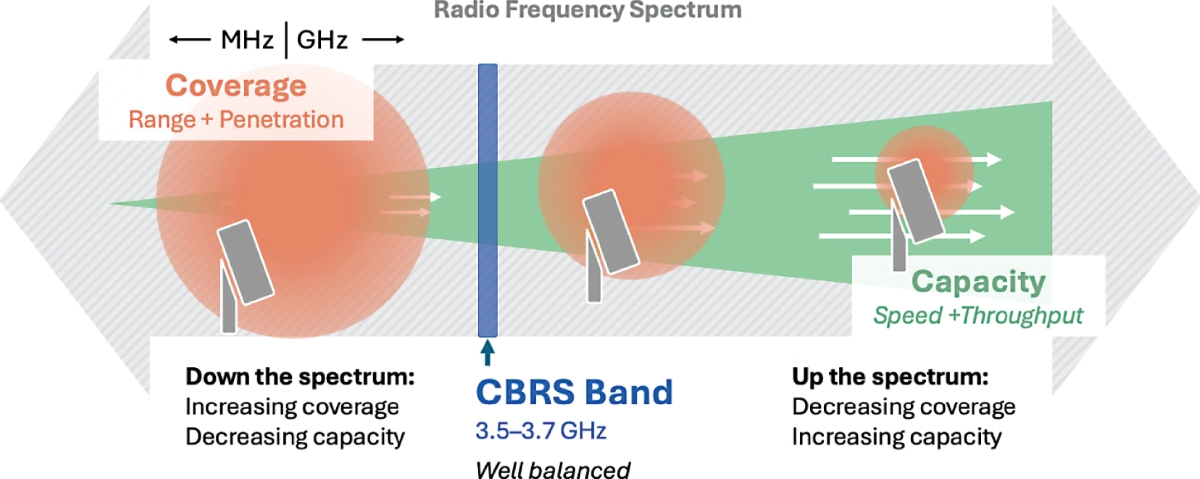
Another major reason PWNs in the United States are so valuable and growing in use is that they can freely leverage a band of wireless spectrum known as the CBRS. The Federal Communications Commission (FCC) created the CBRS band in 2015 and officially released it for use in 2020 within the mid-range of the radio frequency (RF) spectrum (Figure 2). This is an ideal range because it strikes an excellent balance between coverage and capacity, making it well-suited for a wide range of use cases. Because this is the primary band in which PWNs operate in the United States, they are often informally called CBRS networks. They are also known as private mobile networks and private cellular networks.
The existence of the CBRS band is a big deal! In recent years, public operators have spent close to $100 billion to license and deploy mid-band spectrum (S&P Global 2022). Because the CBRS band is freely available for use, many have called it a multibillion-dollar gift from the U.S. government. This is also why the use of PWNs has grown exponentially since mid-2020 when the CBRS band became available.
Put simply: A PWN provides the flexibility to feasibly push connectivity further—today and into the future—all while providing the performance and security demanded by an airport operatorʼs use cases.
U.S. regulatory outlook. The U.S. government has developed a robust strategy for using RF spectrum to maintain global leadership in both business and wireless technology. Beyond gifting mid-band spectrum, the FCC created successful rules for a dynamic yet strict three-tiered sharing system for this CBRS band and is looking to make more room for new application opportunities in both the CBRS band and others.
PWN industry status. The market for PWN technology is mature, but PWN adoption is still in its early stages, especially at airports. This means that many service providers (e.g., vendors, manufacturers) offer a lot of different hardware and software solutions from which airports can choose. Airports should work with their trusted systems integrator or ownerʼs representative to help with the procurement process for hiring a managed service provider (MSP) who is experienced at designing, deploying, and managing a PWN.
CHAPTER 2 CONCEPTUAL CONSIDERATIONS—AN EXECUTIVE OVERVIEW
How CBRS Can Benefit Airport Operators—A Vision of Possibilities
The fact that the CBRS band is freely available for use by U.S. airports is significant—some have called it a multibillion-dollar gift. The following outlines a big-picture view of how airports can benefit from CBRS now and into the future:
- An Airportʼs Own Private Network CBRS enables airports to create their own PWN that is not accessible to the public, with dedicated capacity and security for its connected environment and enables an airport to keep all its wireless data within the enterprise.
- Wi-Fi Improvement An airport can free up capacity on its Wi-Fi network by moving use cases to a PWN, which can improve the Wi-Fi performance for
Long Description.
The figure lists all the aspects of a PWN that are decided and controlled by the airport operator. The aspects are as follows: Where and how it is deployed to support the business; Who uses it; How to monetize it; Network’s performance and security configuration; How and where to start and how to scale it up moving forward; and Every aspect of data ownership. Each aspect has a corresponding icon.
Long Description.
The schematic presents the radio frequency spectrum with frequency ranges labeled in megahertz and gigahertz. It illustrates coverage on the left with range plus penetration, and capacity on the right with speed plus throughput. The CBRS band is narrow and highlighted in the middle between coverage and capacity. It is labeled 3.5 to 3.7 gigahertz with the description, well balanced. There is increasing coverage and decreasing capacity down the spectrum on the left. There is decreasing coverage and increasing capacity up the spectrum on the right.
customers and provide higher quality and more secure connectivity for operational use cases.
- Growing Operational Use Cases Over Time Expanded connectivity provides endless possibilities for improving airport operations (e.g., video cameras, perimeter security, Internet of Things (IoT) devices/sensors, artificial intelligence) and an airport should become familiar with the range of possibilities.
- Tenant Monetization When an airport owns or operates a PWN, it can charge a fee to users such as airlines, concessionaires, retailers, and cargo tenants. The fee can be lower than what tenants are already paying, and the connectivity can be better than what they have been experiencing.
- Neutral Host Network CBRS can be used to create a neutral host network (NHN) that allows multiple mobile network operators (MNOs) to share PWN services. An NHN can complement an existing distributed antenna system (DAS) at an airport, and airports without a DAS can use a CBRS NHN as a cost-effective alternative.
Technical Explanation of PWNs—A High-Level Understanding
The introduction provides a practical explanation of PWNs (they are private and based on mobile technology). Going a bit further, a PWN can be described as a wireless communications network that is privately owned by an organization and leverages RF spectrum through mobile technology. The result is a connected environment.
Four main elements are needed to create a connected environment through a PWN:
- RF Spectrum—the band of wavelengths that carry information
- Mobile technology—the secure network that provides connectivity and coverage
- Network management system (NMS)—the software manager that optimizes communication performance
- End devices—the sources that share or use information
Frequently Asked Questions About PWNs
When an airport is faced with the prospect of incorporating a new advancement, several common questions are typically asked. This summary provides shorter answers; for more detail, see the full report.
1. What Can PWNs Be Used for at Airports?
Airports can install a PWN for use across the enterprise to create never-before feasible or possible connectivity for things like asset tracking, baggage tracking, geofencing, incident response, operational functionality, and access control. Although some airports are struggling with business challenges like poor situational awareness, operational inefficiencies, and siloed data, many PWN use cases have already been developed to provide efficient solutions that can be applied throughout an airportʼs property.
2. How Can an Airport Create a PWN?
An airport of any size can customize and deploy a PWN to meet its connectivity needs—needs that can range from extending wireless network coverage to deploying one use case or many. PWNs are composed of software and hardware (including a core that operates as the networkʼs brains) and small radios that can be installed on existing structures. PWNs can be purchased as plug-and-play kits that can be set up rather quickly and easily for simple use cases, or they can be complex networks that require engineered solutions. PWNs can be deployed to cover specified locations, whether indoors or outdoors. And PWNs are modular—they can start small and be upgraded or expanded over time.
3. How Much Do PWNs Cost?
PWN costs include capital and operational expenditures.
- Upfront capital expenses (CAPEX) typically include costs for network hardware and software; professional services for designing, installing/constructing, and integrating systems; and testing and commissioning the PWN.
- Operating expenses (OPEX) include the costs associated with managing the PWN after installation (e.g., maintenance services, monitoring, technical support) and all subscription costs for software, licensing, and other services such as spectrum leasing, artificial intelligence (AI) or machine learning (ML) services, cloud services.

