Exploring Cellular-Based Private Wireless Networks: Summary (2026)
Chapter: 4 Design Considerations
TABLE 3 The revenue-generating business value of PWN use cases at airports.
PWN USE CASE |
SOLUTION DESCRIPTION |
ENTERPRISE BUSINESS VALUE |
PWN—Indoor coverage (security, gates, etc.) |
PWN—Secure dedicated wireless capacity for airport tenants |
Revenue generation (retail)—support retail pop-up stores and provide connectivity-as-a-service to all airport tenants (e.g., baggage handlers, food delivery robots) |
PWN—Outside coverage (tarmac, airfield, etc.) |
PWN—Secure, high-capacity, and wide coverage over large areas; glitch-free operation of automated ground vehicles and video cameras |
Revenue generation (airlines and contractors)—enable airlines with connectivity-as-a-service for innovation. Enhance field coverage for operational security improvements |
Wired network extension |
PWN extension/replacement of physical wired infrastructure (e.g., copper) or fiber extension, reducing cabling and networking complexity |
Revenue generation (retail)—enable retail concessionaires’ connectivity |
PTT with land mobile radio (LMR) and video |
Migration of legacy PTT/LMR networks and equipment to PWN through an over-the-top application |
Revenue generation (airlines)—enable ground crew communications with emergency response/security personnel |
Video analytics |
Wireless video backhaul from cameras combined with AI analytics through the PWN |
Revenue generation (airlines)—offer the ability to analyze gate operation performance |
MNO offload + roaming |
Migrate roaming and offloading services from MNOs to the PWN |
Revenue generation (MNOs)—offer MNOs an indoor access extension opportunity |
Adoption/Implementation Barriers
Several adoption and implementation barriers exist for airports to consider when exploring and planning for a PWN. These can occur during the planning phase. Some typical barriers follow:
- PWN management/maintenance issues due to lack of in-house technical expertise. These issues can be overcome by procuring one MSP contract to provide this knowledge.
- Scalability. Airports are not always informed that PWNs can be phased in over time versus considering only the TCO, but the request for proposals approach to procurement can help airports identify the right approach and solution to meet their needs.
- Applicability, value, and market maturity. Airports often prefer to wait until a technology is proven and mature before investing in it. The reality is that PWNs are not new. Close to 400,000 CBSDs are operating in the United States as of September 2023, and most deployed PWNs use 4G mobile technology that has been around for more than 10 years.
- Compatibility of PWN infrastructure and CBRS end devices. Some end devices manufactured several years ago might not be compatible with newer software updates, but to ensure applications are supported, solutions are available such as applying manufacturer updates remotely or using interim solutions: dongles or intermediate gateways (e.g., Wi-Fi).
- Coordination. Airports can be wary of the necessary technical coordination among the PWN and other airport enterprise networks and systems. This can be remedied by educating airport staff on the ways PWNs can fit in with their overall telecommunications infrastructure and how PWNs can supplement other connectivity solutions.
CHAPTER 4 DESIGN CONSIDERATIONS
Transitioning from Planning to Design
Closing the Decision-Making Loop
Chapter 3 presents and describes several consideration areas during early planning for a PWN. Transitioning into technical planning and design typically includes balancing the following major factors:
- Airportʼs vision, business drivers, use cases, and governance requirements for a PWN
- Technology capabilities, ease of integrating the network at an airport, and the cost and effort of realizing the vision
This is often an iterative process that builds from some initial decisions that then are refined and improved. Closing the loop on several Chapter 3 discussions, the list below presents questions and considerations airport operators can use to determine the appropriate level of services the PWN will need to provide to meet the unique circumstances. Answering these can help an airport identify some general requirements, features, and services that the airport wants its PWN to provide.
Strategic/executive questions:
- What is the PWNʼs primary purpose?
- What use cases will it be used for?
- What are the airportʼs data policies?
- Who and what will be connecting to it?
- What is the budget for the network? Can the network be monetized?
- What is the scaling approach for the network?
- What growth does an airport anticipate over the next 1 to 3 years?
- What is the airportʼs posture toward proprietary vs. nonproprietary?
- Who will own the network and install, operate, and maintain it (e.g., in-house, MSP, or a hybrid)?
Technical questions:
- What wireless infrastructure does an airport already have?
- Where does an airport want connectivity?
- Can users/end devices be divided into distinct classes with different needs?
- What services will be provided over the network and where will they be hosted?
- What level of security does the network need?
- Are the devices connecting to the network going to be mobile or fixed in place?
- How many users, devices, or IoT end point connections called nodes will access the network? Are these locations mapped?
- What type of traffic will users and devices be generating? What will the devices be connecting to?
- Will transferring data into and out of the network be required?
- In what type of environment will the system be deployed?
- Will the PWN be integrated with other airport networks and systems?
- How mission-critical will the network be?
Procuring a Service Provider
A common finding throughout the research teamʼs interviews, case studies, and literature review was that few airport operators will design, develop, and manage the PWN alone; instead, they will outsource some of or all this effort to an MSP. Therefore, once the previous questions have been considered and answered, an airport should have enough preliminary information to understand what type of features might need to be included in PWN design and choose an MSP—whether to create a simple, discrete solution (PWN kit) or an engineered solution for more complex networks.
Procurement Process
For most PWN design, build, and management projects, the following are suggested for airports:
- Work with their ownerʼs representative or systems integrator that is familiar with the airportʼs networks and systems to create comprehensive procurement solutions.
- Create one bid package for an MSP.
- Select an MSP through a request for proposals or request for qualifications process. Hiring one MSP rather than three or more separate firms (e.g., designer, installer, managed services) benefits airports because the MSP can implement a fully engineered system where architecture is compatible and easily expandable.
MSP Roles
An MSP can be thought of as an outsourced IT department or the prime contractor of a team that can provide robust solutions for airports from concept through design, operations, maintenance, and oversight support. The best MSPs act as strategic partners to the airport. The following are roles that MSPs can play related to PWNs.
- General. In this role, MSPs typically create a PWN team that will provide all the airportʼs requested and required products and services.
- Design and deployment. In this role, MSPs provide project management services for the initial and future design and deployments, collaborate with SAS providers and register PWNs with SAS, and are ultimately responsible for delivering a PWN that meets an airportʼs needs.
- Ongoing operational management services. In this role, MSPs assemble and provide the various resources (e.g., remote or onsite personnel) needed to meet the requested and required management support services and capabilities, including NMS infrastructure and software solutions to perform the ongoing monitoring, notification, and management of the system.
Network-Related Service Providers
Service providers can help an airport create a PWN to meet its unique use cases and overall vision. These providers include engineers and technicians who can provide the elements needed to deploy a PWN. There are many types of service providers that airports or their designers, installers, or MSPs work with and affect many PWN design decisions. These include SAS providers, RAN (CBSD) manufacturers, Core manufacturers, element management system manufacturers, device management manufacturers, and other end device manufacturers.
PWN Design and Integrations
PWN Architecture Overview
Although most airport operators will outsource some of or all the network design, development, and management to an MSP, it is still helpful for airport operators to broadly understand the types of equipment, systems, and decisions that go into this process. The various design elements needed for a fully optimized PWN are shown in Figure 10. The items under “What Needs to be Done” are decisions only the airport can make. Other decisions, especially those noted under “How it Will Be Done,” can be tackled by advanced airport IT departments or left to network design and MSPs. Table 4 lists the design considerations for optimizing the PWN.
Interoperability, Roaming, and NHNs
Unified Wireless Network (Interoperability). PWNs can connect users and end devices operating natively on disparate wireless networks at airports and allow these separate networks to communicate during normal operations and emergency management situations, called a unified wireless network. This is a critical capability because different groups or agencies operating at the airport use different networks according to their operational needs. A unified wireless network enables creating temporary or permanent collaboration groups (including users natively operating on Wi-Fi, land mobile radio (LMR), public mobile/cellular, and private mobile/cellular networks); sharing voice, text, data, and video among users; and setting up collaboration groups during emergency situations.
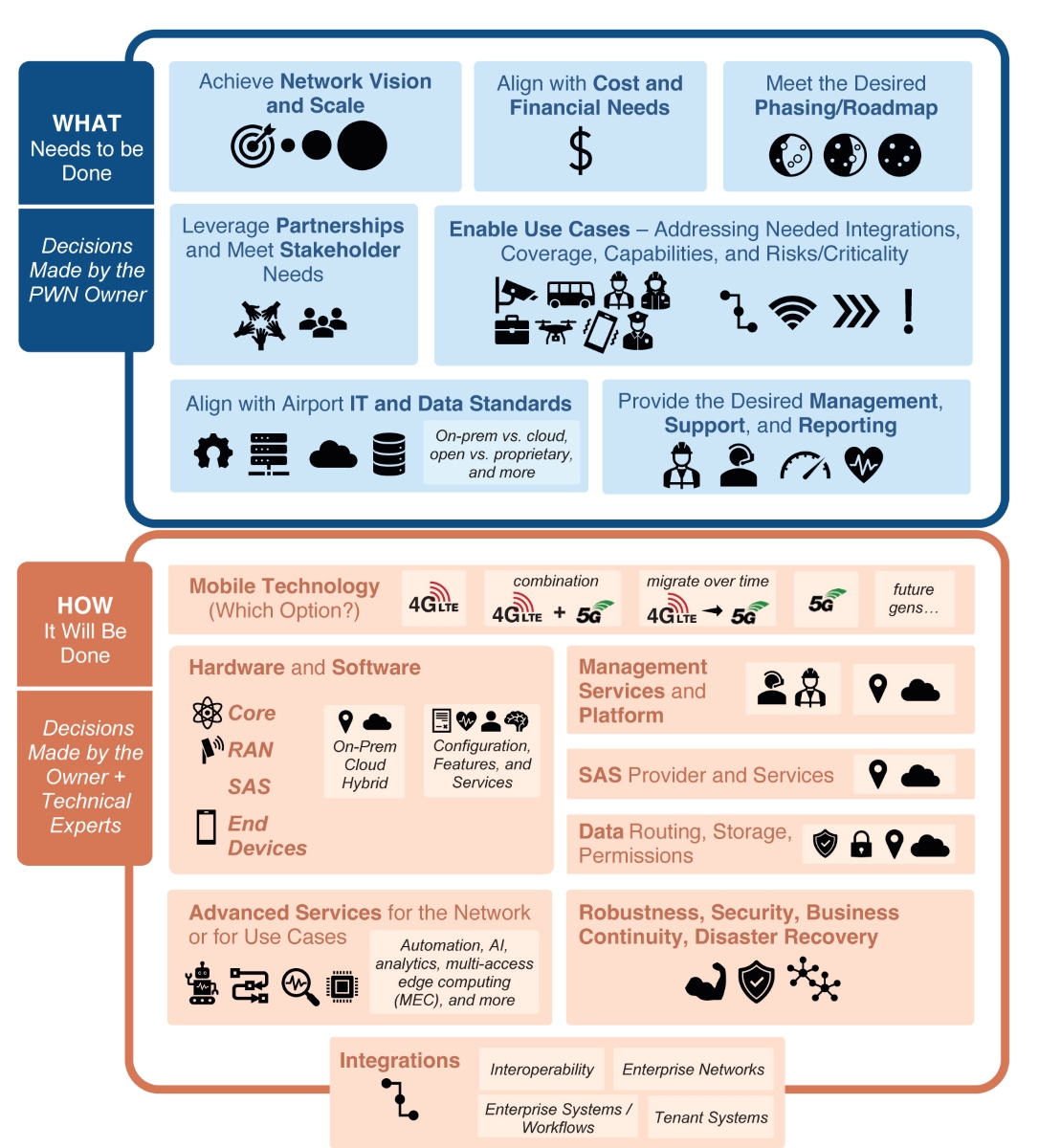
Long Description.
The infographic presents two main sections that outline what needs to be done and how it will be done. Under what needs to be done, decisions made by the PWN owner include achieve network vision and scale, align with cost and financial needs, meet the desired phasing and roadmap, leverage partnerships and meet stakeholder needs, enable use cases while addressing needed integrations, coverage, capabilities, and risks or criticality, align with airport IT and data standards, on-premises versus cloud, open versus proprietary, and more, and provide the desired management support and reporting. Under how it will be done, decisions made by the owner and technical experts include mobile technology, which option, 4G LTE, combination 4G LTE plus 5G, migrate over time 4G LTE to 5G, 5G, and future gens, hardware and software including core, RAN, SAS, end devices, on-premises or cloud or hybrid, configuration features and services; management services and platform, SAS provider and services, data routing, storage, and permissions, advanced services for the network or use cases including automation, AI, analytics, multi-access edge computing, MEC, and more, and robustness, security, business continuity, and disaster recovery, and integrations including interoperability, enterprise networks, enterprise systems and workflows, and tenant systems.
TABLE 4 Architectural design considerations for network optimization.
NETWORK DESIGN ELEMENT |
WHAT IT IS AND WHAT IT DOES |
AIRPORT DECISIONS AND EFFECTS ON NETWORK OPTIMIZATION |
Mobile technology |
Operates on the CBRS band of RF spectrum to provide PWNs with mobile communication/connectivity |
|
The Core (hardware and software) |
The brain of the network that can assign different capabilities called functionalities to different parts of the network |
|
TABLE 4 Architectural design considerations for network optimization. (Continued)
NETWORK DESIGN ELEMENT |
WHAT IT IS AND WHAT IT DOES |
AIRPORT DECISIONS AND EFFECTS ON NETWORK OPTIMIZATION |
RAN (hardware and software) |
Accesses RF spectrum for the network by transmitting and receiving signals from a designated CBRS channel, whether using PAL or GAA |
|
SAS |
Sets the CBRS channel that the PWN accesses, whether GAA or PAL |
|
End devices |
Any connected device (e.g., mobile phones, tablets, bag scanners, thermostats, and computers) |
|
Network management |
Provides PWN management support and typically also includes a NOC |
|
Data |
Digital information about the network itself or that flows through the network |
|
Advanced services |
Any new technology service that can be driven into a PWN as a use case or by optimizing the network |
|
Robustness, security, business continuity, disaster recovery |
The ability of a network to provide a minimum level of availability at any given time |
|
Network coexistence |
The ability of neighboring PWNs in the same area using the same spectrum channels to operate successfully |
|
Modularity and scaling |
The ability of a network to be set up by function or use case and be expanded over time |
|


