Exploring Cellular-Based Private Wireless Networks: Summary (2026)
Chapter: 5 Deployment and Management Considerations
Airport-to-Airport Integrated Networks (Interoperability). Another potential use case on the horizon is for creating an integrated airport-to-airport network across the country that would enable stakeholders like airlines to automatically join an airportʼs network upon coming into a PWNʼs coverage area. Interviews with airlines revealed that they are interested in this type of general interoperability. It is important that airports and their consultants understand the latest industry standards for interoperability interfaces and gateways to make this happen.
Roaming. Roaming is how PWNs enable unified wireless networks to be achieved. Various types of PWN roaming configurations (e.g., private-to-public, public-to-private, private-to-private, public-to-public) can be used, and each type can drive or limit network architecture design options and their support of use cases and overall network requirements. For the purposes of this document, roaming is considered private-to-public and public-to-private.
NHN. One way roaming can be achieved is through an NHN using CBRS that can enable an airport to connect seamlessly with public mobile networks of multiple operators through one contract. Airports need to consider several factors when evaluating an NHN solution.
- An airportʼs requirements for user voice calling type services might not allow a neutral host to manage them.
- There is a risk that an MNO will not share valuable data like an airportʼs network usage or network performance and will own the subscriber provisioning.
- If an airport wants to use licensed spectrum (owned by the MNO) outside the CBRS band, a CBRS NHN might not be compatible.
However, if an airport wants to avoid capital costs of deploying its own PWN network or if it wants to avoid operational costs of running the network, an NHN is a viable option. In addition, other NHN business case benefits should be considered like revenue sharing with an MNO.
Integrations
When PWN architecture stands alone, its design is focused more on preventing network interferences with other networks as described in the Coexistence section. When airports decide to integrate a PWN with other networks, MSPs can design PWNs to integrate with preexisting network management platforms, other airport enterprise networks (e.g., cabled ethernet, Wi-Fi, DAS), enterprise data architectures and airport enterprise systems, and other stakeholder systems (e.g., tenant systems). But regardless of how much integration is planned, developing an overall telecommunications infrastructure integration plan for both wired and wireless networks is suggested.
It is important for an MSP to plan out any anticipated system integrations before designing the PWN. Many different hardware and software solutions (e.g., RAN, Core) are offered with varying capabilities to consider that can be used to integrate a PWN with various platforms and systems in different ways. These products and capabilities continue to evolve. The most important consideration is ensuring the most robust solutions are installed so they can meet current and future integration needs.
A Holistic Approach to Wireless Solutions
An airport operator should look across its current and future enterprise telecommunications infrastructure solutions to see how its PWN design should work alongside other enterprise systems in place. For example, airports will continue to use Wi-Fi for customer/passenger use (potentially charging tenants for it) and DAS for public mobile network coverage for passengers/customers. But an airport can add PWNs to provide unique value for use cases that fit these descriptions:
- Remote with no other feasible option for connectivity
- Located in areas where the layout of wireless obstacles is consistently changing (i.e., airport ramp)
- Mobile such that they move between wireless access points (WAPs)
- Transmit highly sensitive data, requiring a high degree of data security
- Connected to hundreds or thousands of devices, by one radio, needs to be supported (i.e., IoT)
- Involve battery-operated IoT sensors that can sustain power for years
Airports can also consider transitioning use cases to PWNs from other networks in certain circumstances such as the following:
- When use cases are functioning poorly in a network (e.g., baggage system that experiences connectivity issues in hard-to-reach handling areas).
- When network bandwidth or traffic reaches a networkʼs capacity, PWNs can be used to offload network data or network traffic.
- When physical space is needed (some system architecture is large) or when networks become too costly to operate or expand.
The role of PWNs will continue to evolve as the technology surrounding the PWN advances. Manufacturers and suppliers are continually developing new hardware and software that can be added to or integrated with PWNs that enable the PWN to become highly optimized. In addition, technological advancements are quickly moving toward a convergence of various wireless capabilities where, ideally, different wireless services and technologies can all be combined into the same hardware and software. Also in development is the convergence of mobile frequency bands for CBRS, mobile carriers, and other unlicensed spectrums across the entirety of the network (EUDs, RAN, Core). Suppliers are actively working at providing converged solutions of PWNs with even the latest in Wi-Fi technology. The bottom line is that it is becoming easier to integrate various technologies already in use at airports, enabling airports to maximize the benefits and key features from each.
CHAPTER 5 DEPLOYMENT AND MANAGEMENT CONSIDERATIONS
Deployment/Installation Operating Models. Airports have several operating models they can employ, offering flexibility to align with the financial capacity, operational resources, and level of risk and autonomy an airport prefers. Three primary models are being deployed today, which can change over time as an airportʼs goals and internal capabilities grow:
- Private
- Fully airport managed and supported
- Fully on-premises, isolated network and data
- Hosted
- Fully MSP managed and supported
- Primarily remote and cloud support services, network services, and data
- Only minimum network hardware and support staff on-premises
- Hybrid
- Customized roles and levels of airport and MSP management and support
- Fully airport-owned hardware (typical)
- Customized levels of on-premises, cloud, and remote hardware, management, and support
All three options can be implemented using CBRS GAA and PAL spectrum or purchased or leased MNO spectrum.
Clarifying terms: The terms private and host/hosted were defined earlier in this report to mean something different from what they mean in this chapter.
- Private was defined in the introduction as part of the term private wireless network, referring to a wireless network that is exclusive to an organization like an airport and is not accessible to the public. However, here, the term private refers to an operating model. In this chapter, private means that an airport manages and supports the day-to-day operations of a PWN and associated data using their own staff and onsite network hardware and software.
- Host was used in Chapter 2 to refer to an NHN, which is a network that allows multiple MNOs to share a PWNʼs services. Here, the term hosted refers to the operating model for a PWN, meaning that someone other than an airport (e.g., an MSP) manages, operates, and supports a PWN and associated data primarily through remote and cloud-based support services.
Figure 11 show these three models. Table 5 compares the three PWN operational models.
Other Operating Model Considerations. For all models, it is important to ensure that the PWN design and selected network and end devicesʼ hardware and software provide the needed nonproprietary characteristics to facilitate the airportʼs future MSP selection options, should a new MSP be brought in. If the network design and solutions are more solution-specific and proprietary, the airport operators will have fewer options for a new MSP, lose out on its prior investments, and require additional capital to achieve the original network coverage, capabilities, and performance.
Service level agreement (SLA) parameters. When selecting the hosted or hybrid operational model, it is important for an airport to define required levels of service to be provided by an MSP, which is typically called an SLA for NaaS. The SLA will include contractual performance criteria the MSP must meet. Some parameters to define in an SLA include the following: network system availability; defined coverage area based on predefined signal strength and noise parameters; bandwidth/data speeds delivered (downlink and uplink) and associated latency; SAS support and issue resolution response times; PWN support response times; key performance indicators, reporting parameters, and frequency of reports; ownership of network data including payload and user provisioning; and key use case SLAs.
Project plan development. It is important for an airport to work with its MSP to develop a detailed project plan that includes logistics, sequencing, and timing considerations. To maximize an airportʼs investment in PWN infrastructure and any ongoing management contracts, it is important to partner with MSPs that have a mindset that is focused on future expandability.
Equipment installation. During installation, it is important that network hardware and software are deployed according to the design, whether overseen by the airport or its network consultant. Before going live with a network, the airport or its MSP needs to perform thorough testing and optimization. It is also important that the airport make sure a Certified Professional Installer inspects CBSD installations whenever required.
Network configuration. During the deployment phase, the airport or MSP needs to ensure that network elements are configured so that proper communication between RAN and core equipment and software occurs. This includes the following: spectrum licensing or access (GAA vs. PAL), all SIMs are configured and provisioned properly, and verification that the PWN is integrated, is interoperable, and ensures connectivity across the entire network and with the other systems.
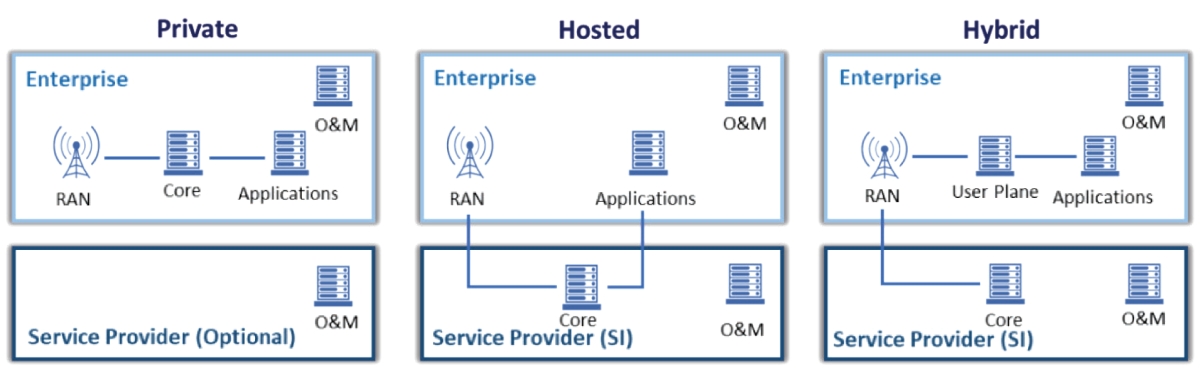
Long Description.
The schematic presents three PWN models labeled Private, Hosted, and Hybrid, and depicts functional connections between components. In the Private model, RAN connects to core, and core connects to applications within the enterprise, while O and M is included within the enterprise and also within the optional service provider section. In the Hosted model, RAN within the enterprise connects to core located with the service provider, SI, and core connects to applications in the enterprise, while O and M is included in both enterprise and service provider sections. In the Hybrid model, RAN within the enterprise connects to user plane, user plane connects to applications within the enterprise, and RAN also connects to core located with the service provider, SI, while O and M is included in both enterprise and service provider sections.
TABLE 5 Comparison of the three operational models for PWNs.
CATEGORY |
PRIVATE |
HOSTED |
HYBRID |
Ownership |
Enterprise: Full |
Enterprise: None |
|
Operations model and on-premises, cloud/remote |
Turnkey or as-a-service |
|
|
Spectrum |
Any of the following:
|
Any of the following:
|
Any of the following:
|
Capacity |
Enterprise design |
SLA with provider |
SLA with provider |
Security level |
High: Data stays on-premises |
Low: All data on provider network |
Core control plane in cloud, data plane behind enterprise firewall |
Availability |
Enterprise design |
SLA with provider |
SLA with provider |
External roaming |
Setup by enterprise |
Setup by provider |
Setup by provider |
Key performance indicators |
Customized by enterprise |
Limited |
Enterprise driven to service provider |
Cost model |
CAPEX |
OPEX only (potentially RAN CAPEX) |
CAPEX and OPEX |
Testing and validation. A critical step that an airport or its MSP should take before deploying a PWN is to conduct extensive testing for functionality, performance, and security. Some key steps to take are validating network performance against all defined use cases. Also, it is important to document RF-delivered signal and quality values through onsite survey measurements. Commissioning the network is another vital step; it is a process that ensures a network performs in accordance with the design intent and SLAs, creating the expected connectivity as planned. Commissioning needs to be performed for all CBSDs and end devices. Airports also need to verify the network meets its key performance indicators, including those listed in the SLA parameters section earlier.
Management. After a PWN has been designed, deployed, validated, and tested, it is time to manage the network and determine the next steps for the network as technology continues to advance. It is also wise to start thinking about scaling expansions and how to remain in step with innovations. Airports can focus on the following areas:
- Monitoring and maintenance. PWN management starts with monitoring and maintaining the PWN, whether this is done by the airport or an MSP. This should involve implementing monitoring tools that continuously assess network performance. It is also important to consider establishing regular maintenance routines to address issues promptly. Areas that should be regularly monitored and maintained follow:
- NOC performance
- Hardware/software alarms
- SAS connectivity and services
- Spectrum channel accessibility and availability
- Interference from other networks
- Troubleshooting. Also important for airports or MSPs to consider is developing a comprehensive troubleshooting process to address network disruptions quickly.
- Updates and upgrades. The airport or its MSP should plan for regular software updates and hardware upgrades because of the evolving nature of technology. Airports should include these updates and upgrades in budgets.
- User support and training. Airports or their MSPs should provide ongoing PWN user support and training to ensure efficient use of the PWN. They should communicate changes and updates effectively and document any changes made to the network for future reference.
- Manage SLAs. Airports should regularly ensure that MSPs are meeting their contractual performance as defined by their SLA. These include ensuring that MSPs have met defined network system availability, maintained agreed-upon coverage, delivered appropriate bandwidth/latency and data speeds, provided timely support and issue resolution, and met key performance indicators.
- Key performance indicators review and network enhancement/expansion/innovation planning. The airport or its MSP should perform key performance indicator reviews regularly to measure


