Exploring Cellular-Based Private Wireless Networks: Summary (2026)
Chapter: 3 Early Planning Considerations
4. Who Can Help Airports Develop a PWN?
Most airport operators will seek help in developing a PWN; the desired complexity of a PWN and the airport resources available are the two main factors that determine how much help is needed. Following are examples:
- High complexity and maximal resources. Only a handful of the largest U.S. hub airports with a sophisticated IT department will attempt to completely own and operate an extensive PWN. The advantage for these airports is that they can fully control how their PWN is deployed and maintained, and they will have full and direct access to stored data at any time.
- Low complexity and few resources. At the smallest scale, airports such as non-hub, reliever, or general aviation can own and operate a PWN. These smaller airports do not typically have big technology budgets or a large IT staff, but because their needs are fewer, they can purchase a plug-and-play PWN kit that can be easily set up for a few use cases with minimal investment or oversight.
- Average complexity and average resources. Almost all other small, medium, and large Part 139 airports are best served by a managed service provider (MSP) that can oversee everything they need, from PWN design through management for a wide range of use case deployments. However, an airport might not want to completely outsource all PWN services; it might want to own certain aspects of the network. In these cases, airports can consider a hybrid ownership-management solution that will depend largely on the airport IT organizationʼs skillset, security and data ownership risk tolerance, and financial model preference (e.g., capital vs. operational expenses). More on this is in Chapter 3.
5. What Makes PWNs Private?
PWNs are private because this type of network exists to serve only the needs of its owner or enterprise—in this case, the airport operator and whoever it allows to participate. In other words, the PWN does not function to serve the needs of everyone like a public mobile network operator (MNO) network does. This means that only owner-designated devices can connect to this network, and the data shared between devices serves the needs of the owner or company and is therefore considered private.
6. How Secure Are PWNs?
PWNs are considered secure for at least the following reasons: (1) 4G LTE and 5G wireless technology has MNO-grade security built into it which can authenticate end devices within the network and wirelessly transmit authenticated data throughout the network (MNO-grade equals the level provided by MNOs like Verizon, AT&T, or T-Mobile); (2) Enterprises like airports can build on the robust authentication policies; and (3) an airport can have full control over their PWNʼs security protocols.
7. How Reliable Are PWNs?
Generally, PWNs are reliable because of the inherent technology features and the many options available to PWN operators to enhance reliability. Following are some key reasons: the maturity and security of mobile technology ensure a baseline of reliable connectivity provided by PWNs; the primary spectrum used (the CBRS band) is mid-level spectrum, which can provide fast speed and low latency; and because PWNs are privately owned, they can be customized to provide even more reliable connectivity.
8. How Do PWNs Compare with Other Airport Wired/Wireless Solutions?
Each wired/wireless connectivity solution has its own set of attributes that make it suitable for some needs and less suitable for others. Because of this, PWNs should be considered as simply one more tool in the connectivity toolbelt.
Chapter 3 presents several examples of use cases for PWNs. In these cases, using a PWN is ideal because of common attributes of PWNs compared to those of other connectivity solutions.
Table 1 compares and contrasts the attributes of these connectivity solutions. The statements in this table should be understood as “typically” because not every possible variable is considered.
9. What Are Some Disadvantages of PWNs?
PWNs do have some limitations. For example, they can be costly to implement if an airport operator chooses to start with a large-scale network that it installs and deploys itself. Complex PWNs require an advanced level of mobile network expertise to deploy and manage, but airports can hire MSPs to design, install, and manage the PWN. As with any IT network, airports will need to ensure their PWN remains compatible with the latest technology and receives regular maintenance including updates and upgrades that require additional costs and possibly some downtime. Some regulatory challenges related to spectrum access exist in certain jurisdictions. These are becoming less common, but they are still a possibility to consider.
CHAPTER 3 EARLY PLANNING CONSIDERATIONS
Having gained an initial understanding of PWNs from Chapters 1 and 2, airport decision-makers who wish to explore a PWN for their organization have several early planning considerations to make across several areas. These are shown in Figure 3.
This chapter provides education on these areas and things to consider for those exploring a PWN. Chapter 4 provides questions in these areas that will help readers transition from planning to design. For full descriptions of each, see the full report.
Network Vision and Scale
Airport operators will have differing degrees to which they use a PWN. In the early planning stages, airport leadership should identify an overall posture toward the network and communicate that to the team involved—for example, answering the following questions:
- Do you see the potential of this network as a key part of your airportʼs digital transformation (and therefore your connectivity strategy and infrastructure) or only as a supplement?
- Do you see the network as something to maximally leverage for critical operations, or do you see it as something you will use minimally for noncritical purposes?
- Do you see this as something to scale or something for limited use?
- Do you see the network being deployed across multiple sites as one large, connected network or something on a much smaller scale?
- Do you see the PWN as something to serve only the airport or to support multiple tenants in whatever way possible?
TABLE 1 Common attributes of PWNs compared to other connectivity solutions.
PWN ATTRIBUTES |
||
|
||
OTHER SOLUTIONS COMPARED* |
||
DAS |
WI-FI |
CABLE |
|
|
|
* This comparison is specific to the types of use cases described in Chapter 3. Further, these statements should be understood as “typically” because they do not account for every possible variable.
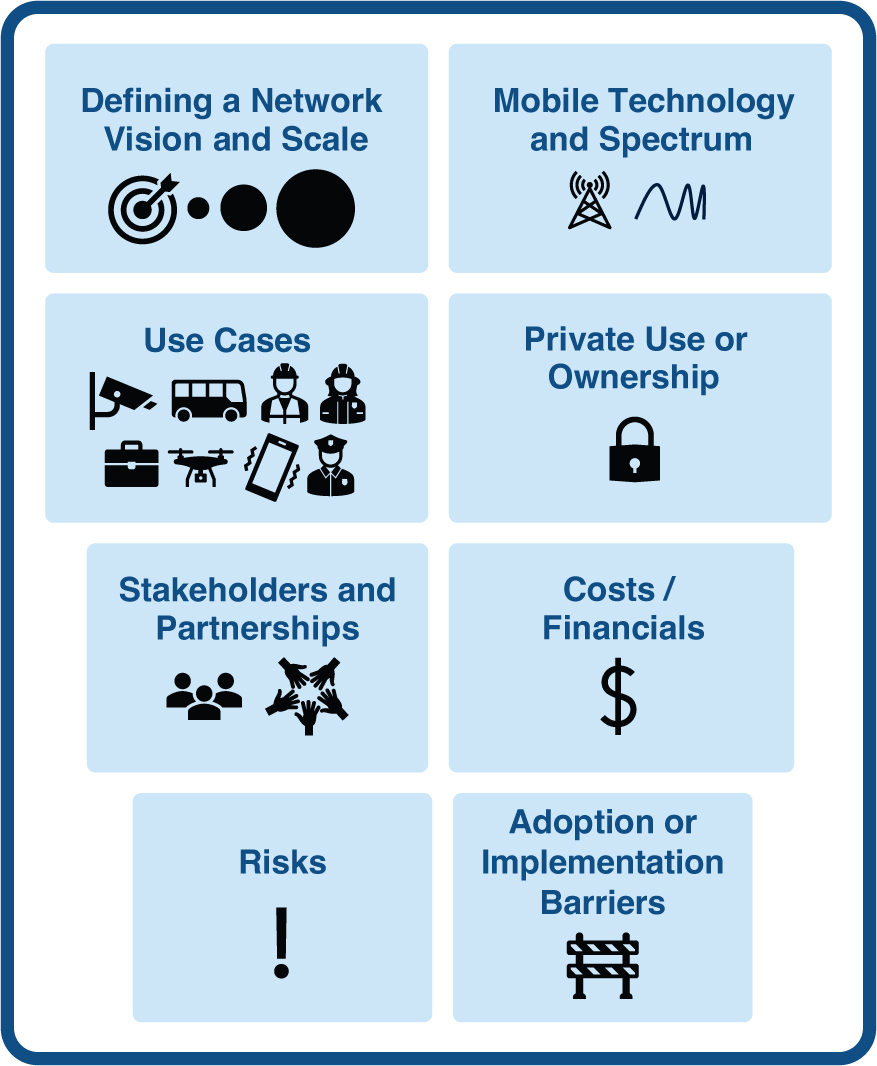
Long Description.
The infographic presents eight key elements for planning a PWN project: defining a network vision and scale, mobile technology and spectrum, use cases, private use or ownership, stakeholders and partnerships, costs or financials, risks, and adoption or implementation barriers. Each section includes an icon representing it.
- Are you interested in monetizing the PWN or simply providing the network as a free service?
- How do you want to approach the investment and scaling of this network? For example:
- Start slow to prove it out, then ramp quickly
- Start slow to prove it out, then make incremental growth investments
- Go all in, continuing to leverage it maximally from the start
For those serious about capturing the value possible through a PWN, it is strongly suggested to fully investigate what the PWN can enable, even including advanced use cases that require additional technologies “up the stack” like data management, analytics, and AI. Airport operators that conduct this level of analysis, develop an accompanying multiyear roadmap, and fully cost-justify the program will be best set up to achieve the value of digital transformation now possible through comprehensive connectivity.
Mobile Technology
PWNs use mobile technology to access RF spectrum for wirelessly transferring various forms of communication securely, quickly, and reliably. In other words, mobile technology is the reason PWNs can provide audio, video, and data to users anywhere.
What is mobile technology? What are its key features? Should airport operators trust it? This section answers these questions and more.
A Brief History of Mobile Technology
Mobile technology began as cellular technology now referred to as the “first generation” or “1G” technology standard, enabling voice conversations between cellular phones. Just as cellular technology advanced from flip phones to smartphones, mobile technology continues to leap in its capabilities as its standards have evolved to current 4G LTE and 5G technology. 4G LTE enabled todayʼs mobile applications and continues to evolve with capabilities like IoT support; 5G significantly expands capacity, flexibility, and performance through features such as enhanced mobile broadband (eMBB), massive machine-type communications (mMTC), and ultra-reliable low-latency communications (uRLLC) to support advanced video, massive device connectivity, and automation.
Mobile technology standards are set by a group called 3GPP (www.3gpp.org/). Though widely unknown among aviation industry stakeholders, 3GPP is a critical global standards organization that defines the interoperable specifications behind 3G, 4G, and 5G, ensuring worldwide compatibility across networks, devices, and vendors.
Spectrum
PWNs use mobile technology for wirelessly transmitting various forms of communication securely, quickly, and reliably over RF spectrum. But what is spectrum, how is it allocated, and how do PWNs access it? This section answers these questions and more.
Spectrum Overview
The electromagnetic (EM) spectrum is the range of all EM radiation, and it comprises the entire domain of all wavelengths from low to high frequencies. Frequency refers to the number of waves that occur per unit of time, usually measured in hertz (Hz). Wavelength, however, refers to the distance between two consecutive points in a wave per unit of time. Frequency and wavelength have an inverse relationship with one another: the greater the frequency, the shorter the wavelength. Spectrum is divided into frequency bands that refer to a range of frequencies, spanning from low to high hertz that are named for their frequency limits, both upper and lower wavelength. In other words, bands identify frequency application.
Wireless communications technologies operate in what is called the RF spectrum (shown in the left half of Figure 4) within the overall EM spectrum.
To summarize the RF spectrum:
- It is a vast resource, but because it is finite, it is regulated by laws in every country.
- It is the band of frequency that falls between 3 Hz (extremely low-frequency band) to 300 GHz (super-high-frequency and extremely high-frequency bands).
- It is fully allocated to countries around the globe for use in broadcasting, cellular technology, radio, navigation devices, and developing PWNs (to name a few uses).
- It is owned and licensed for commercial use by the FCC in the United States. The FCC is championing its commercial access to keep the country a leader in the next generation of wireless service, which is projected to remain one of the main drivers of the global economy for many years to come.
- Each range of frequency bands has strengths and weaknesses for developing PWNs, as compared in Table 2.
CBRS Band Characteristics
CBRS Overview. CBRS is considered “3.5 GHz” and operates in frequencies from 3.55 GHz to 3.7 GHz (Figure 5). It is sometimes also referred to as Band 48. After completing its regulatory processes and auctions, the FCC officially allowed use of the CBRS band in June 2020.
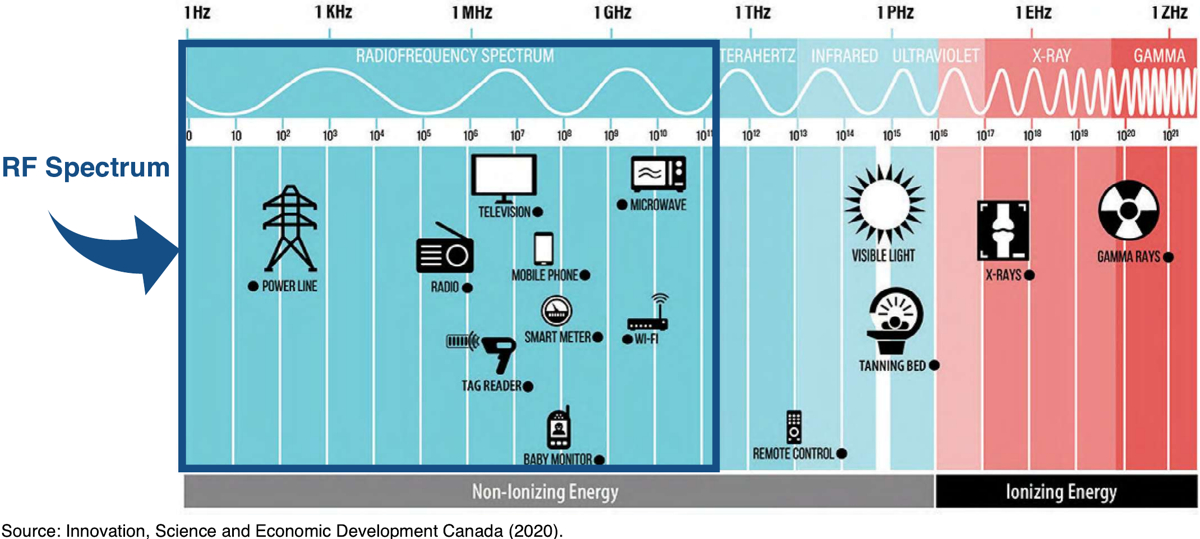
Long Description.
The frequency scale marks 1 hertz, 1 kilohertz, 1 megahertz, 1 gigahertz, 1 terahertz, 1 petahertz, 1 exahertz, and 1 zettahertz, with exponential values indicated between these points. The left section labeled RF Spectrum with the frequency of 1 kilohertz, 1 megahertz, and 1 gigahertz includes a power line, radio, television, mobile phone, microwave, smart meter, Wi-Fi, tag reader, and baby monitor. The middle section with the frequencies of 1 terahertz and 1 petahertz are emitted by Infrared and Ultraviolet rays and include remote control, visible light, and tanning bed. The right section includes X-Rays and Gamma Rays with the frequencies of 1 exahertz, and 1 zettahertz. The frequency of the wave increases, moving from the left to the right. Non-ionizing energy starts with radiofrequency spectrum and ends at ultraviolet. Ionizing energy starts with ultraviolet and ends at gamma. Source: Innovation, Science and Economic Development Canada (2020).
TABLE 2 Characteristics of low-, mid-, and high-bands of RF spectrum.
LOW-BAND SPECTRUM |
MID-BAND SPECTRUM |
HIGH-BAND SPECTRUM |
< 1 GHZ (MHZ) |
1-6 GHZ (INCLUDES CBRS) |
(MMWAVE) |
|
|
|
* Ranges vary because they can be influenced by local geography, infrastructure, and network design.
CBRS supports 4G LTE and 5G technology, or a combination of both, which are efficient and interoperable. It is considered shared spectrum because it has been carved out of space with users called incumbents [primarily the Department of Defense (DoD) for communications with satellites, but DoD use could shift to other bands in the future]. Its band-sharing model could be replicated in other RF spectrum bands as research is ongoing. It is not related to the C-band or radio altimeters because it is a completely separate band of RF spectrum (Figure 6).
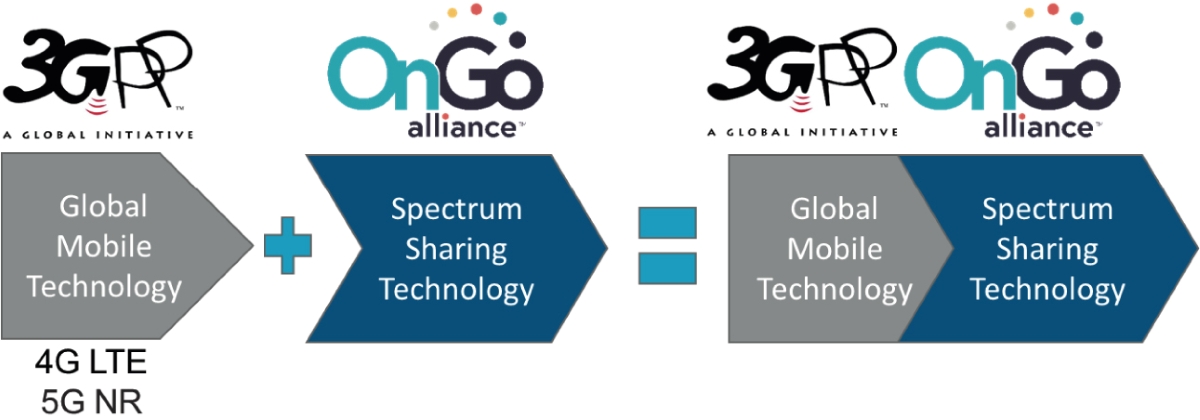
PWN Research and Standardization. International collaboration occurred to standardize RF spectrum use for PWNs. Specifically, the OnGo Alliance was formed, averaging 80–100 global companies per year that invested heavily in PWN technology. OnGo provides the standards, testing, and certification for shared spectrum technology. As Figure 7 shows, this global group developed a way to use current global 4G LTE, 5G, and 5G NR mobile technologies standardized by 3GPP in the CBRS.
Tiered CBRS Sharing via the Spectrum Access System
Because the CBRS band is shared with the DoD and other incumbents, a system needed to be developed for implementing the spectrum sharing.
- What it is called: The system is called the Spectrum Access System (SAS).
- Who created it: The OnGo Alliance in conjunction with another wireless technology research and development conglomerate, Wireless Innovation Forum (WInnForum), collaborated with the DoD, the FCC, the National Telecommunications and Information Administration, and others to define standards, the sharing model, and encourage sharing for more adoption of private wireless technology.
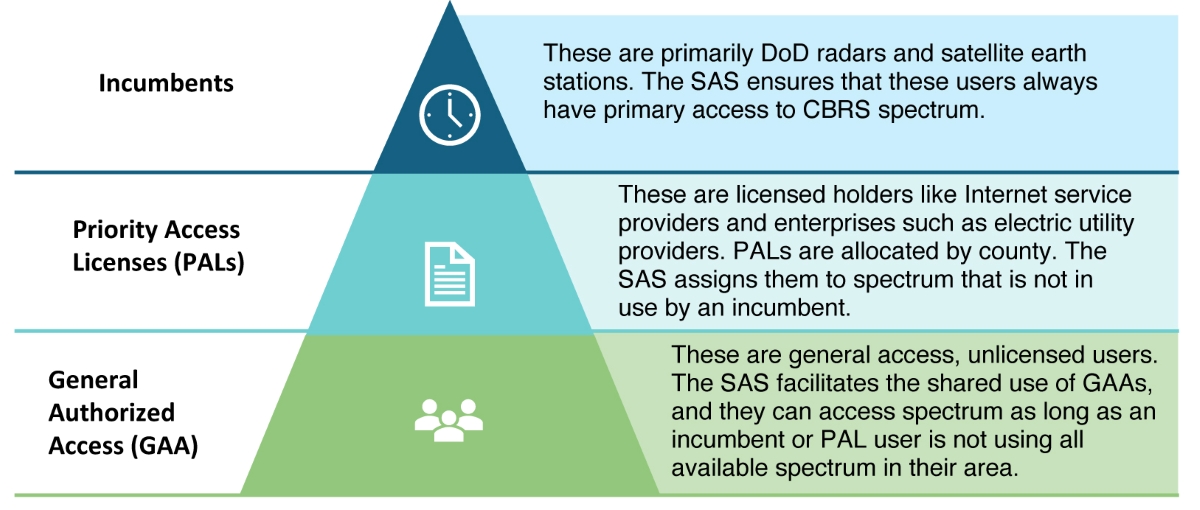
- What the tiers are: Figure 8 shows the three tiers of users.
For any of these tiers of users to access the CBRS band, they must use certified CBRS devices (CBSDs). CBSDs function as radios or access points that communicate with the SAS for spectrum management. They must comply with FCC interference rules and be registered so that device location, access level, and identification are documented before transmitting within a PWN.
How the SAS Works
What Is the SAS?
- It is a cloud-based coordinator system that controls CBSD access to CBRS spectrum channels.
- It dynamically allocates and manages CBRS spectrum channels, creating efficient coexistence among the CBSDs used by three different levels of users.
- It is operated by several SAS providers (e.g., Amdocs, Federated Wireless, Google, and Sony) who are required to share their SAS data with one another to ensure the system protects incumbent users, manages Priority Access Licenses (PAL) users, and facilitates General Authorized Access (GAA) access.
How Are the CBRS Band Channels Allocated? As shown Figure 9, the CBRS is a 150-MHz wide band of spectrum (3550–3700 MHz). It is divided into 15 channels of 10 MHz each.
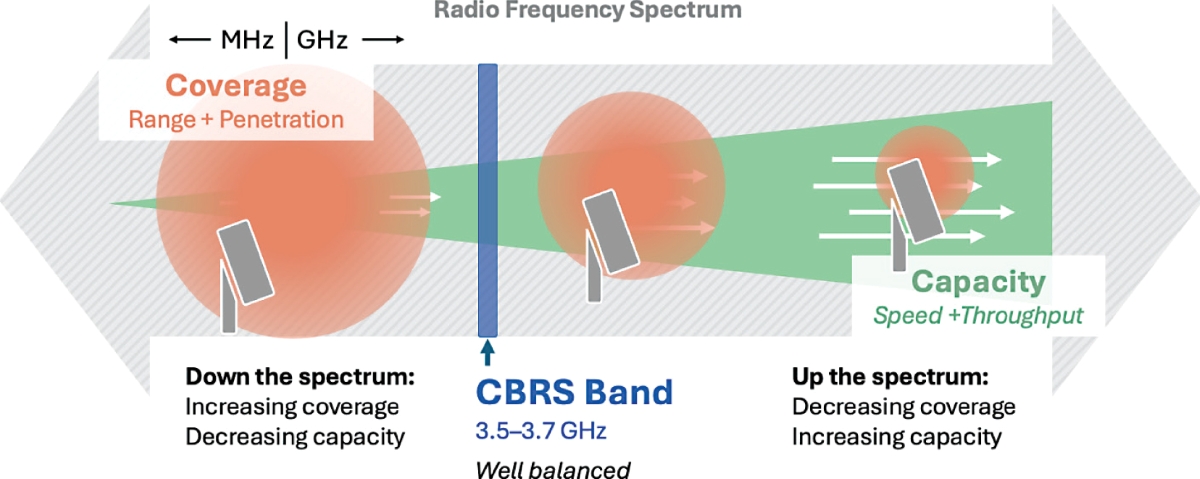
Long Description.
The schematic presents the radio frequency spectrum with frequency ranges labeled in megahertz and gigahertz. It illustrates coverage on the left with range plus penetration, and capacity on the right with speed plus throughput. The CBRS band is narrow and highlighted in the middle between coverage and capacity. It is labeled 3.5 to 3.7 gigahertz with the description, well balanced. There is increasing coverage and decreasing capacity down the spectrum on the left. There is decreasing coverage and increasing capacity up the spectrum on the right.
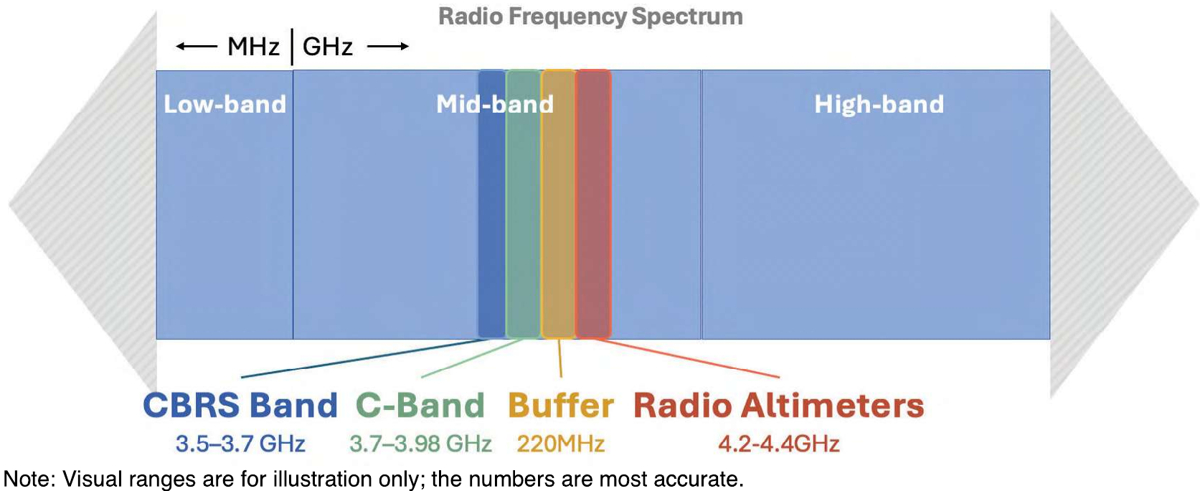
Long Description.
The schematic presents the radio frequency spectrum divided into low-band, mid-band, and high-band along a scale marked megahertz to gigahertz. Within the mid-band region, the CBRS band spans 3.5 to 3.7 gigahertz. Adjacent to it, C-band spans 3.7 to 3.98 gigahertz. A buffer region of 220 megahertz follows. Radio altimeters occupy 4.2 to 4.4 gigahertz. Note: Visual ranges are for illustration only; the numbers are most accurate.
Long Description.
The infographic presents the 3GPP logo with the text, A Global Initiative and the On Go alliance logo. It states that Global Mobile Technology (with the 3GPP logo) featuring 4G LTE and 5G NR plus Spectrum Sharing Technology (with the On Go Alliance logo) equals Global Mobile Technology and Spectrum Sharing Technology.
Long Description.
The infographic presents a triangle divided into three horizontal layers. At the top of the triangle, incumbents are described as primarily DoD radars and satellite earth stations. The SAS ensures that these users always have primary access to CBRS spectrum. In the middle layer, Priority Access Licenses, PALs, are described as licensed holders such as internet service providers and enterprises such as electric utility providers. PALs are allocated by county. The SAS assigns them to spectrum not in use by an incumbent. The bottom layer for General Authorized Access, GAA, is described as general access, unlicensed users. The SAS facilitates shared use of GAAs and enables them to access spectrum as long as an incumbent or PAL user is not using all available spectrum in their area.

Long Description.
The schematic presents a horizontal band divided into numbered channels from 1 to 15. The frequency range ranges from 3,550 megahertz or 3.5 gigahertz, through 3,650 megahertz or 3.6 gigahertz, to 3,700 megahertz or 3.7 gigahertz. Channels 1 through 10 fall under Priority Access Licenses, PALs. Channels 11 through 15 fall under General Authorized Access, GAA.
The SAS dynamically assigns spectrum as follows:
- Incumbent users can access all 15 channels, and their usage supersedes all PAL and GAA users.
- PAL users in each county-based licensing can access the first 10 channels.
- GAA users have access to five channels (Channels 11–15) but can access Channels 1–10 if higher priority users are not using them.
How Does the SAS Allocate Channels? The SAS allocates channels through real-time, dynamic monitoring using a CBSD reauthorization system in which CBSDs send periodic “heartbeat” requests to reserve and transmit on specific frequencies for defined timeframes. The system approves or denies requests, manages interference, and synchronizes CBSD data across all SAS providers nightly as required by the FCC.
CBRS Leasing Options
Before discussing leasing options, it is important to point out that airports can develop PWNs using GAA channels without needing licensing, as can anyone else. However, if an airport decides it wants to become a PAL user of CBRS, it can lease spectrum from PALs. The FCC allows licensees to share CBRS spectrum in various ways. To find a licensee, airports or their MSP can search the PAL map on the OnGo Alliance website (https://ongoalliance.org/pal-map).
Licensees can do the following:
- Partition their licenses
- Partially assign or transfer their licenses
- Lease any bandwidth for any length of time, geography, or both
The SAS Is Evolving
The SAS has a few challenges to overcome. As more CBRS networks are deployed, the SAS will have to manage more congestion. Potentially fewer channels will be available. Also, the SAS does not have any legal management authority of GAA channels and, therefore, could become oversubscribed. However, SAS-related solutions are evolving and expanding. Manufacturers are developing new ways to provide SAS with more detailed spectrum data using CBSD “ground truth” measurements, which are refining and optimizing transmission to CBSDs in real time. Some other advanced spectrum analysis tools could also provide SAS with future mitigation suggestions.
Use Cases
The Nature of PWN Use Cases: Primarily Operational
Each of the PWN uses cases highlighted in this guidance are directly related to the operational use cases of the airport and the airportʼs tenants rather than passenger use cases. This is because PWNs offer MNO-grade security built in, which is critical to airport business and operations use cases, and users can self-enroll or authorize each end device onto the network. Wi-Fi does not require this authorization for the public to achieve connectivity; therefore, it is deemed a better connectivity solution for airport passenger-related use cases. Although this guidance still presents examples of passenger use cases, these are airport owned, managed, and network-authorized end devices that directly interface with a passengerʼs device.
Use Case Business Values
The value of implementing PWNs at an airport is hard to fully quantify. However, these networks can provide several business/operational values:
- CR = Cost Reduction
- Reduces expenses for telecommunication if moving from public network subscriber identity modules (SIMs) to private networks
- Enables predictive maintenance that prevents major outages
- Provides ease of connectivity versus alternatives
- Lower cost than cabling if connectivity is needed in remote or perimeter areas
- Lower cost than public network when a large number of devices are connecting
- Better reach than Wi-Fi such as when access points are in a terminalʼs lower level or when much concrete or steel are present in buildings
- OP = Operational Improvement across an entire airport
- Allows staff efficiencies
- Collects real-time data
- Enables predictive analytics and maintenance capabilities
- Provides better asset tracking
- Promotes innovation
- M = Monetization/New Revenue
- Provides leasing access to tenants including airlines, concessionaires, cargo, federal, and others
- Enables new revenue opportunities, such as autonomous food delivery
- PE = Enhanced Passenger Experience
- Enables new innovation and service offerings that create a “wow” factor
- Stabilizes passenger processing systems
- Enables real-time monitoring of passenger walkways/escalators/elevators/etc.
- S = Safety and Security
- Enables perimeter cameras
- Provides connectivity for body/vehicle cameras
- Improves worker safety (better monitoring, access to resources in the field)
Use Case Listing
Use cases are presented in alphabetical order as they apply to airport functional areas.
Whole Facility
This section presents use cases that span at least more than one functional location; these are the whole facility use cases:
- Asset tracking. Airports are filled with many types of assets, including fixed, mobile, and transportable assets. A PWN can provide consistent connectivity so an airport can achieve asset tracking across the entire campus.
- Autonomous vehicles. Many airports are using or plan to use autonomous vehicles and equipment such as bag carts, tugs, and robots. PWNs can provide stable and low-latency connectivity while vehicles drive across the large areas and roadways.
- Baggage tracking. PWNs enable data from scans at various points. This provides carriers with real-time baggage verification and provides carriers and passengers better baggage visibility.
- Courtesy carts and wheelchair operational communication and location tracking. PWNs offer real-time tracking of carts and wheelchairs throughout the terminal building, curbside, and in parking lots and parking garages. PWNs might enable airport staff to communicate (voice and data) with shuttle buses.
- Digital signage. This plays a vital role in directing and educating passengers and visitors. These signs can be placed anywhere there is PWN connectivity on airport premises, including near roadways.
- Event management. PWNs can provide connectivity for real-time camera streams from first-responder bodycams, vehicles, and drone cameras, including airport drones.
- Geofencing. PWNs can extend coverage out to devices, allowing for geofence use cases (e.g., asset tracking, employee work area definition, vehicle management).
- IoT devices. PWNs can provide stable connectivity to broadly use IoT devices anywhere on the airport premises.
- Legacy radio communications migrated/consolidated to using CBRS. Many airports use legacy radio communications systems to support certain systems throughout the airport property (e.g., PARCS, audio visual interleave, fuel monitoring system). PWNs can replace many of these costly connectivity solutions.
- NHN connectivity as a DAS alternative in small, lightly populated buildings and spaces. An NHN can leverage an existing DAS, which can reduce costs, space, and power needs.
- Passenger processing systems (fixed). PWNs can provide primary or backup connectivity to fixed-positioned processing systems (e.g., common use, signage).
- Passenger processing systems (movable or mobile). PWNs provide flexible connectivity for movable and mobile processing systems (e.g., common use, signage). Temporary agent stations could be established anywhere during a significant irregular operations event.
- Push-to-talk (PTT) communications. PWNs can serve as a communication backbone for PTT across the airport ecosystem. PWN PTT devices come in a variety of hardened options with mobile applications capabilities and price points. Conversely, traditional PTT solutions devices are expensive to purchase, repair, and replace.
- Redundant device connections. PWNs can serve as a secondary, backup connection for a critical system or for a designated group of people or a building.
- Sensitive data connectivity. PWNs can connect with any device (e.g., mobile devices, critical passenger operational devices) or use case that could benefit from higher security authentication than public Wi-Fi such as regulatory agencies including the Transportation Security Administration, Customs and Border Protection, and Federal Aviation Administration (FAA).
- Smart locks. PWNs can provide the connectivity for smart locks on doors or gates that can be opened or locked remotely using an app on an end device.
- Tracking passenger flow. PWNs can provide connectivity for passenger-tracking sensors and beacons across the campus, which can help airport operations make real-time decisions, especially in times of aircraft delays and diversions.
- Utility metering and monitoring devices. PWNs can connect with metering sensors to enable real-time visibility and remote, automated digital data capture into whatever aspect is being monitored (e.g., resource usage, leaks).
- Video surveillance cameras and video analytics (fixed and mobile). PWNs can connect with cameras so that they can provide real-time streaming. AI/ML can then be used to analyze the video and provide data, reporting, and notifications as needed by each use case.
- Wi-Fi on people movers, airport vehicles, shuttles, remote areas. PWNs can extend a Wi-Fi network to provide coverage to passengers on automated people movers and shuttle buses and to airport staff in first-responder trucks and tenant vehicles.
Curbside/Roadways
Following are the curbside/roadways use cases:
- Commercial vehicle transponder counts from roadway sensors. PWNs offer robust extended range out to the roadway environment to help with tracking and counting commercial vehicle operations.
- Roadway height restriction alerting and monitoring systems. PWNs can provide connectivity for signage systems that use light detection and ranging (LiDAR) or other innovative technology that can spot tall vehicles approaching the airport and alert drivers about low height limitations and other critical safety messaging.
- Roadway traffic monitoring cameras and other devices. PWNs can provide connectivity to roadway traffic cameras, which can enable improved operational visibility.
- Transportation network company (TNC) area connectivity. PWNs can extend Wi-Fi coverage for passengers and TNC drivers to communicate in traditionally spotty coverage areas.
Inside Terminals and Concourses
Following are the inside terminals and concourses use cases:
- Autonomous cleaning. PWNs can connect to cleaning robots so automated cleaning occurs at scheduled times, which keeps passengers happy and reduces staff workload.
- Autonomous food delivery. PWNs can improve the passenger experience by bringing the wow factor of autonomous food delivery.
- Building management control system devices. PWNs can connect building systems with control devices on equipment such as elevators, escalators, and heating ventilation and air conditioning equipment, with sensors on thermostats and lights, and with monitoring systems covering areas such as restrooms. Airport
operations staff can remotely adjust systems and equipment in real time as needed.
- Concessions payment tablets/kiosk point-of-sale. PWNs provide secure connectivity for payment handling devices.
- Conference room booking devices. PWNs can provide an alternative connectivity option for airports to use when Wi-Fi is not available.
- Mobile agent devices. PWNs provide stable connectivity that enables staff (e.g., airline, airport, others) to use mobile devices (e.g., phones, tablets) for critical business operations anywhere in the airport.
- Self-bag drop connectivity. PWNs can connect with self-bag drops wirelessly where physical connections do not make sense.
- Sensor connectivity (passenger focused). PWNs provide coverage to a variety of passenger-focused sensors like those that monitor queue wait times or that map passenger traffic flow, and can connect to signage (or other devices) that can direct passengers to shorter queues.
- Signage for concessionaires, including point-of-sale systems. PWNs offer connectivity for a tenantʼs dynamic signage and payment handling systems anywhere they are around an airport.
- Transportation Security Administration and Customs and Border Protection systems and operational functionality. PWNs offer connectivity in many areas where connectivity was previously limited.
Baggage Makeup
The baggage makeup use case follows:
- Baggage makeup communications and systems. PWNs can improve communications in extremely difficult environments such as basement areas, buildings made of concrete or metal, and equipment that uses motors.
Parking Garage/Lots
Following are the parking garage/lots use cases:
- Connectivity and signage in commercial vehicle waiting lots. PWNs can extend connectivity to vehicle waiting lots, where it can enable various types of end devices to function.
- Parking systems. PWNs can extend coverage to parking systems to connect things like license plate recognition, gates, cameras, and sensors where other connectivity solutions might be too expensive or labor intensive to consider. Some of these enhanced systems can also improve revenue capturing.
Ramp
Following are the ramp use cases:
- Aircraft stand automation. PWNs can extend connectivity out to aircraft stands on the ramp bringing automation solutions to things like baggage handling carts.
- Airframe/engine data offloads after landing. A PWN could be deployed in an interoperable way to improve aircraft turnaround times by enabling an aircraft to download data upon landing. This would give airlines the information they need earlier, which enables them to make time-sensitive decisions faster.
- Baggage scanning. PWNs can make real-time bag scanning possible throughout the baggage makeup area and all around the aircraft. This capability is unachievable or infeasible on Wi-Fi and costly on MNO networks.
- Follow-me car/Marshall. PWNs can provide connectivity for in-camera feeds from a follow-me car.
- Jet bridge connectivity. PWNs provide connectivity to jet bridges where Wi-Fi is not feasible.
- Visual docking guidance systems (VDGS). PWNs provide connectivity to VDGS devices, allowing flexible installation.
Airfield
Following are the airfield use cases:
- Autonomous mowing systems and use for other routine maintenance. PWNs can provide connectivity for autonomous maintenance equipment out on the airfield that are not typically covered by Wi-Fi.
- Cargo remote operation of equipment and real-time data and tracking. PWNs can provide connectivity for devices, equipment, and facilities out on the airfield that are not typically covered by Wi-Fi.
- Connectivity for deicing operators. PWNs provide connectivity to deicing equipment sensors out on the airfield that are not typically covered by Wi-Fi.
- Fleet management geofencing and maintenance. PWNs provide connectivity to fleet management devices on the airfield not typically covered by Wi-Fi.
- Inspections for foreign object debris and surface integrity (with drones, cameras, AVs). PWNs provide connectivity to devices on the airfield in areas not typically covered by Wi-Fi, which increases safety by keeping airfield monitoring consistent.
- Monitoring off-gate parking areas for aircraft. PWNs provide connectivity to devices out on the airfield that are not typically covered by Wi-Fi, making real-time off-gate parking options available.
- Remain overnight (RON) parking monitoring. PWNs provide connectivity to devices out on the airfield that are not typically covered by Wi-Fi, which allows for better monitoring of RON areas.
Tenant Buildings
Following are the tenant buildings use cases:
- Maintenance (real-time video support and communication). PWNs provide connectivity for real-time video and communication support in maintenance areas (usually a challenge to connect).
- Maintenance (remote maintenance logs access and entry). PWNs provide connectivity for maintenance workers to access logs and manuals from any location.
- Maintenance (virtual reality). PWNs enable virtual reality device connectivity for improved maintenance operations.
- Other tenant uses. PWNs provide connectivity options for tenant facilities.
Fence Line/Perimeter
Following are the fence line/perimeter use cases:
- Airport noise and air quality sensor monitoring connectivity. PWNs provide enhanced connectivity out to remote sensors, providing real-time data.
- Autonomous fence line patrols/checks (drones, autonomous vehicles). PWNs offer enhanced connectivity for security operations out at the fence line.
- Cameras/sensors/monitoring. PWNs provide general connectivity to cameras and other devices that are difficult to cover with other connection methods.
- Construction connectivity for cameras, trailers, other systems (including whole site/building). PWNs provide enhanced coverage for airport construction sites and operations, ensuring connectivity for mobile devices, high-definition closed-circuit television (CCTV) streaming, and digital signage.
- Perimeter intrusion detection devices (PIDs). PWNs provide connectivity for PIDs deployments.
Behind the Fence/Remote Locations
Following are the behind the fence/remote locations use cases:
- Access control devices. PWNs provide connectivity out to access control devices, without needing cable.
- Backhaul connectivity to/from remote locations. PWNs provide additional backhaul connection needed by remote areas.
- Fuel farm monitoring and systems (leak detection, cameras). PWNs provide stable connection for valuable sensors.
- Remote areas. PWNs provide general connectivity out to remote area systems (e.g., cameras, sensors).
Private Use or Ownership
PWNs give airports the opportunity to have complete control over meeting their own unique connectivity needs, as summarized in Chapter 1 (Figure 1).
Stakeholders and Partnerships
Connectivity is vital for all airport partners and stakeholders in an airport environment. For example, passengers need it to use their smartphones and laptops, airline staff need it for bag scanners and other mobile devices, and airport staff need it for security and monitoring devices. Wireless organizations and regulatory industries are needed to make PWN connectivity possible for enterprises like airports.
The needs or requirements of internal and external partners/stakeholders are vital to consider when planning and designing an airport PWN. Some stakeholders that should be highly involved in the design and deployment of a PWN include in-house IT experts, MSPs, SAS provider, and organizations that rely heavily on data to and from end devices (e.g., ground transportation companies).
Keeping various stakeholders in mind during the network planning stage can help airports develop the most beneficial and useful network, from operational and financial points of view, considering potential revenue-generating opportunities.
For a full list of stakeholders, see the full report.
Cost/Financials
Airports need to consider many factors that translate into costs for designing, developing, deploying, and managing a PWN:
- CAPEX that cover the cost of hardware, software, and professional services needed to design, commission, and deploy the network
- OPEX needed to monitor or maintain the network
Airports that choose to own and operate a PWN will have CAPEX costs (which are upfront costs that can be amortized typically over several years) and OPEX costs for ongoing network maintenance. For airports that choose to implement a PWN without owning, building, or maintaining the networkʼs infrastructure, they will have only Network-as-a-Service (NaaS) OPEX from MSPs.
Potential Network Costs
Here are typical line-item costs for the major components needed to create a PWN.
- Common PWN expenses. End devices, Radio Access Network (RAN) hardware and software, Core hardware and software
- Other optional PWN expenses. Multi-access-edge computing (MEC) hardware and software, professional services, managed services
- Deployment cost considerations (variables). All the previously mentioned common and optional expenses are dependent on network deployment considerations such as
- Coverage area (facility size and indoor/outdoor coverage area)
- Quantity/type of end devices
- RAN solution and hardware
- Core configuration
- MEC sizing
- Civil engineering verification, design, work/installation
- Bandwidth requirements by application
- Resiliency/redundancy
- SAS fees
- Network operations center (NOC) support
- Airportʼs enterprise ethernet network
Total Cost of Operations: The Economics of a PWN
A rough order of magnitude PWN estimate can be calculated from all the cost considerations from the previous section. It is important to note that the total cost of operations (TCO) should include the PWN costs and costs for devices, data management, and end-to-end integration including workflow automation and predictive/preventative modeling on the data (e.g., AI). As a result, airports can expect the following cost breakdown for a 5-year managed services contract for a PWN (Disclaimer: This is based on the research teamʼs PWN knowledge and covers one set of parameters and variables and should not be considered an actual estimate):
- Design and installation: 20%–30% of network costs
- Hardware (RAN and MEC): 15%–20% of network costs
- Software (RAN and Core): 30% of network costs
- Managed services of initial project costs first year: 20% of network costs [Note: Over 5 years, the managed services will double the initial cost of the project (50% of total contract costs). Device costs are also quite variable depending on the use case (tablet versus drone, for example)].
PWN pricing considerations. PWN pricing is typically represented from the MSPs as (a) upfront CAPEX, which typically are RAN and hardware plus costs for professional services; and (b) OPEX, which are typically managed services along with software licenses and SAS licensing. MSPs typically prefer to move most of the upfront CAPEX into the ongoing OPEX pricing and prefer to own the network so they can depreciate it in their accounting records. Airports typically want to pay for the hardware and the design and installation via upfront CAPEX and own the network so they can depreciate it like they do for other procured networks like local area networks and Wi-Fi.
PWN value considerations. The value obtained from a PWN is from the use cases deployed and their resulting business value. Example: One simple PWN use case can be based on quantifying the current amount an airport is paying for wireless services from MNOs and begin migrating devices on MNO networks by changing to SIMs provisioned for the PWN. Airports may find this change provides substantial year over year cost savings for the airport, saving potentially thousands of dollars annually.
Potential approach to value. Airport operators can use the following suggested approach:
- List every airport business problem that requires solutions or needs improvement.
- Align and map every problem and ideas for improvement to defined use cases.
- For each use case, define the “solution stack*” meaning the end devices, software, end-to-end integration, and AI models (predictive and preventative use cases) needed for deployment.
- Quantify the TCO per use case along with the business benefit (i.e., quantify the value in dollars).
- Calculate the full network TCO, which is the PWNʼs NaaS cost from MSPs and costs for all use case solutions (include the full solution stack* for each).
- Deliver a value-based roadmap and identify the breakeven point and overall return on investment for the airport and tenants.
- Create an overall business case (e.g., cost benefit analysis) and justify a full PWN deployment TCO.
*Airports would do well to understand potential cost implications for solution stacks if they hire ad hoc teams composed of multiple providers (i.e., manufacturers, vendors). Sometimes “margin stacking” can occur, which refers to the accumulation of profit margins from each provider on a team. Accumulated risk premiums from each provider can also raise costs. Both of these can lead to a more expensive PWN deployment. However, as the PWN market continues to mature and providers continue to partner and consolidate, these accumulated costs should diminish. Hiring an established MSP with past working experience with subconsultants is suggested.
Once a strong business case is made for a PWN, this can also become a path toward defining an airportʼs overall Digital Transformation Roadmap. Especially if an airport approaches the investment in a strategic holistic manner, a PWN can be the connectivity platform that enables an airport to implement digital transformations that can result in a significant return on investment. The research teamʼs experience suggests that the business value will outweigh PWN costs, and airports can generally anticipate a breakeven point within several years of deployment.
Potential Revenue Streams
Airports can monetize PWNs by charging a fee for use from other partners/stakeholders at an airport like airlines and tenants including concessionaires and fixed base operators. The decision on whether to monetize a PWN typically depends on an airportʼs approach to tenant charges, infrastructure use, and its overall innovation strategy. Another critical consideration related to revenue is finding out which other partners/stakeholders at the airport have high business value use cases that require PWNs for connectivity or that have already developed or are considering developing their own PWNs. Table 3 lists some network use cases where airports might be able to charge their partners/stakeholders.
Risks
Along with the numerous benefits of deploying a PWN, some risks need to be understood, as with all technology advances. Some of the key risks follow:
- Regulatory environment. Ensuring the FAA provides enough reliable access to spectrum for future PWNs via the SAS (shared spectrum) might concern some, but the SAS has been successful so far and could be applied to other bands of spectrum.
- Spectrum licensing. Nearby GAA networks could reduce overall available GAA spectrum channels. To minimize this risk, airports could work with nearby offsite network owners to establish mutually agreed rules or could sublease a PAL instead.
- Disruptions in connectivity. Dynamic protection areas (DPAs) where an incumbent has priority access could pose a slight risk of short-term temporary connectivity interruptions, but SAS providers, MSPs, and CBSD manufacturers all have solutions to minimize or prevent disruptions. Airports can work with an MSP and the SAS provider for a specific CBRS channel for their location (latitude/longitude) and to assess any potential DPA impacts.
- Security. There is always a risk of bad actors interrupting communications, but holistic plans for addressing security issues can be made, especially those related to mission-critical systems.
- Financials/cost. Rushing into PWN deployment without developing proper business cases ahead of time can result in overpaying for services, but when networks are properly designed, they can result in lower costs through operational efficiencies.
- Risk of not acting. Waiting to deploy a network compared to neighbors and airport partners/stakeholders can cost an airport by limiting benefits to the airport like guaranteed spectrum assurance, reliability, and monetizing the network.


