Red-Tinted Bus Lane Experience (2026)
Chapter: 1 Introduction

CHAPTER 1
Introduction
This chapter provides information about the purpose of the synthesis effort, the issues to be addressed by the study, the scope of the project (e.g., what is included and what is not), and the study methodology. This chapter also provides selected relevant definitions and explains the organization of the report.
Objectives and Scope
The purpose of TCRP Project J-07/Topic SD-07 was to document the current state of practice in the implementation and performance of red-tinted bus lanes in North America. Red-tinted bus lanes have been implemented in several cities, but there is relatively little documentation of impacts, operational challenges, and other information of value to entities interested in implementing red-tinted bus lanes. The focus of the synthesis is on the following topics:
- Developing and understanding of why transit agencies and jurisdictions such as cities have implemented red-tinted bus lanes
- Identifying key features of red-tinted bus lanes
- Documenting experiences, challenges, and considerations relevant to implementing, operating, enforcing, and maintaining red-tinted bus lanes
- Understanding the impacts that red-tinted bus lanes have had on transit travel time, reliability, ridership, safety, and other measures of effectiveness
- Identifying factors that contribute to the success of red-tinted bus lanes
Definition of Key Terms
For this synthesis, red-tinted bus lanes are defined as lanes that feature red-colored pavement to enhance the conspicuity of locations, station stops, or travel lanes in the roadway exclusively reserved for vehicles of public transit systems or multimodal facilities where public transit is the primary mode. This definition is based on Section 3H.07 of the 11th edition of the U.S. Manual on Uniform Traffic Control Devices (MUTCD; FHWA 2023) and is consistent with the definition in Part C of the 6th edition of the Manual on Uniform Traffic Control Devices for Canada (MUTCDC; Transportation Association of Canada 2021). The red color treatment can be achieved using tinted paving materials (e.g., colored asphalt), paint, or other materials applied to the surface of the road. It can be applied to the full length of a bus lane, to a portion of a bus lane, or only at locations such as intersection approaches and bus stops.
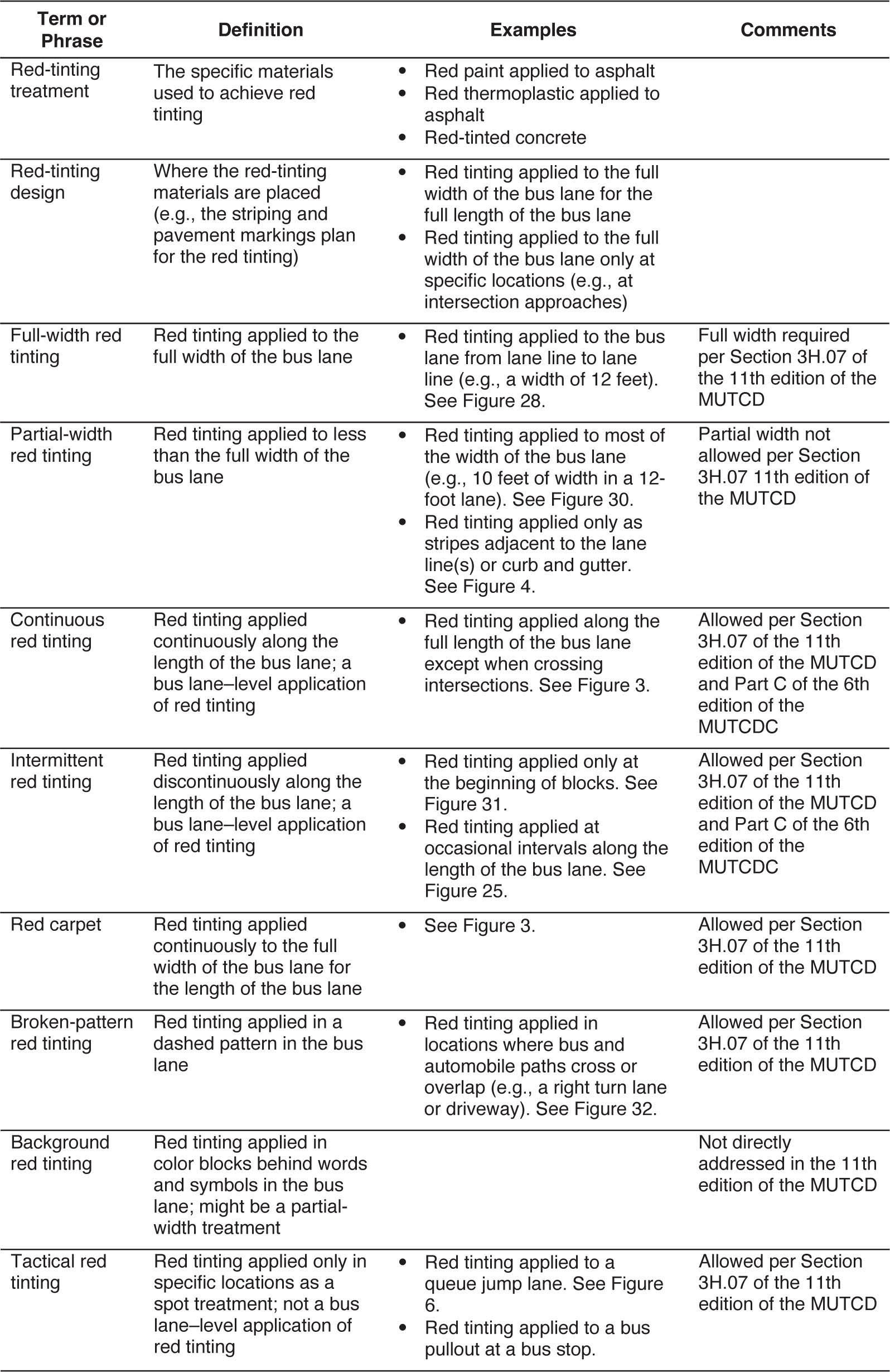
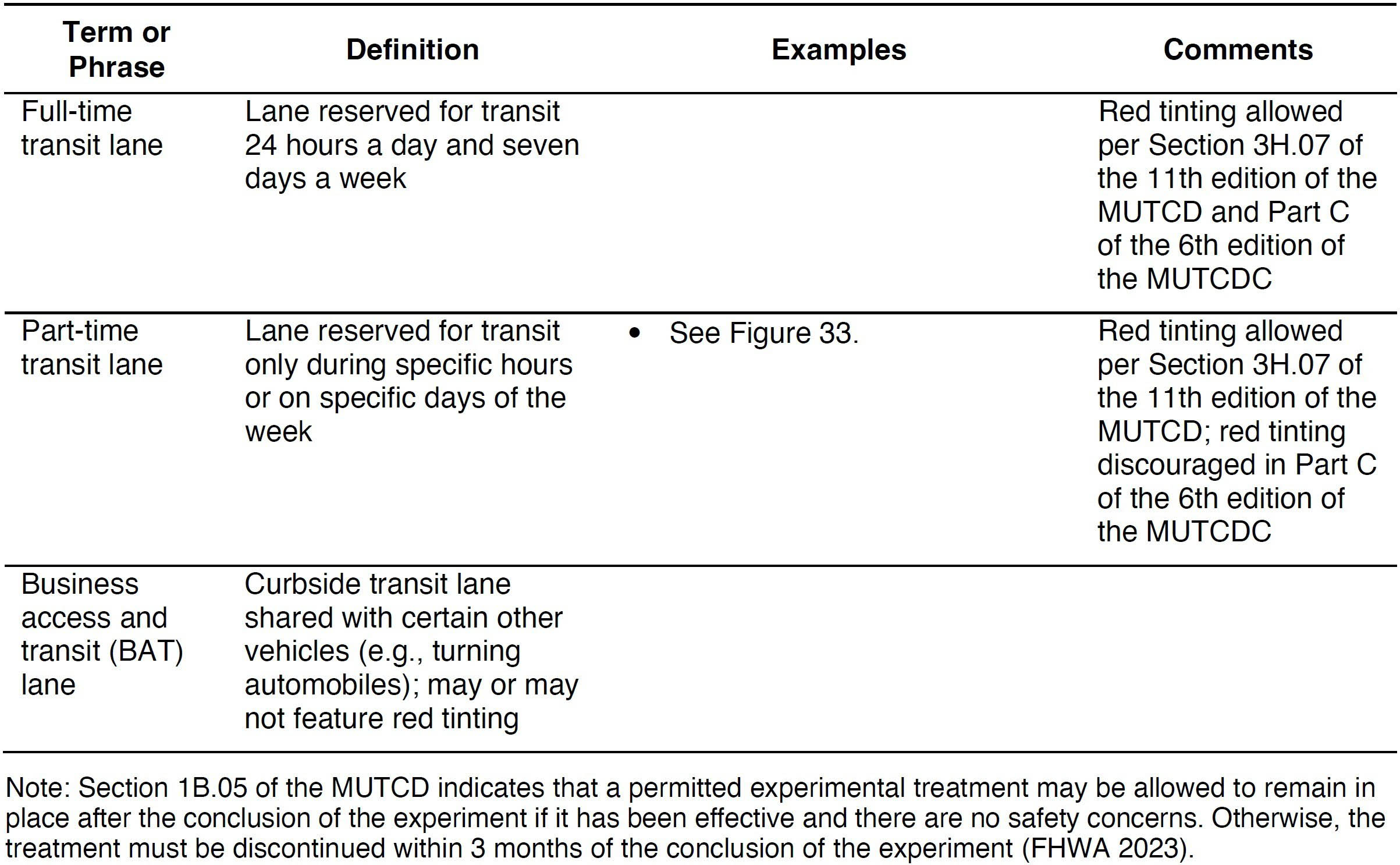
The terms and phrases defined in Table 1 are also used in this report. These terms and phrases are intended to support consistent reporting of this studyʼs findings. The terms and phrases reflect how red tinting has been implemented in the United States and Canada to date, not
(continued on next page)
Long Description.
The column headers of the table are term or phrase, definition, examples, and comments. The data given in the table row-wise are as follows: Row 1: Red tinting treatment, the specific materials used to achieve red tinting, red paint applied to asphalt; red thermoplastic applied to asphalt; red-tinted concrete, blank. Row 2: Red tinting design, where the red tinting materials are placed (for example, the striping and pavement markings plan for the red tinting), red tinting applied to the full width of the bus lane for the full length of the bus lane; red tinting applied to the full width of the bus lane only at specific locations (for example, at intersection approaches), blank. Row 3: Full-width red tinting, red tinting applied to the full width of the bus lane, red tinting applied to the bus lane from lane line to lane line (for example, a width of 12 feet). See figure 28, full-width required per Section 3H.07 of the 11th edition of the MUTCD. Row 4: Partial-width red tinting, red tinting applied to less than the full width of the bus lane, red tinting applied to most of the width of the bus lane (for example, 10 feet of width in a 12-foot lane). See figure 30; red tinting applied only as stripes adjacent to the lane line(s) and or curb and gutter. See figure 4, partial width not allowed per Section 3H.07 11th edition of the MUTCD. Row 5: Continuous red tinting, red tinting applied continuously along the length of the bus lane; a bus lane-level application of red tinting, red tinting applied along the full length of the bus lane except when crossing intersections. See figure 3, allowed per Section 3H.07 of the 11th edition of the MUTCD and Part C of the 6th edition of the MUTCDC. Row 6: Intermittent red tinting, red tinting applied discontinuously along the length of the bus lane; a bus lane-level application of red tinting, red tinting applied only at the beginning of blocks. See figure 31; red tinting is applied at occasional intervals along the length of the bus lane. See figure 25, allowed per Section 3H.07 of the 11th edition of the MUTCD and Part C of the 6th edition of the MUTCDC. Row 7: Red carpet, red tinting applied continuously to the full width of the bus lane for the length of the bus lane, see figure 3, allowed per Section 3H.07 of the 11th edition of the MUTCD. Row 8: Broken pattern red tinting, red tinting applied in a dashed pattern in the bus lane, red tinting applied in locations where bus and automobile paths cross or overlap (for example, a right turn lane or driveway). See figure 32, allowed per Section 3H.07 of the 11th edition of the MUTCD. Row 9: Background red tinting, red tinting applied in color blocks behind words and symbols in the bus lane; might be a partial-width treatment, blank, not directly addressed in the 11th edition of the MUTCD. Row 10: Tactical red tinting, red tinting applied only in specific locations as a spot treatment; not a bus lane-level application of red tinting, red tinting applied to a queue jump lane. See figure 6; red tinting applied to a bus pullout at a bus stop. See figure 6, allowed per Section 3H.07 of the 11th edition of the MUTCD.
Long Description.
The column headers of the table are term or phrase, definition, examples, and comments. The data given in the table row-wise are as follows: Row 11: Full-time transit lane, lane reserved for transit 24 hours a day and seven days a week, blank, red tinting allowed per Section 3H.07 of the 11th edition of the MUTCD and Part C of the 6th edition of the MUTCDC. Row 12: Part-time transit lane, lane reserved for transit only during specific hours and or on specific days of the week, see figure 33, red tinting allowed per Section 3H.07 of the 11th edition of the MUTCD; red tinting discouraged in Part C of the 6th edition of the MUTCDC. Row 13: Business access and transit (BAT) lane, curbside transit lane shared with certain other vehicles (e.g., turning automobiles); may or may not feature red tinting, blank, blank. Note: Section 1B.05 of the MUTCD indicates that a permitted experimental treatment may be allowed to remain in place after the conclusion of the experiment if it has been effective and there are no safety concerns. Otherwise, the treatment must be discontinued within three months of the conclusion of the experiment (FHWA 2023).
necessarily what is allowed for new red-tinting projects in the 11th edition of the MUTCD or in the 6th edition of the MUTCDC. Some terms and phrases may have overlapping definitions.
Technical Approach
The project team conducted the synthesis study by means of the following tasks:
- Survey. Through a survey and review of recent research, the team sought relevant information from U.S. and Canadian transit agencies and jurisdictions that have implemented red-tinted bus lanes. Relevant information includes the following:
- Description of red-tinted bus lanes. Length of lanes, red-tinting design used, type of treatment used, allowed users, and implementation date.
- Purpose of red-tinted bus lanes. Reasons for implementation.
- Partnerships. Primary agencies involved in planning, implementing, operating, enforcing, and maintaining red-tinted bus lanes.
- Implementation method. How red-tinted bus lanes were constructed or otherwise created and the materials used.
- Approaches to operating and enforcing red-tinted bus lanes.
- Approaches to maintaining red-tinted bus lanes.
- Impacts of red-tinted bus lanes. Impacts on ridership, transit reliability, transit speed or travel time, safety of transit users, safety of other roadway users, compliance with lane-usage requirements, and operation of other transportation modes.
- Red-tinted bus lane costs. Costs of implementation, operation, enforcement, and maintenance.
- Lessons learned. Lessons learned that may be of value to other agencies that have implemented red-tinted bus lanes or are considering doing so.
- Case examples. The team conducted case examples to obtain more information about the preceding topics and to learn about case example agenciesʼ decision-making processes relevant to red-tinted bus lanes.
- Summary report. The team prepared this synthesis, which summarizes the approach to and findings of the project and identifies knowledge gaps and future research needs.
Accordingly, the synthesis study included a focused literature review, a survey of agencies and jurisdictions that use or operate red-tinted bus lanes, case examples of 12 metro areas, and development of this synthesis report.
Report Organization
This synthesis report begins with a summary of the project results and this introductory chapter. Chapter 2 provides background information about red-tinted bus lanes and associated impacts and challenges. Chapter 3 describes the methodology for and the results of the survey conducted to obtain relevant data and focus the synthesisʼs case examples. The methodology for and the findings of the case examples are presented in Chapter 4 and Chapter 5, respectively. Chapter 6 summarizes the conclusions of the synthesis effort and discusses future research needs. After a list of references and acronyms used in this report, appendices contain a copy of the survey questionnaire, a list of survey respondents, and case example information organized by metro area.


