Red-Tinted Bus Lane Experience (2026)
Chapter: 5 Case Examples

CHAPTER 5
Case Examples
This chapter presents the findings of the projectʼs 12 case examples in the form of topical summaries. Profiles of each case example metro area can be found in Appendix C. The profiles contain additional detail about each case example metro areaʼs red-tinted bus lanes.
Planning
Findings
The City of Albuquerque Transit Department (ABQ RIDE) first implemented its bus lanes as untinted bus lanes—denoted by pavement markings and street-side signs—and then added red tinting. The criteria that ABQ RIDE used in considering implementation of red tinting included bus lane violations, crashes, and the presence of bus operations that other roadway users might find unusual or unexpected (e.g., buses using the center-running bidirectional bus lane). All bus lanes in Albuquerque are full-time bus lanes.
In Arlington County, VA, Arlington Transit and its partners opted to implement red tinting in the Arlington section of the Crystal City Potomac Yard Transitway to improve the safety and visibility of transit service by reducing confusion experienced by drivers about where they were allowed to turn and how. The future Transitway extension to Pentagon City in Arlington will include red-tinted bus lanes.
In 2018, the City of Austin and the Capital Metropolitan Transportation Authority (CapMetro) formalized the Transit Priority Working Group (TPWG). Building on techniques used in cities like New York and Seattle, TPWG sought to use new and innovative techniques to prioritize buses. Red tinting is used in all bus lanes within the city, except for interim bus lanes in corridors where larger capital projects are planned. The bus lanes on Guadalupe Street and Lavaca Street were mostly originally implemented without red tinting; the contraflow block on Guadalupe Street was implemented with red tinting from the beginning. All bus lanes in Austin are full-time bus lanes. The city and CapMetro considered implementing untinted red bus lanes as an alternative to red-tinted bus lanes.
In Boston, red-tinted bus lanes are planned and designed in conjunction with municipal governments. The Massachusetts Bay Transportation Authority (MBTA) plays a coordination role because the agency believes that red tinting is an important part of making bus lanes consistent across the metro area. The decision to include red tinting in a bus lane is not based on specific analytical criteria. Rather, it is determined through the design process and by comparing estimated cost to available funding. Usually, the decision to tint lanes is presumed and removed only if there is a case-specific reason for doing so (typically cost). Red tinting is more likely to be implemented where bus lanes are not physically separated from general traffic.
With respect to planning red-tinted bus lanes, MBTA stated that getting decision-makers to agree to move a project forward to design can be challenging. Some corridors have three or four roadway owners, and getting them all to agree on a given project can be difficult.
The Broadway/Lincoln Street red-tinted bus lanes in Denver were implemented in 2017 using red paint and the expertise of the NACTO Transit Accelerator Program. The city converted part-time bus lanes to full-time bus lanes at the same time. The city also led the red-tinting projects for the 15th Street/17th Street corridor and 18th Street/19th Street corridor.
The City of Denver typically starts the conversation about implementing red-tinted bus lanes, and both the city and the Regional Transportation District (RTD) are involved in planning them. Candidate locations for red-tinted bus lanes include corridors that carry a high volume of buses; the 15th Street/17th Street corridor was carrying more than 60 buses per hour when red-tinted bus lanes were considered for that corridor. Alternatives to red-tinted bus lanes that the agencies have considered are untinted bus lanes and transit signal priority (TSP).
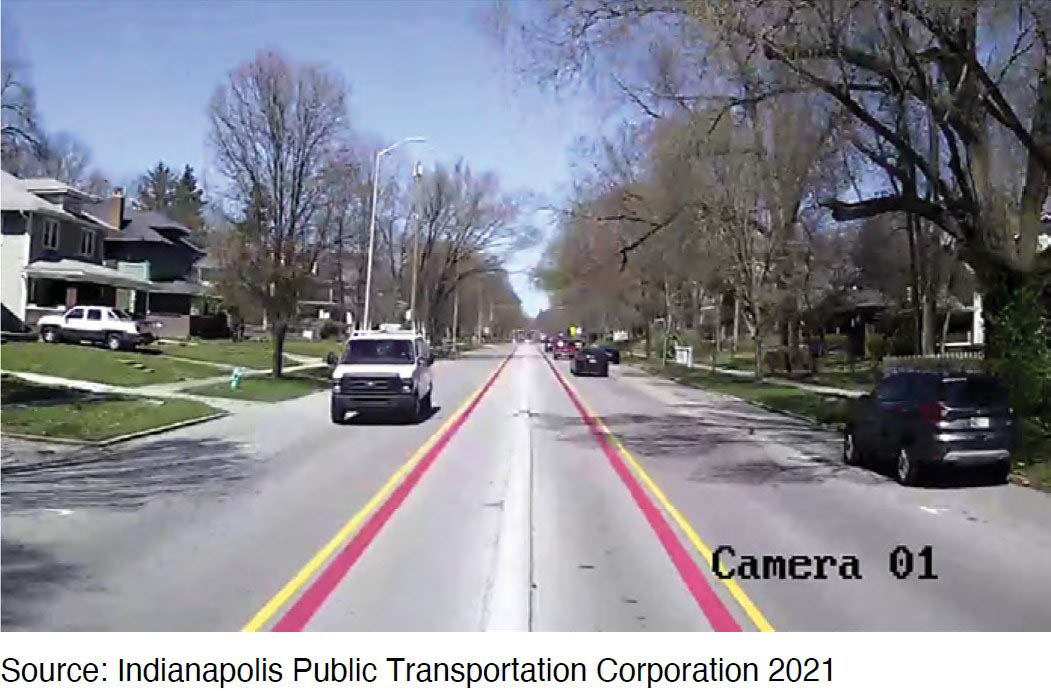
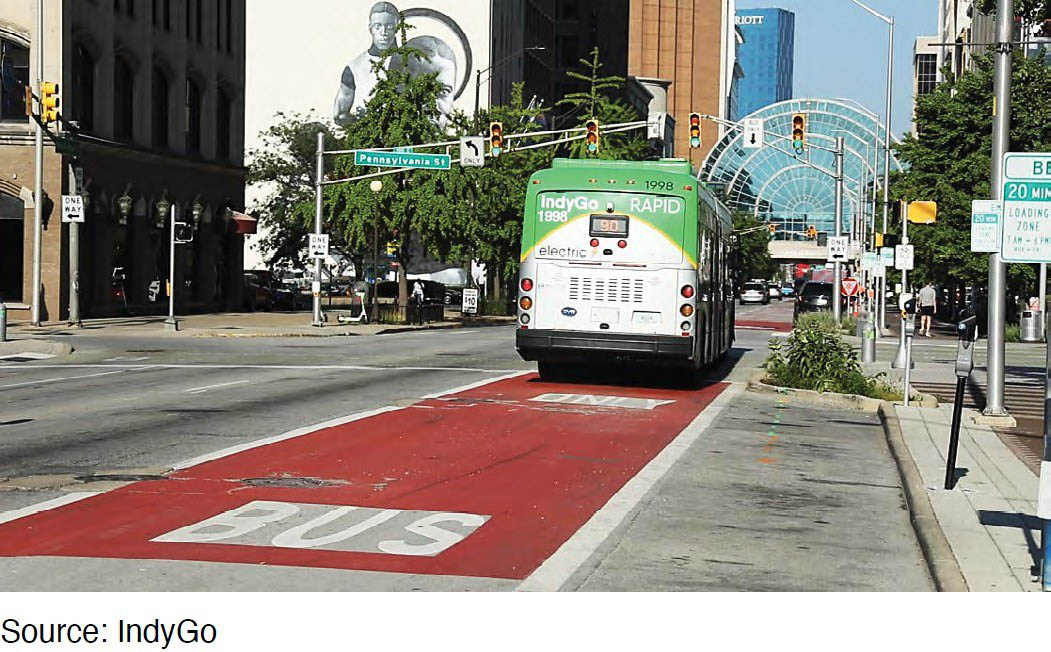
Interest in red-tinted bus lanes in Indianapolis arose from a desire to improve transit operations and reduce crashes. The first Red Line bus rapid transit (BRT) segment was a center-running lane (see Figure 22)—a design unfamiliar to local drivers—and the city and IndyGo believed that red tinting was necessary to add to the conspicuity of the lane. Red tinting also contributed to the branding of the BRT service as a fixed-guideway project (i.e., implementing red tinting instead of rails). City staff wanted red tinting in the contraflow segments of the Red Line to increase the visibility of the contraflow operation.
The Los Angeles County Metropolitan Transportation Authority (LA Metro) and LADOT initiated the planning of red-tinted bus lanes in Los Angeles to improve the speed and reliability of bus service. The first projects were completed when red tinting was still an experimental treatment and were coordinated with the California DOT (Caltrans) and the FHWA. LADOT and LA Metro coordinate to figure out which existing untinted bus lane will be the next to get red tinting—a decision informed by bus volumes and bus lane violation rates (to the extent that the latter violation has been documented). LA Metroʼs philosophy is that the bus lane itself is the core feature of the transit running way, with the red tint only highlighting it, as opposed to red-tinted bus lanes being something entirely different from untinted bus lanes.
LA Metro intends to manage the planning and funding of future red-tinted bus lanes across the metro area, with local governments handling installation. A long-term goal is to retrofit all existing untinted bus lanes with red tinting, and high-frequency bus routes may be considered for new
red-tinted bus lanes. (LA Metroʼs criteria for establishing bus lanes require bus services operating at a peak directional frequency of 10 minutes or less.) An alternative LADOT considered for improving bus lane compliance and increasing the speed and reliability of bus service was increased enforcement.
In Minneapolis, red tinting in the first corridor, Hennepin Avenue South, was applied to the asphalt just after a chip seal and patching project. It served as a pilot project since a road reconstruction project for the corridor was planned to start 5 years later. The red-tinting project was initiated by Metro Transit and city planning staff. An alternate to red tinting was more closely enforcing untinted bus lanes, but Metro Transit and the city deemed this to be infeasible due to limited enforcement staff. The agencies selected MMA for the pilot project in part because it was expected to last the 5-year period until the reconstruction project started. Bus lanes existed in the metro area for many years prior to implementation of the first red-tinted bus lane. Metro Transit and the city expect that new bus lanes will be tinted red to improve compliance and reduce enforcement needs; this is a goal more than a policy.
The purpose of the red tinting in New York City is to discourage drivers from stopping and parking in the bus lanes. NYCDOT and the New York Metropolitan Transportation Authority (NY MTA) initiated the red-tinted bus lane program together. NYCDOT prefers to install red-tinted bus lanes wherever possible due to the visibility they add to bus lanes. In locations where bus-only operation is in effect less than 5 hours a day, the agency will not add red tinting. Broadway is an example of a corridor with red-tinted bus lanes; bus lanes on Broadway are active from 7 a.m. to 10 a.m. and from 4 p.m. to 7 p.m., or for 6 hours a day. During off-peak times, when there is less congestion, the bus lanes are used for curb access (e.g., by delivery vehicles).
NYCDOT considers other physical treatments to separate bus lanes, including flexible posts and jersey barriers, but selection of a treatment depends on the location. For instance, one segment of Woodhaven Boulevard uses plastic delineators to separate the bus lane from general traffic and as a means of enhancing enforcement and safety. Untinted bus lanes are also considered as an alternative to red-tinted bus lanes. Removing a lane of traffic to create a bus lane (red-tinted or untinted) may have impacts on general traffic congestion and delay.
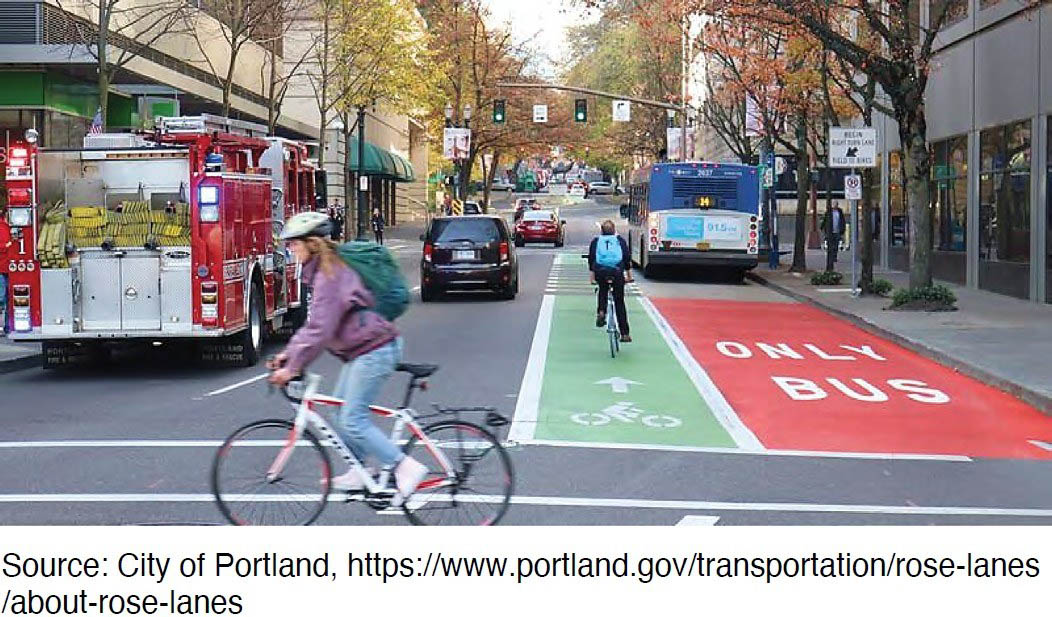
The City of Portland, TriMet, and Metro (the Portland-area metropolitan planning organization) collectively initiated the red-tinted transit lanes effort in the metro area. TriMet has two internal programs (the Better Bus and Transit Priority Spot Improvement programs) that seek funding for transit priority treatments, including red-tinted transit lanes. Some lanes extend outside of Portland.
The red-tinted transit lanes in the Portland metro area are a mix of business access and transit (BAT) lanes and exclusive transit lanes. All are full-time transit lanes. The city and TriMet work closely together to implement red-tinted transit lanes and make decisions about extending existing red-tinted transit lanes. Ultimately, city traffic engineers make the decision about where, how, and to what extent red tinting is implemented. Factors that are considered include bus volumes and input from TriMetʼs operations team (including bus operators) to see where transit-lane compliance issues are. Generally, if transit-lane compliance is already good, there might not be a need for red tinting. The city has also implemented red tinting to help drivers learn about a new transit-lane configuration. Implementing untinted transit lanes, with or without flexible vertical delineators, is considered as an alternative to red-tinted transit lanes.
TriMet is exploring left-side transit lanes with red tinting. There is a small-scale implementation of this treatment on SW Jefferson Street. The agency is planning a larger-scale implementation on SW 4th Avenue.
Red-tinted transit lanes in San Francisco emerged from a policy discussion about cost-effective ways to improve transit operations and performance. San Francisco has had transit lanes since the
1970s, but SFMTA found that the diamond symbol for bus/taxi lanes was not always understood by drivers, and violations were increasing with traffic congestion. Red tinting, first implemented in 2013, has typically been implemented along with other transit priority measures such as boarding islands, TSP, and stop consolidation. Red-tinting projects are initiated by SFMTA. The SFMTA red-tinted transit-lane program is one of the more visible transit priority treatments of the Muni Forward program, an initiative that started in 2014 and is designed to improve reliability and reduce delay. Red-tinted transit lanes have been implemented as a cost-effective alternative to curb-separated transit lanes.
SFMTA uses continuous red tinting for both visibility and branding. The agency believes that the red color clearly indicates that the lane is reserved for transit; it is visible in congested traffic when drivers may not be able to see text or signs. The continuous red tinting is also useful for branding as it shows where high-frequency transit services run. It has been used in marketing, with one slogan stating that SFMTA is “rolling out the red carpet for our riders.” The agency intends to apply red tinting to all full-time transit lanes in the city.
In Washington, DC, the District Department of Transportation (DDOT) and the Washington Metropolitan Area Transit Authority (WMATA) commenced the red-tinted bus lane project primarily to improve transit performance by keeping unauthorized vehicles out of bus lanes. The agencies chose to implement red-tinted bus lanes based on research indicating that the treatment would improve performance more than untinted bus lanes would and it would also make enforcement easier. Physically separated bus lanes—another alternative—are considered but can introduce challenges such as unauthorized vehicles in the bus lane impeding bus movements.
The criteria that are used to inform decision-making about implementation of red-tinted bus lanes in Washington, DC, include bus volumes, ridership, and transit delays.
Public Awareness
Findings
ABQ RIDE did not conduct a campaign to educate the public specifically about red-tinted bus lanes. Rather, ABQ RIDE relied on earlier education campaigns about bus lanes in general.
In Arlington, educating the public about the red tinting has been an ongoing effort, as development of the Transitway has occurred in segments and an extension is planned. Information about the red-tinted bus lanes has been posted online. Other outreach activities have included social media posts, distributing handouts on buses, and conducting public meetings and pop-up events. These activities provide information about the current Transitway as well as future plans for the Transitway. The majority of people who live and work in the area understand how the Transitway works, but there are a lot of visitors who do not.
To educate the public about the red-tinted bus lanes in Austin, CapMetro reaches out to the public via block walks, open houses, social media campaigns, and construction notices. The agency also provides information about red-tinted bus lanes on its website. Most feedback from the public about the red tinting has been positive.
In Boston, MBTA educates the public about red-tinted bus lanes during project outreach. Bus lanes have existed in the metro area for many years, and MBTA believes that most local drivers are familiar with them. Some education has been required for professional drivers.
When the first red-tinted bus lanes were installed in Denver, the city issued press releases about them. The city also conducts outreach to adjacent properties ahead of construction.
To educate the public about the red-tinted bus lanes in Indianapolis, the city and IndyGo used tutorial videos posted online, public meetings, and printed materials.
In Los Angeles, no educational outreach specifically about red-tinted bus lanes has been conducted. All red-tinting projects to date have been retrofits of existing untinted bus lanes, and LA Metro believes that the public is already familiar with how bus lanes work. The agency intends to provide educational materials on a project-by-project basis when installing a new bus lane (tinted or untinted). If the new bus lane features red tinting, the educational materials will reference the red-tinting treatment.
In Minneapolis, public education about red-tinted bus lanes included press releases and local news coverage. The city and Metro Transit noted that tutorial videos for the public were useful when the red-tinted bus lanes were first implemented; a refresher tutorial video campaign might be needed.
In New York City, efforts to educate the public about red-tinted bus lanes have taken the form of public meetings, workshops, social media posts, flyer distribution, and meetings with individual stakeholders, elected officials, and other partners.
The City of Portlandʼs Rose Lanes program has conducted extensive outreach and education related to the red-tinted transit lanes in Portland. TriMetʼs Better Bus program is anticipated to provide educational materials about red-tinted transit lanes regionally. Portland Streetcar staff have reached out to the state Driver and Motor Vehicle Services division about adding information about turns across transit lanes to the driver education manual; this may be an opportunity to provide information about tinted pavements in general.
When red-tinted lanes were first introduced, SFMTA ran public education campaigns using its website, social media, and ads on the exterior of buses. Transit lanes have existed in San Francisco for years, and the rules for red-tinted lanes are the same as for other transit lanes.
In Washington, DC, DDOT conducts extensive public outreach during the red-tinted bus lane planning period. The agency uses a variety of ways to reach the public, like social media posts, posters, in-person events, word of mouth, and its website. DDOT indicated that, with the increasing number of red-tinted bus lanes in the District, it has seen an increase in public acceptance and compliance. The launch of automated enforcement known as the Clear Lanes project—a partnership with WMATA—was an opportunity to provide information about red-tinted bus lanes.
Design and Implementation
Findings
In Albuquerque, red tinting is integrated into the concrete running way at BRT stations. Red treatments are also used in locations where bus movements are unusual compared to driversʼ and pedestriansʼ expectations for general traffic. The bidirectional segment of the bus lane east of downtown Albuquerque is an example of this, as is the bidirectional segment near the University of New Mexico.
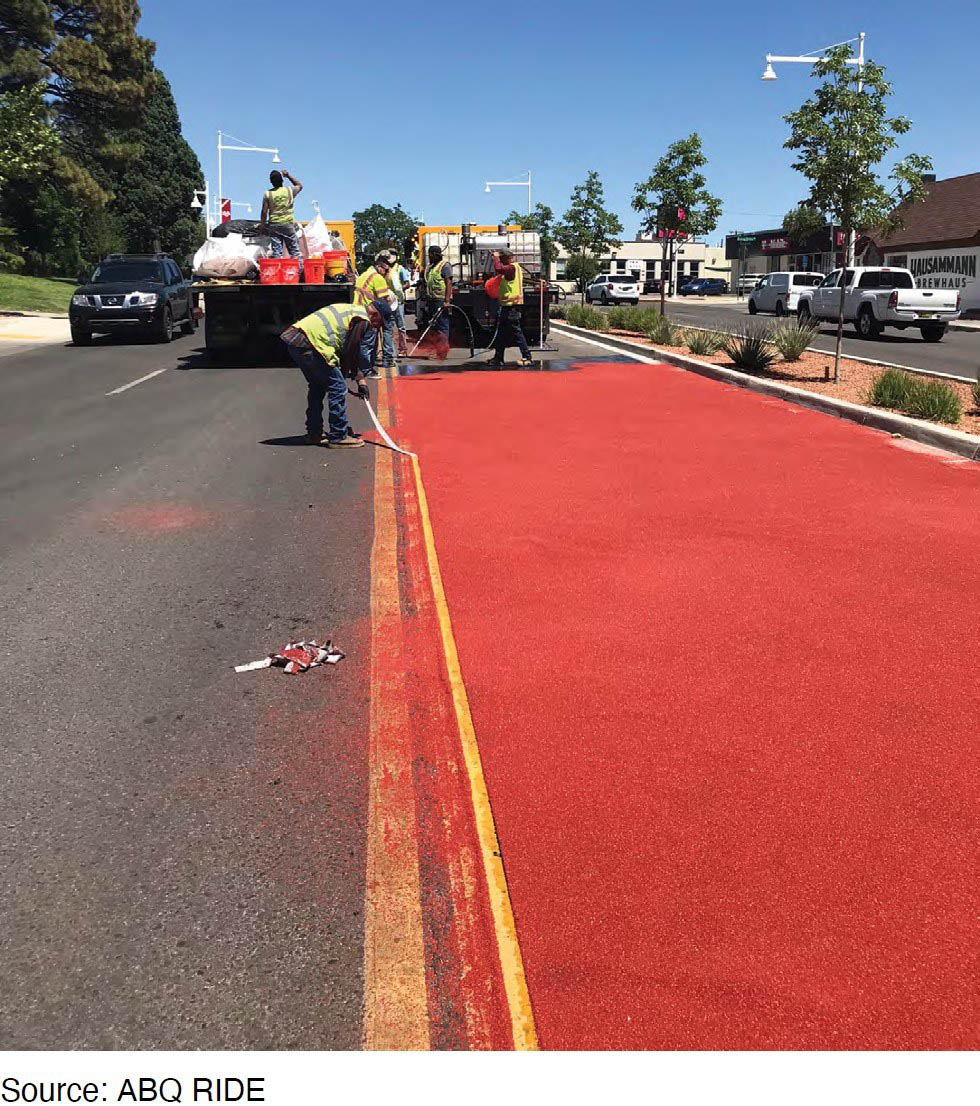
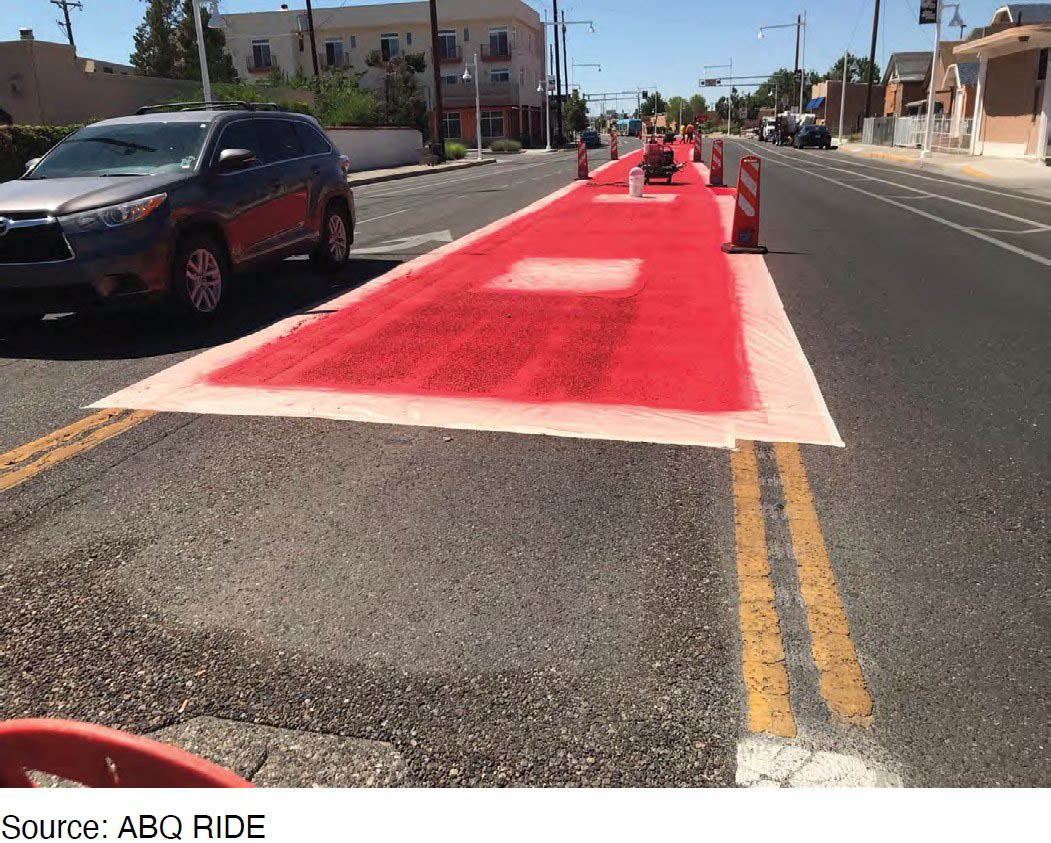
Outside of station areas, ABQ RIDE first applied an HFST using color-coated glass aggregate treatment (Ruby Lake). Figure 23 shows the installation of this treatment. To reduce installation time and labor costs, ABQ RIDE switched to a red paint and epoxy treatment (DecoCoat DP 200 polymer system surface coating). Installation of the red paint and epoxy treatment is shown in Figure 24. The agency stated that red thermoplastic, an alternative considered, seemed too expensive.
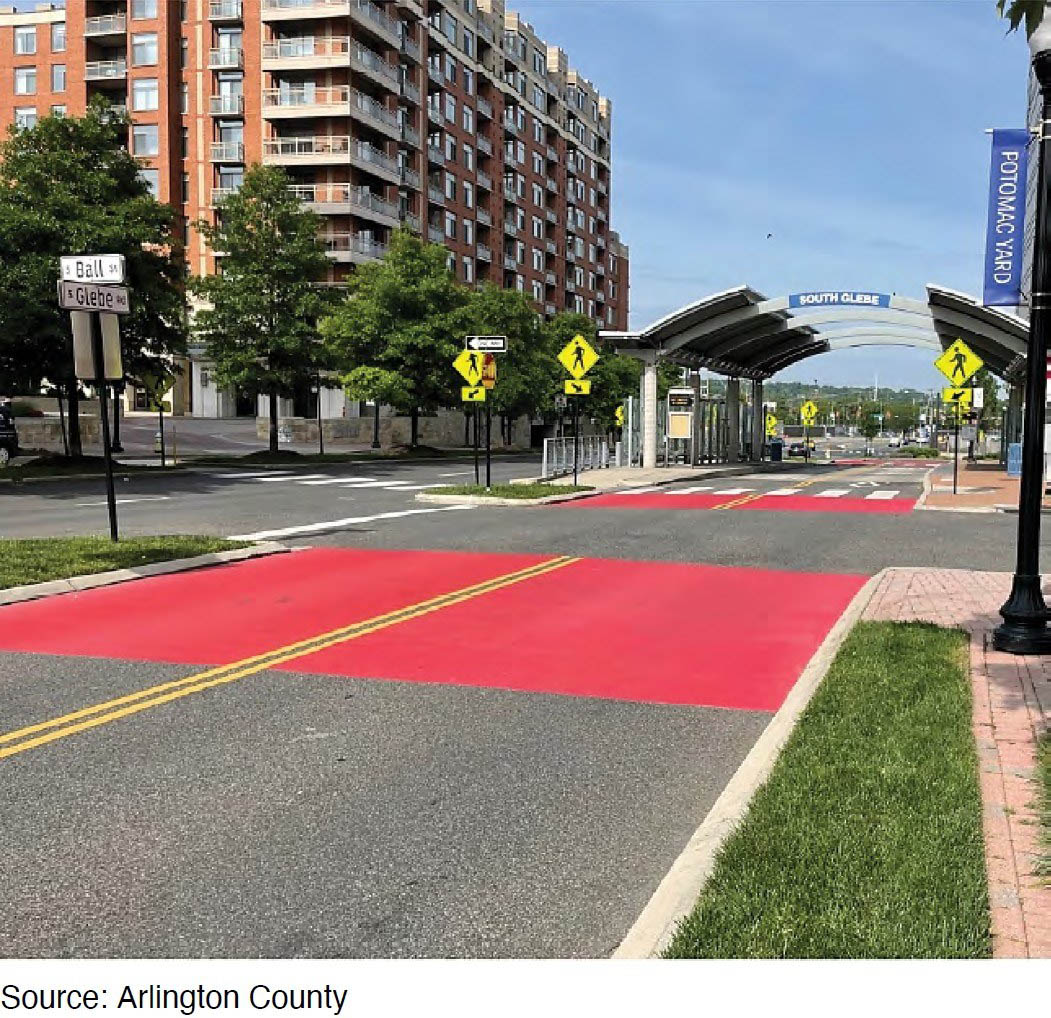
In Arlington, red tinting in the form of red paint and red thermoplastic was applied at six high-frequency bus stops and terminals and upstream and downstream of two intersections along
the Transitway. The intersection treatment is shown in Figure 25. Red tinting was applied in an intermittent design along the Transitway to reduce costs.
Arlington Countyʼs Transportation Engineering and Operations Bureau took the lead in applying the red-tinting treatment. That team had experience with both red paint and red MMA (Ennis-Flint). The traffic engineering team is trying to figure out which treatment options are most effective, most cost-effective, and less maintenance-intensive given the climate and how buses are operated.
The City of Austin currently uses red thermoplastic (as shown in Figure 26) and red MMA to achieve red tinting. The city stated that MMA is fairly expensive, requires specialized training for crews who are installing the treatment (e.g., to achieve skid resistance), and requires approximately 2 hours of curing time after implementation before vehicles can drive in the lane. The curing time can be disruptive to traffic, particularly at locations (like driveways) where vehicles are blocked from using the lane during that period.
On Guadalupe Street and Lavaca Street, the City of Austin generally installed red tinting on one to two blocks per day, on weekdays during off-peak periods. There were a limited number of weekend installations as well. Installation was coordinated around construction projects (e.g., county courthouse construction).
The red-tinted bus lanes in the Boston metro area are typically designed by MBTA and the local jurisdiction and installed by contractors. All of MBTAʼs red-tinted bus lanes implemented to date use a continuous red design, including part-time lanes where parking is allowed outside of the peak hours. Most bus lane projects are short (i.e., less than 1/2 mile in length), and the visibility of a continuous red-tinting design has been prioritized over the cost savings of an intermittent design. MBTA may consider an intermittent design for bus lanes that have physical separation. There are also ongoing concerns about using red tinting for part-time bus lanes since it may be confusing to drivers, and the sight of vehicles parked on a red-tinted lane off-peak degrades the brand.
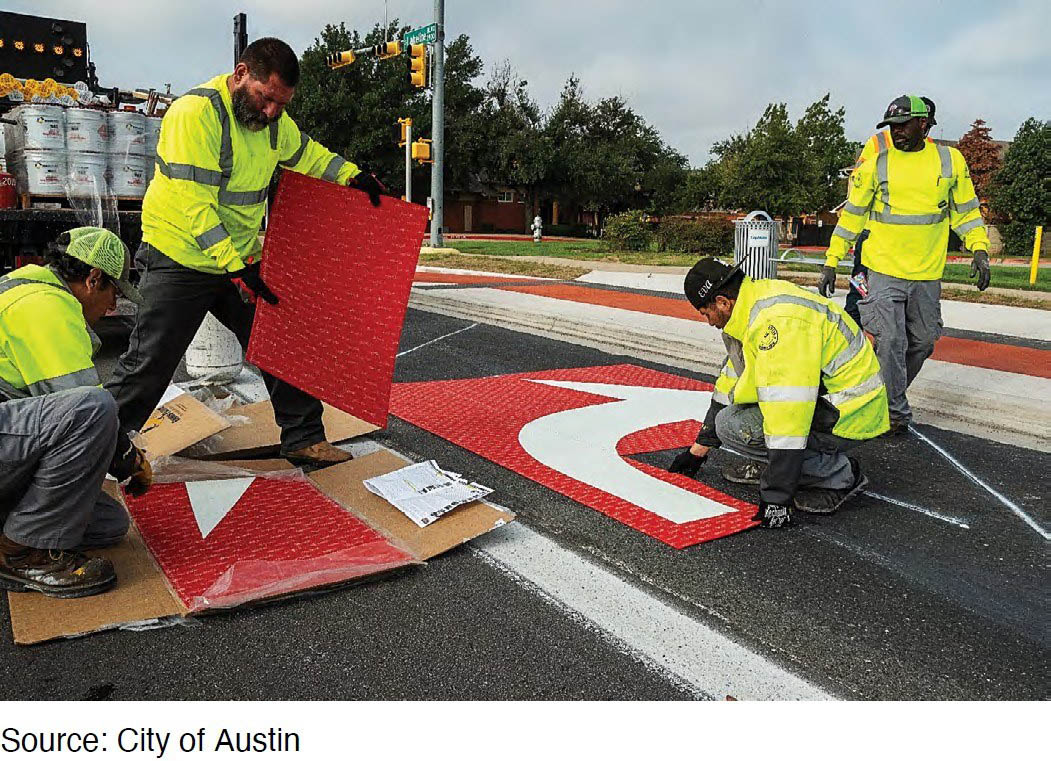
MBTA is a large agency and has successfully implemented red-tinted bus lanes in partnership with several municipalities within its service area. The same red materials are used consistently across the metro area, but other parameters of the bus lanes—including the placement, length, time-of-day restrictions, and allowed users—vary depending on local needs and local context. MBTA often considers the legibility of the lane to other roadway users and the feasibility of physical separation/protection. Once there is consensus with local municipalities on the design, red-tinting projects are relatively quick to implement.
MBTA currently uses an HFST with red color–coated glass aggregate (Ruby Lake). The agency indicated that this treatment is durable in inclement weather, and its application is not overly complex. The agency noted that materials procurement for the treatment can be an issue in rare circumstances. Its cost is not as low as that of other options, but MBTA believes the cost is reasonable given its durability. The HFST with color-coated glass aggregate is currently the preferred material.
MBTA reported that the cost of application of red tinting ranges from $6 to $10 per square foot. For a lane 12 feet wide, this is $380,000 to $634,000 per mile. The Metropolitan Area Planning Council negotiates price lists that any city in the metro area can use to procure red-tinting materials and other pavement marking materials. MBTA and local jurisdictions can pool their striping and pavement marking projects into a single bid.
The City of Denver conducts traffic studies in advance of implementing bus lanes to make sure that automobile level of service does not decline significantly. There was a pre-implementation perception that the red-tinted bus lanes on Broadway would have a negative impact. Broadway was not operating at capacity, however, so no negative impact manifested. Bus volumes were already high enough in the 15th Street/17th Street corridor to result in de facto bus lanes, so implementation of red-tinted bus lanes in that corridor did not have a negative impact either. No parking lanes were converted to bus lanes except on Lincoln Street.
During the review of a state highway plan, Colorado DOT raised a concern about the level of skid resistance of red-tinted bus lanes. The city addressed this concern by using red tinting only as background for text and symbols and in conflict zones. Another benefit of the background red tinting design is that it uses less thermoplastic than a continuous red-tinting design; it was deemed too costly to implement continuous red-tinted bus lanes with thermoplastic.
Background red tinting is likely to be the cityʼs standard treatment for bus lanes in the future because state and city officials want to see consistency in bus lanes. Red tinting might also be used for features like bus pullouts to distinguish them from vehicle turning lanes. Denver is working on developing transit design guidelines to result in more consistent implementation of red-tinted bus lanes. Bus volume is likely to be a criterion since the red-tinted bus lanes in the high-volume 15th Street/17th Street corridor were very successful.
Denver implements red-tinted bus lanes using contractors. (If red-tinted bus lanes are implemented outside the City of Denver in the future, RTD would expect the local jurisdiction to take responsibility for implementation and maintenance.) The city indicated that it prefers thermoplastic as a red-tinting treatment because its contractors use thermoplastic for bicycle lanes and can easily install it in bus lanes too. The city stated that MMA is more expensive and has environmental impacts, so it is much less sustainable, even though it can be made with recycled materials. The process of creating it has side effects, and the material itself can burn skin. The city and RTD noted that, while thermoplastic is cheaper than MMA, it does not work well on concrete pavement surfaces without additional advance preparation of the concrete. MMA appears to be less sensitive to the pavement surface type. The city has considered trying tinted asphalt but believes that its current materials are adequate.
The City of Denver is considering converting the full-time, red-tinted bus lane on Blake Street in downtown Denver to a part-time lane. The city has not decided if the red tinting will be retained if the bus lane is converted. The cityʼs engineering standards do not currently address red-tinted bus lanes but, having acquired experience with bus lanes and red tinting, the city is more comfortable about developing documented guidelines and requirements. In Denver, a policy currently under development is expected to address whether part-time bus lanes will be red tinted.
The City of Indianapolis and IndyGo use different red-tinting designs in different segments of the Red Line. An example of the cityʼs design guidance is shown in Figure 27. Continuous and intermittent designs are used where buses have exclusive use of the bus lane; broken-pattern red tinting is used where other vehicles cross or share the bus lane. In some locations, the tinting is achieved by coloring the full width of the bus lane red, as shown in Figure 28. In other locations, the tinting is achieved with red striping along the lane lines (a partial-width treatment), as was shown in Figure 22. The red-stripe design originated as a means of reducing costs, which is increasingly important to the agencies as they have started to implement corridor-length red tinting instead of tactical implementations. (IndyGo noted that full-width red tinting would have cost about $6 per square foot.) The red-stripe design is used only where there is a curb or other separator to keep traffic from crossing the bus lane.
During the experimental phase, the City of Indianapolis tested the following red-tinting applications:
- Epoxy on concrete
- Thermoplastic on asphalt
- MMA on concrete and asphalt
At the time of this writing, MMA is used for all red tinting in Indianapolis except in the red-stripe design. (The red stripe is thermoplastic or a multicomponent material.) MMA is on the stateʼs pre-approved materials list and has been used on bicycle lanes in the city, so it is readily available and the city and its contractors are familiar with its application and performance. The city and IndyGo report that MMA is durable, generally easy to apply, and effective, but also costly. The material is expensive compared to other options, and it requires a crew of four to five to install. The agency noted that application of MMA can be complex
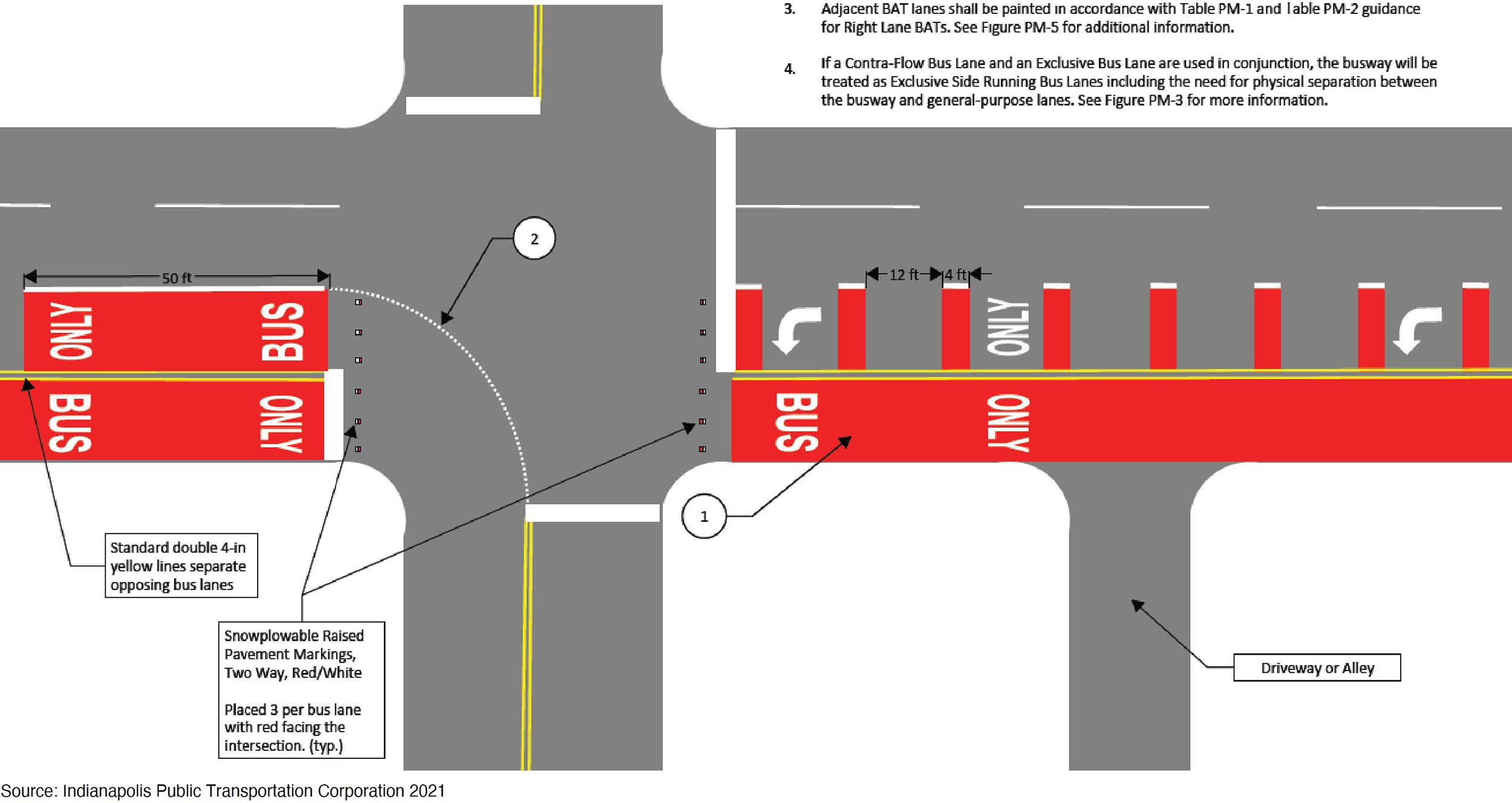
Long Description.
The lanes include white directional arrows and are separated by standard double 4-inch bus lanes. A curved dashed line indicates a turning path across the bus lane. A measurement label shows ‘50 feet’ along the left bus lane. Text boxes read: Standard double 4-inch yellow lines separate opposing bus lanes, and Snowplowable Raised Pavement Markings, Two Way, Red or White. Placed 3 per bus lane with red facing the intersection (type). On the right side, a buffer-separated section includes vertical red-and-white elements with spacing labelled ‘12 feet’ and ‘4 feet’. A label identifies ‘Driveway or Alley’. Numbers ‘1’ and ‘2’ point to a specific bus lane and intersection. The top-right text reads: Adjacent BAT lanes shall be painted in accordance with Table PM-1 and Table PM-2 guidance for Right Lane BATs. See Figure PM-5 for additional information. If a Contra-Flow Bus Lane and an Exclusive Bus Lane are used in conjunction, the busway will be treated as Exclusive Side Running Bus Lanes, including the need for physical separation between the busway and general-purpose lanes. See Figure PM-3 for more information. Source: Indianapolis Public Transportation Corporation 2021
in particular respects; for example, it indicated that it can only be applied under certain temperature conditions (above 50°F). The agency also observed that, in one project, application of MMA on rebuilt concrete pads at Red Line stations created a significant disruption in Red Line service.
The red-tinting projects implemented in Los Angeles to date have mostly been retrofits of existing untinted bus lanes; some of these bus lanes serve buses as frequently as one per minute. Red tinting has also been used in queue jump lanes and exclusive bus turn lanes. The initial, experimental implementation of red-tinting treatments in Los Angeles used an intermittent design to save on material installation and future maintenance costs. Evaluation results showed the intermittent treatment to be effective at decreasing bus lane violations, so intermittent has become the standard for future bus lane projects. (Additionally, LA Metro does not want drivers parking on a continuous red-tinted bus lane because doing so would dilute the meaning of the continuous red-tinted lanes.) LA Metro uses a continuous red treatment in short segments like exclusive turn lanes or queue jumps to emphasize that cars are not allowed. A continuous red treatment may be considered in other cases if an intermittent treatment is not achieving the desired compliance.
LA Metro and LADOT have tested different red-tinting materials. Their current preference is for thermoplastic, which is durable given the speed and volume of buses, has good skid resistance and retroreflectivity, is satisfactory in color, is fast to apply, and is available preformed (Ennis-Flint product). Fast application limits the duration of lane closures. The agencies observed that MMA is messy and odorous, and epoxy sprays require long cure times and multiple applications.
LA Metro prefers that local jurisdictions install the red tinting, but the agency can contribute funding for it. LA Metro recommends that local jurisdictions use California MUTCD signage and pavement markings for all bus lanes, red tinted or not.
Metro Transit and the City of Minneapolis considered an HFST with color-coated glass aggregate to achieve red tinting but had concerns about its ability to withstand winter weather (i.e., its ability to endure road salt and snowplowing). Red MMA (as shown in Figure 29) has been the material used for bus lanes in Minneapolis. To apply MMA initially, the city bought a sprayer but had issues with the material application rate and the machineʼs durability because the sprayer was designed to paint crosswalks and pavement symbols, not miles of bus lanes. On later projects, MMA was applied by hand, which is much slower but produces a better thickness. Metro Transit plans to continue using MMA on future projects but may also consider latex. The agency noted
that MMA installers have to wear respirators, and it has concerns about the environmental impact of MMA. Metro Transit has contracted out implementation since the first project.
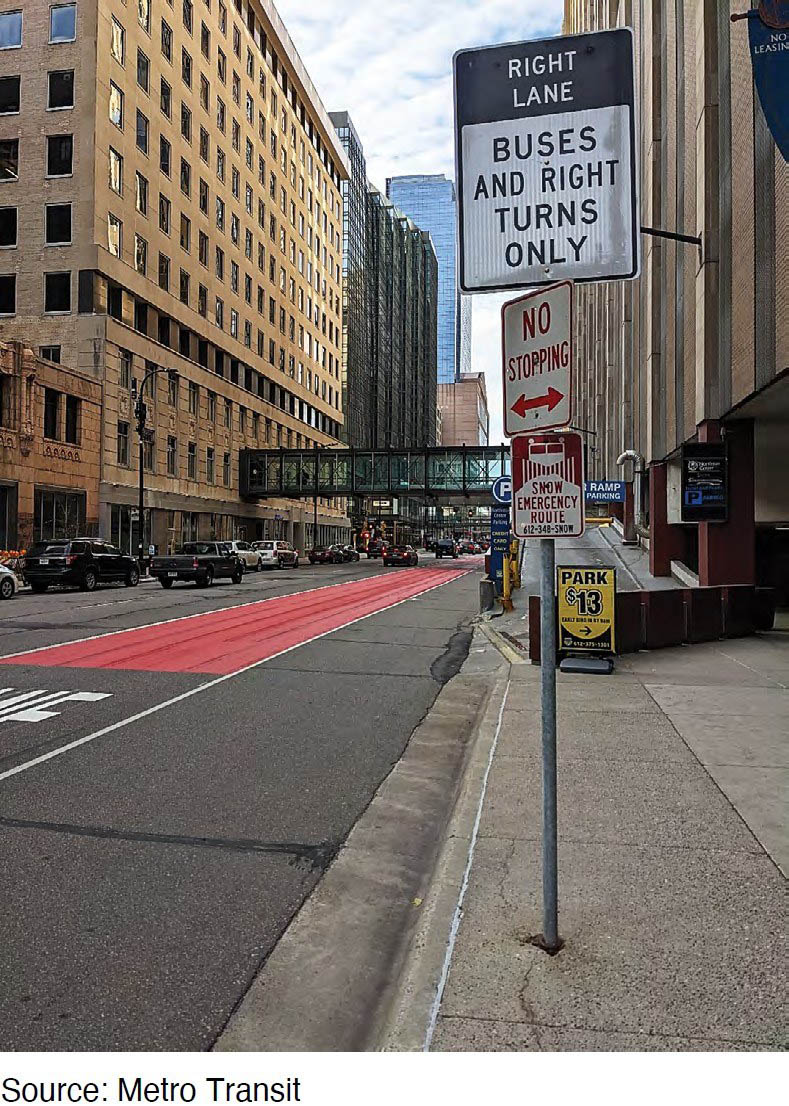
The Hennepin Avenue project in Minneapolis uses full-length red-tinting treatment for maximum visibility because of a high number of curbside conflicts. The red tinting is supplemented by static signage at the curb and variable message signs (VMSs) overhead. The red-tinting design is the partial-width treatment shown in Figure 30; this treatment avoids the gutter and leaves a
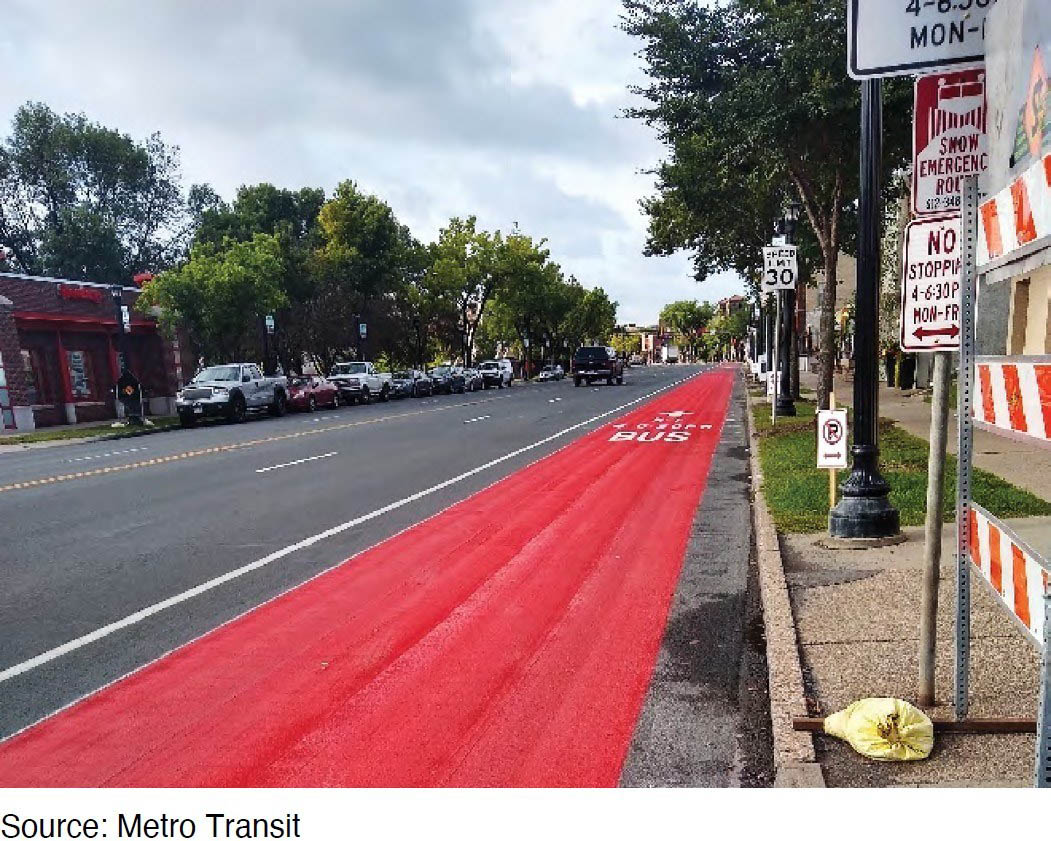
1-foot buffer next to the white lane line. This design was intended to reduce costs; the design is now deprecated as the MUTCD specifies that red tinting should span the full width of the bus lane. To save costs in future projects, Metro Transit is planning to use an intermittent design in areas with fewer intersections, driveways, and curbside conflicts.
NYCDOT stated that quick implementation of projects like bus lanes is essential within the New York City environment. Ideally, a red-tinted bus lane project could be conceptualized and implemented within half a year. When asked about the experience of implementing bus lanes using different red-tinting materials, agency staff shared the following:
- A disadvantage of using red paint as the default tinting material is extended lane closures due to the required four or five coats and associated drying time. Full-time staffing was required to ensure that the required number of coats were applied.
- For MMA red-tinting treatments, NYCDOT established criteria for coefficient of friction for the aggregate, and after one vendor failed to meet that friction level, the agency began to require bauxite or corundum aggregate to provide an adequately high-friction surface. NYCDOT indicated that this treatment is durable, it should extend product life, and it should help reduce overall costs.
- A benefit of MMA and the HFST with color-coated glass aggregate is that these materials have a quick cure time after application, allowing lanes to reopen sooner. In addition, these treatments can be applied in cold weather, allowing more scheduling flexibility. NYCDOT and NY MTA found that both treatments clearly defined the use of the roadway.
- A disadvantage of MMA is its strong chemical odor during application at and around the installation site.
- NYCDOT is still experimenting with red tinting applied to concrete since it has found that no red-tinting surface treatment adheres particularly well to concrete, especially if it is not pretreated appropriately. The agency stated that, ideally, it would tint the concrete red, but there are so many utility cuts and construction projects on New York City streets that it would be challenging to restore tinted concrete if it were damaged.
NYCDOT was initially concerned that some bicyclists might slip on the red-tinted lanes, but this concern has not been realized.
TriMet stated that it is typically the local jurisdictions in the Portland metro area that implement red-tinted bus lanes. The local jurisdictions tend to conduct this through their maintenance departments or contractors. TriMet has been more involved when the red-tinting projects are components of larger, high-capacity transit projects. TriMetʼs involvement may increase as the agency continues to develop its Frequent Express system. The City of Portland is in the process of updating its traffic design manual to include red-tinting treatments. There are no common design standards across jurisdictions in the Portland metro area.
The red-tinting design used in the Portland metro area BAT lanes (i.e., an intermittent treatment featuring red tinting at the beginning of blocks, as illustrated in Figure 31) was chosen with the goal of minimizing maintenance costs with respect to materials and labor. The City of Portland and TriMet also wanted to make responsible use of materials. Treatments that did not cover the full length of the bus lane were, thus, of primary interest to the agencies. The city prefers to use MMA for red-tinting treatments due to its durability and its experience using it in bicycle lanes. There has been discussion about trying red-tinted concrete in a future rebuild of transit lanes on the Burnside Bridge.
In San Francisco, SFMTA has found that, compared to other types of prioritized transit—such as LRT and full BRT—red-tinted bus lanes like the one shown in Figure 32 are economical.
Long Description.
The green-painted bike lane with a bicycle symbol alongside a red-painted bus-only lane marked ‘ONLY BUS’. A cyclist rides in the bike lane while another cyclist crosses. A bus travels ahead in the bus lane, and several cars move in adjacent lanes. A truck is on the left side of the road. Trees line the street, with traffic signals above. Source: City of Portland, https://www.portland.gov/transportation/rose-lanes/about-rose-lanes
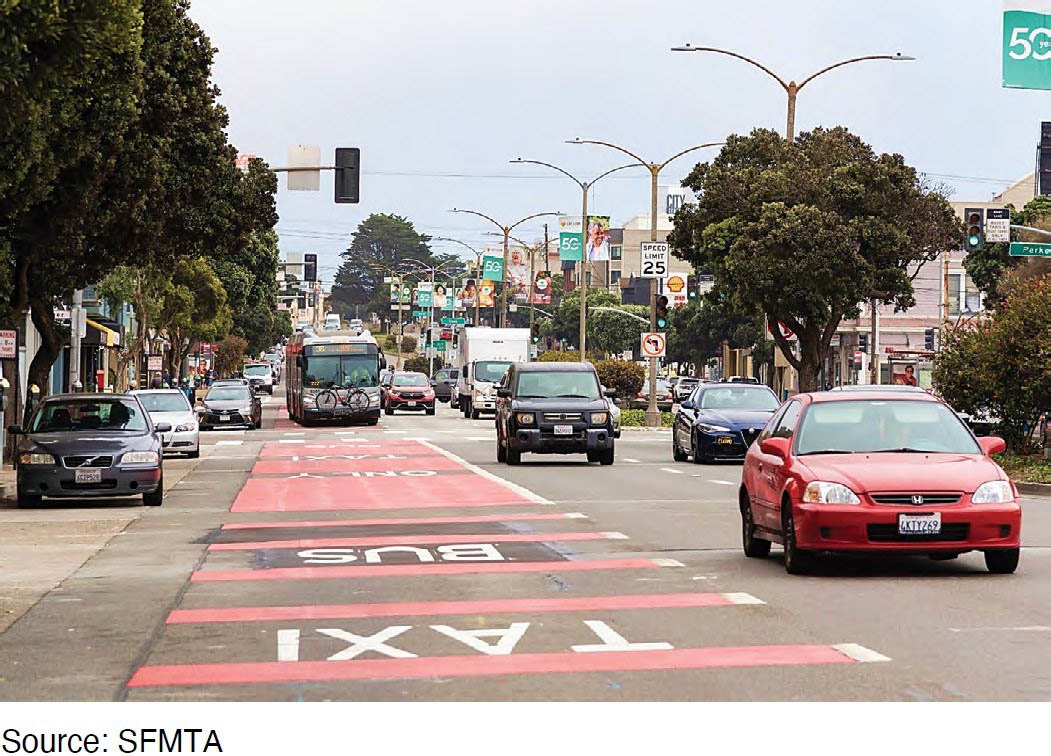
SFMTA reported that the up-front implementation cost for its red-tinting treatments is about $1 million per lane mile. In some cases, new transit lanes implemented as part of pilot projects are not tinted until the pilots are adopted as permanent projects. Quick-build transit lanes may not be tinted red until permanent project construction or pending funding availability. SFMTA uses thermoplastic across most of its red-tinted transit lanes.
SFMTA has generally used red tinting for all new full-time transit lanes since 2013, but not for part-time transit lanes. SFMTA staff indicated that they believe there is potential for driver confusion or reduced effectiveness of the red tinting when it is used in part-time transit lanes. SFMTA indicated that, in cities with lower rates of violations, intermittent red tinting may make more sense, especially if there are funding constraints.
SFMTA observed that red tinting can be a contentious treatment and, across many of the projects that SFMTA has implemented, there has been pushback in some cases by merchants, community organizations, elected officials, motorists, and other groups. Objections range from concerns about aesthetics, concerns about traffic impacts, and cultural issues such as
concern that transportation improvements such as red-tinted transit lanes can be a harbinger of gentrification. However, among riders, implementing red-tinted transit lanes is a popular transit priority treatment and, given the benefits—including faster travel times, improved reliability, and improved safety—riders and transit advocates are generally supportive of red tinting. Bus operators are generally supportive as well, given that lane compliance improves with red tinting. Operators have some concerns with the traction of red-tinted lanes when it rains, given that a thermoplastic treatment may reduce traction; however, SFMTA adds glass beads on the top of the treatment to increase friction and retroreflectivity, which seems to mostly address this issue.
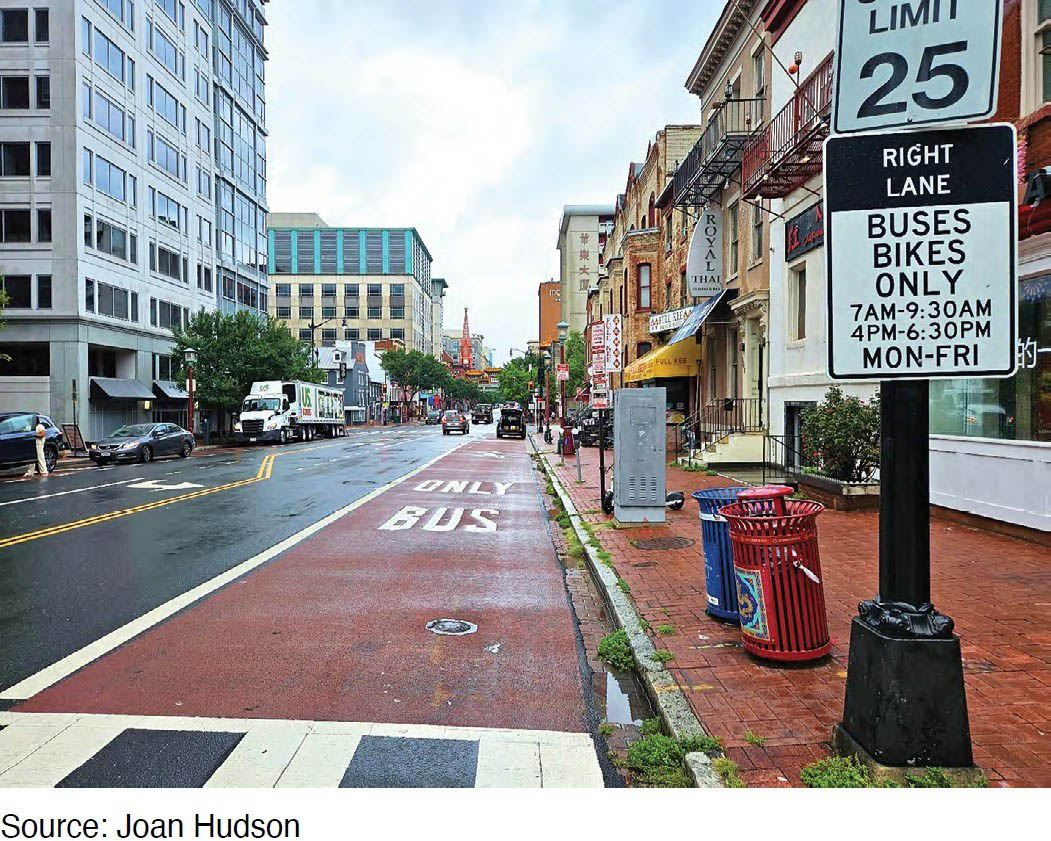
In the Washington, DC, metro area, the majority of DDOTʼs red-tinted bus lanes (one of which is shown in Figure 33) were built as red-tinted bus lanes from the beginning. Some of the pre-existing bus lanes were later retrofitted with red tinting. The general plan for red-tinted bus lanes in the metro area is for them to be in effect full time, although there are some bus lanes that are in effect during specific hours (e.g., 7:00 a.m. to 7:00 p.m.) where the regulation to make them full-time bus lanes has not been updated.
DDOTʼs first red-tinted bus lane was the retrofit of a part-time curbside lane. Red water-based paint was used in the initial installation. The paint did not last long, but it was inexpensive compared to other red-tinting treatments.
DDOT stated that, until recently, its preferred red-tinting treatment was an HFST with color-coated glass aggregate (Ruby Lake) because it seemed to wear better and offer higher friction than alternatives. The downsides of the HFST with color-coated glass aggregate are that it is more expensive to install, installation requires specialized equipment, and there is limited availability of suppliers that can install it. The limited installation resources have made it difficult for DDOT to establish construction and maintenance timelines, which has led to delays and, accordingly, higher costs. DDOT has switched to MMA for upcoming projects because of the limited installation resources.
DDOT indicated that it mostly uses broken-pattern red tinting where general-purpose traffic could be crossing bus lanes. Cars are allowed to enter a red-tinted bus lane 40 feet in advance of a turn. Sometimes there is a sign to mark a different entry location, but the default is 40 feet.
Long Description.
The roadside sign reads ‘Speed Limit 25’ and ‘Right Lane Buses Bikes Only 7 AM to 9:30 AM, 4 PM to 6:30 PM Monday to Friday’. Vehicles, including cars and a truck, are on the road. Buildings line both sides of the street, with a sidewalk and trash bins. Source: Joan Hudson
Operation
The City of Austin and CapMetro collaborated to develop standard operating procedures for bus lanes.
MBTA noted that bus operators in the Boston metro area have said that the red-tinted bus lanes reduce their stress. Primarily, the red tinting makes it easier for them to get to curbs. It also reduces obstacles in the bus lane and helps operators stay on schedule. MBTA administrative staff conduct outreach with bus operators before and after bus lane installation.
For part-time lanes, MBTA indicated that it tries not to paint time-of-day restrictions on the pavement. The restrictions are more easily changed if they are conveyed via signage instead.
MBTA reported that allowed users of red-tinted bus lanes are determined by the roadway owner (i.e., the local municipality) and the specific design of the lanes. In some cases, the roadway is a designated truck route, and MBTA will permit trucks. Similarly, sometimes turning vehicles or bicycles are permitted, but it depends on individual project design.
MBTA reported that the red paint originally used to create red-tinted bus lanes resulted in operator complaints about its slipperiness.
The City of Denver and RTD coordinate regularly about issues that bus operators are experiencing in the bus lanes. The agencies try to resolve these issues with quick fixes or document the issue for future resolution.
The City of Denver and RTD advised that, on the busiest bus lane corridors, other agencies could consider using a double bus lane design (as on 15th Street and 17th Streets in Denver) so that buses can leapfrog buses that are pulled over at stops. Also, double bus lane design allows for separation of buses and right-turning vehicles; the latter can often stack up in busy pedestrian areas. Both bus lanes can be red tinted.
The City of Indianapolis and IndyGo noted that curbside activity can cause issues in the curbside red-tinted bus lanes. They cited the case of a specific hotel property where there are often so many automobiles in the shared portion of the bus lane that bus operators will leave the bus lane to go around them.
The City of Indianapolis observed that agencies cannot rely just on pavement markings (red or not) to make bus lanes work effectively. The city and IndyGo learned through a crash study that agencies also need signs—and signs are not enough on their own. Multiple methods should be used to achieve bus lane compliance. The city noted that it installed plastic delineator posts at first to call extra attention to the lanes, but those were removed because they were too restrictive for bus operators.
On Hennepin Avenue in Minneapolis, Metro Transit went with part-time bus lanes to provide transit priority during the times of day when buses were most affected by congestion and to accommodate business owners who were opposed to completely removing on-street parking.
In Minneapolis, the red tinting is not as visible in snowy conditions, but the bus lane restriction is also indicated by curbside signs and overhead VMSs. The VMSs are also used for special-event traffic management and detours. Most of the red-tinted bus lanes are curbside, and the width of these lanes is reduced by snowbanks in the winter.
Bicyclists are allowed to use bus lanes in Washington, DC. DDOT acknowledged that there might be leapfrogging of buses and bicyclists. DDOT indicated that bicyclists in red-tinted bus lanes are generally not a problem, as the bus lanes are not high-speed roadways. The 14th Street
NW shared bus–bicycle lane includes short sections with a passing lane (also red tinted) for bicyclists to use to move around buses at bus stops.
In Washington, DC, with respect to the dual red-tinted bus lanes near the White House, buses can use the inside bus lane to pass buses that are stopped in the outside bus lane.
Enforcement and Lane Usage
Findings
ABQ RIDE reported that many violators of the bus lane restrictions in Albuquerque are drivers who do not know they are in the wrong lane. Because traffic congestion levels are not high in Albuquerque, drivers who enter the bus lane by mistake are not seen as a significant problem unless they are stopped in the bus lane at an intersection and trying to make a left turn. In that circumstance, there may be only a single receiving lane at that location, intended for drivers turning left from the correct lane, so buses could be delayed.
ABQ RIDE found that implementing red tinting in the bidirectional bus lane segments was inadequate to deter illegal left turns across the bus lane at unsignalized locations. The police department issued warnings for these illegal left turns at first. The pinned curbs were placed on one side of the bidirectional lane. They were placed to the left side of buses approaching the intersection so that an overtaking bus could pull out and merge with traffic traveling in the same direction (rather than go into opposing traffic). ABQ RIDE noted that it is still beneficial to have red lanes in the bidirectional segments to call driversʼ and pedestriansʼ attention to buses doing something unusual in comparison to general traffic (e.g., operating in contraflow).
ABQ RIDE reported cases in which drivers tried to pass parallel-parking drivers by going into the bus lane. The agency also reported ongoing issues with drivers running left-turn signals—mostly where there is no red tinting—and crashing into a bus in the bus lane. ABQ RIDE noted that 65 crashes of this kind have occurred since 2019. ABQ RIDE started a project in 2024 to apply red tinting at the problematic intersections. At these locations, the agency is considering applying red tinting 200 feet upstream and 200 feet downstream of the intersection.
Arlington Transit stated that there have been several crashes at Transitway entry and exit points involving drivers who have entered the busway by mistake. The agency is looking into installing additional signage and potentially implementing camera-based enforcement to reduce these crashes. (There are currently cameras on buses for evaluating crashes and near-crashes, but they cannot be used for enforcing bus lane restrictions.) The agency is weighing the number of violations against the cost of using cameras for enforcement. Legislative changes within the Commonwealth of Virginia would be needed to permit camera enforcement of bus lanes; this would require political support. The agency also looked at installing railroad crossing–style gates at intersections to deter drivers from entering the Transitway but concluded that these would be too costly to install and maintain. It is likely that the agency will try additional signage first and move forward with the camera and gate options if the signage does not address the crashes. One stop-controlled intersection might be redesigned to reduce crashes with buses caused by drivers who fail to stop.
Arlington Transit noted that bicyclists can use the Transitway where there are shared bus/bicycle/high-occupancy vehicle (HOV) lanes; the shared lanes do not have red tinting. Bicyclists are not allowed in the bus-only lanes, which feature intermittent red tinting. However, bicyclists sometimes use the bus-only lanes; the agency hypothesized that bicyclists might be confused because they are allowed to use the lanes in other sections of the Transitway. The agency has not
tried to address bicycling in the bus-only lanes through law enforcement. Rather, they are working with cycling advocacy groups to educate cyclists.
City staff capacity (e.g., police and parking enforcement staff) to support enforcement of Austinʼs red-tinted bus lanes is limited. For the contraflow bus lane segment in Austin, the city paid the police department to do peak-period enforcement for the first 6 months or so since city staff were concerned that drivers would get confused and turn in front of buses or cause a crash. The city observed that, fortunately, the red tinting does seem to help drivers do the right thing; currently, the city does not have the police department go out to specifically patrol the contraflow segment. The city noted that CapMetro is in the process of establishing a transit police force. The transit police force is not likely to be tasked with enforcing bus lane restrictions.
MBTA has faced challenges with parking violations in curbside bus lanes, but center-running bus lanes and targeted improvements (short segments and queue jumps) have worked well. MBTA reported that getting any level of enforcement is challenging. There is no coordinated enforcement; it is up to local jurisdictions to decide the conditions under which tickets will be issued. Ticketing drivers for parking in a bus lane is often a low priority for local police, and transit police tend to focus on MBTAʼs rail network. MBTA observed that peer agencies in other states have reported success with on-board camera enforcement, but this is not currently allowed in Massachusetts because state law prohibits video ticketing. MBTA noted that, if video ticketing were allowed, the red tinting would reduce the ambiguity about whether a lane violation occurred.
In Denver, vehicles parked in bus lanes or at bus stops are a bigger enforcement challenge than unauthorized vehicles traveling in bus lanes. Broadway was the only street that had an untinted bus lane, but red tinting has been added. Generally, Broadway has a high compliance rate because there is a curbside parking lane next to the bus lane.
Enforcement of bus lane violations in Denver is split between moving violations (the responsibility of the police department) and stopped violations [the responsibility of the Division of Right-of-Way Enforcement (ROWE) of the Department of Transportation & Infrastructure (DOTI)]. Because ROWE is a division within DOTI, DOTI has more influence over stopped violations. The City of Denver has started exploring camera enforcement since the state passed a bill in 2023 to allow for automatic camera enforcement of bus and bicycle lanes.
A study conducted by IndyGo to document the experimental use of red tinting classified bus lane violations into three types: drivers moving in the bus lane, drivers parked or stopped in the bus lane for an extended period, and drivers loading or unloading passengers in the bus lane. The city and IndyGo indicated that drivers moving in the bus lane was not something that caused significant issues, but drivers crossing into the bus lane (e.g., to make left turns) had the highest correlation with crashes. The agency attributes most of the crossing movements to drivers not understanding the roadway configuration.
IndyGo stated that enforcing bus lane restrictions is not a priority for the police department because bus lane violations are civil infractions, not criminal infractions. IndyGo hires off-duty police officers from local or adjacent jurisdictions for 5-hour shifts; one officer is dedicated to the bus lanes at all times. The officers typically issue 200 warnings a year and perhaps a couple of citations, but IndyGo led a major bus lane enforcement campaign in 2023 and issued 92 citations that year. IndyGo has not looked into camera enforcement because that type of enforcement would require the approval of the state legislature, and such approval is not likely to be granted. The agency noted that the center-running bus lane segments tend to be self-enforcing.
Since LA Metro does not make a distinction between red-tinted and untinted bus lanes, operations and enforcement of a red-tinted bus lane are the same as for an untinted bus lane. Initial data
indicate that adding red tinting to a bus lane increases the compliance with bus lane restrictions. However, LA Metro is pursuing means of further increasing compliance. LA Metro currently pays the city to assign parking enforcement patrols to bus lane corridors. Moving violations are typically not enforced. LA Metro has also successfully lobbied the state to pass legislation to allow on-board camera enforcement of parking violations in bus lanes, which should further help with enforcement. LA Metro noted that offset (or floating) bus lanes tend to be more self-enforcing than curbside bus lanes.
In Los Angeles, red tinting has helped to reduce bus lane violations, but moving and parking violations still occur. Parking violations are enforced by city parking enforcement, but a transition to on-board camera enforcement has commenced. Moving violations are rarely enforced because tickets can only be issued by a police officer. At times, the city has requested that police enforce bus lane restrictions.
LA Metro has seen a significant drop in bus lane violations from retrofitting existing bus lanes with an intermittent red-tinting treatment. However, most bus lanes in Los Angeles are curbside and continue to experience some issues with moving and parking violations. Parking enforcement costs are expected to drop once enforcement transitions to on-board cameras.
In Minneapolis, enforcement of bus lane restrictions is carried out by the city parking enforcement staff. Metro Transit has a police department, but it cannot be directed to enforce bus lane restrictions. Metro Transit is planning to investigate automated enforcement and approaches used in other metro areas.
In Minneapolis, the most significant operation and enforcement challenge has been parking overstays (i.e., drivers parking in the bus lane in off-peak hours when parking is allowed but failing to move their vehicles before the bus lane restriction goes into effect). The red tinting has helped to reduce bus lane violations related to passenger and commercial loading, but these activities continue to occur. At the northern end of the Hennepin Avenue bus lane, some drivers enter the bus lane early to join the queue for an I-94 on-ramp.
NYCDOT and NY MTA indicated that enforcing bus lane restrictions for unauthorized vehicles or double-parking is challenging because space is limited in New York City. Drivers sometimes use a bus lane for passenger drop-off and pick-up. A 5-minute stop is allowed, but this is a gray area and is hard to capture with the automated camera enforcement system.
New York City laws allow camera enforcement on all bus routes, regardless of operator. (State law allows camera enforcement across all NY MTA routes.) NY MTA has both on-board cameras and on-street cameras, which capture parking in bus lanes and moving violations in bus lanes, respectively. Moving violations include the case in which drivers are allowed to enter a bus lane to turn right but go through the intersection instead.
NYCDOT and NY MTA reported that drivers have abused the use of placards to justify parking in bus lanes. Placards are displayable permits that allow for free parking in metered parking spaces and no-parking areas. The bus lane enforcement system is automated, and cameras do not recognize placards.
The City of Portland and TriMet observed that transit-lane violation types tend to depend on location. Violations in residential areas tend to be associated with parking and trash-bin placement in transit lanes. In downtown Portland, violations are more about people driving in transit lanes or parking in them for loading and unloading; this happens to bicycle lanes as well. Transit police cannot enforce parking violations because that is a city function.
Portland and TriMet identified the convention center area in the NE Martin Luther King Jr Boulevard/NE Grand Avenue corridor as a location where drivers end up in a transit lane
(typically after through movements) even with red tinting in place. In this location, there are separate red-tinted lanes for buses and the streetcar on some blocks, while buses and the streetcar share the same red-tinted transit lane on other blocks. Also in this location, among others, some drivers intentionally use the transit lane to bypass congestion.
Portland and TriMet noted that there are some locations where drivers will make a turn from the general traffic lane adjacent to a transit lane in an effort to beat the streetcar. Some of these drivers end up colliding with the streetcar. This happens with BAT lanes and buses as well, but to a lesser extent. The city and TriMet are not sure if red tinting helps mitigate behavior since it happens where there is red tinting and where there is not. Streetcar staff have reached out to the state Division of Motor Vehicles (DMV) about adding information about this situation to the driver education manual; this may be an opportunity to provide information about tinted pavements in general.
Overall, enforcement of transit-lane violations in Portland is limited because police resources are spread thin. The city and TriMet are interested in technology that can help with enforcement since it would help offset the limited resources available for enforcement, but they have not progressed far in exploring it. The approval of the state legislature might be required to use some technologies.
SFMTA has used untinted transit lanes for many decades but has found improved compliance using red-tinting treatments. SFMTA primarily uses on-board camera enforcement to capture violations and issues citations based on review of this footage. The review program consists of two staff working full-time to review footage. However, the program will be overhauled to use more advanced technology. The San Francisco Police Department (SFPD) can enforce moving violations in transit lanes; however, since there are no dedicated SFPD teams for this, moving violations are not commonly enforced. Overall, SFMTA has found that red-tinted transit lanes are less costly to enforce than enforcement for untinted transit lanes because they are more self-enforcing (i.e., there are fewer violations). SFMTA also observed that red tinting bus lanes is economical compared to investing in LRT and BRT.
In the Washington, DC, metro area, WMATA is not authorized to issue tickets, so its automated enforcement camera images and evidence packages are sent to DDOT, which is authorized to issue tickets. Accordingly, images and evidence packages must meet District standards.
Vehicles parking at bus stops represent the majority of bus lane violations in the Washington, DC, metro area. Unauthorized vehicles driving or parking in bus lanes represent fewer violations, largely due to the fact that there are more bus-stop zones than bus lanes. Automated enforcement cameras have effectively reduced these violations, although issues remain. DDOT indicated that the need for automated enforcement was especially important at bus stops where accessibility issues existed (i.e., where a person in a wheelchair could not get from the curb to the bus or vice versa due to a vehicle parked at the bus stop).
DDOT prioritized placing the automated enforcement cameras on buses with routes using bus lanes. These routes tend to be the most heavily used, and the cameras support DDOTʼs interest in keeping buses on these routes moving. (DDOT noted that automated enforcement has really started to have an impact on 14th Street NW. Sometimes officers are on site there to keep vehicles moving.) Tickets were first issued for parking in bus stops and then for driving in bus lanes. There was a long warning period before DDOT began automated enforcement. DDOT staff stated that the community was already familiar with automated enforcement.
DDOT indicated that there are still untinted bus lanes in the District that are not actively enforced, and drivers think they can park there. DDOT believes that red tinting makes it clearer that parking is not allowed. When DDOT decided to start focusing on priority treatments, it used red tinting to indicate that the agency would be enforcing bus lanes.
Maintenance
Findings
In Albuquerque, maintenance costs associated with the red-tinting treatments are unknown because the red-tinting treatments are still new. The periodic replacement cost (every 10 to 15 years) is anticipated to be approximately $8 to $10 per square foot, including related striping, traffic control, and so forth.
ABQ RIDE indicated that not enough years have passed for it to be able to fully comment on the comparative performance of red-tinting materials. The agency reported that red-tinted concrete is performing well so far. The HFST with color-coated glass aggregate treatment has flaked off in a few places; the agency is not sure if that is a flaw in the materials or in installation since it does not yet have enough experience with the performance of that treatment. The agency reported that the DecoCoat treatment seems to be holding up well. Because the contractor that applies it is not located in the state, it costs more than it would otherwise.
Arlington Transit reported that dealing with the elements and paint fading was a key challenge in maintaining its red-tinted bus lanes. Wear and tear and the impacts of snow, salt, brine, and heat cause the red tinting to fade. The red tinting has been reapplied once since 2021.
The City of Austin indicated that MMA and thermoplastic have both proven to be durable, highly visible, and effective overall in clearly designating the use of lanes for buses. The city and CapMetro originally used three coasts of red acrylic-based paint and a clear coat to achieve red tinting; this treatment faded within 3 months and did not adhere well to asphalt (Bhasin and Hazlett 2019). The original red-paint treatment had been selected due to its low cost. Currently, thermoplastic is used for lettering and symbols, and MMA is used everywhere else. The city noted that MMA and thermoplastic have required little maintenance.
MBTA indicates that its HFST with color-coated glass aggregate has held up well in a cold climate with salting and snowplowing in the winter. Most installations are less than 5 years old and have not needed maintenance yet. In the Boston metro area, the municipalities own the roads and are responsible for maintenance and monitoring the condition of the red tinting. MBTA makes sure that the pavement is in good condition before red tinting is applied. MBTA has a maintenance inspection program, but it is focused on stop accessibility and the effect of pavement condition on buses. Visibility of red-tinting treatments is currently not a concern with respect to the inspection program.
The City of Denver is responsible for maintaining the red-tinted bus lanes in the city. Bus operators report wear and tear and repair needs to RTD, which then coordinates with the city. RTD also communicates concerns about placement and size of red-paint blocks. DOTI has formal street inspectors, and they will periodically check on red-tinted lanes as well as bicycle lanes and other features.
The City of Indianapolis and IndyGo report that no maintenance specific to red tinting has occurred yet. Maintenance activities like snowplowing would occur in the bus lanes whether they were red tinted or not.
The red-tinted bus lanes in Los Angeles have only been in place since 2021 and are performing well so far. Thermoplastic has started to come up on concrete surfaces in some places. Red tinting has been removed or damaged in a few places by developers and utility companies. The city is now requiring utility companies to replace the red tinting and may impose a similar requirement on developers.
In anticipation of the need to maintain red tinting, LA Metro has developed an agreement with LADOT that defines the maintenance to be undertaken by the local jurisdiction. LA Metro also
tried to get ahead of the maintenance issue by selecting and acquiring a product that has a long life and would need less maintenance than other solutions.
Metro Transit and the City of Minneapolis have not experienced any major challenges in maintaining the red-tinted bus lanes, although the installations are fairly recent; the first MMA application is about 5 years old. The treatment has not shown significant damage or degradation in color, but material durability is still being evaluated. Early findings suggest that durability of red-tinting treatments depends on the condition of the underlying pavement, driveway density, and whether the lane is used for parking as well as bus movements.
NYCDOT has a pavement inspection program that makes spot checks of the condition of red-tinting treatments in the New York City metro area. As with any pavement markings, the red tinting requires occasional maintenance where there is heavier use of the bus lane. The red tinting also needs to be reinstalled after a roadway is repaved.
NYCDOT expects red-tinting materials to last at least 5 years. NYCDOT and NY MTA have found that found that red paint is not very durable, which means that it had to be reapplied almost annually. MMA demonstrated better durability and a longer life cycle (i.e., 7 to 8 years). Tinting of asphalt attempted to date has had poor results for color durability.
NYCDOT had a problem with the HFST with color-coated glass aggregate initially used. Testing had produced good results. However, within the expected life of the treatment, the glass started to round and polish; polishing can make the pavement surface slippery, which is a safety issue. The providers of the mix began adding a percentage of corundum to the mix. NYCDOT is testing the new mix in spot locations.
In the Portland metro area, local jurisdictions maintain the red-tinted transit lanes, not TriMet. The City of Portland does not have a formal maintenance or inspection program for the red-tinted transit lanes because the treatments are too new. The city and TriMet communicate informally about the need for restoration and minor repairs. TriMet is setting up a procedure in which field operations staff and bus operators can pass on information about the condition of red-tinting treatments.
The City of Portland has been pleased with the brightness, ease of application, and durability of MMA. It has been less pleased with the durability of red paint as well as the performance of thermoplastic in area-wide treatments.
SFMTA has found that red tinting in the form of red thermoplastic lasts a full repaving cycle in the San Francisco metro area, so it will not need to be replaced for 10 to 15 years in most cases. Given that thermoplastic continues to increase in cost, thermoplastic having a longer lifespan than what SFMTA originally expected has allowed the agency to continue expanding the red-tinted transit-lane network instead of replacing the existing red tinting.
Since SFMTA began using red-tinted lanes in 2013, the agency has focused primarily on conducting spot treatments to address damage to the lanes caused by trenching for underground utility work. This requires SFMTA to identify the contractor responsible for the work and seek remuneration. The agency has estimated that spot treatments will cost roughly $1 million annually across all 20 miles of the existing red-tinted transit-lane network, with contractors covering 60% of the cost.
Water-based paint was the first red-tinting treatment that DDOT used for red-tinted lanes in the Washington, DC, metro area. The results were not favorable, mostly due to the lack of durability of the material. DDOT used MMA on 16th Street NW; this was because the DDOT unit in charge of that project was not the same unit handling the other red-tinting installations. DDOT found that MMA was fine but not as durable as the Ruby Lake HFST with color-coated glass aggregate. The Ruby Lake treatment has been robust so far. However, as noted earlier, DDOT has
found the Ruby Lake treatment to be more expensive and complicated to install and maintain; the agency plans to use MMA in upcoming red-tinting projects for this reason.
The red-tinted bus lanes in the Washington, DC, metro area are mostly asphalt; there are concrete bus pads at bus stops. DDOT indicated that applying a red-tinting treatment to concrete can be more difficult than applying it to asphalt. The Ruby Lake treatment seems to adhere better to concrete than MMA does.
DDOT does not have a rigorous inspection program for red-tinting treatments. DDOTʼs asset management group conducts conditional assessments of the red tinting and flags concerns for follow-up. DDOTʼs primary red-tinting maintenance issue to date has been repairing utility cuts. DDOT is codifying specifications to ensure that utility cuts are appropriately restored.
Evaluation and Impacts
Findings
ABQ RIDE reported that the red-tinted bus lanes in the Albuquerque metro area have been effective overall because violations of the red-tinted bus lane sections appear to be less frequent than violations of the untinted bus lane sections. The red tinting largely eliminated problems at one location where drivers were confused about whether they could enter the bus lane, and the agency is considering implementing red-tinting treatments at intersections where drivers running left-turn signals crash into buses in the (untinted) bus lanes. However, the agency observed that red tinting was not adequate to deter illegal left turns at some unsignalized locations, so the agency installed pinned curbs in these locations to prevent the illegal left turns.
In the Albuquerque metro area, red tinting was first applied during the pandemic, so it was difficult to collect before data that represented normal conditions. The agency expects to have better historical data available to evaluate future installations of red-tinting treatments. ABQ RIDE reported that, anecdotally, transit reliability and transit speeds were improved at a location where other vehicular traffic had often mistaken the bus lane for a left-turn lane.
Arlington Transit stated that implementation of red-tinted bus lanes has been effective overall because it has generally kept non-transit vehicles out of the bus lanes and it has made service more reliable. As described earlier, the agency is considering installing additional signage and implementing camera-based enforcement to reduce crashes involving drivers accidentally entering the Transitway.
The City of Austin stated that, overall, the red-tinted bus lanes have been effective in raising the profile of transit in Austin and increasing safety (through increased lane-use compliance). The city believes there has been no real downside to installing red tinting in bus lanes.
Based on the City of Austinʼs analysis, use of red-tinting treatments in bus lanes has had an unclear impact on average bus travel speeds. A comparison of all-day average bus speeds before and after red-tinting treatment installation showed that average speed declined by 1 to 2 mph (an 8% to 13% reduction) on the relevant Guadalupe Street blocks, while the all-day average speed increased by 3 mph (a 30% increase) on the relevant Lavaca Street blocks. A comparison of average bus speeds before and after the red-tinting treatment installation showed no change in speeds on either Guadalupe Street or Lavaca Street during the p.m. peak, when traffic volumes are typically highest.
The City of Austinʼs analysis also found that use of red-tinting treatments in bus lanes has improved safety where the red tinting is present. Crash data provided by CapMetro show bus crashes on the Guadalupe Street corridor decreased by 66% when comparing July through September 2019 data to July through September 2022 data, and that the number of bus crashes
did not change on the Lavaca Street corridor. Similarly, crash data provided by the cityʼs Vision Zero program show that both the total crash rate and the rate of crashes with at least $1,000 worth of property damage or any level of injury declined on the two corridors when comparing data from before and after the red tinting was implemented.
General-purpose traffic using the bus lane to travel straight through intersections is a prohibited use of the bus lane at all the intersections the City of Austin analyzed. A comparison of the average vehicle counts before and after red-tinting installation shows that the number of drivers traveling straight through the intersections in the bus lane was reduced by 71% to 95% in the blocks analyzed.
MBTA has found the red-tinted bus lanes in the Boston metro area to be effective overall because these lanes improve the speed and efficiency of transit operations. Center-running bus lanes (tinted or not) have typically been more effective than curbside lanes due to enforcement challenges associated with the latter.
MBTA stated that applying red tinting is a low-cost and effective way to improve transit operations. Targeted red-tinting treatments (e.g., in short bus-lane segments and queue jumps) likely provide the best value because they can be implemented in 9 months or less and do not require as much material.
The City of Denver and RTD indicated that their red-tinted bus lanes have been effective overall. The red-tinted bus lanes have improved transit travel times and reliability by essentially removing general traffic from bus lanes.
The City of Indianapolis and IndyGo indicated that their red-tinted bus lanes have been effective overall.
In the Los Angeles metro area, LA Metro has found red tinting to be effective at reducing bus lane violations, which was the main performance metric captured in the experimental evaluation. Preliminary data show a 46% to 71% improvement overall in bus lane compliance with the addition of red tinting. LA Metro and the city deem this a very satisfactory outcome given the costs and work involved in installing red tinting.
LA Metro is pleased with how the red tinting highlights the presence of the bus lane and serves as a reminder to the traveling public of the investments that the agency is making in transit. Surveys of bus operators have also been positive, with 66% to 75% of operators saying that red-tinted bus lanes were great, depending on the survey.
In the Minneapolis metro area, Metro Transit has shown red-tinted bus lanes to be effective overall. The lanes delineate road space for transit purposes, allowing buses to bypass traffic congestion. A study of the Hennepin Avenue corridor in early 2020 found that the bus lanes reduced bus travel times, reduced bus passenger delay, and improved bus travel-time reliability during the peak hours when restrictions were active and—particularly—during snow events when traffic congestion was most severe.
The initial deployment of red-tinted bus lanes in Minneapolis has achieved the goals of improving transit speed and reliability and reducing violations. Each corridor is different, and Metro Transit plans to adapt future projects to local conditions by varying the design (continuous vs. intermittent), the hours of operation, and the placement of the bus lane (e.g., curbside vs. offset). For example, the Lake Street bus lane project will be partially red tinted because that bus lane is associated with fewer conflict points and fewer curbside uses. Experience with red-tinted bus lanes on Hennepin Avenue suggests that full-time operation and an offset placement may be preferable for avoiding issues with parking overstays and snow clearance in that corridor. The future, post-reconstruction version of Hennepin Avenue is expected to include bidirectional bus lanes with red tinting; Metro Transit and the city plan to use MMA for the red tinting.
NYCDOT and NY MTA indicate that, overall, red-tinted bus lanes have had a positive impact because they effectively separate buses from general traffic and improve bus speed and reliability. The agencies indicated that they have seen both quantitative and qualitative benefits. NYCDOT and NY MTA mentioned two other positive outcomes related to the red-tinted bus lanes:
- By narrowing roadways to add bus lanes, general road-user safety improved because of the traffic-calming effect of lane narrowing and diversion of vehicles to other routes.
- Travelersʼ movements are more predictable. A reduction in last-minute lane changes because the use of the road is clearer means improved comfort and safety for pedestrians and bicyclists.
TriMet indicated that bus operators in Portland like the red tinting. However, the city and TriMet are not sure if the red-tinted transit lanes have been effective overall. The red-tinted transit lanes have been successful in some circumstances, but there are challenges yet to address. A key challenge is competing for limited maintenance funds. Compliance with transit-lane restrictions continues to be a challenge. In addition, red treatments developed for BAT lanes seem to confuse some drivers.
Overall, SFMTA has found that red-tinted transit lanes have been effective in achieving their purposes. Red-tinted transit lanes have reduced delays on SFMTAʼs most heavily used transit corridors by dedicating space to buses and trains and reducing violations compared to traditional untinted transit lanes. As a result, ridership growth and post–COVID-19 ridership recovery on corridors where these investments were made have generally outperformed the system as a whole.
SFMTA reports that it has benefited greatly from using continuous red-tinting treatments on the full-time transit lanes. Within the dense urban context, constrained street space and high levels of congestion make continuous red tinting more important in SFMTAʼs experience than saving resources by using intermittent red tinting.
SFMTA only uses red tinting in transit lanes that operate full-time because it believes there is potential for driver confusion or reduced effectiveness of the red tinting when it is used in peak-hour-only transit lanes that allow parking or private vehicles during off-peak hours. SFMTA indicated that, in cities with lower rates of violations, intermittent red tinting may make more sense, especially if there are funding constraints.
SFMTA also uses continuous red tinting for its branding value. Rolling out the red carpet makes transit riders feel that they are prioritized users of the roadway, and it signals a fast, frequent, and reliable service to potential new riders. Along with bus stops, red-tinted transit lanes are some of SFMTAʼs most visible investments in transit and have become associated with the Muni Forward brand in San Francisco.
Most of the red-tinted bus lane projects in Washington, DC, were implemented during the pandemic or after. DDOT indicated that it is difficult to get accurate before-and-after data for evaluating the projects but, overall, the red-tinted bus lanes have been successful. Dedicating roadway space to transit is supported by automated and in-person enforcement. Physical separation of bus lanes in some areas has been modified or removed based on the observed effectiveness of the red-tinted bus lanes. DDOT suggested that other metro areas consider implementing red-tinted bus lanes.
In Washington, DC, using continuous red tinting on part-time lanes was an initial concern during the 2016 experimentation. DDOT observed that some people in the industry claimed that red tinting should only be used in full-time bus lanes, but DDOT concluded that red tinting in part-time bus lanes works in the District and has not had adverse impacts.


