Through-Running Regional Rail (2026)
Chapter: Literature Review
complicate implementation. Furthermore, the research team aimed to define the essential requirements—such as infrastructure characteristics, rolling stock capabilities, scheduling approaches, and governance structures—needed to support successful through-running service. By analyzing global best practices and adapting relevant lessons to North American contexts, the research equips planners and policymakers with a framework for evaluating through-running regional rail initiatives and advancing them if they prove beneficial and cost-effective.
Report Organization
This report contains the following:
- A literature review of rail through-running strategies and rail line capacity methodologies.
- Detailed case studies of systems for regional rail metros and regional mixed services. Operational patterns were determined by using available railway timetables and departure and arrival boards and correlating them with track infrastructure apparent in OpenRailwayMap and aerial imagery.
- An assessment of operational factors (e.g., rolling stock, dwell times, conflicts, complexity).
- A distillation of the core components and characteristics of through-running regional rail and identification of the factors that influence capacity.
- Discussion of through-running regional rail design.
- Recommendations for material to add to the Transit Capacity and Quality of Service Manual (TCQSM) 4th edition.
Regional Rail Service Typology and Definition of Terms
Passenger rail service operating within U.S. metropolitan areas can be defined in two major categories: commuter rail and regional rail. Both service types entail passenger trains operating in the railroad environment, generally using legacy railroad rights-of-way and infrastructure. The service types often involve sharing tracks and rights-of-way with freight trains or intercity passenger trains, or both. They are distinct from (1) heavy rail transit, which operates on dedicated, purpose-built infrastructure, and (2) light rail transit, which can share rights-of-way with motor vehicles but usually not with other types of trains.
Commuter rail is heavily focused on weekday peak commuting to workplaces in the CBD. Most passenger trips occur on weekday mornings toward the CBD and major rail terminal, and in the opposite direction on weekday afternoons (i.e., away from the CBD). For systems that provide all-day service, demand is sharply peaked; much of the commuter rolling stock, and the crews that operate the trains, are used primarily during the peak periods. This situation results in an inefficient operation that has relatively high operating costs. Off-peak, reverse-peak, and weekend service are sparse or nonexistent on many U.S. commuter railroads. The largest systems offer all-day bidirectional service and service on weekends and holidays, but the service and infrastructure are designed around the heavy weekday peak-period demands. Most urban area passenger railroads in the United States were developed or evolved to provide this type of service.
Regional rail service has three primary characteristics that distinguish it from commuter rail:
- All-day service
- Simplified, standardized service patterns with repeating schedules
- Timetable and fare structure integration with connecting public transportation services
Ridership demand on regional rail service also experiences significant weekday peaks, with the largest travel demand occurring during weekday peak periods to and from the CBD, but demand is more spread out than historically has been the case for U.S. commuter rail systems. This demand pattern creates the potential for operating more balanced, bidirectional, all-day service. This type of service is the simplest pattern for regional rail, but this simple configuration works only if incremental peak demand is relatively modest. Balanced base service with directional peak overlay provides a more complicated service but one that is more responsive to likely future patterns of demand and peaking on regional networks.
Within the category of through-running regional rail, two types of service exist, each with unique operational characteristics and different factors driving capacity:
- Regional rail metro (RRM) provides service that closely resembles heavy rail transit in its operational characteristics and capacity.
- Regional mixed service (RMS) blends different types of rail passenger service in an all-through-running or hybrid through-running/turnback configuration. The types of service can include combinations of metro (transit-style) trains, suburban trains either running through or turning, intercity trains operating on fixed schedules over longer distances, and premium intercity trains (including, in some cases, high-speed rail).
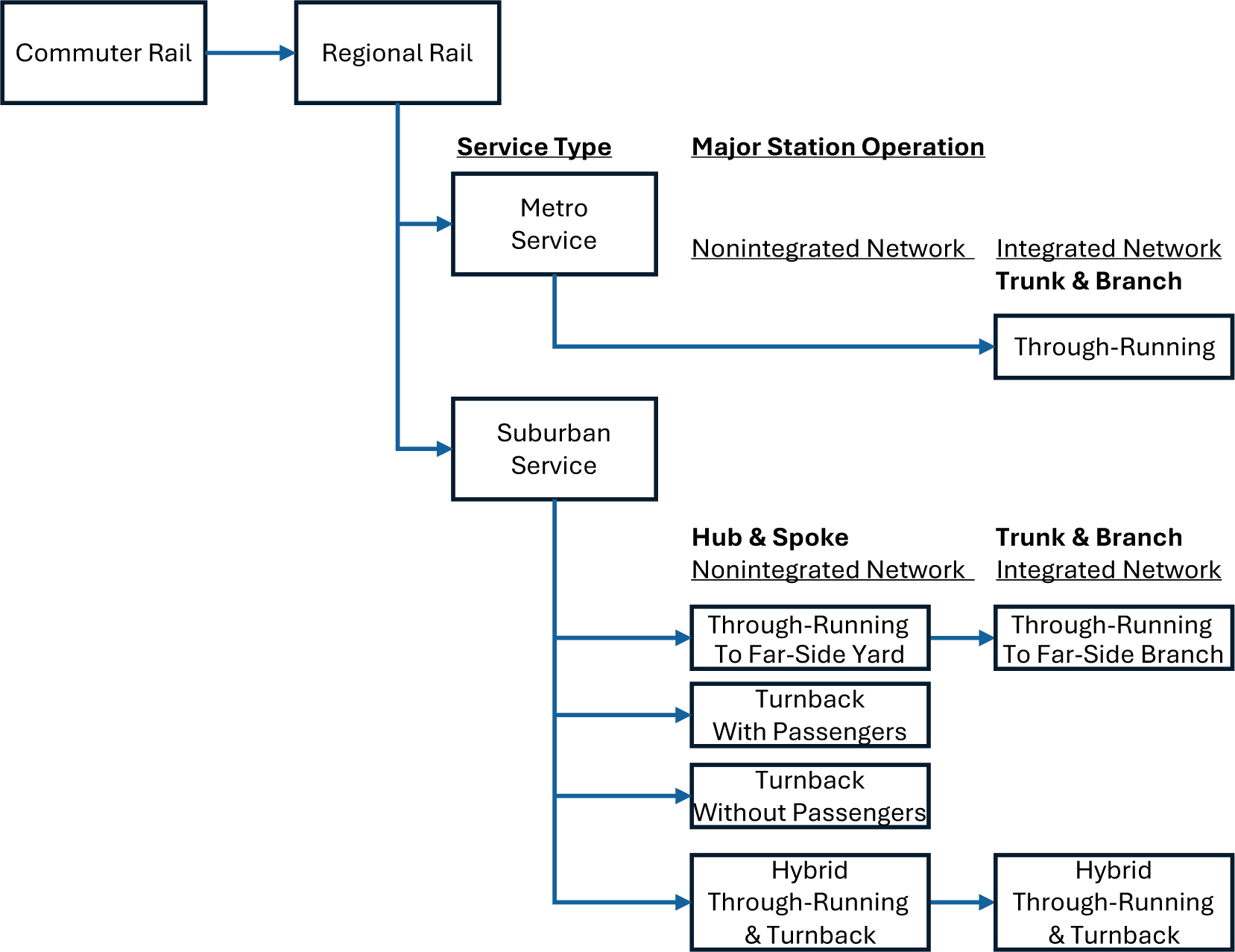
Key service characteristics of the different regional rail service types are shown in Figure 1 and summarized in Table 1.
LITERATURE REVIEW
Doubling Trans-Hudson Train Capacity at Penn Station
The primary literature source was a feasibility study of potential through-running regional rail service at New York Penn Station, prepared by research team members for the New York Metropolitan Transportation Authority, Amtrak, and NJ Transit (WSP and FXCollaborative 2024). For the worldwide examples and best practices section of this study, the researchers looked at RRM examples in Europe to identify their core characteristics. The systems examined were the Paris RER (Réseau Express Régional, or Regional Express Network), Munich S-Bahn, London Crossrail (Elizabeth Line), and London Thameslink. The researchers also examined the regional rail implementation in Philadelphia and the RER system planned for Toronto.
The European RRM systems examined operate in trunk-and-branch configurations. They use trunk lines passing through the city center to connect destinations on opposite sides of the city center. These trunk lines typically were created by stitching together disparate branches of legacy suburban railway lines that previously terminated at major stub-end terminals in the city center and connecting them through new through-running tunnels.
Long Description.
The flowchart shows Commuter Rail leading to Regional Rail. From Regional Rail, two branches are shown under service type as Metro Service and Suburban Service. Under Metro Service, major station operation is shown with two categories, non-integrated network and integrated network; under integrated network is trunk and branch leading from metro service, with thru-running below it. Under Suburban Service, major station operation includes hub and spoke non-integrated network and trunk and branch integrated network. Under hub and spoke non-integrated network, operation types include thru-running to far side yard, turnback with passengers, and turnback without passengers. Under trunk and branch integrated network, the operation type is thru-running to far side branch. A hybrid category is also shown under Suburban Service as hybrid thru-running and turnback under hub and spoke, which leads to hybrid thru-running and turnback under trunk and branch.
TABLE 1 Characteristics of Various Types of Passenger Railroad Service
CHARACTERISTIC |
REGIONAL RAIL METRO (RRM) |
REGIONAL MIXED SERVICE (RMS) |
TRADITIONAL COMMUTER RAIL |
TRADITIONAL INTERCITY RAIL |
Stopping pattern through trunk line |
Uniform: all trains make all stops |
Variable: local and express patterns |
Variable: local and express patterns |
Usually nonstop |
Travel market focus |
Travel within urban and inner suburban areas |
All-day bidirectional service with overlay of peak suburb-to-city trains |
Focus weekday a.m. and p.m. peak travel to downtown workplaces |
City-to-city, megaregion-scale, and long-distance travel |
Trip length |
Within urban and inner suburban region |
Covers a range of trip lengths: urban, suburban, and exurban areas |
Covers suburban and exurban areas, longer than RRM trips |
Long intercity trips |
Major stations |
Through-running with dedicated, purpose-built infrastructure |
Complex track, platform, and interlocking layouts at legacy stations; can support through-running, turnback, or hybrid operations |
Terminals or through-running to storage yard; service not integrated across regional networks |
Relatively long dwell times at major hub stations, with multiple platform tracks required at high-volume stations |
Rolling stock performance |
Uniform |
Variable |
Variable, oriented to maximize train capacity rather than minimize dwell times |
Variable across train types; can be uniform or variable within service types |
Rolling stock interior configuration |
Designed to facilitate boarding and alighting |
Compromise between ease of alighting/boarding and providing seating capacity |
Designed to maximize seating capacity |
Designed for passenger comfort |

