Through-Running Regional Rail (2026)
Chapter: Results
and on weekends. The low frequency might be acceptable to commuters on a traditional commuting schedule in the city center, but it is not suitable for transit purposes.
- Low-level platforms are common throughout the SEPTA Regional Rail system, which increases dwell times.
- Conductors being assigned to trains increases the labor cost of operations, which could make scaling service more difficult.
RESULTS
Capacity Characteristics of RRM and RMS Systems
The initial research effort identified clear differences in the operational characteristics and capacities of the systems providing pure RRM service and more complex, blended RMS. These differences were most evident in practical station platform track throughput, even though both types of service are based on through-running operations. Within each of the service types, a high degree of consistency is in the practical throughput. This leads to an important finding that these two types of regional rail service are fundamentally different from one another and deserve separate analysis and documentation in a future edition of the TCQSM. The tables that follow summarize some of the key characteristics of systems with through-running operations. Systems without shading are the case studies described in the previous section. Systems with gray shading were not studied in-depth but are included to provide additional characteristics data.
Table 2 presents service characteristics of selected through-running systems, including frequencies at key points, number of tracks in the trunk area of each system, and critical CBD station dwell times.
Table 3 presents the infrastructure characteristics of selected through-running services, including service mixing, interlocking characteristics, the number of tracks at the key central station, peak trains per track, and signal system on the trunk line.
Table 4 presents the rolling stock characteristics of the selected through-running systems, including whether rolling stock is similar or varies, and the type of rolling stock [electric multiple unit (EMU) or electric locomotive].
Table 5 presents the characteristics of the key core stations of the selected through-running systems, including the number of core stations, whether there is a core terminal station, and the distance between stations in the urban core.
Lessons Learned
The case study systems have dramatically different characteristics. All the systems, except Philadelphia, rely on separating crossing movements either through grade-separated junctions or strategic placement of trains. This approach enables a greater throughput of trains in the system because the network can operate at a higher level of reliability, and the arrival times of trains from various origin branches at the common trunk line are more predictable.
The lines studied here with the highest-frequency service have either completely or largely separated their through-running regional rail services from other train services on their branches and their trunks. Munich S-Bahn and Seoul Metro Line 1 both have a majority of their network run on lines that do not mix with other train traffic, mix only with light traffic, or only infrequently mix with other train traffic. This design enables these systems to run these branches in a way that optimizes their own frequencies and better harmonizes merges with other branches as they approach the trunk line. In addition, the stopping patterns for all branches of these lines are typically all-stop. This design also maximizes capacity.
The outlier to minimizing service mixing is the Tokyo Toei Asakusa Line. Most Asakusa Line trains originate from or are destined for either the Keikyu or Keisei railways that serve the suburbs. Both railways run significant numbers of trains not destined for the Asakusa Line and operate a variety of local and express stopping patterns. Despite service mixing conditions that typically lead to lower train volumes, the Asakusa Line manages to maintain 22 trains per hour, a figure comparable to other RRMs around the world. This result is in part possible because overtake tracks are positioned at strategic
TABLE 2 Through-Running System Service Characteristics
SYSTEM |
REGIONAL RAIL BRANCH LINE FREQUENCY (TPH*) |
BRANCHES LINE COUNT PER SIDE OF REGIONAL RAIL |
TRUNK FREQUENCY (TPH*) |
TRUNK TRACK COUNT |
TRUNK FREQUENCY PER TRACK (TPH*) |
CBD DWELL (MIN) |
Munich S-Bahn |
3–6 |
4–9 |
30.00 |
2 |
30.00 |
< 1 |
Tokyo Toei Asakusa Line |
5–12 |
3–5 |
22.00 |
2 |
22.00 |
< 1 |
Seoul Metro Line 1 |
8–16 |
1–4 |
16.00 |
2 |
16.00 |
< 1 |
Philadelphia SEPTA CCCC |
1.5–4 |
6 |
14.50 |
4 |
7.25 |
2–5 |
Brussels Noord-Zuidbinding |
1–2 |
4–5 |
35.00 |
6 |
11.67 |
2–18 |
Amsterdam Centraal |
2–9 |
3–7 |
25.00 |
6 |
8.33 |
3–14 |
Crossrail |
6–12 |
2–3 |
24.00 |
2 |
20.00 |
< 1 |
Paris RER A |
4.5–14 |
2–3 |
23.50 |
2 |
23.50 |
< 1 |
Paris RER B |
5–15 |
2 |
19.50 |
2 |
19.50 |
< 1 |
Thameslink |
1–12 |
3–8 |
24.00 |
2 |
24.00 |
< 1 |
Berlin Stadtbahn |
1–4 |
4–5 |
11.50 |
2 |
11.50 |
2–5 |
Utrecht |
1–6 |
7–10 |
30.25 |
8 |
7.56 |
1–26 |
* TPH = trains per hour. Systems with gray shading were not studied but are included to provide additional characteristics data.
TABLE 3 Through-Running System Infrastructure Characteristics
SYSTEM |
SERVICE MIXING |
INTERLOCKING CHARACTERISTICS/ |
MAJOR STATION PLATFORM TRACK COUNT |
STATION FREQUENCY PER TRACK (TPH*) |
TRUNK LINE FIXED BLOCK VS. MOVING BLOCK |
Munich S-Bahn |
Some |
Grade separated |
2 |
30.00 |
Moving |
Tokyo Toei Asakusa Line |
Yes |
Grade separated |
2 |
22.00 |
Fixed |
Seoul Metro Line 1 |
Minimal |
Grade separated |
2 |
16.00 |
Fixed |
Philadelphia SEPTA CCCC |
Minimal |
Some grade separation |
8 |
3.63 |
Fixed |
Brussels Noord-Zuidbinding |
Yes |
Mostly grade separated |
22 |
3.18 |
Fixed |
Amsterdam Centraal |
Yes |
Grade separated |
11 |
4.55 |
Fixed |
Crossrail |
Yes |
Mostly grade separated |
2 |
24.00 |
Moving |
Paris RER A |
Some |
Grade separated |
2 |
23.50 |
Moving |
Paris RER B |
Yes |
Grade separated |
2 |
19.50 |
Fixed |
Thameslink |
Yes |
Mostly grade separated |
2 |
24.00 |
Moving |
Berlin Stadtbahn |
Yes |
Grade separated |
4 |
5.75 |
Fixed |
Utrecht |
Yes |
Grade separated |
12 |
5.04 |
Fixed |
* TPH = trains per hour. Systems with gray shading were not studied but are included to provide additional characteristics data.
locations to maximize the throughput of the two-track suburban mainlines and precise schedule adherence.
The effectiveness of a through-running operation is dependent on the characteristics of the through-running trunk line and the network infrastructure and operations complexity that feeds into the trunk line. A spectrum of through-running operations ranges from the blended systems similar to Brussels and Amsterdam to the RRM operations of the Munich S-Bahn and Seoul Metro. The needs and purpose of a railway network define what kind of regional rail system is sought and what network characteristics are associated with it.
The following rail system components each have individual capacities; these capacities can be measured and compared to determine the overall rail network or system capacity:
- Trunk lines
- Stations
- Interlockings and junctions
- Outlying network
TABLE 4 Through-Running System Rolling Stock Characteristics
SYSTEM |
SIMILAR ROLLING STOCK |
REGIONAL RAIL ROLLING STOCK TYPE |
Munich S-Bahn |
Yes |
EMU* |
Tokyo Toei Asakusa Line |
Yes |
EMU |
Seoul Metro Line 1 |
Yes |
EMU |
Philadelphia SEPTA CCCC |
Yes |
EMU |
Brussels Noord-Zuidbinding |
No |
EMU |
Amsterdam Centraal |
No |
EMU or electric locomotive |
Crossrail |
Yes |
EMU |
Paris RER A |
Yes |
EMU |
Paris RER B |
Yes |
EMU |
Thameslink |
Yes |
EMU |
Berlin Stadtbahn |
No |
EMU or electric locomotive |
Utrecht |
No |
EMU or electric locomotive |
* EMU = electric multiple unit. Systems with gray shading were not studied but are included to provide additional characteristics data.
TABLE 5 Through-Running System Station Typology Characteristics
SYSTEM |
STOPS IN URBAN CORE TRUNK |
MAJOR URBAN CORE TERMINAL STATION |
DISTANCE BETWEEN STOPS IN URBAN CORE (MI*) |
Munich S-Bahn |
6 |
Yes |
0.4 |
Tokyo Toei Asakusa Line |
17 |
No |
0.4 |
Seoul Metro Line 1 |
8 |
Yes |
0.7 |
Philadelphia SEPTA CCCC |
3 |
Yes |
0.6 |
Brussels Noord-Zuidbinding |
5 |
Yes |
0.5 |
Amsterdam Centraal |
3 |
Yes |
1.7 |
Crossrail |
6 |
Yes |
0.9 |
Paris RER A |
6 |
Yes |
1.5 |
Paris RER B |
7 |
Yes |
0.7 |
Thameslink |
4 |
Yes |
0.8 |
Berlin Stadtbahn |
5 |
Yes |
1.0 |
Utrecht |
1 |
Yes |
N/A |
* MI = miles, N/A = not applicable. Systems with gray shading were not studied but are included to provide additional characteristics data.
The systemʼs capacity is defined by its weakest link. If all other system components provide a certain train throughput (trains per hour), but one component is restricted to a lower throughput, that component dictates the systemʼs capacity. For example, if a trunk line is well designed, with signaling that facilitates tight-headway operations, but the outlying branches have numerous flat, busy junctions, the systemʼs capacity is constrained by those outlying junctions, and the trunk lineʼs capacity cannot be fully used. In the case of Philadelphiaʼs CCCC, the new connection itself had more than adequate train capacity, but the junctions on the former Reading Railroad branches limited train throughput to the new connection.
Trunk Lines
Trunk-line operations, whether they are blended systems or RRM systems, typically follow the same operating principles discussed in Chapter 8 of the TCQSM 3rd edition (Rail Capacity) in Section 4, Train Operations and the General Methodology portion of Section 5, Rail System Capacity Methodologies. The two most important components to understanding trunk line capacity are the signaling system and the rolling stock on the through-running system.
One of the most important factors to consider when trying to maximize trunk-line train throughput is the type of signaling system and train control system. This factor is discussed more extensively in TCQSM Chapter 8, section 3. Generally, railways can operate either with a fixed-block or a moving-block signaling system. Fixed-block systems are the norm for North American railroads and for many urban rail systems around the world. The capacity of fixed-block systems can be increased, to a point, with corresponding decreases in the block size and increases in the number of signals. Moving-block systems enable further capacity gains by allowing trains to operate closer together but are not strictly necessary for RRM trunk-line operations. As discussed in section 3, Automatic Train Operation, in conjunction with moving-block systems, may improve train throughput 5%–15% by optimizing train operations. Examples of both fixed- and moving-block signals exist in the case studies discussed, but the system with the highest trunk throughput—the Munich S-Bahn—uses a moving-block system.
The selection and diversity of rolling stock also affect train throughput on the trunk line. In general, trunk lines that are operated with equipment having better acceleration and deceleration profiles have higher train throughput because a train can follow the train in front of it more closely. Electrically propelled trains exceed the performance of diesel-propelled trains and EMUs often outperform locomotive-hauled trains. Rolling stock diversity also affects trunk line performance. Trains with different configurations, weights, and performance characteristics have different acceleration profiles. Permissible train speeds may also vary between equipment types. Different acceleration and speed profiles, in turn, necessitate wider buffers between trains so that faster trains do not catch up to slower ones.
Stations
Stations, especially major ones, can be bottlenecks for through-running systems. Station capacity can be described by the train throughput of each station track per hour, multiplied by the number of tracks that are available for a through-running operation. In turn, a platformʼs train throughput is constrained by the dwell time, schedule padding, and platform operating margin time at that station.
Dwell time is the time any train spends stopped at the station platform. The important elements to consider in dwell time for regional rail are the time it takes to open doors, deploy trap doors if necessary, and passenger alighting and boarding time. The latter depends on the volume of passengers in the two directions, the number of and width of doors on a train, and the ease of circulation and flow of passengers on the train and on the platform.
Schedule padding is the time added to a train schedule to allow it to leave on time and maintain its schedule if a delay occurs. Pad time is often applied at train stations to allow a train to leave on time if it arrives late. Stations provide a convenient location for schedule padding to occur, because trains typically are already stopped. The issue with providing buffer time at stations is that trains running early or on time must be held at the station longer than what the necessary dwell time dictates. Therefore, if pad time is applied at stations, it reduces train throughput at that station. This issue is especially problematic if pad time is applied at major stations on the trunk line. Holding for time on trunk lines can hold up train movements throughout the whole system. For this reason, Thameslink trains in London often operate with very little to no pad time near the city center to reduce the chances of having to hold for time. The end result is that Thameslink trains tend to have a lower on-time performance metric than peer London suburban rail services. Pad time overall is discussed in greater detail in TCRP Research Results Digest 122: Operating Margin and Recovery Factor Practices for Travel Time Estimation and Rail Scheduling (Innao 2026).
Platform operating margin time is the amount of time a train can run behind schedule without interfering with the following train. The minimum schedule time between trains is the combination of minimum desired operating margin and safe separation time. Many of the principles that dictate this time are similar to the principles of operating margins that drive trunk lines, including signal and train control systems and rolling stock. Stations may have safety operating procedures that hold trains outside platforms and interlockings; these procedures can prevent trains from waiting just outside their assigned platform. These procedures may compound capacity constraints from signal and train control systems and rolling stock.
Turnback operations, if applicable, may constrain the throughput of the tracks used for turnback operations. Many through-running regional rail operations have selected trains turn back, such as Londonʼs Elizabeth Line at Paddington Station and Philadelphiaʼs Regional Rail at Suburban Station. More blended operations, such as Brussels-Midi Station or Amsterdam Centraal, terminate and turn back many more trains. Turnback operations can lead to head-on conflicts. Trains that through-run through a station may be assigned to tracks that segregate the two opposing directions and align trains with the appropriate outbound track. However, turning back trains allows less opportunity to segregate opposing directions.
Interlockings and Junctions
Interlocking and junction design dictates how many conflict points may exist between train paths that are neither merging onto nor diverging from a common track. Junctions in North America tend to be built as flat junctions—junctions where all intersecting tracks meet at grade. European and Asian junctions tend to use more flyovers, making them grade separated. If a junction is flat, trains making conflicting moves must be scheduled against each other to ensure the diamond is not being occupied at the same time.
For example, a train moving outbound at a junction on a line will find itself conflicting with an inbound train from a merging line. Both services must then be scheduled to avoid this conflict, which in turn affects overall capacity for both services. An excellent illustration of this problem is the Philadelphia Regional Rail Lansdale/Doylestown Line. Near Glenside, the Warminster Line (which operates two trains per hour) merges with the Lansdale/Doylestown Line. Twice per hour, an outbound train slot is not available to the Lansdale/Doylestown Line when there is an inbound Warminster train. This scenario is repeated at four other junctions along the Lansdale/Doylestown Line outbound and once inbound. All these conflicting train movements must be accounted for when creating a schedule for the Lansdale/Doylestown Line.
Station interlockings are functionally similar to junctions in that they create possibilities of conflict when trains routed from different directions might have to cross each other to reach an assigned platform. Station platform assignments should avoid unnecessary crossing of conflicting movements at interlockings. For example, outbound trains using a line to the right when exiting the station should be positioned to the right of outbound trains continuing straight. If conflicting train routings are inevitable, grade-separated junctions may position trains from various lines at the appropriate entry point to the station interlocking to minimize interfering conflicts. This design is practiced at Midi Station in Brussels. Lines converge into a corridor from the south, approaching Midi Station. Most trains through-run Midi Station to the north side of the city where the trains diverge again. Lines merge into the southern corridor on grade-separated junctions to position trains at Midi Station such that conflicts within the station interlocking occur infrequently.
Turnouts and curve geometry at junctions can affect train throughput at junctions. Slower turnout speeds mean that merging and diverging trains occupy a track section longer than they would if moving at full speed, requiring an additional buffer for following trains to avoid conflict at the point.
Outlying Network Complexity
Although the trunk line tends to be the most intensively used portion of a through-running operation, the overall system capacity is just as dependent on network operations on the branches of the outlying network. The mixing of multiple kinds of services, the network complexity, and stopping patterns can all create capacity inefficiencies on the regional network feeding into the trunk line.
Mixing service types that have different acceleration and speed profiles and different stopping patterns leads to trains having different running times over a track section. Trains must be spaced far enough apart in the schedule such that a fast train does not get caught behind a slow train. Longer-distance, intercity trains (which typically make fewer stops on sections overlapping with regional rail) also tend to need greater schedule padding to accommodate any potential delay to maintain their slot. As a result, a longer buffer may be needed between the departure of an intercity train and the regional train that follows it.
Belgiumʼs Line 124 is a railway line that connects the city of Charleroi to Brussels-Midi Station. On the busiest section of the line, between Nivelles and Linkebeek, two intercity services each operate hourly, one regional service operates twice per hour, one regional service operates once per hour, and a special commuter express runs once per hour, for a total of six trains per hour. This section of Line 124 sees Brussels-bound regional trains leave Nivelles just after an intercity train passes. The next regional train, bound for another area of Brussels, clears Line 124 at Linkebeek in time for the following intercity train to pass. While it may be possible to fit in more trains with some schedule finessing, six trains per hour is close to this lineʼs capacity ceiling. Therefore, increasing the number of regional trains onto the North–South Connection from Line 124 is difficult. To fit more trains on this line, all trains could be made to have similar stopping patterns or extra tracks could be added to allow two different operating speeds.
One strategy to enhance the capacity of lines that mix local and express trains is the addition of overtake sidings or passing tracks. Tokyoʼs Keikyu Railway, one of the suburban railways that feeds the Asakusa Line trunk in the city center, runs a combination of local and express trains on its two-track mainline. At select major stations, local trains move to a siding track on a separate platform edge and wait at the station while express trains overtake them. This strategy can enhance the capacity of railways that mix local and express trains on the same tracks, but line capacity will still be below that of a system using one common stopping pattern. Additionally, this strategy requires good on-time performance for overtaking trains and trains being overtaken to ensure that meets occur where passing tracks are provided.
Overall network complexity and interconnectedness with larger rail networks beyond the through-running network can increase the odds of reliability issues. Incidents and delays may occur off-system that affect trains entering branches and lines used by through-running services. These trains arriving off-schedule may affect through-running services even if the affected trains themselves do not through-run. Accounting for potential ripple effects through the larger rail network by adding schedule padding can reduce system capacity.
Factors Influencing Capacity
This research effort identified 10 major factors that influence capacity in through-running systems. These factors roll up to affect the capacity of the four rail system components that contribute to system capacity. Although other factors can influence capacity, they are typically derivative of these 10.
1. Signaling and Train Control System
Different kinds of signaling and train control systems can allow higher or lower densities of train traffic. For the purposes of broad capacity consideration, the signaling and train control system can be identified as any of the following:
- A fixed-block signal system
- Moving-block signal system with manual train operation
- Moving-block signal system with automatic train operation
Fixed-block signal systems necessitate trains completely clearing a signal block before a train in the preceding block can be allowed into the block. Fixed-block signal capacity can be adjusted, to a point, by increasing the frequency of signals and decreasing the length of a signal block, allowing trains to clear any given signal block faster. Moving blocks allow trains to operate up to a permissible distance from the train in front of it, eliminating the need for
fixed physical blocks. This design allows trains to operate closer together, permitting greater capacity. Automatic train operation in conjunction with moving blocks allows train movements to be even more precisely operated to further optimize capacity. However, the precise capacity permitted by each signaling system depends on the specifications of the signal and train control system and how it interfaces with other elements of the railway.
2. Junction and Interlocking Design
Junction and interlocking design control the degree to which operational conflicts can be minimized through grade separation. If junctions and interlockings throughout the regional rail system can be designed such that crossing conflicts are minimized or completely minimized and merging and diverging conflicts are shortened or reduced, overall system capacity can be maximized.
3. Rolling Stock Performance
A trainʼs acceleration, deceleration, and top speed can affect the performance of every system by changing the time that a block, junction, platform, or track section is occupied. Train performance is heavily dependent on consist configuration and the exact specifications of the vehicles that make up the consist. Typically, the tractive effort, distribution of powered axles in a trainset, and overall weight of that trainset are the primary variables that affect performance. Broadly speaking, trainset performance falls into four categories on the basis of propulsion and distribution of power:
- Diesel locomotive-hauled sets
- Diesel multiple units
- Electric locomotive-hauled sets
- Electric multiple units
In addition, the performance of a multiple unit set can vary depending on the number of powered axles on that trainset. Urban metro trains usually have two powered axles per car on every car. Regional rail trains will sometimes mix unpowered trailer cars with powered cars.
4. Rolling Stock Variability
Differences in rolling stock performance characteristics can affect capacity. If two kinds of rolling stock accelerate differently, slower rolling stock requires a wider berth between it and a faster following rolling stock. In addition, slower rolling stock will lag behind faster rolling stock, creating gaps in service.
5. Stopping Pattern Uniformity
Trains that share the same track but have different stopping patterns lead to differences in average speed through the corridor and thereby reduce overall capacity. Less-frequent stopping leads to faster trains, and more-frequent stopping leads to slower trains. The disparity in speeds means that slow, local trains require a wider berth between them and a faster express or intercity train following them. Faster trains need to be spaced farther behind slower trains to avoid getting caught behind them. Conversely, slower trains lag behind faster trains, creating gaps in service. One possible solution that partially offsets the loss of capacity is creating infrastructure to allow timed overtakes. However, this solution requires precise railway operation and constrictive operating plans, and the resulting capacity is less than that of a railway with a consistent operating pattern.
6. Station Dwell Time
A train dwelling at a station occupies that station track longer than a moving train may occupy a section of line track or a junction. For services that must stop at a station, the line or trackʼs capacity is inversely related to the track occupation time. Station dwell time can include several components:
- Boarding and alighting time. Boarding and alighting time is dependent on the volume of passengers waiting to board or alight, the number and width of doors, and pedestrian flow both within the train and on the platform. Additionally, level boarding between the platform and the train facilitates faster boarding and alighting.
- Schedule padding. Schedule padding may be applied to maintain a late trainʼs schedule. Depending on operating rules, if the train runs early, it could be held at the platform until it is on time.
- Crew changes. Trains sometimes change crews mid-route. Doing so typically takes several minutes, which can add additional dwell time if it exceeds the boarding and alighting time.
- Procedural requirements. Other procedural requirements might be required at stations, including brake tests, switching signal and train control systems, or switching propulsion systems.
7. Number of Tracks at Stations
At stations that are sufficiently busy or require longer dwell times, additional tracks could be required to match the line capacity.
8. Service Mixing
Service mixing introduces the complexities and variables of off-system operations (e.g., intercity trains) onto the regional rail system. Incidents that occur on a different system can result in a ripple effect as trains moving to the regional rail system arrive late, missing their slots. Mixing different types of trains also introduces other operational variables that can lead to differences in travel time, performance, and reliability. Rolling stock typically varies dramatically across service types. Longer-distance trains are optimized for speed over acceleration; regional trains are optimized for acceleration over speed. Station dwell times could be different, with passengers on longer-distance trains taking longer to disembark. Schedule padding practices can also vary between systems, with longer-distance trains requiring more padding and being less predictable in their arrival times than regional trains. In addition, freight trains have completely different operating characteristics than any kind of passenger train. They are slower, longer, and usually do not stop on the regional rail system. Freight trains require wide slots to fully accommodate them, taking capacity away from the rail lines on which they run.
9. Turnback Operations
Turnback operations, typically done at terminal stations, can be a pinch point for regional rail system operations. For through-running operations, turnback operations typically are done at the terminal ends of branches. Some systems turn trains mid-route and sometimes even at a major city-center station. Trains typically have a minimum
recovery time built into the turn time at the station. Most turnbacks have trains simply reversing out across a crossover onto the outgoing track. Some systems might relay or loop trains from an arrival track to a departure track, which also requires additional time. In all cases, sufficient train storage must be provided at the terminal to provide the terminal dwell time needed for turning trains. Track occupation time, similar to other stations, can be minimized through terminal design that enables speedy arrivals and departures, facilitates track reoccupation time, and enables faster train operations.
10. Outlying Network Complexity
The factors listed earlier are applicable to the trunk line as much as they are to any other branch of the regional rail system or another regional rail line. However, when examining the capacity of a regional rail system, it is important to understand that knowing the trunk lineʼs theoretical capacity is not enough. Practical train volumes that can be expected to enter the trunk line might themselves be limited by capacity constraints on the branches and outlying network. A capacity analysis has to be performed to understand the volume of trains that practically can be run on branches and, if relevant, how they might interface with trains that are not part of the regional rail system. Adding complexity to the regional rail system through branching, mixing different stopping patterns, and sharing tracks with other services also decreases the systemʼs overall capacity by introducing new operational variables that have to be taken into consideration.
Station Typology
Estimating station capacity is less straightforward for regional rail than for heavy rail transit systems, because more variables can influence capacity that need to be considered. In particular, station capacity differs most greatly from heavy rail transit. Station capacity depends on the type of regional rail service, whether the service characteristics are uniform or variable, and the stationʼs physical configuration. These operational and physical characteristics apply to existing or new stations and to improvements to an existing station. Station capacity depends in part on the station track and platform configuration and how the platform tracks are used by trains. A simple station on a two-track rail or transit line with through-running operations can have side platforms or a center island platform as shown in Figure 7. Trains move directionally, follow each other along the line, and dwell at the station without the need to change tracks.
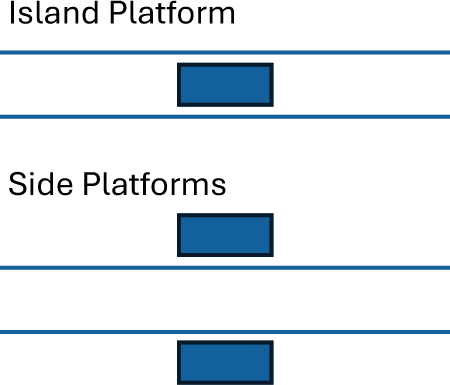
Long Description.
The diagram presents two station configurations. The first configuration is labeled Island Platform and shows one platform placed between two tracks. The second configuration is labeled Side Platforms and shows two platforms placed on either side of two tracks with nothing between the tracks.
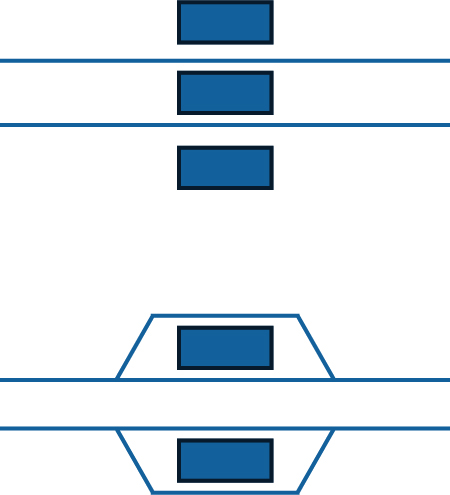
Long Description.
The diagram presents two station configurations. The first configuration shows two tracks with three platforms placed along the tracks, one above, one between, and one below the tracks. The second configuration shows two tracks with platforms on both sides and tracks going from the main tracks, around the platform area, and rejoining the main tracks.
As the TCQSM 3rd edition indicates, overall line capacity can be governed by station dwell time. Where dwell times are sufficiently short, and where train performance and train stopping patterns are uniform for all trains using the line, the station capacity can match the overall line capacity and can deliver high-density service. Many examples of heavy rail transit can achieve 2-min headways (30 trains per hour) or better and RRM service that can reach at least 24 trains per hour.
When station dwell times reach a certain point, the station capacity can be reduced below that of the overall line. Potential configurations that can deliver higher capacity where needed include the following:
- Providing separate platform faces for alighting and boarding passengers, which can reduce station dwell times
- Adding a platform track in each direction to enable alternating trains to use different tracks
These configurations are shown in Figure 8.
The Munich S-Bahn is an example of the former configuration, and the Paris RER Line C has stations with the latter configuration.
Some stations on rail transit and regional rail lines are configured to permit hybrid operations, with some trains running through and others stopping and turning back. Generally, these stations are configured to avoid having trains change direction on the main running tracks because these trains would require longer dwell times for turning and would run the risk of delaying subsequent trains, as shown in Figure 9. Usually, one or two additional tracks and additional platform faces are provided to support both through and turnback operations. If the turnback tracks are on one side of the
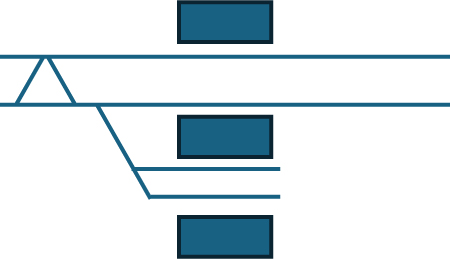
Long Description.
The diagram presents a station layout with connected tracks and platforms. Two main tracks run through the station. A branching track connects to a stub-end track. Three platforms are shown, one along the upper track, one along the middle track, and one along the lower stub-end track. The tracks connect through a junction on the left side.
right-of-way, as shown in the figure, turnback operations would introduce a head-on conflicting train movement, which reduces overall capacity.
Station configurations with one or two pocket tracks between the main tracks, used for turnback movements, would still involve merging conflicts but would eliminate head-on conflicting movements, thereby increasing overall capacity. These types of stations, shown in Figure 10, are prevalent on rail transit and some regional rail systems.
Large, urban, train stations can exist in several configurations and can support a wide range of service types. Stub-end terminal stations provide access to the station platforms from only one end and, as a result, all train movements involve turnbacks. Depending on the number of stub-end tracks, the interlocking or set of switches at the throat of the terminal can be relatively simple or quite complex, incorporating parallel train movements to and from various combinations of station tracks. Following are U.S. examples of stub-end terminal stations with large terminal interlockings, where all train movements are turnback movements:
- Boston South Station and North Station
- Chicago Ogilvie Transportation Center and LaSalle Street Station
- Los Angeles Union Station (in its existing configuration)
- New York Grand Central Terminal
- San Francisco Caltrain 4th and King Station
Research and detailed operations analysis indicates that a single level of flat interlocking can support train throughput of up to approximately 20 trains per hour in each direction. This capacity might be somewhat below the capacity of the rail line feeding the terminal. Providing grade-separated (or flexed) track connections within the interlocking can simplify train movements and reduce head-on movement conflicts, at considerable capital cost. This type of configuration can allow terminal station capacity to meet or exceed that of the rail line or lines feeding it. Schematics of these stub-end configurations are shown in Figure 11.
Large rail stations in urban centers also can be configured to support through-running. These stations differ from the relatively simple transit or RRM stations in the number of platform tracks provided and the size and complexity of the interlockings on both sides of the station. Two configurations of through stations are used in the U.S. and international case studies, shown in Figure 12. The two configurations affect capacity differently:

Long Description.
The diagram presents two station configurations with through tracks and pocket tracks. In the first configuration, two main tracks are shown with one pocket track between them and two platforms placed between the tracks. In the second configuration, two main tracks are shown with one pocket track between them and platforms placed on both sides of the tracks. A total of two pocket tracks is shown, one in each configuration.
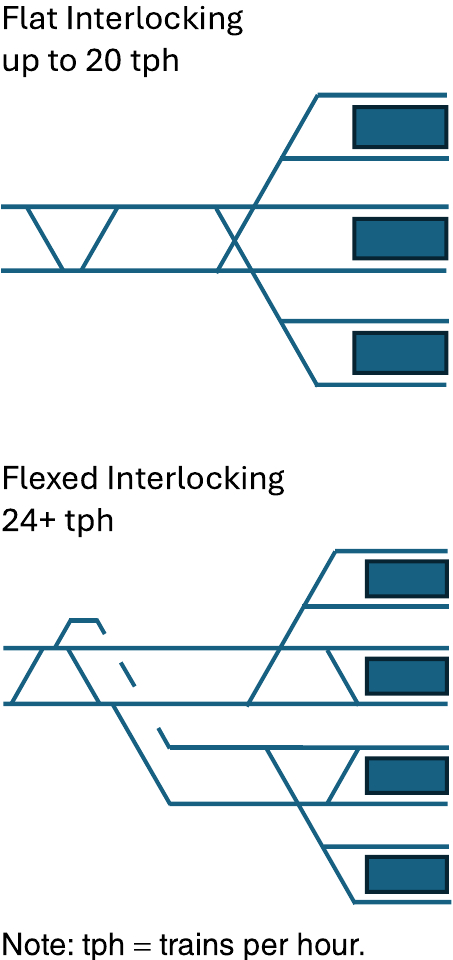
Long Description.
The diagram presents two interlocking configurations for a stub end terminal station. The first configuration is labeled Flat Interlocking up to 20 trains per hour (tph) and shows tracks crossing and connecting to three platform tracks. The second configuration is labeled Flexed Interlocking 24 plus tph and shows a more complex set of track connections leading to four platform tracks. Multiple junctions and crossings connect the main tracks to the platform tracks in each configuration. Note: tph = trains per hour.
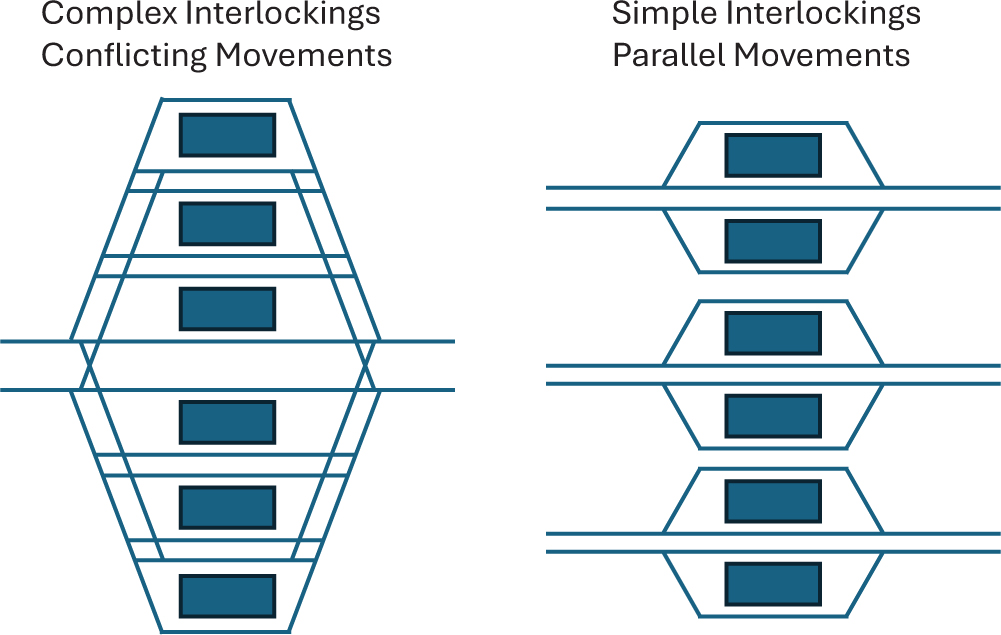
- Universal access. All tracks are accessible from the approach tracks; this configuration is characterized by large, complex interlockings.
- Zoned access. Several smaller stations are side by side, each fed by different sets of approach tracks; this configuration is characterized by smaller interlockings with multiple sets of approach tracks grade separated from each other.
Universal access, shown on the left side of Figure 12, treats the station as one entity, with trains dispatched among all available tracks. This configuration can introduce head-on movement conflicts, relatively long running times, and low speeds for train movements through the interlockings. Its capacity can be limiting. Zoned access, shown on the right side of Figure 12, is more prevalent in Europe. This configuration carves the station into multiple zones, where trains operate in parallel into and out of the station within
Long Description.
The diagram presents two station configurations. The left configuration is labeled Complex Interlockings, Conflicting Movements and shows multiple tracks crossing and connecting to six platforms. The right configuration is labeled Simple Interlockings, Parallel Movements and shows three separate track pairs, each connected to two platforms, with no crossings between the track pairs.


