Developing a Guide to Manage Out-of-Service Utility Facilities (2026)
Chapter: 3 State-of-Practice Survey
CHAPTER 3—STATE-OF-PRACTICE SURVEY
This chapter documents the research team’s methodology to conduct a state-of-practice survey of practitioners dealing with OOS utilities. Following a review of current practices described in the literature, state laws, manuals, and specific guidelines dealing with OOS facilities and hazardous materials, researchers developed a state-of-practice survey for state DOTs, metropolitan planning organizations (MPOs), utility owners, contractors, consultants, and other OOS facility stakeholders to gather information about current practices related to OOS facilities. Key aspects of the survey included the frequency with which OOS facilities are misidentified or not identified in the field; the current practices for discovering OOS facilities; the management of data for OOS facilities; and the impact of OOS facilities on cost overruns, delays, safety issues, and other concerns in highway construction projects. At a high level, the survey focused on several questions related to OOS facilities as follows:
- What are potential outcomes of OOS facilities during active projects (i.e., under design and construction) and during highway operations and maintenance? What is the likelihood and impact of those outcomes?
- How do stakeholders handle OOS facilities throughout the highway lifecycle, and how do stakeholders manage information related to OOS facilities?
- What tools (e.g., spreadsheets, databases) do stakeholders use to manage this information?
- What are potential case studies for the management of OOS facilities?
- What are relevant standards and policies implemented by OOS facility stakeholders?
- What are lessons learned from dealing with OOS facilities during the highway project lifecycle.
The survey further asked questions related to current initiatives, data gaps, and standards and specifications related to OOS facilities. Following the literature review, the research team decided to break up the survey into several subsurveys to better target survey stakeholder groups with relevant questions. As a result, the survey consisted of five parts: an introduction; separate subsurveys for project owners, consultants or contractors, and utility owners; and a closing general section. Figure 8 provides a general overview of the flow of the survey.
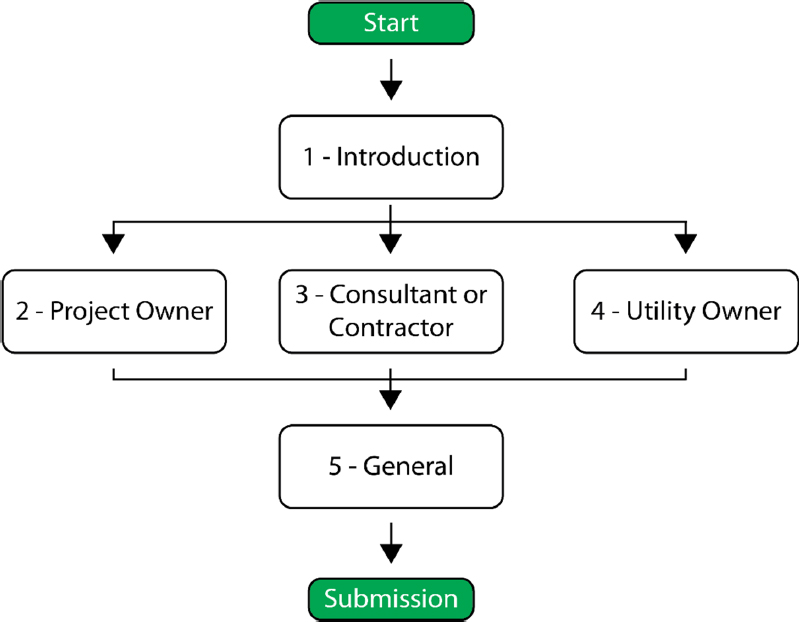
The survey consisted of 51 questions organized in five parts. Appendix A includes a copy of the survey in its final format. An overview of the questions in each part of the survey is provided next.
Part 1–Introduction
Definition of OOS Utilities
Roles and Phases
- Role of survey participant.
- Survey participant’s involvement in phases of project delivery.
Likelihood and Impact
- Potential outcomes of OOS utilities.
- Likelihood of OOS utility outcomes.
- Impacts of OOS utility outcomes.
Part 2–Project Owner Questionnaire
Situations
- Frequency of OOS utility situations.
Challenges and Strategies
- Challenges with OOS utilities.
- Issues with OOS utilities during construction.
- Strategies for dealing with OOS utilities.
Guidelines
- Manual for dealing with OOS utilities.
- Guidelines for coordinating with utility owners.
- Structure to facilitate collaboration with other government agencies.
Identification
- Methods for finding and identifying OOS utilities.
- Tools for identifying OOS utilities.
- Procedures for identifying risks associated with OOS utilities.
- Personnel for addressing OOS utilities.
Tracking and Management
- Management of OOS utilities during the project development process.
- Management of OOS utilities outside of active highway projects.
- Tools or procedures for tracking OOS utilities.
Frequency of OOS Utility Types
- Frequency of OOS utility types.
Other
- Reuse of OOS utilities.
- Need for OOS utility management improvements.
- Prevention of unauthorized OOS utilities.
- Need for updates to federal laws or regulations.
Part 3–Consultant or Contractor Questionnaire
Situations
- Frequency of OOS utility situations.
Challenges and Strategies
- Constructability issues with OOS utilities.
- Removal issues with OOS utilities.
- Strategies for dealing with OOS utilities.
Identification
- Methods for finding and identifying OOS utilities.
- Tools for identifying OOS utilities.
Tracking and Management
- Management of OOS utilities.
- Depiction of OOS utilities.
Frequency of OOS Utility Types
- Frequency of OOS utility types.
Other
- Reuse of OOS utilities.
- Need for OOS utility management improvements.
Part 4–Utility Owner Questionnaire
Situations
- Frequency of OOS utility situations.
Guidelines
- Manual for dealing with OOS utilities.
Processes
- Methods for determining causes and circumstances of OOS utilities.
- Personnel for addressing OOS utilities.
- Procedures for transferring ownership of OOS utilities.
- Procedures for dealing with OOS utilities on private property.
Tracking
- Tracking of OOS utilities.
Other
- Reuse of OOS utilities.
- Need for OOS utility management improvements.
Part 5–General Questionnaire
Other
- Lesson learned.
- Demographic data.
- Additional contacts.
- Additional comments.
- Option to upload a document.
Demographics
- Demographic data.
- Office location.
Submission
Appendix A includes a copy of the final survey, including the email to survey participants, survey introduction, and survey definitions.


