Submarine Exposure Guidance Levels for Selected Hydrofluorocarbons: HFC-236fa, HFC-23,and HFC-404a (2000)
Chapter: CHEMICAL AND PHYSICAL PROPERTIES
3
Hydrofluorocarbon-23
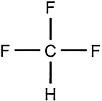
HYDROFLUOROCARBON (HFC)-23, or trifluoromethane, is a combustion product of HFC-236fa. It belongs to the class of halocarbons. As discussed in Chapter 2, HFC-236fa is under consideration for use in centrifugal chillers aboard naval submarines. If HFC-236fa is accidentally leaked, it will pass through the submarine's carbon-monoxide-hydrogen burner system, which operates at 500°F. Under these conditions, less than 0.1 parts per million (ppm) of HFC-23 is formed per 100 ppm of HFC-236fa. Assuming a worst-case scenario of an HFC-236fa leak at concentrations approaching 100 ppm and no HFC-23 being removed from the air, concentrations of HFC-23 within a submarine could rise by 0.5 ppm per day (Naval Surface Warfare Center 1997).
Emergency exposure guidance levels (EEGLs) and continuous exposure guidance levels (CEGLs) are needed to avoid adverse health effects in submariners from short-term or prolonged exposures to HFC-23 and to avoid degradation in crew performance. This chapter presents the available toxicity information on HFC-23 and the subcommittee's evaluation of the U.S. Navy's proposed 1-hr and 24-hr EEGLs and 90-day CEGL.
CHEMICAL AND PHYSICAL PROPERTIES