Introduction
Purpose
Section 106 of the National Historic Preservation Act (NHPA) requires federal agencies, including FHWA, to take into account the effects of their programs and projects on historic properties, namely, those buildings, structures, districts, objects, and sites listed in or eligible for listing in the National Register of Historic Places (National Register). Federal agencies fulfill their responsibilities for Section 106 compliance through consultation with the Section 106 consulting parties, including State Historic Preservation Offices (SHPOs), including the officer and staff; tribal historic preservation officers (THPOs); federally recognized tribes; Native Hawaiian organizations (NHOs); local governments; and other parties who have a demonstrated interest in the undertaking, such as local historical societies and preservation organizations. State departments of transportation (DOTs) frequently assist and coordinate with FHWA in the identification of historic properties and in assessing the effects of FHWA-funded or -approved projects on these properties as part of the transportation project development process. To successfully and effectively comply with the requirements of Section 106, FHWA and state DOTs must be able to clearly communicate their assessments of effects on historic properties to the Section 106 consulting parties and must document those assessments. FHWA and state DOTs must also involve members of the public when making determinations about effects on historic properties.
The Section 106 regulations at 36 CFR Part 800 lay out the process for determining effects on historic properties, including assessing when a federal program or project will have an effect on a historic property and, when there is an effect, assessing whether the effect will be adverse and subsequently require avoidance, minimization, or mitigation. To assist Section 106 practitioners in making these determinations of effects, the research team conducted a national study of best practices for preparing findings of No Effect and No Adverse Effect for FHWA-funded and -approved transportation projects. The work was done under NCHRP Project 25-65, “Preparing Successful No-Effect and No-Adverse-Effect Section 106 Determinations: A Handbook for Transportation Cultural Resource Practitioners.”
This handbook is one of the products of NCHRP 25-65. For the purpose of this handbook, the term “No Effect” is used in place of the Section 106 finding of No Historic Property Affected. The purpose of the handbook is to aid practitioners in the following:
- Navigating both the Section 106 and project development process to prepare successful and defensible determinations of No Effect or No Adverse Effect.
- Effectively conferring with the Section 106 consulting parties on these effect determinations.
- Addressing the challenges practitioners often face when making these determinations of effect on certain types of historic properties and for different types of transportation projects.
This handbook is aimed mainly at cultural resource professionals who work for FHWA, state DOTs, or private-sector firms serving as consultants to state DOTs. It is also for SHPOs, THPOs, tribes, NHOs, and local agencies and organizations with which FHWA and state DOTs consult on these determinations of effect.
Regulatory Context
As noted, the Section 106 regulations require a federal agency to take into account the effects of its projects on historic properties. The effects determinations laid out in the Section 106 regulations are as follows:
- No Historic Properties Affected (36 CFR Part 800.4(d)(1)),
- No Adverse Effect (36 CFR Part 800.5(b)), and
- Adverse Effect (36 CFR Part 800.5(a)).
A finding of No Historic Properties Affected is made when no historic properties are present within a project’s area of potential effects (APE) or when historic properties are present but the undertaking will have no effect on these properties, as defined in 36 CFR Part 800.16(i), which describes an “effect” as an alteration to the characteristics of a historic property that qualify it for inclusion in or eligibility for inclusion in the National Register.
A finding of No Adverse Effect is made when a project’s effects do not meet the criteria of Adverse Effect as defined in 36 CFR Part 800.5(a)(1), or the project is modified, or conditions are imposed that avoid an Adverse Effect.
As noted, these Section 106 effect determinations are made by a federal agency in consultation with the appropriate SHPO, THPO, and other Section 106 consulting parties, including federally recognized tribes and NHOs, local governments, local historical societies, and preservation organizations. Federal agencies also seek and consider the views of the public on these findings.
Approach
This handbook is based on three main components of the work of NCHRP 25-65. The first component was a literature review of existing federal and state-specific manuals, documents, or guidance on making findings of No Effect and No Adverse Effect, focused on projects and programs funded or approved by FHWA. The second component was an online survey sent to FHWA and state DOTs and consulting firms who work for state DOTs, SHPOs, and tribes who review and consult on these effect findings. The purpose of the second component was to gather data on the current state of practice concerning approaches to assessing effects under the Section 106 process and the experiences of consulting parties with these effects assessments. The third component of the study was follow-up telephone interviews with selected respondents to the online survey to obtain insights on their approaches to effects assessments through guided discussion. The online survey and follow-up interviews also identified 10 case studies that highlighted best practices in making findings of No Effect and No Adverse Effect. Pertinent findings of the literature review, online survey, and interviews are integrated into this handbook.
Research began with a review of existing resources on the Section 106 process in the transportation sector available online. Sources included the following:
- Section 106 guidance documents and dedicated cultural resource manuals produced by state DOTs and SHPOs containing specific examples and practices for assessing effects on historic properties,
- Recent statewide delegation transportation programmatic agreements (PAs),
- Forms and tools created by state DOTs and SHPOs for making effects determinations, and
- Guidance and policies on working with consulting parties during the Section 106 process and how consultation is used as part of assessing effects.
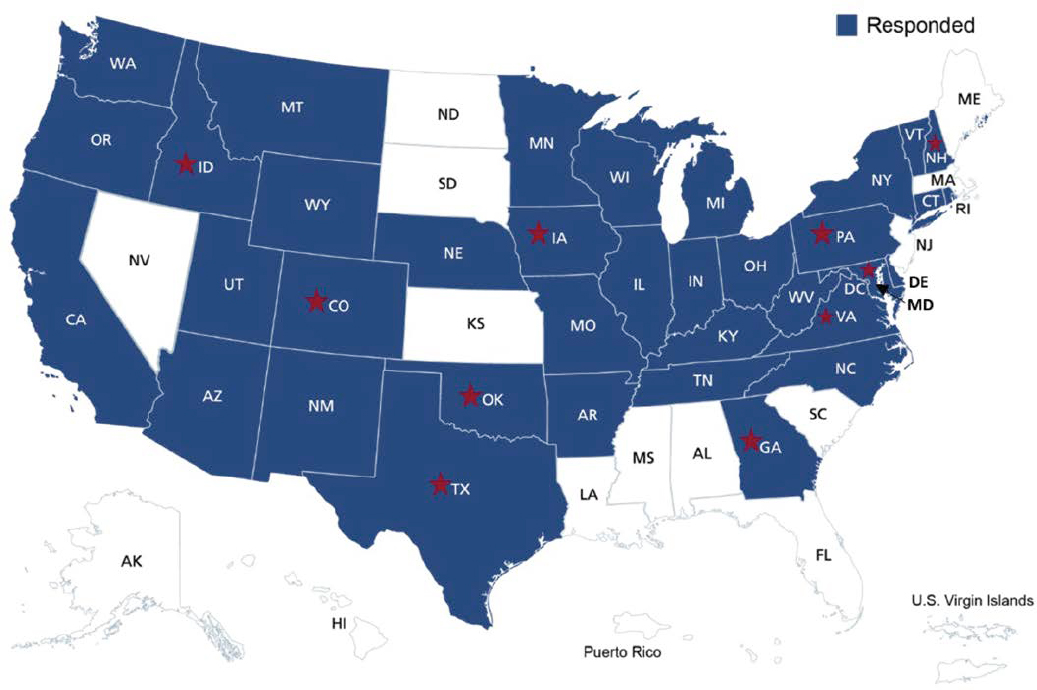
Separate versions of the online survey were used for the following survey respondents: (1) state and federal agencies; (2) preservation organizations and private-sector consultants; and (3) tribes, THPOs, and NHOs. The surveys resulted in 67 responses from 36 states (including from both SHPOs and state DOTs), 13 responses from THPOs, and 11 responses from eight private sector firms. No responses were received from NHOs or preservation organizations.
The follow-up telephone interviews involved 13 state DOTs, eight SHPOs, one private consultant, FHWA headquarters staff [including the FHWA federal preservation officer (FPO)], the Federal Railroad Administration deputy FPO, the Advisory Council on Historic Preservation (ACHP), the National Association of Tribal Historic Preservation Officers (NATHPO), and the National Park Service (NPS) FPO. No tribes participated in the interviews. Five of the state agency interviews featured joint participation of state DOT and SHPO staff.
Figure 1 shows the states that participated in the online survey or interviews and the locations of the selected case studies. The selected case studies reflect geographic diversity as well as a wide range of challenging types of projects and historic properties. The complete case studies are provided in the appendix. Brief synopses of the case studies are included throughout Parts I and II of the handbook.
Research Note: Native Hawaiian Organizations
The online survey was sent to all the NHOs listed in the U.S. Department of the Interior’s Native Hawaiian Organization Notification List, which is maintained by the Office of Native Hawaiian Relations; however, no responses were received from the listed NHOs. The online survey was sent a second time to these NHOs, but no responses were received.
Federal agency consultation with NHOs, following the Section 106 regulations, mirrors the consultation process with tribes, including the process associated with determination of effect on historic properties. As stated in ACHP’s Consultation with Native Hawaiian Organizations in the Section 106 Review Process: A Handbook (ACHP 2011a), agencies are to ensure that consultation
provides the Native Hawaiian organization a reasonable opportunity to identify its concerns about historic properties; advise on the identification and evaluation of historic properties, including those of traditional religious and cultural importance to it; articulate its views on the undertaking’s effects on such properties; and participate in the resolution of Adverse Effects.
In addition, consultation with NHOs should begin early in the project development process. These are the same core requirements that apply to consulting and engaging tribes. Therefore, even though no NHOs responded to the online survey, the best practices for consulting and engaging tribes presented in this handbook can be applied to consulting and engaging NHOs. How an agency consults and engages a tribe may be different for each individual tribe, however, and this is the same for NHOs. Agencies will need to customize NHO consultation and engagement given Native Hawaiian histories, culture, and traditions, in addition to the different types of organizations that are NHOs.
Forms and Tools
Background research, the online survey, and interviews of practitioners revealed that many have developed forms and tools for conducting various steps in the Section 106 process, including findings of No Effect and No Adverse Effect. These forms and tools were developed to provide clear and consistent documentation of Section 106 decision-making and findings. Examples of these forms and tools are listed in Appendix E of the conduct of research report for NCHRP 25-65, which is available on the National Academies Press website (nap.nationalacademies.org) by searching for NCHRP Web-Only Document 412: Creating a Handbook for Successful No-Effect and No-Adverse-Effect Section 106 Determinations. All of the forms and tools were developed in collaboration with state DOTs and SHPOs and have been reviewed by FHWA. (Note: NCHRP does not endorse the use of specific tools or forms.)
Organization
To help practitioners navigate the process of preparing successful and defensible determinations of No Effect or No Adverse Effect and to effectively document and communicate those findings, this handbook is organized into three parts.
Part I. Section 106 Process and Steps in Making Findings of No Effect and No Adverse Effect
- Chapter 1 provides an overview of the Section 106 process, focusing on making determinations of No Effect and No Adverse Effect.
- Chapter 2 consists of a detailed discussion of steps in making successful and defensible findings of No Effect and No Adverse Effect. This chapter relies on the results of the background research, online surveys, and interviews.
Part II. Overcoming the Challenges Often Encountered When Making Findings of No Effect and No Adverse Effect
- Chapter 3 identifies historic properties that prove challenging when determining findings of No Effect and No Adverse Effect and strategies for overcoming those challenges.
- Chapter 4 identifies challenging transportation projects when determining findings of No Effect and No Adverse Effect and strategies for overcoming those challenges.
- Chapter 5 identifies challenges involving indirect, reasonably foreseeable, and cumulative effects and presents strategies for overcoming those challenges.
Part III. Strategies for Consulting and Engaging Tribes in the Effects Assessment Process
- Chapter 6 discusses successful strategies for consulting and engaging tribes in the effects assessment process.
The handbook also includes references and a bibliography, a list of the acronyms used in the text, and an appendix of case studies.
This page intentionally left blank.


