Preparing Successful No-Effect and No-Adverse-Effect Section 106 Determinations: A Handbook for Transportation Cultural Resource Practitioners (2025)
Chapter: 4 Challenges Involving Transportation Projects
CHAPTER 4
Challenges Involving Transportation Projects
Streetscape, Pedestrian Safety, and Other Micromobility Improvements in Historic Districts
Challenge Summary
State DOT and SHPO respondents noted that small-scale transportation projects such as sidewalk installations or improvements, Americans with Disabilities Act (ADA) improvements, and construction of shared-use paths in historic districts in cities and towns are often a challenge in terms of making effects findings. Project designers and engineers often use standard designs for these elements that are not compatible with the setting and character of these historic districts. One state DOT respondent noted that this often “leads to a lot of back and forth with cultural [staff] on how to get to a [No Effect] or [No Adverse Effect] finding.” Part of the challenge of these types of projects is coming to an agreement on whether the small-scale changes constitute a finding of No Adverse Effect or a finding of Adverse Effect:
- “No Adverse Effect—for example, The project will remove one historic era lamppost. Remaining 23 contiguous lampposts are protected from harm. The one to be removed is located immediately adjacent to existing intersection to be improved (at the end of the series of 23). Measures to avoid any additional impacts to contributing features have been included in design. The eligible district was identified as part of [the DOT’s] review of the project (through “good faith effort”) and notified project team early to ensure measures to avoid/minimize were included in design. The SHPO views 36 CFR 800.5a and removal of a contributing feature (even if just one of a series) as Adverse Effect. Our view is that the context and intensity of the undertaking must be considered and whether the federal action diminishes the significance of the district. . . . An Adverse Effect finding due to the removal of one lamppost would trigger an Individual 4f. In the end, the SHPO concurred with No Adverse Effect.”—State DOT Respondent
- “We have had challenges on projects that are providing safety improvements in historic districts such as crosswalks, pedestrian refuge islands, ADA compliant crossing, etc. Our stance has been that the changes benefit the district and make it safer and do not alter the character-defining features to the point of jeopardizing integrity or eligibility and, therefore, have No Adverse Effect. The SHPO has argued that we are changing the way the historic district looks and, therefore, it is an Adverse Effect.”—State DOT Respondent
Often, these are local public agency (LPA) projects that are funded by FHWA programs. In some states, the LPA is able to send Section 106 documentation directly to the SHPO without review or input by the state DOT’s cultural resource staff. This may lead to inconsistencies in the state’s overall Section 106 findings and documentation for FHWA-funded and approved projects. Another challenge, in cases where the state DOT cultural resource staff are involved
in the review of the project, is getting project specifics from local project proponents that are sufficient to complete an adequate assessment of effects.
Case Study: ADA Improvements, U.S.-266, Checotah Historic District, Oklahoma
Finding: No Adverse Effect (ACHP dispute).
Project: Sidewalk improvements to U.S.-266 to improve pedestrian safety that meet ADA standards, including new concrete sidewalks, ADA-compliant ramps, and bump-outs.
Finding of Effect Overview: Project boundaries were located within a National Register-listed commercial historic district. ACHP resolution of a disagreement on effect cites distinction that the proposed bump-outs would not alter the character-defining features of the historic district, as the streetscape was not identified as such in the district nomination.
Overcoming the Challenge
Although standard designs often used for sidewalk projects, ADA improvements, and shared-use paths in historic districts may not be compatible with the feeling or setting of a historic district, this does not necessarily mean that these changes will always have an Adverse Effect on the district. As illustrated in the case study on ADA Improvements, along U.S.-266 in the Checotah Historic District in Oklahoma, it is important to establish whether the existing sidewalks and streetscape are identified and documented as contributing character-defining features within the district.
Several state DOTs have also developed minimization measures for small-scale improvements in historic districts; for example:
- Redesigning lanes, curbs, sidewalks, and other improvements to be compatible in design, scale, and materials with the existing National Register–listed or –eligible property or district. For example, re-using or matching existing street paving or sidewalk paving materials (brick, hexagonal pavers, etc.).
- Using signs, street lighting, traffic lighting, etc. that will be compatible with the National Register–listed or –eligible property or district.
For LPA projects, one state DOT has included a provision in its recently updated statewide PA to require a local programs reviewer within the state DOT’s cultural resource office to review these projects before they are sent to SHPO for their review. (See the case study on the ADA improvements to U.S.-266 in the Checotah Historic District in Oklahoma.)
Traffic Noise Impacts
Challenge Summary
In some cases, Section 106 consulting parties believe that transportation projects designed to improve congestion and safety might result in an increase in traffic that will increase noise impacts on the historic properties adjacent to the areas associated with the improvements. The perception of foreseeable Adverse Effects resulting from traffic noise is, however, generally not borne out by the data related to an increase in noise levels, which leads to conflicts in opinions on effects.
Projects that may result in the construction of noise walls can also be a challenge when it comes to making effect findings. Noise walls can mitigate potential adverse noise impacts resulting from a project, but noise walls can also have an effect on adjacent historic properties if the setting is one of the aspects of integrity and an essential physical feature of an adjacent property. In this scenario, construction of a noise wall might result in a visual Adverse Effect on the property that would diminish its integrity. Projects involving the placement of noise walls often end up in disputes over whether the effect of the construction of the noise wall is adverse or not.
Overcoming the Challenge
The final report for NCRHP 25-25/Task 106, “Highway Noise and Historic Properties: A National Review of Effects and Mitigation Practices,” identified the use of context-sensitive
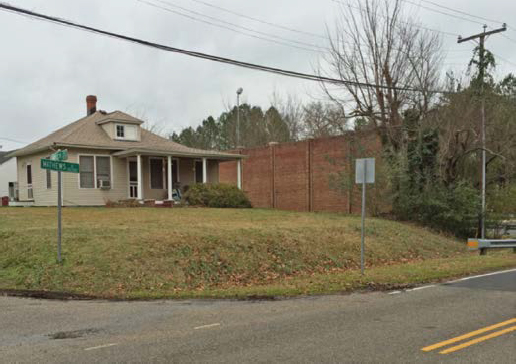
Figure 5. Three-dimensional brick noise barrier (Virginia DOT).
aesthetic treatments of noise walls as being successfully used to avoid potential adverse visual effects (Graham et al. 2019). The study discussed the reconstruction of the double swing span George P. Coleman Bridge in Yorktown, VA, which required the installation of noise walls along portions of the bridge and bridge approaches. Although the reconstruction project was determined to have No Effect on the adjacent Yorktown Historic District or Yorktown Battlefield, installation of the noise barrier was an Adverse Effect on the historic bridge and on nearby historic resources. To minimize the visual effect of the wall on the historic resources, a three-dimensional, brick, urban-themed barrier wall was selected (Figure 5), which resulted in a finding of No Adverse Effect.
When a small number of historic resources will be affected by an increase in noise, other minimization measures can be used, as was the case for the Shiloh Baptist Church, a historic Black church located adjacent to the I-70/I-71 Columbus South Innerbelt Project (Figure 6).
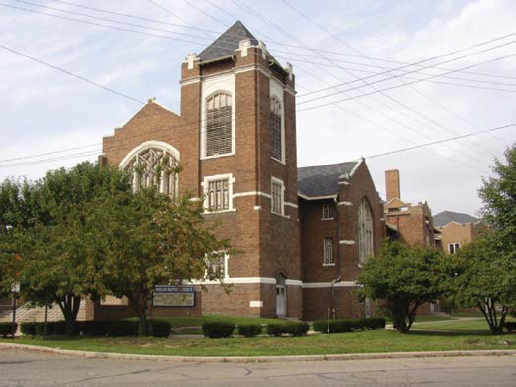
Figure 6. Shiloh Baptist Church.
Case Study: U.S.-6 Auxiliary Lane, Colorado
Finding: No Adverse Effect.
Project: Mobility and pedestrian improvements to U.S.-6 including addition of an auxiliary lane, realignment, addition of curbing at driveways, filling sidewalks, drainage improvements, and new noise walls.
Finding of Effect Overview: Through a thorough noise analysis, noise walls were used to mitigate adverse impacts as a result of noise levels; however, the noise walls themselves required assessment of effect. As a result of the project and design simulations to assess visual impacts from the noise walls, the state DOT made a defensible determination of No Adverse Effect.
This project, also featured in the NCHRP Project 25-25/Task 106 study on noise and historic properties, involved reconstruction of city street bridges over the Interstate mainline and construction on new urban avenues along the mainlines. During a series of project-specific meetings, representatives from Shiloh Baptist explained that the church sanctuary was not air-conditioned and frequently had both windows and doors open during services. Rather than install noise walls that the residents in the area opposed, the Ohio Department of Transportation (ODOT) executed a noise mitigation agreement with the Shiloh Baptist Church for noise abatement work that included installation of central air-conditioning, acoustical drapes and/or double-paned windows, and solid core doors or the equivalent. The project resulted in a finding of No Adverse Effect, with the condition of implementing the noise abatement work for the church.
Additional Information and Resources
Highway Noise & Historic Properties: A National Review of Effects & Mitigation Practices (Graham et al. 2019). See the case study of Virginia’s George P. Coleman Bridge (p. 45).
Vibration Impacts
Challenge Summary
Planning for potential effects of construction-induced vibration is a complex process, partly because of the complexity of predicting how vibrations will travel through different soils and rock and then how historic properties will be affected by the vibration. Vibration might directly impact a structure but can also cause the ground to settle or shift, which can subsequently cause damage structures. Understanding these effects and trying to define an appropriate APE that considers potential vibration effects requires experts in the science of vibration.
Overcoming the Challenge
The final report for NCHRP Project 25-25/Task 72, “Current Practices to Address Construction Vibration and Potential Effect to Historic Building Adjacent to Transportation Projects” provides a compilation of effective practices that address potential impacts of construction vibration on historic buildings adjacent to roadway construction projects (Wilson, Ihrig & Associates, IDF International, and Simpson, Gumpertz & Heger 2012). Section 2.4 of the report “Building Response and Damage,” identifies several key principles for understanding how a building will respond to vibration (both steady and intermittent).
How a particular building will respond dynamically to strong ground vibration depends on many factors, among which are the following:
- The soil on which the building is founded,
- The building’s foundation (e.g., spread footing, piles),
- The building’s mass, and
- The stiffness of the building’s main structural elements.
Whether dynamic motion will damage the building’s structure and its architectural features (e.g., interior surface finishes) depends in large part on the type of construction (e.g., masonry) and the elastic behavior of the building material at higher levels of strain:
- Wood and steel are more elastic than masonry (e.g., brick and stone).
- Interior finishes that are more susceptible to damage are those such as lath and plaster.
These principles, along with the type of vibration expected (short-term/transient or continuous/steady-state) are used as key factors in selecting appropriate threshold criteria for vibration, as there is no single commonly accepted standard.
The final report for NCHRP 25-25/Task 72 outlines several steps to follow when the potential effects from construction vibration are being considered:
- Consultation between the owner of the historic building, development team, and reviewing agencies such as the SHPO and local planning departments to identify potential risks, negotiate changes, and agree on protective measures;
- Documentation of building conditions prior to commencement of adjacent work, including a detailed photo survey of existing damage;
- Establishment of vibration limits based on building conditions, founding soil conditions, and type of construction vibration;
- Implementation of vibration-mitigating measures on the construction site or at the historic building, or both, which could include specific means and methods or protective measures;
- Vibration monitoring by seismograph during construction, with notification by audible or visual alarms, or both, when limits are approached or exceeded; and
- Regular condition surveys and reviews during construction to identify damage, evaluate the efficacy of protective measures already in place, and identify and implement additional corrective steps.
Special provisions placed within construction contracts are commonly used to ensure vibration monitoring is carried out to avoid damage to historic properties. One state DOT provides guidance on what these special provisions should include:
- Outline specific requirements for the monitoring plan.
- Identify specific properties to be protected by vibration-monitoring techniques.
- Establish preconstruction work requirements.
- Specify that the peak particle velocity (PPV) will be determined on the basis of the preconstruction survey.
- Require a postconstruction survey for documenting negation of construction effects on receptors.
Thinking about potential vibration effects early in a project can, according to one state DOT, lessen the possibility of legal issues, avoid liability for repairs, expedite the project, and maintain a good working relationship with consulting parties and the public.
Additional Information and Resources
- Protection of Historic Structures (Vibration Monitoring). Section 10.80 in Iowa DOT Construction Manual (Iowa DOT 2018).
- Iowa DOT Seminar: Vibration Fundamentals, Vibration Criteria, Typical Effects of Construction Equipment (Iowa DOT 2015).
- Iowa DOT’s Vibration Monitoring Program (Bernhard and Hannen 2017).
- Current Practices to Address Construction Vibration and Potential Effect to Historic Building Adjacent to Transportation Projects (Wilson, Ihrig & Associates, IDF International, and Simpson, Gumpertz & Heger 2012).


