Personal Protective Equipment for Influenza A(H5N1) in High-Risk Farm Settings: Proceedings of a Workshop (2026)
Chapter: 7 Innovative Personal Protective Equipment Technology and Research
7
Innovative Personal Protective Equipment Technology and Research
The sixth session of the workshop highlighted existing and emerging technologies, products, and key research questions to improve effective implementation of personal protective equipment (PPE) use in farm settings. The session also explored strategies to drive sustainable innovation in PPE. Herek L. Clack, associate professor at the University of Michigan, Ann Arbor, and cofounder and co-chief executive officer at Taza Aya, moderated the session. He spotlighted a 2024 National Institute for Occupational Safety and Health (NIOSH) report, NIOSH Healthcare Personal Protective Technology Targets for 2020 to 2030, which called for expanding private sector engagement in PPE research and establishing PPE centers of excellence (Moore et al., 2024). Clack stated that these recommendations are yet to be implemented, and that the public is at a greater risk when voluntary programs rely on the compliance of agricultural workers to wear respiratory protection they do not prefer and for which no formal respiratory protection program is in place to ensure proper fit and use.
RESEARCH PRIORITIES AND GAPS
James Coburn, senior advisor for emerging technologies at the U.S. Food and Drug Administration (FDA) on detail as portfolio lead to the Advanced Research Projects Agency for Health (ARPA-H), discussed the role of ARPA-H in PPE innovation and distribution. Recalling his experiences working 12-hour shifts in full PPE, he attested to the challenges discussed in the workshop regarding wearing PPE for long working hours. Coburn was involved in creating the National Institutes of Health (NIH) 3D
Print Exchange, a community-driven portal hosted by the National Institute of Allergy and Infectious Diseases within NIH that allows users to share bioscientific and medical models for three-dimensional (3D) printing. Made available on the NIH 3D Print Exchange during the COVID-19 pandemic, the COVID 3D Trust is a repository of respiratory protective devices and other accessories backed by scientific or medical testing.1 Coburn recounted that his mantra while working to educate people about COVID-19 pandemic risks and safety measures was “better than a bandana.” Currently, he works with ARPA-H, an agency established in 2022 with the mission of accelerating better health outcomes for everyone. The agency employs the model of innovation and high-risk, high-reward funding into research and development (R&D) created by the Defense Advanced Research and Projects Agency. One such R&D initiative is ARPA-H’s Building Resilient Environments for Air and Total Health (i.e., BREATHE) program, which is focused on developing solutions for cleaner indoor air. Coburn clarified that this program is not specific to farm safety.
Ease of Use and Comfort
Coburn stated that innovation plays a role in addressing barriers to PPE use. Ease of use issues persist with PPE, drive lack of compliance, and can pose worker safety issues. Innovation in this area explores new materials and novel methods to prioritize comfort and enable long-term use. Additionally, PPE is being developed that eliminates training requirements—either by fitting properly without training or by not requiring a proper fit to function effectively—with powered air-purifier respirators serving as a quintessential example, Coburn described. However, he acknowledged that these devices are expensive and can present ease of use challenges not related to fit. Given that many types of work require long-term wearability, durability, and manual dexterity in PPE, ARPA-H is exploring materials that meet these criteria. Moreover, the agency is searching for innovations that offer breathability and open designs. For instance, antimicrobial or viral-neutralizing particles could potentially be integrated into products without implicating the side effects that occur with some antimicrobial coatings. The development of tiny sensors creates the opportunity to develop smart fabrics and smart respirators. Such PPE would sense changing conditions that require a different layer of protection and automatically adapt pore size in response, Coburn highlighted.
___________________
1 The COVID 3D Trust is available at https://3d.nih.gov/collections/covid-19-response (accessed November 7, 2025).
Reprocessing and Durability
Ease of use cannot come at the expense of function, Coburn stated, emphasizing that users must be able to trust that new materials and technologies provide security. Technology developed through FDA funding for medical countermeasures has enabled PPE to be reprocessed with vapor-phase hydrogen peroxide. Cleaning multi-use PPE can be time-consuming and expensive, but single-use materials are also costly and create substantial waste. A reprocessing design that increases the ease of decontamination could simultaneously achieve improved economics. For instance, he posited that reprocessing could potentially integrate an additive that renews the protecting factor of the PPE while decontaminating it, much like oiling rainproof boots increases protection and durability. He explained that a century ago, milk handling was one of the first industries to implement sanitary standards after infection outbreaks and other issues necessitated design changes for pipes and handling equipment. Design standards required that infrastructure and equipment had the capability to be cleaned in addition to transporting milk. Coburn remarked that because current PPE standards do not require cleanability, this feature is often excluded in the PPE design process.
Ensuring Protection and Increasing Accessibility
In an era of counterfeiting, Coburn emphasized ARPA-H’s focus on maintaining safety standards and assuring quality. Many PPE products profess to match a standard without basis. Modern methods of tracking—such as non-fungible tokens, unique identification tags, and blockchain technologies—enable the identification of authentic products that meet safety standards. He added that other agencies could create technology to locate and identify the people creating counterfeit products. Given that existing standards may not apply to innovations such as respiratory protective devices designed not to require fit testing and novel materials with variable pore structure, new testing standards may be necessary. He noted that buyer confidence in new technologies is influenced by assurance that they offer the desired levels of safety. Moreover, PPE must be accessible to be used. Stockpiles are a method of ensuring supply, but they require distribution to users. Distributed manufacturing is an approach to increase accessibility, with 3D printed PPE as an example. Coburn acknowledged that filtering materials are not currently printable via 3D technologies. Advanced Functional Fabrics of America is a public–private partnership working to develop new, advanced textiles. Another area of innovation discussed was built-in exposure monitoring, which could track filter life while accounting for factors such as humidity, reduced filter capacity, and back pressure
generation. Performance monitoring could be a component of a connected ecosystem that includes surface sensors detecting and monitoring amounts of pathogens or particulates in the environment. He underscored that such technology would bolster facility management knowledge of existing exposure risks and inform workers of present danger and any need for increased PPE. Ultimately, as workers understand specifically why PPE is needed in their immediate contexts, such innovation would increase PPE adoption and worker visibility, said Coburn.
LESSONS LEARNED FROM INNOVATIVE PRODUCTS
Richard Gordon, chief executive officer of Air99 LLC, outlined challenges in PPE innovation and manufacturing faced by the creators of the Airgami® mask. In 2011, Gordon’s family was living in China, and he searched fruitlessly for an effective mask to protect his four-year-old son from exposure to extreme air pollution. As an engineer, he began working to design a mask, efforts that culminated in the Airgami mask. Created in 2016, Airgami won multiple awards including the Biomedical Advanced Research and Development Authority (BARDA) Mask Innovation Challenge. From 2021–2023, Airgami sold 55,000 units to more than 15,000 customers during pilot production. Airgami passed the NIOSH 42 CFR Part 84 standard, Gordon highlighted, and achieved best-in-class breathability via Nelson Labs testing.2 With an electrostatically charged filter, Airgami blocks non-oil particulates and is compatible with other types of filters. Featuring a self-conforming fit, the harness is adjustable, and the design allows micro-adjustments. Airgami is lightweight, reduces fogging on glasses, and improves speech intelligibility in comparison to other masks. With no nose wires or exhale valves, Airgami is MRI safe, does not shift off the nose nor collapse during inhalation, and remains firmly sealed in winds up to 40 miles per hour. Moreover, the mask is reusable, rinseable, and can be disinfected with heat. Despite these benefits, Airgami closed production in November 2023 due to investment, testing, certification, production, and legal challenges, said Gordon.
Investment Challenges
Making Airgami suitable for use in the dairy and poultry industries would require design modifications and a 100-fold cost reduction, Gordon explained, stating that these technical objectives are feasible in a reasonable timeframe but necessitate substantial demand, investment, specialized manufacturing expertise, and time. Investment for mask innovation is very
___________________
2 Code of Federal Regulations, Title 42, Part 84 Approval of Respiratory Protective Devices.
limited, he emphasized, noting that the prize monies from the BARDA Mask Innovation Challenge totaled $500,000 and were spread across 14 winners selected from nearly 1,500 submissions. Thus, inventors face limited funding opportunities even when they are able to satisfy investor criteria that their products can be made, marketed, protected, and feature a planned exit for investors. Dominant mask companies are not acquiring startup businesses, and some are considering divesting in PPE, he remarked. Although NIOSH lists over 10,000 active respirator approvals, these are concentrated among approximately 100 companies. Large companies with expansive, established product lines are not interested in adding complexity to products, he maintained. In describing how venture capitalists perceive the PPE industry as mature and that the boom-bust cycle is not conducive for investment, Gordon contended that innovation stalls in the absence of capital.
Testing and Certification Challenges
Design innovation depends on rapid iteration through cycles of specifications, designs, implementation, testing, and analysis, said Gordon. Faster iterations enable more rapid innovation, but mask testing faces a bottleneck. Quantitative fit testing measures how well a mask seals. The TSI Incorporated PortaCount standard for fit testing involves substantial expense, as the test destroys the sample by puncturing a hole in it. Airgami has multiple sizes, and testing multiple units in each size becomes costly and time-consuming. Gordon explained that some designs do not include a probe point and noted that this presents challenges for demonstrating mask effectiveness, prompting discussion of alternative methods for evaluating performance. He suggested that mask innovators may need to develop improved methods of proving mask effectiveness. For example, the Airgami mask weighs less than the testing sampling hose, requiring implementation of a repeatable method to support the test hose in order to achieve repeatable, accurate results. Gordon added that regardless of how effective a filter is, masks only protect users when their fit achieves a seal.
The process of determining the filtration efficiency and breathing resistance of a mask involves testing bottlenecks, said Gordon. Costing hundreds of thousands of dollars, the test equipment is not affordable for startups and small companies, and testing performed by other companies can involve wait times of several weeks for results. Given that quantitative fit testing involves puncturing masks to insert a sampling probe, and mask filtration efficiency and breathing resistance require sealing the test masks to a test fixture with a layer of beeswax, and NIOSH statistical requirements necessitate results on 25 units, the testing process poses barriers to
prototyping. Additionally, laboratory test conditions do not always reflect the reality of use. For example, testing breathing resistance with a TSI 8130A machine involves using beeswax to seal the mask against a flat test plate. This maximizes the amount of surface area available for the air to pass through. Sealed to a flat surface, the mask does not shift with inhalations, as can be the case for respirators on faces. Therefore, laboratory tests for breathing resistance were described as overestimating usable surface area and underestimating actual breathing resistance. Gordon added that these challenges highlight opportunities for affordable testing approaches that provide rapid feedback and more accurately reflect real-world use.
Certification is essential, but many standards can slow or even disadvantage innovation, Gordon maintained. For instance, NIOSH and Nelson Labs collaborated on a study indicating that a surgical mask with 98 percent filtration efficiency according to the FDA particle filtration efficiency (PFE) test only demonstrated 54 percent efficiency using the NIOSH test (Rengasamy et al., 2017). The agencies use different test protocols, and Gordon asserted that some mask manufacturers exploit the gap between protocols to mislead customers by quoting certified high filtration numbers without disclosing that only the FDA PFE test—and not the NIOSH test—was performed. He stated that this practice crowds out truly innovative, high-quality masks. Moreover, the European Union (EU), China, South Korea, and Japan each have independent standards. The EU prohibits the sale of masks not certified according to EU standards, and overseas shipping of such masks can result in serious legal liability. Thus, innovators with global ambitions face hurdles of both local standards and complicated import-export regulations. He contended that multiple standards applicable to the same feature do not increase protection for the public; they slow or disadvantage innovation and increase cost. For example, some of the filtering face piece respirators made in the EU can pass N95® standards, and consolidating international standards could increase the availability of these devices, said Gordon.
Current certification standards are limited in scope, Gordon highlighted. The N95® certification standard is designed for occupational use, and standards do not exist for consumers, pediatrics, or reuse. Given that NIOSH only certifies respirators with head straps, innovators have no method of certifying that masks with ear loops perform equally well to those with head straps. Similarly, a standard does not exist for certifying the number of disinfection cycles a mask can safely withstand. He described a circular challenge in which innovators are unable to build factories without orders, customers only order products with N95® certification, and obtaining certification requires a factory, thus leaving innovators trapped in a cycle. The COVID-19 pandemic offered Air99 LLC an opportunity to exit this loop via an emergency use authorization that enabled sale of Airgami.
Gordon clarified that his company never claimed Airgami was N95® certified, despite that it had a filtration efficiency greater than 95 percent for most penetrating 0.3 µm particles. The pandemic PPE supply shortages made it possible to sell Airgami without N95® certification. He explained that certification involves pausing production and building a quality management system, and any minor change can trigger a recertification process. The cost and time involved in recertification discourage innovation and delay novel products from reaching the market, said Gordon.
Production Challenges
U.S. manufacturing capacity has decreased over the past 40 years, noted Gordon, and domestic automation expertise lags compared to that in China. Most masks are made of polypropylene, and China dominates the global polypropylene supply chain, creating vulnerability in U.S. production capability. The COVID-19 pandemic caused onshoring of much U.S. respiratory protective device manufacturing, which is a time-consuming process. He remarked that Air99 LLC spent years adapting existing machinery and inventing new production tools to enable Airgami pilot production. Given that the product is origami, automatic tools for folding origami were not available and had to be invented. Noting that his company is not unique in this regard, Gordon said that most innovators must develop downline tools to manufacture new products. For instance, Elon Musk has spoken about the development of production lines required for Tesla manufacturing. Invention propagates downstream and therefore changes in the upstream design must propagate through to the production line. During pilot production, Gordon faced a choice of stabilizing the process to meet demand or innovating on materials and processes. The experience of experimenting on a stable production line taught him how disruptive and destabilizing such an initiative can be. For instance, innovation can necessitate building a second R&D line separate from the production line, thereby doubling equipment cost, and scaling to mass production requires exponentially greater capital investment. Although automation is essential in reducing labor cost, it amplifies mistakes, said Gordon, noting that he once witnessed a machine create hundreds of unusable parts before it could be stopped.
Automation requires a predictable, high-volume demand, and the COVID-19 pandemic exemplified how unpredictable demand can be, Gordon remarked. Whereas no manufacturers showed interest in Air99 LLC prior to the pandemic, manufacturers began seeking the company out after COVID-19 emerged. Demand fluctuated throughout the pandemic, and Airgami would sell out one month but receive few orders the next. When production closed in 2023, loyal customers purchased 2 months of inventory within a few hours. Gordon stated that mask production is
capital-intensive, vulnerable to supply chain interruptions, and subject to widely fluctuating demand cycles, all while contending with forces hostile to innovation.
Legal Challenges
Patents are necessary to attract investors, but the intellectual landscape for masks is densely crowded, Gordon remarked. Filings are slow and expensive, and international coverage raises costs substantially. Return on investment is often negligible, in that innovators may outlay considerable expense to obtain a patent and never successfully attract investors. Moreover, these funds are then unavailable for innovation. He emphasized the potential liability risks that innovators face—for example, 3M was sued for hundreds of millions of dollars in respirator lawsuits. Additionally, large corporations have secured the occupational and industrial markets, making market entry difficult. The business-to-consumer approach requires broad, effective customer support, and Gordon highlighted that small companies are often challenged in providing support to thousands of customers.
Gordon explained that despite Airgami’s top-performing design, high quality, and overwhelming positive customer feedback, barriers related to investment, testing, certification, production, and legal procedures prevented Air99 from scaling. He added that PPE is an issue of work culture, and its use must be driven from the top down. Before entering the Air99 factory, everyone from employees, to top management, and visitors were required to don an Airgami mask, gloves, shoe coverings, lab coat, head covering, ear protection, and eye protection. Gordon stated that top-level management should solicit employee feedback while fulfilling the responsibility to ensure that their workers are safe.
WEARABLE AIR CURTAINS: NOVEL RESPIRATORY PROTECTION AGAINST AIRBORNE PATHOGENS
Clack, serving as both moderator and panelist, described and presented performance data on non-thermal plasma (NTP) and wearable air curtains in reducing pathogen exposure. A startup company, Taza Aya is grounded in intellectual property that stems from Clack’s research laboratory at the University of Michigan. Emphasizing the importance of cross-discipline collaboration, Clack described how coupling his research in electrostatic control of emissions from coal-fired power plants with colleague Krista Wigginton’s study of the fate of viruses in wastewater treatment led to studying the effect of electric fields on airborne viruses in 2012. They developed a research enterprise in which they aerosolized a surrogate virus, bacteriophage MS2, then passed it through an NTP, which utilizes technology
similar to that used to remove coal ash particles from the exhaust of coal-fired power plants. Their research demonstrated that NTPs can be highly effective at inactivating airborne virus, creating an alternative process to filtering airborne viruses (Xia et al., 2019). Incorporating this research, Clack and Wigginton developed a prototype NTP reactor in 2019 that they tested on a Michigan pig farm. During these pre-pandemic years, interest in engineered solutions to prevent human airborne transmission was minimal, Clack noted, but agricultural interest in preventing airborne transmission of infectious diseases for livestock was high, and his research was funded by agricultural organizations including the U.S. Department of Agriculture (USDA) and Pork Checkoff, a program of the National Pork Board.
Non-Thermal Plasma for Air Disinfection
Originally conceived as an infrastructure solution to the threat of airborne infectious pathogens, use of NTP was envisioned for incorporation into building ventilation systems, not PPE, Clack explained. He described fit testing for respiratory protective devices as comparable to building air tightness in barns, given that a barn must be airtight to develop the negative pressure needed to draw in treated outdoor air. This dynamic posed a barrier to installing high-efficiency particulate air (HEPA) filters in barns, as their effectiveness would rely on the barn being airtight. Thereby, the air tightness of the barn parallels the fit-tested seal of a mask, he asserted. Moreover, the high cost of replacing respiratory protective devices aligns with the high costs of retrofitting barns to be airtight, and the breathing restriction of a respiratory protective device aligns with the reduced airflow rates that HEPA filters would cause in cooling airflow to a barn. Thus, despite notable differences in applications, some challenges are similar across filtration methods of preventing airborne pathogen transmission, Clack noted.
Clack described NTP as an ionized (i.e., charged) state of matter, typically induced using strong electric or magnetic fields. Although NTP is used in electronics with plasma displays, fabrication of microelectronics, and chemical catalysis, its use in air disinfection is challenging. For instance, the treatment of flowing air entails a short exposure time. In applications of plasmas for water or surface treatment, the duration of plasma treatment time is tens of seconds to tens of minutes. In contrast, the exposure time of a flowing airstream passing through a plasma treatment device is tens to hundreds of milliseconds. Potential interferences of the electric field can influence the motion of the airflow or of the aerosol suspended in the airflow. Additionally, deep dilution is caused from liquid nebulization into the air. A solution containing a virus is nebulized to enable that virus to be
suspended in the air, and this process deeply dilutes the target of the plasma treatment, increasing the difficulty of measuring effect. Also, plasma applied in air generally produces ozone, necessitating ozone mitigation. The nonliving nature of viruses poses further challenges in that the effectiveness of NTP treatment on viruses can only be assessed from inferences about the viral host, said Clack. He outlined that they collect samples before and after plasma treatment, then inoculate the host of the virus with treated samples, and assess differences in cytopathic effects of the host.
A comparison of the performance of air treatment processes reveals that HEPA filters, ultraviolet (UV) irradiation, and NTPs each demonstrated reduction of the same viral aerosol, MS2 phage, by at least 97 percent, Clack detailed, highlighting that NTP had the highest reduction of more than 99 percent of pathogens (Tseng and Li, 2005; Xia et al., 2019; Zhang et al., 2020). Moreover, NTP demonstrates advantages over HEPA and UV in terms of airflow, pressure drop, flow area, and treatment volume. Achieving the efficacy of HEPA and UV, NTP treats 3 to 4.5 times the airflow rate while at the same time inducing 25 percent lower pressure drop than HEPA filtration. Flow area and treatment volume—key factors for miniaturization—are 3 to 44 times smaller for NTP than for HEPA or UV. Clack explained that NTP’s ability to treat large volumes of air with equivalent efficacy, less pressure drop, and within a more compact package than other methods holds potential for miniaturization.
Increased Awareness of Airborne Virus Transmission and Innovative Responses
In 2019, BARDA and JLABS launched the Invisible Shield Quickfire Challenge with the goal of developing solutions that repel and protect against airborne viruses while integrating seamlessly into everyday life, Clack detailed. The winner of the challenge was a prototype, developed by Taza Aya, that features a visor worn on the head with small pumps attached that direct airflow to the front of the face. The device demonstrated effectiveness at deflecting water mist as it approaches the face. The design also offered benefits that included elimination of the need for fit testing, no added breathing resistance, respiratory protection while eating and drinking, and respiratory protection for all ages, face shapes, and facial hair styles. Moreover, the device does not fog glasses or goggles, it sits atop the head and therefore avoids the contact irritation that some respiratory devices cause on skin, and it does not impede communication for people who are deaf or hard of hearing or who speak with heavy accents, outlined Clack.
The COVID-19 pandemic caused a massive shift in understanding of the role of airborne transmission in disease spread, said Clack (Kupferschmidt,
2022). Prior to the pandemic, it was widely believed that few, if any, diseases could be transmitted through the air (Jimenez et al., 2022). In 2020, aerosol scientists contended that COVID-19 was transmitted by air, upending previous assumptions (Morawska and Milton, 2020). Early in the pandemic, USDA discovered that COVID-19 outbreaks were occurring in meat and poultry processing plants. In 2023, the General Accountability Office issued a report citing that in some cases, the risk of COVID-19 transmission within a meat or poultry processing plant was 50 to 70 times that of the general public (U.S. Government Accountability Office, 2023). Potential factors responsible for this increased risk include the close proximity of workers over long periods of time and the noise level of the environment, which necessitates loud speaking voices that likely project and emit greater burdens of virus than speaking softly.
Wearable Air Curtain Technology
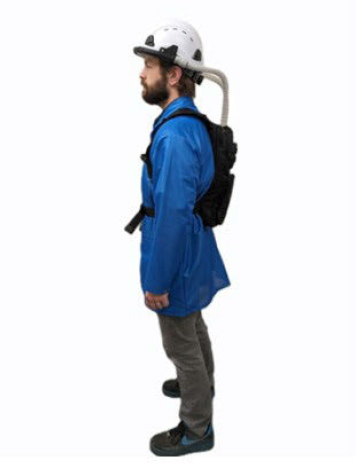
In September 2022, USDA launched the Meat and Poultry Processing Research Initiative with a goal of identifying modifications to worker safety protocols to mitigate communicable diseases such as COVID-19, Clack stated. These modifications could include sanitation strategies. As an element of their award from the USDA program, Taza Aya received and incorporated feedback from poultry workers on their design including partner in the project, Michigan Turkey Producers. Workers commented that the one-piece visor design added too much weight to existing headgear, but a backpack would not be more burdensome than other PPE used. Thus, Taza Aya moved from the one-piece visor design to a two-piece design that minimizes additional weight on the head, preserves worker ability to wear preferred head protection, and is easily added to existing PPE ensembles. The design, shown in Figure 7-1, features a 3D-printed nozzle array that can clip onto any preferred hard hat or bump cap. A 9.5-lb. hardshell backpack contains electro-mechanical components and a battery with 7.5 hours of battery life. Clack highlighted that this design is appropriate for farmworkers because it does not create breathing resistance, it does not cause fogging of safety goggles, and it does not hinder communication between people who may speak different primary languages.
Third-party testing demonstrates that the air curtain provides 99.8 percent reduction in inhaled viral aerosols by the person wearing the device and, Clack underscored, a 95 percent reduction in inhaled viral aerosols by a person without a device standing in close proximity to someone wearing the air curtain. Additionally, NTP has been shown to inactivate more than 90 percent of viral aerosols, with Taza Aya testing demonstrating inactivation of 99.2 percent of viral aerosols. Taza Aya completed the USDA prototype development project and is currently conducting validation testing
SOURCE: Clack presentation, September 30, 2025; image credit: Taza Aya.
of the beta prototype at Michigan Turkey Producers while confirming with workers that the revisions to the alpha prototype address their earlier feedback, said Clack.
WEARABLE TECHNOLOGIES AND DESIGN OF PERSONAL PROTECTIVE EQUIPMENT
Lucy Dunne, codirector of the University of Minnesota Wearable Technology Lab, outlined design and testing considerations for functional, wearable PPE and application of electronics in next generation devices. She emphasized the balance between high-functionality design and wearer comfort. Comfort is a driver of willingness to wear PPE, and the concept encompasses many dynamics. Physical comfort involves temperature, moisture, contact pressure, movement, and airflow. Masks or respirators can increase physical temperature and respiratory moisture build up. Contact pressure is associated with fit and the way in which a rigid or tensioned structure relates to the underlying anthropometrics and anatomy. Dunne underscored that high variability across an immense population is an important consideration for the potential contact pressure of PPE. Movement pertains to the efficacy of the product while the wearer is moving as well as to the distribution of contact pressure during movement. Airflow
enables the ability to breathe without expending additional effort. Dunne remarked that these physical components are more intuitive and better researched than psychosocial factors, which she described as undervalued.
Psychosocial components include cognitive and psychological factors that can affect effective PPE implementation, said Dunne. For example, a person may have uncertainty about when PPE is needed, whether they are using a product correctly, whether the PPE is clean, and how to properly don and doff it. Moreover, a person may not be aware of contextual changes that necessitate higher levels of protection. Reusable products and PPE with reusable components require maintenance, and this involves the capacity and capability of a user or system to maintain, clean, sanitize, and monitor the condition of a product within the environment. Dunne emphasized the role of aesthetics and social interaction in a user’s comfort with PPE. Whether a user feels self-conscious in a device may seem like a trivial consideration in protecting against deadly pathogens. However, if users are unwilling to wear PPE they feel self-conscious in, the safety effort has failed, she remarked, noting that countless highly functional products go unused because people do not like how they look or feel. The COVID-19 pandemic demonstrated complex and widely variable cultural influences that affect PPE choices and behaviors. Moreover, these cultures were resistant to change despite the incredibly disruptive nature of the pandemic, she stated. Many people associate their identities and social perceptions with aesthetics, and she contended that too often the design of protective or functional clothing minimizes the value people place on aesthetics. Given that changes in PPE color or style necessitate regulatory processes, systemic hurdles make updates challenging. Therefore, innovators should consider aesthetics on the front end as well as a device’s potential effects on the user’s ability to clearly communicate, said Dunne.
Next Generation Personal Protective Equipment
The COVID-19 pandemic spurred numerous innovations, although barriers prevented most of them from being adopted into widespread use, Dunne noted. Yet, the potential to improve PPE, particularly reusable products, is substantial. She explained that adding electronics to PPE increases costs and manufacturing complexity, making this technology more feasible for reusable products. Tracking contact between the product and the skin, sensors yield data such as whether or not the PPE was used, how long it was worn, and the context in which it was worn. Leak detection is possible through contact sensing or via airflow or pressure detection, such as sensing pressure changes between the inside and outside of a respiratory protective device. Real-time detection of a specific pathogen is highly complex, and detecting particulate is more feasible. Such detection capability
informs understanding of an environment’s risk level, whether different PPE is needed, and whether a next generation device adapts its functionality to address a higher particle load. Sensing capabilities could potentially trigger activation of disinfection. For example, active filtration that generates an electrostatic charge would causes absorption in a more dynamic way than passive filtration. Other potential disinfection actuation methods include the release of mist to encourage particles to settle or the release of sterilizing agents such as hypochlorous acid to deactivate or sterilize pathogens. Active fitting, another area of potential innovation, could include shape memory garments that conform to the body using a trigger such as body heat. A shape memory alloy that transitions at body temperature could reshape the product to fit more closely once donned. Dunne explained that active fitting innovations could help overcome the challenges of fitting PPE to a large and variable population.
Systemic Barriers to Innovation
Outlining barriers to the creation of next generation PPE, Dunne noted that clothing design is an underrepresented discipline in the PPE field, which typically features domains more heavily focused on engineering. She described how various subfields of PPE development often lack expertise on soft goods or textiles, clothing design, achieving good fit to the human form, and anthropometrics, sizing, and fit. She contended that this knowledge gap leads to wasted effort and missed innovation opportunities and emphasized the role of interdisciplinary design processes. Such processes can be created by establishing cross-discipline communication with shared vocabulary and by developing an understanding of the value that different disciplines can bring to PPE innovation. Testing and regulatory approval processes for PPE are complicated, and they become far more complex with the addition of electronics and textiles, a combined domain for which standards have yet to be established. Regulatory process inputs are still emerging, making it difficult for innovators to comply with requirements. Given that PPE has fluctuating demand levels, the supply chains for many innovations are not yet well established. In the field of e-textiles, underdeveloped supply chains pose challenges to sourcing and scaling. Dunne highlighted the difficulty of identifying partners willing to take an innovation pathway with a high level of risk.
REGULATORY PATHWAYS AND STANDARDS
Sundaresan Jayaraman, professor at the Georgia Institute of Technology School of Materials Science and Engineering, offered an overview of the relational processes involved in PPE innovation, technology, and standards
development. Underscoring the critical nature of innovation to PPE technology, he remarked that standards and conformity assessments are important in ensuring that products offer the needed level of protection.
The Personal Protective Equipment Development Lifecycle
The protection offered by PPE against a pathogen such as Influenza A(H5N1) can have a substantial impact on farmworkers, communities, public health, stakeholders, and on the economy in terms of the price of grocery staples such as milk and eggs, Jayaraman stated. Systemic barriers to PPE use in farm settings include demographics, financial burden, and farm cultures where a culture of safety is absent. In outlining a PPE development lifecycle, he noted that innovation typically begins with a risk-based assessment to determine the specific needs of farmworkers and the tasks they perform, at which point a framework is identified to harness innovations and materials for the needed protection. Innovators consider how to integrate materials, information technology, and manufacturing methods to better meet the needs of farmworkers. Once new PPE technology is developed, it must go through certification processes. Acknowledging that standards can lag innovation, he remarked that standards cannot be forecast in advance of technology yet to be developed. Jayaraman emphasized that standards are of critical importance, and they should develop in response to new technologies, which entails lag time. Standards development organizations work independently and collaboratively to develop necessary standards and corresponding conformity assessments. An innovative product must complete this process to be certified as meeting standards. Jayaraman noted that changing a feature, such as the color of a product, can potentially alter the performance of the product, necessitating recertification. Within the lengthy process of the PPE development lifecycle, he underscored enablers that fuel the process. He noted that expertise is required throughout, including that from NIOSH and its National Personal Protective Technology Laboratory (NPPTL). Additionally, funding is required for all steps of the development lifecycle, said Jayaraman.
The Innovation Cycle
The typical innovation cycle begins with identification that a person needs protection from a hazard, followed by a risk-based assessment, Jayaraman stated. He described how technology development begins once requirements for a particular application are identified. As innovative PPE technologies are refined, corresponding standards are identified, initiating the standards development process. He noted that standards development occurs in response to technological refinement and typically involves an
inherent lag time. Once the standards have been developed, conformity assessment of the innovation can begin. This lengthy process requires the resources of time, expertise, and funding, Jayaraman explained.
The Centers for Disease Control and Prevention (CDC) and its institute, NIOSH, created a hierarchy of controls that includes, in order of most effective to least effective, elimination of the hazard, substitution, engineering controls, administrative controls, and PPE, said Jayaraman (NIOSH, 2024). Steps taken in the first four tiers may not require certification. For instance, process improvements could be implemented on a farm to reduce hazards, such as rotating staff to reduce heat stress, providing enhanced education, and instituting a culture of safety. Many such process improvements are not expensive and can be easily implemented, Jayaraman contended, adding that administrative and engineering controls implemented at one farm can be replicated across farms nationwide.
Referring to a “valley of death” that lurks between innovation and reality, Jayaraman underscored that not all innovations progress through the PPE development lifecycle to eventual implementation and adoption. He remarked that in the pharmaceutical industry, only one out of thousands of ideas comes to fruition, at an expense of billions of dollars. Progressing through the innovation cycle and successfully creating a product used by farmworkers requires innovators with the will to make the product a reality, Jayaraman stated, and the participation of all stakeholders—including farm owners, farmworkers, the industry, and regulators—to contribute expertise and funding to fuel the process.
Personal Protective Equipment Standards Development
The process of developing PPE standards begins with identifying gaps in current standards and categorizing these gaps by hazard, attribute, or standard type, said Jayaraman (Joint Supply Chain Resilience Workgroup, 2024). For instance, a hazard may require respiratory, eye, or hand protection or supply chain gaps may be at play. Once the gaps are categorized, standard actions to reduce these gaps are identified and prioritized based on factors such as burden, impact, ease of realization, and cost. At this point, responsibility for the standards is assigned to agencies and standard development organizations, such as the American National Standards Institute, ASTM International, or the National Fire Protection Association. Jayaraman emphasized that the process of standards development is critical in protecting farmworkers. A NIOSH framework outlines the process for developing PPE conformity assessments for new standards, and it features inputs including hazard identification and risk-based assessment, identification of needed PPE, and identification and selection of appropriate
standards, whether existing or needed (NIOSH, 2017). Once inputs are in place, requirements are defined, at which point innovators can submit applications and engage in the process of conformity assessment, Jayaraman noted.
Standards and Conformity Assessment Benefits and Barriers
Standards and conformity assessments enable people to protect themselves from hazards, said Jayaraman, noting that during the COVID-19 pandemic these measures allowed users to identify the level of respiratory protection needed. Acknowledging that these processes can be seen as barriers due to the lag time between innovation and the development of standards relevant to the new technology, he remarked on efforts to increase the speed of standards and conformity assessment processes to minimize unavoidable lag time. He described standards as essential to protecting human life, highlighting the resource-intensive nature of standards and conformity assessment processes. They involve the integration of science, engineering, technology, and education, and thus agencies that coalesce this expertise, such as NIOSH and NPPTL, are essential in maintaining the health of the population and the prosperity of the nation, Jayaraman contended.
Safety measures can foster the health and prosperity of a farm, and innovation to protect lives and livelihood should be promoted, Jayaraman stated. He maintained that standards often lag technological advances and discussed efforts to reduce this lag by increasing the pace of new standards development. Moreover, he remarked on opportunities to enhance the conformity assessment process and address systemic barriers to support a more seamless transition between innovation, technology, and standards and conformity assessment. Enablers for this transition include incentives to support the guidance, time, expertise, and funding needed throughout the PPE development lifecycle. For instance, the FDA Orphan Drug program spurs drug innovation for small populations by tasking innovators with carrying out testing and offering market exclusivity and liability protection (FDA, 2024). Jayaraman stated that such a model is helpful for small companies and innovators seeking to develop products for populations too small to attract large markets. Over the past two decades, NIOSH and NPPTL have sponsored numerous studies and reports focused on keeping the United States safe, healthy, and prosperous, said Jayaraman. He emphasized that the expertise of these organizations is essential in providing research, education, science, technology, and funding for continued PPE innovation and protection to keep our farmworkers and our nation safe.
DISCUSSION
The Post-Pandemic Personal Protective Equipment Landscape
Clack asked whether the COVID-19 pandemic substantially changed the PPE landscape in terms of adding or removing barriers to innovation. Dunne replied that prior to 2020, the field of PPE was functional and operational but niche. The pandemic raised awareness and drew many more players to the PPE field. This dynamic simultaneously increased innovation while diluting resources and in the absence of expanded resources, created a bottleneck in the PPE development process. She highlighted that academia and startups each have unique obstacles, and collaboration could potentially bridge some gaps to avoid the “valley of death” in innovation. For instance, she has expensive equipment in her laboratory, and perhaps by collaborating with a startup and allowing use of her equipment, the company could redirect investment dollars to other needs, said Dunne. Coburn stated although awareness of the importance of PPE increased, the same systemic issues present in the industry before the pandemic persist today. Given that PPE is a commodity market, as opposed to an incentive-based market, production startup is challenging. Addressing underlying factors could foster innovation, Coburn remarked, such as ensuring the availability of raw materials as part of the larger global supply chain through incentives or new methods.
Gordon described the COVID-19 pandemic as history’s greatest marketing awareness campaign for masks, creating familiarity with N95® respirators worldwide. The market for N95® respirators, which was approximately $2 billion before the pandemic, saw steep compound annual growth. Although the end of the pandemic brought a sharp decline in growth, the market remains larger than it was before the advent of COVID-19, he highlighted. Market growth enabled Air 99 LLC and other startup companies to begin production and secure customers. Gordon remarked that mask design had remained largely unchanged for a century, and he remains optimistic that novel designs such as Airgami can move forward. Noting the breadth of expertise and creativity on this panel, he underscored the potential innovation possible with collaboration. However, funding and attention are currently lacking. Commenting that most people wish to forget about the pandemic, he said he has heard little about H5N1 since the initial outbreaks. Gordon stated that although the pandemic created much greater awareness of airborne transmission of viruses, the value of PPE, and the potential for another pandemic, it also caused fatigue about viral threat. Coburn added that dramatically increased awareness of PPE during the COVID-19 pandemic was not all positive, with some messaging sparking controversy about PPE that was not present before the pandemic.
Moving Personal Protective Equipment Innovation Forward
Jayaraman contended that recommendations and solutions clearly define a path forward, but the biggest barrier to widespread adoption of innovative PPE is the will to make it happen. Determination and funding are necessary fuel for creating systemic change, and engaged stakeholders—such as milk producers and farm owners—ensure that the process remains aligned with the ultimate goal of keeping farms and farmworkers safe, he stated. Technology will only contribute to a culture of safety if it is accessible to the end user, Jayaraman emphasized. Coburn echoed that PPE adoption requires that stakeholders can access it and are willing to use it. Commenting on the role of the federal government, he spoke to the challenge of creating incentives for an industry that is not federalized. For instance, within the health care industry, Medicare rules stipulate that a cross-section of the N95® respirators worn by health care workers must be made in the United States, but parallel dynamics are not at play within agriculture. Coburn noted that the government attempted to support mass manufacturing of PPE during the COVID-19 pandemic, but the demand signal declined sharply after the pandemic. State and local governments could influence demand through top-down guidance. Moreover, education efforts could encourage producer groups to increase demand. For instance, awareness about counterfeit PPE, quality disparities, or design features that make PPE more appealing to farmworkers could spur owners to buy U.S. products. Coburn remarked that when buyers demand change, they influence the industry, particularly if they communicate that they will pay more for a product that meets their needs. He added that federal and state governments can issue statistics about cost-benefit analysis, informing potential users that spending 10 percent more could generate 20 to 40 percent in long-term savings.
Commenting on the “pull” force of increasing demand, Jayaraman stated that supply chains strengthen in response to demand. He maintained that if farmworkers, producers, and other agricultural stakeholders advocate for their needs in contending with hazards, innovators will enter the field to meet these needs. Jayaraman challenged that the health and well-being of farms is bolstered by a continuum in which stakeholders voice their needs, innovators listen and respond to these needs, industry implements innovation, and standards and conformity organizations regulate the innovations. Gordon added that quantitative fit testing should be made widely available. For instance, incentives could be provided to primary care physicians to have on-site PortaCount machines, enabling them to fit test patients in the privacy of their offices and assist patients with finding a mask that fits properly. Moreover, mobile fit testing units could visit farms and communities. Gordon noted that qualitative fit tests are not accurate for people who cannot smell the challenge agent, thereby necessitating quantitative fit testing.
This page intentionally left blank.


