The Silent Landscape: The Scientific Voyage of HMS Challenger (2003)
Chapter: Kelp and Cold Light
Kelp and Cold Light
Hamilton, Bermuda, 32° 18′ N, 64° 48′ W Atlantic Ocean, to Edinburgh, Tristan da Cunha, 37° 03′ S, 12° 18′ W
Nearly everyone was pleased to leave Bermuda. Herbert Swire wrote “Thank heaven we sail tomorrow! This is indeed a most fearful place to be stationed. Oh Bermuda, I regret thee not at all. Thy shady lanes winding between groves of magnificent but mosquito infested oleanders; thy cedars that give no shade, and thy burning sun from which there is no escape. . . . May I never clap eyes on thee again, and mayst thou soon declare thy independence and free the English nation from the obligation of occupying thy fortresses.”
Joseph Matkin, too, was not sorry to see the back of Bermuda but he was not able to properly enjoy his departure. By the time Challenger cleared her moorings at 3 P.M. on June 12, 1873, he was doubled over with racking stomach pains. He was violently sick, unable to keep anything down and suffering chronic diarrhea. As if to punish him for the dislike he felt for the islands, their parting gift to him was the travelers’ disease, dysentery. He dosed it with arrow-root and Liebhes beef tea, a concoction, invented by a German chemist of the same name, which had rocketed to fame in the Victorian world as a universal panacea. Indeed some were so convinced of its efficacy, they predicted that it would eventually replace the need for food. The bluejackets, though, had their own name for it—“animal fluid”—reflecting their cynicism at the newfound love
affair that the middle classes were enjoying with the new Victorian religion, science.
Challenger left Bermuda in a hurry, driven from there by news that the disease was spreading across the island. But, as Matkin could now unhappily testify, they were not completely successful in avoiding it. The crew complement was further reduced by the need to leave two particularly severe cases behind in hospital. This loss, combined with the desertions in Halifax, had brought the crew complement down to 236. All the missing men would have to be replaced at the Cape. But first there was the long haul down the Atlantic via the Azores, Cape Verde Islands, St. Paul’s Rocks, Bahia, and Tristan da Cunha, a journey that would take almost four months. Yet on the first leg to the Azores dredging proceeded apace and successfully, the Scientifics were gleeful, and Captain Nares regularly issued wine to Challenger’s hardworking crew.
It was in Bermuda that Wyville Thomson started the first of the several articles he was to write for the popular magazine Good Words, despite a correspondence workload that was already high. He was already sending regular scientific updates back to the Philosophical Transactions of the Royal Society of London as well as to the Macmillan brothers recently established journal, Nature. But Wyville Thomson, like many other great Victorian thinkers (including his estranged friend William Carpenter and the titanic Thomas Henry Huxley, future president of the Royal Society), felt the need to promulgate the excitement of science to a more general audience. The Challenger expedition, being just about the biggest thing ever to happen in Victorian science, had attracted a lot of general interest, and before he left London, Wyville Thomson had agreed to contribute to Good Words because of its wide readership.
While in Bermuda, and despite the fact that they had already been three months at sea, he started his account with the tale of the shakedown crossing from London to Madeira. He then wrote lyrically about the caves and corals that they had just seen in the West Indies. As the ship pulled away from Bermuda, northeast toward the
Azores, he explained to his audience the importance of their new destination; situated on the northern border of one of the strangest places in the North Atlantic. For more than 300 years, since the time of Columbus, its name had struck terror in the hearts of mariners all over the world and tales were told of ships becalmed for all eternity in a choking mass of seaweed that matted the center of the mid-Atlantic. When Challenger finally made harbor in the Azores, she would have sailed completely around the Sargasso Sea.
THE PRAIRIE OF KELP
Strangely enough, legends of “a sea of lost ships” were common centuries before the Bermuda Triangle became notorious. Since the Middle Ages, floating derelicts have often been found in this region of the Atlantic, which broadly extends between about 20° N and 35° N and 30° W and 70° W (the large uncertainty in this estimate is part of the mystery of the Sargasso Sea). The legend maintains that the Sargasso Sea derelicts are found shipshape but otherwise bereft of a living soul. On one occasion a slaver was sighted but when boarded was found to contain nothing but the skeletal remains of crew and slaves. In 1840, the merchant ship Rosalie sailed through the area but, as the London Times later reported, was thereafter found drifting and derelict. In 1857, only a handful of years before the Challenger expedition, the bark James B. Chester was found becalmed in the Sargasso, with the chairs up-ended, a putrefying meal still on the mess table, and no sign of the crew.
Even after the Challenger voyage, legends about ship disappearances continued to haunt the area. In 1881, the schooner Ellen Austin, bound for London, discovered a derelict adrift in the Sargasso. The captain put a prize crew aboard but then the two ships became separated by a squall. When Ellen Austin re-sighted the derelict, the prize crew was gone. And today, in the early twenty-first century, more recent legends of the Sargasso continue to haunt
us. As recently as 1955, the Connemara IV was found deserted and drifting in the area, only 150 miles from Bermuda.
For hundreds of years the Sargasso Sea, like the Bermuda Triangle, has been a magnet for the tabloid press. Lurid nineteenth-century paintings show sailing vessels being devoured by the weed that floats on the surface of the sea: Sargassum, so named by Portuguese sailors who spotted the resemblance of the weed’s air-filled bladders to the grapes of their homeland. And like the myth of the Bermuda Triangle, the legends of the Sargasso Sea have some basis in fact. Much of the sea’s peril comes from its location in the almost windless “Horse Latitudes,” so called because ships en route to the Spanish Main were often becalmed there and their horses were slaughtered for fresh meat and to preserve water.
The Sargasso Sea is surrounded by some of the strongest surface-water currents in the world: the Florida Current to the southwest, the Gulf Stream to the northwest and north, the North Atlantic Current to the north and northeast, the Canary Current to the east, and the North Equatorial Drift running along the entire southern margin of the sea. These currents form a cordon around the sea, isolating it from the rest of the Atlantic. This isolation causes two other curious features: the sea’s unique temperature structure and its unique ecology. The Sargasso Sea is actually a thin lens of warm water perched on top of much colder water and is home to great floating beds of the Sargassum kelp that gives the sea its name. Christopher Columbus noticed this unusual plant on his first trans-Atlantic voyage in 1492. He encountered great floating masses of it not far to the west of the Azores and by the time he reached the middle of the Atlantic there was “such an abundance of weed that the ocean seemed to be covered with it.” When his ship was becalmed for three days, his men grew alarmed, thinking that they had reached a shore and were in imminent danger of running aground. To allay their fears, Columbus sounded and found the bottom to be well below the maximum depth his line could reach. We know now that the ocean floor beneath the Sargasso Sea is at a
staggering depth of more than three miles. The silent landscape there is named the Nares Abyssal Plain in honor of Challenger’s captain.
In late Victorian times the legend of the Sargasso Sea, like many macabre tales, continued to grow. As late as 1897, and in the aftermath of the Challenger expedition, a writer in the Chambers Journal of Popular Literature, Science and Arts said, “it seems doubtful whether a sailing vessel would be able to cut her way into the thick network of weeds even with a strong wind behind her. With regard to a steamer, no prudent skipper is ever likely to make the attempt for it certainly would not be long before the tangling weeds would choke his screw and render it useless.”
Because of variations in the strength and direction of the sea’s boundary currents, the borders of this prairie of kelp are not constant. Indeed attempts to define the Sargasso Sea’s area have always proved difficult. Only five years after Challenger returned home, the German scientist Otto Krummel analyzed the reports of German sea captains, who for many years had been required to record their observations of the location of the drifting weed beds of the Atlantic. Krummel concluded that the Sargasso Sea covered an elliptical area of some 1,720 square miles, extending from the mid-Atlantic to the North American coast.
In 1923 the Danish botanist Otto Wing made a second attempt to define the boundaries of the Sargasso and his estimate dwarfed Krummel’s. He placed the eastern boundary near the Azores, almost exactly where Columbus first encountered floating weed 500 years before, and the southern boundary near the West Indies. The western and northern boundaries, Wing found, shifted position on an apparently seasonal basis, which he attributed to yearly changes in local weather patterns. But not until the 1930s and the 1940s did oceanographers realize that the Sargasso Sea was better defined in terms of its encircling currents than by any other criterion. This explains how the precise size and shape of the sea varies according to the position of these boundary currents.
Later investigations focused on the sea’s thermal structure and determined that it is actually a huge body of warm water separated from the colder layers below by a pronounced thermocline—a zone of rapidly changing temperature. In profile, the sea is lens-shaped because of the current-driven clockwise rotation of the Sargasso water mass. This clockwise rotation piles water up in the center of the sea until it is fully two feet higher there than at the outermost edges. At its deepest, the Sargasso lens is only about 3,000 feet thick, so it can be thought of as a thin homogenous layer of warm water lying atop a body of cold water at least five times thicker. Temperature measurements also defined the edges of the sea more accurately and confirmed the importance of the encircling surface water currents.
But what keeps the vast mats of kelp—which is, after all, the best known feature of the region and the source of its legends—trapped there? In 1927, while voyaging across the Atlantic, physicist Irving Langmuire noticed that when the wind veered at right angles to its former direction, the bands of seaweed reformed in the new direction within 20 minutes. From this observation he concluded that something more than simple wind power must be responsible for the orientation of the bands, especially because the winds of the Sargasso Sea are, as Columbus discovered, notably weak. Langmuire suggested that shifts in small surface-water currents within the sea might be responsible for the orientation of the bands. He later demonstrated experimentally that the action of even sluggish winds over open fetches of water produces long avenues of counter-rotating eddies with bands of sinking water between them. This sinking region concentrates the Sargassum into long characteristic bands.
So what exactly are these weeds that have excited so much interest, controversy, and fear over the centuries? Between 1932 and 1935 Albert E. Power, director of the Bingham Oceanographic Laboratory at Yale University collected more than 5,000 pounds of the Sargassum kelp and made a detailed study of its biology. He
found that more than 90 percent of the Sargassum was made up of only two species, both unique to the Sargasso Sea. They are never found attached to anything and they lack the organs for sexual reproduction.
So where do the weeds come from and how do they reproduce? Columbus suggested that the drifting clumps were torn loose from great submerged beds near the Azores and then gradually collected in the Sargasso Sea. However, no such beds have ever been found either in the Azores or even in Bermuda, which lies more or less in the geographic center of the sea. More recently, botanists have suggested that the weed originates in the great floating banks of kelp found near the West Indies and in the Gulf of Mexico. Yet there is no evidence that these banks can spawn the presumably huge streamers of weed that would be expected to be found traveling northwest via the Gulf Stream. Also, detailed ecological studies have shown that the sea’s standing crop of weed weighs a staggering 7 million tons, too much to have been brought north on the Gulf Stream. Finally, the Sargassum does not look moribund and decrepit, as it would if it really had been torn loose from a colony and transported thousands of miles. On the contrary, the weed is a healthy green color and routinely shows evidence of fresh new growth.
In short, the evidence suggests Sargasso Sea kelp is a native of the sea itself. Although its ancestors might have been bottom-dwelling kelp, over the course of eons it independently evolved the ability to prosper and reproduce in its surface environment. Today Sargassum reproduces asexually by vegetative budding of new shoots that eventually break off to form new plants.
This unique floating world of kelp also supports an ecosystem of animals—crabs, mollusks, and fish, many of which have evolved bizarre camouflage that makes them indistinguishable from the kelp on which they live. Perhaps the best example is the pipefish Syngnathus pelagicus, a close relative of the common seahorse that has evolved flaps of greenish-brown skin that perfectly disguise it as
a frond of Sargassum kelp. In all, there are more than 50 species of fish, and many more species of invertebrates (such as gastropod snails, moss-like bryozoans, polychaete worms, anemones, and sea-spiders) whose lives are intimately linked to the ecology of this prairie of kelp.
Another unique feature of the Sargasso fauna is that they are omnivores, capable of deriving nutrition from vegetation as well as animal prey. This generalist ecology is a reflection of the strangest feature of all in the Sargasso Sea: In biological terms it is a desert.
Like the rest of the world’s seas, the Sargasso Sea has a population of the subsurface algae called coccoliths as well as planktonic foraminifera. But strangely, despite its vast floating forests of kelp, the Sargasso Sea is the least productive of any sea in the world. This is clearly seen in the extreme clarity of the dark-blue waters between the kelp bands; in other oceans these waters would be tinged green by the teeming photosynthesis that is a feature of most brightly lit upper-ocean waters. This is a paradox; how can we explain the fact that despite its obvious and abundant surface life, at even shallow depths the Sargasso Sea is, comparatively speaking, biologically barren?
The most likely explanation relates to the most obvious and earliest known facts about the Sargasso Sea: Things that enter it do not leave. This is a function of the bounding surface-water currents and the slowly rotating mass of warm water in the middle, which has the effect of inhibiting the supply of nutrient so that photosynthesis cannot proceed with its customary vigor. This physical isolation is further compounded by the sea’s thermal isolation, which prevents nutrients from welling up from below.
The Sargasso Sea is one of nature’s oddities and sadly, it has its own unique pollution problems. The same circulation phenomena that concentrate the Sargassum kelp in the center of the sea also attract garbage from all over the North Atlantic, from trash thrown overboard by ocean-going liners to the tar balls that result from oil spills. The tar balls in particular are a problem, because they are not biodegradable and they do not sink. Gradually, the Sargasso Sea is
becoming the world’s biggest oil slick and one of the concerns for our, and future, generations must be how to save this unique ecosystem.
The Azores, June 30, 1873, 38° 30′ N, 28° 00′ W
On July 1, 1873, Challenger dropped anchor off Horta, capital of the Azorean island of Pico. “We are pretty close in now and in a few minutes the pipe will go ‘all hands bring ship to anchor’” wrote Joe Matkin, “and out will come the Portuguese boats with fish, fruit etc. . . . the chief town [is] Horta, a very pretty place built all along the beach and looking like Brighton from the sea.” For the young scribe below decks it was all a welcome change from the heat, humidity, and disease that had dogged their stay in Bermuda. After a considerable delay, the quarantine boat came alongside. Eventually they were given grudging permission to land but they soon found that the town was in the grip of a smallpox epidemic and that another raged in Madeira. On the strength of this, Nares decided that their visits to both islands would be as short as possible and that they would make all plain sail for the South Atlantic and the Cape at the earliest opportunity.
Moving swiftly on from the contaminated island, Challenger put in at St. Miguel on July 4, 1873, American Independence Day, for some much-needed shore leave. Despite the 18-day transit time, the trip from Bermuda had been an enormous success and the Scientifics at least were in fine fettle. To the middle and upper classes of Victorian Britain the Azorean island of St. Michael was a favorite stopover, being the largest of the islands and famous for the sweetness and quantity of its oranges. The bluejackets, though, favored the Azores for a different reason: They were only 1,100 miles, five day’s sailing, from Southampton. To the tars of Victoria’s navy, especially those returning from the farthest flung corners of the empire, the Azores were the gateway to home. And here was the rub, the reason for the bluejackets’ restlessness. Until a few days ago it had seemed that Challenger would have to make that 5-day journey
home for emergency repairs. The condenser that converted seawater to fresh water—providing drinking water for the crew—had malfunctioned and fixing or replacing it at the Portsmouth dockyard had seemed like a real prospect.
In fact, the condenser had not operated properly since their arrival in Bermuda, but in the true tradition of the greatest navy in the world, Spry and the other engineers had managed to fix it at sea, with the result that now the much anticipated trip home would not materialize. Challenger would, after all, be turning immediately southward on the long transit to Simonstown and the Cape of Good Hope. Matkin realized sadly that whatever happened now it would be another three years before they saw the Azores again. Only then, with a fair wind up-channel, would they truly be only “five days from home.”
There was also the lingering suspicion below decks that Captain Nares’s reluctance to sail for home had as much to do with the many desertions that had already occurred as the skill of William Spry and his fellow engineers. Perhaps Nares thought that if they did touch home soil again, he would lose most of his crew. Certainly their brief stopover in Halifax had hemorrhaged their manpower. With these bitter thoughts swirling through their minds, it was inevitable that as soon as they hit shore many of the sailors found themselves in brawls with the locals. On July 5th, some of the tars came back on board with the makings of a Sunday dinner that they had “liberated” from the islands—half a sheep here, several pounds of goat meat there, some even carrying pigs’ heads. To a man they were drunk and had been causing trouble ashore. Joe Matkin, with his moderate tastes, watched in amusement as his messmates came staggering and slipping up the gangplank and tried to form coherent replies to the enraged officer of the watch. Those that could not walk in a straight line were written up as being drunk, fined a day’s leave, and sent below to sleep it off.
In the end Matkin was glad not to go ashore until the 7th. The
fallout from the brawls caused the Portuguese authorities to complain officially to Challenger’s acting officer (Nares, the Scientifics, and several of the officers including Herbert Swire, having headed off into the interior of San Miguel to investigate the hot springs there) and for a little while the matter was rather tense. The next day, a Sunday, there was a repeat of the trouble of the previous night. The Azores being a Catholic country, the wine shops and bars opened after Church at midday and the tars drank the strong red wine as though it were the weaker ale of England. This time the regiment was called out, backed up by several enraged civilians, and the fighting was intense. The soldiers used their bayonets and several men returned to the ship with cuts and gashes. But they dressed each other’s wounds so that the ship’s surgeon would not have to become involved and “write them up” again. However, because several Portuguese civilians and soldiers were injured, the bluejackets could not disguise the trouble completely and after this second incident, shore leave was cancelled for all except the very few who had not already been ashore.
Challenger left San Miguel on July 9, 1873 under all plain sail for the island of Madeira, 490 miles to the southeast. The transit would take a week because of the usual delays of sounding and dredging. Because of the smallpox outbreak there, none aboard expected to stay very long in Madeira and indeed, Nares was so impatient to leave that the ship, which arrived in the evening of July 16, was in port only 24 hours before departing again for the Cape Verde Islands, a thousand miles to the south.
Challenger lingered in Madeira just long enough to take on board wine, fresh meat, vegetables, bread, and fruit. The brevity of the visit was a bother to the crew because it meant that the mail bag was barely opened before it was shut again and those who were tardy in composing their letters home had missed their chance until Challenger arrived in the Cape Verde Islands at the beginning of August. But Joe Matkin was not too unhappy; that brief stopover
had brought him eight letters from home as well as the Mercury, the local paper from the tiny English county of Rutland where he grew up.
Under the influence of the northeast trade winds, Challenger made good time despite the frequent stops required by the Scientifics. Heading south, they dredged again near the Canaries in an effort to rediscover the area where they had found the manganese nodules on their first trans-Atlantic transect. They found the narrow plateau where they had retrieved the first specimens but not the exact spot, in spite of having, as George Campbell put it, “the night before run before the wind under bare poles so as not to overshoot it.”
Following the 1,000-mile run south to the Cape Verde islands, by July 27th the Challenger crew was dredging off the island of St. Vincent. There they were to pick up two new members of the crew, a new sub-lieutenant and a replacement schoolmaster sent out from England to take over the care of Captain Nares’s young son, Billy, following the death of Adam Ebbels in Bermuda. But when they arrived at St. Vincent they found that the schoolmaster had disappeared. The new lieutenant, Harston, could shed little light on the matter except that the schoolmaster had gone out for a walk soon after their arrival eight days before and had not been seen since. Enquiries of the British consul on the island elicited little except the disquieting information that the new man had arrived penniless—his pay was ready for him aboard Challenger—and the fact that the consul had declined to advance him any money while he waited for the arrival of his new berth. A search revealed nothing and, with the tight timeline imposed on the ship’s itinerary by the Lords back in London, Challenger could not tarry.
Despite heavy hearts at not being able to locate the schoolmaster, the departure from the island was a welcome relief. “St. Vincent is, I think, the most dismal place I know,” growled Campbell, while Swire wrote, “I was not much grieved to get away from St. Vincent. It was indeed but a sorry hole.” The word among the crew was that the other islands of the group were much more
pleasant, but Joe Matkin was not about to be easily impressed, noting his opinion of the island group even as they left St. Vincent “they are rocky, barren and unfruitful, scarcely worth occupying.” During their survey of the harbor at St. Vincent, the troopship Simoom arrived from Britain bound for South Africa and the fresh trouble in the colony there, the Ashanti War. The King of the Ashanti tribe had declared war against the British Empire and had marched on a settlement with 30,000 men. They had been repulsed at the Battle of Elmina by a lieutenant and 30 bluejackets, but now the Simoom’s contingent of marines were outbound to administer some rough colonial justice, or as Swire put it bluntly, “to slaughter Ashantees at Cape Coast Castle.”
Matkin’s misgivings about the rest of the Cape Verde islands were assuaged when on August 6th Challenger anchored at the island of St. Iago (Santiago). All on board found it to be such a pleasant change that they elected to stay for three days instead of the one that was originally planned. Fruit was abundant so they stocked up on the sailors’ traditional defense against scurvy, taking on board no fewer than 5,000 limes and a considerable quantity of oranges, bananas, and coconuts. The coconuts in particular impressed Swire: “The milk from the green coconuts is very refreshing on a hot stifling day, and differs very much indeed from the liquid got from the nuts in the state in which they arrive in England.”
From Santiago, Challenger headed south and east into the Gulf of Guinea, that expanse of ocean under the bulge of Africa. Their course took them far eastward of the usual track of ships bound for the southern hemisphere, a direction that was not welcomed by the crew. “The Gulf of Guinea is no pleasant place to be in,” wrote Swire, “because of its horrible, wet muggy atmosphere and the frequent rains which occur all the year round.” Their proximity to Sierra Leone and the “White Man’s Grave” was a cause of considerable consternation for many of the Scientifics because of the life insurance policies that would be invalidated if they went to the west coast of Africa. But Nares knew what he was about, and hav-
ing approached within 160 miles of the coast, “till the third degree of north latitude,” as Campbell put it, turned about and headed westward for the desolate peaks in the equatorial Atlantic known as St. Paul’s Rocks. On this leg of the journey Campbell saw something that affected him more deeply than any other sight he had seen in nine months at sea.
On the night of the 14th the sea was most gloriously phosphorescent, to a degree unequalled in our experience. A fresh breeze was blowing and every wave and wavelet as far as one could see from the ship on all sides to the distant horizon flashed brightly as they broke, while above the horizon hung a faint but visible white light. Astern of the ship, deep down where the keel cut the water, glowed a broad band of blue, emerald-green light, from which came streaming up or floated on the surface, myriads of yellow sparks which glittered and sparkled against the brilliant cloud-light below, until both mingled and died out astern far away in our wake. Ahead of the ship, where the old bluff bows of the Challenger went ploughing and churning through the sea, there was light enough to read the smallest print with ease. It was as if the milky way . . . had dropped down on the ocean, and we were sailing through it.
Challenger had discovered yet another carpet of the deep, this one powered by a phenomenon that is common to all the world’s oceans, bioluminescence.
THE LIGHT OF THE OCEAN
It is important to understand that there is an essential difference between the phosphorescence mistakenly mentioned by Campbell and true bioluminescence. Phosphorescence is a physical process like fluorescence, in which an electron orbiting the nucleus of an atom is driven temporarily into a higher orbit when hit by a passing photon (particle of light). This energy is almost immediately re-emitted (at a longer wavelength; that is, one with less energy) in the form of another photon. Phosphorescence is similar, except that the time taken to emit the energy is greater, which is why light shines from phosphorescent materials, such as glow-in-the-dark stickers, even after the initial source of light energy is extinguished.
Bioluminescence, in contrast, is a true biological photochemical reaction. Contrary to popular belief, bioluminescence is very common in the sea, and indeed is the main source of light in many parts of it. It is found in many different groups of animals and plants and appears to have evolved independently several times. All bioluminescent systems are based on two chemical compounds: One, which actually produces the light, is called the “luciferin”; the other, a “luciferase,” is the biological catalyst that controls the reaction. (It is a convention in biology that compounds ending in “ase” are some form of biological catalyst known formally as an enzyme.) Although the precise chemical structure of luciferins and luciferases varies between groups of bioluminescent organisms, four combinations are common: those in bacteria; those in the seed-shrimp Vargula; the “Coelenterazine” system (the most widely used in the animal kingdom); and that used by the fantastically abundant, floating, single-celled plants known as dinoflagellates. The dinoflagellates’s bioluminescence is generated by a modified form of chlorophyll, which caused the “phosphorescence” that so impressed Campbell that long ago night in August 1873.
All these systems operate the same way even if the chemical basis varies. The luciferase adds a molecule of oxygen to the luciferin, which stimulates it to emit a photon of light and creates a new compound called an oxyluciferin. Because of this chemical transformation, the luciferin must be regularly replaced either through synthesis from more basic chemical building blocks or through the emitting organism’s diet. Sometimes the luciferin and the luciferase are bound together, forming a larger molecule called a photoprotein, which emits light when a negatively charged atom or ion, often calcium, is added. In all cases, however, bioluminescence is unique in that it is a “cold light.” Unlike most artificial light sources, which depend on the glow of heated materials, or even natural light sources like the sun and stars, bioluminescent light generates very little heat radiation.
The light that Lord George Campbell and the others saw en-
route to St. Paul’s Rocks was predominantly green. This is because bioluminescent light is concentrated toward the blue end of the visible electromagnetic spectrum—the wavelength of light to which seawater is most transparent. The dinoflagellates that provided the illumination at the bow and the keel as Challenger ploughed through the water produce bursts of illumination that last only a tenth of a second, but each burst consists of 600,000 photons. Larger organisms such as jellyfish produce much larger numbers of photons, often billions, in bursts that can last tens of seconds. In single-celled organisms like the dinoflagellates, the luminescence is triggered when the cell surface is deformed by minute forces such as the disturbed currents of water from a passing ship. The deformation of the cell surface translates into a tiny electrical current that admits subatomic particles called protons into the interior of the cell and stimulates its luciferin-luciferase system. In higher multicellular organisms though, the luminescence is under nervous control and is often triggered by some behaviorally significant event. In other organisms light can be produced by “photic excitation,” that is, the receipt of a photon of light from an outside source, even another luminescing organism. This can lead to a cascade of luminescence among shoals of organisms after just one has been mechanically or behaviorally stimulated.
But what are the advantages of bioluminescence? They clearly must be major because it is estimated that bioluminescence has evolved more than 30 separate times in different, and unrelated, groups of animals. It is thought that there are two main benefits: defense and mating. The defense idea is based on the “burglar alarm” hypothesis. The idea is that if a prey is endangered by a predator, it will bioluminesce, thereby drawing attention to itself. If this attracts a larger predator the chances are that it will be interested in something larger than the original prey and attack the original predator, thereby giving the bioluminescing prey the opportunity to escape. The mating idea is more obvious. It is thought that in many higher invertebrates the ability to bioluminesce enables mates to find each
other in the darkness of the ocean’s depths. In some cases the light emitted for mating might be of a species-specific frequency, enabling mates to find each other without alerting potential predators.
St Paul’s Rocks, Equatorial Atlantic Ocean, August 27, 1873, 01° 00′ N, 29° 23′ W to Edinburgh, Tristan da Cunha, South Atlantic Ocean, October 15, 1873, 37 ° 03′ S, 12° 18′ W
“On 27th August,” wrote Lord Campbell,
. . . we sighted St. Paul’s Rocks, steamed to leeward of them, and as there is no anchorage, sent boats with ropes and hawsers to the rocks, wound a rope round and round a bit of rock, made a hawser fast to the rope and swung to it with a length of 75 fathoms of hawser, 104 fathoms of water under our bows and there we comfortably lay for a day and two nights, made fast to a pinnacle of rock in the middle of the Atlantic!—something no other ship has ever done here before. St. Paul’s Rocks are a cluster of five separate craggy rocks, all lying close together in a horse-shoe shape, the highest being about 60 feet high, which, as are also two other peaks rather less high, is colored white from the birds ‘boobies’ and ‘noddies’ which were sitting about on the rocks, flying over the ship and close over the sea, in thousands.
Bringing the big ship to station at St. Paul’s Rocks (see Figure 6), with its sheer walls of rock and no mooring, was tense work, and Captain Nares and Navigating Lieutenant Tizard took no chances as they guided the corvette close in to the island. Together they stood in the foretops and conned the ship in through the seething maelstrom of the equatorial current. “I never properly realized the strength of an oceanic current,” wrote Moseley, “until I saw the equatorial current running past St. Paul’s Rocks . . . a small fixed point in the midst of a great ocean current, which is to be seen running past the rocks like a mill race. . . .” Indeed, so strong was the current that Challenger was held secure and immobile with just a single hawser. The remoteness of their situation was not lost below decks, either. Joe Matkin wrote of the Rocks, “They are 850 miles from the African, and 650 miles from the American continent, and are only 90 miles from the equator. The sea all around them is two
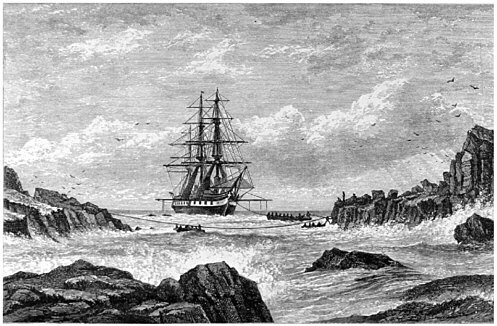
FIGURE 6 Challenger at St. Paul’s Rocks
miles in depth, they rise only 60 feet out of the water, and as it breaks all over them, landing is very difficult. . . . They are out of the track of any ships, and as nothing is to be obtained, no vessel ever comes, the last known to call here was a man of war in 1845.”
By 6:00 that night they had made fast and a jolly boat was sent out to attempt a landing on the island’s sheer sides. This, too, was no easy matter, with the surf rising and falling a full 7 feet up and down the glistening black sides of the island. Eventually, landing was accomplished by “a spring and a scramble when the boat is on the top of a wave,” as Wyville Thomson put it, and “When we landed the sun was just setting behind the ship. There was not a cloud in the sky, and the sun went down into the sea a perfect disk, throwing wonderful tints of rose color upon the fantastic rocks.”
In fact, St. Paul’s Rocks had excited the interest of no less a person than the Challenger expedition’s spiritual and intellectual mentor 31 years earlier. Charles Darwin was a young man of 23 when Beagle paused there on its long voyage south. Darwin was
curious that the rocks of the islands were not of volcanic origin, as was the case for almost every other oceanic island, and he surmised that St. Paul’s Rocks were the tips of mountains of a much larger land mass, perhaps even a continent, that had sunk beneath the Atlantic waves eons before. Challenger’s Scientifics agreed and hypothesized that the next leg of their journey would yield evidence that they were indeed in shallow water, and following the course of an ancient sunken continent.
For Wyville Thomson, it was another moment of delicious anticipation in a voyage that so far had been just one scientific triumph after another. Only a couple of days earlier he had to deliver on a foolish bet that he made after one of the earliest successes of the voyage. On the transit from the Gulf of Guinea to St. Paul’s Rock’s, they had dredged another specimen of Umbellularia, a crinoid of the same genus that had excited so much interest before their arrival in Gibraltar because it seemed to be the first proof of Darwin’s suggestion that the deep ocean was a haven for “fossil” life. To most of the officers aboard Challenger, though, that second discovery had a more immediate and welcome consequence than merely adding to the annals of science. “The Professor having previously made a bet with the mess generally that we should not get another Umbellularia tonight at dinner paid the penalty in champagne ‘all round’” wrote Campbell.
On August 29, 1873, Challenger cast off from the desolate pinnacles of St. Paul’s Rocks and headed for the equator, only 90 miles distant. Matkin wrote, “We crossed the Line at 1pm on Aug. 30th, no shaving etc was allowed,” (a reference to the traditional treatment by old hands of those who crossed the equator for the first time), “but the Captain issued Wine to all hands in honor of the event.”
Their next stop, the island of Fernando Noronha, hove into view on September 1st. Brazil used the island as a penal colony for its worst offenders, “The prisoners in this establishment are chiefly of low grade,” wrote Wyville Thomson, “and most are convicted of
heavy crimes. . . .” The landing at Fernando Noronha was difficult because of the heavy swell, and the boat containing Henry Moseley and Herbert Swire capsized. All on board were dumped unceremoniously in the water and two were trapped underneath. As Swire and Navigating Lieutenant Tizard fought among the breakers to free the trapped men, Swire could not contain his disgust at the actions of the enlisted men. He wrote later, “All the bluejackets made for the shore and left Tizard and myself to extricate two people who were still under the boat, but on finding that there was no danger (the water was only about five feet deep) they [then] came gallantly to the rescue.”
Meanwhile, Wyville Thomson and Nares (accompanied by his young son Billy) were paying a visit to the governor of the island, a major in the Brazilian army. They were courteously received. “We found the Governor a grave, rather saturnine Brazilian, silent, partly because he spoke no foreign language and we could only communicate with him through an interpreter, and partly, I think naturally.” Despite his reticence and the fact that he was burdened with the job of looking after 1,400 prisoners with only 200 men, the governor graciously gave them leave to pursue their investigations in natural history. Yet Nares and Wyville Thomson could see that he was perplexed. Several times he asked them what port in England they hailed from and did not seem to be able to comprehend the purpose of a man o’ war adapted for scientific endeavor.
After coffee and cakes, Nares and Wyville Thomson took their leave of the governor and made their way back to Challenger’s anchorage in the tiny harbor, admiring en route the way that the convicts caught their fish. They were permitted two pieces of wood fastened together by cross pieces on which perched a stool. On this the fisherman sat with a basket and a round coil of fishing line. The simple catamaran rode so low in the water that, according to Wyville Thomson, “those fellows . . . look oddly as if they were running about on the water without any support.” The simple construction of the boats was an effective way of ensuring that no convicts could
leave the island, and even the garrison there did not have anything bigger.
Next morning disaster struck. Overnight, the governor’s suspicions had apparently got the better of him and he rescinded his decision to allow the party access to the island. Wyville Thomson was devastated. “We were all extremely anxious to work up this island thoroughly. From its remarkable position nearly under the equator . . . in all its biological relations mainly a South American colony, it presented features of special interest to European naturalists.” But the governor was adamant and despite Nares’s best diplomatic efforts only a minimum of collecting was allowed.
On the morning of Wednesday, September 3, Challenger weighed anchor and left Fernando Noronha. With a heavy heart Wyville Thomson watched the tiny penal settlement disappear over the horizon. “Some of us,” he wrote, “had set our hearts upon preparing a monograph of the natural history of the isolated little island.” But Campbell, as usual, was more practical and forthright, “I was mighty glad,” he wrote, “as it was a stupid little place.” Swire at least could understand the factors that had triggered the governor’s decision. “It is not much to be wondered at that he should have his doubts concerning us, for we did not carry out the usual routine of saluting the flag, we had been long at sea and consequently were very disreputable in appearance, and lastly the Captain made his visit of ceremony accompanied by his small son Billy and two or three of his savants, which again is not strictly in accordance with ordinary usage on such occasions.” And yet, on reflection, Wyville Thomson tended to agree with Campbell’s assessment, “I am inclined to think that there was a general feeling of relief on leaving a place which, with all its natural richness and beauty, is simply a prison, the melancholy habitation of irreclaimable criminals.”

After the desolation of St. Paul’s Rocks and the remoteness and hostile reception at Fernando Noronha, Challenger’s crew were only too pleased at the prospect of several days rest and recuperation in the mainland port of Bahia on the east coast of Brazil. They arrived there on September 14 after a difficult passage against the southeast trade winds. Finding that they had not been making sufficient way to windward, Nares ordered the sails reefed and steam power used instead. Thereafter they made good time until just outside Bahia, when William Spry rang up from the engine room with the news that they had only two buckets of coal left. The tricky approach to the harbor would now have to be made under sail and the remaining coal kept for maneuvering power as Challenger berthed.
Landfall was made successfully, however, amid a cloud of butterflies that enveloped the ship as it maneuvered into the quay. And all agreed that, with one exception, Bahia was a fine place. Campbell summed up everyone’s views: “The town of Bahia is from the harbor beautiful; partly built on the face of a high steep bank which, as it recedes on either side of the town, is covered with tropical vegetation, among which palms, bananas, huge aloes and mangoes are visible. Red-roofs, church-spires and domes, yellow walls and coco-palms stand out at the top of the bank; all glitter light and color against a deep blue sky. The town of Bahia from the streets is not so beautiful, and is, to put it mildly, extremely odiferous.” Even the equable Moseley, who elected to walk up the steep little streets to the town’s center rather than use the sedan chairs favored by the locals, was moved to note, “I . . . made my way through steep narrow stinking streets, where the slops were constantly being emptied from upper stories without any warning or ‘Gare a l’eau.’”
In all, Challenger spent 10 days at Bahia and in that time several expeditions were fielded. Henry Moseley was pleased to be able to naturalize after the thin pickings at St. Paul’s Rocks and the disappointments at Fernando Noronha, and immediately made plans for an investigation of the interior. In this he and the others were aided by the generous hospitality afforded them by the local rail-
road company, which was busy laying track into the interior of the continent. The railroad company, like the local steamship company, was British owned and both enterprises made the weary sailors feel welcome by issuing them with free train tickets. Campbell wrote smugly, “English companies . . . own what ever is enterprising and go-ahead in Bahia,” and happily accompanied Moseley into the interior.
They headed about 20 miles inland along a railroad track that was intended to eventually reach the small settlement of Pernambuco. Moseley spent the time observing and making notes, while his companions enjoyed the hospitality of the first-class compartment in which they rode and ate ham and eggs. After some time the train stopped and the companions alighted for a closer exploration of the primeval forest through which they rode, Moseley waxing lyrical about “the immense height of the trees, their close packing and great variety.” He noted that the tree trunks were everywhere covered with parasites and climbers such as various species of mistletoe and bromeliads. “The forest was so thick as to be quite gloomy and dark, and as we passed along the path we heard no sound and saw no living animal, except a few butterflies.”
That evening they returned to the station, where two cane sofas had been prepared for them to sleep on. The gleam of an oil lamp cast a brilliant pool of light through the open door and they saw that a table had been laid for supper. It was incongruous to sit and dine in such luxury with the thick blackness of the tropical night pressing in just beyond the open doorway, but if anything it heightened their enjoyment. “Then our servant brought in coffee, fried eggs and bread so, with the bottle of wine that we had brought and the game-pate we were not much to be pitied were we?” wrote Campbell. Even Moseley’s scientific enthusiasms were not immune to the lure of these creature comforts from home and he noted happily, “Thanks to the energy of the English railway officials, Bass’s ale is to be had at all the stations on the line at 2s. 2d a bottle.”
Afterward, they strolled out into the darkness, and sat and
smoked while the small boys of the village made “horrible squealing noises by blowing through short conical tubes, made by rolling up strips of palm leaf spirally. . . . Such excruciating sounds seem to be as pleasing to the youthful African ear as to that of the London street boy.”
Herbert Swire joined John Murray for a separate expedition into the interior and also enjoyed the extravagances of the British away from home in the heyday of empire. He was particularly taken with the kindness of the railroad company’s director. “Mr. Mawson placed a saloon sleeping carriage at the disposal of the officers, to take us whenever we liked, to go in wherever we liked, and to keep up the line as long as we liked.” Settling into their personal carriage, they watched as the servant the railroad had allocated them brought on board essential supplies. “Soon afterward we were fairly installed in our new house, with guns etc neatly stowed away overhead, carpet bags etc methodically arranged under the sleeping bunks, and our man making himself generally useful laying in a stock of beer and other necessaries for the journey.”
Before they left Brazil, Moseley decided to have one last adventure. A large fair was scheduled 70 miles upriver at Feira St. Anna, a town beyond Caxoeira and, with his interest in local customs at least as strong as his interest in science, he could not pass up the opportunity. Availing himself of the hospitality of the local steamship companies, he headed up river to Caxoeira and then switched to mule. His guide was a German who acted as an interpreter for the railroad. He was, said Moseley, “a wild sort of young fellow, and had undergone various vicissitudes of fortune,” but for all that was “a capital merry companion, knowing everyone on the road and having a joke for all.” Moseley enjoyed himself immensely, finding the landscape and the ride on the well-broken mules convivial. There was refreshment in abundance, too. “Good Lisbon Wine is sold along the road; the drinking places consist of a hole about a yard square in the gable end of the usual mud-walled cottage, placed at such a height as to be convenient to a man on horseback.” After a
seven-hour ride they arrived at the tiny town of Feira St. Anna, where they took lodging at the inn, which consisted of a single-story house with a large communal eating room, two communal sleeping rooms, and a kitchen.
It was a perfect opportunity for Moseley to inspect the locals, who, for the most part, were cattle dealers assembled for the next day’s market. The beds in the communal bedrooms were packed so closely together that they touched and he was not impressed to find himself sharing a room with a filthy tobacco dealer. And so the night passed uncomfortably, with Moseley rendered sleepless by the fleas, lying in the cramped bedroom, and listening “to the mingled crying of children, barking of dogs, croaking of frogs in the marsh below, and squealing and groaning of the axles of the ox-carts bringing merchandise to the fair.”
By 10 o’clock the next morning, the main street of the town was a seething mass of humanity and animals with stalls where farinha, the coarse meal used locally, jerked beef, fruit, and vegetables in abundance were for sale. Other stalls sold needles and thread, still others sweetmeats for the children “but most trying to a naturalists eye,” wrote Moseley, “were stalls where various rodents and other small native animals were for sale, spitted on wooden skewers roasted and dried for eating . . . the skulls of all were split open, and they were utterly lost to science.” High-quality leather goods were also for sale and here Moseley bought a sturdy leather hat that would last him well for the rest of the voyage, “with this on my head I could butt my way head first into any bush with impunity.”
But the most splendid sight of the fair was the cattle market. “The cattle are bred at estates far up the country, where they run wild in the bush and are caught and branded and drafted for market every two years.” Moseley quickly developed a deep respect for the vaqueiros, the men who herded the cattle. Dressed completely in leather, they were expert riders and “it is marvelous what work they get out of their small horses.” Every now and then one of the cattle broke free and was chased up the street by several vaqueiros. Usually
they were brought to heel quickly, but “Sometimes the animals are very fresh and wild, and make off at full pace and cannot be herded. The vaqueiros then strain every effort to come up behind them, catch hold of their tails, and spurring their horses forward so as to get up alongside their beasts, give a sudden violent pull, which twists the animals round, and throws them sprawling on their sides.”
There were few breeders at the market, the cattle having been sold by them to local dealers who then re-sold them to the lowland merchants who would take them downriver to Caxoeira or Bahia. The cattle were herded into the pens where the merchants, who never dismounted from the small horses that they themselves rode, could examine them and dicker over the price. Moseley spent a happy day observing the market before spending the night at the house of a friend of his guide. This lodging was on the road to St. Amaro from which Moseley caught a steamer bound for Bahia in the morning.
By noon the next day he was safely back aboard Challenger. He found the officers and Scientifics relaxing with new friends. The American corvette Lancaster lay in harbor, and “we fraternized greatly with the officers,” wrote Herbert Swire, “who turned out to be a capital set of fellows.” Indeed, Swire was having an excellent time, he and several of the other officers having struck up great friendships with the members of Bahia Cricket Club with whom they played the sport of gentlemen.
So cordial had relations become, in fact, that the Challenger crew had no fewer than three balls to look forward to. But then disaster struck. “During the first few days of our stay a large amount of rain had fallen,” wrote William Spry, “this, succeeded by a hot sun and again by rain, formed just the forcing bed for disease.” On the day of the ball to be given in their honor by the Bahia Cricket Club, one of the bluejackets went down with Yellow Jack. He was immediately hospitalized and Nares put Challenger out to sea, bound under all plain sail for colder lands where the disease could not flourish.
For a time it was touch and go: Would they reach colder climes before the disease had a chance to spread among the lower decks? One man looked as if he had succumbed but speedy action by the surgeon quarantined him on the upper deck, where he was kept under observation. He recovered and before long they were in latitudes where they could feel safe from yellow fever.
Challenger was safe but many were sorry to have said goodbye so abruptly to the friends they had made in Brazil. “On the very day fixed for the ball we left the harbor,” wrote Swire, “much to our disappointment and that of our friends on shore. I call it a very delicate attention on the part of the BCC to put our ship’s crest at the top of the programmes, and we should very much like to have repaid all their civility by giving some sort of turn-out on board.” But it was not to be and by mid-October the ship was within sight of one of its most desolate destinations, the remote, forbidding, island of Tristan da Cunha.