The Silent Landscape: The Scientific Voyage of HMS Challenger (2003)
Chapter: Threshold of the Deep
Threshold of the Deep
Portsmouth, England, December 20, 1872, 50° 48′ N, 1 ° 05′ W
THE ABYSS OF TIME
If you could stand on the brow of the hill behind the English town of Portsmouth in late December of the year 1872, you would see below you a harbor crowded with warships. To the left—the Portsea Island side—are the new men o’ war; three-decked iron-clad, steam powered battleships like HMS Warrior, as well as other, older, square-rigged, wooden men o’ war little changed since the time of Nelson. These are the ships that show the flag in the farthest-flung corners of empire. It is invigorating to see these potent symbols of dominion ready to put to sea at an hour’s notice, able to bring the might of the world’s greatest empire to any situation that might need it. To the right—the Gosport side—are the government offices, dry docks, cranes, piers, and jetties. On this side, too, are the troop transports and official yachts. In the middle the open water of the fairway is crowded with pinnaces, jolly-boats, cutters, and pleasure steamers. The total effect is of controlled bustle and purpose in this nerve center of the Victorian navy, the clearinghouse for the most potent military symbol in the world.
But what’s that in the corner? Almost hidden by the gunmetal-gray flanks of the huge battleships are the three small masts of an unremarkable corvette, a ship tiny in comparison with the hulking
leviathans around it, but one that is about to change the face of science forever: HMS Challenger.

The purpose of HMS Challenger’s voyage was primarily scientific; her orders were to explore the ocean and the ocean floor not just in the waters around Britain or even her imperial territories, but also across the entire world, or at least as much of it as could be done in the three-and-a-half years allotted to the expedition. Encouraged by the successes of the recent scientific expeditions that had been sent out with the express purpose of studying the sea and its inhabitants, the Admiralty had authorized the voyage only the year before.
This sudden naval interest in the seafloor was a direct consequence of the enthusiasm and activities of two scientists: Charles Wyville Thomson and William Carpenter. Wyville Thomson was professor of natural history at the University of Edinburgh, an institution that, since the early years of the nineteenth century, had a long and distinguished interest in the natural sciences. The University’s first professor of natural history, Robert Jameson, had trained some of the most notable natural historians of the nineteenth century; his most famous alumnus was Charles Darwin. Edward Forbes, another Jameson-trained naturalist, eventually succeeded him in the professorship. Although Forbes occupied the Chair for only a few months, he successfully seeded one of the strangest ideas of the mid-nineteenth century, namely that below 300 fathoms (1,800 feet) no life could exist in the ocean. This was the so-called “azoic” (a = without, zoic = life) theory and the supposed lifeless region below 300 fathoms was the “azoic zone,” an abyss where no life could exist.
The professorship of natural history in the University of Edinburgh was far and away the most influential position in natural
sciences in the Victorian Empire—if not the world—and the pronouncements of the post-holder tended to be accepted as received wisdom by a Victorian society obsessed with science. Resonating with the typical Victorian’s preoccupation with death, the azoic theory assumed fundamental importance in the public imagination as well as the scientific mind. But Wyville Thomson was not convinced by the azoic theory. He had been present when the Norwegians dredged clear evidence of organic remains from a fjord known to be more than half a mile deep, and he had heard from his friend Fleeming Jenkin, Edinburgh’s first professor of engineering, that the frayed ends of a broken telegraph cable recovered from the depths of the Mediterranean had barnacles encrusting it. To Wyville Thomson, Forbes’s azoic theory could not be correct.
Wyville Thomson was determined to investigate Forbes’s theory scientifically and systematically. In this endeavor he was extremely fortunate to have friends in high places, in fact, one particular friend in one of the highest places in all of Victorian science—his friend William Carpenter was a vice-president of the Royal Society. Senior officers of the “Royal,” then as now, occupied a strange but enormously powerful position in the scientific world because they were both bureaucrats and scientists. On the one hand, they were capable of steering, if not actively diverting, funds into a cause that they were interested in championing and on the other, they were scientists enough to know that in so doing they were not about to make fools of themselves.
Carpenter had worked with Wyville Thomson in the 1860s and both shared a common love of the lower invertebrates—single-celled foraminifera, echinoderms such as starfish, and the sponges whose place in the grand scheme of life, then as now, was far from certain. Carpenter was persuaded by his friend that the azoic theory was worth investigating and so Carpenter in turn persuaded the Admiralty to let Wyville Thomson have the use of the steam frigate HMS Lightning for part of the summer of 1868. The ship sailed between the Faeroes and the Shetlands throughout that wet and
windy summer, and despite cramped conditions on board and the inadequate resources of a boat that had not been fitted out for scientific research, Wyville Thomson made two discoveries of enormous significance. First, he successfully dredged unquestionable remnants of organic life from a carefully measured depth of more than 600 fathoms—twice the depth at which Forbes’s theory had predicted the lifeless zone to start—and second, he found that below about 200 fathoms water temperatures stopped their usual, latitudinally dependent, decrease and took on a life of their own. Wyville Thomson discovered the first firm evidence that the deep ocean was dominated by water currents that have their own temperature and physical characteristics and move under mysterious influences unaffected by conditions at the surface.
So successful was the Lightning’s voyage that it was quickly followed by three others: two by HMS Porcupine in 1869 and 1870, again led by Wyville Thomson, and one in 1871, conducted by the frigate HMS Shearwater. The Porcupine’s voyages were notably successful; the Shearwater’s was less so, with, as we shall see, far-reaching consequences for the future route of Challenger. But even after the Shearwater expedition Wyville Thomson and Carpenter had seen enough to be convinced of the scientific effectiveness of deep sea dredging and sounding.
When, in 1870, Wyville Thomson was elected to Forbes’s former Chair in the University of Edinburgh, he and Carpenter were influential enough to persuade the council of the Royal Society (then headed by the eminent Thomas Henry Huxley) and the Admiralty to let them organize a much larger expedition. Thus was born the voyage of HMS Challenger and an otherwise unremarkable group of naval officers and scientists found themselves walking unawares into scientific history one cold morning in the winter of 1872.
The objectives of the voyage, as finally agreed upon by the circumnavigation committee of the Royal Society were fourfold:
-
To investigate the physical conditions of the deep sea in the
-
great ocean basins (as far as the neighborhood of the Great Southern Ice Barrier) in regard to depth, temperature, circulation, specific gravity, and penetration of light.
-
To determine the chemical composition of seawater at various depths from the surface to the bottom, the organic matter in solution and the particles in suspension.
-
To ascertain the physical and chemical character of deepsea deposits and the sources of these deposits.
-
To investigate the distribution of organic life at different depths and on the deep seafloor.
The naval men on board must have been amazed at the speed with which the expedition had been organized. Wyville Thomson and Carpenter applied for funding in 1871, it was approved in April 1872, and by that December the expedition was ready to put to sea! All this because of some success in disproving another professor’s pet theory? Of course not. What they did not know was the real reason behind Wyville Thomson’s enthusiasm, the Royal Society’s rapid deliberations, and the Admiralty’s speedy agreement to their request.
Only 14 years earlier the Victorian establishment had been rocked to hear Darwin’s ideas about the mutability of animal and plant species by means of his proposed mechanism of natural selection. It was an idea that was still being debated in meeting halls, lecture theatres, salons, and parlors across the empire, but it was gaining wide acceptance among scientists and lay people alike. One of the central tenets—and most significant problems—of Darwin’s theory was the burden of proof from the rocks. The fossil record would provide either ultimate affirmation or annihilation of the theory of evolution and the ocean would be its supreme testing ground. Darwin theorized that it was in the ocean that marine organisms found on land only as fossils would still be found alive. Forbes’s azoic theory predicted that the very opposite would be found in this abyss of time. It was this investigation that was to form a major part of the Challenger expedition. The ship would set out
not only to investigate the geology and geography of the sea and seafloor, but also to find the proof of the theory of evolution, or as it was then known, “descent with modification.”
It is not fair to say that the voyage of HMS Challenger was to be another expedition in the tradition of Darwin’s seminal voyage aboard HMS Beagle from 1831 to 1836 or Huxley’s on HMS Rattlesnake from 1846 to 1850, because both of these had been naval voyages with the primary objectives of exploration and territorial annexation. The voyage of Challenger was quite different; indeed it was unprecedented in the Victorian world, for it was to be the first voyage sent out with the primary purpose of gathering scientific information. Other nations in the 1860s had begun to appreciate the importance of understanding the sea. The United States, Germany, and Scandinavia had all organized their own expeditions, but notably only Britain had the vision and ability to conceive the idea of funding, outfitting, and deploying such a global mission for purely scientific purposes. Why was this? What made Great Britain so different from the rest of the world? The answer is twofold. First, Britain’s economic supremacy was unrivalled in the latter decades of the nineteenth century; it was the largest, wealthiest, and most influential nation on Earth. It could afford to send out a mission for purely scientific purposes and show the world the true meaning of Pax Britannica. A scientific naval expedition simply enhanced Britain’s prestige in the same way that America’s space program would do a century later. For even in the 1860s and 1870s, as sometime Prime Ministers Gladstone and Disraeli fought and bickered in the House of Commons over their humanitarian versus imperial policies, the British Empire’s size and hold on the world were still growing; and its sunset was at least four decades away. Second, Britain’s economic supremacy was built on a century of maritime pre-eminence. Its merchant marine was the largest in the world as was the navy that looked after it. It simply had the know-how to conduct such an expedition.
But there might have been a third reason, both more funda-
mental yet less easily articulated. By sending out the Challenger, was the Victorian Empire addressing a nagging question that had been spectacularly exposed when “Darwin’s Bulldog,” Thomas Henry Huxley, clashed with Wilberforce, the Bishop of Oxford, at a meeting of the British Association for the Advancement of Science held in Oxford 12 years earlier? On that occasion, Wilberforce had sneeringly asked Huxley whether it was from his grandfather or his grandmother’s side of the family that he claimed descent from an ape. Huxley had easily turned aside the taunt, answering dryly that he would rather have a miserable ape for a grandfather than ridicule reasoned scientific debate. Yet that exchange exposed the schizophrenia of a society that was trying to reconcile God and Science. It was a question that struck right to the heart of that self-satisfied Victorian imperial superiority, the self-belief of a nation that had tamed the world, and which lived and died—at least in public—by a rigid moral code. Was the real brief of the Challenger expedition nothing less than a last chance to choose between God and Science? If it was, perhaps that explains why to the Victorians the Challenger expedition was every bit as important as the Apollo moon landings would be to another great nation a century later.
TO BOLDLY GO . . .
Sheerness, England, November 22, 1872, 51 ° 27′ N, 00 ° 45′ E
HMS Challenger was built in the Royal Naval Shipyards at Woolwich and launched on February 13, 1858, the same year that the first transatlantic telegraph cable was completed. Indeed the advent of the telegraph was to be hugely important for the success of the Challenger expedition because, via this “Victorian internet,” the expedition’s leaders provided regular progress reports to satisfy the voracious appetite for science back home. Challenger was a spardecked, three-masted corvette with a modestly powered auxiliary steam engine that engaged with a twin-bladed propeller assembly,
which could be disconnected and hoisted clear of the water when the ship was under sail. Technologically she was a hybrid that straddled the eras of sail and steam. In 1861 she left for her first foreign tour on the east coast of North America and in the West Indies, taking part, in 1862, in operations against Mexico. Her next commission was in the South Seas on the Australian station (as it was called) where she visited Fiji on a punitive mission to avenge the death of a missionary and his dependents who had been murdered by natives. This was typical of Victorian foreign policy, which ruled the empire by naval action, though often just its threat was sufficient.
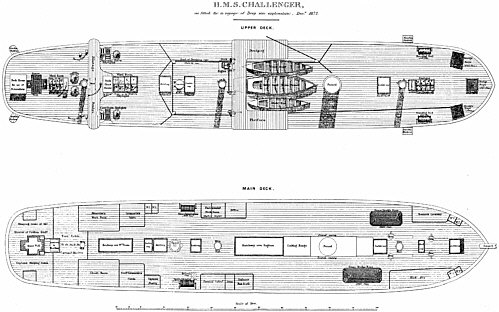
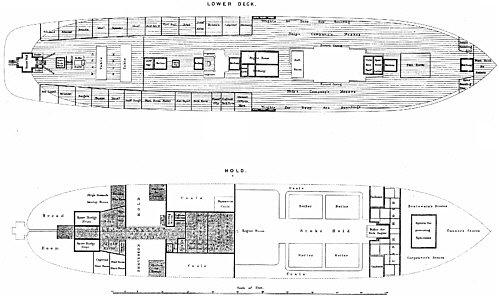
Even by the standards of the day, Challenger was not large, displacing only 2,300 tons and being only 200 feet long. But this was, as Wyville Thomson commented, an advantage, because she had all the extra space and amenities of a frigate combined with the maneuverability and draught of a corvette. All but two of her original 17 guns were removed to make room for laboratories and storage cupboards, the cabins for the scientists, and the miles and miles of hemp dredging rope and steel piano wire that were to be used for sounding. The funnel dominated the ship. Fully 10 feet in circumference, it was the exhaust for the relatively small and very inefficient 1,234-horsepower steam engine. Amidships on the upper deck was the dredging platform itself, flanked by zinc specimen boxes and with a small steam donkey engine to one side to pull up the dredge with its precious cargo of samples. Figure 1 shows the layout of the ship.
This engine drove an axle that ran clear across the ship. For’ard were berths for three small boats, the gigs for additional sampling (see Figure 2), going ashore, or rendezvousing with other vessels at sea. Below was the cramped main deck with an enormous cooking range that dominated the center of the ship. Around an open central area were arranged the cabins for the senior officers and the scientific team with the captain’s and principal scientist’s berths situated aft near a main laboratory that was dedicated to drawing, describ
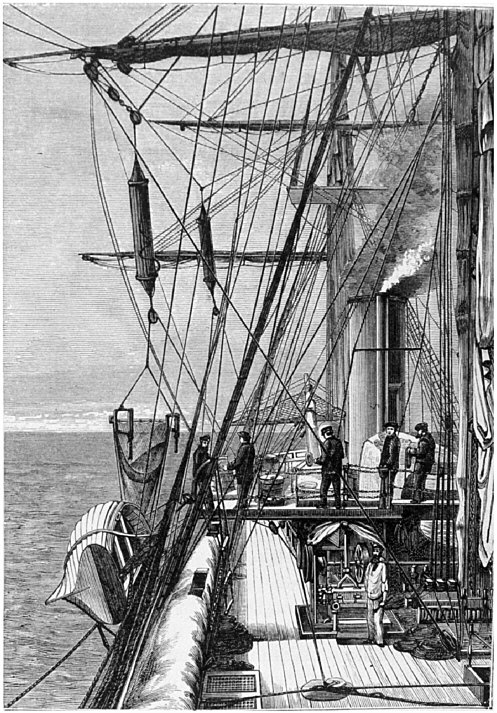
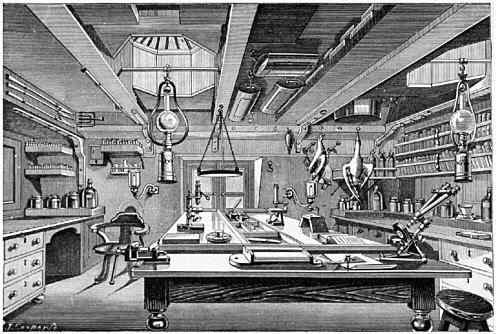
FIGURE 3 Naturalist’s lab
ing, cataloging, and preserving specimens. Figure 3 shows the naturalist’s lab aboard Challenger. This main deck was dimly illuminated, lit only by three small skylights during the day or by oil lamps at night. Below the main deck was the lower deck with cabins for the junior officers and the berths and messes for the ship’s company—the bluejackets and marines—even darker and more poorly ventilated. With a total crew complement of 269, Challenger was very cramped—even the junior officers had to share cabins— and it is not surprising that in the course of that four-year voyage fully a quarter of the seamen aboard deserted, especially when tempted by such exotic locales as South Africa and Australia. Below the lower deck was the hold, with storage room for food and coal, additional dredging and sounding rope, and the engine and its four boilers.
Challenger was commanded by Captain George S. Nares, one of the greatest surveyors in the navy, who in later years became famous as an Arctic explorer. He commanded 23 naval officers and a crew
of 240 ratings and able seamen. Wyville Thomson was the chief scientist, assisted by a scientific staff of five. One of these was John Murray, a fiery and outspoken Canadian who was to become the most famous of all Challenger scientists as the lead author of the massive 50-volume tome that eventually “summarized” their findings. Murray had an overwhelming interest in natural history and was prepared to rough it for weeks or months on end—on land or at sea—in pursuit of interesting specimens. However, his interest in natural history was not matched by a parallel interest in conventional scholarship. As a student, he commonly missed lectures and never attended examinations, preferring instead to work hard at any subject to which his eclectic interests led him. He was that rarest of scientists, a synthesist capable of seeing what we now call “the big picture.” Murray, too, was an Edinburgh product and it says much about that University’s far-sighted system that it let him have his own way. “Having his own way,” in fact, was something at which John Murray excelled, for as well as being a talented intellectual he was also a brilliant entrepreneur and in later years amassed a significant fortune by combining his talent for science with an innate business acumen. He exploited the Christmas Island guano deposits for fertilizer. But at the start of Challenger’s voyage Murray, only 31 years old, was merely another of the young scientists attracted by Wyville Thomson’s brilliance and reputation.
Another such scientist on board Challenger was Henry Nottidge Moseley who, like most of the other scientists and crew, was a young man in his 20s when the expedition departed. He was born in Wandsworth, London in 1844 and early on developed a love of natural history that was to stay with him for the rest of his life. Although Moseley was to become one of the greatest natural scientists of his generation he was not, as were many Victorian scientists like Darwin and Huxley, wedded to science to the exclusion of all else. His interest in travel and natural history seems to have owed as much to an early love of Defoe’s Robinson Crusoe as to any formal education. He was educated at Harrow school where he did not
stand out as either scholar or sportsman. Yet he loved to fool around in his small homemade laboratory and was able to produce smells there of such extraordinary potency that his normally indulgent headmaster feared he would have to put a stop to them on the grounds of sanitation. In 1864 Moseley went up to Exeter College, Oxford to take a degree that was to be in either math or classics (his father was both a canon of the Church and a noted mathematician). But Moseley was enormously unhappy. He was cut out neither for religion nor for the dry minutiae of algebra and he idled away his days in long country rambles around Oxford, collecting curiosities for his own natural history collection. It was in this state that he was discovered one day by an old—and rather more liberal—friend of his father’s. This friend, also a clergyman, realizing that Moseley was wasting his life in Oxford, interceded on his behalf with George Rolleston, professor of anatomy. Moseley was enrolled in the recently established Honor School of Natural Science at Oxford, where he immediately blossomed. He won a first-class degree in natural sciences in 1868 and, after a four-year dalliance with a career in medicine, was chosen for the Challenger expedition.
It was a moment of high excitement for Moseley who, as a boy, had been much influenced by Darwin’s book The Voyage of the Beagle. He spent several months fitting out a state-of-the-art zoological laboratory on board the ship before boarding it in preparation for departure at Sheerness in November 1872. He was a short rather stoutish young man with a luxuriant black moustache that hung down to his chin. He was also, as his companions were soon to discover, immensely kind and sympathetic and had enormous energy and enthusiasm for the voyage ahead.
There was one lonely young man in particular who was pleased to meet the likeable Moseley. At 25, Rudolf von Willemoes Suhm was the youngest of the “Scientifics” (as they came to be dubbed by the crew) to be recruited to the voyage. He had started his intellectual life thinking that he was destined to be a lawyer but had spent so much of his first year at the University of Bonn indulging his
interest in natural history that he soon changed to major in zoology. He took a precocious doctor’s degree only two-and-a-half years later, by which time he had developed a deep interest in marine invertebrates. His career was interrupted by military service but then he returned to science, this time to the University of Munich as an assistant in the zoological museum.
His involvement with the Challenger expedition began quite by accident, and very late on in the preparations. He met Wyville Thomson in October 1872, when the German survey vessel Phoenix put into Edinburgh to coal. He and Wyville Thomson hit it off so famously that Wyville Thomson asked him there and then if he would care to join the Challenger expedition. The young von Willemoes Suhm was so overwhelmed by the invitation that he immediately took a leave of absence from the Phoenix. Five days later, and on Wyville Thomson’s instruction, von Willemoes Suhm traveled by land to London for an appointment with the doyen of Victorian science, Thomas Henry Huxley, in his lair in the South Kensington Museum. Huxley greeted him with great warmth and promised to use his influence with the circumnavigation committee to secure von Willemoes Suhm a place on the expedition. Less than a week later, having rejoined the Phoenix, von Willemoes Suhm received a telegram in Copenhagen from the Admiralty informing him that he had been appointed a naturalist on the expedition. It was the crowning moment of the young German’s life, an entrée into a glittering career in science of which his scientific peers could only dream. With no inkling of the tragedy that awaited him he gleefully accepted this once in a lifetime invitation.
At 29 John Young Buchanan was slightly older than von Willemoes Suhm when Challenger departed Portsmouth. Like von Willemoes Suhm, he had come to science relatively late, having started a degree in Glasgow to read arts before discovering a deep-seated love of chemistry. After studying on the Continent he returned to Scotland to work with Crum Brown, the noted professor of chemistry at Edinburgh. Buchanan was a superbly practical
chemist, capable of making his own instruments and skilled in the art of glass blowing, something that was likely to be in great demand on a naval vessel braving some of the roughest waters in the world. Buchanan was a kindly man, very sincere, but so shy that his sunny nature was almost never apparent. However, when he did form friendships they were deep and long lasting and this was the case when he met the young German, von Willemoes Suhm, who was feeling very alone and very young when he, too, joined Challenger at the end of November 1872. Like von Willemoes Suhm’s other new friend, Henry Moseley, Buchanan established a well-equipped laboratory on board, for despite the overarching imperative to find the proof of Darwin’s theory of descent with modification, the physical sciences were no less regarded than the natural sciences on the expedition. Consequently, one of the gun bays on the main deck was converted into a tiny but serviceable physical and chemical laboratory for Buchanan’s use.
The final member of the Scientifics who joined Challenger at Sheerness—John James Wild—is today something of an enigma. He was Wyville Thomson’s secretary and was allocated part of the great man’s cabin in the aft of the ship. Wyville Thomson wrote “[The port-end of the fore-cabin] being appropriated to my use and that of my secretary, Mr. Wild, to whose facile pencil we are indebted for beautiful illustrations of our novelties, and who sits with me in gathering the various threads which we combine into a symmetrical web as best we may.”
A month before Challenger arrived in Portsmouth to be readied for its departure on its long voyage, it finished a complete refit in the naval dockyard at Sheerness. It was here that all but two of its 17 68-pound guns were removed and the rest of the conversions—such as Buchanan’s and Moseley’s laboratories—were completed, thus changing an unremarkable corvette into the first dedicated scientific exploration vessel in the history of the world.
But important as the laboratory fitments and the scientific staff were to the future success of the voyage there was another, larger,
group on board that was arguably even more crucial. These were the officers and crew (the latter known as “tars” or “bluejackets”) who would actually look after the command, navigational, and housekeeping chores without which the scientific work would be impossible. Three of the officers published accounts of their voyage on their return, and one of these even made it onto the late Victorian bestseller lists. From the perspective of the Victorian public, perhaps the most notable of these literary officers was the aristocratic Lord George Campbell, youngest son of the eighth duke of Argyll and a sub-lieutenant on board Challenger. He was tall and lean with a well-trimmed dark beard and a sardonic sense of humor. In physical appearance he was a perfect counterpoint to Navigating Sub-lieutenant Herbert Swire. Swire was unbearded, blond, and some years younger than Campbell but, like Campbell, had an irreverent sense of humor. It was Swire who, in his diary, unpublished until after his death, named Challenger’s earnest scientific staff the “Philosophers.” Swire was particularly amused by the clothing that the Philosophers chose to wear: formal gentlemen’s garments with waistcoats and watch fobs that would have looked at home in Pall Mall but that were anything but suitable for the deck of a small corvette. But he was an intelligent young man, hard-working, with a keen eye and an appreciation of the finer things in life, and it was he who wrote most lyrically about the colors, sunsets, and lands that they saw on their long voyage. More practical, but with a flair for detail, were the writings of Engineering Sub-lieutenant William Spry, a man who spent much of his time tending Challenger’s temperamental steam engine. It was Spry’s book that became the best-selling account of the voyage when he returned to England, running into more than 10 editions by the end of the nineteenth century.
Until very recently we had no record of life below decks on Challenger. Indeed there was no expectation of one, because the average tar was hardly noted for his literary ability. Many of those who shipped below decks in the service of the empire could not even read, despite the educational reforms that were even then
beginning to sweep Britain. But incredibly, on board Challenger there was one seaman who left an account of the voyage in 69 letters to his family and friends at home. Until 1985 there was no hint that these letters existed, but in that year his granddaughter gave them to the Scripps Institution of Oceanography in La Jolla, California.
Joseph Matkin, a short dark-complexioned lad with dark hair and pale blue eyes that missed nothing on their long trip around the world, was the ship’s steward’s assistant. He was only 18 years old but had received an excellent education at a good school near his home in Oakham (a town in the small county of Rutland). The quality of his education there was vital for his future literary efforts; so was his upbringing by parents who wanted their offspring to enjoy all the benefits of the education that they had not had. So young Joe Matkin was very much a child of his times, plugged into the new Victorian ethos of self-betterment.
By the time he was 12, Matkin had left school and enrolled, somewhat surprisingly, in the merchant marine. In that service he sailed for Australia aboard Sussex, returning the following summer aboard Agamemnon. Not long after that he sailed for Australia again, this time aboard Essex, remaining in Melbourne for a year. He was back in England by 1870 and decided to enlist in the Royal Navy, where he served as ship’s steward’s boy aboard HMS Invincible and HMS Audacious. Life in the Royal Navy had improved quite a bit since the privations suffered by seamen in the 1850s during the Crimean War—with less risk of being “pressed” and better controls on the use of punishments employed in the old canvas-and-tar navy to maintain discipline. However, life afloat in the Victorian sail-to-steam transitional navy was still not notably comfortable and Challenger, with its several laboratories and huge storerooms, was even less so than Matkin’s previous vessels. However, he was a bright and ambitious boy and it was the promise of advancement—as well as an all-expenses-paid trip around the world—that brought him on board three weeks before his nineteenth birthday on November 12, 1872.
Challenger put out from Sheerness on December 7, 1872 in the shadow of recent tragedy. At seven o’clock in the evening of Monday, November 18, a young marine, Tom Tubbs, was negotiating the ship’s gangway in the treacherous darkness of the unlit dockyard when he missed his footing. It was a straight drop into the rank filthy waters of the Dock Basin and he sank without trace in his heavy clothes, drowning in front of his shipmates before they could find a light or throw him a line. All night his mates and the dock police frantically dredged the area where he fell under the glare of hastily rigged lights. But their efforts were to no avail and at first light a diver was called. With nothing but the clank of the hand-operated air pump to disturb the silence, everyone on board Challenger looked on, as the diver, in his iron-weighted suit, was lowered over the side into the scummy water. For several minutes he searched without success until suddenly he came upon Tubbs’ bloated body propped bolt upright against the side of the 27-foot-deep basin, his sightless eyes staring off into the blackness.
So it was a subdued company, muttering nervously about ill omens, that set out from Sheerness a few weeks later, en route for Portsmouth, where they would load the last of the stores. Their mood—and their misgivings—were not improved by the ferocious southwesterly they encountered as soon as they left the harbor. So violently was the ship tossed around that only two days after leaving Sheerness Challenger had to put into Deal in Kent, where—to a man—the scientific staff suddenly rediscovered the delights of rail travel. They arrived in Portsmouth two days before the ship that was to be their scientific and spiritual home for the next three-and-a-half years.
It was an inauspicious message to send to their shipmates and was received with appropriate contempt by the officers and bluejackets who had sailed the ship on to Pompey (the colloquial name for Portsmouth in the British navy) alone and had been forced to put in twice more because of foul weather. Challenger finally arrived at Portsmouth on Thursday, December 12, 1872. In the
time it took the ship to travel those trivial 105 miles Challenger made less that 1 knot against the headwind—and that was under the full power of her steam engine. That was not the only abuse that the ship’s primitive engine endured so soon after leaving home; at the height of the storm, the heavy sea found its way through several unsecured hatchways into the engine room. If not for the fast work of Engineer Spry and his colleagues, the boilers themselves would have been doused with water, risking an explosion that could have destroyed the ship.
On Saturday, December 21, 1872, Challenger finally left Portsmouth, having taken on so many additional supplies that the holds seemed, as William Spry put it, “scientifically constructed of some elastic material so as to stretch to any size.” As soon as they reached the chops of the Channel they were once again in heavy weather and Challenger and her crew, who had not yet had the time to find their sea legs, were pitched around by the swell. Weighing heavily upon them too was the knowledge that they would not see the shores of Britain again for four long years.
In his cabin, Wyville Thomson reflected sadly on the wife and son he was leaving behind and wondered again whether he had been right to accept the circumnavigation committee’s invitation to lead the expedition in the face of William Carpenter’s obvious wish to do so. In fact, the last few days at Portsmouth had been made very difficult by Carpenter’s blatant expression of anger and humiliation at not being selected. It was a sad end to the fertile relationship that had led them from a common love of the lower animals in university zoology labs to the commissioning of the Lightning, Porcupine, and Shearwater expeditions and then the organization of this, the ultimate voyage of scientific discovery, the Challenger expedition itself.
Down in the engine room, as the pistons pounded and the regulators spun into a blur, William Spry wrote of the “cherished recollections” that would need to sustain him in the long task ahead and tried to contain the “melancholy impressions” that besieged him. In the
Chief Petty Officer’s mess, Joe Matkin had problems beyond his own sense of loss at leaving England. He and the six companions who shared the mess with him were obliged, as all ratings were, to kit their mess out with cutlery and crockery at their own expense. After that and the purchase of some necessary items of clothing, his advance looked very paltry. Now he would not be able to pay back the 10 pounds his father had lent him until he reached New York in the early summer of the following year. For an honest lad who knew that his father’s health was failing, the omission was all but unbearable.
Despite all the hardship and bad luck, on December 25 the crew tried to make the best of their first Christmas aboard. The Captain led the worship, for ships with fewer than 295 hands did not rate their own chaplain. Christmas dinner in all the messes was a miserable affair. In the midst of a storm with a heavy swell, the diners found themselves constantly having to hang onto their crockery while those with weaker constitutions were confined by sea-sickness to their cabins. One wave was so heavy that John Buchanan was flung from his seat out of the officer’s mess and into an adjoining cabin! Yet it was the officers who came off worst that first Christmas Day, for just before dinner, at a few minutes to six o’clock, their turkey mysteriously disappeared from the galley. The next night, on Boxing Day, their roast goose was similarly appropriated and all that was found of it were some scraps of meat and flakes of salt up in the main top rigging. So as Challenger crossed the Bay of Biscay—not far from the spot where the navy’s new ironclad HMS Captain had gone down with all hands only two years before—her crew battled not only with the weather, their homesickness, and their cramped conditions, but the knowledge that somehow—along with all their extra provisions—they had shipped a thief, too.
THE FLOATING WORLD
As Challenger headed south for Lisbon and Gibraltar, it crossed the European continental shelf. It was an area that had already been
studied by the Porcupine, Lightning, and Shearwater and so was home ground to the Scientifics aboard Challenger. They looked forward to leaving this familiar territory and entering the realm of the truly unknown beyond Gibraltar. But continental shelves have their own fascination. They make up more than 8 percent of the world’s total oceanic area and the European continental shelf is one of the largest in the world, swelling outward from the Spanish port of Santander in the southern part of the Bay of Biscay and extending far north to the edge of the deep Arctic Ocean.
Technically, continental shelves are defined as the region of ocean floor between the coast and the shelf-break, where the seafloor steepens into the continental slope and plunges toward the abyssal depths. Most shelves have a gently rolling “ridge and swale” topography and slope gradually toward the shelf-break at inclinations of not much more than a tenth of a degree per kilometer. Because they are so shallow—typically less than 300 meters deep—continental shelves are very susceptible to the variations in sea level caused by the waxing and waning of the ice sheets. Indeed the noted American oceanographer, Don Swift, has said that continental shelves can be thought of as ancient parchments continually written on by geology and yet erased by the movement of the ice sheets and sea level. Technically, continental shelves are continuations of the continents, because they have the same geology—the outcropping (that is, surface) rock beneath the sea is the same as the outcropping rock on the adjacent land—and because they are made up of a type of crust called continental crust. It has only been in the last 40 years that the difference between continental and oceanic crust has come to be appreciated as one of the most fundamental geological distinctions on our planet.
To understand just how important continents—and therefore continental shelves—are, we need to know a little planetary geology. There are three types of planetary crust. “Primary crust” is planetary crust that was formed at the time the solar system was formed. It is common on dead planetary bodies—a good example being the
light-colored highlands of our Moon. “Secondary crust” is that formed by the action of heat generated by the decay of radioactive minerals inside planets. This heat gradually accumulates and eventually causes localized eruptions of basaltic magmas (molten igneous rock). The surfaces of planets such as Mars and Venus are of this type and, crucially, the ocean floor of our own planet is also constructed in this way. The third type, “Tertiary crust,” is, as far as we know, unique to our home world. It forms when surface rock is continuously recycled back into the interior of a planet by the processes associated with geological activity.
“Geologically active” in Earth science circles implies the involvement of the phenomenon known as plate tectonics, the processes by which new rock is formed at the mid-ocean ridges and subducted at the ocean margins. We will see just how importantly the Challenger expedition contributed to the understanding of plate tectonics. For the moment, though, it is enough to think of this continuous production and consumption of crust as a form of distillation—not in this case of whisky or gin—but of rock itself. The normal type of igneous or “volcanic” rock on our planet is basalt, a hard, black, featureless, and heavy rock that underpins the sediments of the oceans. But continental crust—formed by this endless process of distillation—is quite different; it is a paler gray in color, lighter in weight, and thicker. This means it floats higher than oceanic crust and continents stand proud of the oceans. All crust floats on top of the eternally roiling cauldron of the fluid mantle, but oceanic crust floats lower. Think of two bottles of shampoo floating in the suds during the kid’s bath time. One is full and so floats lower in the water than the one that is half full—that’s the difference between oceanic and continental crust.
What, then, is the singular process that produced this strange duality between oceanic and continental crust—a difference that, as far as we know, is not duplicated on any other planet in the solar system? A crucial factor is the rate of the distillation process—the rate of cooling of the magma. On volcanically active planets like
Venus, the surface roils and churns so quickly that solid crust does not have a chance to form. On geologically static planets like the Moon, geology was a game that was played only once, very quickly after the planet was formed, and then was gone forever. NASA’s Apollo missions showed very clearly that the only geological action now on the moon comes from the eternal impact of dust particles captured by its indifferent gravity as well as the occasional apocalyptic arrival of an impacting asteroid or planetoid.
Only Earth, as far as we know, has the compromise necessary to produce continents—the internal fires burn quickly enough to bring magma to the surface and, as it spreads away from the mid-ocean ridges, it has the necessary time to cool. It is then recycled back into the interior of the planet at the ocean margins where, like a sinking slab of toffee, it is returned to a molten state. This mass of molten continent still, however, retains enough homogeneity to be returned more or less as a unit at the mid-ocean ridges eons later as the rock cycle continues. Then it starts the same process all over again. With each iteration—each distillation—the chemical composition of the heated magma changes, becoming lighter and lighter, so that in time these great slabs of rock ride higher in the magma ocean than the oceanic crust. The continents are like the ships of the Victorian navy, patiently constructed to ride the oceans of the inner planet.
Looked at this way, with the advantage of a century and a half of geological research that Challenger’s Scientifics could not have imagined, we can see that as our iron-and-wood corvette made her way across the Channel and out into the storm-racked Bay of Biscay she had not even started her long voyage of discovery. Her officers, bluejackets, and Scientifics were finally at sea, yet from the perspective of geology they had not yet even left the continents. The true silent landscape still lay before them.