Acute Exposure Guideline Levels for Selected Airborne Chemicals: Volume 15 (2013)
Chapter: 7 Selected Monoisocyanates Acute Exposure Guideline Levels
7
Selected Monoisocyanates1
Acute Exposure Guideline Levels
PREFACE
Under the authority of the Federal Advisory Committee Act (FACA) P.L. 92-463 of 1972, the National Advisory Committee for Acute Exposure Guideline Levels for Hazardous Substances (NAC/AEGL Committee) has been established to identify, review, and interpret relevant toxicologic and other scientific data and develop AEGLs for high-priority, acutely toxic chemicals.
AEGLs represent threshold exposure limits for the general public and are applicable to emergency exposure periods ranging from 10 minutes (min) to 8 hours (h). Three levels—AEGL-1, AEGL-2, and AEGL-3—are developed for each of five exposure periods (10 and 30 min and 1, 4, and 8 h) and are distinguished by varying degrees of severity of toxic effects. The three AEGLs are defined as follows:
AEGL-1 is the airborne concentration (expressed as parts per million or milligrams per cubic meter [ppm or mg/m3]) of a substance above which it is predicted that the general population, including susceptible individuals, could
____________________
1 This document was prepared by the AEGL Development Team composed of Robert Young and Carol Wood (Oak Ridge National Laboratory), Heather Carlson-Lynch (SRC, Inc.), Chemical Managers Susan Ripple and Marc Ruijten (National Advisory Committee [NAC] on Acute Exposure Guideline Levels for Hazardous Substances), and Ernest V. Falke (U.S. Environmental Protection Agency). The NAC reviewed and revised the document and AEGLs as deemed necessary. Both the document and the AEGL values were then reviewed by the National Research Council (NRC) Committee on Acute Exposure Guideline Levels. The NRC committee has concluded that the AEGLs developed in this document are scientifically valid conclusions based on the data reviewed by the NRC and are consistent with the NRC guidelines reports (NRC 1993, 2001).
experience notable discomfort, irritation, or certain asymptomatic, nonsensory effects. However, the effects are not disabling and are transient and reversible upon cessation of exposure.
AEGL-2 is the airborne concentration (expressed as ppm or mg/m3) of a substance above which it is predicted that the general population, including susceptible individuals, could experience irreversible or other serious, long-lasting adverse health effects or an impaired ability to escape.
AEGL-3 is the airborne concentration (expressed as ppm or mg/m3) of a substance above which it is predicted that the general population, including susceptible individuals, could experience life-threatening health effects or death.
Airborne concentrations below the AEGL-1 represent exposure concentrations that could produce mild and progressively increasing but transient and nondisabling odor, taste, and sensory irritation or certain asymptomatic, nonsensory effects. With increasing airborne concentrations above each AEGL, there is a progressive increase in the likelihood of occurrence and the severity of effects described for each corresponding AEGL. Although the AEGL values represent threshold concentrations for the general public, including susceptible subpopulations, such as infants, children, the elderly, persons with asthma, and those with other illnesses, it is recognized that individuals, subject to idiosyncratic responses, could experience the effects described at concentrations below the corresponding AEGL.
SUMMARY
Four monoisocyanates are considered in this chapter: ethyl isocyanate, n-butyl isocyanate, cyclohexyl isocyanate, and phenyl isocyanate. These monoiso-cyanates appear to exert toxic effects, including delayed lethality, that are similar to those induced by methyl isocyanate. AEGL-1 values were not derived for methyl isocyanate because it has poor warning properties, and because systemic toxicity is possible at concentrations lower than those associated with AEGL-1 effects (NRC 2003). On the basis of similarities between the selected monoisocyanates and methyl isocyanate, AEGL-1 values were not derived.
Data on ethyl isocyanate and cyclohexyl isocyanate were limited to rat lethality studies that used few animals, lacked analytic measurement of concentrations, and had 100% mortality at nearly all test concentrations. Because of the data limitations, AEGL-2 and AEGL-3 values were based on the AEGL values for methyl isocyanate. A comparison of the available lethality data on the three chemicals suggests that use of methyl isocyanate as a surrogate and applying a modifying factor of 2, to account for the possibility that ethyl isocyanate and cyclohexyl isocyanate might be more toxic, results in sufficiently protective AEGL values. For example, when groups of three rats were exposed to ethyl isocyanate for 6 h, all rats survived at 27 ppm and no rats survived at 82 ppm. When three rats were exposed for 6 h to cyclohexyl isocyanate at 18 ppm, one
died on day 7 post-exposure and the others were killed on day 8, presumably due to moribund condition. For comparison, the 6-h LC50 (lethal concentration, 50% lethality) for methyl isocyanate in rats was 6.1 ppm (NRC 2003).
Rat lethality data were adequate to derive AEGL-3 values for n-butyl isocyanate and phenyl isocyanate, and AEGL-2 values were estimated as one-third of the corresponding AEGL-3 values. To derive AEGL-3 values for these compounds, an interspecies uncertainty factor of 3 was applied because of the limited species variability exhibited by methyl isocyanate. A factor of 10 was applied to account for intraspecies variability, as was done for methyl isocyanate (NRC 2003). A modifying factor 3 was also applied because data on the potential developmental toxicity of n-butyl isocyanate and phenyl isocyanate were lacking; methyl isocyanate is a known developmental toxicant.
AEGL values for the selected monoisocyanates are presented in Table 7-1. AEGL values for methyl isocyanate and toluene diisocyanate are presented in Table 7-2 for comparison.
1. INTRODUCTION
The monoisocyanates generally occur as colorless to yellow liquids, and typically have a high vapor pressure and pungent odor. When heated, monoisocyanates decompose and form toxic fumes of hydrogen cyanide and nitrogen oxides (IPCS 1997, 2002). Cyclohexyl isocyanate decomposes in water, and unlike some isocyanates, it does not self-polymerize (Eastman Kodak 1990). The chemical and physical properties of ethyl, n-butyl, cyclohexyl, and phenyl isocyanate are presented in Table 7-3.
Ethyl isocyanate is used as an intermediate in the manufacture of pharmaceuticals and pesticides. It may be produced by the reaction of phosgene with amines or amine salts. The thermal cleavage of urethanes, performed using the appropriate amine, urea, and alcohol, is a common commercial production method (HSDB 2007a).
n-Butyl isocyanate is used in closed systems for the manufacture of chemicals, dyes, and pesticides (ANPON 2008). Global production of n-butyl isocyanate is estimated at 1,000 to 5,000 metric tons per year (OECD 2005). Phenyl isocyanate is used in the production of polymers and as an intermediate in organic syntheses (Richter 1986; Karol and Kramarik 1996).
Current use and production information for cyclohexyl isocyanate were not found.
In the sections below, general factors to consider in developing AEGL values for the selected monoisocyanates are presented first, and are followed by chemical-specific data.
TABLE 7-1 AEGL Values for Selected Monoisocyanatesa
| Classification | 10 min | 30 min | 1 h | 4 h | 8 h | End Point (Reference) |
| Ethyl isocyanate | ||||||
| AEGL-1 (non-disabling) | NR | NR | NR | NR | NR | Insufficient warning properties; possible systemic effects at concentrations lower than those that produce irritation. |
| AEGL-2 (disabling) | 0.20 ppm (0.58 mg/m3) | 0.065 ppm (0.19 mg/m3) | 0.034 ppm (0.099 mg/m3) | 0.0085 ppm (0.025 mg/m3) | 0.0040 ppm (0.012 mg/m3) | Based on AEGL-2 values for methyl isocyanate |
| AEGL-3 (lethal) | 0.60 ppm (1.7 mg/m3) | 0.20 ppm (0.58 mg/m3) | 0.10 ppm (0.29 mg/m3) | 0.025 ppm (0.073 mg/m3) | 0.013 ppm (0.038 mg/m3) | Based on AEGL-3 values for methyl isocyanate |
| Cyclohexyl isocyanate | ||||||
| AEGL-1 (non-disabling) | NR | NR | NR | NR | NR | Insufficient warning properties; possible systemic effects at concentrations lower than those that produce irritation. |
| AEGL-2 (disabling) | 0.20 ppm (1.0 mg/m3) | 0.065 ppm (0.33 mg/m3) | 0.034 ppm (0.17 mg/m3) | 0.0085 ppm (0.043 mg/m3) | 0.0040 ppm (0.020 mg/m3) | Based on AEGL-2 values for methyl isocyanate |
| AEGL-3 (lethal) | 0.60 ppm (3.1 mg/m3) | 0.20 ppm (1.0 mg/m3) | 0.10 ppm (0.51 mg/m3) | 0.025 ppm (0.13 mg/m3) | 0.013 ppm (0.066 mg/m3) | Based on AEGL-3 values for methyl isocyanate AEGL-3 |
| n-Butyl isocyanate | ||||||
| AEGL-1 (non-disabling) | NR | NR | NR | NR | NR | Insufficient warning properties; possible systemic effects at concentrations lower than those that produce irritation. |
| AEGL-2 (disabling) | 0.10 ppm (0.41 mg/m3) | 0.10 ppm (0.41 mg/m3) | 0.083 ppm (0.34 mg/m3) | 0.053 ppm (0.21 mg/m3) | 0.026 ppm (0.11 mg/m3) | One third of AEGL-3 values. |
| AEGL-3 (lethal) | 0.31 ppm (1.3 mg/m3) | 0.31 ppm (1.3 mg/m3) | 0.25 ppm (1.0 mg/m3) | 0.16 ppm (0.65 mg/m3) | 0.078 ppm (0.32 mg/m3) | No morality in rats exposed at 14 ppm for 4 h (Pauluhn et al. 1990). |
| Classification | 10 min | 30 min | 1 h | 4 h | 8 h | End Point (Reference) |
| Phenyl isocyanateb | ||||||
| AEGL-1 (non-disabling) | NR | NR | NR | NR | NR | Insufficient warning properties; possible systemic effects at concentrations lower than those that produce irritation. |
| AEGL-2 (disabling) | 0.012 ppm (0.058 mg/m3) | 0.012 ppm (0.058 mg/m3) | 0.0096 ppm (0.047 mg/m3) | 0.0061 ppm (0.030 mg/m3) | 0.0030 ppm (0.015 mg/m3) | One-third of AEGL-3 values. |
| AEGL-3 (lethal) | 0.036 ppm (0.18 mg/m3) | 0.036 ppm (0.18 mg/m3) | 0.029 ppm (0.14 mg/m3) | 0.018 ppm (0.088 mg/m3) | 0.0091 ppm (0.044 mg/m3) | 4-h BMCL05 of 1.64 ppm in rats (Bayer AG 1991a) |
aWhen more than one of the monoisocyanates is detected at a scene, the lowest AEGL should be applied to the sum total concentration of all detected monoisocyanates because of a presumed common mode of action. On the basis of toxicity data on methyl isocyanate, it is plausible that exposure to these monoisocyanates might be associated with systemic toxicity at concentrations below those associated with irritation. Absence of AEGL-1 values does not imply that concentrations below AEGL-2 values are without effect.
bPhenyl isocyanate has shown dermal sensitizing effects. Its respiratory sensitizing potential is unknown. Individuals who have a strong reaction might not be protected within the definition of effects for each AEGL level.
Abbreviations: BMCL05, benchmark concentration, 95% confidence limit with a 5% response; MF, modifying factor; NR, not recommended; and UF, uncertainty factor.
TABLE 7-2 AEGL Values for Methyl Isocyanate and Toluene Diisocyanate
| Classification | 10 min | 30 min | 1 h | 4 h | 8 h |
| Methyl isocyanate | |||||
| AEGL-1 (nondisabling)a | NR | NR | NR | NR | NR |
| AEGL-2 (disabling) | 0.40 ppm (0.94 mg/m3) | 0.13 ppm (0.32 mg/m3) | 0.067 ppm (0.16 mg/m3) | 0.017 ppm (0.034 mg/m3) | 0.0080 ppm (0.020 mg/m3) |
| AEGL-3 (lethal) | 1.2 ppm (2.8 mg/m3) | 0.40 ppm (0.95 mg/m3) | 0.20 ppm (0.47 mg/m3) | 0.050 ppm (0.12 mg/m3) | 0.025 ppm (0.060 mg/m3) |
| Toluene 2,4- and 2,6-diisocyanate | |||||
| AEGL-1 (nondisabling) | 0.02 ppm (0.14 mg/m3) | 0.02 ppm (0.14 mg/m3) | 0.02 ppm (0.14 mg/m3) | 0.01 ppm (0.07 mg/m3) | 0.01 ppm (0.07 mg/m3) |
| AEGL-2 (disabling) | 0.24 ppm (1.71 mg/m3) | 0.17 ppm (1.21 mg/m3) | 0.083 ppm (0.59 mg/m3) | 0.021 ppm (0.15 mg/m3) | 0.021 ppm (0.15 mg/m3) |
| AEGL-3 (lethal) | 0.65 ppm (4.63 mg/m3) | 0.65 ppm (4.63 mg/m3) | 0.51 ppm (3.63 mg/m3) | 0.32 ppm (2.28 mg/m3) | 0.16 ppm (1.14 mg/m3) |
aInsufficient warning properties; possible systemic effects at concentrations lower than those that produce irritation. Absence of AEGL-1 values does not imply that concentrations below the AEGL-2 are without effect.
2. CONSIDERATIONS RELEVANT TO THE SELECTED MONOISOCYANATES
2.1. Absorption, Distribution, Metabolism, and Excretion
Metabolism and disposition data are not available for ethyl isocyanate, n-butyl isocyanate, cyclohexyl isocyanate, or phenyl isocyanate. Data on the distribution of the related compound methyl isocyanate are available. Tissue radioactivity levels in guinea pigs exposed to 14C-methyl isocyanate at 0.38-15.2 ppm for 1-6 h were proportional to the concentration-time product (Kennedy et al. 1993). Radioactivity was highest in the proximal airways but was detected throughout the entire nasal respiratory epithelial layer. In the tracheobronchial region and in the lung, the radioactivity accumulated in the subepithelial level extending to the terminal bronchiole, but was not detected in the alveolar region.
Isocyanates are known to form labile glutathione conjugates from which they may subsequently be released at a distal location (Zoltán and Klaassen 2001).
2.2. Mechanism of Toxicity
No studies that address the mechanism(s) of toxicity for ethyl isocyanate, n-butyl isocyanate, cyclohexyl isocyanate, or phenyl isocyanate are available. Because the toxicity of these monoisocyanates are clinically similar to that described for the structurally similar compound methyl isocyanate (respiratory tract irritation with delayed lethality), these compounds might share a similar mode of action.
TABLE 7-3 Chemical and Physical Data on Selected Monoisocyanates
| Parameter | Ethyl Isocyanate | n-Butyl Isocyanate | Cyclohexyl Isocyanate | Phenyl Isocyanate 6 |
| Synonyms | Isocyanatoethene; isocyanic acid, ethyl ester | 1-Isocyanatobutane; isocyanic acid, butyil ester | Isocyanatocyclohexane isocyanic acid cyclohexyl ester | Isocyanatobenzene; carbamil; phenyl carbamide |
| CAS registry no. | 109-90-0 | 111-36-4 | 3173-53-3 | 103-71-9 |
| Chemical formula | C3H5NO | C5H9NO | C7H11NO | C7H5NO |
| Molecular weight | 71.1 | 99.1 | 125.17 | 119.12 |
| Physical state | Liquid | Liquid | Colorless liquida | Liquid |
| Melting point | – | -75°C | – | -30°C |
| Boiling point | 60°C | 115°C | 166°Ca | 158-168°C |
| Flash point | – | 19°C (closed cup) | 48°C (closed cup)b | 55.5°C (open cup) |
| Density/specific gravity | 0.9031 g/cm3 | 0.88 g/cm3 at 20°C | 0.98 g/cm3 at 25°C | 1.0956 g/cm3 at 20°C |
| Relative vapor density (air = 1) | 2.45 | 3.0 | 4.3b | |
| Solubility in water | Insoluble | Slightly soluble | Decomposesa | Reacts violentlyc |
| Vapor pressure | 200 mm Hg at 25°C | 17.6 mm Hg at 25°C | 94.6 mmHg at 20°Cd | 1.15 mm Hg at 20°C |
| Conversion factors in air | 1 ppm = 2.9 mg/m3 1 mg/m3 = 0.34 ppm | 1 ppm = 4.05 mg/m3 1 mg/m3 = 0.25 ppm | 1 ppm = 5.11 mg/m3 1 mg/m3 = 0.196 ppm | 1 ppm = 4.87 mg/m3 1 mg/m3 = 0.21 ppm |
Source: HSDB 2007a,b, 2012, 2013 except where noted; aEastman Kodak 1990; bIPCS 1997; cICI 1977; dSigma Aldrich 2012.
Results from human and animal studies indicate that methyl isocyanate is a severe irritant to mucous membranes. Ocular irritation was the most pronounced symptom reported in human experimental studies (Mellon Institute 1963, 1970; Kimmerle and Eben 1964). The most frequently reported symptoms in a population exposed to methyl isocyanate in Bhopal, India, were burning of the eyes, coughing, respiratory distress from pulmonary congestion, watering of the eyes, nausea, vomiting, muscle weakness, and central nervous system involvement secondary to hypoxia (Kamat et al. 1985; Lorin and Kulling 1986; Misra et al. 1987; Weill 1987; Andersson et al. 1988; Kamat et al. 1992). Human (Varma and Guest 1993) and animal (Fowler and Dodd 1986) fatalities are attributed to pulmonary edema.
Cyanide does not contribute significantly to the toxicity of methyl isocyanate. Cyanomethemoglobin was not found in the population exposed to methyl isocyanate in Bhopal (Misra et al. 1987), pulmonary lesions are not characteristic of cyanide intoxication (Weill 1987; Varma 1989), and standard thiosulfate/nitrite cyanide antidotes have not been successful in preventing deaths in animal studies (Nemery et al. 1985; Bucher et al. 1987; Varma et al. 1988). Finally, the time-to-death in humans and animals was not consistent with that associated with high dose cyanide intoxication (Varma and Guest 1993).
Developmental toxicity was observed in rodents after controlled exposure to methyl isocyanate. The mechanism of the systemic toxicity is unknown.
2.3. Structure-Activity Relationships
Data on the selected monoisocyanates are limited, so information on related compounds was also consulted. Toluene diisocyanate and methyl isocyanate have robust databases that include animal and human studies. The monoisocyanates reviewed in this chapter appear more similar to methyl isocyanate than 2,4- or 2,6-toluene diisocyanate with respect to lethality and respiratory irritation. Lethality benchmarks for the monoisocyanates are similar to those for methyl isocyanate; 4-h LC50 values in rats were 4.6 ppm for phenyl isocyanate (Bayer AG 1991a), 18 ppm for n-butyl isocyanate (Bayer AG 1978), and 5-18 ppm for methyl isocyanate (NRC 2003). For toluene diisocyanate, 4-h LC50 estimates for rats were 14-51 ppm (NRC 2004). In addition, deaths from toluene diisocyanate occur soon after exposure (within 36 h after a 1-h exposure in a rat study [Horspool and Doe 1977]), whereas deaths from the monoisocyanates, including methyl isocyanate, can occur as late as 30 days after exposure. Little respiratory-irritation data were available for comparison of the monoisocyanates. RD50s (concentrations that reduce the respiratory rate by 50%) were estimated to be 1.3 ppm for mice exposed to methyl isocyanate for 90 min (Ferguson et al. 1986) and 2.7 ppm for rats exposed to phenyl isocyanate for 45 min
(Pauluhn et al. 1995). RD50s for toluene diisocyanate were estimated to be 1.372.12 ppm in rats exposed for 3 h, 0.39 ppm in mice exposed for 1 h, and 0.8 ppm in mice exposed for 10 min (NRC 2004).
Differences exist in the sensitization potential, developmental effects, and systemic toxicity of methyl isocyanate and 2,4- or 2,6-toluene diisocyanate; however, no data are available to determine which of these structurally-related compounds is more representative of the selected monoisocyanates with respect to these end points. Karol and Kramarik (1996) noted that respiratory sensitization is a result of exposure to diisocyanates not monoisocyanates in the workplace. Toluene diisocyanate is a proven respiratory sensitizer in both human and laboratory animals (NRC 2004). Methyl isocyanate is not a respiratory sensitizer in animals (Mellon Institute 1970). No data on the sensitizing potential of ethyl isocyanate, n-butyl isocyanate, or cyclohexyl isocyanate were available. However, a mouse ear-swelling test indicated that phenyl isocyanate is a potent contact sensitizer in mice, stimulating both cellular and humoral immune responses (Karol and Kramarik 1996). Phenyl isocyanate was more potent than toluene diisocyanate in the ear-swelling test (Karol and Kramarik 1996). The potential for respiratory sensitization by phenyl isocyanate is not known.
Systemic effects have been well-documented after exposure to methyl isocyanate but not toluene diisocyanate. Methyl isocyanate produced fetal and neonatal deaths after inhalation exposure, but toluene diisocyanate did not. No inhalation data on the developmental toxicity of ethyl, n-butyl, cyclohexyl, or phenyl isocyanate in animals were available. In an oral exposure study, no evidence of developmental toxicity was observed in mice administered a single dose of phenyl isocyanate at 9.8 mg/kg (one-twentieth of the LD50 [lethal dose, 50% lethality]) on gestation days 4, 7, 11, or 15 (Nehez et al. 1989). Cardiac arrhythmias have been reported in studies of methyl isocyanate but not in studies of toluene diisocyanate. For methyl isocyanate, systemic effects may occur at concentrations equal to or below those that cause irritation (NRC 2003).
In summary, the selected monoisocyanates exhibit toxic effects (respiratory irritation and delayed lethality) that are more similar to those associated with methyl isocyanate than with toluene diisocyanate. Differences exist in the sensitization potential, developmental effects, and systemic toxicity of methyl isocyanate and 2,4- or 2,6-toluene diisocyanate; however, the data are insufficient to determine which of these structurally-related compounds is more representative of the selected monoisocyanates with respect to these effects.
2.4. Species Differences
Toxicity data on ethyl isocyanate, n-butyl isocyanate, cyclohexyl isocyanate, and phenyl isocyanate in species other than the rat are lacking. Lethality data for the related compounds methyl isocyanate and toluene diisocyanate exhibit little species variability, as shown in Table 7-4.
TABLE 7-4 Lethality (LD50s) of Methyl Isocyanate and Toluene Diisocyanate in Different Species
| 1 h | 2 h | 3 h | 4 h | 6 h | |
| Methyl isocyanate (ppm) | |||||
| Rat | 41-45 | 21-27 | – | 5-18 | 6.1 |
| Mouse | – | – | 27 | – | 12 |
| Guinea pig | – | – | 27 | 11 | 5.4 |
| Toluene diisocyanate (ppm) | |||||
| Rat | 66 | – | – | 14-51 | – |
| Mouse | – | – | – | 9.7 | – |
| Guinea pig | – | – | – | 13 | – |
| Rabbit | – | – | – | 11 | – |
Sources: NRC 2003, 2004.
2.5. Concurrent Exposure Issues
Limited data comparing the toxicity of the four selected monoisocyanates with the well-studied compound methyl isocyanate suggest similarities in toxicity among the monoisocyanates that may reflect a common mode(s) of action. Thus, the lowest AEGL value for any of the detected monoisocyanates at an emergency scene should be applied to the sum total concentration of all monoisocyanates when multiple monoisocyanates are present.
2.6. Concentration-Exposure Duration Relationship
The relationship between concentration and duration of exposure with respect to lethality was examined by ten Berge et al. (1986) for approximately 20 irritant or systemically-acting vapors and gases. The investigators analyzed individual animal data sets by probit analysis, with exposure duration and exposure concentration as independent variables. An exponential function of Cn × t = k, where the value of n ranged from 0.8 to 3.5 for different chemicals, was found to be an accurate quantitative descriptor for the chemicals evaluated. For methyl isocyanate, rat LC50 data were used to estimate an empirical value for n of 1.0. However, data were inadequate to calculate an empirical value of n for the selected monoisocyanates in this chapter. Thus, default values of n = 1 for extrapolating from shorter to longer durations and n = 3 for extrapolating from longer to shorter durations were used.
2.7. Special Considerations
Some of the toxicity data on the four monoisocyanates in this chapter may have uncertainty with respect to exposure concentrations. One analysis (DuPont, unpublished material, 2008) showed that impinger/gas chromatography (GC) methods used to analyze n-butyl isocyanate underestimated concentrations when
compared with XAD-7 tube/high performance liquid chromatography (HPLC) analysis. In 1994, 20 air samples were collected side-by-side in various areas of a production facility using the impinger and XAD-7 tube sampling methods and subsequently analyzed using GC and HPLC methods, respectively. Comparison of the data showed that the XAD-7/HPLC method generally measured higher concentrations (two-fold higher on average) than the impinger/GC method; however, the magnitude of the difference was not consistent across the samples and the measurements were not always higher (see Table 7-5). A second analysis (Mobay 1978) reported that the Marcali colorimetric method underestimated concentrations of phenyl isocyanate (in a rat lethality study) when compared with HPLC analysis, and that the HPLC results were more consistent with the calculated concentrations. Information in the Mobay Corp. (1978) report was insufficient to allow an independent evaluation of the differences. Whether the analytic uncertainties also apply to ethyl isocyanate and cyclohexyl isocyanates is not known; however, studies of the latter two compounds were conducted in the 1960s and concentrations were calculated rather than measured. In light of the potential analytic uncertainties, information on the method used to analyze exposure concentrations is included in the descriptions of the toxicity data for the individual monoisocyanates presented later in this chapter.
TABLE 7-5 Comparison of n-Butyl Isocyanate Concentrations Obtained Using Impinger/GC and XAD-7 Tube/HPLC Methods
Impinger/GC (ppb) | XAD-7 Tube/HPLC (ppb) | Difference |
1.3 | 9.4 | 623% |
1.9 | 11.8 | 521% |
2.5 | 10.5 | 320% |
3.8 | 5 | 32% |
4.4 | 9.4 | 114% |
4.5 | 5.7 | 27% |
5.2 | 7.1 | 37% |
5.3 | 4.6 | -13% |
5.7 | 5.6 | -2% |
6.5 | 10 | 54% |
6.6 | 9.6 | 45% |
6.6 | 11 | 67% |
8 | 11.6 | 45% |
8.1 | 10.1 | 25% |
8.3 | 9.1 | 10% |
8.4 | 12.9 | 54% |
10.7 | 21.3 | 99% |
13.6 | 10.4 | -24% |
27 | 40.9 | 51% |
32.4 | 24.5 | -24% |
| Average percent difference | 103% |
Source: DuPont, unpublished material, 2008.
2.8. Data Adequacy and Research Needs
Some of the toxicity data on the four monoisocyanates in this chapter may have uncertainty with respect to exposure concentrations, as discussed in detail in Section 2.7. As will be discussed in subsequent sections, no data relevant to AEGL-1 or AEGL-2 end points in humans or animals exposed to ethyl isocyanate or cyclohexyl isocyanate were available. Toxicity data on ethyl isocyanate and cyclohexyl isocyanate are primarily from poorly-documented unpublished lethality studies that used small groups of rats. Thus, data on the well-studied, related compound—methyl isocyanate—were used to derive AEGL values for these two isocyanates. Additional research on the inhalation toxicity of ethyl isocyanate and cyclohexyl isocyanate might provide data suitable for the deriving chemical-specific AEGL values. Animal data were adequate to derive AEGL-3 values for n-butyl isocyanate and phenyl isocyanate; AEGL-2 values were derived from corresponding AEGL-3 values.
Methyl isocyanate is a developmental toxicant, and developmental effects were the basis for AEGL-2 and AEGL-3 values for this compound (NRC 2003). No inhalation data on the developmental toxicity of the four monoisocyanates in humans or animals were available. An oral study found no developmental toxicity in mice treated once with phenyl isocyanate at 9.8 mg/kg on gestation days 4, 7, 11, or 15 (Nehez et al. 1989). To account for the potential developmental toxicity of n-butyl isocyanate and phenyl isocyanate, a modifying factor was applied in the derivation of AEGL-2 and AEGL-3 values. Additional research on the developmental toxicity of these selected monoisocyanates might provide opportunities to refine the AEGL values for these compounds.
Of the two well-studied isocyanates, toluene diisocyanate is a known and potent respiratory sensitizer, whereas methyl isocyanate is not. The potential for respiratory sensitization induced by the four monoisocyanates is not known. However, phenyl isocyanate has been found to be a potent dermal sensitizer (Karol and Kramarik 1996). A cautionary note has been included in the AEGL tables for phenyl isocyanate to indicate that individuals who have a strong reaction might not be protected within the definition of effects for each AEGL level; this note is the same as used for the AEGL values for toluene diisocyanate (NRC 2004). Additional research on the potential respiratory sensitization of phenyl isocyanate would be beneficial.
3. ETHYL ISOCYANATE
3.1. Human Toxicity Data
No information regarding lethality, nonlethal toxicity, developmental toxicity, genotoxicity, or carcinogenicity in humans after acute inhalation exposure to ethyl isocyanate was available.
3.2. Animal Toxicity Data
3.2.1. Acute Lethality
Groups of three rats (strain and sex not specified) were exposed to ethyl isocyanate at 27 ppm for 6 h, 82 ppm for 6 h, or 506 ppm for 2 h and 50 min (Eastman Kodak 1964). Documentation of this study was limited to a summary table with few details. A known amount of liquid ethyl isocyanate was placed in a 6-cc test tube in a exposure chamber (24-24.5ºC), and air was pumped into the chamber. Exposure concentrations were calculated from the amount of compound placed in the chamber and the chamber volume. Clinical signs in all the test groups were consistent with irritation. No deaths occurred in the 27-ppm group and all rats in the 82- and 506-ppm groups died within 24 h. Animals in the 27-ppm group were killed 14 days post-exposure; at necropsy, the lungs were reportedly hemorrhagic. Mortality and clinical data are summarized in Table 7-6.
3.2.2. Nonlethal Toxicity
No information on the nonlethal toxicity, developmental or reproductive toxicity, genotoxicity, or carcinogenicity of ethyl isocyanate in animals was available.
TABLE 7-6 Lethality and Clinical Findings in Rats Exposed to Ethyl Isocyanate
| Calculated Concentration (ppm) | Duration | Mortality | Time of Death | Clinical Signs (time observed) |
| 27 | 6 h | 0/3 | – | Blepharism, piloerection (1 min); lacrimation (15 min); dark eyes (1 h); nasal discharge (1 hr, 20 min). |
| 82 | 6 h | 3/3 | Within 24 h (none during exposure) | Blepharism, piloerection, lacrimation (1 min). Gasping, dyspnea, dark eyes (20 min); ptyalism (55 min). |
| 506 | 2 h, 50 min | 3/3 | 2 h, 15 min; | Blepharism, piloerection, |
| 2 h, 20 min; | lacrimation (immediately); | |||
| 2 h, 50 min | ptyalism (1 min); gasping, | |||
| dyspnea, dark eyes (5 min); | ||||
| nasal discharge (15 min); | ||||
| prostration (1 h, 35 min); | ||||
| convulsions (2 h 15 min). | ||||
Source: Eastman Kodak 1964.
3.3. Data Analysis for AEGL-1 Values
3.3.1. Human Data Relevant to AEGL-1
No human data relevant to deriving AEGL-1 values for ethyl isocyanate were available.
3.3.2. Animal Data Relevant to AEGL-1
No animal data relevant to deriving AEGL-1 values for ethyl isocyanate were available.
3.3.3. Derivation of AEGL-1 Values
AEGL-1 values were not derived for ethyl isocyanate. The available data suggest that ethyl isocyanate and the three other selected monoisocyanates exert toxic effects, including delayed lethality, that are similar to those induced by methyl isocyanate (see Section 2.3). AEGL-1 values were not derived for methyl isocyanate because it has poor warning properties, and because systemic toxicity is possible at concentrations lower than those associated with AEGL-1 effects (NRC 2003). On the basis of similarities between the selected monoisocyanates and methyl isocyanate, AEGL-1 values were not derived for ethyl isocyanate. Absence of AEGL-1 values does not imply that concentrations below the AEGL-2 values are without effect.
3.4. Data Analysis for AEGL-2 Values
3.4.1. Human Data Relevant to AEGL-2
No human data relevant to deriving AEGL-2 values for ethyl isocyanate were available.
3.4.2. Animal Data Relevant to AEGL-2
No animal data relevant to deriving AEGL-2 values for ethyl isocyanate were available. In the only available study, blepharism and lacrimation were observed in three rats exposed at 27 ppm for 6 h; that concentration was the only nonlethal exposure level examined (Eastman Kodak 1964).
3.4.3 Derivation of AEGL-2 Values
The toxicologic database on ethyl isocyanate was inadequate to derive AEGL-2 values. Therefore, AEGL-2 values were determined by using the AEGL-2 values established for the related compound methyl isocyanate (NRC 2003) and dividing them by a modifying factor of 2 to account for the possibility that ethyl
isocyanate might be more toxic than methyl isocyanate. AEGL-2 values for ethyl isocyanate are presented in Table 7-7, and the calculations are presented in Appendix A.
3.5. Data Analysis for AEGL-3 Values
3.5.1. Human Data Relevant to AEGL-3
No human data relevant to deriving AEGL-3 values for ethyl isocyanate were available.
3.5.2. Animal Data Relevant to AEGL-3
Only one study on the acute lethality of ethyl isocyanate was available. Groups of three rats were exposed by inhalation to ethyl isocyanate at three concentrations for up to 6 h. All rats survived exposure at 27 ppm, whereas all animals died at 82 ppm and 506 ppm (Eastman Kodak 1964). Documentation of the study provided few details and concentrations were calculated rather than analytically confirmed.
3.5.3. Derivation of AEGL-3 Values
The toxicologic database on ethyl isocyanate was inadequate to derive AEGL-3 values. As discussed in Section 2.3 (Structure-Activity Relationships), ethyl isocyanate and the other three monoisocyanates considered in this chapter are structurally similar to and exert toxic effects comparable to methyl isocyanate. Therefore, AEGL-3 values were determined by using the AEGL-3 values established for the methyl isocyanate and dividing them by a modifying factor of 2 to account for the possibility that ethyl isocyanate might be more toxic than methyl isocyanate. A comparison of the available lethality data on the two chemicals suggests that use of methyl isocyanate as a surrogate with a modifying factor of 2 to account for potentially higher toxicity results in sufficiently protective AEGL values. When groups of three rats were exposed to ethyl isocyanate for 6 h, all rats survived at 27 ppm and no rats survived at 82 ppm. For comparison, the 6-h LC50 for methyl isocyanate in rats (6/sex) was 6.1 ppm (NRC 2003). AEGL-3 values for ethyl isocyanate are presented in Table 7-8, and the calculations are presented in Appendix A.
TABLE 7-7 AEGL-2 Values for Ethyl Isocyanate
| 10 min | 30 min | 1 h | 4 h | 8 h |
| 0.20 ppm (0.58 mg/m3) | 0.065 ppm (0.19 mg/m3) | 0.034 ppm (0.099 mg/m3) | 0.0085 ppm (0.025 mg/m3) | 0.0040 ppm (0.012 mg/m3) |
TABLE 7-8 AEGL-3 Values for Ethyl Isocyanate
| 10 min | 30 min | 1 h | 4 h | 8 h |
| 0.60 ppm (1.7 mg/m3) | 0.20 ppm (0.58 mg/m3) | 0.10 ppm (0.29 mg/m3) | 0.025 ppm (0.073 mg/m3) | 0.013 ppm (0.038 mg/m3) |
Consideration was also given to basing AEGL-3 values on the study of ethyl isocynate conducted by Eastman Kodak (1964), in which 27 ppm caused no deaths in a group of three rats exposed for 6 h. If this approach is used, an interspecies uncertainty factor of 3 and an intraspecies uncertainty factor of 10 would be applied, as well as a modifying factor of 10 to account for the sparse database on ethyl isocyanate. Time scaling would be performed using the equation Cn × t = k, with default values of n = 3 for extrapolating to shorter durations and n = 1 for extrapolating to longer durations. These calculations would result in AEGL-3 values of 0.30 ppm for 10 min, 0.21 ppm for 30 min, 0.16 ppm for 1 h, 0.10 ppm for 4 h, and 0.068 ppm for 8 h. However, this approach has greater uncertainty, particularly with respect to poor documentation of the study, small numbers of animals tested, and lack of analytic confirmation of the exposure concentrations (Eastman Kodak 1964).
3.6. Summary of AEGLs
3.6.1. AEGL Values and Toxicity End Points
AEGL-1 values are not recommended for ethyl isocyanate because of insufficient data and the potential for systemic effects to occur at concentrations below those associated with irritation. AEGL-2 and AEGL-3 values for ethyl isocyanate were estimated using the AEGL values established for methyl isocyanate (NRC 2003) and dividing them by a modifying factor of 2 to account for the possibility that ethyl isocyanate might be more toxic than methyl isocyanate. AEGL values for ethyl isocyanate are presented in Table 7-9.
3.6.2. Other Standards and Guidelines
There are no other standards or guidelines for ethyl isocyanate.
4. CYCLOHEXYL ISOCYANATE
4.1. Human Toxicity Data
No information regarding the lethality, nonlethal toxicity, developmental toxicity, genotoxicity, or carcinogenicity in humans following acute inhalation exposure to cyclohexyl isocyanate was available.
TABLE 7-9 AEGL Values for Ethyl Isocyanatea
| Classification | 10 min | 30 min | 1 h | 4 h | 8 h |
| AEGL-1b (nondisabling) | NR | NR | NR | NR | NR |
| AEGL-2 (disabling) | 0.20 ppm 0.58 mg/m3) | 0.065 ppm (0.19 mg/m3) | 0.034 ppm (0.099 mg/m3) | 0.0085 ppm (0.025 mg/m3) | 0.0040 ppm (0.012 mg/m3) |
| AEGL-3 (lethal) | 0.60 ppm (1.7 mg/m3) | 0.20 ppm (0.58 mg/m3) | 0.10 ppm (0.29 mg/m3) | 0.025 ppm (0.073 mg/m3) | 0.013 ppm (0.038 mg/m3) |
aWhen more than one of the monoisocyanates is detected at a scene, the lowest AEGL value should be applied to the sum total concentration of all detected monoisocyanates because of a presumed common mode of action for these chemicals.
bNR, not recommended. On the basis of toxicity data on methyl isocyanate, it is plausible that exposure to ethyl isocyanate might be associated with systemic toxicity at concentrations below those associated with irritation. Absence of AEGL-1 values does not imply that concentrations below the AEGL-2 values are without effect.
4.2. Animal Toxicity Data
4.2.1. Lethality
Groups of three rats (strain and sex not specified) were exposed to cyclohexyl isocyanate at 17.79, 53.2, or 1,017 ppm for up to 6 h (Eastman Kodak 1990, 1992). Documentation of the study, which was conducted in 1964 and submitted to the U.S. Environmental Protection Agency under the Toxic Substances Control Act Test Submission (Section 8D), consists of a tabular report. Chamber atmospheres were generated by passing air through a gas washing bottle or through a short open-end bubbler and diluting with clean air. The method for determining chamber concentrations was not specified, so whether the concentrations were calculated or measured is unknown. During exposure at 17.79 ppm, clinical signs of toxicity included blinking within 5 min, rough hair coat by 10 min, vasodilatation after 1 h and 25 min, lacrimation and accelerated respiration at 1 h and 55 min, and dyspnea in 4 h and 25 min. One rat died on day 7 post-exposure and the remaining animals were killed on day 8, presumably due to moribund condition. All of the treated animals had enlarged and spongy lungs that exhibited collapse and were consolidated by acute inflammatory exude; congestion of the kidneys and liver was also seen. At 53.2 ppm, clinical signs were similar, but appeared slightly earlier, and also included salivation at 3 h and 50 min and gasping in 4 h and 50 min. Two animals died in 6 h and the third rat died 12 days later. At 1,017 ppm, all rats died within 4 h and 10 min after exhibiting pronounced clinical signs.
Six male rats (strain not specified) were exposed whole-body to cyclohexyl isocyanate at an average chamber concentration of 1,401 ppm (Younger Laboratories 1974). Saturated vapors (generated by passing air through a 500-mL
flask containing 42.4 g of cyclohexyl isocyanate) were introduced into the chamber and the concentration was calculated from the amount of material vaporized. All animals died within 2.5 h after the start of exposure. Clinical signs of irritation were observed before death, and pulmonary hemorrhage was found at necropsy. In a similar experiment, four male and four female rats died within 2 h after the start of exposure to saturated vapor of cyclohexyl isocyanate generated in the same manner (Crawford and Anderson 1974); vapor concentrations were not estimated in this study.
Groups of five male and five female Wistar rats were exposed whole-body to saturated vapors of cyclohexyl isocyanate for 3 min, 10 min, or 1 h, followed by a 14-day observation period (Bayer AG 1980a). All rats exposed for 3 min survived until the end of the observation period; clinical signs of irritation were observed during exposure and persisted until 2 days post-exposure. Necropsy revealed speckled or dark red spots on the lungs in about 50% of the rats. Animals exposed for 10 min died within 11 days post-exposure; clinical signs of irritation and respiratory problems were observed. All rats died during the 1-h exposure. Necropsy of the animals that died in the 10-min and 1-h groups revealed enlarged lungs with dark red spots, fluid in the thoracic cavity, lobulated pattern of the liver, and bloated stomach. A summary of the acute lethality data from studies of rats exposed to cyclohexyl isocyanate are presented in Table 7-10.
TABLE 7-10 Acute Lethality in Rats Exposed to Cyclohexyl Isocyanate
| Concentration (ppm) | Duration | Lethality | Clinical and Necropsy Findings | Reference |
| 17.79 | 6 h | 1/3 on day 7 2/3 killed on day 8 | Irritation, lacrimation, dypsnea, inflammation in lungs, congestion of kidney and liver. | Eastman Kodak 1990, 1992 |
| 53.2 | 6 h | 2/3 during exposure 1/3 on day 12 | Same effects as the 17.79-ppm group, plus salivation, and gasping. | |
| 1,017 | 4 h | 3/3 after 4 h | Same effects as the 53.2-ppm group, but more severe. | |
| 1,401 | 1-2.5 h | 6/6 | Irritation, hemorrhage in lungs. | Younger Laboratories 1974 |
| Saturated | 2 h | 8/8 | None reported. | Crawford and Anderson 1974 |
| 3 min | 0/10 | Irritation, dark spots on lungs. | Bayer AG 1980a | |
| 10 min | 10/10 within 11 days | Respiratory problems, enlarged lungs with red spots, fluid, lobulated liver. | ||
| 1 h | 10/10 during exposure | Same effects as the 10-min group. | ||
4.2.2. Nonlethal Toxicity
No information on the nonlethal toxicity, developmental or reproductive toxicity, genotoxicity, or carcinogenicity of cyclohexyl isocyanate in animals was found.
4.3. Data Analysis for AEGL-1 Values
4.3.1. Human Data Relevant to AEGL-1
No human data relevant to calculating AEGL-1 values for cyclohexyl isocyanate were available.
4.3.2. Animal Data Relevant to AEGL-1
No animal data relevant to calculating AEGL-1 values for cyclohexyl isocyanate were available.
4.3.3. Derivation of AEGL-1 Values
AEGL-1 values were not derived for cyclohexyl isocyanate. The available data suggest that cyclohexyl isocyanate and the three other selected monoisocyanates considered in this chapter exert toxic effects, including delayed lethality, that are similar to those induced by methyl isocyanate (see Section 2.3). AEGL-1 values were not derived for methyl isocyanate because it has poor warning properties, and because systemic toxicity is possible at concentrations lower than those associated with AEGL-1 effects (NRC 2003). On the basis of similarities between the selected monoisocyanates and methyl isocyanate, AEGL-1 values were not derived for cyclohexyl isocyanate. Absence of AEGL-1 values does not imply that concentrations below the AEGL-2 values are without effect.
4.4. Data Analysis for AEGL-2 Values
4.4.1. Human Data Relevant to AEGL-2
No human data relevant to calculating AEGL-2 values for cyclohexyl isocyanate were available.
4.4.2. Animal Data Relevant to AEGL-2
No animal data relevant to calculating AEGL-2 values for cyclohexyl isocyanate were available. All of the concentrations of cyclohexyl isocyanate tested were associated with 100% mortality (Crawford and Anderson 1974; Younger Laboratories 1974; Bayer AG 1980a; Eastman Kodak 1990, 1992).
4.4.3. Derivation of AEGL-2 Values
The toxicologic database for cyclohexyl isocyanate was inadequate to derive AEGL-2 values. AEGL-2 values were determined by using the AEGL-2 values established for the related compound methyl isocyanate and dividing them by a modifying factor of 2 to account for the possibility that cyclohexyl isocyanate might be more toxic than methyl isocyanate. AEGL-2 values for cyclohexyl isocyanate are presented in Table 7-11, and the calculations are provided in Appendix A.
4.5. Data Analysis for AEGL-3 Values
4.5.1. Human Data Relevant to AEGL-3
No human data relevant to calculating AEGL-3 values for cyclohexyl isocyanate were available.
4.5.2. Animal Data Relevant to AEGL-3
All of the studies on cyclohexyl isocyanate were conducted in rats, and all of the test concentrations resulted in 100% mortality (Crawford and Anderson 1974; Younger Laboratories 1974; Bayer AG 1980a; Eastman Kodak 1990, 1992). The lowest concentrations of cyclohexyl isocyanate tested in these studies were 17.79 ppm for 6 h, 1,017 ppm for 4 h, and 1,401 ppm for 2.5 h or less.
4.5.3. Derivation of AEGL-3 Values
The toxicologic database for cyclohexyl isocyanate was inadequate to derive AEGL-3 values. AEGL-3 values were determined by using the AEGL-3 values established for the related compound methyl isocyanate and dividing them by a modifying factor of 2 to account for the possibility that cyclohexyl isocyanate might be more toxic than methyl isocyanate. A comparison of the available lethality data on the two chemicals suggests that this approach results in sufficiently protective AEGL values. When three rats were exposed to cyclohexyl isocyanate at 18 ppm for 6 h, one died on day 7 post-exposure and the other two were killed on day 8, presumably because of moribund condition. For comparison, the 6-h LC50 for methyl isocyanate in rats is 6.1 ppm (NRC 2003). AEGL-3 values for cyclohexyl isocyanate are presented in Table 7-12, and the calculations are provided in Appendix A.
TABLE 7-11 AEGL-2 Values for Cyclohexyl Isocyanate
| 10 min | 30 min | 1 h | 4 h | 8 h |
| 0.20 ppm (1.0 mg/m3) | 0.065 ppm (0.33 mg/m3) | 0.034 ppm (0.17 mg/m3) | 0.0085 ppm (0.043 mg/m3) | 0.0040 ppm (0.020 mg/m3) |
TABLE 7-12 AEGL-3 Values for Cyclohexyl Isocyanate
| 10 min | 30 min | 1 h | 4 h | 8 h |
| 0.60 ppm (3.1 mg/m3) | 0.20 ppm (1.0 mg/m3) | 0.10 ppm (0.51 mg/m3) | 0.025 ppm (0.13 mg/m3) | 0.013 ppm (0.066 mg/m3) |
4.6. Summary of AEGLs
4.6.1. AEGL Values and Toxicity End Points
AEGL-1 values are not recommended for cyclohexyl isocyanate because of insufficient data and because of the potential for systemic effects to occur at concentrations below those associated with irritation. AEGL-2 and AEGL-3 values for cyclohexyl isocyanate were estimated from those established for methyl isocyanate and dividing them by a modifying factor of 2 to account for the possibility that cyclohexyl isocyanate might be more toxic than methyl isocyanate. AEGL values for cyclohexyl isocyanate are presented in Table 7-13.
4.6.2. Other Standards and Guidelines
There are no other standards or guidelines for cyclohexyl isocyanate.
5. n-BUTYL ISOCYANATE
5.1. Human Toxicity Data
5.1.1. Acute Lethality
No information regarding lethality in humans after acute inhalation exposure to n-butyl isocyanate was available.
5.1.2. Nonlethal Toxicity
An industrial hygiene survey conducted at a facility using n-butyl isocyanate as a chemical intermediate reported that exposure to n-butyl isocyanate at a concentration of 5-10 ppb (0.005-0.01 ppm) resulted in “noticeable” ocular irritation, and that normal work operations were not possible at 50 ppb (0.05 ppm) (Haskell Laboratory 1989). The report included an opinion that exposure to n-butyl isocyanate at 50 ppb (0.05 ppm) was not expected to impair ability to escape, but did not provide any supporting details. Concentrations of n-butyl isocyanate were measured using an impinger/gas chromatograph (GC) method. A later report compared measurements using this method with those obtained from XAD-7 tube/HPLC (DuPont, unpublished material, 2008), and found that the
impinger/GC method underestimated n-butyl isocyanate concentrations by 40400%. Analysis of those data indicates that, when averaged across all of the samples, the XAD-7 tube/HPLC method gave results that were two-fold higher than the impinger/GC method (see Table 7-5).
DuPont (unpublished material, 2008) also reported the findings of two industrial hygiene surveys. In one assessment, subjective responses regarding ocular irritation and lacrimation were obtained from five workers who were not required to wear respirators. Data collected from the workers’ personal air samplers indicated that “personnel did not experience eye irritation/lacrimation up to 52.8 ppb over a 7- to 8-h sample” (measured concentrations were 12.9-52.8 ppb [0.013-0.053 ppm]). In the second assessment, air monitoring data were assessed in conjunction with daily logs recording reports of ocular irritation or lacrimation by persons not wearing respirators. This assessment concluded that “personnel without respiratory protection were not experiencing eye irritation when air sample results indicated airborne butyl isocyanate levels ranging from 8 to 40 ppb” (DuPont, unpublished material, 2008). Neither survey was sufficiently rigorous to be used as a basis for deriving AEGL values.
5.1.3. Developmental and Reproductive Effects, Genotoxicity, and Carcinogenicity
No information regarding the developmental or reproductive toxicity, genotoxicity, or carcinogenicity of n-butyl isocyanate in humans was available.
TABLE 7-13 AEGL Values for Cyclohexyl Isocyanatea
| Classification | 10 min | 30 min | 1 h | 4 h | 8 h |
| AEGL-1b (nondisabling) | NR | NR | NR | NR | NR |
| AEGL-2 (disabling) | 0.20 ppm (1.0 mg/m3) | 0.065 ppm (0.33 mg/m3) | 0.034 ppm (0.17 mg/m3) | 0.0085 ppm (0.043 mg/m3) | 0.0040 ppm (0.020 mg/m3) |
| AEGL-3 (lethal) | 0.60 ppm (3.1 mg/m3) | 0.20 ppm (1.0 mg/m3) | 0.10 ppm (0.51 mg/m3) | 0.025 ppm (0.13 mg/m3) | 0.013 ppm (0.066 mg/m3) |
aWhen more than one of the monoisocyanates is detected at a scene, the lowest AEGL value should be applied to the sum total concentration of all detected monoisocyanates due to presumed common mode of action for these chemicals.
bNR, not recommended. On the basis of toxicity data on methyl isocyanate, it is plausible that exposure to cylcohexyl isocyanate might be associated with systemic toxicity at concentrations below those associated with irritation. Absence of AEGL-1 values does not imply that concentrations below the AEGL-2 values are without effect.
5.2. Animal Toxicity Data
5.2.1. Acute Lethality
In experiments conducted by Younger Laboratories for Monsanto Chemical Company (Younger Laboratories 1956), groups of three male rats died 10-15 min after being exposed to an unspecified concentration of n-butyl isocyanate (described only as “considerably less than saturated"). Another group of three rats exposed to “relatively low” concentrations died after 45, 60, and 75 min. All rats exhibited signs of irritation and respiratory distress immediately after exposure began. Necropsy revealed severe edema in the nasal passages and pulmonary congestion.
Mobay Chemical Company (1961) conducted experiments in which groups of six rats were exposed to a saturated vapor of n-butyl isocyanate (about 22,000 ppm). Although the experimental protocol specified a 6-h exposure, results showed that all six rats died within 10-15 min. No further details of the experiments were provided.
The acute inhalation toxicity of n-butyl isocyanate in groups of six male Spartan Sprague-Dawley rats (200-300 g) was reported by IRDC (1965). Rats were exposed to n-butyl isocyanate at 5.5, 7.9, 10.9, 12.0, 18.9, 21.7, 27.9, 28.2, or 34.6 mg/m3 (1.4, 1.9, 2.7, 3.0, 4.7, 5.4, 7.0, 7.1, and 8.7 ppm) for 1 h in a 9-L, airtight chamber, and were subsequently observed for 14 days. n-Butyl isocyanate vapor was generated by heating the compound in a U-tube submersed in a water bath, and the resulting vapor was passed through glass wool filters and calcium chloride drying tubes. Concentrations were adjusted by varying the infusion rate into the U-tube. Samples of the chamber atmosphere were analyzed spectrophotometrically and compared to a pre-established standard curve. Clinical signs of toxicity in rats exposed to n-butyl isocyanate increased with concentration and included hypoactivity, increased grooming and escape behavior during exposure, salivation, lacrimation, dyspnea, and death. Group-specific mortality incidences and necropsy findings are presented in Table 7-14. Although no deaths occurred at 12.0 mg/m3 (3.0 ppm), deaths in the groups exposed at 7.9 and 10.9 mg/m3 (1.9 and 2.7 ppm, respectively) suggest that the absence of mortality in the 12-mg/m3 group was probably a function of the small group size. The investigators calculated a 1-h LC50 of 15.2 mg/m3 (95% CI: 12.1-19.0 mg/m3), equivalent to 3.8 ppm, using the method of Litchfield and Wilcoxon (1949). As shown in Table 7-14, lethality was often delayed.
A lethality assay using groups of six male ChR-CD rats exposed to n-butyl isocyanate (purity not specified) for 4 h was conducted by DuPont (Haskell Laboratory 1968). Concentrations of 12.5, 17.5, 22, 31.5, and 33.5 ppm were measured by impinger/GC analysis. Vapor was generated by metering n-butyl isocyanate into a heated (125-150ºC) stainless steel T-tube. Vapor was then carried via measured air flow to a 16-L bell jar containing the rats. Rats exhibited irregular breathing, hyperemia, gasping, pale ears, and lacrimation during exposure. Post-exposure observations included 10-20% loss of body weight during
the first day; respiratory distress characterized by gasping, labored breathing, congestion, and rales; red discharge from the eyes; and priapism. Lethality findings are presented in Table 7-15. Some deaths occurred during the 30-day observation period at all test concentrations. Body weight loss and signs of respiratory distress were observed throughout the post-exposure period. Death occurred during exposure only at the two highest concentrations. Pathology findings included dark red-colored, edematous lungs, necrosis and desquamation of respiratory epithelium, and signs of increased capillary permeability. Surviving rats exhibited regeneration of the bronchial epithelium and proliferation of connective tissue resulting in fibrotic changes and atelectasis. Bronchopneumonia was evident in many rats by post-exposure day 14. A 4-h LC50 of 15.6 ppm (95% CI: 13.3-18.2 ppm) was reported.
TABLE 7-14 Lethality in Rats After Exposure to n-Butyl Isocyanate Vapor for 1 Hour
Concentrationa | Lethality | Comments and Necropy Findings |
5.5 mg/m3 (1.4 ppm) | 0/6 | No gross lesions in four rats; two had 8-mm areas of congestion or hemorrhage in lungs. |
7.9 mg/m3 (1.9 ppm) | 1/6 | Death on post-exposure day 1; rat had hemorrhagic lungs. All survivors had inflated lungs and involuted thymus; four had mucus in trachea and bronchi; two had lungs with dark areas or areas of consolidation; one had gastric edema and hemorrhage. |
10.9 mg/m3 (2.7 ppm) | 2/6 | Deaths on post-exposure days 9 and 13. Survivors had inflated lungs, and three had involuted thymus and fluid in small intestine. |
12.0 mg/m3 (3.0 ppm) | 0/6 | All rats had inflated lungs; two had pulmonary consolidation; one had pulmonary congestion; one had lungs with dark areas; one had pulmonary hyperemia; one had mucus in the trachea. |
18.9 mg/m3 (4.7 ppm) | 6/6 | Five deaths on post-exposure day 2, one death on post-exposure day 13. No necropsy findings reported. |
21.7 mg/m3 (5.4 ppm) | 4/6 | Two deaths on post-exposure day 2, one death each on days 9 and 11. Survivors had lungs with dark foci/consolidation, fluid in gastrointestinal tract. |
27.9 mg/m3 (7.0 ppm) | 6/6 | Two deaths on day of exposure, four deaths on post-exposure day 1. |
aMeasured spectrophotometrically.
Source: IRDC 1965.
TABLE 7-15 Lethality in Male Rats Exposed to n-Butyl Isocyanate for 4 Hours
| Concentrationa (ppm) | Mortality | |||
| During Exposure | 14-Days Post-Exposure | 30-Days Post-Exposure | ||
| 12.5 | 0/6 | 0/6 | 2/6 | |
| 17.5 | 0/6 | 2/6 | 3/6 | |
| 22 | 0/6 | 2/6 | 5/6 | |
| 31.5 | 2/6 | 6/6 | 6/6 | |
| 53 5 | 2/6 | 6/6 | 6/6 | |
aMeasured by impinger/GC.
Source: Haskell Laboratory 1968.
A series of studies on n-butyl isocyanate were conducted by Bayer AG Institute for Toxicology for Miles, Inc. (Bayer AG 1978), which submitted the reports (in German) to EPA’s toxic substances control act test submissions (TSCATS Section 8E) database. The studies included: 1- and 4-h lethality experiments in rats; another 1-h lethality study in rats; a study of cholinesterase activity in rats exposed to a lethal concentration; and a study of nonlethal effects in rats exposed for 4 h. The study of nonlethal effects was published by Pauluhn et al. (1990), and is described in Section 5.2.2.1. Salient portions of the acute lethality studies were translated to describe the other studies. In a 1-h inhalation study, groups of five male and five female Wistar rats were exposed to n-butyl isocyanate at 156, 520, or 978 mg/m3. Vapors were generated at room temperature and distributed through the chamber with a fan, and were analyzed by flame ionization detection (FID). Mortality incidences were recorded 14 days postexposure (see Table 7-16). A 1-h LC50 of 425 mg/m3 (95% CI: 280-646 mg/m3) or its equivalent of 105 ppm (95% CI: 70-162 ppm) was reported for males and females. Labored breathing was apparent as soon as exposure was initiated at all concentrations. During the post-exposure period, animals exhibited dull and unkempt coat, stiff gait, tearing, and labored breathing. Areas of the ocular and nasal mucosa were reddened and swollen. In the 4-h lethality study, groups of five male rats were exposed to n-butyl isocyanate at 90 or 285 mg/m3 (22 or 70 ppm) and groups of five female rats were exposed at 90, 285, or 469 mg/m3 (22, 70, and 116 ppm) (Bayer AG 1978). Mortality data from this study are presented in Table 7-16. A 4-h LC50 of 80 mg/m3 (18 ppm) was reported for female rats; the 4-h LC50 for males was less than 90 mg/m3 (22.5 ppm). Clinical observations were observed in all groups and were consistent with those reported in the 1-h study.
In a second 1-h inhalation study, groups of five male and five female Wistar rats were exposed to n-butyl isocyanate at 375, 887, or 932 mg/m3 (94, 222, and 233 ppm), and followed for 28 days (Bayer AG 1978). The experimental design prevented dermal contact with the vapor, although details of the apparatus were not provided. Concentrations were analyzed by FID. Mortality incidences were
recorded at 28 days post-exposure (see Table 7-16). The 1-h LC50 values estimated for male and female rats were 500 mg/m3 (125 ppm) and 600 mg/m3 (150 ppm), respectively. Animals in all the exposure groups exhibited labored breathing, and sedation was observed in some. Mucosal irritation was observed. Necropsy findings included pulmonary edema, emphysema, and “spotty changes"; pale liver and spleen; lobular appearance of the liver; and distended stomach and intestines.
Lethality benchmarks for n-butyl isocyanate are presented in Table 7-17.
5.2.2. Nonlethal Toxicity
5.2.2.1. Rats
IRDC (1965) exposed groups of six rats to n-butyl isocyanate at concentrations of 5.5, 7.9, 10.9, 12.0, 18.9, 21.7, 27.9, 28.2, or 34.6 mg/m3 for 1 h. Clinical signs included hypoactivity, increased grooming (during exposure), escape behavior (during exposure), salivation, lacrimation, and dyspnea. Although these responses were reportedly related to concentration, it was unclear which (if any) were associated with the nonlethal exposures. Deaths occurred in all but the 5.5 mg/m3-ppm and 12.0 mg/m3-groups (see Section 5.2.1).
TABLE 7-16 Lethality in Rats Exposed to n-Butyl Isocyanate for 1 or 4 Hours
Concentration | Lethality | Time of Death |
1-h, 14-day follow-up |
|
|
156 mg/m3 (39 ppm) | 0/5 (males) |
|
520 mg/m3 (130 ppm) | 3/5 (males) | 8-14 days post-exposure |
978 mg/m3 (245 ppm) | 5/5 (males) | 1-3 days post-exposure |
1-h, 28-day follow-up |
|
|
375 mg/m3 (94 ppm) | 1/10 (males) | 10 days post-exposure |
887 mg/m3 (222 ppm) | 10/10 (males) | 8 h to 24 days post-exposure |
932 mg/m3 (233 ppm) | 10/10 (males) | 6 h to 12 days post-exposure |
4-h, 14-day follow-up |
|
|
90 mg/m3 (22 ppm) | 4/5 (males) | 7-10 days post-exposure |
285 mg/m3 (70 ppm) | 5/5 (males) | 1 h to 8 days post-exposure |
469 mg/m3 (116 ppm) | 5/5 (females) | 2 h to 4 days post-exposure |
aMeasured by flame ionization detection.
Source: Bayer AG 1978.
TABLE 7-17 Lethality Benchmarks for n-Butyl Isocyanate
Study (analytic method) | Lethality Benchmark | Comments |
IRDC 1965 (spectrophotometry) | 1-h LC50: 3.8 ppm | Deaths delayed 1-13 days |
Haskell Laboratory 1968 (impinger/GC) | 4-h LC50: 15.6 ppm | Post-exposure deaths; time to death was a function of concentration. |
Bayer AG 1978 (FID) | 1-h LC50: 105 ppm (males and females) | Followed for 14 days |
| 1-h LC50: ~125 ppm (males) | Followed for 28 days |
| 1-h LC50: ~150 ppm (females) | Followed for 28 days |
| 4-h LC50: <22.5 ppm (males) | Followed for 14 days |
| 4-h LC50: ≈18 ppm (females) | Followed for 14 days |
Pulmonary function, arterial blood gases, acid-base status, and bronchio-alveolar lavage fluid (BALF) composition were analyzed in groups of 20 male Wistar rats (WISW SPF-Cpb; 9-12 weeks old) exposed to n-butyl isocyanate (technical grade, 99.5%) at target concentrations of 0, 8, 25, or 50 mg/m3 for 4 h (Pauluhn et al. 1990). Analytic concentrations of 7.6, 23.5, and 55.2 mg/m3 (equivalent to 1.9, 5.9, and 14 ppm) were determined by HPLC analysis of three samples (sampling rate of 0.5 L/min). The animals were exposed using a head-nose only dynamic method that prevented mixing of the test atmosphere with exhaled air and also prevented hydrolytic degradation and aerosol formation. Rats exposed to n-butyl isocyanate at 7.6 mg/m3 exhibited only transient clinical signs (hypothermia, bradypnea, and mucous membrane irritation) during the first day. In the 23.5- and 55.2-mg/m3 groups, signs of severe respiratory distress were observed that resolved within 1week in the 23.5-mg/m3 group but persisted through the 4-week observation period in the 55.2-mg/m3 group. At the highest concentration, decreased body temperature (data not provided in report) was detected 10-min post-exposure. Observations at 4 weeks post-exposure included minor (but statistically insignificant relative to controls) changes in some pulmonary function parameters, significantly decreased arterial oxygen, increased arterioalveolar oxygen difference, and significantly increased blood proteins, lactate dehydrogenase (LDH) activity levels, and relative lung weight. Histopathologic examinations of the lungs revealed the greatest effect in rats exposed at the highest concentration, which included gross findings of consolidation, distention, hemorrhagic areas, edema, and pleural effusions. Microscopic changes included increased numbers of alveolar macrophages, perivascular round-cell infiltration, focal fibroproliferative reactions, emphysema, thickening of the septa, and pneumonia in rats exposed at 23.5 mg/m3 or higher; the effects were described as occurring “marginally” in the 23.5-mg/m3 group. In summary, a 4-h exposure of male rats to n-butyl isocyanate at 7.6 mg/m3 produced minor transi-
ent clinical effects that fully resolved within 24 h. More notable effects were observed at 23.5 mg/m3, which resolved within 1 week, and persistent clinical effects and notable histopathologic findings consistent with significant pulmonary injury were found at 55.2 mg/m3.
5.2.2.2. Guinea Pigs
Tests of n-butyl isocyanate-bovine serum albumin conjugate in groups of four male Hartley guinea pigs induced only a weak, transient response (Haskell Laboratory 1982). The experiments involved multiple head-only exposures for 10-min/day, 5 days/week until a positive respiratory response occurred. During exposure, guinea pigs were placed in Lucite® body plethysmographs which were connected to an air pressure transducer to assess changes in respiratory rate. Three guinea pigs developed a positive response to n-butyl isocyanate after 2 weeks but the response was transient and of insufficient duration to allow for assessing the response to a challenge with other isocyanates. The concentration of n-butyl isocyanate-bovine serum albumin conjugate that generated the transient response was not specified.
5.2.3. Repeated Exposure
In a lung function study, groups of 20 male Wistar rats were exposed (head-nose only) to n-butyl isocyanate vapors at target concentrations of 0 (conditioned air), 1, 5, 15, or 25 mg/m3 (0, 0.25, 1.25, 3.75, 6.25 ppm) for 6 h/day for 5 days, and were observed for 5 weeks (Pauluhn and Eben 1991). Analytic concentrations of 0, 1.09, 6.22, 14.67, and 25.97 mg/m3 (0, 0.27, 1.55, 3.67, and 6.49 ppm) were determined by HPLC analysis of nitro-reagent reaction product. Twelve rats in the 25 mg/m3-group died 2 weeks after exposure; no deaths occurred in the other groups. No clinical signs of toxicity were observed in rats of the 1- or 5 mg/m3-groups. At 15 and 26 mg/m3, rats exhibited unkempt appearance, labored breathing, reduced motility, hypothermia, and serous nasal discharge. Overall evaluation of lung function revealed no significant differences in the 1-mg/m3 group compared with the control group. Rats in the 15-mg/m3 group exhibited some effects (BALF composition) that were marginally different from controls. On the basis of clinical signs, pulmonary function test results, and BALF analysis, the investigators concluded that delayed lethality was the result of obstructive and progressive lung damage with associated severe disturbance of ventilatory perfusion.
5.2.4. Developmental and Reproductive Effects
No information on the developmental or reproductive toxicity of n-butyl isocyanate vapor in animals was available.
5.2.5. Genotoxicity
n-Butyl isocyanate was not mutagenic in Salmonella typhimurium strains TA 1535,TA 1537, TA 98, or TA 100 with or without metabolic activation (OECD 2005). In the mouse lymphoma assay, n-butyl isocyanate was genotoxic only in the absence of metabolic activation, but it was not determined if this was the result of gene mutation or chromosomal aberrations (OECD 2005). No in vivo genotoxicity data were available.
5.2.6. Carcinogenicity
No information on the carcinogenicity of n-butyl isocyanate vapor in animals was available.
5.3. Data Analysis for AEGL-1
5.3.1. Human Data Relevant to AEGL-1
Data relevant to AEGL-1 effects in humans are limited to industrial hygiene reports noting that exposure to n-butyl isocyanate at concentrations as high as 40-50 ppb (0.040-0.050 ppm) did not cause ocular irritation in workers (Haskell Laboratory 1989; DuPont, unpublished material, 2008). However, the reports were not sufficiently rigorous or well documented to form the basis of AEGL-1 values for n-butyl isocyanate.
5.3.2. Animal Data Relevant to AEGL-1
Reliable exposure-response data for AEGL-1 severity effects in animals were not available for n-butyl isocyanate. Signs of irritation and respiratory distress were observed in surviving rats in lethality studies, but the severity of the nonlethal effects was not specified.
5.3.3. Derivation of AEGL-1 Values
AEGL-1 values were not derived for n-butyl isocyanate or any of the other three selected monoisocyanates. The available data suggest that n-butyl isocyanate and the other monisocyanates exert toxic effects, including delayed lethality, that are similar to those induced by methyl isocyanate (see Section 2.3). AEGL-1 values were not derived for methyl isocyanate because it has poor warning properties, and because systemic toxicity is possible at concentrations lower than those associated with AEGL-1 effects (NRC 2003). On the basis of similarities between the selected monoisocyanates and methyl isocyanate, AEGL-1 values were not derived for n-butyl isocyanate. Absence of AEGL-1 values does not imply that concentrations below the AEGL-2 values are without effect.
5.4. Data Analysis for AEGL-2
5.4.1. Human Data Relevant to AEGL-2
The industrial hygiene report of DuPont (Haskell Laboratory 1989) provided the only information on n-butyl isocyanate relevant to AEGL-2 effects in humans. The report stated that exposure to n-butyl isocyanate at 50 ppb (0.05 ppm) for an unspecified duration was considered incompatible with normal work operations, but would not impair escape. However, no details of exposure estimates or health evaluations were provided; thus, the data were considered unsuitable for deriving AEGL-2 values.
5.4.2. Animal Data Relevant to AEGL-2
A single 4-h exposure of rats to n-butyl isocyanate at a concentration 23.5 mg/m3 (5.9 ppm) resulted in signs of severe respiratory distress which resolved within 1 week, whereas exposure at 55.2 mg/m3 (14 ppm) resulted in persistent clinical effects (Pauluhn et al. 1990). Histopathologic findings at 55.2 mg/m3 were consistent with significant pulmonary injury; “marginal” pulmonary histopathologic findings were reported at 23.5 mg/m3, but details of the incidence and severity of effects were not provided (Pauluhn et al. 1990); thus, it is difficult to evaluate whether the findings were consistent with AEGL-2 effects.
In a repeated exposure study, rats exposed to n-butyl isocyanate at 15 mg/m3 (3.8 ppm) for 6 h/day for 5 consecutive days had minor changes in BALF composition but no significant histopathologic findings; in rats similarly exposed at 25 mg/m3 (6.3 ppm), 60% mortality (12/20) occurred during postexposure week 2 (Pauluhn and Eben 1991).
5.4.3. Derivation of AEGL-2 Values
The available human data and single-exposure animal toxicity data were inadequate for deriving AEGL-2 values for n-butyl isocyanate. Therefore, AEGL-2 values were determined by adjusting the AEGL-3 values for n-butyl isocyanate; each of the corresponding AEGL values was divided by 3. This approach is justified by the steep concentration-response curve observed in a mortality study; no rats died after a 1-h exposure at 39 ppm, and 70% (7/10) died at 130 ppm (Bayer AG 1978). AEGL-2 values for n-butyl isocyanate are presented in Table 7-18, and their derivation is presented Appendix A.
TABLE 7-18 AEGL-2 Values for n-Butyl Isocyanate
| 10 min | 30 min | 1 h | 4 h | 8 h |
| 0.10 ppm (0.41 mg/m3) | 0.10 ppm (0.41 mg/m3) | 0.083 ppm (0.34 mg/m3) | 0.053 ppm (0.21 mg/m3) | 0.026 ppm (0.11 mg/m3) |
For comparison, consideration was given to possible AEGL-2 values based on the repeated-exposure study of Pauluhn and Eben (1991). The no-effect level relevant to AEGL-2 values in that study was 3.8 ppm; only minor changes in BALF composition were observed. If 3.8 ppm is used as the point of departure (assuming a 6 h duration), AEGL-2 values could be calculated by applying a total uncertainty factor of 30 (3 for interspecies differences and 10 for intraspecies variability), applying a modifying factor of 3 (to account for potential developmental toxicity of n-butyl isocyanate based on data for the related compound methyl isocyanate), and performing time scaling with the equation Cn × t = k (using default values of n = 3 for extrapolation to shorter durations and n = 1 for extrapolation to longer durations). The resulting AEGL-2 values would be 0.097, 0.097, 0.077, 0.048, and 0.032 ppm for 10-min, 30-min, 1-h, 4-h, and 8-h durations, respectively. These values are consistent with those obtained by adjusting the AEGL-3 values.
5.5. Data Analysis for AEGL-3
5.5.1. Human Data Relevant to AEGL-3
No data on lethality in humans exposed to n-butyl isocyanate vapor were available.
5.5.2. Animal Data Relevant to AEGL-3
Lethality data on inhalation exposure to n-butyl isocyanate are only available for rats exposed for 1 or 4 h (IRDC 1965; Haskell Laboratory 1968; Bayer AG 1978); lethality benchmarks from these studies are presented in Table 7-17. In addition to lethality studies, a pulmonary function study (Pauluhn et al. 1990) identified a nonlethal concentration of 14 ppm for a 4-h exposure. Table 7-19 compares these studies. The 1-h studies identified divergent LC50 and nonlethal concentrations, despite using similar group sizes. Likewise, the 4-h studies also had inconsistent results; 14 ppm was not lethal to male rats in the study by Pauluhn et al. (1990), whereas LC50 values of 15.6 and about 20 ppm were identified in the studies by DuPont (Haskell Laboratory 1968) and Miles, Inc. (Bayer AG 1978).
The Pauluhn et al. (1990) study was selected as the basis for deriving AEGL-3 values. The study was the only one to use HPLC analysis, a method that appears to be more reliable than either spectrophotometric methods or GC analysis. Furthermore, the study was published, and used large group sizes (20 per exposure).
5.5.3. Derivation of AEGL-3 Values
The highest nonlethal concentration of 14 ppm in the 4-h rat study by Pauluhn et al. (1990) was selected as the point of departure for deriving AEGL-3 values. That study tested a larger number of rats and used a more reliable analytic
technique (HPLC analysis) for measuring exposure concentrations than other studies. An interspecies uncertainty factor of 3 was applied on the basis of LC50 data on the related compound methyl isocyanate, which showed relatively little interspecies differences (about a 2-fold difference in 6-h LC50s among rats, mice, and guinea pigs; see Section 2.4). An intraspecies uncertainty factor was 10 was also applied. Both uncertainty factors are consistent with those applied in the derivation of AEGL-3 values for methyl isocyanate (NRC 2003). Finally, a modifying factor of 3 was applied to account for potential developmental toxicity of n-butyl isocyanate on the basis of data on methyl isocyanate.
Time scaling was performed using the equation Cn × t = k. Default values of n = 3 for extrapolating to shorter durations and n = 1 for extrapolating to longer durations were used. Because of uncertainties associated with extrapolating a 4-h point of departure to a 10-min value, the 30-min AEGL-3 values was adopted as the 10-min value. AEGL-3 values for n-butyl isocyanate are presented in Table 7-20, and the calculations are presented in Appendix A.
5.6. SUMMARY OF AEGLS
5.6.1. AEGL Values and Toxicity End Points
AEGL-1 values are not recommended for n-butyl isocyanate or any of the other selected monoisocyanates because of insufficient data and the potential for systemic effects to occur at concentrations below those associated with irritation. AEGL-2 values for n-butyl isocyanate were derived by dividing the AEGL-3 values by 3, because of the lack of reliable data on AEGL-2 end points. A concentration causing no mortality in rats exposed for 4 h (Pauluhn et al. 1990) was used as the basis of AEGL-3 values for n-butyl isocyanate. AEGL values are summarized in Table 7-21.
TABLE 7-19 Comparison of Lethality Data on n-Butyl Isocyanate
| Study | Sampling and Analysis Method | Follow-up (days) | No. of Animals | Highest Nonlethal Concentration (or Lowest Lethal Concentration) (ppm) | LC50 (ppm) |
| 1 hour | |||||
| IRDC 1965 | Spectrophotometry | 14 | 6 males | 1.4 | 3.8 |
| Bayer AG 1978 | FID | 14 | 5 males, | 39 | 105 |
| 5 females | |||||
| Bayer AG 1978 | FID | 28 | 10 males | None (94) | ~125 |
| 10 females | None (94) | ~150 | |||
| 4 hours | |||||
| Haskell | Impinger/GC | 30 | 6 males | None (12.5) | 15.6 |
| Laboratory 1968 | |||||
| Bayer AG 1978 | FID | 14 | 5 males | None (22) | <22.5 |
| 5 females | None (22) | 18 | |||
| Pauluhn et al. 1990 | HPLC | 28 | 20 males | 14 | Not applicable |
TABLE 7-20 AEGL-3 Values for n-Butyl Isocyanate
| 10 min | 30 min | 1 h | 4 h | 8 h |
| 0.31 ppm (1.3 mg/m3) | 0.31 ppm (1.3 mg/m3) | 0.25 ppm (1.0 mg/m3) | 0.16 ppm (0.65 mg/m3) | 0.078 ppm (0.32 mg/m3) |
TABLE 7-21 AEGL Values for n-Butyl Isocyanatea
| Classification | 10 min | 30 min | 1 h | 4 h | 8 h |
| AEGL-1b (nondisabling) | NR | NR | NR | NR | NR |
| AEGL-2 (disabling) | 0.10 ppm (0.41 mg/m3) | 0.10 ppm (0.41 mg/m3) | 0.083 ppm (0.34 mg/m3) | 0.053 ppm (0.21 mg/m3) | 0.026 ppm (0.11 mg/m3) |
| AEGL-3 (lethal) | 0.31 ppm (1.3 mg/m3) | 0.31 ppm (1.3 mg/m3) | 0.25 ppm (1.0 mg/m3) | 0.16 ppm (0.65 mg/m3) | 0.078 ppm (0.32 mg/m3) |
| AEGL-3 | 0.31 ppm | 0.31 ppm | 0.25 ppm | 0.16 ppm | 0.078 ppm |
| (lethal) | (1.3 mg/m3) | (1.3 mg/m3) | (1.0 mg/m3) | (0.65 mg/m3) | (0.32 mg/m3) |
aWhen more than one of the monoisocyanates is detected at a scene, the lowest AEGL value should be applied to the sum total concentration of all detected monoisocyanates because of a presumed common mode of action.
bNR, not recommended. On the basis of toxicity data on methyl isocyanate, it is plausible that exposure to n-butyl isocyanate may be associated with systemic toxicity at concentrations below those associated with irritation. Absence of AEGL-1 values does not imply that concentrations below the AEGL-2 value are without effect.
5.6.2. Other Exposure Criteria
Standards and guidelines for exposure to n-butyl isocyanate are presented in Table 7-22. Emergency response planning guidelines (ERPGs) for n-butyl isocyanate were derived in 1994 (AIHA 2011). The 1-h ERPG-1 value was based on an industrial hygiene survey (Haskell Laboratory 1989); this study was not used to derive AEGL values because it lacked adequate documentation. The ERPG-2 was also based on the survey study, which concluded that 0.05 ppm was not expected to impede escape. Finally, the ERPG-3 of 1 ppm is based on a calculated LC01 of 6.8 ppm for rats exposed to n-butyl isocyanate for 4 h (Haskell Laboratory 1968). As noted earlier in this chapter, these data were not used to derive AEGL values because of the uncertainty associated with the analytic method (gas chromatograph) used to measured n-butyl isocyanate.
6. PHENYL ISOCYANATE
6.1. Human Toxicity Data
No information regarding lethality, nonlethal toxicity, developmental toxicity, genotoxicity, or carcinogenicity in humans after acute inhalation exposure to phenyl isocyanate was available.
TABLE 7-22 Standards and Guidelines for n-Butyl Isocyanate
| Guideline | Exposure Duration | ||||
| 10 min | 30 min | 1 h | 4 h | 8 h | |
| AEGL-1 | NR | NR | NR | NR | NR |
| AEGL-2 | 0.10 ppm | 0.10 ppm | 0.083 ppm | 0.053 ppm | 0.026 ppm |
| AEGL-3 | 0.31 ppm | 0.31 ppm | 0.25 ppm | 0.16 ppm | 0.078 ppm |
| ERPG-1 (AIHA)a | 0.01 ppm | ||||
| ERPG-2 (AIHA) | 0.05 ppm | ||||
| ERPG-3 (AIHA) | 1.0 ppm | ||||
aERPG (emergency response planning guidelines, American Industrial Hygiene Association) (AIHA 2011)
ERPG-1 is the maximum airborne concentration below which it is believed nearly all individuals could be exposed for up to 1 h without experiencing other than mild, transient adverse health effects or without perceiving a clearly defined objectionable odor.
ERPG-2 is the maximum airborne concentration below which it is believed nearly all individuals could be exposed for up to 1 h without experiencing or developing irreversible or other serious health effects or symptoms that could impair an individual’s ability to take protective action.
ERPG-3 is the maximum airborne concentration below which it is believed nearly all individuals could be exposed for up to 1 h without experiencing or developing life-threatening health effects.
6.2. Animal Toxicity Data
6.2.1. Acute Lethality
Four albino rats exposed to phenyl isocyanate at a concentration of 0.33 mg/L (about 67 ppm) died after 1 h (2 rats), 2 h, and 2.5 h of exposure (SA 1954). In a second experiment, all rats survived exposure to phenyl isocyanate at 0.14 mg/L (about 29 ppm) for 4 h. Concentrations were determined by spectrophotometric analysis and comparison with a standard curve. No other information was provided in the report.
Groups of four male and four female Alderley Park rats were exposed for 1 h to phenyl isocyanate (purity not specified) in a 17-L chamber at concentrations of 0.358, 1.325, 1.45, 2.167, 4.368, 6.08, 7.942, or 9.187 ppm, and were observed for 14 days (see Table 7-23) (ICI 1977; Mobay 1978). Concentrations of phenyl isocyanate was determined by a colorimetric technique (Marcali method; phenyl isocyanate content in absorption media determined by spectrophotometric analysis and comparison with a standard curve). The 1-h LC50 was estimated to be 3.9 ppm (95% CI: 2.9-5.3 ppm). Most deaths occurred 8-12 days after exposure. In a preliminary summary of this study, Mobay Corp. (1978) reported that the chamber concentrations had been analyzed by both the Marcali method and by HPLC analysis, and that the two methods gave divergent results. According to Mobay (1978), the HPLC values were closer to the calculated concentrations. The original report (ICI 1977) did not discuss analysis of the chamber concentrations by HPLC, and
Mobay (1978) did not provide individual exposure concentrations measured by HPLC. On the basis of the HPLC results, Mobay (1978) estimated a 1-h LC50 of 12.6 ppm (95% CI: 8.4-19.0 ppm). Uncertainty with respect to the reliability of the Marcali method for analyzing exposure concentrations, coupled with lack of documentation on the exposure concentrations estimated by HPLC analysis, limits the use of this study for calculating AEGL values.
TABLE 7-23 Lethality in Rats Exposed to Phenyl Isocyanate for 1 Hour
Concentrationa (ppm) | Lethality | Comments |
0.358 | 0/8 | No clinical signs; small hemorrhagic sites on lungs of one male and one female found at necropsy. |
1.325 | 0/8 | No clinical signs in females; slight body weight loss and signs of toxicity (piloerection, wheezing, hunched posture) in males; four males with evidence of lung damage at necropsy; all animals had increased lung weight. |
1.45 | 0/8 | Slight wheezing after exposure; reversible body weight loss in males; no clinical signs in females; no significant findings at necropsy. |
2.167 | 2/4 males | Males: deaths on days 5 and 12; increased lung weight and focal hemorrhage. |
4.368 | 1/4 males | Males: death on day 8; respiratory distress; pulmonary hemorrhage; air in intestines; increased lung weight. |
6.08 | 2/4 males | Males: deaths on days 10 and 12; labored respiration; hunched posture; focal pulmonary hemorrhage; air in intestines; increased lung weight. |
7.942 | 4/4 males | Males: deaths on days 7, 9, and 8 (two rats); signs of severe respiratory distress; all animals moribund; focal pulmonary hemorrhage; air in intestines; increased lung weight. |
9.187 | 4/4 males | Males: deaths on days 1, 9, 11, and 14; severe respiratory distress; moribund; necropsy findings indicative of severe pulmonary damage. |
aAnalyzed by Marcali method.
Sources: Adapted from ICI 1977 and Mobay 1978.
In an experiment in which groups of five male and five female Wistar rats were exposed to a saturated atmosphere of phenyl isocyanate (about 1,600 ppm at 20ºC) for 3, 10, or 30 min, all rats died (Bayer AG 1981). Time to death was inversely related to exposure duration: 8-11 days for the 3-min exposure, 3-24 h for the 10-min exposure, and 32-59 min for the 30-min exposure. The observation period was 14 days. The only gender-related differences in findings occurred in the group exposed for 10 min; male rats died as early as 3 h after exposure whereas all female rats died at 24 h. Signs of toxicity (ocular and nasal irritation and respiratory distress) appeared very quickly, and rats that survived the first week experienced body weight loss. Necropsy findings confirmed pulmonary damage.
In an acute inhalation toxicity study in rats, groups of five male and five female young adult Wistar rats were exposed to phenyl isocyanate (99.9% pure) for 4 h at measured concentrations of 0.7, 5.4, 15.2, 11.7, 27.9, 47.1, and 87.8 mg/m3 (equivalent to 0.14, 1.1, 3.1, 2.4, 5.7, 9.7, and 18 ppm) (Bayer AG 1991a). Controls were exposed to clean air only. On the basis of clinical signs and gross pathology findings, the primary target of toxicity appeared to be the respiratory tract. Most rats died within 9 days. The investigators reported a 4-h LC50 of 22 mg/m3 (95% CI: 19-27 mg/m3) for males and females combined; mortality data are presented in Table 7-24. No mortality occurred at concentrations of 0.7 and 5.4 mg/m3 (0.14 and 1.1 ppm, respectively).
In summary, lethality data for phenyl isocyanate vapor are only available for rats. Lethality benchmarks for phenyl isocyanate are summarized in Table 7-25.
6.2.2. Nonlethal Toxicity
In the 4-h study of phenyl isocyanate in rats (Bayer AG 1991a) described in Section 6.2.1, no clinical signs of toxicity were observed at 0.7 mg/m3 (0.14 ppm). Exposure at 5.4 mg/m3 (1.1 ppm) resulted in slightly slowed and labored breathing in some rats. At 11 and 15.2 mg/m3 (2.4 and 3.1 ppm), these symptoms were accompanied by unkempt ruffled fur, coughing sounds, serous nasal secretions, and decreased locomotor activity, tachypnea, cyanosis, high-stepping gait, and emaciated appearance; one death occurred among the 20 rats exposed at these two concentrations. Rats in the highest exposure groups (27.9 mg/m3 [5.7 ppm] and higher), which experienced significant mortality, also exhibited rattling sounds, lethargy, and prostration. Reflex testing on the day of exposure or shortly thereafter revealed no signs of neurological effects. Marginal hypothermia was noted in rats exposed to phenyl isocyanate at 15.2 mg/m3; higher concentrations were associated with marked hypothermia as well as depressed body weight. At necropsy, inflated lungs were found in rats exposed at 15.2 mg/m3 and higher that survived the observation period. Rats that died before the observation period ended had inflated, edematous, mucous-filled lungs; hydrothorax; reddened nasal areas; bloody mucous-filled gastrointestinal tracts; reddened mucosa of the small intestines; pale liver, spleen, and kidneys; and lobular appearance of the liver.
TABLE 7-24 Lethality in Rats Exposed to Phenyl Isocyanate for 4 Hours
| Exposure Concentration (ppm) | Mortality | ||
| Females | Males | Total | |
| 0.14 | 0/5 | 0/5 | 0/10 |
| 1.1 | 0/5 | 0/5 | 0/10 |
| 2.4 | 0/5 | 1/5 | 1/10 |
| 3.1 | 0/5 | 0/5 | 0/10 |
| 5.7 | 3/5 | 4/5 | 7/10 |
| 9.7 | 5/5 | 5/5 | 10/10 |
| 18 | 5/5 | 5/5 | 10/10 |
aAnalyzed by high performance liquid chromatography.
Source: Bayer AG 1991a.
TABLE 7-25 Summary of Rat Lethality Benchmarks for Phenyl Isocyanate
Study (analytic method) | Lethality Benchmark | Comments |
SA1954 (not specified) | 1-2.5 h at 67 ppm | 100% lethality |
ICI 1977; Mobay 1978 (Marcali method and HPLC) | 1-h LC50: 12.6 ppm (by HPLC) or 3.9 ppm (by Marcali method) | Deaths at 8-12 d post-exposure |
Bayer AG 1991a (HPLC) | 4-h LC50: 4.6 ppm | Most deaths at 9 d post-exposure |
Bayer AG 1981 (saturated vapor; not measured) | 3 min at 1,600 ppm | 10/10 died at 8-11 d |
In a pilot study by Pauluhn et al. (1995), groups of four male Wistar rats exposed (nose-only) to analytically determined phenyl isocyanate concentrations of 0, 1.9, 5.14, or 12.92 mg/m3 (0, 0.4, 1.1, and 2.7 ppm) for 45 min exhibited a concentration-related decrease in respiratory rate (approximately 20-50% decrease relative to controls). On the basis of data presented graphically, the highest exposure (12.92 mg/m3) resulted in a decrease in respiratory rate of about 50%, suggesting that the RD50 for phenyl isocyanate in rats is about 13 mg/m3 (2.7 ppm). The investigators reported an estimated threshold exposure for upper respiratory tract sensory irritation of 1.1 mg/m3 (0.2 ppm). A bradypnoic response was observed, but no evidence of changes in minute volume or tidal volume were found.
6.2.3. Repeated Exposure
Groups of 10 male and 10 female young-adult Wistar rats were exposed to phenyl isocyanate at 0, 0.12, 0.57, or 3.14 mg/m3 (0, 0.03, 0.1, or 0.7 ppm) for 6
h/day for 5 days, and were observed for 3 weeks (Bayer AG 1991b). Concentrations of phenyl isocyanate were determined by HPLC analysis. No rats died at any concentration. No significant clinical signs were observed in the rats exposed at 0.03 or 0.1 ppm, and no effects on body weight or rectal temperature were found. Rats exposed at 0.7 ppm exhibited serous nasal discharge but had no cumulative effects. Lung lavage fluid and LDH analysis on days 7-8 of the experiment revealed no significant treatment-related effects in the 0.7-ppm group. Although there were no observations reported after just one exposure, results of this study indicated that multiple 6-h exposures to phenyl isocyanate at 0.1 ppm were without serious effect and multiple exposures at concentrations as high as 0.7 ppm did not result in significant toxicologic consequences.
In a study by ICI (1980), groups of eight male and eight female Alderley Park, Wistar-derived rats were exposed to phenyl isocyanate at concentrations of 0.05 ppm or 0.5 ppm for 6 h/day for 11 days. The original protocol specified a 3-week study duration, but severe respiratory distress in the rats necessitated a shorter duration. Control groups included rats exposed to clean air or petroleum ether (the diluent used with the test article). Test atmospheres were generated by heating a known amount of phenyl isocyanate and diluting the vapor with petroleum ether. Exposures were conducted in 60-L Perspex chambers that allowed for individual housing of the rats. Airflow was 15-45 L/min depending on the exposure group. Phenyl isocyanate concentrations were determined by the Marcali method, and were found to vary from the target concentrations by 25% or more. Rats in the control groups and the 0.05-ppm group exhibited no clinical signs and results of post-mortem exams were unremarkable. Two rats in the 0.5-ppm group died (on days 9 and 11), and most exhibited signs of respiratory distress and overall poor condition as early as the first exposure day. The investigators concluded that, under the conditions of this experiment, 0.05 ppm was close to a no-effect level. However, uncertainty with respect to the reliability of the Marcali analytic method limits the utility of this study for deriving AEGL values.
In a 2-week study, groups of 20 male Wistar rats were exposed (nose-only) for 6 h/day, 5 days/week to phenyl isocyanate at concentrations of 0, 1.04, 4.1, 7.18, or 10.39 mg/m3 (0, 0.2, 0.8, 1.5, or 2.1 ppm) (Pauluhn et al. 1995). With the exception of Goblet cell hyperplasia in the nasal and paranasal regions and main bronchi of rats in the 4-mg/m3 group, the incidences of histopathologic lesions in rats of the 1- or 4-mg/m3 groups was not significantly different than controls. Rats in these groups were free of clinical signs. Findings in the two highest exposure groups were indicative of significant airway injury and decrements in pulmonary function consistent with the clinical signs of respiratory-tract irritation. Most of the signs observed in the 7- and 10-mg/m3 groups regressed during the first post-exposure week, although sporadic recurrence of irregular breathing patterns and wheezing was observed. Necropsy findings in these groups included macroscopic lung lesions (hepatoid foci and red areas or complete redness of the lung surface) and pleural adhesions.
6.2.4. Developmental and Reproductive Effects
No information regarding the developmental and reproductive toxicity of phenyl isocyanate vapor in animals was available.
6.2.5. Genotoxicity
Phenyl isocyanate was not toxic in Salmonella at concentrations of 2,50012,500 μg/plate. There was no significant evidence of mutagenic effects in Sal-monella/microsome tests (Bayer AG 1980b). Results of a mouse micronucleus test revealed no evidence of a clastogenic effect from phenyl isocyanate at 30 mg/kg (Bayer AG 1990).
6.2.6. Carcinogenicity
No information regarding the carcinogenicity of phenyl isocyanate vapor in animals was available.
6.3. Data Analysis for AEGL-1
6.3.1. Human Data Relevant to AEGL-1
No data regarding AEGL-1 severity effects in humans exposed to phenyl isocyanate are available.
6.3.2. Animal Data Relevant to AEGL-1
Pauluhn et al. (1995) estimated a threshold for upper respiratory tract sensory irritation of 1.1 mg/m3 (0.2 ppm) in a study of Wistar rats exposed to phenyl isocyanate for 45 min. A bradypnoic response was observed, but no evidence of changes in minute volume or tidal volume was found. In a follow-up multiple exposure study (6 h/day, 5 days/week for 2 weeks), rats exposed to phenyl isocyanate at concentrations up to 0.2 ppm had no discernible effects (Pauluhn et al. 1995). The incidence of histopathologic lesions in the 1- or 4- mg/m3 (0.2 or 0.8 ppm) groups was not significantly different from those of controls. Rats in these exposure groups were also free of clinical signs.
6.3.3. Derivation of AEGL-1 Values
AEGL-1 values were not derived for phenyl isocyanate. The available data suggest that phenyl isocyanate and the other three selected monisocyanates exert toxic effects, including delayed lethality, that are similar to those induced by methyl isocyanate (see Section 2.3). AEGL-1 values were not derived for methyl isocyanate because it has poor warning properties, and because systemic
toxicity is possible at concentrations lower than those associated with AEGL-1 effects (NRC 2003). On the basis of similarities between the selected monoisocyanates and methyl isocyanate, AEGL-1 values were not derived for phenyl isocyanate. Absence of AEGL-1 values does not imply that concentrations below the AEGL-2 values are without effect.
6.4. Data Analysis for AEGL-2
6.4.1. Human Data Relevant to AEGL-2
No information regarding AEGL-2 severity effects in humans following inhalation exposure to phenyl isocyanate was available.
6.4.2. Animal Data Relevant to AEGL-2
Studies with rats indicate that respiratory-tract irritation and subsequent tissue damage are the critical effects from exposure to phenyl isocyanate vapor. No rats died after exposure to phenyl isocyanate at 0.03, 0.1, or 0.7 ppm for 6 h/day for 5 days, and observed for 3 weeks (Bayer AG 1991b). No significant clinical signs were observed in rats exposed at 0.03 or 0.1 ppm, and no effects on body weight or rectal temperature were found. Rats exposed at 0.7 ppm exhibited serous nasal discharge but no cumulative effects. Lung lavage fluid and LDH analysis on days 7-8 revealed no significant treatment-related effects in the 0.7-ppm group. Although no observations were reported after just one exposure, results of this study indicated that multiple 6-h exposures to phenyl isocyanate at 0.1 ppm were without serious effect and multiple exposures to concentrations as high as 0.7 ppm did not result in significant toxicologic consequences. Pauluhn et al. (1995) reported that rats exposed to phenyl isocyanate up to 4 mg/m3 (0.8 ppm) for 6 h/day, 5 days/week for 2 weeks exhibited no clinical signs of toxicity, no gross lesions in the respiratory tract, no significant findings regarding BAL analysis, and no effects on organ and body weights. The only histopathologic finding was Goblet cell hyperplasia in the nasal and paranasal regions and main bronchi. In another study, hypothermia and respiratory-tract irritation were observed in rats exposed at 5 mg/m3 (1.1 ppm) for 4 h (Bayer AG 1991a).
6.4.3. Derivation of AEGL-2 Values
Animal data relevant to AEGL-2 values were available for phenyl isocyanate. However, those data would lead to 4- and 8-h AEGL-2 values that are very similar to AEGL-3 values (see below). Therefore, to provide adequate protection, AEGL-3 values were divided by 3 to derive AEGL-2 values for
phenyl isocyanate. This approach is recommended by NRC (2001) for compounds with a steep concentration-response relationship. Mortality data from a study of rats exposed to phenyl isocyanate for 4 h indicates a steep relationship; no rats died at 3.1 ppm and 70% died at 5.7 ppm (Bayer AG 1991a). AEGL-2 values for phenyl isocyanate presented in Table 7-26, and the calculations are presented in Appendix A.
If AEGL-2 values were calculated on the basis of the available animal data for phenyl isocyanate, the most relevant point of departure would be the estimated threshold for respiratory-tract injury. In the Pauluhn et al. (1995) study, 0.8 ppm would be a no-effect level for AEGL-2 severity effects. AEGL-2 values could be calculated by applying a total uncertainty factor of 30 (3 for interspecies differences and 10 for intraspecies variability), applying a modifying factor of 3 (to account for potential developmental toxicity of n-butyl isocyanate on the basis of data for the related compound methyl isocyanate), and performing time scaling with the equation Cn × t = k (using default values of n = 3 for extrapolation to shorter durations and n = 1 for extrapolation to longer durations). This approach would results in 4- and 8-h AEGL-2 values of 0.01 and 0.007 ppm, respectively. Because these values are very close to the 4- and 8-h AEGL-3 values of 0.018 and 0.009 ppm for this compound, this approach was not used to derive AEGL-2 values for phenyl isocyanate.
6.5. Data Analysis for AEGL-3
6.5.1. Human Data Relevant to AEGL-3
No information regarding AEGL-3 severity effects in humans following vapor exposure to phenyl isocyanate was available.
6.5.2. Animal Data Relevant to AEGL-3
Only rat lethality data are available for phenyl isocyanate. The candidate studies include a 1-h study using groups of four male and four female rats (ICI 1977; Mobay 1978) and a 4-h study using five male and five female rat (Bayer AG 1991a). ICI (1977) and Mobay (1978) reported different LC50 values, depending on the analytic technique used to measure phenyl isocyanate; an LC50 of 3.9 ppm measured by Marcali colorimetric analysis or 12.6 ppm measured by HPLC analysis. The highest nonlethal concentration was 1.45 ppm, as measured by the Marcali method. Uncertainty with respect to the reliability of the Marcali method for analyzing exposure concentrations, coupled with lack of documentation on the exposure concentrations estimated by HPLC analysis, limited the use of this study for deriving AEGL-3 values.
TABLE 7-26 AEGL-2 Values for Phenyl Isocyanate
| 10 min | 30 min | 1 h | 4 h | 8 h |
| 0.012 ppm (0.058 mg/m3) | 0.012 ppm (0.058 mg/m3) | 0.0096 ppm (0.047 mg/m3) | 0.0061 ppm (0.030 mg/m3) | 0.0030 ppm (0.015 mg/m3) |
In the Bayer AG (1991a) study, groups of five male and five female young-adult Wistar rats were exposed to phenyl isocyanate for 4 h at concentrations of 0.7, 5.4, 15.2, 11.7, 27.9, 47.1, and 87.8 mg/m3 (0.14, 1.1, 3.1, 2.4, 5.7, 9.7, and 18 ppm). Concentrations were determined by HPLC analysis. The investigators reported a 4-h LC50 of 22 mg/m3 (95% CI: 19-27 mg/m3); the highest nonlethal concentration was 5.4 mg/m3. Benchmark dose modeling of the data resulted in BMCL05 (benchmark concentration, 95% confidence limit with a 5% response) and BMC01 (benchmark concentration with 1% response) estimates of 1.64 and 1.73 ppm, respectively. This study was selected for use in deriving AEGL-3 values for phenyl isocyanate.
Monsanto (SA 1954) reported a nonlethal concentration of 29 ppm for phenyl isocyanate in a 4-h study of four rats; however, this study was not considered as a basis for deriving AEGL values because the number of animals tested was small, the sex and strain of rat were not specified, and no additional details were provided in the report. In addition, the nonlethal concentration in this study was much higher than concentrations associated with lethality (3.1 ppm and higher) in a later study with better documentation (Bayer AG 1991a).
6.5.3. Derivation of AEGL-3 Values
The 4-h BMCL05 value of 1.64 ppm calculated from the rat lethality data reported by Bayer AG (1991a) was used as the basis for deriving AEGL-3 values for phenyl isocyanate. This point of departure is supported by data from a study of repeated 6-h exposures to phenyl isocyanate, in which 2.1 ppm was not lethal to 20 male rats exposed for 2 weeks (Pauluhn et al. 1995). Interspecies and intraspecies uncertainty factors of 3 and 10, respectively, were applied. An interspecies uncertainty factor of 3 was considered appropriate on the basis of mortality data on the related compound methyl isocyanate that indicated limited species differences; about a two-fold difference in 6-h LC50s for rats, mice, and guinea pigs was found (see Section 2.4). A factor of 3 is also consistent with that used for deriving AEGL values for methyl isocyanate. A factor of 10 was applied to account for intraspecies variability, and was also consistent with the factor applied in the derivation of AEGL-3 values for methyl isocyanate (NRC 2003). Finally, a modifying factor of 3 was applied to account for potential developmental toxicity of phenyl isocyanate on the basis of data on methyl isocyanate.
Time scaling was performed using the equation Cn × t = k, with default values of n =1 for extrapolating to longer durations and n = 3 for extrapolating to shorter durations. Because of the uncertainties associated with extrapolating a 4-h point of departure to a 10-min value, the 30-min AEGL-3 was adopted as the 10-min value. AEGL-3 values for phenyl isocyanate are presented in Table 7-27, and the calculations are presented in Appendix A.
6.6. Summary of AEGLs
6.6.1. AEGL Values and Toxicity End Points
AEGL-1 values are not recommended for phenyl isocyanate because of insufficient data, and because of the potential for systemic effects to occur at concentrations below those associated with irritation.
Although data on AEGL-2 end points for phenyl isocyanate were available, calculations using those data would result in AEGL-2 values very close to AEGL-3 values. Therefore, AEGL-2 values were derived from the AEGL-3 values for phenyl isocyanate by dividing them by 3 to provide adequate protection. The BMCL05 calculated using data from a 4-h lethality study (Bayer AG 1991a) was used as the point of departure for AEGL-3 values for phenyl isocyanate.
AEGL values for phenyl isocyanate are presented in Table 7-28.
6.6.2. Other Exposure Criteria
Only two exposure guidelines for phenyl isocyanate were found. The Swedish Work Environment Authority (SWEA 2005) has a level limit value (occupational limit for one working day) of 0.005 ppm and a 5-min ceiling value (occupational limit for a 5-min period) of 0.01 ppm.
TABLE 7-27 AEGL-3 Values for Phenyl Isocyanate
| 10 min | 30 min | 1 h | 4 h | 8 h |
| 0.036 ppm (0.18g | 0.036 ppm (0.18 mg/m3) | 0.029 ppm (0.14 mg/m3) | 0.018 ppm (0.088 mg/m3) | 0.0091 ppm (0.044 mg/m3) |
TABLE 7-28 AEGL Values for Phenyl Isocyanatea
| Classification | 10 min | 30 min | 1 h | 4 h | 8 h |
| AEGL-1b (nondisabling) | NR | NR | NR | NR | NR |
| AEGL-2 (disabling) | 0.012 ppm (0.058 mg/m3) | 0.012 ppm (0.058 mg/m3) | 0.0096 ppm (0.047 mg/m3) | 0.0061 ppm (0.030 mg/m3) | 0.0030 ppm (0.015 mg/m3) |
| AEGL-3 (lethal) | 0.036 ppm (0 18 m /m3) | 0.036 ppm (0 18 mg/m3) | 0.029 ppm (0 14 mg/m3) | 0.018 ppm (0 088 mg/m3) | 0.0091 ppm (0 044 mg/m3) |
aWhen more than one of the monoisocyanates is detected at a scene, the lowest AEGL should be applied to the sum total concentration of all detected monoisocyanates because of a presumed common mode of action. Phenyl isocyanate has shown dermal sensitizing effects. Its respiratory sensitizing potential is unknown. Individuals who have a strong reaction might not be protected within the definition of effects for each level.
bNR, not recommended. On the basis of toxicity data on methyl isocyanate, it is plausible that exposure to phenyl isocyanate may be associated with systemic toxicity at concentrations below those associated with irritation. Absence of AEGL-1 values does not imply that concentrations below the AEGL-2 values are without effect.
7. REFERENCES
AIHA (American Industrial Hygiene Association). 2011. Current ERPG Values. The AIHA 2011 Emergency Response Planning Guidelines and Workplace Environmental Exposure Level Handbook. American Industrial Hygiene Association, Fairfax, VA.
Andersson, N., M.K. Muir, V. Mehra, and A.G. Salmon. 1988. Exposure and response to methyl isocyanate: Results of a community based survey in Bhopal. Br. J. Ind. Med. 45(7):469-475.
ANPON (Jiangsu Anpon Electrochemical Company, Ltd). 2008. n-Butyl Isocynate: Product Description [online]. Available: http://anpon.en.alibaba.com/product/l0276009/51026270/Intermediate~ChemicalslN_Buty [accessed Jan. 25, 2008].
Bayer AG. 1978. n-Butylisocyanat: Untersuchungen zur aktuen Toxizität. Report No. 7442/3. Bayer AG Institut für Toxikologie, Wuppertal-Elberfeld, Germany. April 7, 1978. Submitted to EPA by Miles Inc., Pittsburg, PA with Cover Lettar Dated 8/10/92. EPA Document No. 88-920005842. Microfiche No.OTS0543303.
Bayer AG. 1980a. Cyclohexylisocyanat Gewerbetoxikologische Untersuchungen. Report No. 9152/5. Bayer AG Institut für Toxikologie, Wuppertal-Elberfeld, Germany. May 13, 1980. Submitted to EPA by Mobay Corporation, Pittsburgh, PA with Cover Letter Dated 12/10/90. EPA Document No. 86-910000200. Microfiche No. OTS0528 432.
Bayer AG. 1980b. Phenylisocyanat: Salmonella/Mikrosmen-Test zur Untersuchung auf Punktmutagene Wirkung. Report No. 9170/3. Bayer AG Institut für Toxikologie, Wuppertal, Germany. May 20, 1980. Submitted to EPA by Mobay Corporation, Pittsburgh, PA with Cover Letter Dated 12/10/90. EPA Document No. 86-910000 199. Microfiche No. OTS0528431.
Bayer AG. 1981. Phenyl Isocyanat: Untersuchungen zur Gewerbetoxikologie. Report No. 9694/5. Bayer AG Institut für Toxikologie, Wuppertal-Elberfeld, Germany. January 20, 1981. Submitted to EPA by Mobay Corporation, Pittsburgh, PA with Cover Letter Dated 12/10/90. EPA Document No. 86-910000198. Microfiche No. OTS052 8430.
Bayer AG. 1990. Phenylisocyanate: Micronucleus Test on the Mouse. Study No. T6033839. Report No. 19566. Bayer AG. Fachbereich Toxicology, Wuppertal, Germany. September 9, 1990. Submitted to EPA by Mobay Corporation, Pittsburgh, PA with Cover Letter Dated 12/27/90. EPA Document No. 86-10000575. Microfiche No. OT S0530311.
Bayer AG. 1991a. Phenylisocyanat: Untersuchungen zur akuten Inhalationstoxizität an der Ratte. Study No. T7037386. Report No. 20354. Bayer AG Institut für Toxikologie, Wuppertal, Germany. June 12, 1991. Submitted to EPA by Mobay Corporation, Pittsburgh, PA with Cover Letter Dated 8/16/91. EPA Document No. 88-910000236. Microfiche No. OTS0533666.
Bayer, AG. 1991b. Phenylisocyanate: Untersuchungen zur orientierenden subakuten Inhalationstoxizität an der Ratte. Study No. T6039581. Report No. 20132. Bayer AG Institut für Toxikologie, Wuppertal, Germany. March 28, 1991. Submitted to EPA by Mobay Corporation, Pittsburgh, PA. EPA Document No. 86-910000828. Microfiche No. OTS0530419.
Bucher, J.R., B.N. Gupta, B. Adkins, Jr., M. Thompson, C.W. Jameson, J.E. Thigpen, and B.A. Schwetz. 1987. Toxicity of inhaled methyl isocyanate in F344/N rats and B6C3F1 mice. I. Acute exposure and recovery studies. Environ. Health Perspect. 72:53-61.
Crawford, C.R., and R.H. Anderson. 1974. Acute Toxicity Studies of Cyclohexyl Isocyanate. Report No. 40870. CHEMAGRO Division of Baychem Corporation, June 14, 1974. Submitted to EPA by Mobay Corporation, Pittsburgh, PA with Cover Letter Dated 12/10/90. EPA Document No. 86-910000203. Microfiche No. OTS0528435.
Eastman Kodak. 1964. Toxicity and Health Hazard Summary: Ethyl Isocyanate. Submitted to EPA by Eastman Kodak, Co., Rochester, NY with Cover Letter Dated 10/29/90. EPA Document No. 86-910000051. Microfiche No. OTS0528345.
Eastman Kodak. 1990. Health and Safety Study on Cyclohexyl Isocyanate with Attachments. Submitted to EPA from Eastman Kodak Company, Rochester, NY with Cover Letter Dated 10/29/90. EPA Document No. 86-910000052. Microfiche No. OTS0 528346.
Eastman Kodak. 1992. Initial Submission: Acute Inhalation Toxicity Test with Cyclohexyl Isocyanate in Rats with Cover Letter Dated 08/10/92. Eastman Kodak Co, Rochester, NY. EPA Document No. 88-920005123. Microfiche No. OTS0544097.
Ferguson, J.S., M. Schaper, M.F. Stock, D.A. Weyel, and Y. Alarie. 1986. Sensory and pulmonary irritation with exposure to methyl isocyanate. Toxicol. Appl. Pharmacol. 82(2):329-335.
Fowler, E.H., and D.E. Dodd. 1986. Acute inhalation studies with methyl isocyanate vapor. II. Respiratory tract changes in guinea pigs, rats, and mice. Fundam. Appl. Toxicol. 6(4):756-771.
Haskell Laboratory. 1968. Acute Inhalation Toxicity of Isocyanic Acid Butyl Ester in Rats. Haskell Laboratory for Toxicology and Industrial Medicine Report No. 289-68. MR No. 581-243. December 19, 1968. Submitted to EPA by DuPont, Wilmington, DE with Cover Lettar Dated 10/15/92. EPA Document No. 88-9200010305. Microfiche No. OTS 0571701.
Haskell Laboratory. 1982. Guinea Pig Respiratory Response to Isocyanates. Report No. 681-81. Du Pont de Nemours and Co., Haskell Laboratory for Toxicology and Industrial Medicine, Newark, DE. January 5, 1982. Submitted to EPA by DuPont, Wilmington, DE, with Cover Lettar Dated 12/26/90. EPA Document No. 86-910000448. Microfiche No. OTS 0530206.
Haskell Laboratory. 1989. Butyl Isocyanate Industrial Hygiene Survey. Letter to G.L. Kennedy, from D.P. Kelly, Central Research and Development Department, Haskell Laboratory for Toxicology and Industrial Medicine. January 4, 1989.
Horspool, G.M., and J.E. Doe. 1977. Toluene Di-isocyanate: Acute Inhalation Toxicity in the Rat. Study No. HR0082. Report No. CTL/T/1097. Imperial Chemicals Industries Limited, Central Toxicology Laboratory, Macclesfield, Cheshire, UK.
HSDB (Hazardous Substances Data Bank). 2007a. Ethyl Isocyanate. CAS No. 109-90-0. TOXNET, Specialized Information Services, U.S. Library of Medicine, Bethesda, MD [online]. Available: http://toxnet.nlm.nih.gov/cgi-bin/sis/htmlgen?HSDB [accessed May 6, 2013].
HSDB (Hazardous Substances Data Bank). 2007b. n-Butyl Isocyanate. CAS No. 111-36-4. TOXNET, Specialized Information Services, U.S. Library of Medicine, Bethesda, MD [online]. Available: http://toxnet.nlm.nih.gov/cgi-bin/sis/htmlgen?HSDB [accessed May 6, 2013].
HSDB (Hazardous Substances Data Bank). 2012. Phenyl Isocyanate. CAS No. 103-71-9. TOXNET, Specialized Information Services, U.S. Library of Medicine, Bethesda, MD [online]. Available: http://toxnet.nlm.nih.gov/cgi-bin/sis/htmlgen?HSDB [accessed May 6, 2013].
HSDB (Hazardous Substances Data Bank). 2013. Ciclohexylisocyanate. CAS No. 3173-533. TOXNET, Specialized Information Services, U.S. Library of Medicine, Bethesda, MD [online]. Available: http://toxnet.nlm.nih.gov/cgi-bin/sis/htmlgen?HSDB [accessed May 6, 2013].
ICI (Imperial Chemical Industries, Ltd). 1977. Phenyl Isocyanate: Acute Inhalation Toxicity. Study No. HR0081. Report No. CTL/T/1098. Imperial Chemical Industries, Ltd., Central Toxicology Laboratory, Macclesfield, Cheshire, UK. October 1977. Submitted to EPA by Mobay Corporation, Pittsburgh, PA with Cover Letter Dated 12/10/90. EPA Document No. 86-910000202. Microfiche No. OTS 0528434.
ICI (Imperial Chemical Industries, Ltd). 1980. Phenyl Isocyanate: Subacute Inhalation Toxicity Study in Rats. Study No. MR0004. Report. No. CTL/T/1349. Imperial Chemical Industries, Ltd., Central Toxicology Laboratory, Macclesfield, Cheshire, UK. Submitted to EPA by Dow Chemical Company with Cover Letter Dated 06/04/92. EPA Document No. 88-920003412. Microfiche No. OTS0540063.
IPCS (International Programme on Chemical Safety). 1997. Cyclohexyl isocyanate. International Chemical Safety Card ICSC: 0856 [online]. Available: http://www.inchem.org/documents/icsc/icsc/eics0856.htm [accessed May 6, 2013].
IPCS (International Programme on Chemical Safety). 2002. Phenyl Isocyanate. International Chemical Safety Card ICSC: 1131 [online]. Available: http://www.inchem.org/documents/icsc/icsc/eics1131.htm [accessed May 6, 2013].
IRDC (International Research and Development Corporation). 1965. Acute Inhalation Toxicity (LC50) in the Male Albino Rat: PAPI, MDI (Pure, Distilled), MDI (Precut, 3% total) and BUNCO (n-Butyl isocyanate). Report No. 203-004. January 29, 1965. Submitted to EPA by Dow Chemical Company, Midland. MI with Cover Lettar Dated 8/17/92. EPA Document No. 88-920005285. Microfiche No. OTS 0544179.
Kamat, S.R., A.A. Mahashur, A.K. Tiwaris, P.V. Potdar, M. Gaur, V.P. Kolhatkar, P. Vaidya, D. Parmar, R. Rupwate, T.S. Chatterjee, K. Jain, M.D. Kelkar, and S.G. Kinare. 1985. Early observations on pulmonary changes and clinical morbidity due to the isocyanate gas leak at Bhopal. J. Postgrad. Med. 31(2):63-72.
Kamat, S.R., M.H. Patel, P.V. Pradhan, S.P. Taskar, P.R. Vaidya, V.P. Kolhatkar, J.P. Gopalani, J.P. Chandarana, N. Dalal, and M. Naik. 1992. Sequential respiratory, psychologic, and immunologic studies in relation to methyl isocyanate exposure over two years with model development. Environ. Health Perspect. 97:241-253.
Karol, M.H., and J.A. Kramarik. 1996. Phenyl isocyanate is a potent chemical sensitizer. Toxicol. Lett. 89(2):139-146.
Kennedy, A.L., G. Singh, Y. Alarie, and W.E. Brown. 1993. Autoradiographic analyses of guinea pig airway tissues following inhalation exposure to 14C-labeled methyl isocyanate. Fundam. Appl. Toxicol. 20(1):57-67.
Kimmerle, G., and A. Eben. 1964. On the toxicity of methyl isocyanate and its quantitative determination in air [in German]. Arch. Toxikol. 20:235-241.
Litchfield, J.T., and F. Wilcoxon. 1949. Simplified method of evaluating dose-effect experiments. J. Pharmacol. Exp. Ther. 96(2): 99-113.
Lorin, H.G., and P.E. Kulling. 1986. The Bhopal tragedy - what has Swedish disaster medicine planning learned from it? J. Emerg. Med. 4(4):311-316.
Mellon Institute. 1963. The Feasibility of Using Methyl Isocyanate as a Warning Agent in Liquid Carbon Monoxide. Special Report 26-23. March 15, 1963. Submitted to EPA by Rhone-Poulenc, Inc., Princeton, NJ with Cover Letter Dated 12/7/90. EPA Document No. 86-910000271. Microfiche No. OTS0528503.
Mellon Institute. 1970. Acute Inhalation Toxicity, Human Response to Low Concentrations, Guinea Pig Sensitization, and Cross Sensitization to Other Isocyanates. Special Report 33-19. March 6, 1970. Submitted to EPA by Rhone-Poulenc, Inc., Princeton, NJ with Cover Letter Dated 12/7/90. EPA Document No. 86-910000268. Microfiche No. OTS0528500.
Misra, N.P., R. Pathak, K.J. Gaur, S.C. Jain, S.S. Yesikar, P.C. Manoria, K.N. Sharma, B.M. Tripathi, B.S. Asthana, H.H. Trivedi, V.K. Sharma, Y. Malhotra, A. Verma, D.K. Bhargava, and G. Batni. 1987. Clinical profile of gas leak victims in acute phase after Bhopal episode. Indian J. Med. Res. 86(suppl.):11-19.
Mobay. 1961. Toxicity and Safe Handling of Isocyanates. Mobay Chemical Company, Pittsburgh, PA. EPA Document No. FYI-0794-1022. Microfiche No. OTS0001022.
Mobay, 1978. Letter to EPA from Mobay Chemical Corporation Submitting Information on Phenyl Isocyanate with Attachments. June 8, 1978. EPA Document No. 887800178. Microfiche No. 0200682.
Nehez, M., G.W. Fischer, I. Nehez, H. Scheufler, and I. Desi. 1989. Investigations on the acute toxic, cytogenetic, and embroyotoxic activity of phenyl isocyanate and diethoxyphosphoryl isocyanate. Ecotoxicol. Environ. Saf. 17(2):258-263.
Nemery, B., S. Sparrow, and D. Dinsdale. 1985. Methyl isocyanate: Thiosulphate does not protect. Lancet 326(8466):1245-1246.
NRC (National Research Council). 1993. Guidelines for Developing Community Emergency Exposure Levels for Hazardous Substances. Washington, DC: National Academy Press.
NRC (National Research Council). 2001. Standing Operating Procedures for Developing Acute Exposure Guideline Levels for Hazardous Chemicals. Washington, DC: National Academy Press.
NRC (National Research Council). 2003. Methyl isocyanate. Pp. 384-443 in Acute Exposure Guideline Levels Selected Airborne Chemicals, Vol. 3. Washington, DC: National Academies Press.
NRC (National Research Council). 2004. Toluene 2,4- and 2,6-diisocyanate. Pp. 198-249 in Acute Exposure Guideline Levels Selected Airborne Chemicals, Vol. 4. Washington, DC: National Academies Press.
OECD (Organization for Economic Co-Operation and Development). 2005. Investigation of High Production Volume Chemicals. SIDS Initial Assessment Profile: n-Butyl isocyanate, CAS Reg. No. 111-36-4. Organization for Economic Co-Operation and Development, Paris, France.
Pauluhn, J., and A. Eben. 1991. Altered Lung Function in Rats after Subacute Exposure to n-Butyl Isocyanate. Bayer AG, Wuppertal, Germany. Submitted to EPA by Mobay Corporation, Pittsburgh, PA, with Cover Letter Dated 06/06/91. EPA Document No. 86-910000864. Microfiche No. OTS0530451.
Pauluhn, J., A. Eben, and G. Kimmerle. 1990. Functional, biochemical, and histological evidence of airway obstruction in rats following a four-hour acute inhalation exposure to n-butyl isocyanate. Exp. Pathol. 40(4):197-203.
Pauluhn, J., W. Rüngeler, and U. Mohr. 1995. Phenyl isocyanate-induced asthma in rats following a 2-week exposure period. Fundam. Appl. Toxicol. 24(2):217-228.
Richter, R.H. 1986. Isocyanates. Kirk-Othmer Encyclopedia of Chemical Technology. New York: John Wiley & Sons, Inc.
SA (Scientific Associates). 1954. Toxicological Investigations of Octadecyl Isocyanate and Phenyl Isocyanate. Monsanto Project No. SA-39. Scientific Associates, St. Louis, MO. June 17, 1954. Submitted to EPA by Monsanto Company, St. Louis,
MO with Cover Letter Dated 08/11/92. EPA Document No. 88-920007667. Microfiche No. OTS0545863.
Sigma Aldrich. 2012. Material Safety Data Sheet for Cyclohexyl Isocyanate. Sigma Aldrich [online]. Available: http://www.sigmaaldrich.com/catalog/ProductDetail.do7D7=0&N5=SEARCH_CONCAT_PNO%7CBRAND_KEY&N4=C105 198%7CALDRIC H&N25=0&QS=ON&F=SPEC [accessed May 6, 2013].
SWEA (Swedish Work Environment Authority). 2005. P. 46 in Occupational Exposure Limit Value and Measures against Air Contaminants. AFS 2005:17 [online]. Available: http://www.av.se/dokument/inenglish/legislations/eng0517.pdf [accessed May 7, 2013].
ten Berge, W.F., A. Zwart, and L.M. Appelman. 1986. Concentration-time mortality response relationship of irritant and systemically acting vapours and gases. J. Hazard. Mater. 13(3):301-309.
Varma, D.R. 1989. Hydrogen cyanide and Bhopal. Lancet 2(8662):567-568.
Varma, D.R., and I. Guest. 1993. The Bhopal accident and methyl isocyanate toxicity. J. Toxicol. Environ. Health 40(4):513-529.
Varma, D.R., J.S. Ferguson, and Y. Alarie. 1988. Inhibition of methyl isocyanate toxicity in mice by starvation and dexamethasone but not by sodium thiosulfate, atropine, and ethanol. J. Toxicol. Environ. Health 24(1):93-101.
Weill, H. 1987. Disaster at Bhopal: The accident, early findings and respiratory health outlook in those injured. Bull. Eur. Physiopathol. Respir. 23(6):587-590.
Younger Laboratories. 1956. Toxicological Investigation of n-Butyl Isocyanate. Younger Laboratories, Saint Lous, MO. September 10, 1956. Monsanto Project No. Y-56-55. Submitted to EPA by Monsanto Chemical Company, Pittsburg, PA, with Cover Lettar Dated 12/10/90. EPA Document No. 86-910000209. Microfiche No. OTS05 28441.
Younger Laboratories, 1974. Toxicological Investigation of Cyclohexyl Isocyanate. Younger Laboratories, Saint Louis, MO, October 31, 1974. Submitted to EPA by Mobay Corporation, Pittsburg, PA with Cover Letter Dated 12/10/90. EPA Document No. 86-910000204. Microfiche No. OTS0528436.
Zoltán, G., and C.D. Klaassen. 2001. Mechanisms of toxicity. P. 35-82 in Casarett and Doull’s Toxicology: The Basic Science of Poisons, 6th Ed., C.D. Klaassen, ed. New York: McGraw-Hill.
APPENDIX A
DERIVATION OF AEGL VALUES FOR SELECTED MONOISOCYANATES
Ethyl Isocyanate
Derivation of AEGL-1 Values
AEGL-1 values were not derived for ethyl isocyanate because of insufficient data. The available data suggest that ethyl isocyanate and the three other selected monoisocyanates exert toxic effects, including delayed lethality, that are similar to those induced by methyl isocyanate (see Section 2.3). AEGL-1 values were not derived for methyl isocyanate because it has poor warning properties, and because systemic toxicity is possible at concentrations lower than those associated with AEGL-1 effects (NRC 2003). On the basis of similarities between the selected monoisocyanates and methyl isocyanate, AEGL-1 values were not derived for ethyl isocyanate. Absence of AEGL-1 values does not imply that concentrations below the AEGL-2 values are without effect.
Derivation of AEGL-2 Values
The toxicologic database on ethyl isocyanate was inadequate to derive AEGL-2 values. AEGL-2 values were determined by using the AEGL-2 values established for the related compound methyl isocyanate (NRC 2003) and dividing them by a modifying factor of 2 to account for the possibility that ethyl isocyanate might be more toxic than methyl isocyanate.
Calculations:
10-min AEGL-2: | 0.40 ppm ÷ 2 = 0.20 ppm |
30-min AEGL-2: | 0.13 ppm ÷ 2 = 0.065 ppm |
1-h AEGL-2: | 0.067 ppm ÷ 2 = 0.034 ppm |
4-h AEGL-2: | 0.017ppm ÷ 2 = 0.0085 ppm |
8-h AEGL-2: | 0.008 ppm ÷ 2 = 0.0040 ppm |
Derivation of AEGL-3 Values
The toxicologic database on ethyl isocyanate was inadequate to derive AEGL-3 values. As discussed in Section 2.3 (Structure-Activity Relationships), ethyl isocyanate and the three other monoisocyanates considered in this chapter
are structurally similar to and exert toxic effects comparable to methyl isocyanate. AEGL-3 values were determined by using the AEGL-3 values established for methyl isocyanate (NRC 2003) and dividing them by a modifying factor of 2 to account for the possibility that ethyl isocyanate might be more toxic than methyl isocyanate. A comparison of the available lethality data on the two chemicals suggests that this approach results in sufficiently protective AEGL values. When groups of three rats were exposed to ethyl isocyanate for 6 h, all rats survived at 27 ppm and no rats survived at 82 ppm. For comparison, the 6-h LC50 for methyl isocyanate in rats (6/sex) was 6.1 ppm (NRC 2003).
Calculations:
10-min AEGL-3: | 1.2 ppm ÷ 2 = 0.60 ppm |
30-min AEGL-3: | 0.40 ppm ÷ 2 = 0.20 ppm |
1-h AEGL-3: | 0.20 ppm ÷ 2 = 0.10 ppm |
4-h AEGL-3: | 0.050 ppm ÷ 2 = 0.025 ppm |
8-h AEGL-3: | 0.025 ppm ÷ 2 = 0.013 ppm |
Cyclohexyl Isocyanate
Derivation of AEGL-1 Values
AEGL-1 values were not derived for cyclohexyl isocyanate because of insufficient data. The available data suggest that cyclohexyl isocyanate and the three other selected monoisocyanates exert toxic effects, including delayed lethality, that are similar to those induced by methyl isocyanate (see Section 2.3). AEGL-1 values were not derived for methyl isocyanate because it has poor warning properties, and because systemic toxicity is possible at concentrations lower than those associated with AEGL-1 effects (NRC 2003). On the basis of similarities between the selected monoisocyanates and methyl isocyanate, AEGL-1 values were not derived for cyclohexyl isocyanate. Absence of AEGL-1 values does not imply that concentrations below the AEGL-2 values are without effect.
Derivation of AEGL-2 Values
The toxicologic database on cyclohexyl isocyanate was inadequate to derive AEGL-2 values. AEGL-2 values were determined by using the AEGL-2 values established for the related compound methyl isocyanate (NRC 2003) and dividing them by a modifying factor of 2 to account for the possibility that cyclohexyl isocyanate might be more toxic than methyl isocyanate.
Calculations:
10-min AEGL-2: | 0.40 ppm ÷ 2 = 0.20 ppm |
30-min AEGL-2: | 0.13 ppm ÷ 2 = 0.065 ppm |
1-h AEGL-2: | 0.067 ppm ÷ 2 = 0.034 ppm |
4-h AEGL-2: | 0.017ppm ÷ 2 = 0.0085 ppm |
8-h AEGL-2: | 0.008 ppm ÷ 2 = 0.0040 ppm |
Derivation of AEGL-3 Values
The toxicologic database on cyclohexyl isocyanate was inadequate to derive AEGL-3 values. AEGL-3 values were determined by using the AEGL-3 values established for methyl isocyanate (NRC 2003) and dividing them by a modifying factor of 2 to account for the possibility that cyclohexyl isocyanate might be more toxic than methyl isocyanate. A comparison of the available lethality data on the two chemicals suggests that this approach results in sufficiently protective AEGL values. When three rats were exposed to cyclohexyl isocyanate at 18 ppm for 6 h, one died on day 7 post-exposure and the other two were killed on day 8, presumably because of moribund condition. For comparison, the 6-h LC50 for methyl isocyanate in rats is 6.1 ppm (NRC 2003).
Calculations:
10-min AEGL-3: | 1.2 ppm ÷ 2 = 0.60 ppm |
30-min AEGL-3: | 0.40 ppm ÷ 2 = 0.20 ppm |
1-h AEGL-3: | 0.20 ppm ÷ 2 = 0.10 ppm |
4-h AEGL-3: | 0.050 ppm ÷ 2 = 0.025 ppm |
8-h AEGL-3: | 0.025 ppm ÷ 2 = 0.013 ppm |
n-Butyl Isocyanate
Derivation of AEGL-1 Values
AEGL-1 values were not derived for n-butyl isocyanate because of insufficient data. The available data suggest that n-butyl isocyanate and the three other selected monoisocyanates exert toxic effects, including delayed lethality, that are similar to those induced by methyl isocyanate (see Section 2.3). AEGL-1
values were not derived for methyl isocyanate because it has poor warning properties, and because systemic toxicity is possible at concentrations lower than those associated with AEGL-1 effects (NRC 2003). On the basis of similarities between the selected monoisocyanates and methyl isocyanate, AEGL-1 values were not derived for n-butyl isocyanate. Absence of AEGL-1 values does not imply that concentrations below the AEGL-2 values are without effect.
Derivation of AEGL-2 Values
The toxicologic database on n-butyl isocyanate was inadequate to derive AEGL-2 values. In particular, the 4-h study by Pauluhn et al. (1990) lacked data on the incidence and severity of histopathologic findings. AEGL-2 values were determined by dividing the AEGL-3 values for n-butyl isocyanate by 3 (NRC 2001). This approach is justified by the steep concentration-response curve observed in mortality studies; no rats died after a 1-h exposure at 39 ppm, and 70% (7/10) died at 130 ppm (Bayer AG 1978).
Calculations:
10-min AEGL-2: | 0.31 ppm ÷ 3 = 0.10 ppm |
30-min AEGL-2: | 0.31 ppm ÷ 3 = 0.10 ppm |
1-h AEGL-2: | 0.25 ppm ÷ 3 = 0.083 ppm |
4-h AEGL-2: | 0.16 ppm ÷ 3 = 0.053 ppm |
8-h AEGL-2: | 0.078 ppm ÷ 3 = 0.026 ppm |
Derivation of AEGL-3 Values
Key study: | Pauluhn, J., A. Eben, and G. Kimmerle. 1990. Functional, biochemical, and histological evidence of airway obstruction in rats following a four-hour acute inhalation exposure to n-butyl isocyanate. Exp. Pathol. 40:197-203. |
Critical effect: | Highest nonlethal concentration (14 ppm) in a 4-h rat study. Study tested more animals and used a more reliable analytic method (HPLC analysis) to measure concentrations of n-butyl isocyanate than other studies. |
Time scaling: | The exposure concentration-exposure duration relationship for many irritant and systemically acting vapors and gases may be described by the equation Cn × t = k, where the exponent n ranges from 0.8 to 3.5 (ten Berge et al. 1986). In the absence data to determine an empirical value of n, default values of n = 1 for extrapolating to longer durations and n = 3 for extrapolating to shorter durations were used. The 10-min AEGL-3 value was set equal to the 30-min value because of the uncertainties associated with extrapolating a 4-h point of departure to a 10-min value (NRC 2001). |
Uncertainty factors: | 3 for interspecies differences; 6-h LC50s for the related compound methyl isocyanate differed about two-fold between rats, mice, and guinea pigs (see Section 2.4). A factor of 3 is also consistent with the one used for deriving AEGL-3 values for methyl isocyanate (NRC 2003). |
Modifying factor: | 3 to account for potential developmental toxicity of n-butyl isocyanate, on the basis of data on methyl isocyanate. |
Calculations: |
|
10-min AEGL-3: | 0.31 ppm (set equal to the 30-min AEGL-3) |
30-min AEGL-3: | C3 × 0.5 h = 10,976 ppm-h |
1-h AEGL-3: | C3 × 1 h = 10,976 ppm-h |
4-h AEGL-3: | 14 ppm ÷ 90 = 0.16 ppm |
8-h AEGL-3: | C1 × 8 h = 56 ppm-h |
Phenyl Isocyanate
Derivation of AEGL-1 Values
AEGL-1 values were not derived for phenyl isocyanate because of insufficient data. The available data suggest that phenyl isocyanate and the three other selected monoisocyanates exert toxic effects, including delayed lethality, that are similar to those induced by methyl isocyanate (see Section 2.3). AEGL-1 values were not derived for methyl isocyanate because it has poor warning properties, and because systemic toxicity is possible at concentrations lower than those associated with AEGL-1 effects (NRC 2003). On the basis of similarities between the selected monoisocyanates and methyl isocyanate, AEGL-1 values were not derived for phenyl isocyanate. Absence of AEGL-1 values does not imply that concentrations below the AEGL-2 values are without effect.
Derivation of AEGL-2 Values
Data on phenyl isocyanate were not used to derive AEGL-2 value because they would lead to 4- and 8-h AEGL-2 values that are very similar to AEGL-3 values (see below). Therefore, AEGL-3 values for phenyl isocyanate were divided by 3 to derive AEGL-2 values. This approach is justified by the steep concentration-response curve observed in mortality studies; in a 4-h study, no rats (0/10) died after exposure at 3.1 ppm and 70% (7/10) died after exposure at 5.7 ppm (Bayer AG 1991a).
If AEGL-2 values were to be calculated from animal data for phenyl isocyanate, the point of departure would be a no-effect level of 0.8 ppm identified in a repeated exposure study (Pauluhn et al. 1995). An uncertainty factor of 3 for interspecies differences and a factor of 10 intraspecies variability would be applied. Time scaling would be performed using the equation Cn × t = k, with default values of n = 3 for extrapolating to shorter durations and n =1 for extrapolating to longer durations. This approach would lead to 4- and 8-h AEGL-2 values of 0.01 and 0.007 ppm, respectively. These values are very close to the AEGL-3 values of 0.018 and 0.009 ppm for this compound, so this approach was not used to derive AEGL values.
Calculations:
10-min AEGL-2: | 0.036 ppm ÷ 3 = 0.012 ppm |
30-min AEGL-2: | 0.036 ppm ÷ 3 = 0.012 ppm |
1-h AEGL-2: | 0.029 ppm ÷ 3 = 0.0096 ppm |
4-h AEGL-2: | 0.018 ppm ÷ 3 = 0.0061 ppm |
8-h AEGL-2: | 0.0091 ppm ÷ 3 = 0.0030 ppm |
Derivation of AEGL-3 Values
Key study: | Bayer, AG. 1991a. Phenyl isocyanate; Untersuchungen zur akuten inhalationstoxizität an der Ratte. Report No.. 20354. Study No. T7037386, Bayer AG Institut für Toxikologie, Wuppertal-Elberfeld, Germany. |
Critical effect: | Estimated lethality threshold in rats (4-h BMCL05 of 1.64 ppm) |
Time scaling: | The exposure concentration-exposure duration relationship for many irritant and systemically acting vapors and gases may be described by the equation Cn × t = k, where the exponent n ranges from 0.8 to 3.5 (ten Berge et al. 1986). In the absence data to determine an empirical value of n, default values of n = 1 for extrapolating to longer durations and n = 3 for extrapolating to shorter durations were used. The 10-min AEGL-3 value was set equal to the 30-min value because of the uncertainties associated with extrapolating a 4-h point of departure to a 10-min value (NRC 2001). (1.64 ppm)1 × 4 h = 6.56 ppm-h (1.64 ppm)3 × 4 h = 17.644 ppm-h |
Uncertainty factors: | 3 for interspecies differences; 6-h LC50s for the related compound methyl isocyanate differed about two-fold between rats, mice, and guinea pigs; see Section 2.4). A factor of 3 is also consistent with the one used for deriving AEGL-3 values for methyl isocyanate (NRC 2003). |
10 for intraspecies variability; this factor is consistent with the one used for deriving AEGL-3 values for methyl isocyanate (NRC 2003). Modifying factor:3 to account for potential developmental toxicity of phenyl isocyanate, on the basis of data on methyl isocyanate. | |
Calculations: |
|
10-min AEGL-3: | Set equal to the 30-min AEGL-3 of 0.036 ppm |
30-min AEGL-3: | C3 × 0.5 h = 17.644 ppm-h |
1-h AEGL-3: | C3 × 1 h = 17.644 ppm-h |
4-h AEGL-3: | C × 4 h = 6.56 ppm-h |
8-h AEGL-3: | C × 8 h = 6.56 ppm-h |
APPENDIX B
ACUTE EXPOSURE GUIDELINE LEVELS FOR SELECTED MONOISOCYANATES
Derivation Summary for Ethyl Isocyanate
AEGL-1 Values for Ethyl Isocyanate
| 10 min | 30 min | 1 h | 4 h | 8 h |
| NR | NR | NR | NR | NR |
Data adequacy: AEGL-1 values were not derived for ethyl isocyanate because of inadequate data. The available data suggest that ethyl isocyanate and the three other selected monoisocyanates exert toxic effects, including delayed lethality, that are similar to those induced by methyl isocyanate (see Section 2.3). AEGL-1 values were not derived for methyl isocyanate because it has poor warning properties, and because systemic toxicity is possible at concentrations lower than those associated with AEGL-1 effects (NRC 2003). On the basis of similarities between the selected monoisocyanates and methyl isocyanate, AEGL-1 values were not derived for ethyl isocyanate. Absence of AEGL-1 values does not imply that concentrations below the AEGL-2 values are without effect.
AEGL-2 Values for Ethyl Isocyanate
| 10 min | 30 min | 1 h | 4 h | 8 h |
| 0.20 ppm (0.58 mg/m3) | 0.065 ppm (0.19 mg/m3) | 0.034 ppm (0.099 mg/m3) | 0.0085 ppm (0.025 mg/m3) | 0.0040 ppm (0.012 mg/m3) |
Modifying factor: 2, to account for the possibility that ethyl isocyanate might be more toxic than methyl isocyanate.
Data adequacy: The toxicologic database on ethyl isocyanate was inadequate to derive AEGL-2 values. AEGL-2 values were determined by using the AEGL-2 values established for the related compound methyl isocyanate (NRC 2003) and dividing them by a modifying factor of 2.
AEGL-3 Values for Ethyl Isocyanate
| 10 min | 30 min | 1 h | 4 h | 8 h |
| 0.60 ppm (1.7 mg/m3) | 0.20 ppm (0.58 mg/m3) | 0.10 ppm (0.29 mg/m3) | 0.025 ppm (0.073 mg/m3) | 0.013 ppm (0.038 mg/m3) |
Modifying factor: 2, to account for the possibility that ethyl isocyanate might be more toxic than methyl isocyanate.
Data adequacy: The toxicologic database for ethyl isocyanate was inadequate to derive AEGL-3 values. As discussed in Section 2.3 (Structure-Activity Relationships), ethyl isocyanate and the other three monoisocyanates considered in this chapter are structurally similar to and exert toxic effects comparable to methyl isocyanate.
A comparison of the available lethality data on the chemicals suggests that use of methyl isocyanate as a surrogate for ethyl isocyanate and applying a modifying factor of 2 to account for potentially higher toxicity results in sufficiently protective AEGL values. When groups of three rats were exposed to ethyl isocyanate for 6 h, all rats survived at 27 ppm and no rats survived at 82 ppm. For comparison, the 6-h LC50 for methyl isocyanate in rats (6/sex) was 6.1 ppm (NRC 2003).
Derivation Summary for Cyclohexyl Isocyanate
AEGL-1 Values for Cyclohexyl Isocyanate
| 10 min | 30 min | 1 h | 4 h | 8 h |
| NR | NR | NR | NR | NR |
Data adequacy: AEGL-1 values were not derived for cyclohexyl isocyanate because of inadequate data. The available data suggest that cyclohexyl isocyanate and the three other selected monoisocyanates exert toxic effects, including delayed lethality, that are similar to those induced by methyl isocyanate (see Section 2.3). AEGL-1 values were not derived for methyl isocyanate because it has poor warning properties, and because systemic toxicity is possible at concentrations lower than those associated with AEGL-1 effects (NRC 2003). On the basis of similarities between the selected monoisocyanates and methyl isocyanate, AEGL-1 values were not derived for cyclohexyl isocyanate. Absence of AEGL-1 values does not imply that concentrations below the AEGL-2 values are without effect.
AEGL-2 Values for Cyclohexyl Isocyanate
| 10 min | 30 min | 1 h | 4 h | 8 h |
| 0.20 ppm (1.0 mg/m3) | 0.065 ppm (0.33 mg/m3) | 0.034 ppm (0.17 mg/m3) | 0.0085 ppm (0.043 mg/m3) | 0.0040 ppm (0.020 mg/m3) |
Modifying factor: 2, to account for the possibility that cyclohexyl isocyanate might be more toxic than methyl isocyanate.
Data adequacy: The toxicologic database for cyclohexyl isocyanate was inadequate to derive AEGL-2 values. AEGL-2 values were determined by using the AEGL-2 values established for the related compound methyl isocyanate (NRC 2003) and dividing them by a modifying factor of 2.
AEGL-3 Values for Cyclohexyl Isocyanate
| 10 min | 30 min | 1 h | 4 h | 8 h |
| 0.60 ppm (3.1 mg/m3) | 0.20 ppm (1.0 mg/m3) | 0.10 ppm (0.51 mg/m3) | 0.025 ppm (0.13 mg/m3) | 0.013 ppm (0.066 mg/m3) |
Modifying factor: 2, to account for the possibility that cyclohexyl isocyanate might be more toxic than methyl isocyanate.
Data adequacy: The toxicologic database for cyclohexyl isocyanate was inadequate to derive AEGL-3 values. AEGL-3 values were determined by using the AEGL-3 values established for the related compound methyl isocyanate and dividing them by a modifying factor of 2. A comparison of the available lethality data on the two chemicals suggests that this approach results in sufficiently protective AEGL values. When three rats were exposed to cyclohexyl isocyanate at 18 ppm for 6 h, one died on day 7 post-exposure and the other two were killed on day 8, presumably because of moribund condition. For comparison, the 6-h LC50 for methyl isocyanate in rats is 6.1 ppm (NRC 2003).
Derivation Summary for n-Butyl Isocyanate
AEGL-1 Values for n-Butyl Isocyanate
| 10 min | 30 min | 1 h | 4 h | 8 h |
| NR | NR | NR | NR | NR |
Data adequacy: AEGL-1 values were not derived for n-butyl isocyanate because of inadequate data. The available data suggest that n-butyl isocyanate and the three other selected monoisocyanates exert toxic effects, including delayed lethality, that are similar to those induced by methyl isocyanate (see Section 2.3). AEGL-1 values were not derived for methyl isocyanate because it has poor warning properties, and because systemic toxicity is possible at concentrations lower than those associated with AEGL-1 effects (NRC 2003). On the basis of similarities between the selected monoisocyanates and methyl isocyanate, AEGL-1 values were not derived for n-butyl isocyanate. Absence of AEGL-1 values does not imply that concentrations below the AEGL-2 values are without effect.
AEGL-2 Values for n-Butyl Isocyanate
| 10 min | 30 min | 1 h | 4 h | 8 h |
| 0.10 ppm (0.41 mg/m3) | 0.10 ppm (0.41 mg/m3) | 0.083 ppm (0.34 mg/m3) | 0.053 ppm (0.21 mg/m3) | 0.026 ppm (0.11 mg/m3) |
Data adequacy: The toxicologic database on n-butyl isocyanate was inadequate to derive AEGL-2 values. In particular, the 4-h study by Pauluhn et al. (1990) lacked data on the incidence and severity of histopathologic findings. In the absence of adequate data, the AEGL-3 values for n-butyl isocyanate were divided by 3 to derive AEGL-2 values (NRC 2001). This approach is justified by the steep concentration-response curve observed in mortality studies; no rats died after a 1-h exposure at 39 ppm, and 70% (7/10) died at 130 ppm (Bayer AG 1978).
AEGL-3 Values for n-Butyl Isocyanate
| 10 min | 30 min | 1 h | 4 h | 8 h |
| 0.31 ppm (1.3 mg/m3) | 0.31 ppm (1.3 mg/m3) | 0.25 ppm (1.0 mg/m3) | 0.16 ppm (0.6 mg/m3) | 0.078 ppm (0.32 mg/m3) |
Reference: Pauluhn, J., A. Eben, and G. Kimmerle. 1990. Functional, biochemical, and histological evidence of airway obstruction in rats following a four-hour acute inhalation exposure to n-butyl isocyanate. Exp. Pathol. 40:197-203.
Test species/Strain/Sex/Number: Rat, Wistar, males, 20/group
Exposure route/Concentrations/Durations: Inhalation; 0, 8, 25, 50 mg/m3 (0, 1.9, 5.9, 14 ppm) for 4 h
Effects: No deaths (assessed up to 28 days post-exposure)
End point/Concentration/Rationale: Estimated lethality threshold of 14 ppm (4-h nonlethal concentration). Study tested more animals, had a 28-day follow-up period, and used a more reliable analytic method (HPLC analysis) to measure concentrations of n-butyl isocyanate than other studies.
Uncertainty factors/Rationale:
Total uncertainty factor: 30
Interspecies: 3, because 6-h LC50s for the related compound methyl isocyanate differed about two-fold between rats, mice, and guinea pigs (see Section 2.4). A factor of 3 is also consistent with the one used for deriving AEGL-3 values for methyl isocyanate (NRC 2003).
Intraspecies: 10, is consistent with the one used for deriving AEGL-3 values for methyl isocyanate (NRC 2003).
Modifying factor: 3, to account for potential developmental toxicity of n-butyl isocyanate on the basis of data on methyl isocyanate.
Animal-to-human dosimetric adjustment: Not applicable
Time scaling: Cn × t = k; default values of n = 1 for extrapolating to longer durations and n = 3 for extrapolating to shorter durations. The 10-min AEGL-3 value was set equivalent to the 30-min value because of uncertainties associated with extrapolating a 4-h point of departure to a 10-min value (NRC 2001).
Data adequacy: Although lethal and nonlethal toxicity data are available for only one species, data on the related compound methyl isocyanate provide support for the AEGL derivations.
Derivation Summary for Phenyl Isocyanate
AEGL-1 Values for Phenyl Isocyanate
| 10 min | 30 min | 1 h | 4 h | 8 hr |
| NR | NR | NR | NR | NR |
Data adequacy: AEGL-1 values were not derived for phenyl isocyanate because of inadequate data. The available data suggest that phenyl isocyanate and the three other selected monoisocyanates exert toxic effects, including delayed lethality, that are similar to those induced by methyl isocyanate (see Section 2.3). AEGL-1 values were
not derived for methyl isocyanate because it has poor warning properties, and because systemic toxicity is possible at concentrations lower than those associated with AEGL-1 effects (NRC 2003). On the basis of similarities between the selected monoisocyanates and methyl isocyanate, AEGL-1 values were not derived for phenyl isocyanate. Absence of AEGL-1 values does not imply that concentrations below the AEGL-2 values are without effect.
AEGL-2 Values for Phenyl Isocyanate
| 10 min | 30 min | 1 h | 4 h | 8 h |
| 0.012 ppm (0.058 mg/m3) | 0.012 ppm (0.058 mg/m3) | 0.0096 ppm (0.047 mg/m3) | 0.0061 ppm (0.030 mg/m3) | 0.0030 ppm (0.015 mg/m3) |
Data adequacy: AEGL-3 values for phenyl isocyanate were divided by 3 to derive AEGL-2 values (NRC 2001). This approach is justified by the steep concentration-response relationship; in a 4-h lethality study in rats, there was no mortality (0/10) at 3.1 ppm and 70% (7/10) mortality at 5.7 ppm (Bayer AG 1991a). If AEGL-2 values were to be calculated from animal data on phenyl isocyanate, the point of departure would be a no-effect level of 0.8 ppm identified in a repeated exposure study (Pauluhn et al. 1995). An uncertainty factor of 3 for interspecies differences and a factor of 10 intraspecies variability would be applied. Time scaling would be performed using the equation Cn × t = k, with default values of n = 3 for extrapolating to shorter durations and n =1 for extrapolating to longer durations. This approach would lead to 4- and 8-h AEGL-2 values of 0.01 and 0.007 ppm, respectively. These values are very close to the AEGL-3 values of 0.018 and 0.009 ppm for this compound, so this approach was not used to derive AEGL values.
AEGL-3 Values for Phenyl Isocyanate
| 10 min | 30 min | 1 h | 4 h | 8 h |
| 0.036 ppm (0.18 mg/m3) | 0.036 ppm (0.18 mg/m3) | 0.029 ppm (0.14 mg/m3) | 0.018 ppm (0.088 mg/m3) | 0.0091 ppm (0.044 mg/m3) |
Reference: Bayer, AG. 1991a. Phenyl isocyanate; Untersuchungen zur akuten Inahlationstoxizität an der Ratte. Bercht- Nr. 20354. Studien-Nr. T7037386, Bayer AG Institut für Toxikologie.
Test species/Strain/Sex/Number: Rat, Wistar, 4 males and 4 females per group
Exposure route/Concentrations/Durations: Inhalation; 0, 2.1, 10.4, 20.8, 31.3, 64.6, 82.9, or 150.2 mg/m3 (0, 0.4, 2.2, 4.4, 6.6, 7.7, 17.4, and 31.3 ppm) for 4 h
Effects: Lethality
End point/Concentration/Rationale: Estimated lethality threshold (4-h BMCL05 1.64 ppm)
Uncertainty factors/Rationale:
Total uncertainty factor adjustment: 30
Interspecies: 3, because 6-h LC50s for the related compound methyl isocyanate differed about two-fold between rats, mice, and guinea pigs (see Section 2.4). A factor of 3 is also consistent with the one used for deriving AEGL-3 values for methyl isocyanate (NRC 2003).
Intraspecies: 10, is consistent with the one used for deriving AEGL-3 values for methyl isocyanate (NRC 2003).
Modifying factor: 3, to account for potential developmental toxicity of phenyl isocyanate on the basis of data on methyl isocyanate.
Animal-to-human dosimetric adjustment: Not applicable
Time scaling: Cn × t = k; default values of n = 1 for extrapolating to longer durations and n = 3 for extrapolating to shorter durations. The 10-min AEGL-3 value was set equivalent to the 30-min value because of uncertainties associated with extrapolating a 4-h point of departure to a 10-min value (NRC 2001).
Data adequacy: Although lethal and nonlethal toxicity data are available for only one species, data on the related compound methyl isocyanate provide support for the AEGL values.
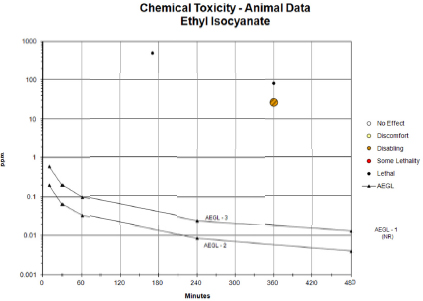
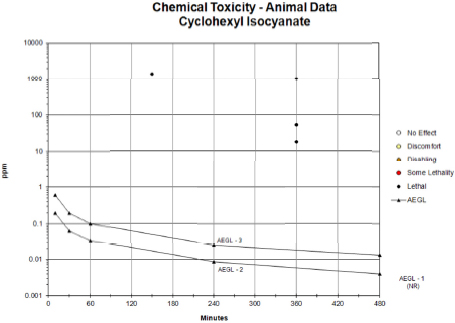
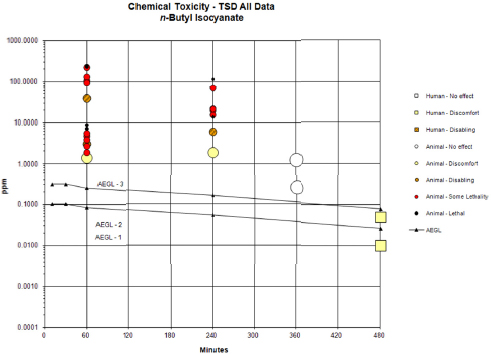
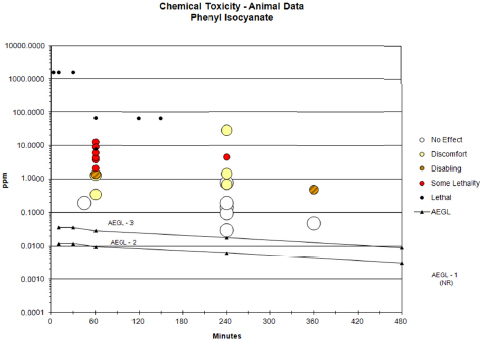
TABLE C-1 Data Used in Category Plot for Ethyl Isocyanate
| Source | Species | Sex | No. of Exposures | ppm | Minutes | Category | Comments |
| AEGL-1 | NR | 10 | AEGL | ||||
| AEGL-1 | NR | 30 | AEGL | ||||
| AEGL-1 | NR | 60 | AEGL | ||||
| AEGL-1 | NR | 240 | AEGL | ||||
| AEGL-1 | NR | 480 | AEGL | ||||
| AEGL-2 | 0.20 | 10 | AEGL | ||||
| AEGL-2 | 0.065 | 30 | AEGL | ||||
| AEGL-2 | 0.034 | 60 | AEGL | ||||
| AEGL-2 | 0.0085 | 240 | AEGL | ||||
| AEGL-2 | 0.0040 | 480 | AEGL | ||||
| AEGL-3 | 0.60 | 10 | AEGL | ||||
| AEGL-3 | 0.20 | 30 | AEGL | ||||
| AEGL-3 | 0.10 | 60 | AEGL | ||||
| AEGL-3 | 0.025 | 240 | AEGL | ||||
| AEGL-3 | 0.013 | 480 | AEGL | ||||
| Eastman | Rat | 1 | 27 | 360 | 2 | ||
| Kodak 1964 | |||||||
| Rat | 1 | 82 | 360 | 3 | Mortality (3/3) | ||
| Rat | 1 | 506 | 170 | 3 | Mortality (3/3) | ||
For category: 0= no effect, 1= discomfort, 2 = disabling, 3 =lethal; SL= some lethality.
TABLE C-2 Data Used in Category Plot for Cyclohexyl Isocyanate
| Source | Species | Sex | No. of Exposures | ppm | Minutes | Category | Comments |
| AEGL-1 | NR | 10 | AEGL | ||||
| AEGL-1 | NR | 30 | AEGL | ||||
| AEGL-1 | NR | 60 | AEGL | ||||
| AEGL-1 | NR | 240 | AEGL | ||||
| AEGL-1 | NR | 480 | AEGL | ||||
| AEGL-2 | 0.20 | 10 | AEGL | ||||
| AEGL-2 | 0.065 | 30 | AEGL | ||||
| AEGL-2 | 0.034 | 60 | AEGL | ||||
| AEGL-2 | 0.0085 | 240 | AEGL | ||||
| AEGL-2 | 0.0040 | 480 | AEGL | ||||
| AEGL-3 | 0.60 | 10 | AEGL | ||||
| AEGL-3 | 0.20 | 30 | AEGL | ||||
| AEGL-3 | 0.10 | 60 | AEGL | ||||
| AEGL-3 | 0.025 | 240 | AEGL | ||||
| AEGL-3 | 0.013 | 480 | AEGL | ||||
| Eastman Kodak 1990, 1992 | Rat | 1 | 17.79 | 360 | 3 | Mortality (3/3), irritation, lacrimation, dypsnea, inflammation in lungs, congestion of kidney and liver. | |
| Source | Species | Sex | No. of Exposures | ppm | Minutes | Category | Comments |
| Rat | 1 | 53.2 | 360 | 3 | Mortality (3/3, two during exposure, one on day 12), irritation, lacrimation, dypsnea, inflammation in lungs, congestion of kidney and liver. | ||
| Rat | 1 | 1,017 | 360 | 3 | Mortality (3/3, after 4 h), irritation, lacrimation, dypsnea, inflammation in lungs, congestion of kidney and liver, salivation, gasping. | ||
| Younger Laboratories 1974 | Rat | 1 | 1,401 | 150 | 3 | Mortality (6/6), no other details | |
| Crawford and Anderson 1974 | Rat | 1 | Saturated | 120 | 3 | Mortality (8/8), no other details | |
| Bayer AG 1980a | Rat | 1 | Saturated | 3 | 2 | No deaths, respiratory problems, enlarged lungs with red spots, fluid, lobulated liver. | |
| Rat | 1 | Saturated | 10 | 3 | Mortality (10/10, within 11 days), respiratory problems, enlarged lungs with red spots, fluid, lobulated liver. | ||
| Rat | 1 | Saturated | 60 | 3 | Mortality (10/10, during exposure), respiratory problems, enlarged lungs with red spots, fluid lobulated liver. | ||
For category: 0 = no effect, 1= discomfort, 2 =disabling, 3 = lethal; SL = some lethality.
TABLE C-3 Data Used in Category Plot for n-Butyl Isocyanate
| Source | Species | Sex | No. of Exposures | ppm | Minutes | Category | Comments |
| AEGL-1 | NR | 10 | AEGL | ||||
| AEGL-1 | NR | 30 | AEGL | ||||
| AEGL-1 | NR | 60 | AEGL | ||||
| AEGL-1 | NR | 240 | AEGL | ||||
| AEGL-1 | NR | 480 | AEGL | ||||
| AEGL-2 | 0.10 | 10 | AEGL | ||||
| AEGL-2 | 0.10 | 30 | AEGL | ||||
| AEGL-2 | 0.083 | 60 | AEGL | ||||
| AEGL-2 | 0.053 | 240 | AEGL | ||||
| AEGL-2 | 0.026 | 480 | AEGL | ||||
| AEGL-3 | 0.31 | 10 | AEGL | ||||
| AEGL-3 | 0.31 | 30 | AEGL | ||||
| AEGL-3 | 0.25 | 60 | AEGL | ||||
| AEGL-3 | 0.16 | 240 | AEGL | ||||
| AEGL-3 | 0.078 | 480 | AEGL | ||||
| Haskell 1989 (industrial hygiene report) | Human | 1 | 0.01 | 480 | 1 | ||
| Haskell 1989 (industrial hygiene report) | Human | 1 | 0.05 | 480 | 1 | ||
| Source | Species | Sex | No. of Exposures | ppm | Minutes | Category | Comments |
| IRDC 1965 | Rat | Male | 1 | 1.4 | 60 | 1 | |
| IRDC 1965 | Rat | Male | 1 | 1.9 | 60 | SL | |
| IRDC 1965 | Rat | Male | 1 | 2.7 | 60 | SL | |
| IRDC 1965 | Rat | Male | 1 | 3.0 | 60 | 2 | |
| IRDC 1965 | Rat | Male | 1 | 4.7 | 60 | SL | |
| IRDC 1965 | Rat | Male | 1 | 5.4 | 60 | SL | |
| IRDC 1965 | Rat | Male | 1 | 7.0 | 60 | 3 | |
| IRDC 1965 | Rat | Male | 1 | 7.1 | 60 | 3 | |
| IRDC 1965 | Rat | Male | 1 | 8.7 | 60 | 3 | |
| Bayer AG 1978 | Rat | Both | 1 | 106 | 60 | SL | LC50 |
| Bayer AG 1978 | Rat | Male | 1 | 22.5 | 240 | SL | LC50 |
| Bayer AG 1978 | Rat | Male | 1 | 20.0 | 240 | SL | LC50 |
| Pauluhn and Eben 1991 | Rat | Male | 5 | 0.25 | 360 | 0 | Multiple exposures; no clinical signs after 6 h/d for 5 d. |
| Pauluhn and Eben, 1991 | Rat | Male | 5 | 1.3 | 360 | 0 | Multiple exposure study; no clinical signs after 6 h/d for 5 d. |
| Haskell 1968 | Rat | Male | 1 | 15.6 | 240 | SL | LC50 |
| IRDC 1965 | Rat | Male | 1 | 3.8 | 60 | SL | LC50 |
| Pauluhn et al. 1990 | Rat | Male | 1 | 1.9 | 240 | 1 | Transient clinical signs (hypothermia, bradypnea, mucous membrane irritation). |
| Pauluhn et al. 1990 | Rat | Male | 1 | 14.0 | 240 | 3 | Pulmonary function changes even at 4 wk post-exposure, pathologic findings in lungs. |
| Pauluhn et al. 1990 | Rat | Male | 1 | 5.9 | 240 | 2 | Notable pulmonary effects that resolved within 1 wk. |
| Bayer AG 1978 | Rat | Both | 1 | 39 | 60 | 2 | No mortality |
| Bayer AG 1978 | Rat | Both | 1 | 130 | 60 | SL | Mortality (7/10) |
| Bayer AG 1978 | Rat | Both | 1 | 245 | 60 | 3 | Mortality (10/10) |
| Bayer AG 1978 | Rat | Both | 1 | 94 | 60 | SL | Mortality (3/20) |
| Bayer AG 1978 | Rat | Both | 1 | 222 | 60 | SL | Mortality (19/20) |
| Bayer AG 1978 | Rat | Both | 1 | 233 | 60 | 3 | Mortality (20/20) |
| Bayer AG 1978 | Rat | Both | 1 | 22 | 240 | SL | Mortality (7/10) |
| Bayer AG 1978 | Rat | Both | 1 | 70 | 240 | SL | Mortality (9/10) |
| Bayer AG 1978 | Rat | Female | 1 | 116 | 240 | 3 | Mortality (5/5) |
For category: 0 = no effect, 1 = discomfort, 2 = disabling, 3 = lethal; SL = some lethality.
TABLE C-4 Data Used in Category Plot for Phenyl Isocyanate
| Source | Species | Sex | No. of Exposures | ppm | Minutes | Category | Comments |
| AEGL-1 | NR | 10 | AEGL | ||||
| AEGL-1 | NR | 30 | AEGL | ||||
| AEGL-1 | NR | 60 | AEGL | ||||
| AEGL-1 | NR | 240 | AEGL | ||||
| AEGL-1 | NR | 480 | AEGL | ||||
| AEGL-2 | 0.012 | 10 | AEGL | ||||
| AEGL-2 | 0.012 | 30 | AEGL | ||||
| AEGL-2 | 0.0096 | 60 | AEGL | ||||
| AEGL-2 | 0.0061 | 240 | AEGL | ||||
| AEGL-2 | 0.0030 | 480 | AEGL | ||||
| AEGL-3 | 0.036 | 10 | AEGL | ||||
| AEGL-3 | 0.036 | 30 | AEGL | ||||
| AEGL-3 | 0.029 | 60 | AEGL | ||||
| AEGL-3 | 0.018 | 240 | AEGL | ||||
| AEGL-3 | 0.0091 | 480 | AEGL | ||||
| SA 1954 | Rat | 1 | 67 | 60 | 3 | ||
| SA 1954 | Rat | 1 | 67 | 120 | 3 | ||
| SA 1954 | Rat | 1 | 67 | 150 | 3 | ||
| Mobay 1978 | Rat | Both | 1 | 12.6 | 60 | SL | LC50 |
| ICI 1980 | Rat | Both | 1 | 3.9 | 60 | SL | LC50 |
| ICI 1977, Mobay 1978 | Rat | Both | 1 | 0.358 | 60 | 1 | No clinical signs, minor histopathologic findings. |
| ICI 1977, Mobay 1978 | Rat | Both | 1 | 1.325 | 60 | 1 | Minor clinical signs, pulmonary damage at necropsy. |
| ICI 1977; Mobay 1978 | Rat | Both | 1 | 1.45 | 60 | 2 | Minor clinical signs, notable histopathologic effects. |
| ICI 1977, Mobay 1978 | Rat | Both | 1 | 2.167 | 60 | SL | 2/4 males, 2/4 females dead 5-12 d post-exposure. |
| ICI 1977, Mobay 1978 | Rat | Both | 1 | 4.368 | 60 | SL | 1/4 males, 3/4 females dead at 4-8 d post-exposure. |
| ICI 1977, Mobay 1978 | Rat | Both | 1 | 6.08 | 60 | SL | 2/4 males, 2/4 females dead at 8-13 d post-exposure. |
| ICI 1977, Mobay 1978 | Rat | Both | 1 | 7.942 | 60 | 3 | 100% lethality at 7-12 d post-exposure. |
| ICI 1977, Mobay 1978 | Rat | Both | 1 | 9.187 | 60 | SL | 4/4 males, 3/4 females dead at 1-14 d post-exposure. |
| ICI 1980 | Rat | Both | 11 | 0.05 | 360 | 0 | No clinical signs, no histopathologic findings. |
| ICI 1980 | Rat | Both | 11 | 0.5 | 360 | 2 | Respiratory distress on first day of exposure. |
| Bayer AG 1981 | Rat | Both | 1 | 1,600 | 3 | 3 | Dead at 3-11 d. |
| Bayer AG 1981 | Rat | Both | 1 | 1,600 | 10 | 3 | Dead at 3-24 h post-exposure. |
| Bayer AG 1981 | Rat | Both | 1 | 1,600 | 30 | 3 | Dead at 32-59 min post-exposure. |
| SA 1954 | Rat | 1 | 29 | 240 | 1 | No deaths but effects uncertain. |
| Source | Species | Sex | No. of Exposures | ppm | Minutes | Category | Comments |
| Bayer AG 1991b | Rat | 5 | 0.03 | 240 | 0 | No clinical signs after multiple exposures. | |
| Bayer AG 1991b | Rat | 5 | 0.10 | 240 | 0 | No clinical signs after multiple exposures. | |
| Bayer AG 1991b | Rat | 5 | 0.70 | 240 | 1 | Serous nasal discharge after 5 d, no findings for BAL and LDH analysis. | |
| Pauluhn et al. 1995 | Rat | Male | 1 | 0.20 | 45 | 0 | Threshold for respiratory tract irritation. |
| Pauluhn et al. 1995 | Rat | Male | 10 | 0.20 | 240 | 0 | No clinical signs, no histopathologic findings. |
| Pauluhn et al. 1995 | Rat | Male | 10 | 0.80 | 240 | 0 | No clinical signs, no histopathologic findings. |
| Pauluhn et al. 1995 | Rat | Male | 10 | 1.50 | 240 | 1 | Signs of irritation, histopathologic findings after full exposure duration. |
| Bayer AG 1991a | Rat | Both | 1 | 0.14 | 240 | 0 | |
| Bayer AG 1991a | Rat | Both | 1 | 1.1 | 240 | 0 | |
| Bayer AG 1991a | Rat | Both | 1 | 2.4 | 240 | SL | Mortality (1/10) |
| Bayer AG 1991a | Rat | Both | 1 | 3.1 | 240 | 0 | |
| Bayer AG 1991a | Rat | Both | 1 | 5.7 | 240 | SL | Mortality (7/10) |
| Bayer AG 1991a | Rat | Both | 1 | 9.7 | 240 | 3 | Mortality (10/10) |
| Bayer AG 1991a | Rat | Both | 1 | 18 | 240 | 3 | Mortality (10/10) |
For category: 0 = no effect, 1 = discomfort, 2 = disabling, 3 = lethal; SL = some lethality.
APPENDIX D
BENCHMARK DOSE MODELING FOR PHENYL ISOCYANATE
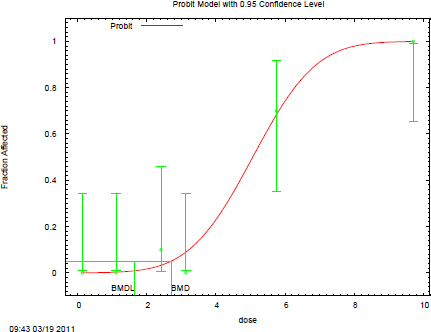
FIGURE D-1 Probit model (with 0.95 confidence level) of phenyl isocyanate data from 4-h lethality study (Bayer AG 1991a).
Probit Model. (Version: 3.2; Date: 10/28/2009)
Input Data File: C:\Documents and Settings\BayerAG1991.dax.(d)
Gnuplot Plotting File: C:\Documents and Settings\ BayerAG1991.plt
Sat Mar 19 10:43:49 2011
BMDS_Model_Run
The form of the probability function is:
P[response] = CumNorm(Intercept+Slope*Dose),
where CumNorm(.) is the cumulative normal distribution function
Dependent variable = Col2
Independent variable = Col1
Slope parameter is not restricted
Total number of observations = 6
Total number of records with missing values = 0
Maximum number of iterations = 250
Relative Function Convergence has been set to: 1e-008
Parameter Convergence has been set to: 1e-008
Default Initial (and Specified) Parameter Values
Background = 0 Specified
Intercept = -2.56468
Slope = 0.462909
Asymptotic Correlation Matrix of Parameter Estimates
| Intercept | Slope | |
| Intercept | 1 | -0.94 |
| Slope | -0.94 | 1 |
(***The model parameter(s) background have been estimated at a boundary point, or have been specified by the user, and do not appear in the correlation matrix)
Parameter Estimates
| Variable | Estimate | Standard Error | 95.0% Wald Confidence Interval | |
| Lower Confidence Limit | Upper Confidence Limit | |||
| Intercept | -3.51993 | 0.86272 | -5.21083 | -1.82903 |
| Slope | 0.69465 | 0.185701 | 0.330683 | 1.05862 |
Analysis of Deviance Table
| Model | Log (likelihood) | No. of Parameters | Deviance TestDF | P-value | |
| Full model | -9.35947 | 6 | |||
| Fitted model | -10.8144 | 2 | 2.90976 4 | 0.573 | |
| Reduced model | -36.6519 | 1 | 54.5848 5 | <0.0001 | |
AIC: 25.6287
Goodness of Fit
| Scaled | |||||
| Dose | Estimated Probability | Expected | Observed | Size | Residual |
| 0.1400 | 0.0003 | 0.003 | 0.000 | 10 | -0.056 |
| 1.1100 | 0.0030 | 0.030 | 0.000 | 10 | -0.173 |
| 2.4100 | 0.0325 | 0.325 | 1.000 | 10 | 1.205 |
| 3.1300 | 0.0892 | 0.892 | 0.000 | 10 | -0.990 |
| 5.7500 | 0.6824 | 6.824 | 7.000 | 10 | 0.120 |
| 9.7100 | 0.9994 | 9.994 | 10.000 | 10 | 0.079 |
Chi-square= 2.49; DF = 4; P-value = 0.6472
Benchmark Dose Computation
Specified effect = 0.05
Risk Type = Extra risk
Confidence level = 0.95
BMC = 2.70217
BMCL05 = 1.64064
BMC01
Probit Model. (Version: 3.2; Date: 10/28/2009)
Input Data File: C:\Documents and Settings\BayerAG1991a.dax(d)
Gnuplot Plotting File: C:\Documents and Settings\ BayerAG1991a.plt
Sat Mar 19 10:44:31 2011
BMDS_Model_Run
The form of the probability function is:
P[response] = CumNorm(Intercept+Slope*Dose),
where CumNorm(.) is the cumulative normal distribution function
Dependent variable = Col2
Independent variable = Col1
Slope parameter is not restricted
Total number of observations = 6
Total number of records with missing values = 0
Maximum number of iterations = 250
Relative Function Convergence has been set to: 1e-008
Parameter Convergence has been set to: 1e-008
Default Initial (and Specified) Parameter Values
Background = 0 Specified
Intercept = -2.56468
Slope = 0.462909
Asymptotic Correlation Matrix of Parameter Estimates
| Intercept | Slope | |
| Intercept | 1 | -0.94 |
| Slope | -0.94 | 1 |
(***The model parameter(s) -background have been estimated at a boundary point, or have been specified by the user, and do not appear in the correlation matrix)
Parameter Estimates
| Variable | Estimate | Standard Error | 95.0% Wald Confidence Interval | |
| Lower Confidence Limit | Upper Confidence Limit | |||
| Intercept | -3.51993 | 0.86272 | -5.21083 | -1.82903 |
| Slope | 0.69465 | 0.185701 | 0.330683 | 1.05862 |
Analysis of Deviance Table
| Model | Log (likelihood) | No. of Parameters | Deviance Test | DF | P-value |
| Full model | -9.35947 | 6 | |||
| Fitted model | -10.8144 | 2 | 2.90976 | 4 | 0.573 |
| Reduced model | -36.6519 | 1 | 54.5848 | 5 | <0.0001 |
AIC: 25.6287
Goodness of Fit
| Scaled | |||||
| Dose | Estimated Probability | Expected | Observed | Size | Residual |
| 0.1400 | 0.0003 | 0.003 | 0.000 | 10 | -0.056 |
| 1.1100 | 0.0030 | 0.030 | 0.000 | 10 | -0.173 |
| 2.4100 | 0.0325 | 0.325 | 1.000 | 10 | 1.205 |
| 3.1300 | 0.0892 | 0.892 | 0.000 | 10 | -0.990 |
| 5.7500 | 0.6824 | 6.824 | 7.000 | 10 | 0.120 |
| 9.7100 | 0.9994 | 9.994 | 10.000 | 10 | 0.079 |
Chi-square = 2.49; DF = 4; P-value = 0.6472
Benchmark Dose Computation
Specified effect = 0.01
Risk Type = Extra risk
Confidence level = 0.95
BMC01 = 1.72968
BMCL = 0.591986


