Oil in the Sea IV: Quick Guide for Practitioners and Researchers (2023)
Chapter: Oil Spill Response
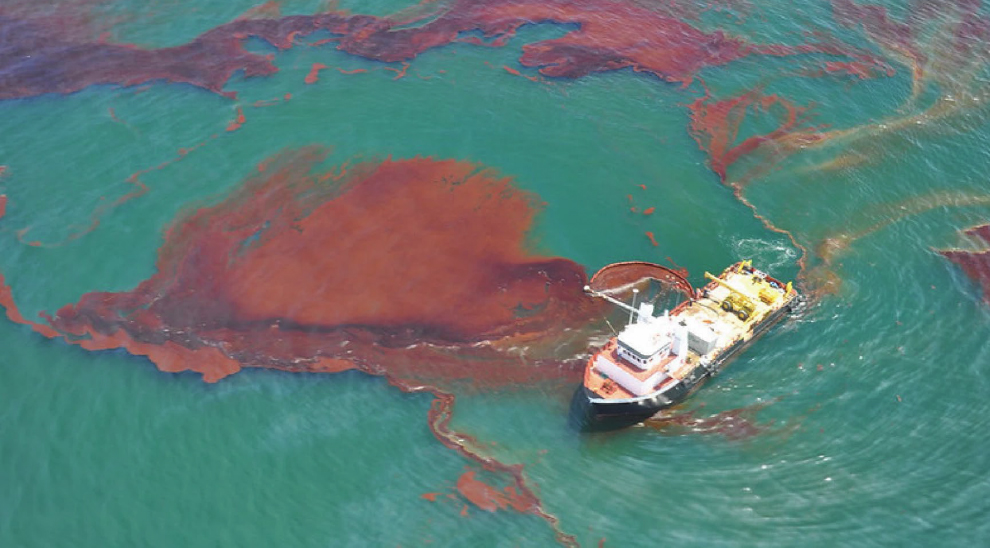
Oil Spill Response
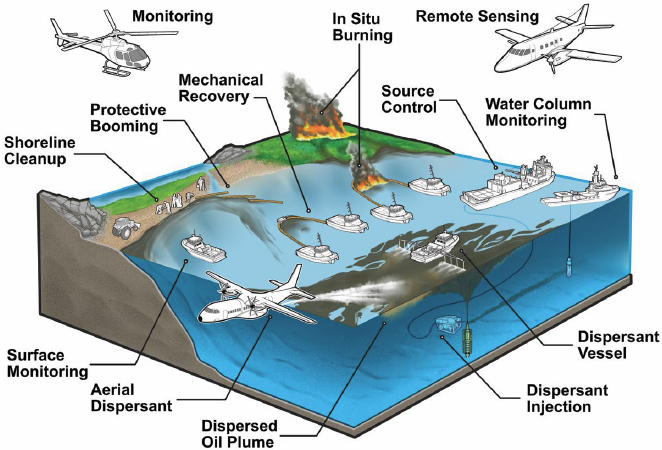
Despite efforts to prevent oil spills, accidental spills will continue to occur as long as there is offshore oil production and transportation. A variety of different response techniques could be employed during an oil spill, including mechanical recovery of oil, in situ burning, and the use of dispersants (see Figure 5). Together, these techniques can be thought of as an oil spill response toolbox ready to be deployed to reduce the potential impacts of a spill on people, animals, and the environment.
The Oil Spill Response Toolbox
A number of techniques, listed below, are available for responding to oil spills. Continuing the analogy of a toolbox, one must choose the right tool for the job. No single oil spill response technique is effective, safe, or necessary in every spill situation. Each brings its own advantages, challenges, and optimal operational conditions for use. Choosing the most appropriate response tools involves considering
IMAGE SOURCE: National Oceanic and Atmospheric Administration.
SOURCE: Image provided courtesy of the American Petroleum Institute, produced by Iron Octopus Productions, Inc.
factors including the type of oil, the location of the spill, water depth, temperature, and wind speed. Environmental and socioeconomic concerns must also be considered, and the techniques chosen should do no further harm. If needed, the processes of net environmental benefit analysis or spill impact mitigation assessment can be used to compare response options and select the optimal combination of activities to clean up an oil spill.
MONITORING AND ASSESSMENT TOOLS
Monitoring and assessment tools are used to gather critical information about an oil spill, including the physical and chemical characteristics of the oil, the location and extent of the spill, and the environmental conditions. These criteria are used to select the most appropriate response tools. Much of this information is gathered from sensors that make visual and chemical observations of the oil above and below the ocean surface. The sensors are moved through the environment by monitoring platforms, which can include moored
instruments and equipment casts from subsurface and surface vessels. An essential component of oil spill response is remote sensing, in which sensors on aircraft, vessels, or satellites track oil spills from a distance (see Figure 6).
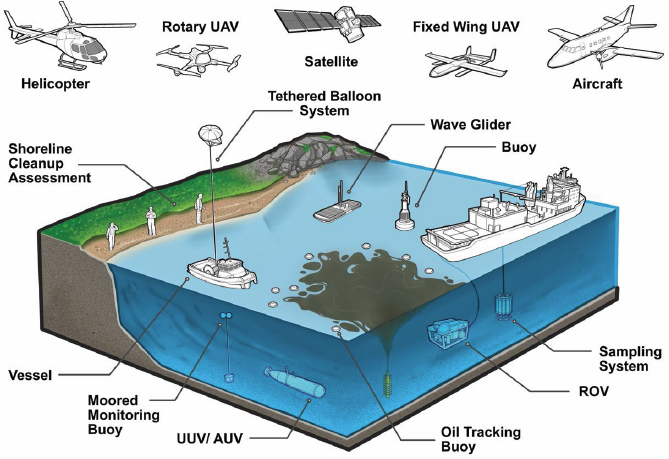
NOTE: AUV = autonomous underwater vehicle; ROV = remotely operated vehicle; UAV = unmanned aerial vehicle; UUV = unmanned underwater vehicle.
SOURCE: Image provided courtesy of the American Petroleum Institute, produced by Iron Octopus Productions, Inc.
MECHANICAL RECOVERY
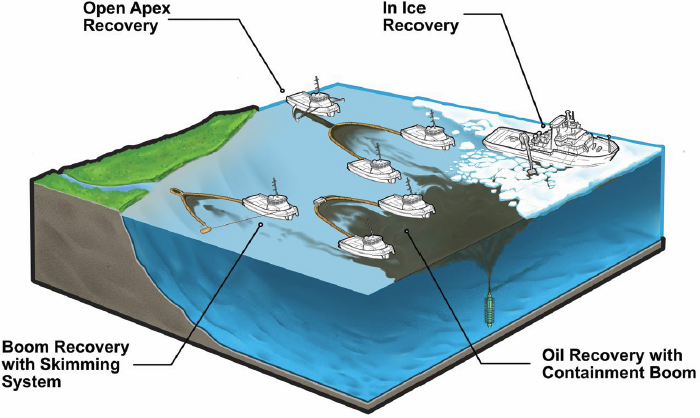
Mechanical recovery physically removes spilled oil from the surface of the water (see Figure 7). Remote sensing techniques are used to identify thicker oil slicks, which are more amenable to mechanical recovery than thin sheens. Then, the oil is corralled into thick layers using specially designed floating barriers called booms, which are towed by vessels. Skimming devices at the apex of the boom separate the oil from water and move the recovered oil into storage before it is transferred to shore for recycling or disposal. When spills occur far offshore or when winds or sea waves are high, mechanical recovery
may not be effective in recovering large volumes of oil. Furthermore, mechanical recovery requires much more personnel, equipment, and complex logistical support over a long period of time than any other response technique.
SOURCE: Image provided courtesy of the American Petroleum Institute, produced by Iron Octopus Productions, Inc.
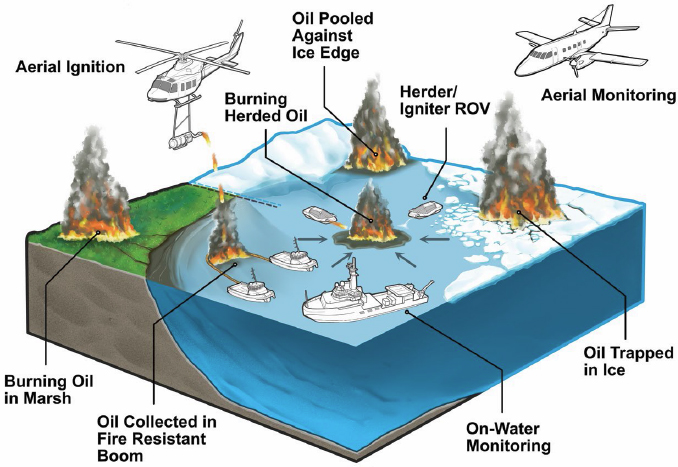
IN SITU BURNING
In situ burning is the controlled burning of an oil slick to reduce the quantity of floating oil, prevent the associated risks to human health and safety, and minimize environmental impacts of oil (see Figure 8). A critical factor for successful in situ burning is oil slick thickness. To help oil burn, it must be corralled into thick layers with special booms, similar to the process of mechanical recovery. Recently, the use of oil-herding chemicals—which make oil slicks contract into smaller, thicker slicks—have been tested in laboratory and field-scale experiments.
Decades of research and field responses have shown that in situ burning can be a valuable response tool for removing large volumes of oil quickly, safely, and effectively with minimal environmental impact. Successful in situ burning also removes the need to collect, store, transport, and dispose of recovered oil, as would be the case with mechanical recovery. More than 400 controlled burns were safely conducted during the DWH response, removing an estimated 222,000 to 310,000 barrels of oil from the Gulf of Mexico sea surface. In situ burning is also one of the few response techniques that can be effective under Arctic conditions.
DISPERSANTS
Response techniques such as mechanical recovery and in situ burning require the deployment of many field personnel and much equipment and are challenged by the need to collect and concentrate spread-out, patchy oil slicks. These techniques may not be as effective in
SOURCE: Image provided courtesy of the American Petroleum Institute, produced by Iron Octopus Productions, Inc.
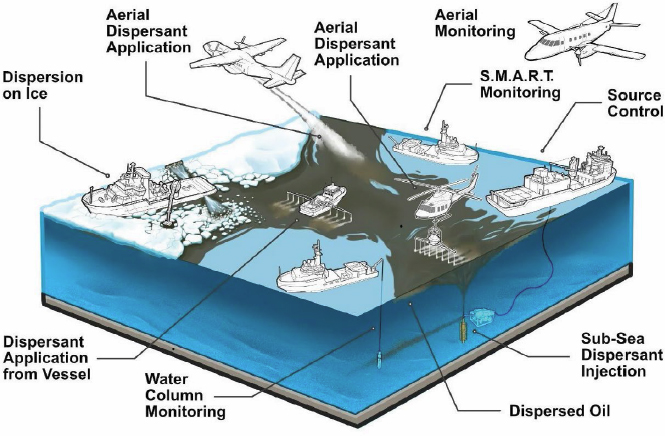
recovering large offshore spills in remote areas or in high-wind and turbulent-sea conditions. In these situations, an aerial or vessel application of dispersant may be a critical response tool (see Figure 9).
Dispersants are chemical mixtures that help enhance the natural process of oil dispersal: the breakup of oil into tiny droplets and the dispersal of the oil droplets into the water column. Dispersants work by reducing the surface tension between the water and oil, making it easier for waves or other turbulence to create small oil droplets and dissipate them. These droplets are quickly diluted in the water column and biodegraded by the naturally occurring bacteria.
Chemical dispersants are most effective when applied during or quickly after a spill. Natural processes such as the dilution, weathering, and emulsification of the oil can reduce the effectiveness of dispersants. Dispersants can be used over a wider range of sea conditions than other response conditions and is the only response technique that can be used in high waves and winds.
SOURCE: Image provided courtesy of the American Petroleum Institute, produced by Iron Octopus Productions, Inc.
Application of dispersants at the source of subsea blowouts is the latest application method that holds the promise to treat large volumes of oil at the source with high efficiency. This technique, termed subsea dispersant injection (SSDI), was first used as a major response option during the DWH spill. As well as enhancing natural dispersion of the released oil to the water column, SSDI also limits the amount of oil that reaches the sea surface, where it may pose a hazard to humans (including the operators of source control vessels working on closing the well and stopping the release of oil into the environment), marine mammals, birds, and other marine life.
However, not all oils are suitable for chemical dispersing. Very volatile oils evaporate rapidly and are typically allowed to do so. Very heavy oils that have density higher than water are not suitable for dispersion, and oils that have cooled to below their pour point—the temperature at which oil remains liquid—may become very viscous and lose the ability to disperse.
Furthermore, the application of dispersants comes with the potential for negative impacts on the environment. For example, the use of dispersants temporarily increases the concentration of oil in the water column before the plume of dispersed oil is diluted. This could expose organisms at the top portion of the water column to higher concentrations of oil. Chemically or naturally dispersed oil in waters with high turbidity and sediment content could result in the formation of marine oil snow (a sediment formed when oil mixes with dead animals, plants, soot, and dust; see “Insights into Oil Fate Afforded by the Deepwater Horizon Oil Spill” in Section 5). In addition, the process of applying dispersants could result in workers coming into contact with dispersant chemicals.
MANAGING OIL RESPONSE: INCIDENT COMMAND SYSTEM
In the 1970s, California was devastated by a series of catastrophic forest fires encroaching on urban turf. As these incidents were investigated, it was found that incident response failures were far more likely to result from inadequate management rather than from lack of resources, faulty tactics, or other factors. This insight led to the development of the Incident Command System (ICS)—a tool used for the command, control, and coordination of emergency response to major disasters, including oil spills. ICS provides a management structure that allows agencies and industry to work together using common terminology and operating procedures controlling personnel, facilities, equipment, and communications. The system represents organizational “best practices,” and has become the standard for emergency management across the United States.
Shoreline Protection and Cleanup
The greatest impacts to people and to the environment take place when oil reaches the shoreline, which is often densely populated and supports recreation, fishing, industry, and tourism activities. Shorelines are also often home to many fish, animals, plants, and microbes in delicately balanced ecosystems.
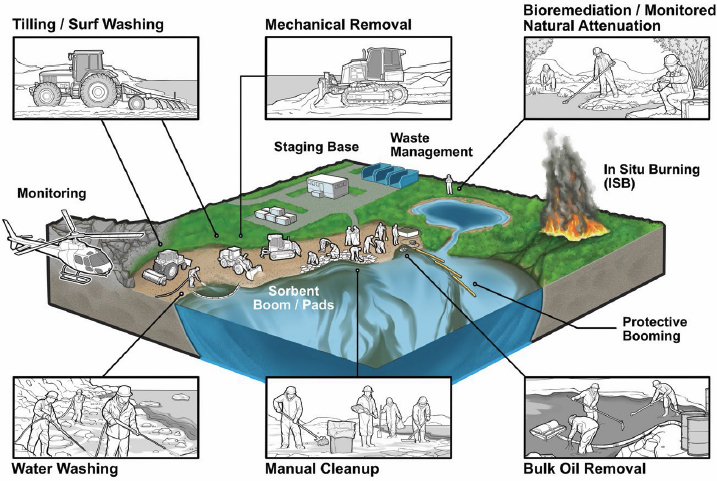
Many oil spill response tools have been developed for shoreline response (see Figure 10) but may also cause negative impacts on the shoreline environment. Typically, they involve moving large numbers of people and equipment into an area for long periods of time, and they generate large volumes of waste. One example comes from the use of booms designed to prevent oil from reaching the shore, which take time to deploy and must be carefully positioned because they can drift into sensitive shoreline. In the DWH oil spill response, long stretches of boom were not able to stop oil from coming to shore and created additional impacts when they were pushed into marshes, requiring complicated retrieval operations.
SOURCE: Image provided courtesy of the American Petroleum Institute, produced by Iron Octopus Productions, Inc.
BALANCING RESPONSE VERSUS IMPACT
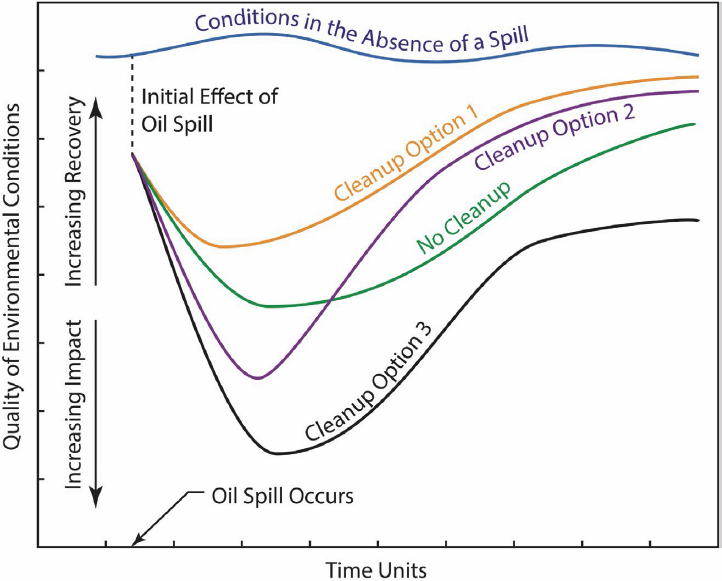
The choice of oil response technique is always a trade-off among efficacy, expedience, safety, and environmental impact of the cleanup (see Figure 11). Complete removal of the oil may not be a desirable endpoint, if such a degree of removal damages flora and fauna and causes stress to vulnerable species. In some cases, even minimal human cleanup activities may affect feeding behavior of certain species, such as threatened or endangered birds or nesting turtles. Depending on the situation, the best choice may be no response at all. For example, a small to medium size spill of light fuel oil in high seas may evaporate or disperse naturally, not requiring an active cleanup.
SOURCE: Adapted from the National Oceanic and Atmospheric Administration.
Looking Ahead: Future Oil Spill Response Needs
In coming years, the changing energy landscape will likely present the following new challenges for oil spill response.
OIL SPILL RESPONSE IN ARCTIC CONDITIONS
The Arctic environment presents unique challenges for oil spill cleanup including limited daylight hours during winter, frequent days with fog, strong wind gusts, and low temperatures. Limited infrastructure presents another obstacle to field operations: above the Arctic circle in North America there are no rail connections, and only two deep-water ports and four airports. Furthermore, there are very few settlements in the Arctic, making it difficult to accommodate response personnel.
These logistical challenges, together with the large volumes of waste that would be generated by cleanup activities and the disturbance to the environment from increased human presence, mean that monitored natural attenuation may outweigh the benefits of cleanup (see Box 3).
RESPONDING TO SPILLS OF NEW FUEL TYPES
New requirements for low-sulfur fuel oils for marine shipping came into effect in 2020, but to date, insufficient research has been conducted on these oils to determine transport and weathering
behavior, biodegradability, and toxicity under various environmental conditions. The few very low sulfur fuel oil (VLSFO) and ultra-low sulfur fuel oil (ULSFO) samples studied to date have different chemical properties.
Although the transition to alternative, renewable energy will ultimately reduce oil pollution in the sea, alternative energy sources and fuels may bring their own safety and pollution concerns. The regulatory and research community and the industry will need to proactively review and address any potential adverse effects from these transitions.
Research Gaps: Source Control and Oil Response
The following research is needed in the areas of source control and oil spill response.
FIELD EXPERIMENTS WITH REAL OIL TO TEST AND IMPROVE RESPONSE TECHNIQUES UNDER REALISTIC CONDITIONS
While some experiments can be effectively carried out in the laboratory or with oil surrogates, field experiments with real oil would be more effective for testing and optimizing response techniques under realistic conditions.
LIFE-CYCLE ANALYSIS OF OIL SPILLS FOR DIFFERENT RESPONSE SCENARIOS
Many research projects look only at a very small component of oil fate, behavior, impacts, or response options in specific conditions and scenarios. This specificity makes it difficult for decision makers to draw broad conclusions about how different response scenarios may affect oil fate, behavior, or impacts.
UNDERSTANDING HEALTH AND PSYCHOLOGICAL RISKS TO RESPONSE PROFESSIONALS
Oil spill responders are trained professionals using appropriate strategies and personal protective equipment, but their exposure to oil and the risks of response operations may affect their physical and mental health.


