Origins, Worlds, and Life: Planetary Science and Astrobiology in the Next Decade (2023)
Chapter: Front Matter

Origins,
Worlds,
and Life
Planetary Science and Astrobiology
in the Next Decade
This booklet is based on the Space Studies Board report Origins, Worlds, and Life: A Decadal Strategy for Planetary Science and Astrobiology 2023–2032 (available online at https://nap.nationalacademies.org/catalog/26522). Details about obtaining copies of the full report, together with more information about the Space Studies Board and its activities, can be found at https://www.nationalacademies.org/ssb/space-studies-board.
Origins, Worlds, and Life: A Decadal Strategy for Planetary Science and Astrobiology 2023–2032 was authored by the Committee on the Planetary Science and Astrobiology Decadal Survey, which consisted of a steering group (members listed below) and six supporting panels (see the full report for the complete list of all participants).
ROBIN M. CANUP, NAS, Southwest Research Institute, Co-Chair
PHILIP R. CHRISTENSEN, Arizona State University, Co-Chair
MAHZARIN R. BANAJI, NAS, Harvard University
STEVEN J. BATTEL, NAE, Battel Engineering
LARS E. BORG, Lawrence Livermore National Laboratory
ATHENA COUSTENIS, National Centre for Scientific Research, Paris Observatory
JAMES H. CROCKER, NAE, Lockheed Martin Space Systems Company
BRETT W. DENEVI, Johns Hopkins University Applied Physics Laboratory
BETHANY L. EHLMANN, California Institute of Technology
LARRY W. ESPOSITO, University of Colorado Boulder
ORLANDO FIGUEROA, Orlando Leadership Enterprise
JOHN M. GRUNSFELD, Endless Frontier Associates
JULIE HUBER, Woods Hole Oceanographic Institution
KRISHAN KHURANA, University of California, Los Angeles
WILLIAM MCKINNON, NAS, Washington University in St. Louis
FRANCIS NIMMO, NAS, University of California, Santa Cruz
CAROL RAYMOND, Jet Propulsion Laboratory
BARBARA SHERWOOD LOLLAR, NAS/NAE, University of Toronto
AMY SIMON, NASA Goddard Space Flight Center
The Space Studies Board is a unit of the National Academies of Sciences, Engineering, and Medicine, which provide independent, objective analysis and advice to the nation and conduct other activities to solve complex problems and inform public policy decisions. The National Academies also encourage education and research, recognize outstanding contributions to knowledge, and increase public understanding in matters of science, engineering, and medicine.
Support for this publication was provided by the National Aeronautics and Space Administration (Contract NNH17CB02B/NNH17CB01T) and the National Science Foundation (Grant 2040016).
The Space Studies Board acknowledges David H. Smith and Robert Pool for drafting the text of this booklet.
Copyright 2023 by the National Academy of Sciences. All rights reserved.
Printed in the United States of America
Cover: NASA/JPL/SSI. https://solarsystem.nasa.gov/resources/12920/titans-halo.
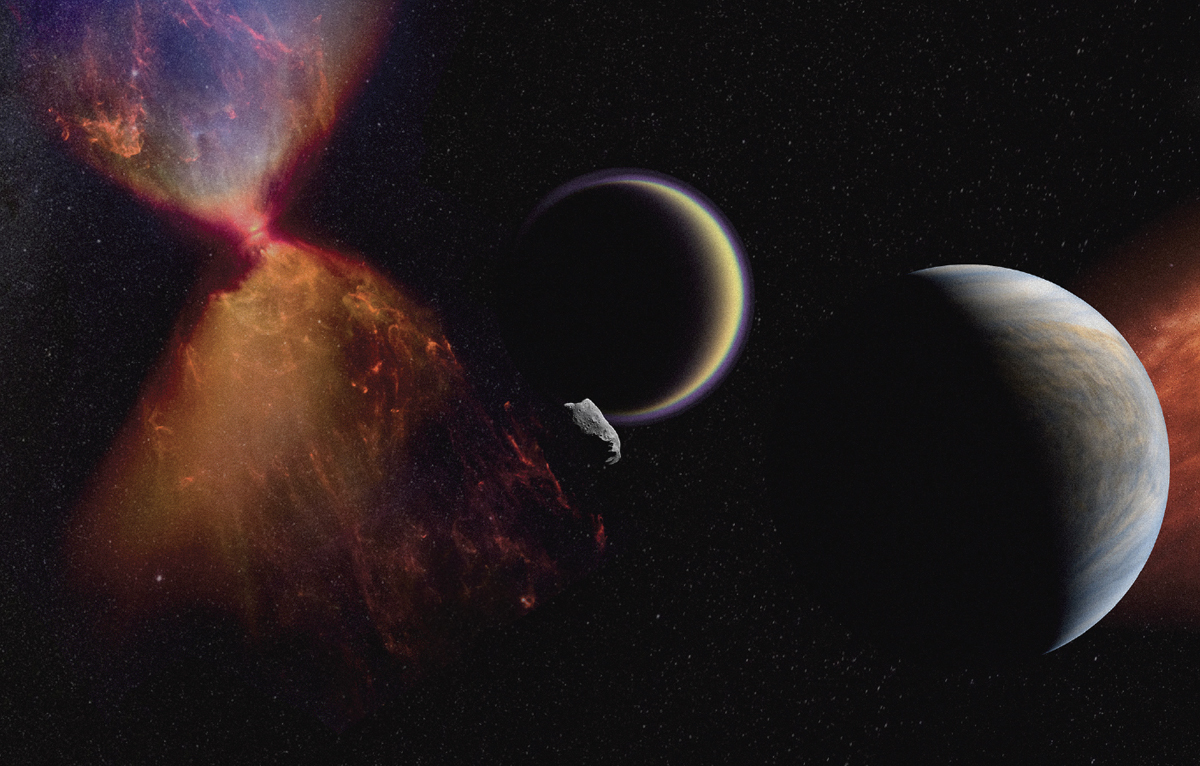
Frontispiece: Design by Paul Byrne. Images (Left): Bipolar nebula, NASA/ESA/CSA/STScI, https://webbtelescope.org/contents/media/images/2022/055/01GGWCXTEXGJ0C3FWSCB3SDBV5; Titan, NASA/JPL/Space Science Institute, https://solarsystem.nasa.gov/resources/12920/titans-halo; Asteroid, NASA/JPL, https://solarsystem.nasa.gov/resources/777/asteroid-ida-five-frame-mosaic; Venus, JAXA/ISAS/DARTS/Kevin M. Gill, https://www.flickr.com/photos/kevinmgill/52459599993/in/album-72157716561343202. (Right): Comet, NASA/ESA/Hubble Heritage Team (STScI-AURA), https://science.nasa.gov/missions/hubble/nasas-hubble-sees-comet-ison-intact; Protoplanetary disk, ESO/L. Calçada, https://www.eso.org/public/images/eso1436f; Saturn, NASA/JPL, https://photojournal.jpl.nasa.gov/catalog/PIA01969; Magma ocean world, ESA/Hubble, M. Kornmesser, https://sci.esa.int/web/hubble/-/57406-artist-s-impression-of-55-cancri-e-close-up; Earth, ESA/OSIRIS Team MPS/UPD/LAM/IAA/RSSD/INTA/UPM/DASP/IDA/Gordan Ugarkovic, https://www.planetary.org/space-images/crescent-earth-from-rosetta; Starfield, ESO/S. Brunier, https://www.eso.org/public/outreach/partnerships/photo-ambassadors/#brunier.
Planetary Science and Astrobiology
Planetary science and astrobiology are fundamentally related multidisciplinary activities that merge insights from the geosciences and life sciences with astronomy in a quest for new understanding about our place in the universe. The same motivation that led Galileo to study the heavens inspires today’s researchers to push the envelope of what is technically feasible, to seek what lies beyond our earthly horizons, and to find answers to fundamental questions about the origins of the solar system, the diversity of worlds, and the emergence of life on Earth and, maybe, other planetary bodies.
The diversity of astronomical and planetary bodies discussed in the decadal survey Origins, Worlds, and Life and summarized in this booklet include the following (left to right): stellar birthplaces such as the bipolar nebula L1527; asteroids like Ida; giant satellites such as Titan; cloud-covered Venus; comets like Comet ISON; planet-forming disks about young stars (artist’s impression); Saturn and its rings; exoplanets such as the magma ocean world 55 Cancri E (artist’s impression); and Earth, the only planet known (so far) to be an abode of life.


