Progress and Priorities in Ocean Drilling: In Search of Earth's Past and Future (2024)
Chapter: Summary
Summary
Research supported by scientific ocean drilling has fundamentally transformed the understanding of the planet, with key scientific contributions to the discovery and understanding of plate tectonics; the formation and destruction of ocean crust and how these processes generate geohazards; the reconstruction of extreme greenhouse and icehouse climates that existed during the past 100 million years; the identification of major extinctions; and the discovery of a diverse community of microbes living in ocean sediments, rocks, and fluids below the seafloor.
Scientific ocean drilling is now at a critical juncture. The U.S. dedicated drilling vessel for deep-sea research, the JOIDES Resolution,1 has been the workhorse for collaborative international scientific ocean drilling for decades. The contract to operate the JOIDES Resolution has not been renewed, and operations will end in 2024. Currently, there is no plan in place for a future dedicated U.S. drilling vessel. Meanwhile, U.S. scientific ocean drilling’s international partners in Europe and Japan are jointly moving forward with plans for a new program phase, with berths on contracted vessels available to contributing member countries. The United States has not joined this consortium (branded as the International Ocean Drilling Program-3 [IODP3]). Additionally, China is developing a new scientific ocean drilling program independently. Thus, the landscape for scientific ocean drilling will change after 2024.
With the absence of a dedicated drilling vessel supported by the United States, the capacity for future scientific ocean drilling for the United States and its present international partners will likely be reduced to approximately 10 percent of its current capacity. Without new infrastructure or sampling investments, participation of U.S. scientists on expeditions will become limited, and access to new ocean drilling samples and data will be curtailed. These conditions will impact progress on globally vital and urgent research. This includes research on pressing topics such as ground truthing predictive models of climate and ocean ecosystem changes, monitoring and assessing tectonically generated geologic hazards, and evaluating the potential for carbon sequestration in the ocean crust.
There are high-priority science questions, with potential to yield societal benefits, that can be addressed only with ocean drilling research. In order to advance that research, new approaches addressing resources, infrastructure, and capacity need to be considered.
___________________
1 “JOIDES” is an acronym for the Joint Oceanographic Institutions for Deep Earth Sampling (see https://joidesresolution.org/about-the-jr).
PLANNING FOR THE FUTURE PROGRAM
The United States has led the international scientific ocean drilling community since 1968. The JOIDES Resolution, funded by the National Science Foundation and its operational team, provides essential leadership. The JOIDES Resolution and its predecessor vessel have operational capabilities that are unique for scientific ocean drilling—the ability to operate in deep water and collect continuous samples (cores and associated materials) to depths exceeding 1 kilometer below the seafloor under a wide range of sea conditions. Since beginning operations in 1985, the JOIDES Resolution has collected 95 percent of the total core length for international scientific ocean drilling, with free and open access to samples and data from these cores available to the international Earth and ocean science community. U.S. scientists have also led the scientific ocean drilling community in the conception and design of drilling projects and in the dissemination of research results (e.g., publications) and collaborations.
Owing to rising costs that now far exceed the funding designated to operate the JOIDES Resolution, NSF will terminate support for the vessel in 2024. As possible next steps, NSF is considering a U.S. mission-specific platform (MSP) program, and alternative drilling and coring options may be possible in the future; however, these options will not achieve the vital and urgent objectives identified in this report. Furthermore, no funding mechanism has been identified for building or operating a vessel with capabilities similar to those of the JOIDES Resolution that could address these science objectives.
In preparation for the impending retirement of the JOIDES Resolution, and at the request of NSF, the scientific ocean drilling community has taken steps to envision and plan for the next phase of the drilling program. This effort has included international and U.S. identification of priority science areas and U.S. conceptualization of drilling vessel requirements. Additionally, NSF asked the National Academies of Sciences, Engineering, and Medicine’s Committee on the 2025–2035 Decadal Survey of Ocean Sciences for the National Science Foundation to produce and publish this consensus study, serving as an interim report for a more encompassing decadal survey to come. The interim report provides a timely and broad perspective on critical research and infrastructure needed to answer the most compelling research questions that can be advanced only with scientific ocean drilling. The committee’s statement of task for this interim report is included in Box S.1.
BOX S.1
Interim Report Statement of Task
The Committee will produce an interim report to provide advice to NSF OCE on the resources and infrastructure available to address high priority research questions requiring scientific ocean drilling. The interim report will cover the following:
1. Based on previous reports, assess progress on addressing high priority science questions that require scientific ocean drilling and identify new, if any, equally compelling science questions that would also require scientific ocean drilling.
2. Of the unanswered scientific questions, which could be addressed using existing scientific drilling assets including sediment or rock core archives and existing platforms, and which questions would require new infrastructure or sampling investments?
PROGRESS OVER THE LAST DECADE
Since the scientific ocean drilling program commenced in 1968, scientific ocean drilling expeditions and research have fundamentally transformed the understanding of the planet by revealing the critical features of Earth’s dynamic history, processes, and structure, including the solid Earth (i.e., upper mantle/crust), ocean, atmosphere, and ecosystems. The list of scientific ocean drilling–related achievements is extensive, represented in large part by the number of publications and, until recently, by the sustained support for drilling by the international Earth sciences community.
Over roughly the last decade, the scientific ocean drilling program has operated within the funding phase branded as the International Ocean Discovery Program (IODP-2). From 2014 to 2023, IODP-2 completed 57 expeditions: 46 using the JOIDES Resolution, 5 using the Chikyu, and 6 using MSPs. This extensive use of the JOIDES Resolution, compared with the other IODP-2 components, illustrates the value and productivity of the JOIDES Resolution. While research from the current phase of the program is still in progress, the findings from several expeditions have already yielded important scientific insights, as illustrated by the sample accomplishments listed below:
Climate and ocean change: Reading the past, informing the future
- Documented the influence of ice sheet dynamics on the magnitude of sea level change.
- Quantified data on ocean circulation and climate sensitivity to changing greenhouse gas levels.
- Progressed understanding of regional monsoon precipitation.
- Identified physical and biogeochemical changes that affect ecosystems and climate.
Earth connections: Deep processes and their impact on Earth’s surface environment
- Developed new insights and models for chemical and fluid exchanges between ocean crust and seawater.
- Fulfilled a 60-year goal of scientific ocean drilling by successfully drilling into and recovering upper mantle rock.
- Elucidated the processes by which ocean crustal architecture is created and modified from rifting to seafloor spreading.
- Increased understanding of how mantle melting processes evolve during and after subduction initiation.
Biosphere frontiers: Deep life and environmental forcing of evolution
- Revealed global diversity of microbial communities in subseafloor environments (e.g., sediments, rocks, fluids).
- Made pioneering observations about microbial life in extreme environments, including the limits of life. Documented ecosystem responses to major environmental shifts.
- Revealed how marine microbial and planktonic communities respond to pronounced changes in climate, including events that led to mass extinctions.
Earth in motion: Processes and hazards on human timescales
- Documented new carbon cycling links between Earth’s surface and its deeper interior along plate boundaries, making connections to climate change.
- Advanced characterization of fluid flow in a range of environmental settings using borehole instruments and core records.
- Made major progress in deep drilling, sampling, and borehole instrumentation of plate boundaries to understand a range of fault types, geologic properties, and motions leading to earthquakes.
- Provided new recognition of climatically linked submarine landslides.
It should be noted that the scientific ocean drilling program has not conducted a formal evaluation of the scientific progress made and would benefit from developing and executing such an evaluation to assess progress and communicate the program’s achievements and value.
FUTURE SCIENTIFIC OCEAN DRILLING PRIORITIES
Funding for scientific research is not unlimited; forward-looking prioritization is needed to guide investments in research, infrastructure, and workforce development. Important research that can be advanced only using scientific ocean drilling is identified here in recognition of the serious nature of regional and global change, the risks of geologic hazards, and the research areas of greatest societal impact. With this context, the committee defined two prioritization categories to provide guidance to NSF: vital science and urgent science.
Vital science encompasses compelling, high-priority research that has the potential to transform scientific knowledge of the interconnected Earth system and the critical role of the ocean in that system. Vital scientific research can lead to paradigm shifts in understanding, potentially opening new doors to research and technology innovations that can benefit humanity with direct societal relevance.
Urgent science is vital research that is time sensitive and has immediate societal relevance given the emerging challenges at regional to global scales. Research on urgent science questions needs to be done now to understand changes or new circumstances that can inform predictive models and decision making and may be related to tipping point vulnerabilities. It implies that immediate action is needed and is thus a higher priority than vital science.
The committee identified five high-priority research areas (Figure S.1, described in the text below) that continue to require scientific ocean drilling in order to advance understanding. Each of these high-priority research areas are vital; some are additionally classified as urgent because of their direct societal benefits, such as predicting the collapse of deep-sea currents that regulate global temperatures or predicting future geohazards.
This interim report also identifies first-order infrastructure parameters required to accomplish these vital and urgent ocean drilling science research priorities.
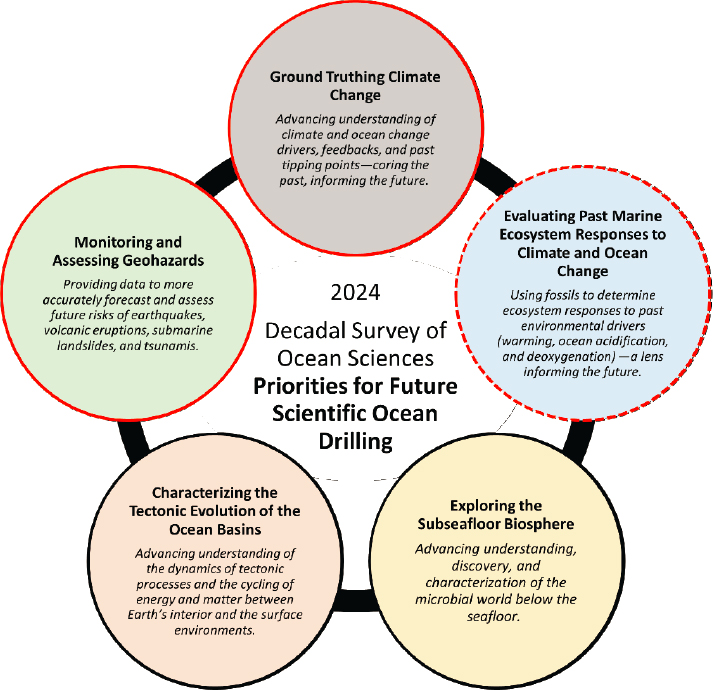
Ground Truthing Climate Change
Advancing understanding of climate and ocean change drivers, feedbacks, and past tipping points—coring the past, informing the future.
Ground truthing climate change is deemed both vital and urgent because records recovered through scientific ocean drilling are important past analogs for modern and near-future challenges of rapid global warming, sea level rise, and widespread ocean acidification and deoxygenation. Data from these records are useful in informing predictive models today because they contain paleoclimate proxies of climate and ocean variables. The proxy data collected and measured serve essentially as surrogates, or indirect indicators, of past changes in temperature, ice volume, and ocean chemistry, among others. Direct observations of global climate from less than a century ago provide too little data to adequately assess the ability of advanced models to accurately simulate Earth’s climate at greenhouse gas levels significantly higher (or lower) than present. Additionally, long, continuous, and high-resolution paleoclimatic and paleoceanographic sedimentary records from the subseafloor are useful to constrain the processes that regulate or destabilize feedbacks in Earth’s climate system and to examine the geological record of past tipping points (critical points that, when exceeded, will lead to large and often irreversible change); transient climate states; and the dynamics of ice, ocean, and atmosphere interactions in past periods of elevated temperatures.
Future Research: Additional observations obtainable only by scientific ocean drilling are required to assess the skill of climate models to replicate greenhouse gas–forced switches (i.e., tipping points) over geological timescales in temperatures, ice sheet dynamics, sea level, and ocean circulation and to constrain the role of feedbacks (physical or biogeochemical responses that amplify or dampen perturbations). To constrain Earth climate sensitivity to high greenhouse gas levels, additional scientific drilling is required to fill data gaps for extreme warm intervals in climatically sensitive regions (e.g., the Arctic and equatorial oceans, and in a few cases, the midlatitudes). Similarly, to fully characterize the sensitivity of hydroclimates (including regional monsoons) to greenhouse gas forcing, records obtained for the Northern Hemisphere need to be complemented with records from the Southern Hemisphere.
Evaluating Past Marine Ecosystem Responses to Climate and Ocean Change
Using fossils to determine ecosystem responses to past environmental drivers (warming, ocean acidification, and deoxygenation)—a lens informing the future.
Evaluating past marine ecosystem responses to climate and ocean change is vital and potentially urgent, especially given the importance of marine ecosystems as a source of seafood. Just as the past can help understand drivers of climate change, so too can it provide insights into marine ecosystem responses across multiple timescales and geographies. This topic necessarily goes hand in hand with ground truthing climate change. Records that can be recovered only through scientific ocean drilling can provide insight into past ecosystem responses to accelerated changes in climate and ocean. Such records provide a framework and foundation to situate modern studies of changing climate and ocean conditions, and provide a necessary long-term context for assessing impacts and feedbacks on ecosystem dynamics and food webs. Collectively, these data inform predictive models of future change.
Future Research: Additional scientific ocean drilling that prioritizes locations with limited records, such as the equatorial, midlatitude, and polar oceans and open ocean environments during past periods of extreme warmth, will allow paleobiologists to inform models of plankton ecosystem dynamics during past analog climate states (e.g., rapid warming). In addition, existing long-term paleo records can be further exploited for studies, capitalizing on the development of new databases and existing core samples to assess global marine ecosystem responses to climatic and oceanic shifts more fully.
Monitoring and Assessing Geohazards
Providing data to more accurately forecast and assess future risks of earthquakes, volcanic eruptions, submarine landslides, and tsunamis.
Deep, subseafloor observatories, which can only be installed through scientific ocean drilling, are used for what is considered both vital and urgent research under the theme of monitoring and assessing geohazards (earthquakes, volcanic eruptions, submarine landslides, and tsunamis). These observatories are an order of magnitude more sensitive to fault slip than other real-time systems (e.g., seabed observations), allowing smaller events to be detected and improving the potential for future earthquake forecasting. The results of this research could have direct societal benefit in terms of preparing for and better mitigating future geohazard risks.
Future Research: Future studies of subduction systems, including borehole monitoring, will allow scientists to better understand different conditions that promote either seismogenic or stable (non-earthquake-producing) fault motion. These data will constrain numerical models of dynamic fault ruptures, earthquake cycles, and tsunami genesis to advance understanding of the conditions under which natural hazards occur and to create a more robust warning system.
Exploring the Subseafloor Biosphere
Advancing understanding, discovery, and characterization of the world of living microbes below the seafloor.
Exploring the subseafloor biosphere is characterized as vital; although findings could have direct societal benefit, the research is exploratory in nature. Building on pioneering research by ocean drilling over the past decade in particular, those exploring subsurface microbial life are on the cusp of discoveries that are expected to transform scientific understanding of microbial activity in extreme environments. Subseafloor sediment and hard rock records are essential to understanding what makes the planet habitable, and where and how life originated and evolved. Understanding the limits of life requires knowledge of the complex exchanges of fluids and nutrients that occur between the subseafloor biosphere, Earth’s crust, the ocean, and the atmosphere. Research has also shown that the subsurface biosphere—including the deeper subsurface environs—can have a pronounced impact on biogeochemical cycles. However, few studies to date have explicitly focused on biogeochemical and ecological coupling (e.g., the extent of community exchange between the subsurface and the overlying water column).
Future Research: Scientific ocean drilling is necessary to address key unanswered questions about the subseafloor biosphere and to advance understanding of the limits to life, as well as the way biological communities interact and move within the subsurface biosphere and how they are distributed across space and time. Such research has direct implications for understanding the potential for life in other areas of the solar system, the origins of life on Earth, and the integral building blocks of ecosystems that nurture the biological world.
Characterizing the Tectonic Evolution of the Ocean Basins
Advancing understanding of the dynamics of tectonic processes and the cycling of energy and matter between Earth’s interior and surface environments.
Characterizing the tectonic evolution of the ocean basins is vital, high-priority research. Sampling oceanic crust of different ages provides insight into Earth processes that govern the occurrence of earthquakes, tsunamis, and volcanoes and the global cycling of energy and matter that produces economic resources that have importance now (i.e., oil and gas) and that have potential to become an economic resource in the future (i.e., critical minerals).
Future Research: Only scientific ocean drilling can provide key constraints regarding the formation and evolution of oceanic crust and the upper mantle. The cycling of fluids through the subseafloor and corresponding chemical exchanges between the liquid and solid Earth have implications for processes with direct societal relevance, including the production of mineral resources, sequestration of atmospheric carbon dioxide, and origin of geohazards (including volcanic eruptions, earthquakes, and related tsunamis).
Although they differ in detail and nuance, the five priority areas identified by the committee align with the initiatives identified throughout the years by the scientific ocean drilling community; they also connect and respond directly to U.S. research priorities identified by the White House, by the scientific ocean drilling community, and by several previous National Academies studies (Table S.1).
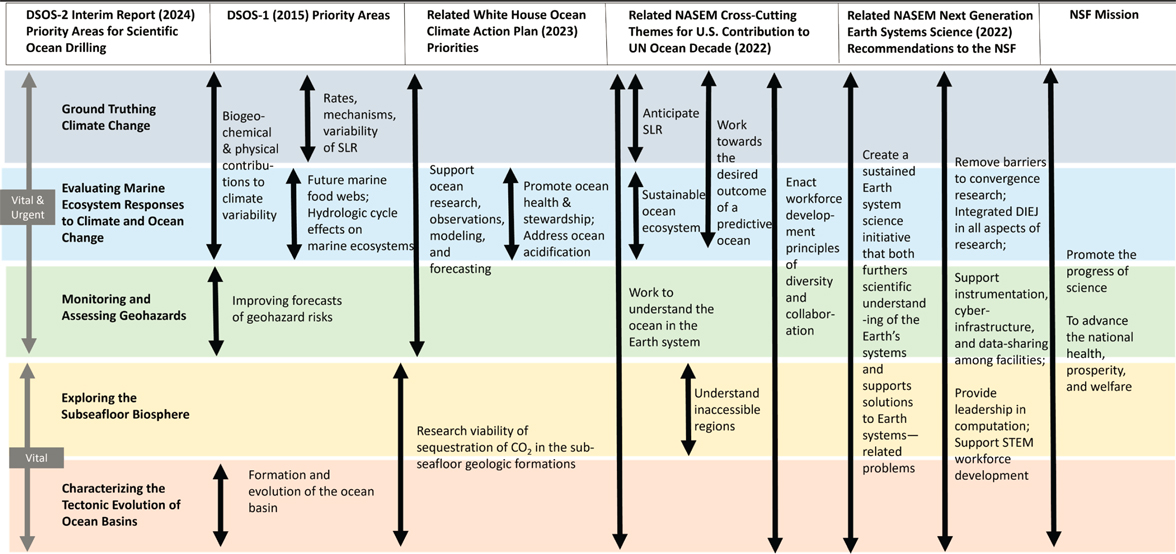 |
NOTES: DSOS = Decadal Survey of Ocean Sciences; DEIJ = diversity, equity, inclusion, and justice; NSF = National Science Foundation; SLR = sea level rise; STEM = science, technology, engineering, and mathematics.
USING RESOURCES WISELY—LEGACY ASSETS
Opportunities exist to use available archived materials (i.e., legacy assets), including collected cores, data, and other samples, to accomplish groundbreaking and essential scientific research (Table S.2). However, not all scientific objectives will be met without collection of new cores (and associated data) and installation of new observatories. A holistic approach to understanding the high-priority scientific areas includes strategic use of existing archives along with targeted drilling for new records and access to the subseafloor.
Across scientific ocean drilling priorities, legacy assets can help address the following types of research and analysis:
- Community-driven, collaborative, multidisciplinary research.
- Big data analytics on a wide range of subseafloor standard measurements (e.g., physical properties, petrophysics/logging, paleomagnetic data).
- Large-scale “syntheses of science” studies (i.e., producing topical reviews) that integrate data across multiple expeditions/boreholes, addressing global or regional geographies and time intervals.
- Development and testing of new proxy methods (that are not dependent on ephemeral properties).
- Undergraduate and graduate education and training on materials and methods used in scientific ocean drilling research to engage early-career scientists and develop workforce-ready skills.
High-priority scientific ocean drilling research and analyses that cannot be advanced using legacy assets include:
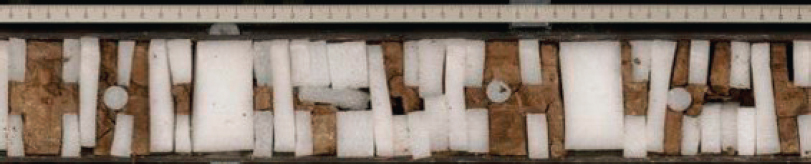
- Sample-intensive, high-resolution studies using cores that have already been heavily sampled (Figure S.2).
- Real-time monitoring of fault motion using existing borehole instruments.
- Microbiological and biogeochemical studies requiring fresh samples/biomass.
- Comprehensive studies of igneous and metamorphic rocks, as there is very little repository material of these rock types.
- Studies of challenging rock types, such as those in fault zones, because there is little repository material of intervals from such locations (the exception being those samples from along the Japan margin).
- Analyses that depend on ephemeral properties (e.g., pore water, organic carbon).
TABLE S.2 Available Assets Obtained from Select Scientific Ocean Drilling Programs* to Advance Some Vital and Urgent Research Priorities
| Cores | Approximately 150 km of collected core from all drilling platforms are stored in each of three locations: Gulf Coast (United States), Bremen (Germany), and Kochi (Japan), for a total of ~450 km. Approximately one-third of the total core length is appropriate for high-priority science. Cores of high scientific and societal interest are quickly depleted by use. Also, cores recovered in earlier phases of the program are now dried, and some are contaminated by mold (a natural consequence of long-term core storage), which makes obtaining chemical data from these older sediments difficult. |
| Data | Approximately 1,000,000 unique measurements per drilling expedition, and ~700 core images and ~700 X-ray images per km of each core exist. Continued support for data stewardship activities is critical to handle issues related to data quality, resolution of the time record, calibration, and combining datasets. |
| Microbiology Samples | Approximately 1,300 samples exist that are frozen for preservation for molecular analysis. However, freezing commonly limits usability in future analysis, and past experience has highlighted challenges in storage. For example, frozen samples are not suitable for determining microbial activity or rates of activity and are unsuitable for any potential cultivation work. |
| Instrumented Boreholes | Approximately 50 borehole active observatories exist, but few transmit data in real time and most require revisitation to install/reinstall apparatus and/or download data. Additionally, ~90 inactive borehole observatories are ready for reentry and reinstrumentation by a vessel, if determined practical and feasible. |
*Select scientific drilling programs include the Deep Sea Drilling Project, Ocean Drilling Program, International Ocean Discovery Programs 1 and 2.
SOURCE: JOIDES Resolution Science Operator.
- Creation of high-temporal-resolution geochemical records obtained from carbonate and molecular fossil materials to reconstruct ocean conditions (e.g., temperature, salinity); this limitation is due to degradation of fossil material from acidic pore waters present in the legacy cores.
- Coordinated land–sea studies (e.g., continental drilling and ocean drilling studies), either because existing cores and other assets were not necessarily taken from locations best positioned for linking to adjacent continental records, or continental and ocean records are not yet available (e.g., not yet drilled).
A new approach to collaborative research has been proposed by the scientific ocean drilling community, with the first call for proposals for Legacy Asset Projects (LEAPs) issued in October 2023 by the IODP Science Support Office. LEAPs provide opportunities to maximize the use of already acquired material and data and foster discovery and innovation. However, many of the vital and urgent science priorities cannot be addressed with stored material (e.g., preservation of microbiology samples limits their usability) and the core materials in critical locations and intervals have been depleted by use yet remain in high demand (Figure S.2). A funded LEAP initiative would not replace the need for drilling capacity. An ideal scientific drilling program would include a robust LEAPs program combined with recovery of new subseafloor cores and installation of borehole observatories that address the five high-priority research areas.
While funding the use of legacy assets is important, it is equally important that the metadata and data collected, regardless of type or source, be findable, accessible, interoperable, reproducible (FAIR), and shared in a timely manner. Timely sharing is essential and could be incentivized and valued as much as publications of expedition outcomes. Crediting use-inspired data sharing, as one produces a publication, has the potential to ensure that the culture includes FAIR, responsible, ethical (e.g., CARE principles2), and timely data sharing, not just in the scientific ocean drilling program, but throughout the field of ocean science.
INFRASTRUCTURE NEEDS
The committee identified key criteria, or parameters, for successful achievement of the scientific goals associated with each of the five high-priority areas for future scientific ocean drilling. Rather than recommend any specific path forward in terms of drilling infrastructure, key parameters necessary for successfully fulfilling the scientific themes categorized as vital and/or urgent are identified in the column headings in Table S.3. The parameters are not an exhaustive list but define the high-level screening parameters relevant to generating the data needed by scientists to address these themes, which are listed as rows in Table S.3.
___________________
2 CARE stands for Collective benefit, Authority to control, Responsibility, Ethics (see https://www.gida-global.org/care).
TABLE S.3 Parameters for Accomplishing Vital and Urgent Ocean Drilling Science Research Priorities
| Deep Water >3,000 m of water |
Deep Penetration >30 m into sediment/rock |
Continuous Records from Cores No unknown gaps in recovery |
Ephemeral Properties Porewater, Magnetics |
Borehole Observatory/Instrumentation Chemistry, Physics, Biology, Geology |
Logging Downhole tools after coring |
Ice Strengthened (not icebreaker) | |
| Ground Truthing Climate Change | R | R | R | R | NN | NN | R |
| Records are from all world’s ocean environments | Required for old records AND younger records with high resolution (high sed rates) | Requires multiple recoveries per location with intentional offsets | To document potential alteration of physically recovered material | Cannot replace continuous records from cores | Dependent on target of interest | ||
| Evaluating Marine Ecosystem Responses to Climate and Ocean Change | R | R | G | G | NN | NN | R |
| Records are from all world’s ocean environments | Required for deep-time biotic events | Required to infer timing and tempo of ecological response to environmental perturbations | Chemical fluxes upward from the seafloor to the ocean are indicators of and sustain deep life | Dependent on target of interest | |||
| Monitoring and Assessing Geohazards | R | R | R/I | R/I | R | I/R | G |
| Continental margin and trenches, deep-water records of volcanic ash, midocean ridge relationships | Deep seismogenic zones, old records of recurrence | Dependent on target of interest (yes to temporal earthquake records, eruption records), multiple recovery not required | Dependent on target of interest | Very strong requirement for time-dependent hazards assessment | Perhaps could replace continuous core recovery in certain cases | Dependent on target of interest | |
| Exploring the Subseafloor Biosphere | R | R | NN | R | I | NN | NN |
| Organic matter supply varies with depth and distance from shore | Habitability in low-energy substrates | Depth and age (only) necessary | Very strong requirement | Dependent on target of interest | Dependent on target of interest | ||
| Characterizing llk Tectonic Evolution of Ocean Basins | R | R | R/I | NN | R | R | I/G |
| Midocean ridges and old oceanic crust are deep water | Establishing crustal boundaries and accessing crust beneath buried sediments | Depending on target of interest (see Logging) | Very strong requirement | Due to challenging recovery of hard rock |
NOTES: G = good if a byproduct of a primary driver; I = important, but not required by itself; NN = not necessary; R = required.
Workforce Needs
A diverse, equitable, and inclusive workforce in ocean science and engineering is an infrastructure component fundamental to the advancement and future success of scientific ocean drilling. With that underpinning, a trained workforce skilled in planning, collection, analysis, and archiving of scientific samples and stewardship of data has been and will continue to be critical to the future of all ocean sciences, and ocean drilling contributes significantly to this goal. Some of the highly specialized positions in the drilling program will likely be lost with the closure, or even temporary cessation, of the U.S. scientific drilling program.
Managing the Future Scientific Ocean Drilling Enterprise
A nimble and focused management structure is key to a sustainable and successful future U.S.-based scientific ocean drilling effort. Management and staffing requirements will depend on the nature of the U.S. program design—whether, for example, a program moving forward is one focused on using contracted MSPs or an acquired (through long-term lease or build) globally ranging dedicated vessel. Potential questions to consider in determining the scale and scope of a future management structure include:
- What are the short- and long-term financial, scientific, operational, and leadership advantages and disadvantages to various platform options?
- Which measurements are required to be made on the platform?
- How many shore- and ocean-based scientific and technical staff are needed and what is the most appropriate staffing model to meet the needs of the program?
- What is the minimum advisory structure needed for the program?
Given the resource constraints affecting scientific ocean drilling, the answers to these questions could help trim the cost of operations and maintenance, which have plagued the ocean sciences community not only for scientific drilling, but also for other critical infrastructure. Identifying the minimum required program capabilities to advance vital and urgent scientific goals would help to facilitate a stable, successful, dynamic, and sustainable U.S. scientific ocean drilling research program.
CONCLUSION
The rapid pace of climate change and related extreme events, sea level rise, changes in ocean currents and chemistry threatening ocean ecosystems, and devastating natural hazards such as earthquakes are among the greatest challenges facing society. By coring the past to inform the future, U.S.-based scientific ocean drilling research continues to have unique and essential roles in addressing these vital and urgent challenges.


