Effective Low-Noise Rumble Strips (2024)
Chapter: 3 Evaluation of Existing Rumble Strips

CHAPTER 3
Evaluation of Existing Rumble Strips
To extend the database of sinusoidal rumble strip performance beyond 14-inch wavelength strips that were available in California, measurements of other existing sinusoidal strips were performed in other locations in the U.S. (after COVID-19 travel restrictions were eased). These included testing of existing strips at three sites in Indiana with wavelengths of 12, 18, and 24 inches, and at one of the sites in Michigan where 14-inch wavelength strips had been installed for comparison to those in California. The strips in Indiana had been documented and evaluated previously using different test procedures (Balmos et al. 2017, Mathew et al. 2018). Personnel at the Michigan DOT indicated that the 14-inch sinusoidal strips in Michigan had recently been installed and had not yet been tested. All four of these sites had shoulder and centerline rumble strips. This chapter discusses those test sites and the results of the testing.
Description of Indiana and Michigan Rumble Strips
Indiana Sites
All three sites with sinusoidal strips in Indiana are located on Highway Indiana 1 (IN-1), just northwest of Fort Wayne. This is a semi-rural two-lane highway with posted speeds of 50 and 55 mph. The wavelengths of the strips are 12, 18, and 24 inches installed on the shoulders under the edge-of-lane stripe and on the center line under the stripes. These strips had previously been evaluated by Purdue University and the Indiana DOT, as first reported in 2016 and published in 2018 (Balmos et al. 2017, Mathew et al. 2018). The measurements conducted in the current research were done at the same locations as two of the sites used in the previous study, with the third site just slightly northeast of the previous site. The previous measurements were conducted using an intrusion method, in which the test vehicle was briefly operated on the strips simulating a sudden lane departure and correction. The design dimensions of the three sinusoidal strips are shown in Figure 24 (Mathew et al. 2018).
Upon initial visit to the sites, it was found that the pavement and 12- and 18-inch rumble strips had been overlaid with chip seal, while the 24-inch site appeared to be in its original as-milled condition. Photographs of the 12-, 18-, and 24-inch rumble strips are shown in Figure 25. The profiles of the strips were documented using a 20-inch contour gauge, and the results are shown in Appendix C.
From Figure 25a and 25b (12-inch strips) and 25c and 25d (18-inch strips), the presence of the rumble strips is barely distinguishable from the coarse pavement. Upon closer examination of both sites, which can be seen in the additional photographs provided in Appendix C, the shape at the 12-inch site is more distinguishable than the 18-inch site, which is all but lost relative to the pronounced surface texture of the chip seal. For the 24-inch strips, the pavement did not

have a chip seal overlay like the other sites. As a result, the sinusoidal shape was better defined. The pavement had suffered some distress, and sealant had been applied at some time, particularly in the tire paths and the shoulder. The pavement was an older dense grade asphalt with less texture than the 12- and 18-inch sites. From the profiles shown in Appendix C, each rumble strip design was measured, and Table 2 summarizes the nominal dimensions compared to the measured dimensions.
Michigan Site
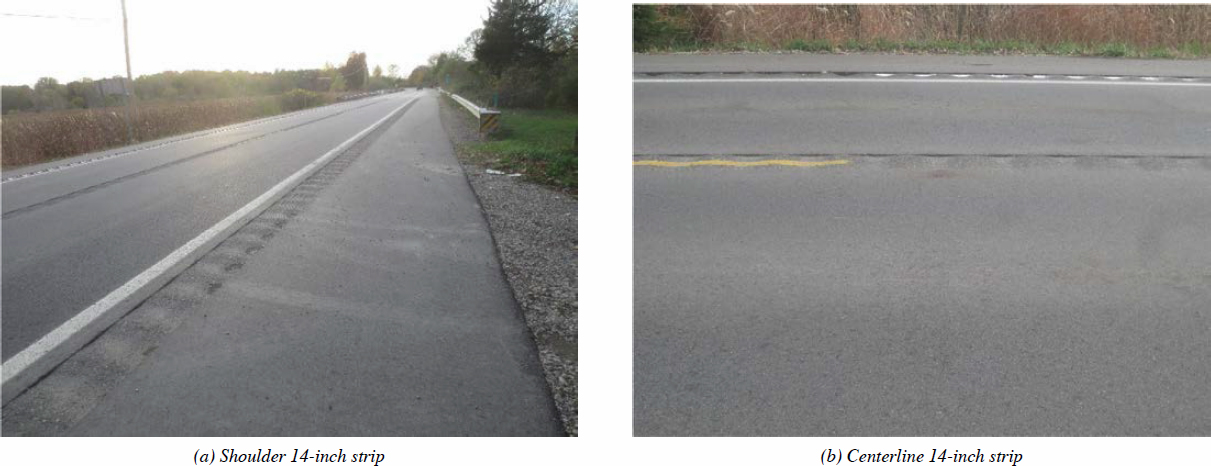
The site of the 14-inch wavelength sinusoidal rumble strips in Michigan was on State Route 124 (SR 124), just east of Brooklyn. SR 124 is also a two-lane highway in a semi-rural environment. The rumble strips were on the shoulders and centerline, and the posted speed limit was 55 mph. According to Michigan DOT, these strips were recently installed and had not yet been documented with noise or vibration measurements. The pavement appeared to be relatively new dense graded asphalt with fine aggregate. Photographs of the strips are shown in Figure 26. For these strips, the recess is clearly visible from the photographs. The profile contours for the Michigan site are provided in Appendix C. Table 2 compares the nominal dimensions to the measured dimensions of the 14-inch Michigan site.
Table 2. Specified and as installed dimensions of the sinusoidal rumble strips in the Midwest.
| Location | Wavelength, in. | Amplitude, in. | Recess, in. | |||
|---|---|---|---|---|---|---|
| Specified | Measured | Specified | Measured | Specified | Measured | |
| Indiana | 12 | 10½ to 11 | 3/8 | 7/16 | 1/8 | 0 |
| Michigan | 14 | 14 to 15⅛ | N/Aa | 15/32 | N/Aa | 7/32 |
| Indiana | 18 | 18 | 3/8 | 11/32 to 3/8 | 1/8 | 0 |
| Indiana | 24 | 21 | 3/8 | 1/4 to 3/8 | 1/8 | 0 |
a Specified dimensions were not made available to the research team.

Measurement Results at the Midwest Test Sites
Test Vehicles at the Midwest Test Sites
Following the suggested test procedure described in Chapter 2 and detailed in Appendix B, four vehicles, each representing the four identified vehicle categories (a small compact car, mid- to full-size sedan, mid-size SUV, and large, full-frame pickup truck or SUV) were used for shoulder and centerline testing in the Midwest. To complete the Midwest testing, two sets of vehicles were used for the pass-by testing completed in October 2020 and the interior noise and vibration testing completed in June 2021. Photos and dimensions for these vehicles can be found in Appendix C. Except for the full-size SUVs, all other test vehicles were front wheel drive vehicles.
OBSI at the Midwest Test Sites
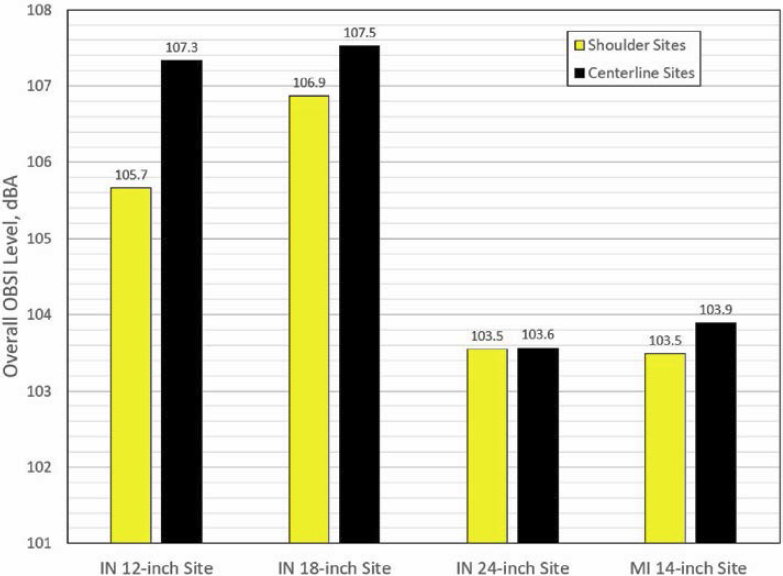
OBSI data were collected in both directions at each site since the centerline rumble strips at all four sites were tested in the opposite direction of travel as the shoulder strips. Five-second overall averages from all four sites are summarized in Figure 27. The chip seal sites (Indiana 12- and 18-inch sites) had levels about 4 dB higher than the DGAC pavements at the Midwest test sites (Indiana 24-inch site and Michigan 14-inch site). Spectral data is detailed in Appendix C.
Pass-by Measurement Results at the Midwest Test Sites
The shoulder rumble strips pass-by noise measurements were performed following the test procedure described in Chapter 2 of this report. Sound level meters (SLM) were used for the Midwest pass-by measurements. One SLM was positioned 25 feet from the center of the nearest lane, one was positioned 25 feet from the center of the vehicle when on the shoulder strips, and one was positioned 25 feet from the center of the vehicle when on the centerline strips in the far lane of travel. For the off-rumble strip measurements on the centerline strips, the vehicle would be about 3 feet further away, creating a 1 dB lower level due to spherical spreading relative to 25 feet, which was added back to the level for the off strips case.
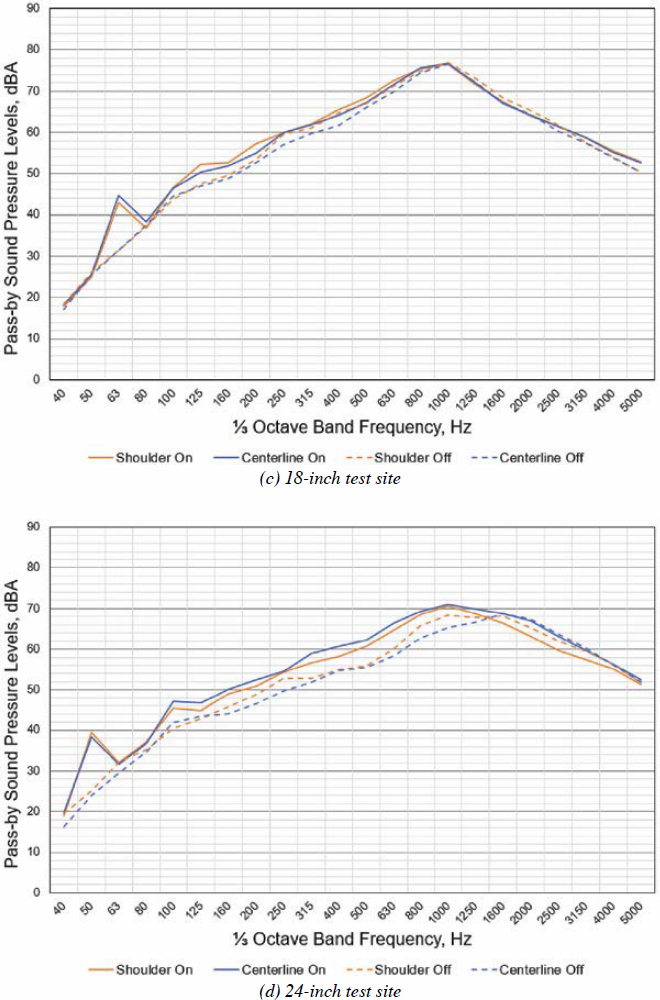
The ⅓ octave band spectra averaged across all test vehicles are shown in Figure 28 for on- and off-the-shoulder and centerline strips. The overall trends for each test site with varying wavelengths show peaks for all test vehicles at 100 Hz for the 12-inch strips, 80 Hz for the 14-inch
strips, 63 Hz for the 18-inch strips, and 50 Hz for the 24-inch strips. The spectra show a smaller peak at the second repetition rate for each test site.
The spectra measured at the sites with 12- and 14-inch wavelengths showed the greatest difference between on and off strips at frequencies below 1,000 Hz. Of these two designs, the 12-inch strips produce the highest ⅓ octave band level at the frequency corresponding to the wavelength repetition rate (100 Hz). In the absence of the high noise levels produced by the chip seal, the higher amplitude produced by the 12-inch strip would be more detectable and possibly a source of complaints. In contrast, there is little to no difference between on and off strips at the 18- and 24-inch sites at frequency bands above 160 Hz for the 18-inch wavelength and above 125 Hz for the 24-inch wavelength.
Due to the elevated levels in the upper-frequency bands (over 200 Hz at each site), the overall pass-by levels, which are typically calculated by summing the energy in the bands up to 10 kHz, would be heavily influenced by the noise from bands unattributable to the rumble strips. For exterior pass-by measurements, the upper-frequency bands are more influenced by the pavement than noise on the vehicle interior. Since the purpose of this research is to design an effective rumble strip to minimize rumble strip noise projected to the wayside of the roadways, the pass-by spectra at each of the sites in the Midwest were band-passed from 31.5 to 200 Hz for calculating the overall levels. This would isolate the bands excited by the rumble strips for a better comparison between the designs without contamination from the pavement.
The band-passed overall pass-by results for each site, on and off the strips, are shown in Figure 29 for the average of all vehicles at the shoulder and centerline strips at 60 mph. The average overall levels measured on the 12- and 14-inch strips were about 63 to 71 dB, while the average on-strips levels at the 18- and 24-inch strips were about 55 to 60 dB. The off-strips levels were highest at the chip seal sites (12- and 18-inch sites), ranging from 55 to 57 dB, while the sites with aged DGAC (14- and 24-inch sites) had average off-strips levels of 51 to 55 dB.


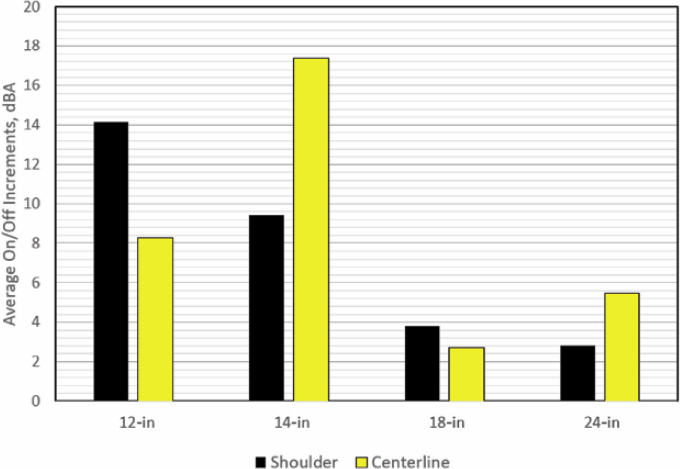
The on/off increments are shown in Figure 30 for the shoulder and centerline strips at 60 mph. At the sites with chip seal pavement, the on/off differences were 3 to 4 dB at the 18-inch site and 8 to 14 dB at the 12-inch site, which indicates considerable variability between the shoulder and centerline strips. The increments at the 24-inch site ranged from 3 to 6 dB. The highest on/off increments occurred at the 14-inch site in Michigan, which ranged from about 9 to 17 dB.
Runs were made at 45 mph at each site, and the detailed results can be found in Appendix C. Similar to data collected at 60 mph, the overall levels were recalculated from 31.5 to 200 Hz to
reduce the influence of the pavement. Average on/off increments were lowest at the 18-inch site (1 to 3 dB). The second lowest on/off increments were measured at the 24-inch site (4 to 5 dB). The highest on/off increments were measured at the 14-inch site (13 dB at both shoulder and centerline strips), and the increments at the 12-inch site were 4 to 7 dB.
Interior Noise and Vibration Measurement Results at the Midwest Test Sites
The ability of a rumble strip to alert a vehicle operator to an out-of-lane departure depends on the magnitude of the change in the audible and tactile input to the operator. This is considered to be the increase in interior noise and vibration produced by departing from the lane of travel and striking the rumble strip. Suggested increases in level on/off the strips are from 10 to 15 dB (Torbic et al. 2009). All acceleration and interior noise data were acquired simultaneously using analog-to-digital converters and software. These consisted of 0.1-second Leq values acquired every 0.1 second for a total duration of 10 seconds. Interior noise was measured at the primary position, CC, and at the secondary position, FC. Triaxial acceleration was measured at the primary seat track (ST) location and at the secondary steering column (SC) position, and the levels from the three directions were summed logarithmically to produce the reported acceleration levels.
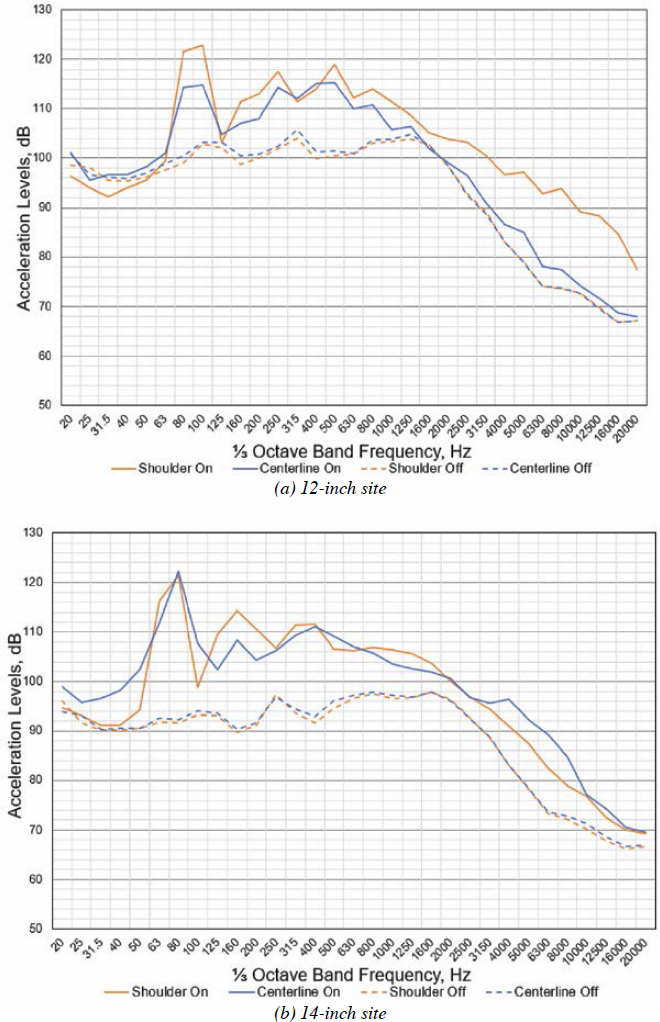
The ⅓ octave band spectra averaged across all test vehicles are shown in Figures 31 and 32 for the primary microphone (CC) and primary accelerometer (ST), respectively, at the shoulder and centerline strips of each site. Results for secondary sensors are provided in Appendix C.
At both sensors, the peaks on the 18-inch strips were the least defined of all the sites for both shoulder and centerline strips. The 12-inch peaks at the shoulder and centerline showed the biggest average difference among all the sites, which may indicate some inconsistencies with the installation. The peaks at the centerline strips were 6 to 8 dB lower than the shoulder strips.
Consistently at frequency bands above 315 Hz, there was no difference between the on- and off-strip spectra at the 18-inch site. While the frequency spectra did indicate that each set of strips at the shoulder and centerline locations effectively excite sound pressure in the vehicle cabs of each type of vehicle, the elevated levels at the remaining bands (due to pavement type) would reduce the effectiveness displayed in the overall levels on each set of strips, similar to that discussed with the pass-by data. For this reason, the overall levels were filtered between 31.5 and 315 Hz to reduce the impact of the pavement on the overall levels.
The band-passed interior overall levels averaged for all test vehicles on and off the shoulder and centerline strips are shown in Figure 33 for the CC microphone position (a) and the ST accelerometer position (b). Results at the FC microphone and SC accelerometer positions are shown in Appendix C.
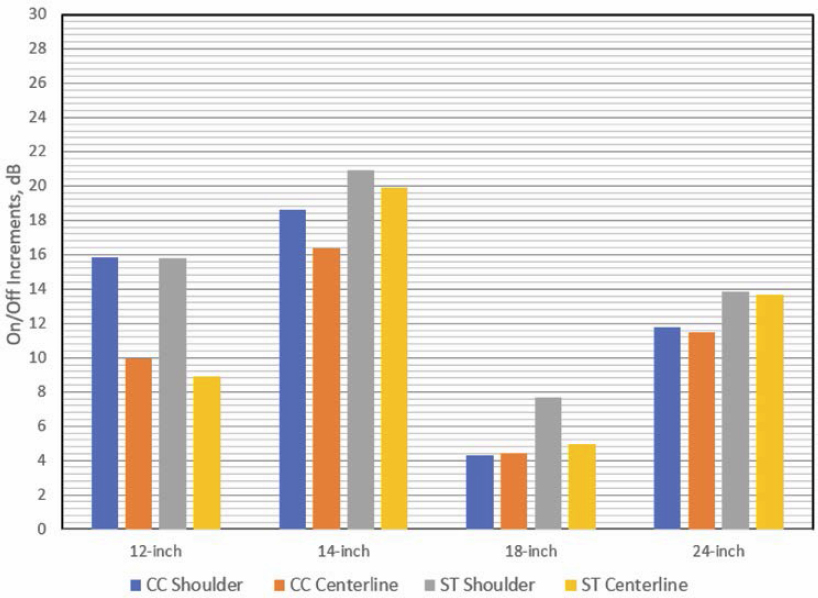
As expected, the loudest off-strips data measured with both sensors occurred at the 12- and 18-inch sites, which both have chip seal. The DGAC pavement at the 14-inch site in Michigan had band-passed overall levels slightly lower than the overall levels at the 24-inch site in Indiana. On the strips, the 12- and 14-inch sites had the highest levels, with the 14-inch site showing more consistency between the shoulder and centerline strips with both sensors.
Figure 34 shows the average on/off increments for both sensors at the shoulder and centerline strips. For both sensors at the shoulder and centerline strips, the highest on/off increments of 16 to 21 dB were measured at the 14-inch site. The 12-inch increments were less consistent, with the on/off increments on the shoulder strips about 16 dB with both sensors and on the centerline strips about 9 to 10 dB. This further indicates inconsistency with the installation of the strips at this site. The 24-inch strips resulted in on/off increments of 12 to 14 dB. The lowest on/off increments of about 4 to 8 dB were measured at the 18-inch site. This site does not meet the 10 dB requirement for alerting the driver of lane departure.




At 45 mph, the measured increments when band-pass filtered from 31.5 to 315 Hz were less than 60 mph. However, the highest increments, which ranged from 14 to 26 dB, were measured at the 14-inch site, and the lowest increments, which ranged from about 3 to 8 dB, were measured at the 18-inch site. Similar to the increments at 60 mph, the 12-inch site had the greatest variation, with increments of about 4 to 15 dB. At the 24-inch site, increments met the 10 dB design requirement, with increments of 11 to 18 dB, similar to the increments at 60 mph. All data can be found in Appendix C for 45 mph.
Suggestions for Experimental Sinusoidal Rumble Strip Designs
The evaluation of the 12- and 18-inch strips was muddied by the presence of the chip seal overlay compared to the other strips. As an aside to the objective of the study, during pass-by measurements at the 12- and 18-inch test sites in Indiana and at the 14-inch test site in Michigan, neighbors in the area provided unsolicited, subjective critiques of the pavements and rumble strips. The chip seal overlay at the Indiana sites was extremely unpopular. Most neighbors were hoping this testing would lead to removing the overlay. When the Indiana neighbors were asked about the rumble strips, they did not complain about any increase in noise from the rumble strips either prior to or after the chip seal overlay. The neighbors in Michigan were not bothered in the least by the rumble strips. They did complain about noise from a nearby bridge pavement, but the newly installed 14-inch sinusoidal rumble strips were not disturbing to the residents in the middle of the night.
From the literature search and data from California, it was apparent that sinusoidal designs were the most promising, as they were typically quieter for pass-by and produced equal or better warning to the vehicle operator of a lane departure. Due to pavement of the 12- and 18-inch sites,
pass-by data was band-pass filtered from 31.5 to 200 Hz, and the interior noise and vibration data was band-pass filtered from 31.5 to 315 Hz. Comparison of filtered pass-by data from Indiana, Michigan, and California showed the lowest on/off increments at the 18- and 24-inch sites, with increments of 6 dB or below. However, the filtered interior increments at these sites were below 10 dB at the 18-inch site and ranged from 12 to 14 dB at the 24-inch site. The 12-inch site resulted in pass-by increments of 8 to 14 dB, while the interior increments ranged from 9 to 16 dB. The 14-inch sites in California and Michigan resulted in similar increments, with pass-by increments ranging from 9 to 17 dB and interior increments ranging from 16 to 21 dB.
The project team, in cooperation with the Washington Department of Transportation (WSDOT), selected 20 sinusoidal designs to be installed along a stretch of SR 105 near Aberdeen, Washington. Table 3 summarizes the proposed design configurations. The goal is to create interior noise and vibration on/off increments of 10 to 15 dB, while reducing pass-by on/off levels to 5 dB or below. In conducting tests in the Midwest, it was found that, unlike the California design, most designs in the Midwest region use recessed sinusoidal designs. As a result, iterations in recess versus no recess will be evaluated along with wavelength and peak-to-peak sine wave amplitude. Due to the ambiguity created by the chip seal in Indiana sites, these designs will be replicated in Washington for further testing.
Table 3. Proposed test site designs for evaluation in Washington.
| Case # | Wavelength, in. | Peak-to-Peak, in. | Recess, in. |
|---|---|---|---|
| 1 | 12 | 3/8 | 1/8 |
| 2 | 13 | 3/8 | 1/8 |
| 3 | 14 | 3/8 | 1/8 |
| 4 | 14 | 7/16 | 0 |
| 5 | 14 | 1/2 | 1/8 |
| 6 | 14 | 5/16 | 0 |
| 7 | 14 | 3/8 | 0 |
| 8 | 14 | 1/2 | 0 |
| 9 | 14 | 7/16 | 1/8 |
| 10 | 14 | 5/16 | 1/8 |
| 11 | 15 | 5/16 | 0 |
| 12 | 15 | 1/2 | 0 |
| 13 | 15 | 3/8 | 1/8 |
| 14 | 16 | 3/8 | 1/8 |
| 15 | 16 | 5/16 | 0 |
| 16 | 16 | 1/2 | 0 |
| 17 | 16 | 3/8 | 0 |
| 18 | 17 | 3/8 | 1/8 |
| 19 | 18 | 3/8 | 1/8 |
| 20 | 24 | 3/8 | 1/8 |


