Guide on Methods for Assigning Counts to Adjustment Factor Groups (2024)
Chapter: Appendix A: NCDOT Case Study: Statistically Based Assignment of Count Stations to Factor Groups Using Seasonal Counts

APPENDIX A
NCDOT Case Study: Statistically Based Assignment of Count Stations to Factor Groups Using Seasonal Counts
This case study describes how NCDOT assigns seasonal short-duration count sites to adjustment factor groups using a statistical data-driven approach based on seasonal count data.
Background
NCDOT’s current system of volume factor groups was established in the late 1980s and early 1990s and has been maintained since then with periodic updates. Adjustment factor groups are evaluated annually, but the assignment of short-duration count stations is not reevaluated on a fixed cycle but when resources allow or when reclassification is likely (e.g., after a new road opens, altering traffic patterns in the area).
The volume factor groups were developed using a clustering approach that follows the process recommended in the TMG. The method was agglomerative hierarchical clustering, which begins with a cluster for each CCS and merges clusters with similar seasonal patterns after each iteration. Ward’s minimum variance theorem is the algorithm used to identify clusters to group in each iteration. This method requires manual selection of the optimum number of groups based on the amount of variability introduced in each clustering step and the characteristics of the stations being grouped.
NCDOT began collecting seasonal counts in 1999. These consist of four sets of five-day SDCs (Wednesday–Sunday) at the same location spread across the four seasons of the year. The meteorological definition of seasons is used (e.g., winter is December to February). Counts are collected during typical traffic conditions for a season and exclude holidays, adverse weather events, and other events causing unusual traffic patterns. Based on these counts, the seasonal pattern of a site can be identified so that it can be assigned to the best factor group. Seasonal counts were conducted regularly from 1999–2008 and were used to update the factor group assignment of short-duration count sites.
NCDOT has found seasonal counts to be valuable but resource-intensive, and they were discontinued in 2008 due to budget cuts. Between 2008 and 2019, limited revisions to factor group assignments were done. NCDOT conducted seasonal counts in one county in 2013 and on the interstate system in 2016. NCDOT staff use in-house software tools developed in SAS JMP to perform the analyses. A large-scale effort to collect seasonal counts and update factor group assignments county-by-county began in 2019 with approximately 1,000 sample stations counted in 23 counties but was suspended in 2020 due to the pandemic. In 2023, NCDOT resumed outsourcing seasonal traffic data collection efforts and has collected seasonal counts at 600 stations in 13 counties with 20 days of count data at each station spread across four different seasons.
Current Method
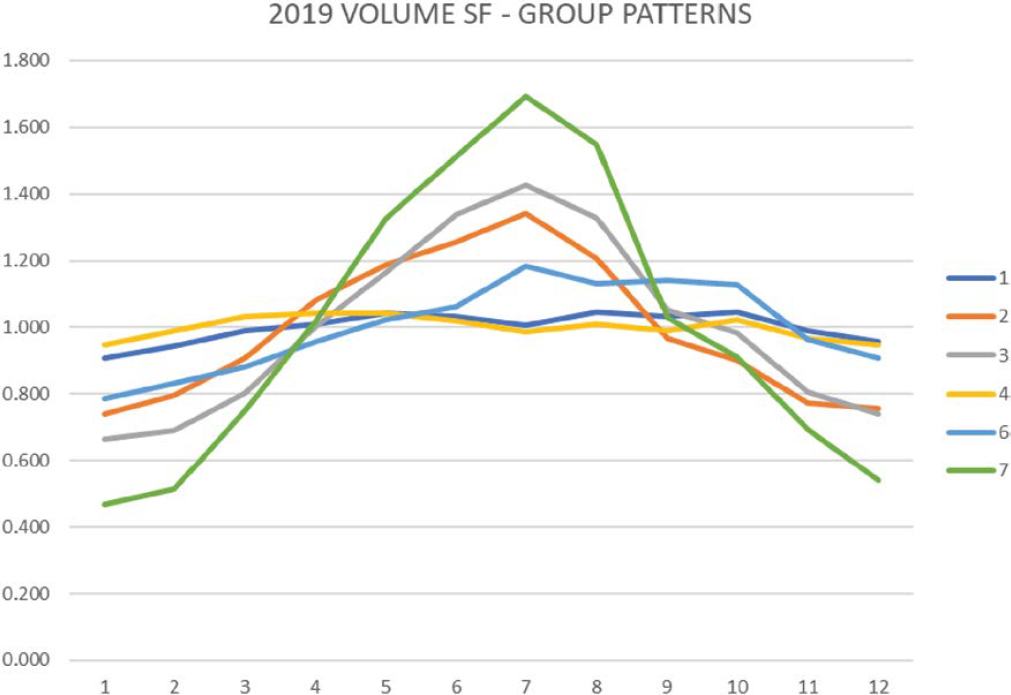
NCDOT currently has 12 adjustment factor groups, six of which are used for interstates and six for non-interstates. The non-interstate factor groups are rural, low-beach recreational, mid-beach recreational, urban, mountain recreational, and high-beach recreational. In essence, the factor groups cover rural, urban, and recreational traffic patterns. The majority of stations (approximately 95 percent) are assigned to the rural and urban groups. These factor groups are numbered 1–7 (excluding 5, which was not used), and their seasonal patterns can be seen in Figure A-1.
Application
As noted above, seasonal counts are managed on a county-by-county basis. Seasonal count locations are selected to sample the main corridor segments of the county, broken by major intersections or changes in land use. An example of seasonal count selection in Wake County is shown in Figure A-2.
Short-duration count sites are assigned to factor groups in a data-driven process that is based on seasonal counts. This process includes four steps.
- Step 1. Four sets of five-day counts are taken at each seasonal count station. Figure A-3 shows an example of seasonal count data collected at one station and the corresponding monthly day-of-week adjustment factors of the six non-interstate groups (G1, G2, G3, G4, G6, G7).
Source: NCDOT
Figure A-1. NCDOT non-interstate volume seasonal factor groups (x: month, y: monthly factor).

Figure A-2. Example of corridor segmentation and seasonal count selection.
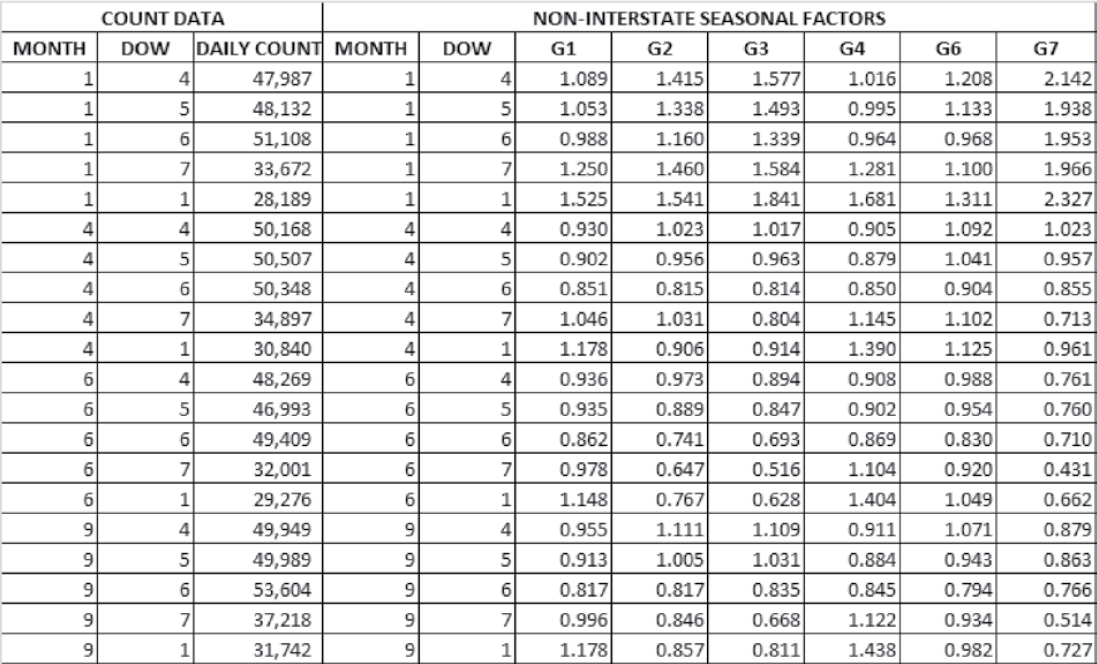
Figure A-3. Example of seasonal count data from one station and seasonal adjustment factors of six non-interstate groups.
- Step 2. All four sets of counts for each station are annualized using the appropriate factor from each of the six factor groups (either the six interstate or the six non-interstate groups). The result is 120 AADT estimates (= 5 days × 4 seasonal counts × 6 factor groups) per count station and year. Figure A-4 shows the AADT estimates produced after multiplying each daily count shown in Figure A-3 by the corresponding monthly day-of-week adjustment factor of each group.
- Step 3. NCDOT calculates the CV of the 20 AADT estimates (= 5 days × 4 seasonal counts) generated per factor group. The CV is the ratio of the standard deviation of the 20 AADT estimates to the mean value of these estimates.
- Step 4. In the last step, the count is assigned to the factor group that results in the lowest CV. In the example shown in Figure A-4, the station would be assigned to the fourth group (G4: Urban) because it resulted in the lowest CV (0.07, highlighted in green) among all six groups.
At locations where no seasonal count is available, the factor group assignment is based on a combination of nearest neighbors with seasonal count-based assignments and engineering judgment. Although the two largest factor groups are named rural and urban, the assignment is based on traffic patterns and not a rural or urban designation. NCDOT has found numerous cases where an urban traffic pattern extends outside of the urban boundary on primary routes or where lower-volume secondary roads within an urban area exhibit a typical rural traffic pattern. Factor group assignments are sometimes adjusted to keep all stations on a corridor in the same group. Another exception to nearest neighbors is in areas with recreational traffic. NCDOT has observed that recreational traffic is typically concentrated on main corridors, whereas some secondary roads connected to the main corridor are mainly used by local year-round residents and follow a typical rural or urban pattern.
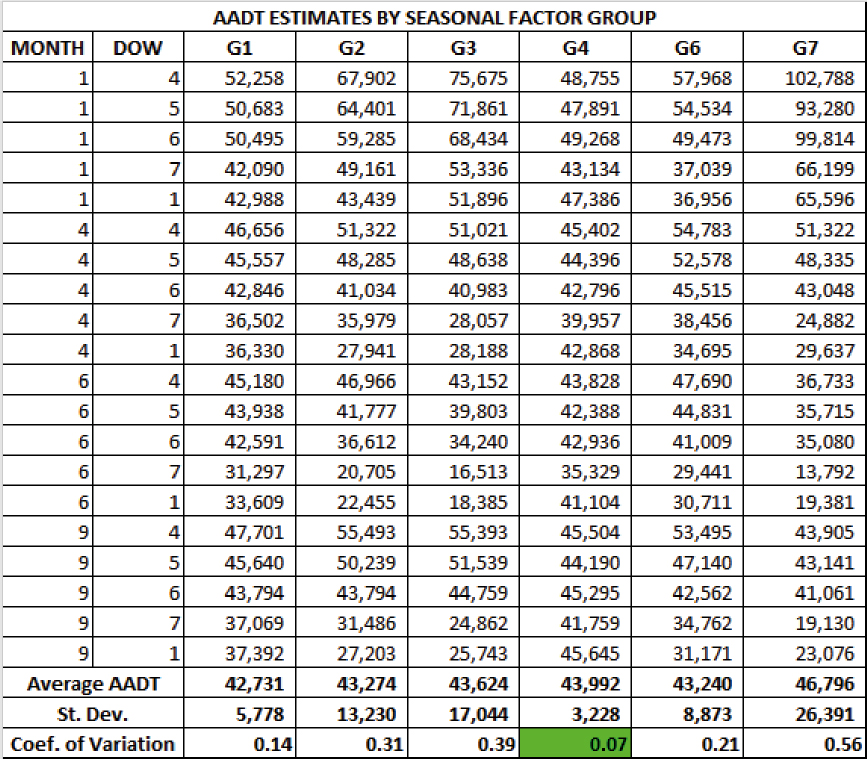
Figure A-4. Example of AADT estimates produced for each month, day of week, and factor group.
Summary
NCDOT has a long-established set of 12 adjustment factor groups, with six on interstates and six on non-interstates. Factor group assignments are reviewed when resources allow using an innovative and data-driven process of seasonal counts. In a seasonal count, selected locations are counted in all four seasons of the year, which establishes the seasonal traffic pattern and allows them to be assigned to the best factor group based on the CV in AADT estimates. This program of seasonal counts requires a large commitment of resources to collect the data, but it improves the level of quality and confidence in AADT estimates. Sites without seasonal counts are assigned based on a combination of nearest neighbors and engineering judgment.
This page intentionally left blank.


