Guide on Methods for Assigning Counts to Adjustment Factor Groups (2024)
Chapter: Appendix C: WisDOT Case Study: Development of Axle Factor Groups Using Clustering

APPENDIX C
WisDOT Case Study: Development of Axle Factor Groups Using Clustering
This case study describes how WisDOT develops axle-correction factor groups and assigns short-duration classification counts to these groups. Wisconsin is a mid-sized state in the Midwest region. WisDOT’s traffic monitoring program includes 338 active permanent sites, all located on higher functional classes, and approximately 26,000 short-term count sites, of which 3,000 are on lower functional classes. The state conducts between 5,000 and 8,000 short-term counts each year. Short-term counts are done on a cyclical basis, and lower functional classes are counted in years ending in 9, 0, and 1, with approximately 1,000 counts taking place in each of these years. WisDOT generally performs 48-hour short-term counts between Monday and Thursday, and from May to October.
Background
WisDOT had considered using clustering to develop axle factor groups starting in 2015. The state discussed clustering with its data management vendor for several years before ultimately deciding to adopt clustering for developing axle factor groups in 2020–2021.
The main reasons for using cluster analysis were to incorporate data from a larger number of permanent classification sites, to have better (more homogeneous) axle factor groups, and to have a statistical analysis justifying potential changes in axle factor groups. The cluster analysis was performed by WisDOT’s data management vendor and documented in a technical report dated March 2021.
Current Method
WisDOT’s data management vendor performed a cluster analysis based on 247 class and length sites that had 12 months of full data in 2019. These data were divided into interstate and non-interstate locations. The two groups were clustered separately. For each group, the clustering was done in programming language R using the k-means method.
The original k-means method takes the number of clusters as an exogenous variable. To determine an appropriate number of clusters, the analysts ran the k-means method with different numbers of clusters and calculated the within-group sum of squares. The results for non-interstate sites, shown in Figure C-1, show a bend in the plot at three clusters. In other words, going from 1 to 3 sharply improves the homogeneity of the clusters and the approximation error in the axle factors calculated for each cluster, but after three clusters, there are diminishing returns from adding additional clusters. As a result, the analysts selected three non-interstate clusters.
The average axle factors for the three resulting clusters are shown in Figure C-2.

Figure C-1. Within-group sum of squares versus number of clusters, non-interstate sites.
The next step was to determine what each of the three groups represented so that short-term count locations could be assigned to the correct group. The analysts determined that the sites in Cluster 2 shared a high truck percentage, while sites in Cluster 1 were primarily rural and sites in Cluster 3 were primarily urban. The clusters were labeled Urban Other (Cluster 3), Rural Other (Cluster 1), and Truck Routes (Cluster 2).
The analysis was repeated for interstate sites. Figure C-3 indicated that the optimal number of clusters was four.
The average axle factors for each group are shown in Figure C-4.
The analysts determined that Cluster 4 represented urban interstate sites, while clusters 1–3 represented rural interstate sites. The rural interstate clusters represented different ranges of axle

Figure C-2. Average axle factors for three non-interstate clusters.
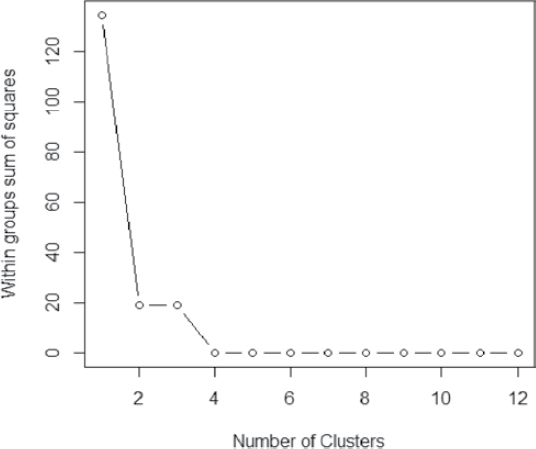
Figure C-3. Within-group sum of squares versus number of clusters, interstate sites.
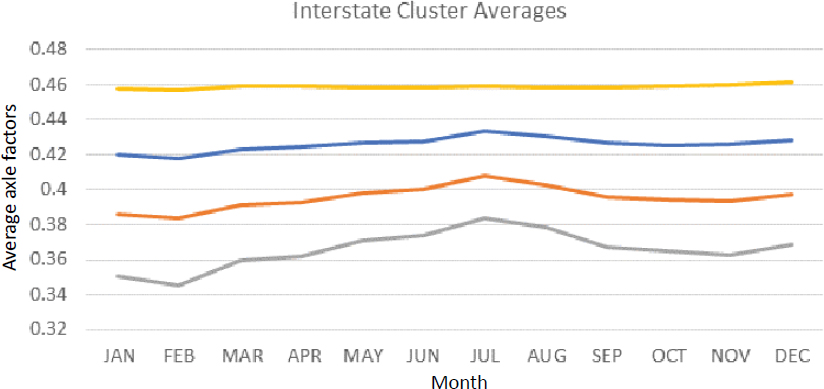
Figure C-4. Average axle factors for four interstate clusters.
factors but were not easily identifiable by WisDOT’s previous axle factor groups. However, the analysts determined that axle factors were highly correlated with truck percentage, and the truck percentage was a known attribute of the permanent classification sites. Figure C-5 shows the correlation plot, which uses transformations to normalize the axle factor (axle factor × 2) and truck percentage (1 − %trucks). Table C-1 shows the axle factor and truck percentage ranges that uniquely identify each interstate cluster.
Application
The clustering method that WisDOT uses was recently adopted and based on an analysis of 2019 data. WisDOT has not determined an update cycle for revisiting the cluster analysis but monitors the axle factors at each permanent class site for anomalies. WisDOT calculates the combination unit percentage (Class 8 and above) and uses that to assign each site to a factor group. WisDOT has found from experience that combination unit trucks have the most impact

Figure C-5. Correlation of transformed axle factor (axle factor × 2) and truck percentage (1 − %trucks).
Table C-1. Truck percentage range for interstate clusters.
| Cluster | Min Avg AF | Max Avg AF | Est. Min % Trucks | Est. Max % Trucks |
|---|---|---|---|---|
| 4 | 0.44 | 0.48 | 0.00 | 0.08 |
| 1 | 0.41 | 0.44 | 0.09 | 0.14 |
| 2 | 0.38 | 0.41 | 0.15 | 0.20 |
| 3 | 0.35 | 0.38 | 0.21 | 0.27 |
Source: WisDOT.
and focuses on these classes, rather than the overall truck percentage, which may be dominated by two- to three-axle single units.
Within each cluster, 12 average monthly axle factors are calculated and applied to short-term classification counts. After the axle factor is applied, the volume is factored using seasonal (12 monthly) and day-of-week (84 monthly day-of-week) factors to obtain an AADT estimate for the site. The 84 monthly day-of-week factors are calculated relative to the MADT so that this process is not double factoring for seasonal variations.
Summary
WisDOT used a clustering approach to develop axle factor groups and to assign short-term classification counts to these groups. The cluster analysis was performed by WisDOT’s data management vendor in 2021 based on permanent classification sites with complete data for 2019. The cluster analysis was done separately for non-interstate and interstate sites. For non-interstate sites, the analysis produced three clusters: Urban Other, Rural Other, and Truck Routes. Assigning short-term count sites to these clusters is straightforward: if a site has a truck count, the combination unit percent is used, and if it does not, the count is assigned based on the rural or urban designation. For interstate sites, the analysis produced four clusters and determined that the best way to assign sites to these clusters was based on the truck percentage. WisDOT has since modified the assignment process for interstate sites to use the combination unit percentage instead. Short-term class counts are then factored using a monthly axle factor, a monthly volume factor, and a monthly day-of-week factor (relative to the MADT).


