Construction Stormwater Program Management, Tracking, Reporting, and Compliance (2025)
Chapter: Front Matter
 |
|
| NCHRP Synthesis 648 A SYNTHESIS OF HIGHWAY PRACTICE |
National Cooperative Highway Research Program |
Construction Stormwater Program Management, Tracking, Reporting, and Compliance
TRANSPORTATION RESEARCH BOARD 2025 EXECUTIVE COMMITTEE*
OFFICERS
CHAIR: Leslie S. Richards, Professor of Practice, University of Pennsylvania, Philadelphia
VICE CHAIR: Joel M. Jundt, Secretary of Transportation, South Dakota Department of Transportation, Pierre
EXECUTIVE DIRECTOR: Victoria Sheehan, Transportation Research Board, Washington, DC
MEMBERS
James F. Albaugh, President and CEO, The Boeing Company (retired), Scottsdale, AZ
Carlos M. Braceras, Executive Director, Utah Department of Transportation, Salt Lake City
Douglas C. Ceva, Vice President, Customer Lead Solutions, Prologis, Inc., Jupiter, FL
Nancy Daubenberger, Commissioner of Transportation, Minnesota Department of Transportation, St. Paul
Marie Therese Dominguez, Commissioner, New York State Department of Transportation, Albany
Garrett Eucalitto, Commissioner, Connecticut Department of Transportation, Newington
Andrew Fremier, Executive Director, Metropolitan Transportation Commission, San Francisco, CA
Martha Grabowski, Professor Emerita, Information Systems, Le Moyne College, Madden College of Business & Economics, Cazenovia, NY
Randell Iwasaki, President and CEO, Iwasaki Consulting Services, Walnut Creek, CA
Carol A. Lewis, Professor, Transportation Studies, Texas Southern University, Houston
Hani S. Mahmassani, W.A. Patterson Distinguished Chair in Transportation; Director, Transportation Center, Northwestern University, Evanston, IL
Scott C. Marler, Director, Iowa Department of Transportation, Ames
Ricardo Martinez, Adjunct Professor of Emergency Medicine, Emory University School of Medicine, Decatur, GA
Russell McMurry, Commissioner, Georgia Department of Transportation, Atlanta
Craig E. Philip, Research Professor and Director, VECTOR, Department of Civil and Environmental Engineering, Vanderbilt University, Nashville, TN
Steward T.A. Pickett, Distinguished Senior Scientist, Cary Institute of Ecosystem Studies, Millbrook, NY
Susan A. Shaheen, Professor and Co-Director, Transportation Sustainability Research Center, University of California, Berkeley
Marc Williams, Executive Director, Texas Department of Transportation, Austin
EX OFFICIO MEMBERS
Michael R. Berube, Deputy Assistant Secretary for Sustainable Transportation, U.S. Department of Energy, Washington, DC
Steven G. Bradbury, Deputy Secretary, U.S. Department of Transportation, Washington, DC
Steven Cliff, Executive Officer, California Air Resources Board, Sacramento
LeRoy Gishi, Chief, Division of Transportation, Bureau of Indian Affairs, U.S. Department of the Interior, Germantown, MD
Firas Ibrahim, Director, Office of Research, Development, and Technology, Office of the Assistant Secretary for Research and Technology (OST-R), Washington, DC
Jason Kelly, Deputy Commanding General for Civil Works and Emergency Operations, U.S. Army Corps of Engineers, Washington, DC
Sandra Knight, President, WaterWonks, LLC, Washington, DC
Ben Kochman, Acting Administrator, Pipeline and Hazardous Materials Safety Administration, Washington, DC
Zahra “Niloo” Parvinashtiani, Engineer, Mobility Consultant Solutions, Iteris Inc., Fairfax, VA, and Chair, TRB Young Members Coordinating Council
Chris Rocheleau, Acting Administrator, Federal Aviation Administration, Washington, DC
Gloria Shepherd, Acting Deputy Administrator, Federal Highway Administration, Washington, DC
Karl Simon, Director, Transportation and Climate Division, U.S. Environmental Protection Agency, Washington, DC
Paul P. Skoutelas, President and CEO, American Public Transportation Association, Washington, DC
Jim Tymon, Executive Director, American Association of State Highway and Transportation Officials, Washington, DC
___________________
* Membership as of May 2025.
NATIONAL COOPERATIVE HIGHWAY RESEARCH PROGRAM
NCHRP SYNTHESIS 648
Construction Stormwater Program Management, Tracking, Reporting, and Compliance
A Synthesis of Highway Practice
Christofer M. Harper
BLACK DOG CONSULTANTS, LLC
Fort Collins, CO
Daniel Tran
TRAN AND ASSOCIATES, LLC
Lawrence, KS
Roy E. Sturgill, Jr.
BLUE CYCLONE, LLC
Ames, IA
Subscriber Categories
Construction • Environment
Research sponsored by the American Association of State Highway and Transportation Officials in cooperation with the Federal Highway Administration

NATIONAL COOPERATIVE HIGHWAY RESEARCH PROGRAM
Systematic, well-designed, and implementable research is the most effective way to solve many problems facing state department of transportation (DOT) administrators and engineers. Often, highway problems are of local or regional interest and can best be studied by state DOTs individually or in cooperation with their state universities and others. However, the accelerating growth of highway transportation results in increasingly complex problems of wide interest to highway authorities. These problems are best studied through a coordinated program of cooperative research.
Recognizing this need, the leadership of the American Association of State Highway and Transportation Officials (AASHTO) in 1962 initiated an objective national highway research program using modern scientific techniques—the National Cooperative Highway Research Program (NCHRP). NCHRP is supported on a continuing basis by funds from participating member states of AASHTO and receives the full cooperation and support of the Federal Highway Administration (FHWA), United States Department of Transportation.
The Transportation Research Board (TRB) of the National Academies of Sciences, Engineering, and Medicine was requested by AASHTO to administer the research program because of TRB’s recognized objectivity and understanding of modern research practices. TRB is uniquely suited for this purpose for many reasons: TRB maintains an extensive committee structure from which authorities on any highway transportation subject may be drawn; TRB possesses avenues of communications and cooperation with federal, state, and local governmental agencies, universities, and industry; TRB’s relationship to the National Academies is an insurance of objectivity; and TRB maintains a full-time staff of specialists in highway transportation matters to bring the findings of research directly to those in a position to use them.
The program is developed on the basis of research needs identified by chief administrators and other staff of the highway and transportation departments, by committees of AASHTO, and by the FHWA. Topics of the highest merit are selected by the AASHTO Special Committee on Research and Innovation (R&I), and each year R&I’s recommendations are proposed to the AASHTO Board of Directors, the FHWA, and the National Academies. Research projects to address these topics are defined by NCHRP, and qualified research agencies are selected from submitted proposals. Administration and oversight of research contracts are the responsibilities of NCHRP.
The needs for highway research are many, and NCHRP can make significant contributions to solving highway transportation problems of mutual concern to many responsible groups. The program, however, is intended to complement, rather than to substitute for or duplicate, other highway research programs.
NCHRP SYNTHESIS 648
Project 20-05, Topic 55-11
ISSN 0547-5570
ISBN 978-0-309-73470-7
Library of Congress Control Number 2025941424
© 2025 by the National Academy of Sciences. National Academies of Sciences, Engineering, and Medicine and the graphical logo are trademarks of the National Academy of Sciences. All rights reserved.
COPYRIGHT INFORMATION
Authors herein are responsible for the originality and accuracy of their materials and for obtaining written permissions from publishers or persons who own the copyright to any previously published or copyrighted material used herein.
The National Academy of Sciences (NAS) grants permission to reproduce written material in this publication for classroom and non-commercial purposes subject to the rights of any third parties and appropriate attribution. Permission is given with the understanding that none of the material will be used to imply NAS, TRB, AASHTO, APTA, FAA, FHWA, FTA, GHSA, or NHTSA endorsement of a particular product, method, or practice. For other uses of the written material, users must request permission from the National Academies Press.
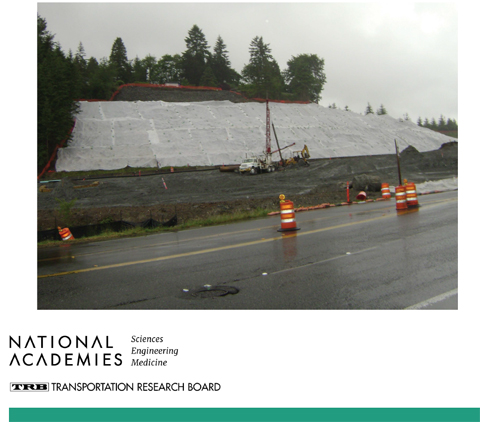
Cover photo: Plastic sheeting used to protect a slope from erosion.
Photo credit: Washington State Department of Transportation, https://www.flickr.com/photos/wsdot/3632308077/in/photostream/
https://creativecommons.org/licenses/by-nc-nd/2.0/
NOTICE
The report was reviewed by the technical panel and accepted for publication according to procedures established and overseen by the Transportation Research Board and approved by the National Academies of Sciences, Engineering, and Medicine.
This material is based upon work supported by the FHWA under Agreement No. 693JJ32350025. Any opinions, findings, and conclusions or recommendations expressed or implied in this document are those of the researchers who performed the research and are not necessarily those of the Transportation Research Board; the National Academies of Sciences, Engineering, and Medicine; the FHWA; or the program sponsors.
The Transportation Research Board does not develop, issue, or publish standards or specifications. The Transportation Research Board manages applied research projects which provide the scientific foundation that may be used by Transportation Research Board sponsors, industry associations, or other organizations as the basis for revised practices, procedures, or specifications.
The Transportation Research Board; the National Academies of Sciences, Engineering, and Medicine; and the sponsors of the National Cooperative Highway Research Program do not endorse products or manufacturers. Trade or manufacturers’ names or logos appear herein solely because they are considered essential to the object of the report.
Published reports of the
NATIONAL COOPERATIVE HIGHWAY RESEARCH PROGRAM
are available from
National Academies Press
500 Fifth Street, NW, Keck 360
Washington, DC 20001
(800) 624-6242
and can be ordered through the Internet by going to
https://nap.nationalacademies.org
Printed in the United States of America
The National Academy of Sciences was established in 1863 by an Act of Congress, signed by President Lincoln, as a private, nongovernmental institution to advise the nation on issues related to science and technology. Members are elected by their peers for outstanding contributions to research. Dr. Marcia McNutt is president.
The National Academy of Engineering was established in 1964 under the charter of the National Academy of Sciences to bring the practices of engineering to advising the nation. Members are elected by their peers for extraordinary contributions to engineering. Dr. Tsu-Jae Liu is president.
The National Academy of Medicine (formerly the Institute of Medicine) was established in 1970 under the charter of the National Academy of Sciences to advise the nation on medical and health issues. Members are elected by their peers for distinguished contributions to medicine and health. Dr. Victor J. Dzau is president.
The three Academies work together as the National Academies of Sciences, Engineering, and Medicine to provide independent, objective analysis and advice to the nation and conduct other activities to solve complex problems and inform public policy decisions. The National Academies also encourage education and research, recognize outstanding contributions to knowledge, and increase public understanding in matters of science, engineering, and medicine.
Learn more about the National Academies of Sciences, Engineering, and Medicine at www.nationalacademies.org.
The Transportation Research Board is one of seven major program divisions of the National Academies of Sciences, Engineering, and Medicine. The mission of the Transportation Research Board is to mobilize expertise, experience, and knowledge to anticipate and solve complex transportation-related challenges. The Board’s varied activities annually engage about 8,500 engineers, scientists, and other transportation researchers and practitioners from the public and private sectors and academia, all of whom contribute their expertise in the public interest. The program is supported by state departments of transportation, federal agencies including the component administrations of the U.S. Department of Transportation, and other organizations and individuals interested in the development of transportation.
Learn more about the Transportation Research Board at www.TRB.org.
COOPERATIVE RESEARCH PROGRAMS
CRP STAFF FOR NCHRP SYNTHESIS 648
Monique R. Evans, Director, Cooperative Research Programs
Waseem Dekelbab, Deputy Director, Cooperative Research Programs, and Manager, National Cooperative Highway Research Program
Jo Allen Gause, Senior Program Officer
Deborah Irvin, Associate Program Officer
Natalie Barnes, Director of Publications
Heather DiAngelis, Associate Director of Publications
NCHRP PROJECT 20-05 PANEL
Joyce N. Taylor, Maine Department of Transportation, Augusta, ME (Chair)
Anita K. Bush, CDM Smith, Carson City, NV
Joseph D. Crabtree, Kentucky Transportation Center, Lexington, KY
Mostafa Jamshidi, Nebraska Department of Transportation, Lincoln, NE
Jessie X. Jones, Arkansas Department of Transportation, Little Rock, AR
Raymond J. Khoury, Virginia Department of Transportation, Richmond, VA
Brenda Moore, North Carolina Department of Transportation (retired), Cary, NC
Jesus Alberto Sandoval-Gil, Arizona Department of Transportation, Phoenix, AZ
Cynthia J. Smith, Mississippi Department of Transportation, Jackson, MS
Jean M. Wallace, Minnesota Department of Transportation, St. Paul, MN
Mary Huie, FHWA Liaison
TOPIC 55-11 PANEL
Dragomir J. Bogdanic, California Department of Transportation, Oakland, CA
Jennifer Ferngren Cappelleti, Florida Department of Transportation, DeLand, FL
Heather A. Carman, Texas Department of Transportation, Austin, TX
Rongdu Lu, New Jersey Department of Transportation, Trenton, NJ
Michael A. Perez, Auburn University, Auburn, AL
Melissa Serio, Iowa Department of Transportation, Ames, IA
Brian L. Smith, FHWA Liaison
Brian Roberts, TRB Liaison
ABOUT THE NCHRP SYNTHESIS PROGRAM
Highway administrators, engineers, and researchers often face problems for which information already exists, either in documented form or as undocumented experience and practice. This information may be fragmented, scattered, and unevaluated. As a consequence, full knowledge of what has been learned about a problem may not be brought to bear on its solution. Costly research findings may go unused, valuable experience may be overlooked, and due consideration may not be given to recommended practices for solving or alleviating the problem.
There is information on nearly every subject of concern to highway administrators and engineers. Much of it derives from research or from the work of practitioners faced with problems in their day-to-day work. To provide a systematic means for assembling and evaluating such useful information and to make it available to the entire highway community, the American Association of State Highway and Transportation Officials—through the mechanism of the National Cooperative Highway Research Program—authorized the Transportation Research Board to undertake a continuing study. This study, NCHRP Project 20-05, “Synthesis of Information Related to Highway Practices,” searches out and synthesizes useful knowledge from all available sources and prepares concise, documented reports on specific topics. Reports from this endeavor constitute an NCHRP report series, Synthesis of Highway Practice.
This synthesis series reports on current knowledge and practice, in a compact format, without the detailed directions usually found in handbooks or design manuals. Each report in the series provides a compendium of the best knowledge available on those measures found to be the most successful in resolving specific problems.
FOREWORD
By Jo Allen Gause
Staff Officer
Transportation Research Board
State department of transportation (DOT) construction activities must comply with federal and state National Pollutant Discharge Elimination System construction general permit requirements. The regulations require state DOTs to implement policies, procedures, and practices to minimize offsite discharges of sediment-laden stormwater to protect downstream receiving water bodies during construction. To obtain permit coverage, regulated construction activities require the development, implementation, and maintenance of project-specific stormwater pollution prevention plans (SWPPPs). The SWPPP provides construction stormwater-related management requirements and details on the installation and maintenance of structural and non-structural practices implemented during land-disturbing activities.
The objective of this synthesis is to document state DOT practices, tools, and approaches for managing compliance with state and federal construction stormwater permit requirements.
Information for this study was gathered through a literature review, a survey of state DOTs, and follow-up interviews with selected DOTs. Case examples of six state DOTs provide additional information on construction stormwater program management practices.
Christofer M. Harper, Black Dog Consultants, LLC; Daniel Tran, Tran and Associates, LLC; and Roy E. Sturgill, Jr., Blue CyClone, LLC, collected and synthesized the information and wrote the report. The members of the topic panel are acknowledged on page iv. This synthesis is an immediately useful document that records practices that were acceptable within the limitations of the knowledge available at the time of its preparation. As progress in research and practice continues, new knowledge will be added to that now at hand.
This page intentionally left blank.
CONTENTS
National Pollutant Discharge Elimination System
Stormwater Pollution Prevention Plans
Municipal Separate Storm Sewer System Permits
Erosion and Sediment Discharges
Best Management Practices and Erosion and Sediment Control Measures
Chapter 3 State of the Practice Survey
Overview of Construction Stormwater Management Programs
Preparation and Management of Stormwater Pollution Prevention Plans
Responsibilities for Construction Stormwater Management
Design Standards and Qualifications of Construction Stormwater Programs
Stormwater Management Tracking and Inspection
Construction Stormwater Management Audits
Chapter 4 State DOT Case Examples
Colorado Department of Transportation
Florida Department of Transportation
Iowa Department of Transportation
New York State Department of Transportation
Pennsylvania Department of Transportation
List of Abbreviations and Acronyms
Appendix A Survey Questionnaire
Appendix B Individual Survey Responses
Appendix C Case Examples Questionnaire
Appendix D Oklahoma DOT Clean Water Inspection Form
Appendix E West Virginia DOT Division of Highways Environmental Construction Inspection Form
Appendix F Colorado DOT Form 1176: Stormwater Field Inspection Report
Appendix G Florida DOT SWPPP Template
Appendix H Iowa DOT QA Inspection Form
Appendix I New York State DOT SPDES Stormwater Inspection Report Form
Appendix J Pennsylvania DOT Summary of Compliance Response Policy Table
Appendix K Texas DOT Form 2118: Field Inspection and Maintenance Report


